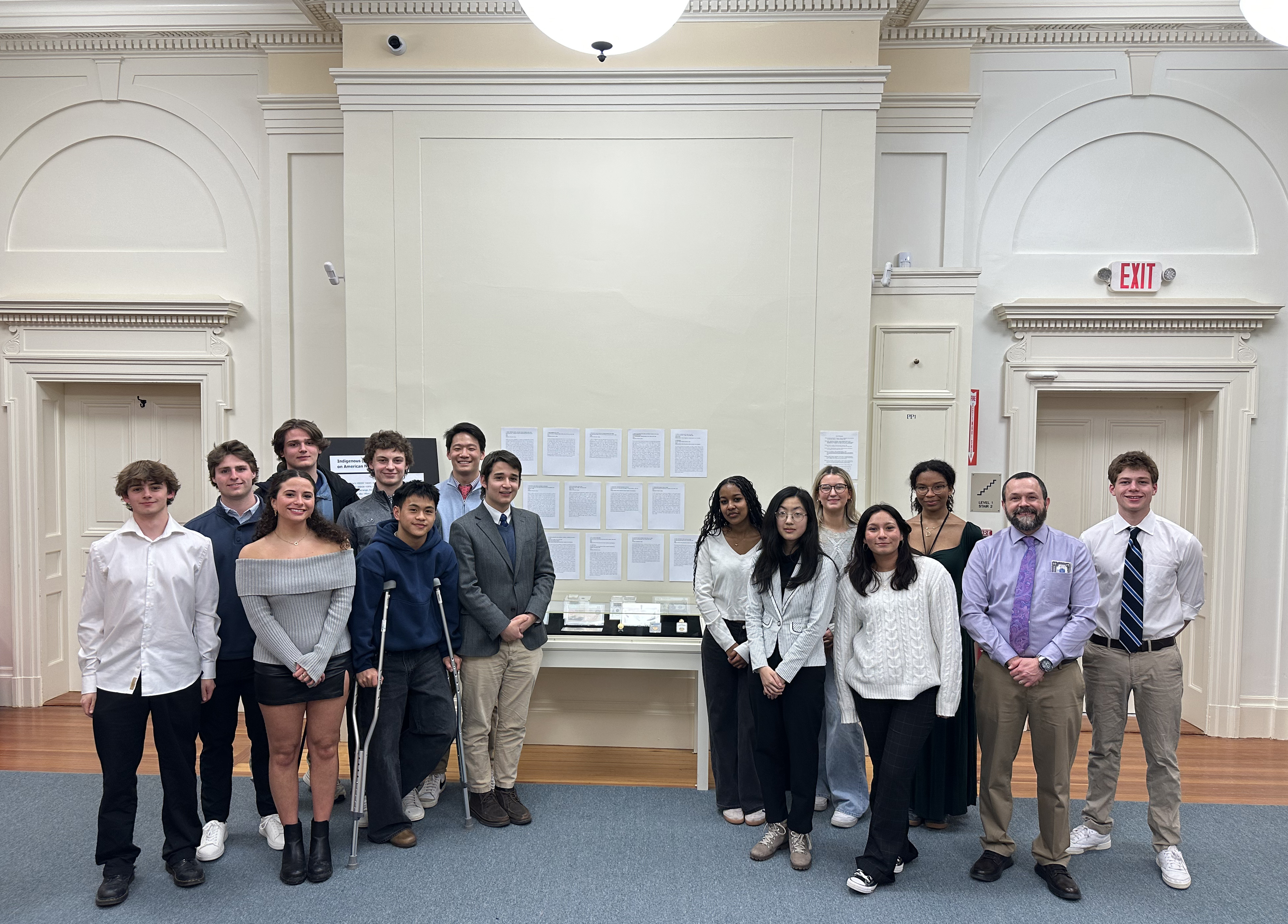
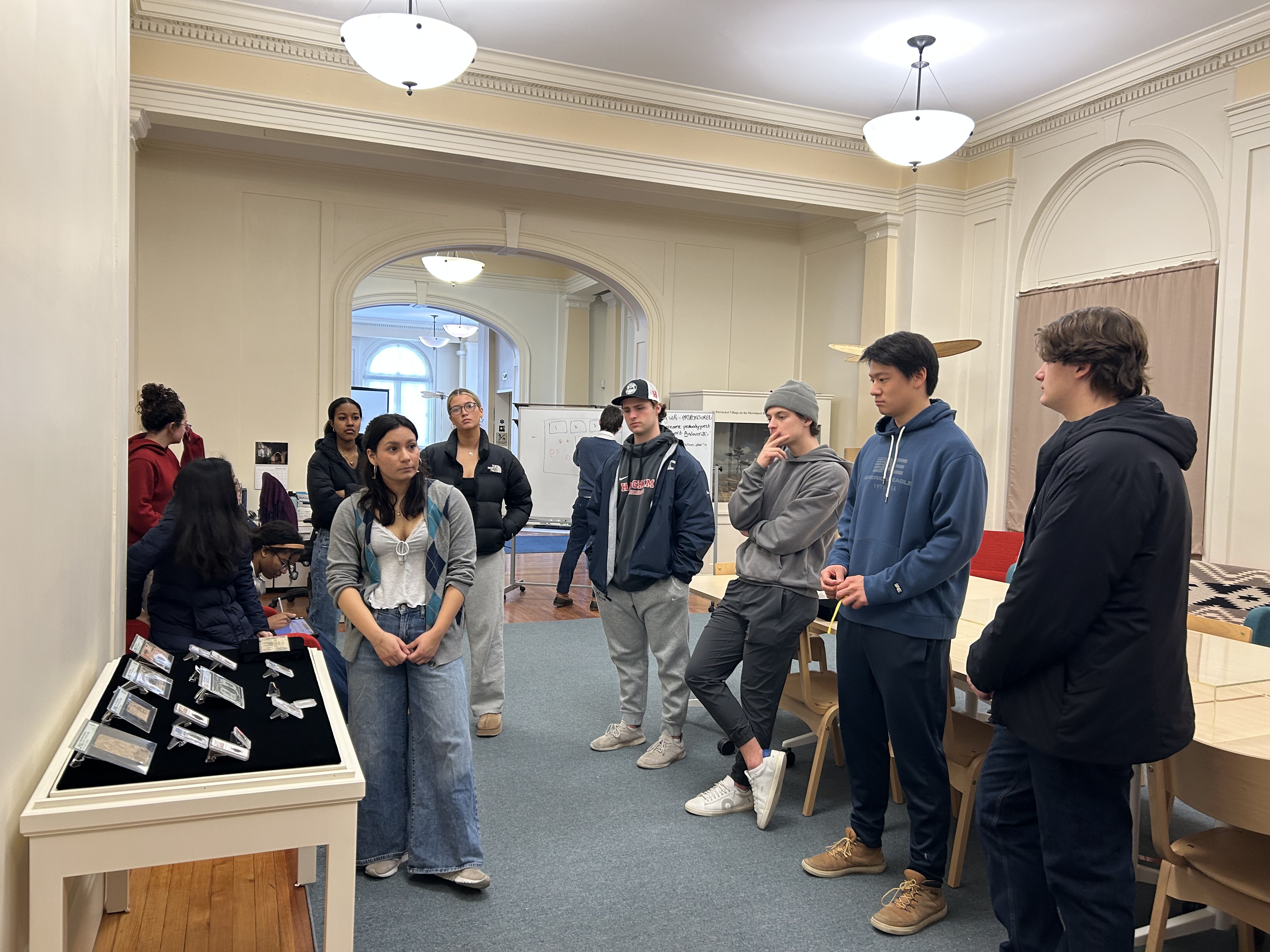
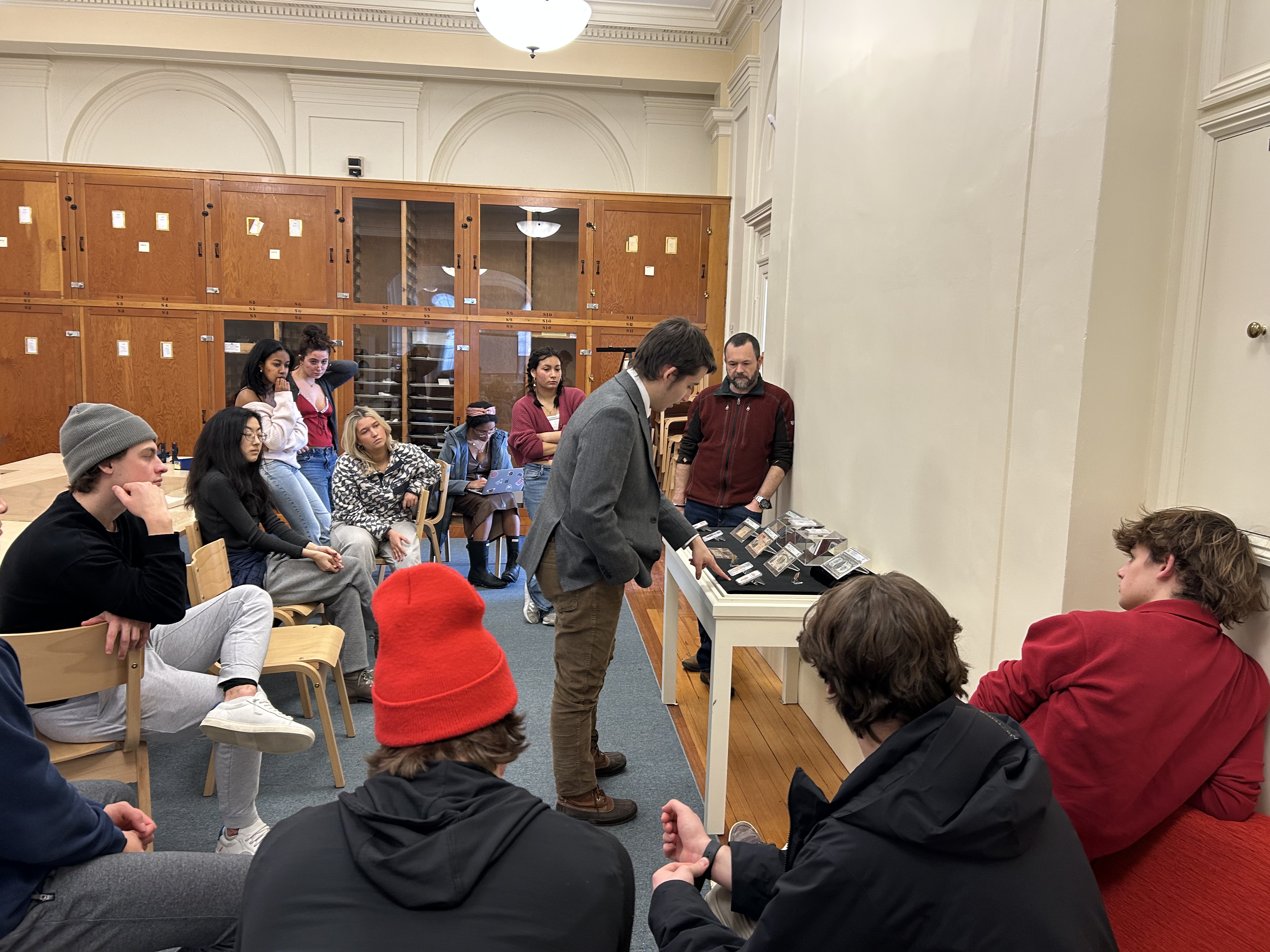
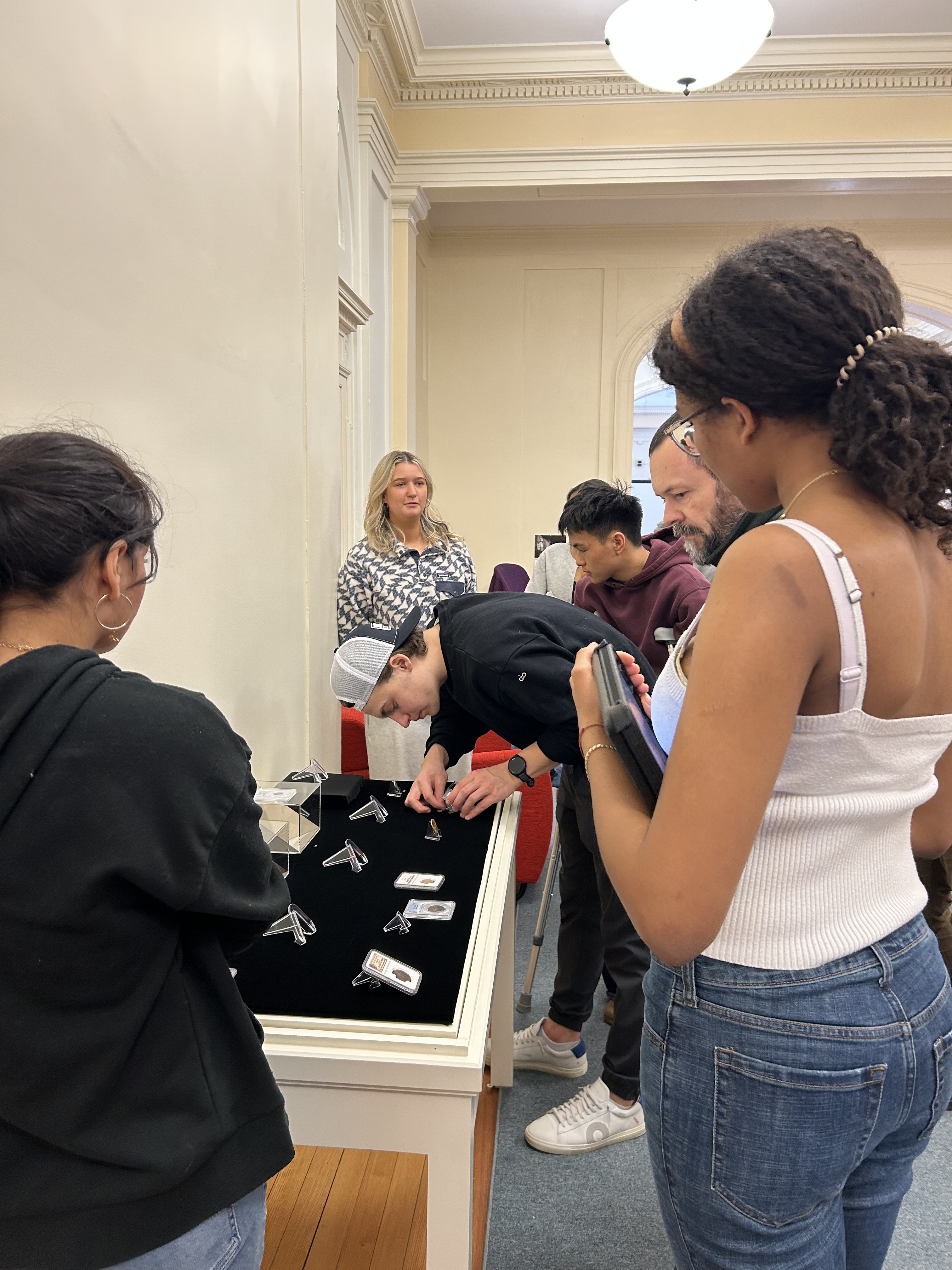
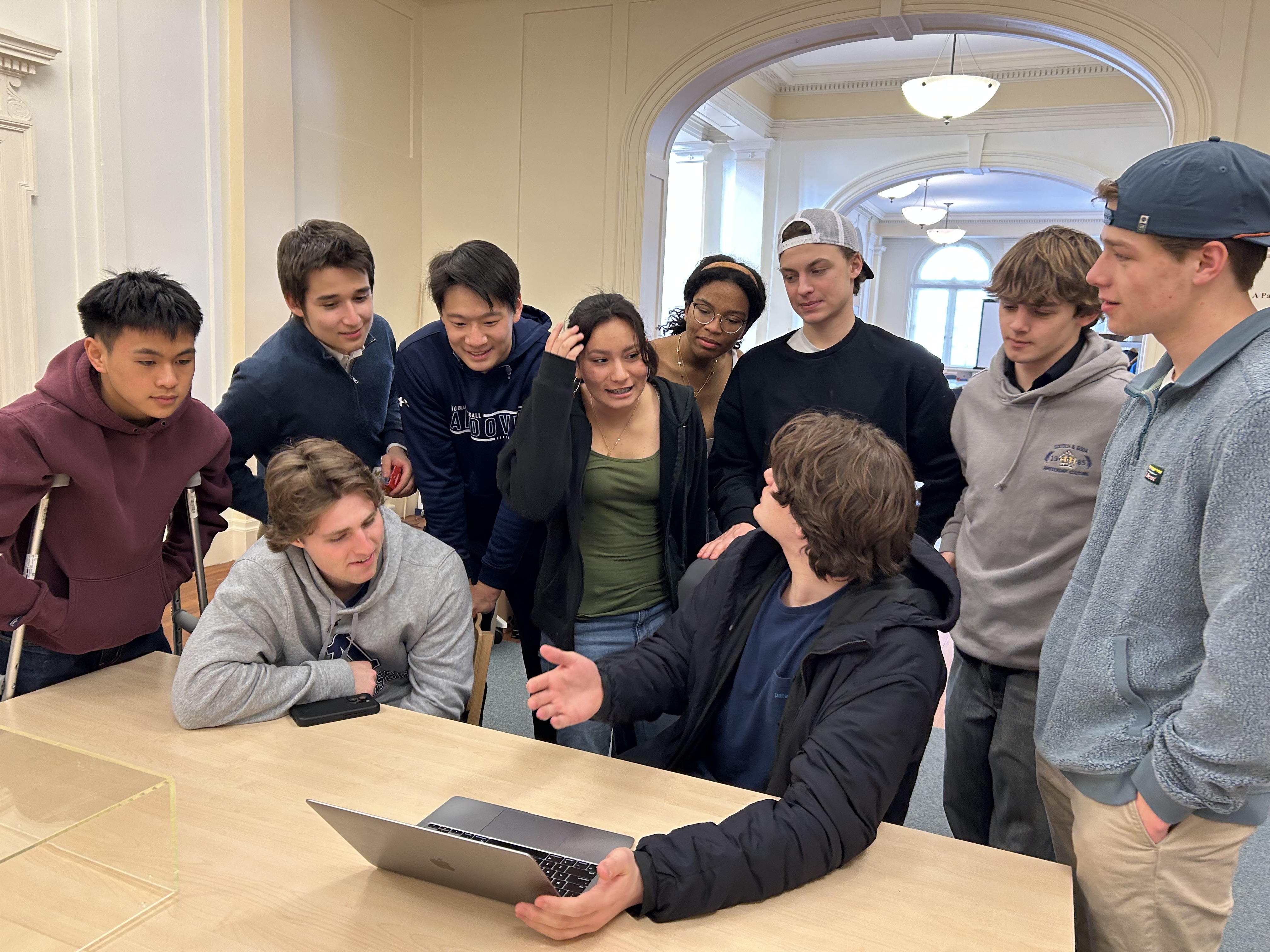
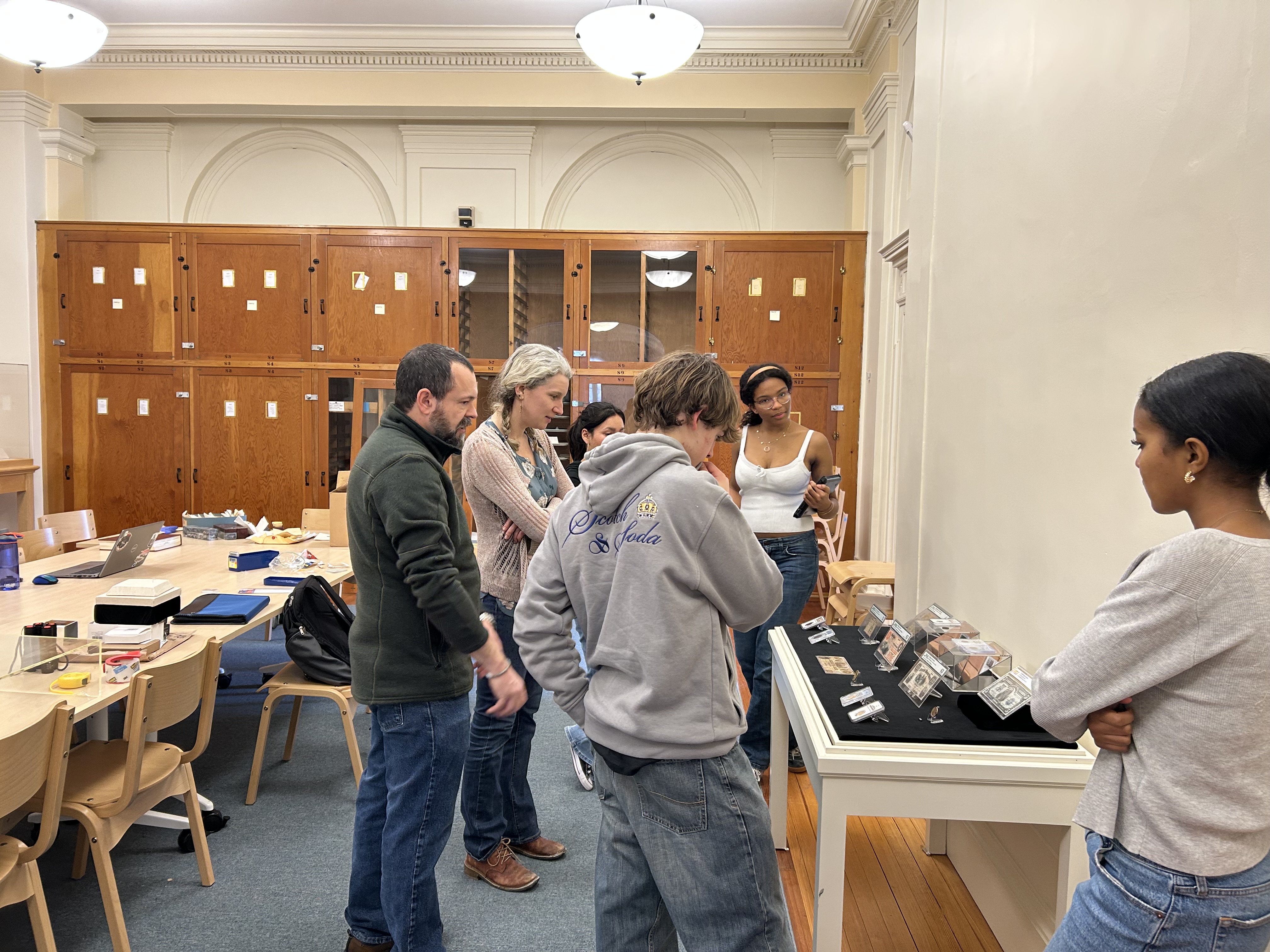
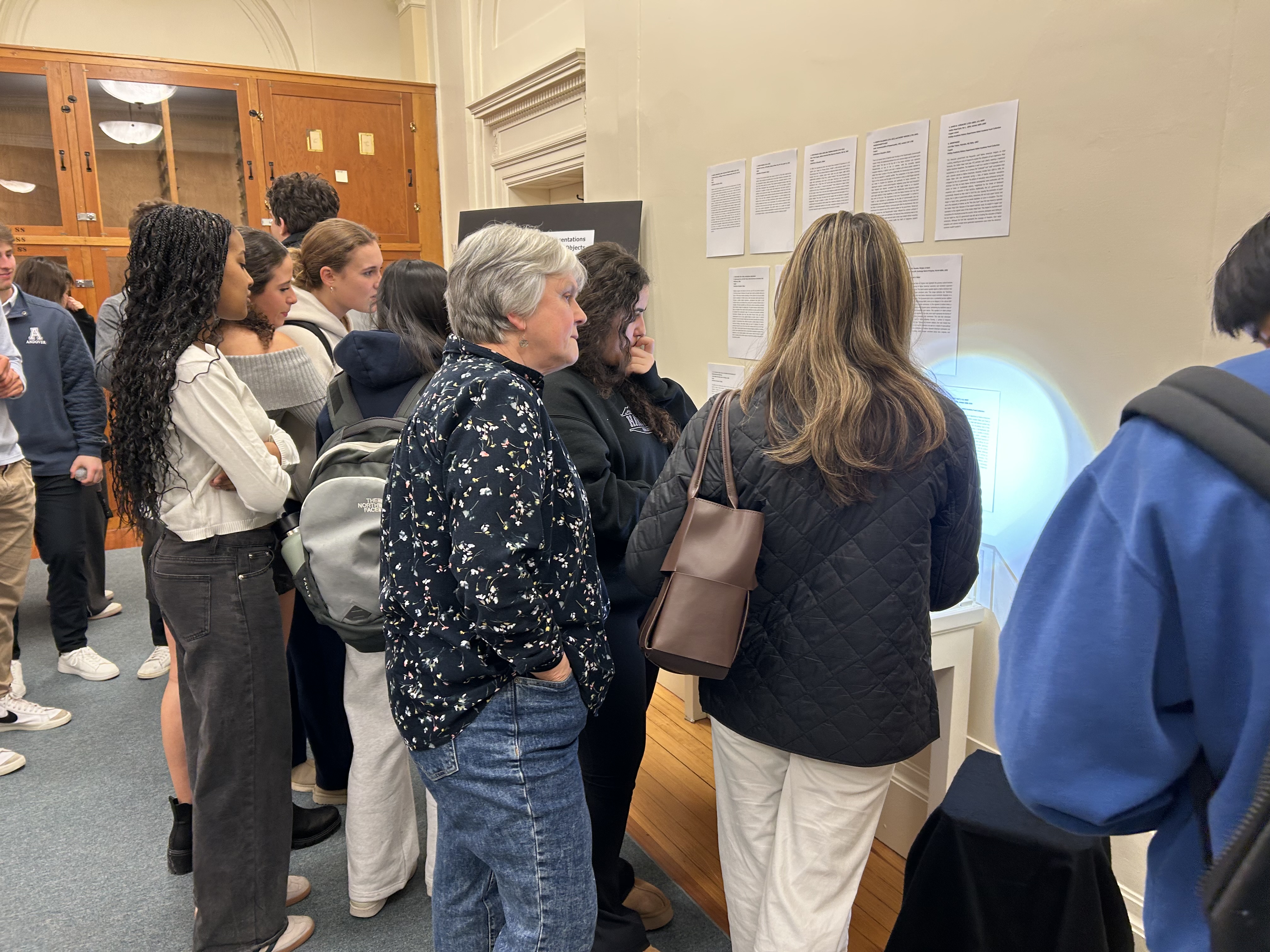
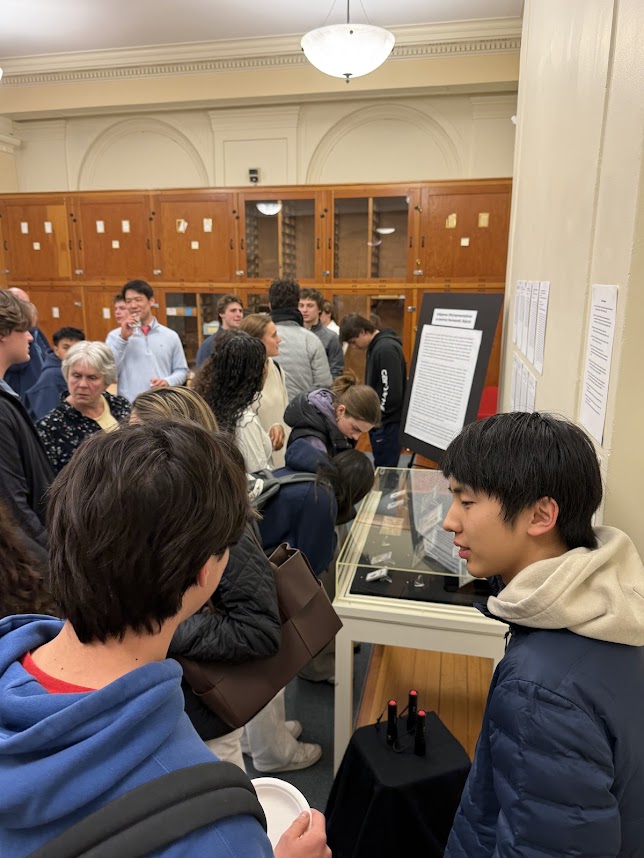
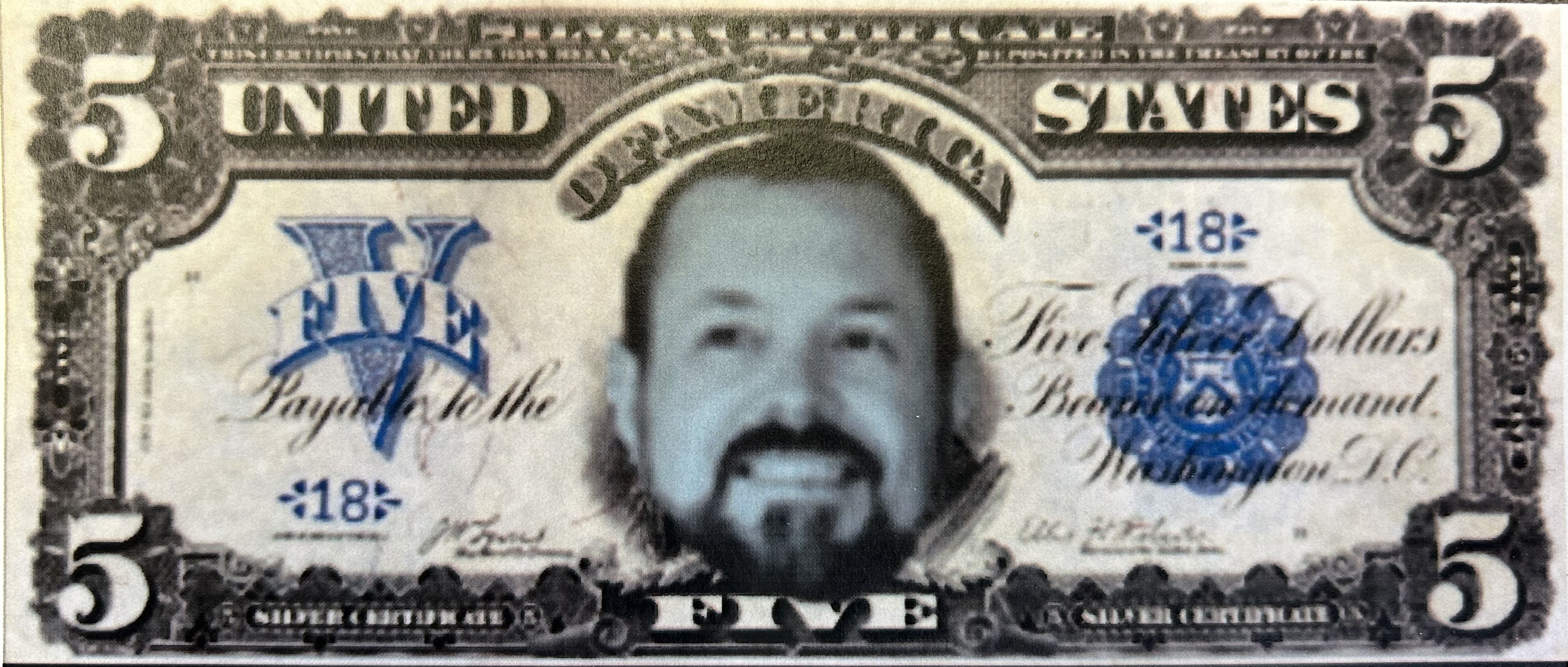
The Peabody Institute is currently host to the exhibit “Indigenous (Mis)representations on American Numismatic Objects,” displaying items from the History and Social Science department, the personal collections of Donny Slater, and the hard work of the students in his class HSS507: History in Your Pocket – American Stories, Ideals, and Economics as Told through Coins and Currency.
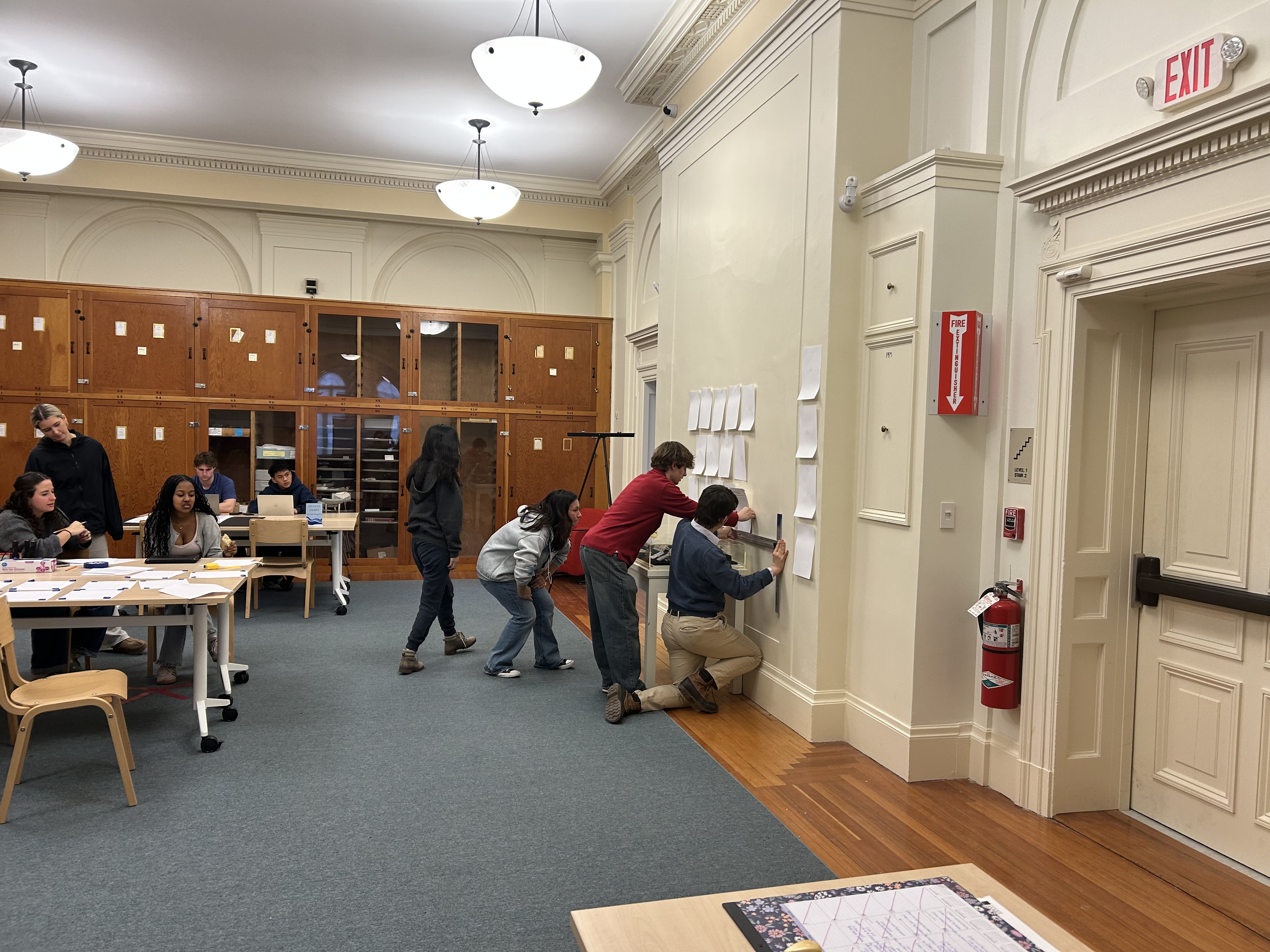
Combining historical investigation and close examination of the images depicted on American coins, bank notes, and tokens dating from 1744 to 2000, Donny’s students connected the use of Native American iconography on these objects of exchange to efforts to build a national identity that hid the violence of Westward Expansion at the country’s core, choosing this as the story they wanted to share with the Andover community. While the Peabody provided the class with the space and the display case, all the work of the design and installation came from the students themselves.
Everyone was deeply engaged in the process, and the results speak for themselves.
The exhibit will remain up through Alumni weekend, ending June 9, 2025.
Pre-installation day 1: finding the layout to match the narrativePre-installation day 2: debating and finalizing arrangementInstallation day 1: setting the caseSelecting that just-right sans serif fontSharing with fellow-coin enthusiast Elena Dugan (PhilRel)Installation day 2: mounting labels and finishing touchesOpening night!
Student (Mis?)representations of Their Teacher Donny Slater
What do, parfleche, ceramics, paintings, and basketry all have in common? They are all currently on display at the Addison Gallery of American Art here at Phillips Academy as part of the Kay WalkingStick/Hudson River School exhibition.
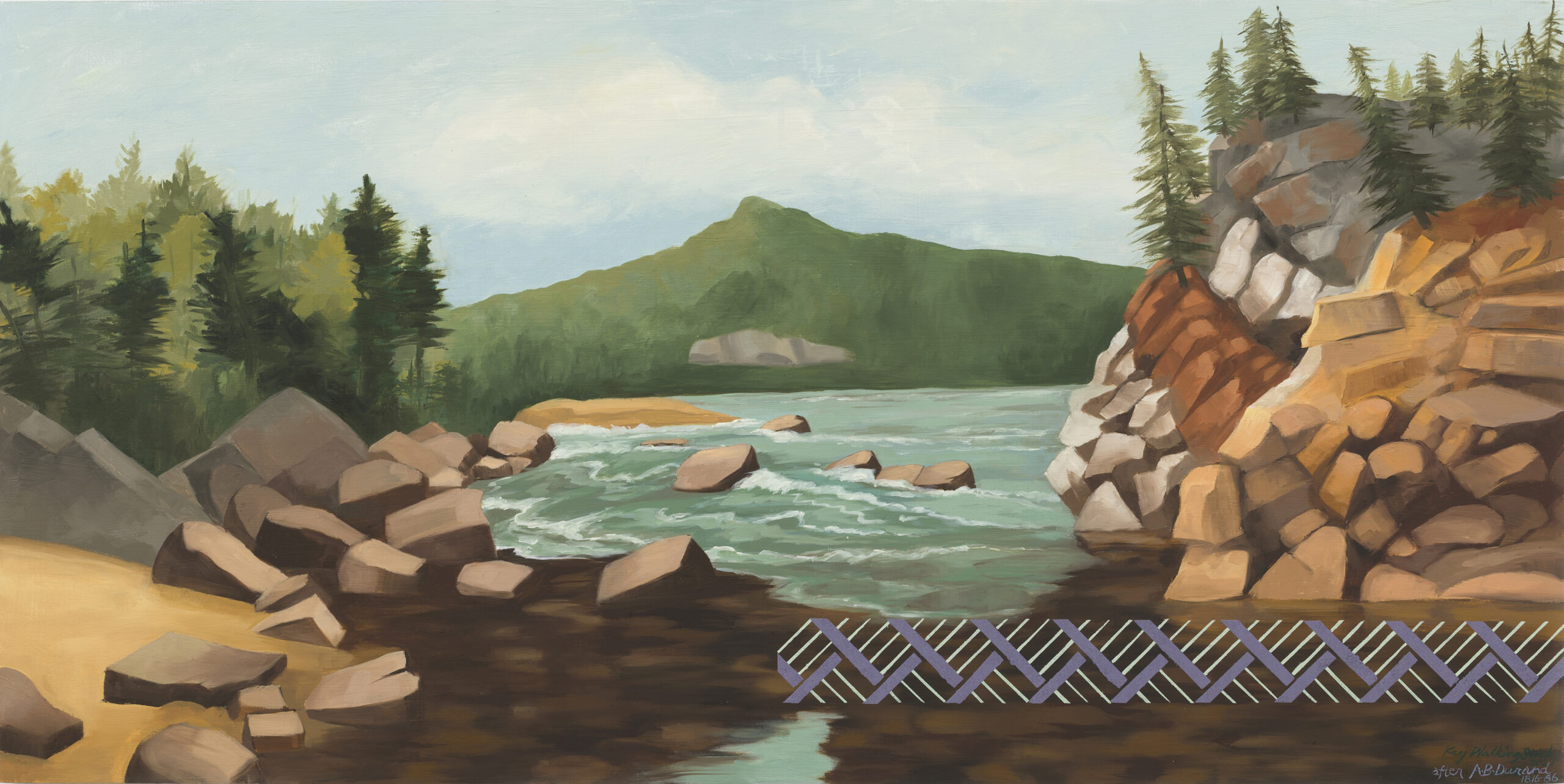
Kay WalkingStick (Cherokee) is a contemporary artist and educator known for her landscape paintings. This exhibition originated at the New-York Historical Society and has been joined by over a dozen pieces from the Addison’s permanent collection as well as three from the Peabody Institute.
In another wonderful collaboration with the Addison Gallery, the Peabody loaned two Mohican culture baskets and a vessel made by Wampanoag artist Ramona Peters to be placed in dialogue with Kay’s work. The items were thoughtfully selected and contribute to an intentional conversation between traditional painting techniques and Indigenous art.
We really appreciate the opportunity to collaborate with the Addison and highlight pieces from the Peabody Institute. Check it out if you are in the area!
Kay WalkingStick, Durand’s Homage to the Mohawks, 2021. Oil on panel. Colby College Museum of Art, Waterville, Maine; The Lunder Collection. Photo by JSP Art Photography. Copyright Kay WalkingStick
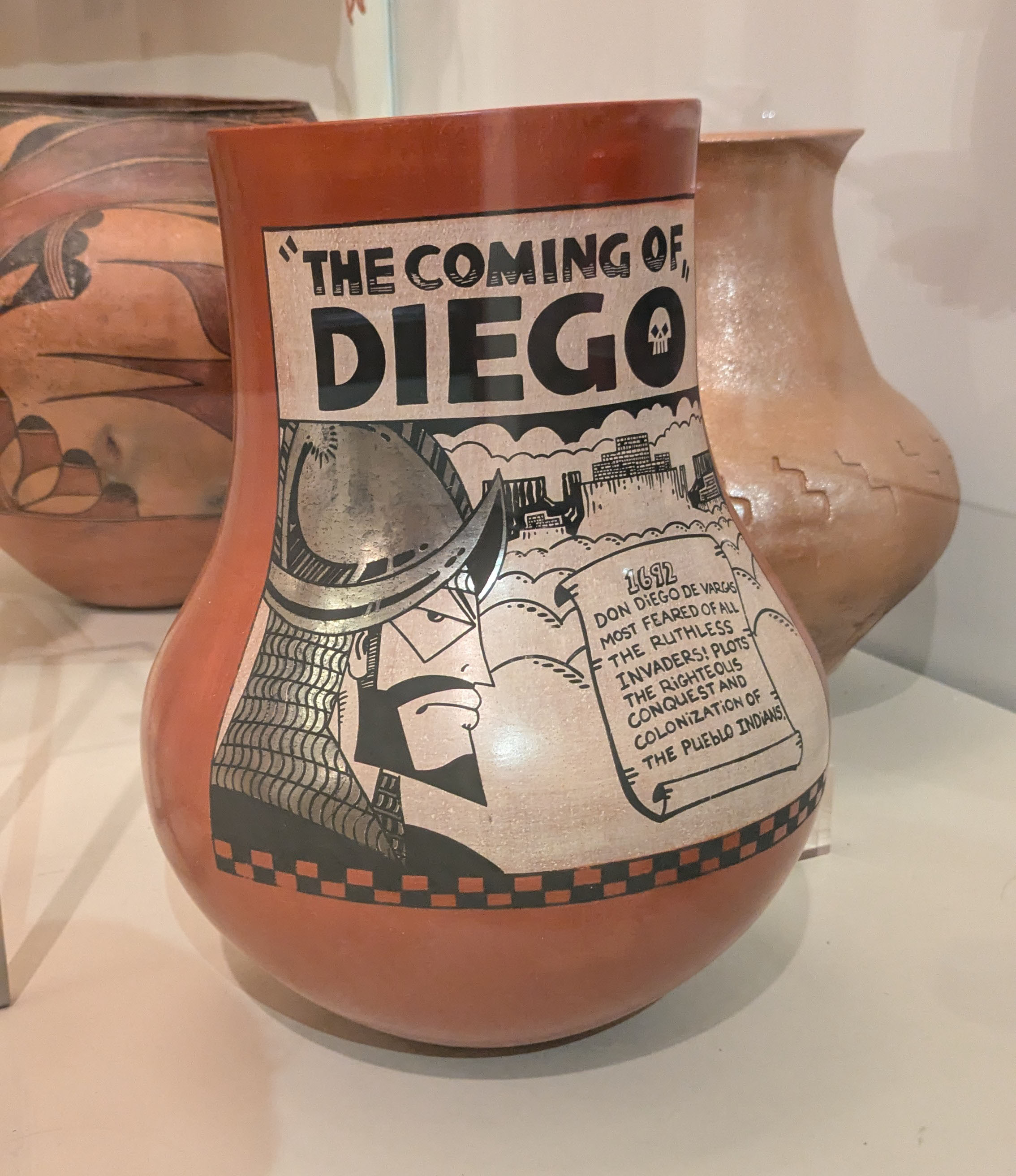
June brought a family trip to London, including a visit to the British Museum. Many websites list the top ten items that you should not miss at the museum, and the British Museum itself has a leaflet with their recommended highlights. The British Museum is sort of ground zero for archaeology, anthropology, and colonialism, as well as mounting calls for repatriation (many people are surprised that the British Museum is prevented from repatriating cultural items by law, and can only deaccession items that are deemed duplicates, damaged, or no longer of public interest). A surprise was a number of pieces by contemporary artists that stand in juxtaposition to items from the past. It was particularly neat to encounter several ceramic pieces by Diego Romero in the case along with older and ancient pieces of Pueblo pottery. After the visit, I decided that I’d shared my own British Museum top ten list and my own repatriation recommendations.
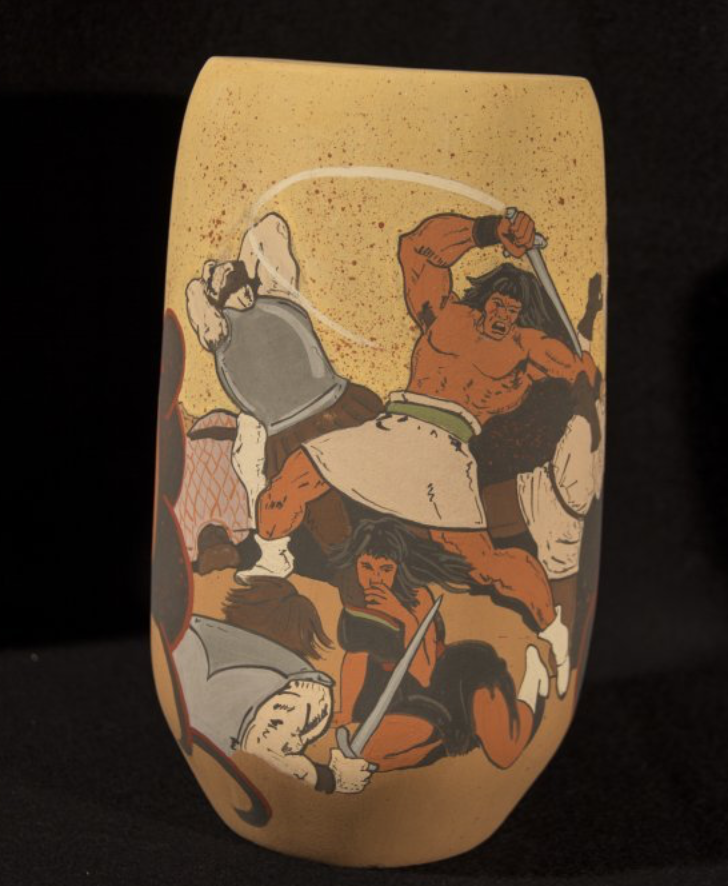
Diego Romero’s contemporary Pueblo pottery commemorates the Pueblo Revolt of 1680; at the British Museum Romero’s work appears with older and ancient pieces.
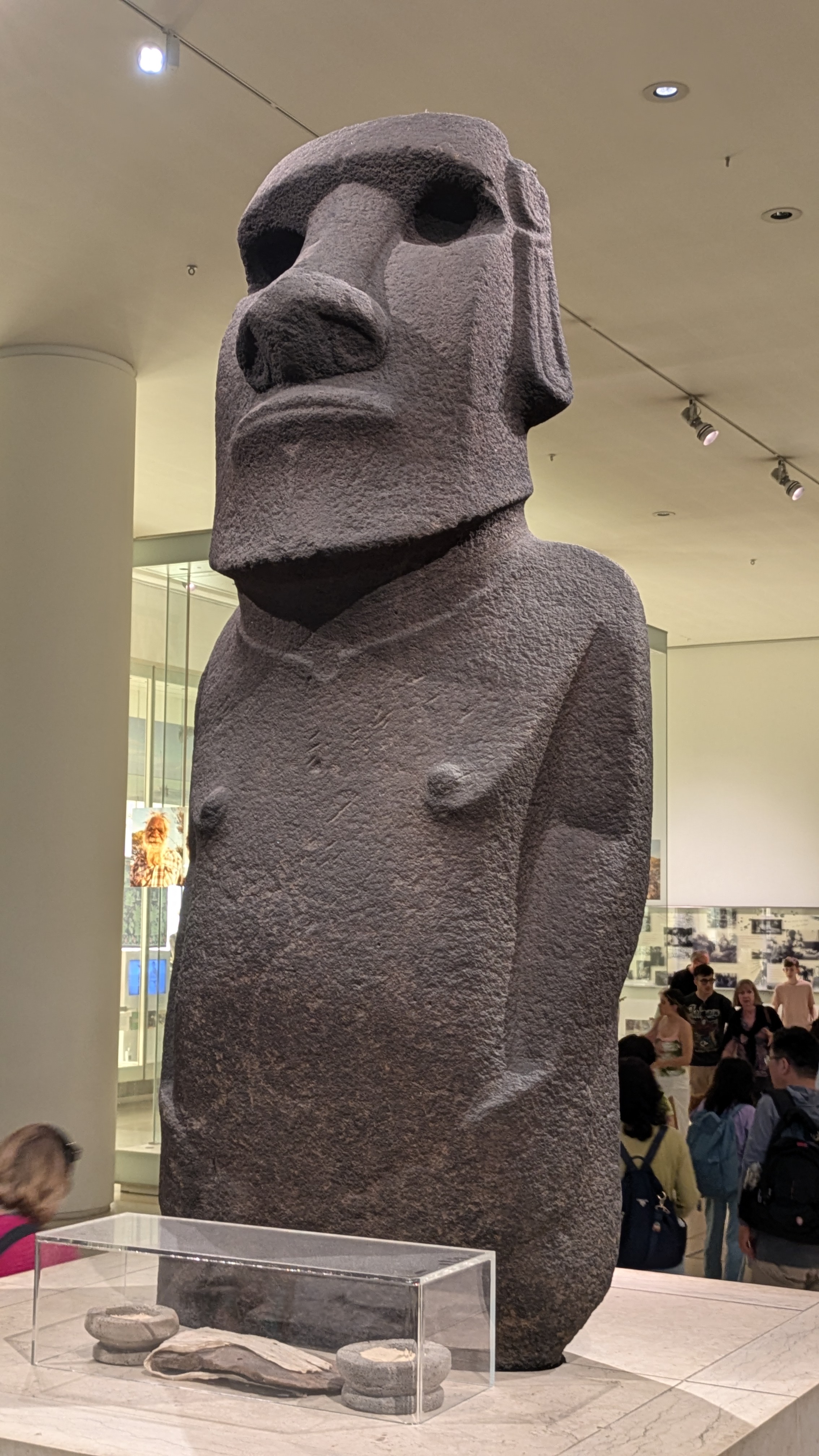
No. 1 Hoa Hakananai’a (meaning ‘lost, hidden, or stolen friend’)
Hoa Hakananai’a is one of two Moai from Rapa Nui (Easter Island) held by the British Museum. According the exhibit text, both Moai were taken from Rapa Nui in 1868 by Commodore Richard Powell and the crew of a British survey ship, HMS Topaze. The Admiralty presented Hoa Hakananai’a to Queen Victoria, who ultimately gave him to the British Museum, rejoining Moai Hava, who went directly from the Admiralty to the museum. Near the base of the colossal figure of Hoa Hakananai’a are offerings made by representatives from Rapa Nui. The Rapa Nui requested repatriation in 2019 and the exhibit text explains that conversations about return are ongoing.
Should the British Museum repatriate Hoa Hakananai’a and Moai Hava? Yes.
No. 2 Parthenon Marbles
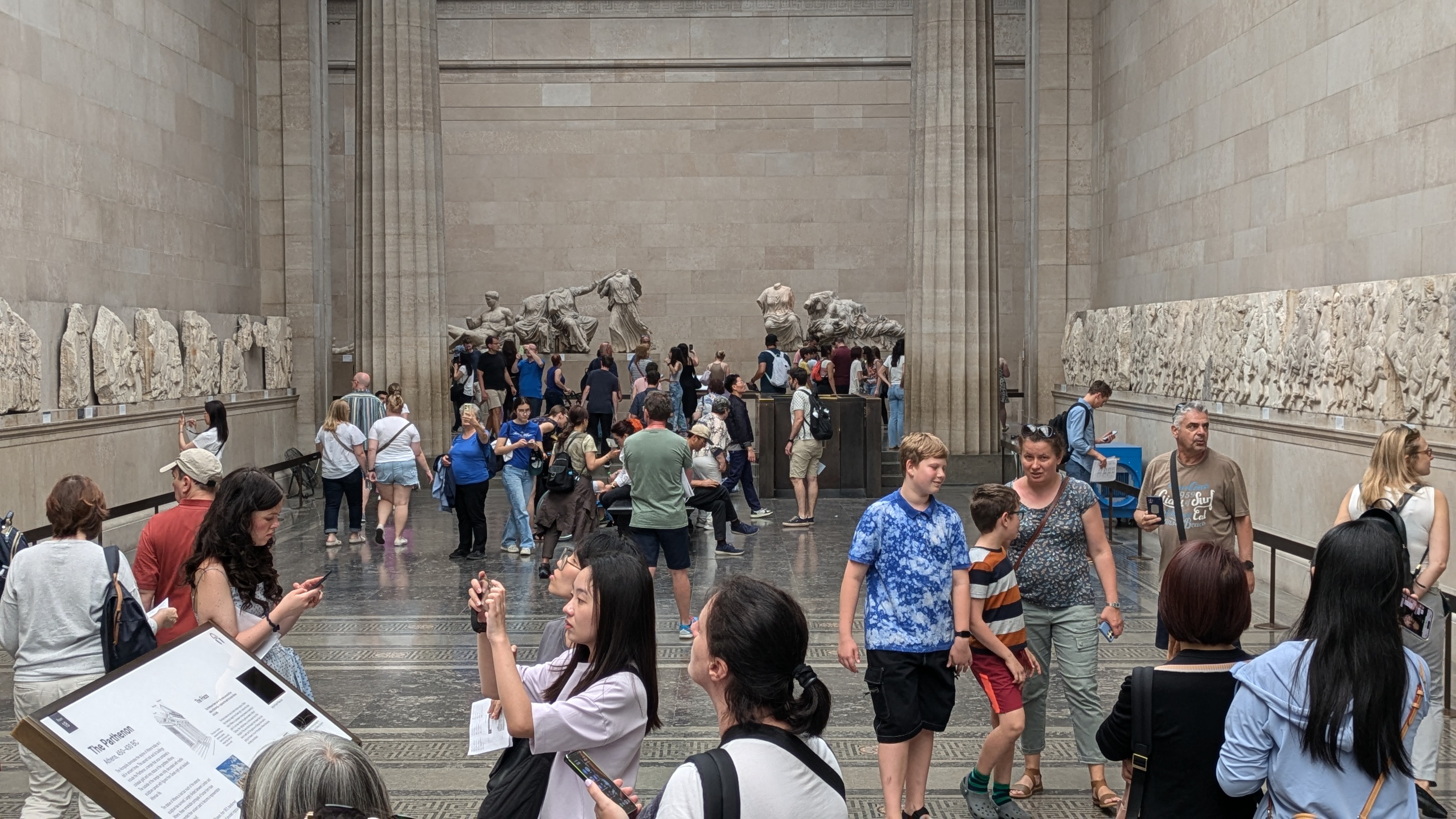
Perhaps central to requests for repatriation of cultural items from the British Museum are the sculpted frieze panels from the Parthenon–long called the Elgin Marbles, after the individual who originally took the panels. These impressive carvings once adorned the Parthenon–the Temple of Athena–on the Acropolis in Athens and date from nearly 2,500 years ago. The pamphlets that are usually available to explain why the panels shouldn’t be repatriated were all gone by the time we were there, but the British Museum website explains, “It is universally recognised that the sculptures that survive are best seen and conserved in museums.” Is it? The website goes on to note that in 2009, a new museum was constructed in Athens to showcase the panels. Greece has asked for the return of the carvings numerous times. Two notes from our visit. First, our friend Bill, a big comic and graphic novel connoisseur, noted that the so-called “South Metopes,” the panels depicting a battle between centaurs and Lapiths at the marriage feast of Peirithoos, followed the graphic, sequential storytelling now best known from comic books. Once he pointed this out, it completely changed my appreciation for the panels. Secondly, if you look out the windows of Gallery 18, where the sculptures and carvings are exhibited, you could see someone making breakfast in a flat directly behind the museum. I found the juxtaposition of these culturally and politically charged items with the quotidian of daily life to bring the entire, global conversation about the marbles into stark relief.
The gallery featuring the Parthenon Marbles was a popular destination when we visited in June.
Should the British Museum repatriate the Parthenon Marbles? Yes.
No. 3 Hopewell platform pipes
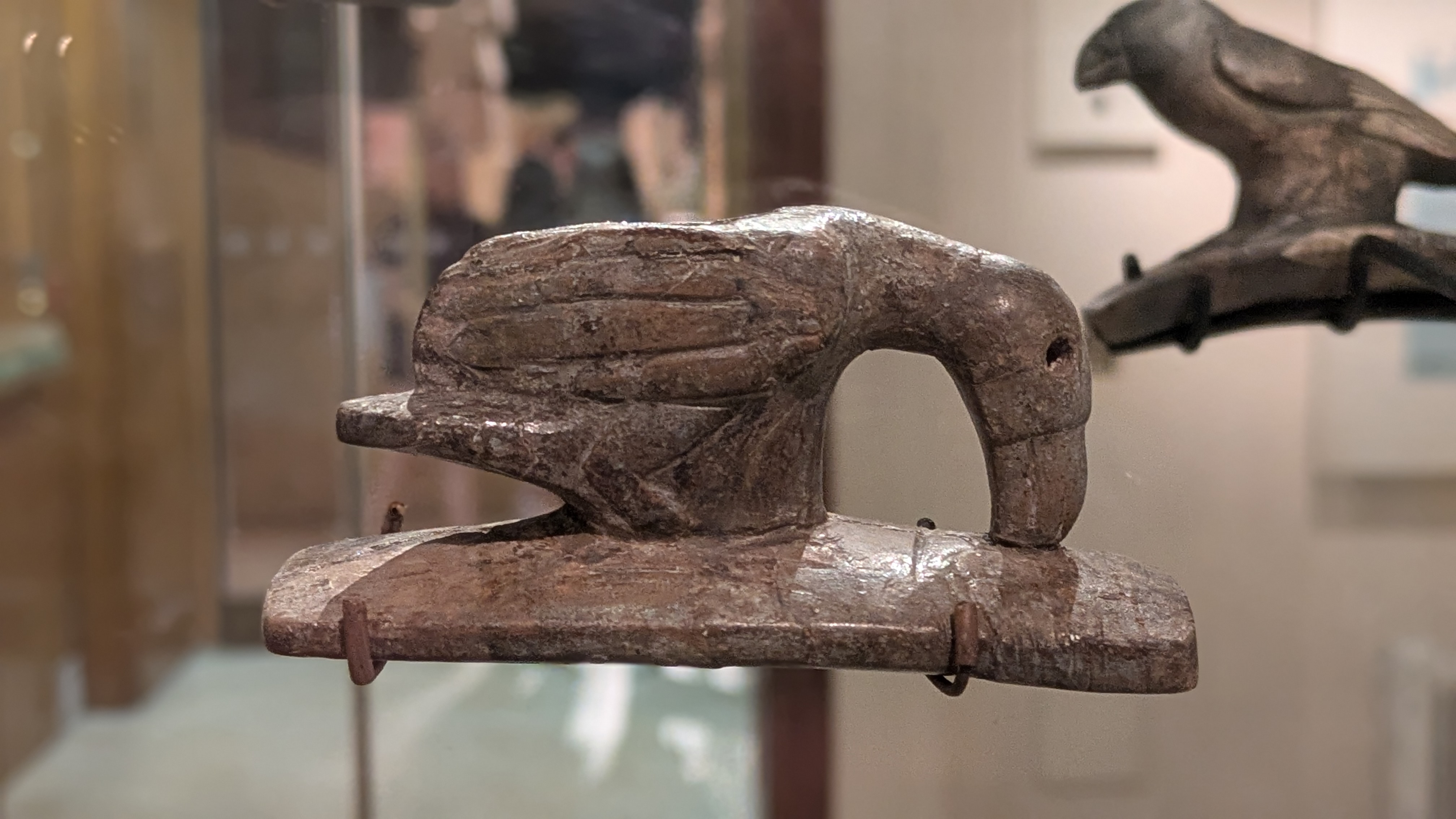
I’m definitely deviating from the top ten lists provided by the British Museum and other writers at this point, but for a student of archaeology of the Southeastern United States, I was really looking forward to seeing the Hopewell platform pipes. The Hopewell pipes, of stone, with beautifully carved birds and animals in miniature, were removed from Mound City in Ohio by E.G. Squier and Edwin Davis–remember Squier and Davis? Authors of 1848’s Ancient Monuments of the Mississippi Valley, one of the earliest archaeological publications of the Smithsonian Institution, sent this remarkable group of nearly fifty carvings abroad. According to the catalog for the 1977 exhibition Sacred Circles, “These little sculptures have a meaning that far outstrips their size. One feels their importance. It has something to do with the salient presentation of each animal, quail, hawk, bear, panther, snake, beaver or squirrel.” Acknowledging the high arts, architecture, and far-flung influences of the Hopewell, UNESCO recently designated eight of these monumental earthwork complexes as world heritage sites. Many institutions in the United States hold material heritage of Hopewell, and consultation with Tribes and Nations, as well as affiliations are beginning to happen.
Hopewell platform pipes from Ohio displayed at the British Museum.
Should the British Museum repatriate the Hopewell platform pipes? Yes.
No. 4 Sutton Hoo ship burial
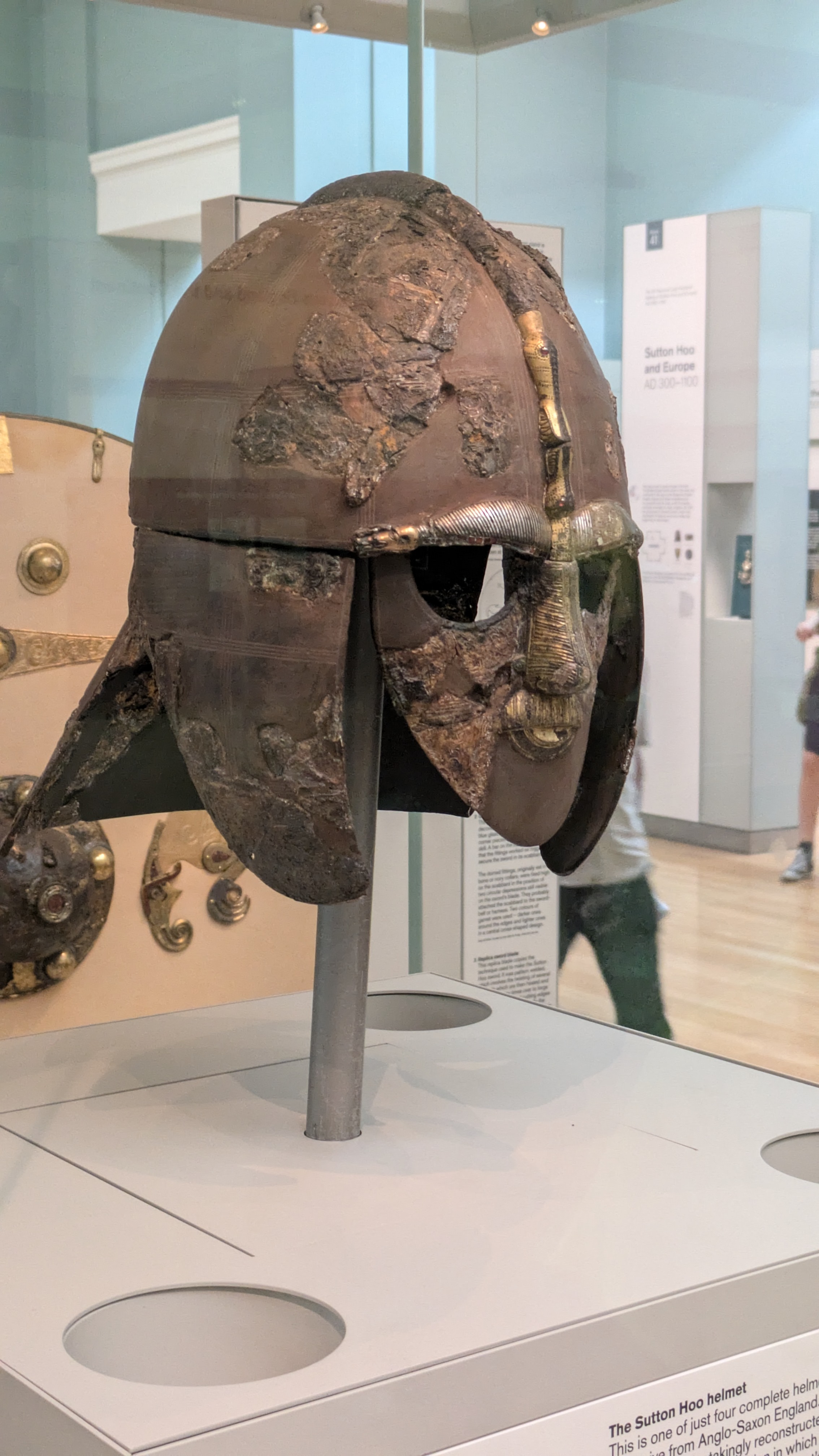
I was excited to see the items from the seventh century Sutton Hoo ship burial. In 1939, in Suffolk, avocational archaeologist Basil Brown worked with landowner Edith Pretty to excavate the remains of an Anglo-Saxon ship burial, including a trove of weapons and jewels, including gold and garnet items and a fabulous portrait helmet of iron and copper alloy, that some have thought might be King Raedwald of East Anglia.
The Sutton Hoo portrait helmet.
Many learned a little about Sutton Hoo from the 2021 Netflix movie The Dig starring Carey Mulligan and Ralph Fiennes. Sadly The Dig didn’t tell us much about the discovery or the project itself, even changing elements of the story and characters, like Mercie Lack and Barbara Wagstaff, teachers and amateur photographers who volunteered to help and captured amazing images of the fragile and rapidly deteriorating find (they became a man in the movie–why?). Okay, so, you probably are thinking Sutton Hoo, Suffolk, solidly in England, no question of repatriation, right? Well, a 2020 blog on Cultural Restitution called for the return of the Sutton Hoo helmet and other items from the ship burial to regional and local museums. The blog, based on an argument forwarded by historian James Barr, notes all the reasons the British Museum would oppose such a repatriation–Edith Pretty donated the items to the museum, the 1963 act that prohibits repatriation, as well as environmental and ethical concerns. Interestingly, we encountered a similar position in 2014 after the Peabody Institute of Archaeology’s repatriation of Mesolithic era painted pebbles to France’s National Museum of Archaeology (Édouard Piette, who had discovered the pebbles and donated them to the national museum, stipulated that they should never leave the so-called Piette Room). We felt pretty good about the repatriation, but upon visiting the area where the pebbles were found, locals complained that the pebbles weren’t coming home to them, but rather hoarded in Paris. Hmmm, good questions.
Should the British Museum repatriate the Sutton Hoo ship burial? Yes.
No. 5 Lewis Chessmen
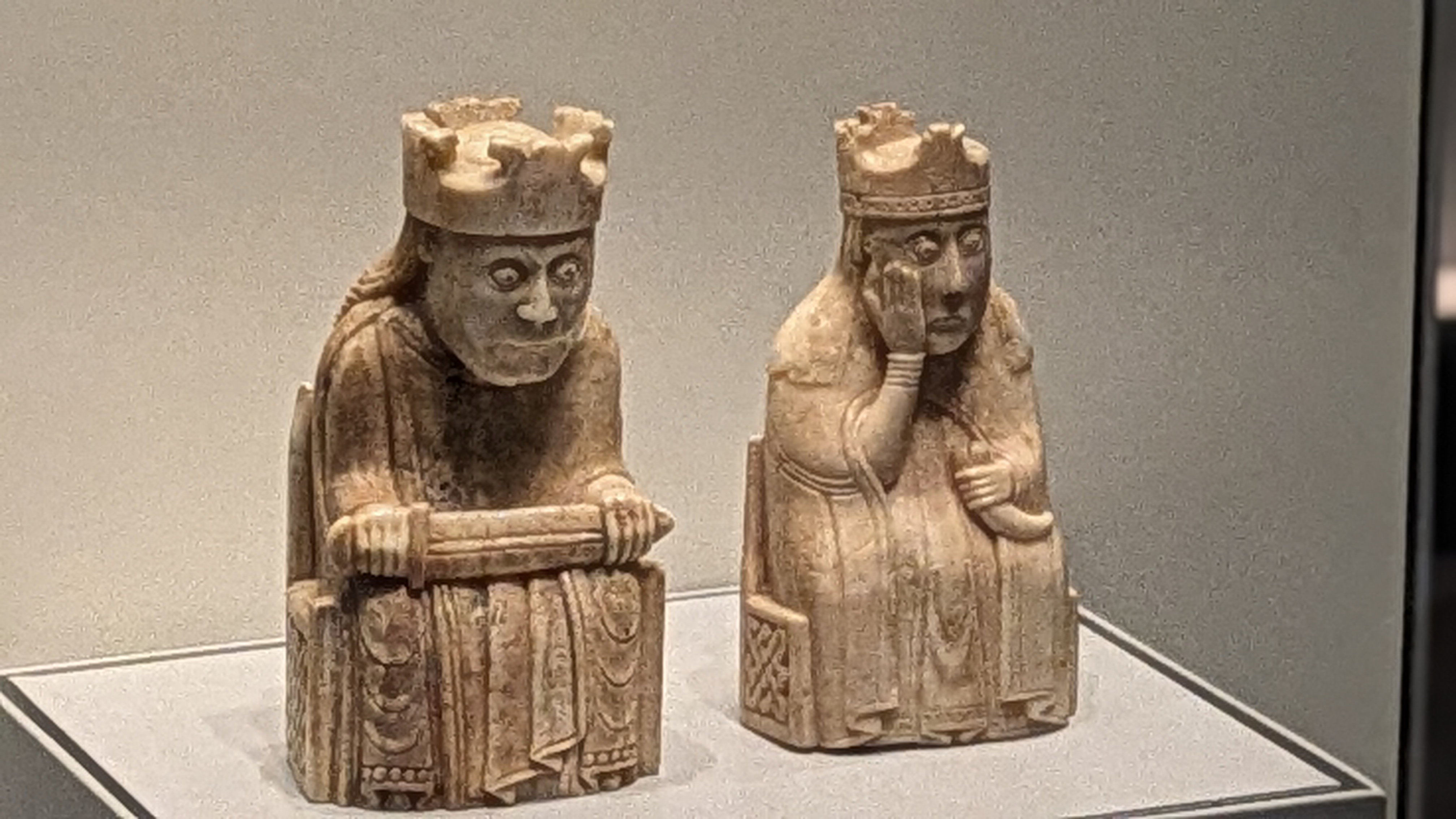
A Lewis Chessmen queen seems to be considering her plight.
A gallery or two over from Sutton Hoo and you find the twelfth century Lewis Chessmen, carved of walrus ivory and found in the nineteenth century in the Outer Hebribean Isle of Lewis in Scotland. Some went to the National Museum of Scotland–we saw them on our trip in 2017–but the bulk were sold to the British Museum. The source of the ivory and where the figures were made (maybe Norway!) is debated, but they are delightful, including berserkers chomping on their shields and queens doing what only could be described as a medieval face palm. You might think, wait, these are from the UK, so all good for the British Museum to keep, right? I wasn’t too surprised, however, to see that there have been efforts to return the chessmen not only to Scotland, but in 2010 Scottish MP Angus MacNeil called for the chessmen to return to Museum nan Eilean (museum of the islands) at Lews Castle in Stornoway, the major town of the Outer Hebrides. A 2017 Global Heritage blog post notes, “Recognition that the Lewis Chessmen are part of the heritage of the Western Isles of Scotland has come in the last few years after much lobbying, when the British Museum decided to loan six chess pieces to the Museum nan Eilean.”
Should the British Museum repatriate the Lewis Chessmen? Yes.
No. 6 Rosetta Stone
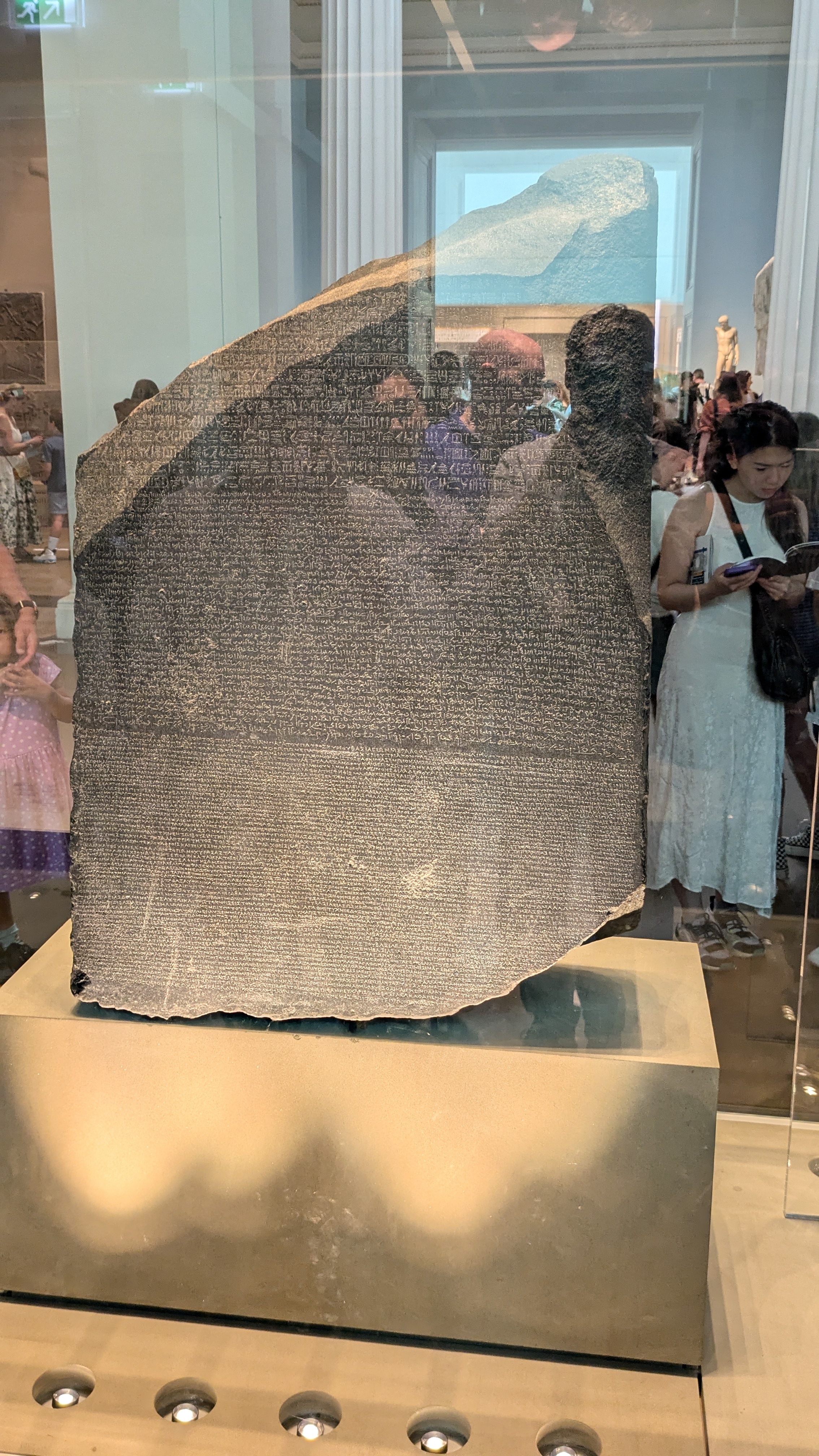
The Rosetta Stone was one of the more popular objects–I lament that I didn’t get a photo of the three young men capturing a selfie.
The Rosetta Stone is sort of like the British Museum’s Mona Lisa–a lot of people were crammed in to get a look and it’s a little smaller than you think it will be. A group of young men in their 20s did a selfie. The Rosetta Stone includes translations of a text in three writing systems–classical hieroglyphics, Demotic script (a simplified hieroglyphics), and Ancient Greek. This allowed nineteenth century scholars–especially French archaeologist Jean-Francois Champollion–to crack the code of ancient Egyptian hieroglyphics, earning the Rosetta Stone a place in archaeology’s top ten. In 2022, Monica Hanna, dean at the Arab Academy for Science, Technology & Maritime Transportation, organized a petition calling for the repatriation of the Rosetta Stone, noting, “the British Museum’s holding of the stone is a symbol of Western cultural violence against Egypt.” The petition garnered over 4,000 signatures. Zahi Hawass, well-known Egyptian archaeologist–circulated a similar petition–which got over 100,000 signatures. According to reporting in 2022, the British Museum argued that an 1801 treaty included legally transferred ownership of the famous tablet.
Should the British Museum repatriate the Rosetta Stone? Yes.
No. 7 North West palace of Ashurnasirpal gate
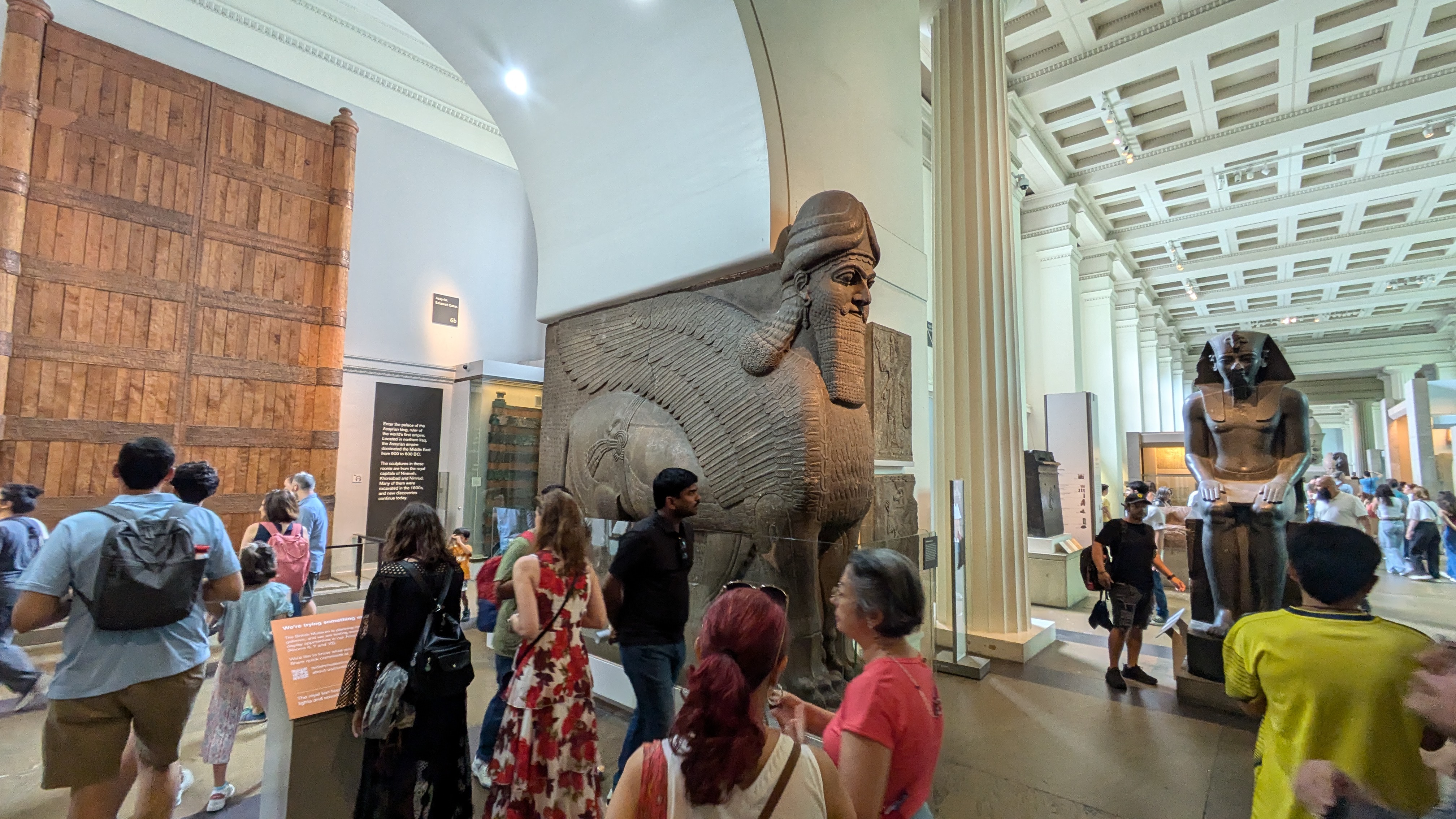
The lamassu figure from Ashurnasirpal’s palace throne room entrance is paired with the replica of the Balawat Gate (to the left in this picture).
Of all the cultural treasures housed at the British Museum, the Ashurnasirpal gate is perhaps one of the most striking. I first learned about these massive carvings of winged human-headed lions (or lamassu) guardians from the royal palace at Nimrud (modern northern Iraq) in grad school. The late Barbara Barletta taught a fantastic art history course on Ancient Mesopotamia and Egypt. The tests were very different from those in archaeology, and were based around projected slides that corresponded to questions on the test. I became proficient at making quick sketches in my notes so I could keep track of which architectural features and cultural items were which. Erected during the reign of neo-Assyrian king Ashurnasirpal II, almost 3,000 years ago, the figure was excavated by Sir Austen Henry Layard in 1851. A similar, perhaps matching figure is at the Met in New York. I can’t find any specific calls for repatriation by governments of Iraq, but they have been increasingly involved in the return of looted cultural items, including cuneiform tablets that landed at the Museum of the Bible and Cornell University. In 2023 Iraqi-American artist Michael Rakowitz offered his 2018 sculpture The Invisible Enemy Should Not Exist–his version of a massive lamassu–in exchange for repatriation of the Ashurnasirpal carving. An article about Rakowitz’s offer indicate that he specifically wanted to see the return of the Ashurnasirpal carving to respond to the destruction of a lamassu dating to 700 BCE at the Nergal Gate in Nineveh, which was purposely destroyed by the Islamic State in 2015.
Should the British Museum repatriate the Ashurnasirpal gate? Yes.
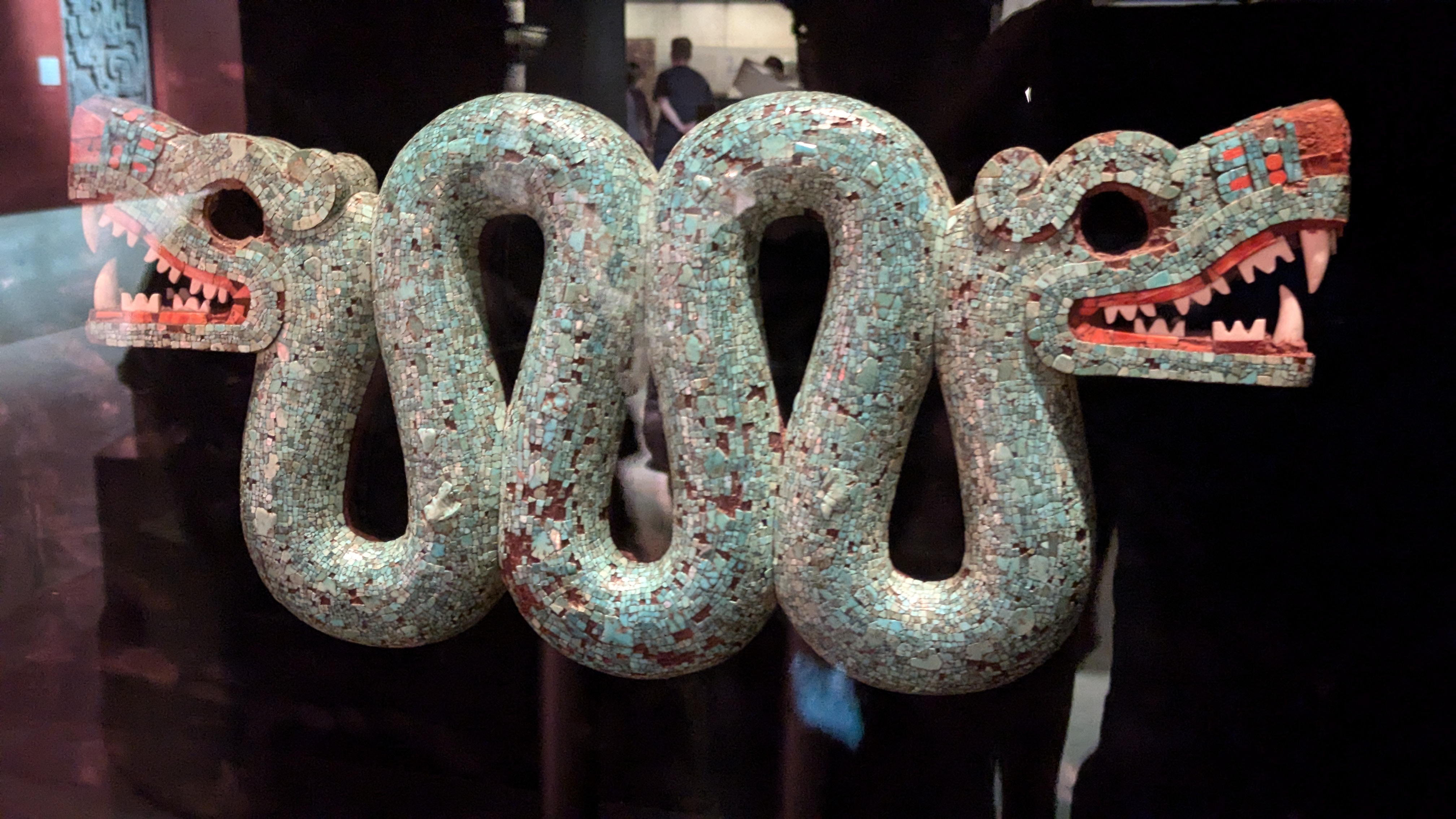
No. 8 Aztec serpent pectoral
The mosaic on the Aztec serpent (or caterpillar!) pectoral is made of thousands of chips of turquoise with spondylus shell highlights.
The serpent pectoral is one of several turquoise mosaics from Mesoamerica associated with the Aztec and Mixtec of central Mexico, dating from 1,400 to 1,521. Carved of cedar wood, the undulating body of the double-headed serpent is covered with an intricate mosaic of turquoise and shell. The back side is flat, and unadorned, leading most to describe this as a pectoral, which could have been worn suspended on the chest of a person or larger statue. A catalog note by Vila Llonch notes, “The Nahuatl term ‘coatl’ can be translated as both serpent and twin. The Mexica considered serpents to be powerful, multifaceted creatures that could bridge the spheres (the underworld, water and sky) owing to their physical and mythical characterisitics.” Joshua Fitzgerald offers another interpretation, suggesting the pectoral is not a snake, but rather a caterpillar, representing less bad omens, and more a physical representation of how to think about life stages. The pectoral was purchased by the British Museum from a dealer, representing “an Italian gentleman” in 1894, after considerable negotiations about the price, as well as intrigue involving Duchessa Massimo (Teresa Maria Doria-Pamphili-Landi) and the Massimo Family of Rome. It’s almost impossible to look at a book about the Aztecs or Mesoamerican archaeology without encountering the mosaic pectoral–it’s famous! I can’t find specific instances of Mexico calling for the return of the mosaic pectoral, but a 2022 article by Amah-Rose Abrams points out increasing opposition by Mexico to international auctions, as well as a legacy of protecting cultural heritage from pilfering and removal that dates back to at least 1911, following the Mexican Revolution. In that piece, Mexico’s culture minister, Alejandra Frausto Guerrero, is quoted, stating “any piece of national heritage that is permanently outside the country, not temporarily for an exhibition or cultural cooperation, comes from an illegal act.”
Should the British Museum repatriate the Aztec serpent pectoral? Yes.
No. 9 Nisga’a house pole
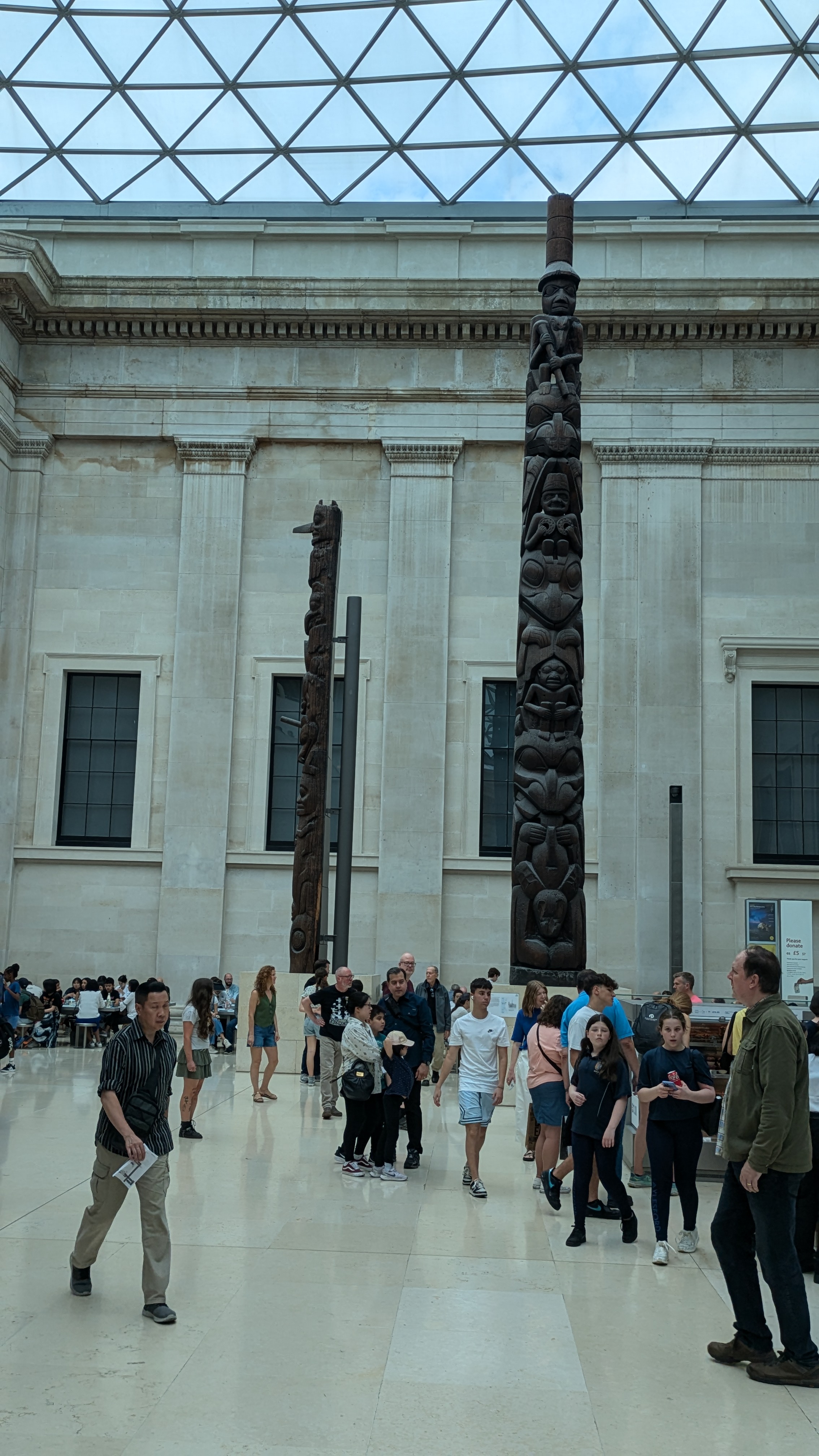
The Nisga’a and Haida house poles overlooking the British Museum lunch area.
Two house poles–what many might call totem poles–occupy an area near where you can have lunch at the British Museum. One is Haida, the other Nisga’a, from Angeedaw on the Nass River in British Columbia. I was particularly interested to see the Nisga’a house pole, since a presentation at the November 2023 AAIA repatriation conference highlighted the rematriation of another Nisga’a house pole from the National Museums of Scotland. Both pts’ann were taken by anthropologist Marius Barbeau, who was commissioned to acquire these items from the UK museums. The online entry for the Nisga’a pole includes this text:
The receipt in the Canadian Museum reads: ‘M.Barbeau Nass River Aug 30 1932. [To] Smith and his clan For totem pole of Eagle-Beaver, their property, which they cede in complete clan agreement without further claim (assuming responsibility of division of price between themselves) to M.Barbeau for his disposal according to authority received. Received payment in full (signed) William Smith his mark. (witness) Albert Allen. $310’ The difference in sale and cost figures being accounted for by travel and other expenses?
Apparently, similar documents exist for the rematriated pts’ann, but family stories contradict the receipted account, according to an October 17, 2023 story in IndigiNews. That story–and the presentations at the November repatriation conference–explained that these pts’ann were carved as memorials to deceased family members and are considered more than objects, but as ancestors themselves. The Angeedaw pts’ann is about 25 feet tall with carvings of mythological creatures, an eagle, and beavers.
Should the British Museum repatriate the Nisga’a house pole? Yes.
No 10 Citico shell gorget
Note–I’m not including any images of the shell gorget, as this is so clearly a funerary item.
In a case near the Hopewell pipes described above was a beautiful example of a Citico style shell gorget. I was surprised to encounter this cultural item at the British Museum, as I had become quite familiar with these objects in repatriation work here at the Robert S. Peabody Institute of Archaeology. These gorgets, made from the outer whorl of a large whelk shell and depicting stylized rattlesnakes, appear almost exclusively in burials of the late Mississippian era in the southeastern United States. A similar gorget from Etowah, a major mound complex near Atlanta, Georgia, was on exhibit at the Smithsonian’s National Museum of Natural History when I was there last summer. All of the examples from Etowah and Little Egypt here at the Peabody are awaiting repatriation, either as associated or unassociated funerary objects. My degree of familiarity with these gorgets increased in 2018 when we began working with the FBI to recover several stolen shell gorgets–which was partially successful. That work led me to scour publications, auction catalogs, and online auctions for shell gorgets in the hopes of recognizing one of the stolen ones. Helpful in all that is an exhaustive catalog of shell gorgets compiled by Jeffrey P. Brain and Philip Phillips, published by the Harvard Museum Press in 1996. The British Museum example, which apparently came to the museum in 1884 from William Bragge, does not appear in the Brain and Phillips catalog. Bragge was a nineteenth century engineer, antiquarian, and collector, with a specialty in tobacco; the British Museum holds 1,899 objects that are related to Bragge’s collecting efforts, including objects from far-flung Indigenous cultures, often pipes or smoking-related paraphernalia.
Should the British Museum repatriate the Citico shell gorget? Yes.
Did you know that the Smithsonian is opening a new gallery – the Molina Family Latino Gallery of the National Museum of the American Latino – dedicated to highlighting Latino contributions to the United States?
I learned about this cool gallery about 18 months ago when the Peabody Institute was first contacted about potentially loaning an item from the collection for the inaugural exhibition that will open in mid-2022. The exhibition is the first to be presented by the National Museum of the American Latino. We were thrilled to contribute a small piece to the important story of how Latinos and Latinas inform and shape U.S. history.
What did they want to borrow?
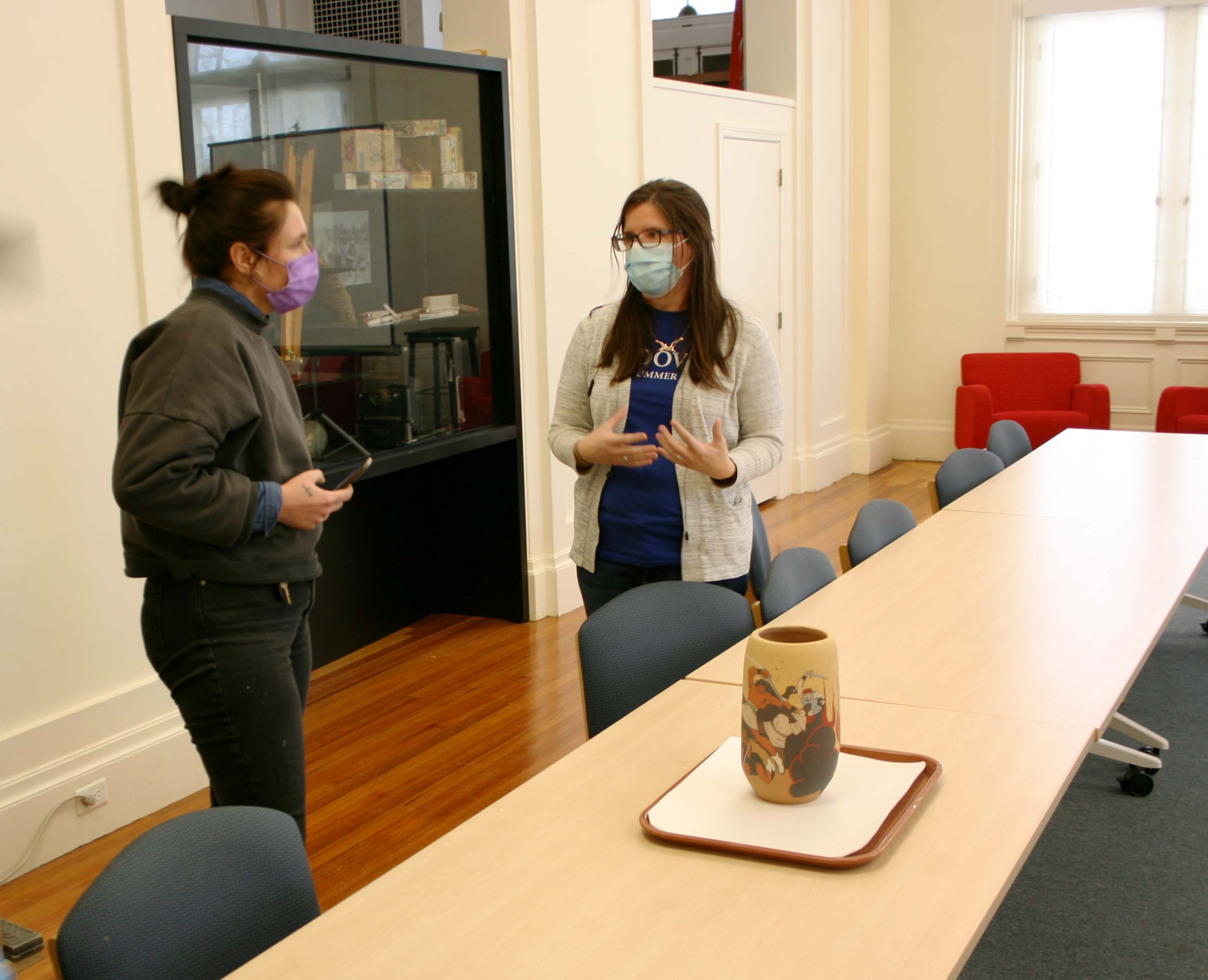
Vessel depicting the Pueblo Revolt by Jason Garcia
This amazing vessel by Jason Garcia (Okuu Pin), Santa Clara Pueblo, is an exploration of the Pueblo Revolt of 1680. Garcia is known for his mixture of traditional materials and methods with pop culture. Past blog posts have discussed this piece and his work.
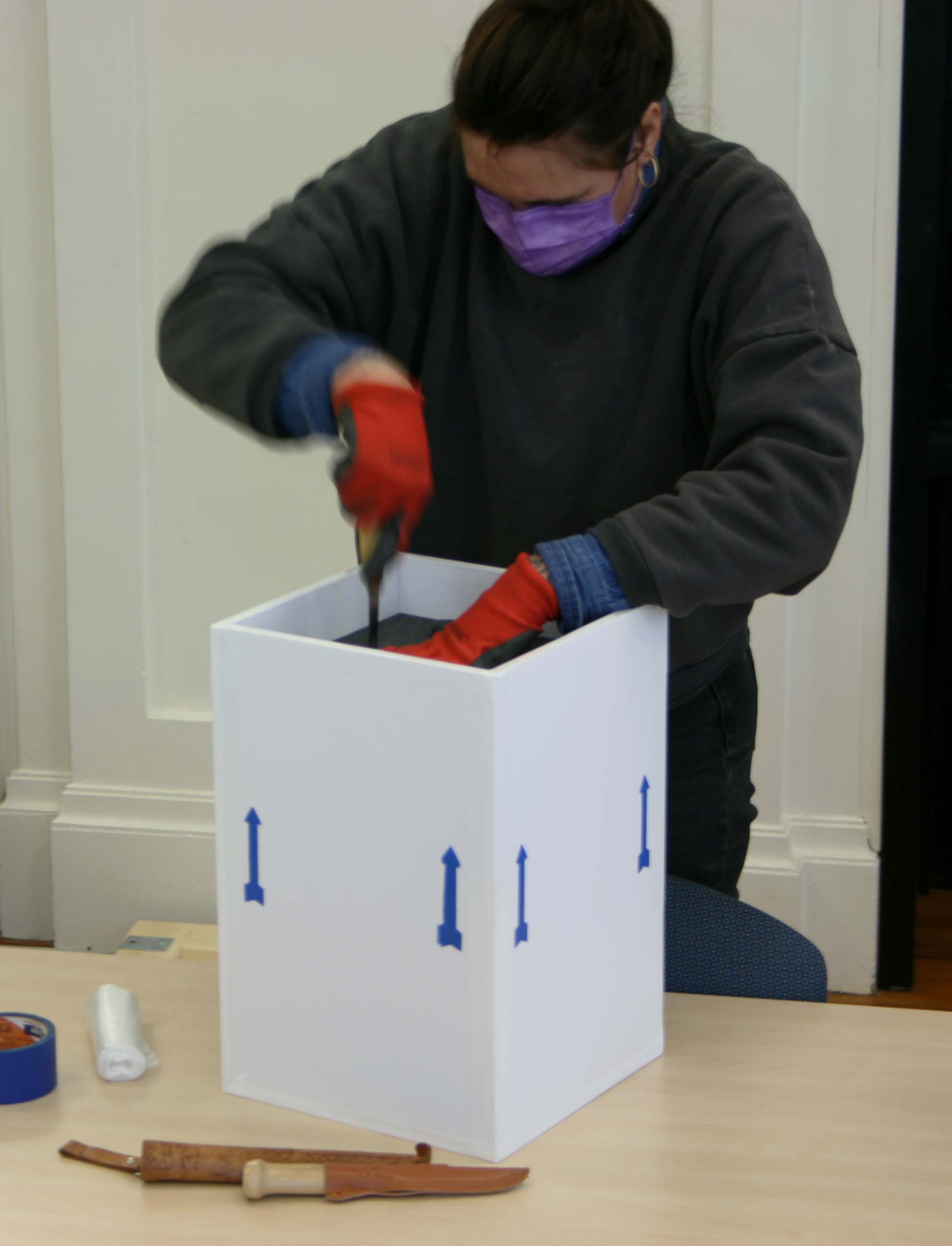
After months of correspondence and paperwork, the vessel was packed for transportation in mid-February of this year. It is always a pleasure to watch skilled art handlers create custom packaging and work to ensure that items make it safely to their destination. The team was great and the vessel is awaiting installation in its new temporary home.
I enjoyed learning more about the Molina Family Latino Gallery and the National Museum of the American Latino and encourage you to explore the newest branch of the Smithsonian. Keep your eyes peeled for an online version of the gallery later in 2022 for those who are unable to travel there in person.
Last fall, the Peabody loaned ten objects to the Addison Gallery of American Art here at Phillips Academy. They spent nearly a year there for the exhibition A Wildness Distant from Ourselves: Art and Ecology in 19th Century America.
Due to public health concerns related to COVID-19, both the Peabody and the Addison have been closed to visitors since mid-March. But, the behind the scenes work never ends. The Addison regularly exhibits works of art on loan from other institutions and actively loans its own collection to museums around the world. Returning these objects during COVID shutdowns has been a logistical challenge for our friends, and we were happy to coordinate with them to return the materials back across the street to us.
When the objects from the Peabody went to the Addison, a professional fine arts shipping company took care of packing and moving everything. To come home, the Addison staff did the packing themselves – and they are awesome at it!
It is now up to me to put these artifacts back into our storage areas – a job I am happy to do! Typically, we would use many of these in the upcoming school year for classes, but this year is different. Like most other institutions, any of our classes will be taught online.
But I know that I will be happy to see Champ the auk back at home in his case every time I come into the Peabody.
The Centers for Disease Control and Prevention (CDC) issued guidelines to limit the spread of COVID-19, also known as the coronavirus. One recommendation included in these guidelines was for “social distancing” – a term referring to the conscious effort to reduce close contact between people and hopefully hinder the community transmission of the virus.
While schools, companies, and various workplaces determine the best possible options to both adhere to these guidelines as well as provide the appropriate support to their staff, students, and customers – many have chosen to close their doors. Some institutions and companies have shut down indefinitely, while various schools and universities have moved to remote teaching, where students complete their classes online and stay at home. Universities and colleges all over the country have moved courses to online platforms. Undergrads are being told to move out of their dorms and off campus for the remainder of the semester.
Phillips Academy (PA), a New England boarding school and the Peabody’s parent institution has instituted similar measures, following the directives issued by Massachusetts Governor Charlie Baker.
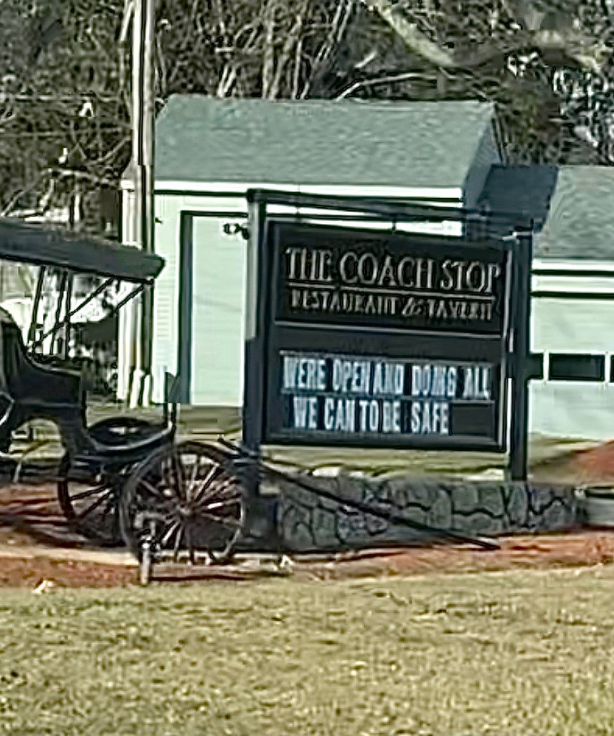
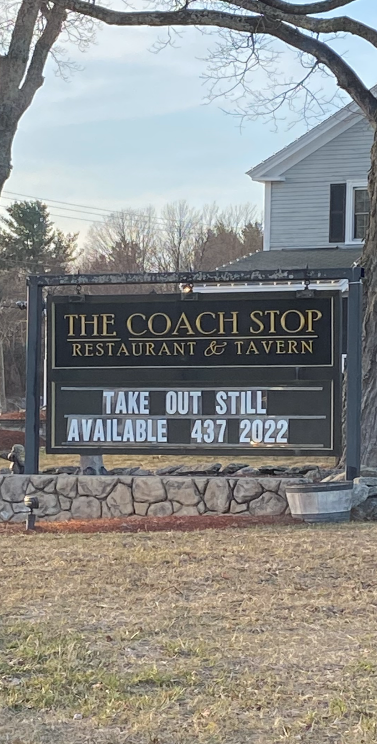
A local restaurant closes their doors in light of “on-site eating” bans over COVID-19
Now many would say they like working from home and actually get more done, but it is not the case for everyone. The Peabody staff are doing what they can to continue their museum work from home. For the Peabody collections team, it is very difficult to continue much of the work they do every day at the institution, as much of the collections and material cannot leave the building. While inventory, rehousing, and cataloguing of the collection is put on hold, our staff is editing object photographs, digitizing documents, transcribing collection ledgers, writing blogs (like this one), and more.
My dog, Rourke, is very happy to have me working from home!
Outside of my remote-work, I am wondering like many others who are stuck at home – what else can I do with the rest of my week? By being at home, we miss out on the daily interactions with our coworkers, colleagues, and classmates. Our experiences with each other fuel our creativity and critical thinking, and are important for much needed collaborative efforts. Through “social distancing” we are recommended to not take part in every day, public activities such as eating out, going to the store, or visiting a museum or historical site with our friends and family.
But don’t let social distancing doom your week and weekend! Museums have found a way to bring some of their collections to their visitors. So worry no more! You can view that Van Gough from the couch!
I was happy to enjoy a little culture and education in my off-time while at home. According to Fast Company, Google Arts & Culture has teamed up with over 500 museums and galleries around the world to bring virtual tours and online exhibits to a global audience.
Some of the museums highlighted by Google Arts & Culture include the British Museum in London, the National Gallery of Art in Washington, D.C., the Musée d’Orsay in Paris, France, the National Museum of Anthropology in Mexico City, Mexico, and various historical parks and sites.
Design of the Musée d’Orsay in 1979 Image courtesy of A.C.T. Architecture and the Musée d’Orsay
The first museum I “visited” was the Musée d’Orsay in Paris, France. As a student, I had visited this museum on a class trip many years ago and I was interested in the exhibits they provided online. This exhibit was a detailed history on the building of the museum titled, From Station to the Renovated Musée d’Orsay. This endeavor was a groundbreaking project for Paris as it was the first time an industrial building had been restored to accommodate a major museum. The virtual exhibit showcases the early building plans and images of the Orsay train station and hotel from the 1900s as well as images of the museum and its galleries after the renovation project in the early 2000s. Explore this virtual exhibit here!
I visited a second virtual exhibition, this time, at the National Gallery of Art in Washington, D.C. The exhibition is called, Fashioning a Nation. This exhibit features drawings from the Index of American Design, a collection of more than 18,000 watercolor pictures of American decorative art objects. This exhibition explores the American fashions from 1740 to 1895, giving insight into the character and quality of American life from the colonial period to the Industrial Revolution. Click here to explore this exhibit!
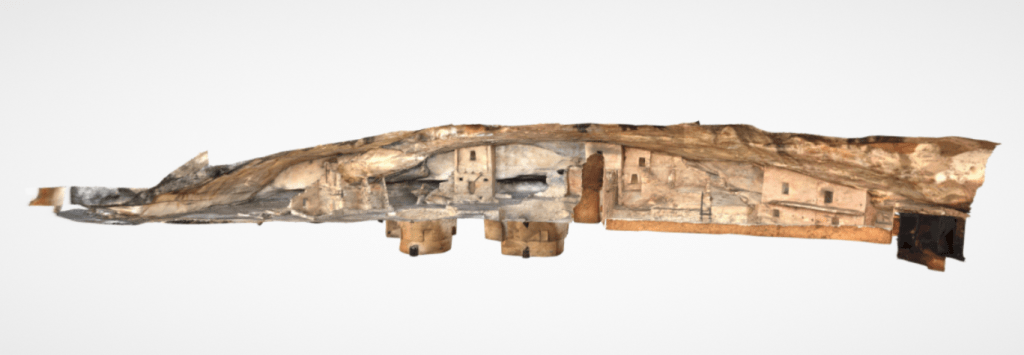
3D model of the Balcony House at Mesa Verde National Park Image courtesy of CyArk and Open Heritage – Google Arts & Culture
If museums aren’t your thing, explore a historic site!Open Heritage – Google Arts & Culture offers iconic locations in 3D, using 3D modeling techniques for you to explore. You can learn about the tools of digital preservation and how people all over the world are preserving our shared history. One site I visited was the Mesa Verde National Park. This site is home to Native American cliff dwellings in southern Colorado that span over 700 years of Native American history (600-1300 CE). An expedition was led by CyArk in February 2017. CyArk is a nonprofit organization that specializes in the digital documentation and preservation of historic sites. The organization documented the Balcony House at Mesa Verde using Light Detection and Ranging (LIDAR) and terrestrial photogrammetry. Combining these two technologies is what creates the 3D model of a site. To explore the 3D model of the Balcony House at Mesa Verde, click here!
Unfortunately, not all popular museums and galleries are included on Google Arts & Culture’s collection website, but some museums are offering virtual tours and online visits on their own websites, such as the Louvre in Paris, France. To see more of Google Arts & Culture’s collection of virtual museums and exhibits, visit their collection website. Explore and enjoy your visit!
The Addison Gallery of American Art is across the street from the Peabody at Phillips Academy. While I am happy to gently tease that the Peabody is cooler, the Addison is a pretty amazing institution as well. Founded in 1931, the Addison’s collection of American art is one of the most comprehensive in the world, including more than 20,000 objects spanning the eighteenth century to the present. I strongly recommend that you take the time to check out their awesome collection online.
Several months ago, Gordon Wilkins, the Robert M. Walker Associate Curator of American Art, requested a loan of several objects from the Peabody for an exhibition. We were thrilled to be able to help out and loan ten objects to the Addison for their show A Wildness Distant from Ourselves: Art and Ecology in 19th-Century America. The exhibition considers how the evolution of the European-American understanding of the natural world fundamentally altered the ecology of North America. From the Puritans’ seventeenth century “errand into the wilderness” to the present, the perceived dichotomy between man and nature has defined the European-American experience in the so-called “New World.” A Wildness Distant from Ourselves focuses on the nineteenth century, an era that witnessed both the extreme exploitation of the land and its peoples and the birth of a modern conservation movement.
I have been over there to check it out, and the exhibition looks great! It is wonderful to see the objects from the Peabody seamlessly integrated with other examples of American art to contribute to an important story.
If you are in the Andover area, I strongly recommend taking in the exhibition. And don’t miss the opening reception on Friday, October 4th from 6-8pm.
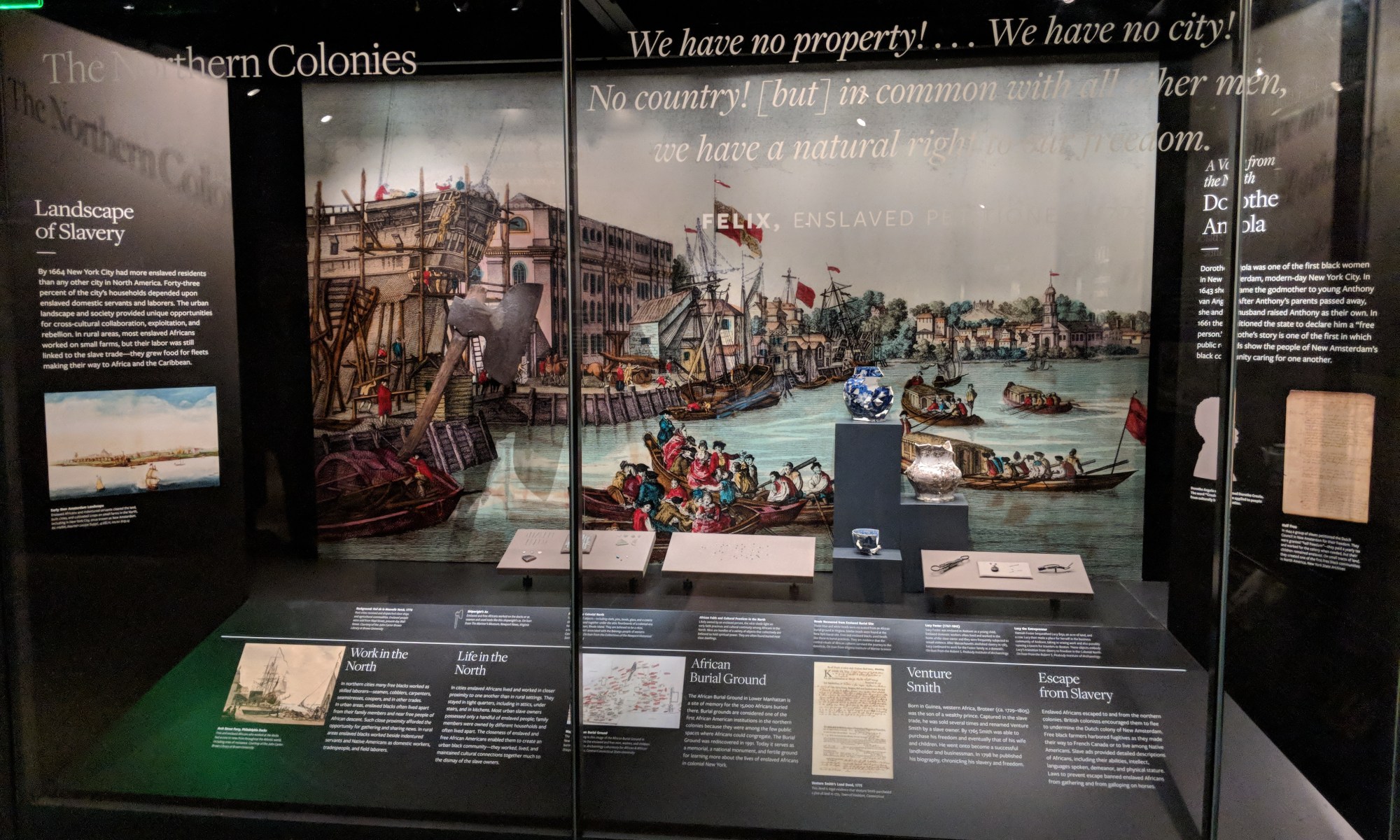
The Slavery and Freedom inaugural exhibition is at the physical heart of the Smithsonian’s National Museum of African American History and Culture. The exhibition invites visitors to explore the complex and intertwined histories of slavery and freedom through the personal stories of those who experienced it. Chronicling the early 15th century through 1876, the exhibition explores the cultural, economic, and political legacies of the making of modern slavery and the foundation of American freedoms. Visitors will encounter both free and enslaved African Americans’ contributions to the making of America in body, mind, and spirit. They will glimpse a vision of freedom—an American freedom—pushed to its fullest and most transformational limits through the everyday actions of men and women. Most importantly, they will walk away with an understanding of how the story of slavery and freedom is a shared American history with deep roots linking all people together and that still impacts American society today.
The discovery of Lucy Foster’s homestead was an accident in 1945 as archaeologists Adelaide and Ripley Bullen were looking for evidence of an ancient Native American settlement. Lucy’s early nineteenth century homestead was instead one of the first African American archaeological sites excavated in the United States. To learn more about the excavation and the artifacts recovered, check out these sources:
You can also find many of Lucy’s belongings in our online collection.
A partially reconstructed mug from the Lucy Foster site
Five buttons from the Lucy Foster site
Knife from the Lucy Foster site
Padlock from the Lucy Foster site
The Lucy Foster site objects are displayed in Slavery and Freedom in “The Northern Colonies: Expanding Merchant Capital” section of the museum. These objects allow the NMAAHC to tell the story of women and their work in the north and bring to light the personal voice and story of Lucy Foster. Foster was born in Boston in 1767 and was sold into the household of Job and Hannah Foster at age four, in 1771. She worked as a domestic in their household until Job’s death in 1789, when she moved with Hannah to her new husband Philemon Chandler’s household. After Chandler’s death, they moved back to the Foster household until Hannah’s death in 1815. Lucy then established her own household on land willed to her by Hannah. Lucy died of pneumonia on November 1, 1845. Occasional mentions of Lucy in historical documents, coupled with the archaeological remains, has allowed a glimpse into her life.
The NMAAHC requested these objects because Lucy’s story is unique. She is one of two People of Color from this area with documentary and archaeological records to tell her story. Lucy was part of both free and enslaved communities in Andover, and these objects show how she continually used her sewing and cooking skills to carve a place for herself in the Andover community. These objects embody the presence of women and their work as fundamental to the northern states and are a rare example of objects from the early nineteenth century concretely connected to an enslaved person.
If you are in the D.C. area, be sure to stop by and say “hello” to Lucy!
Exhibits and exhibitions are not the focus of the Peabody. However, once in a while a unique opportunity presents itself.
Visual artist Angela Lorenz (’83, P’14) reached out in early 2017 to suggest a collaboration with the Peabody. Angela’s newest art book, r.ed monde in r.ed engender.ed, explores the world around us through pointy-shapes and r.ed.
After spending decades in a drawer in the artist’s studio, r.ed steps out on a journey of self-identity. r.ed identifies with pointy-shaped objects and images from around the world – many of which are similar to pieces in the Peabody’s collection.
Angela Lorenz’s newest art book
r.ed holding a sherd that will be part of the upcoming exhibit
Angela and I surveyed collection and collaborated to create r.ed in residence: r.ed monde visits the Peabody. This short exhibition will have an opening reception on Saturday, October 21st from 1-4pm. Angela will discuss r.ed and her work from 1-2pm and be available to talk with visitors. Refreshments will be served and we will have hands-on activities for all ages.
Come by to explore a new way to examine archaeological artifacts through the lens of contemporary art!
The central staircase of the Peabody includes a mural of American Indian life and history titled “Culture Areas of North America” by Stuart Travis (1868-1942). Travis was an accomplished and prolific American artist, illustrator, and designer who studied at the Académie Julian in Paris. His works—mostly drawings and watercolors—appeared frequently in magazines, books, and advertisements in the early twentieth century. Travis first came to Phillips Academy in 1928 to create the mural “History and Traditions of the School and Vicinity” in the Oliver Wendell Holmes Library. He continued to work at Phillips Academy, where he painted a total of three murals; he also designed the stone and wood gate that now leads to the Moncrieff Cochran Sanctuary.
Stuart Travis Mural at the Robert S. Peabody Museum of Archaeology. Photography by Gil Talbot.
The Peabody mural measures 13’11” by 10’2” and reflects ideas about anthropology and archaeology in the 1930s and 1940s. Major elements include the Maya Pyramid of the Magician at Uxmal on the left and a totem pole of the Northwest Coast on the right, with a map of cultures areas of North and Middle America occupying a central position, surmounted by six portraits across the top of the mural. Details and insets abound, illustrating artifacts, archaeological sites, ethnographic items, and scenes from Aztec and Maya codices. Illustrations of artifacts are drawn from the British Museum, the Museum of the American Indian (now the National Museum of the American Indian), the American Museum of Natural History, the Robert S. Peabody Museum of Archaeology, as well as several other prominent institutions.
Major Maya archaeological sites are labeled on the central map, but the majority of the map surface only depicts watersheds and topography, suggesting that Travis may have planned to add even more detail to the mural. The shadow of a thunderbird is painted over the central map, with a note explaining the widespread belief in supernatural birds in the Americas. Other details include an inset illustrating details of the Cahokia, Etowah, and Hopewell sites—likely a nod to long-time Peabody Director Warren K. Moorehead’s work. In all, there are over 30 American Indian artifacts illustrated (some in low relief), ranging from an example of Mi’kmaq writing on birch bark to a Tlingit “raven hat.” Many of these artifacts were probably drawn from contemporary books and articles on archaeology, while some may have been suggested by Museum staff. Detailed notes about the artifacts were likely included so the mural could be used as a teaching tool for visitors.
Travis dated the mural 1938, but continued with additions through 1942. The mural was restored in 1997 by Christy Cunningham-Adams through the generous support of the Abbott Academy Association.











 The Peabody