In January I wrote about a student volunteer project aimed at improving housing for moccasins that we steward at the Peabody (link). The purpose of the project is to give moccasins at the Peabody more space and internal support to maintain their shape. At the time of posting the blog, the project was in an initial design phase with students making practice mounts and internal supports. Since then the students and I worked through iterations of mounts and with feedback from our Curator of Collections, Marla Taylor, we arrived at the final design.
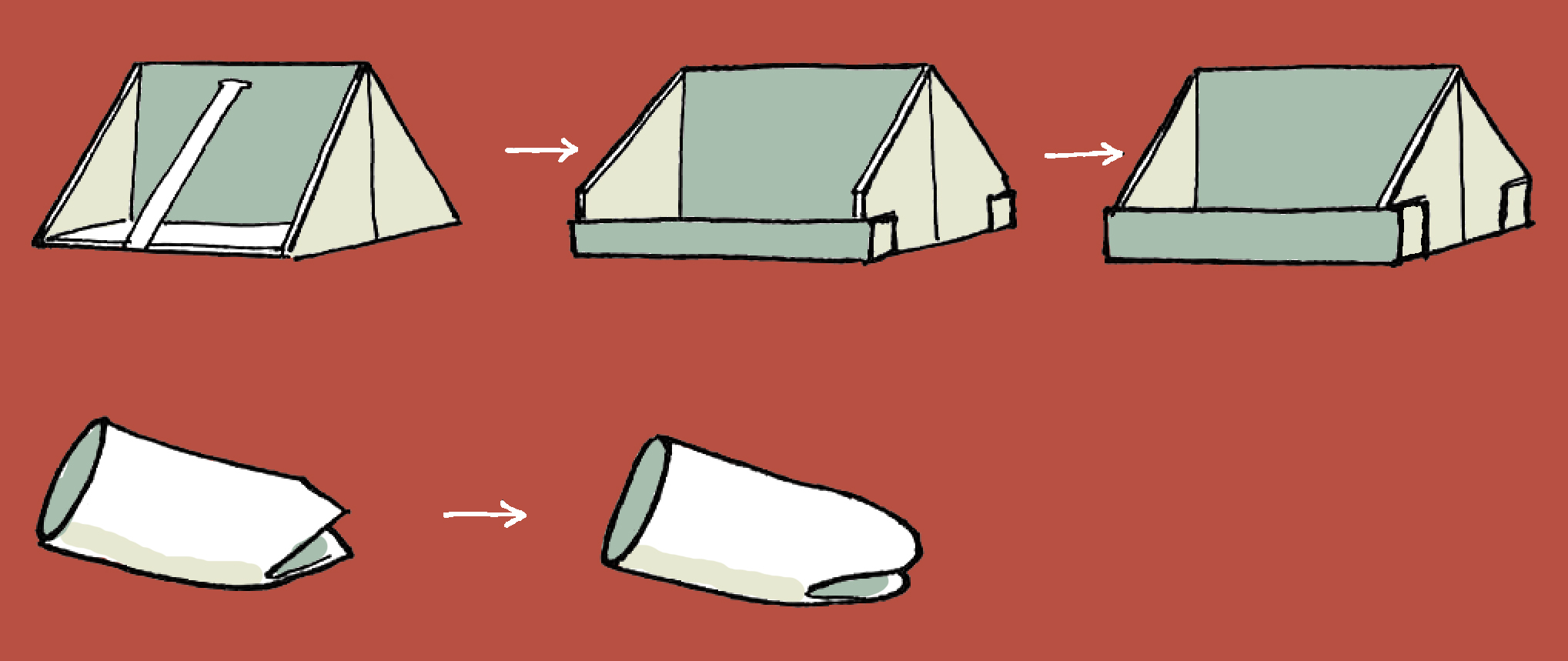
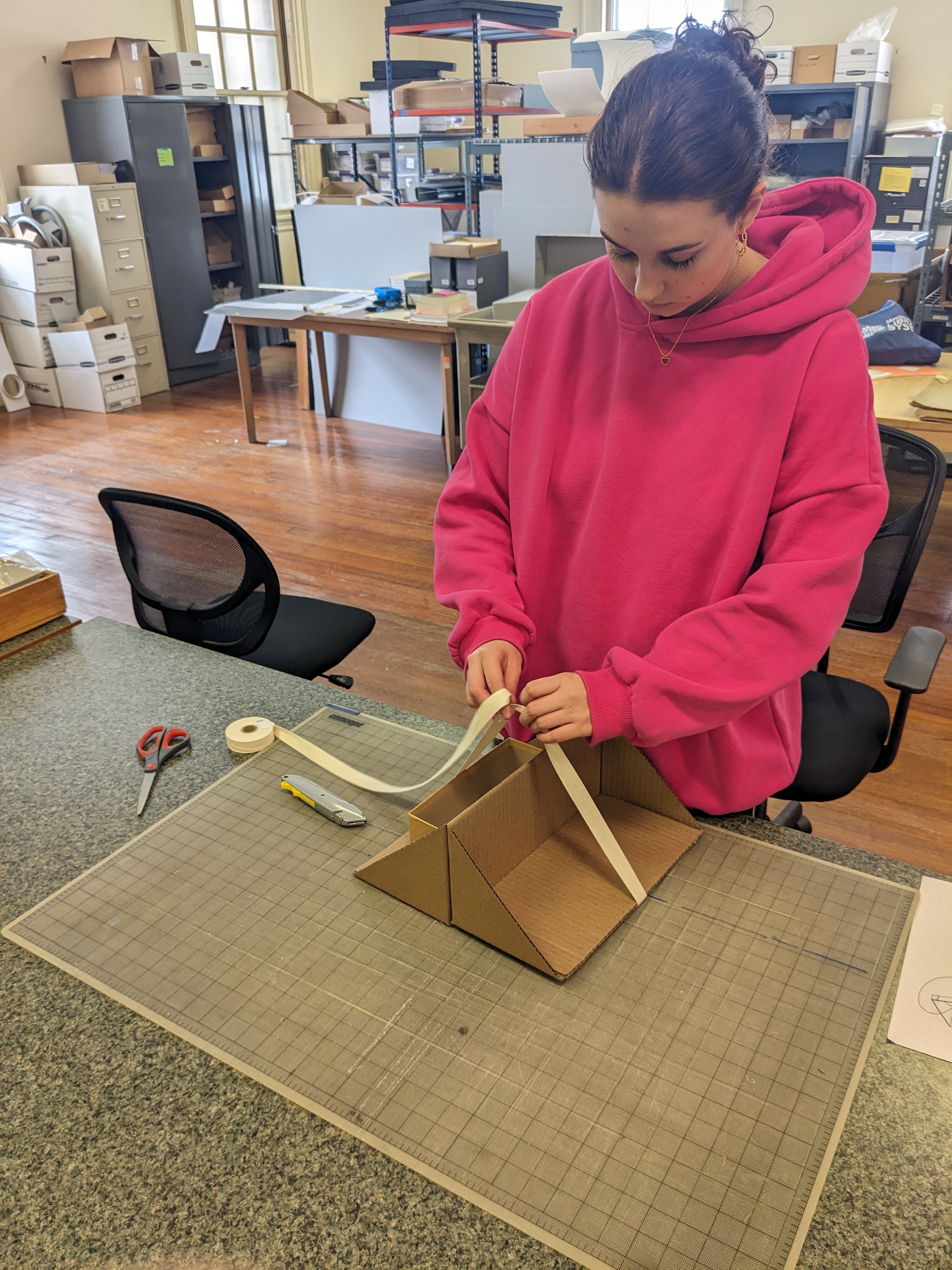
Top: evolution of mount design. Bottom: changes to the interior support pillow from a “v” toe to one that matches the shape of the moccasin.
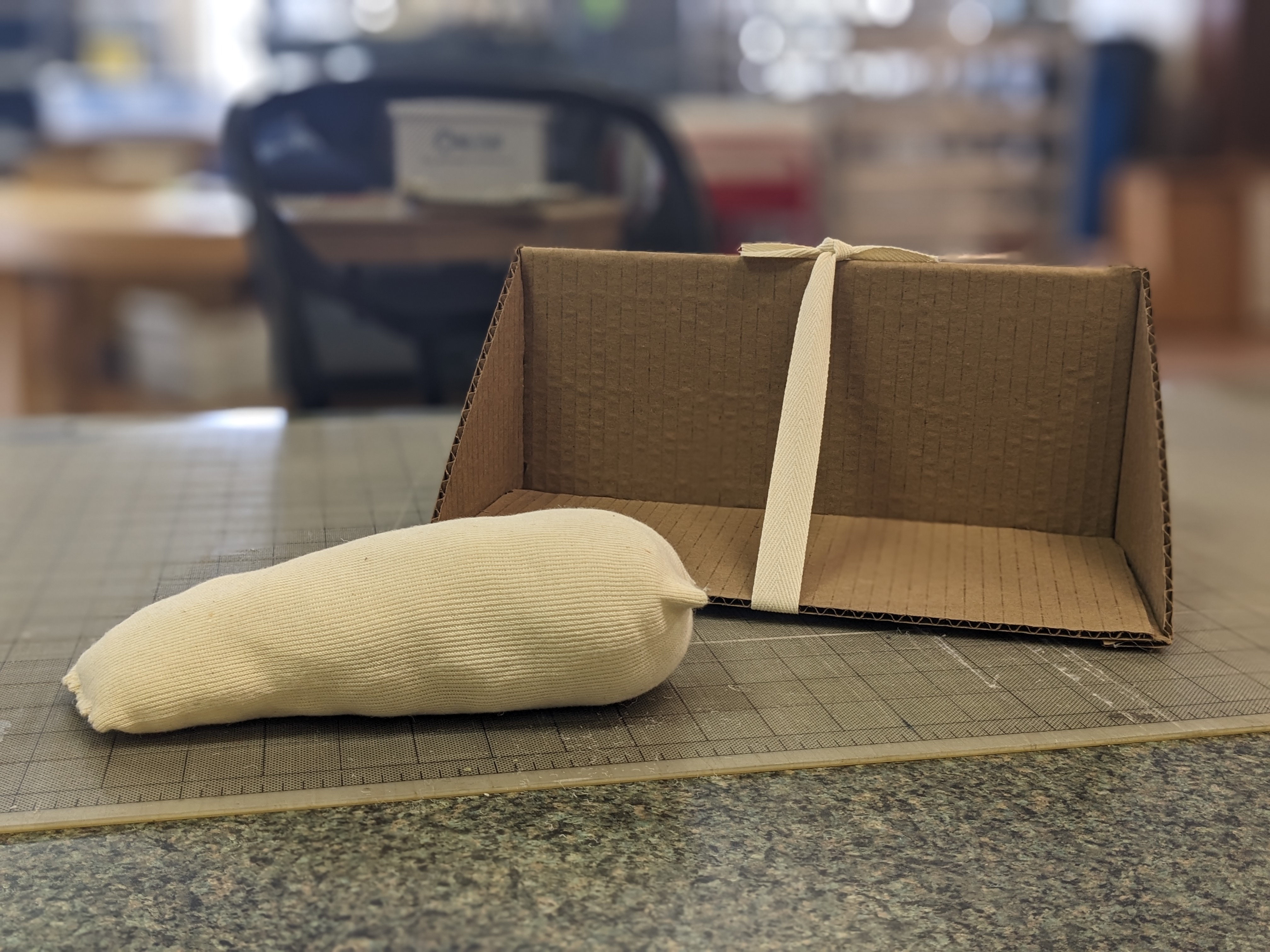
With the mount finalized we selected a pair of moccasins to rehouse and moved on to solve how to make interior mounts. We intended to make an internal support “pillow” of stockinet filled with polyester fiber. However, the height of the moccasins meant that the pillow alone couldn’t support the ankle area.
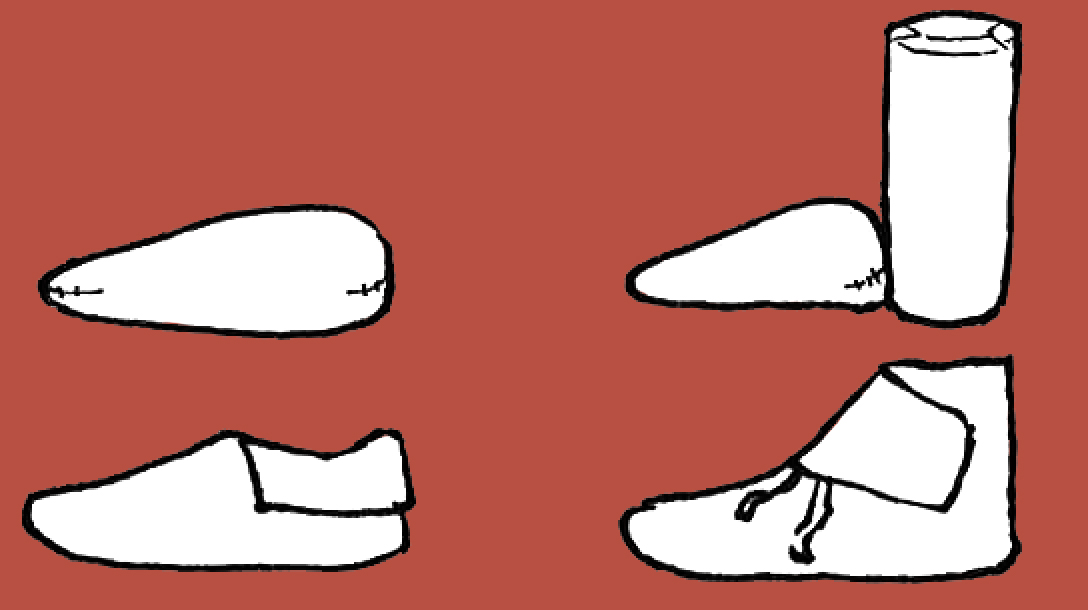
We consulted a great presentation at the 2017 Association of Tribal Archives, Libraries, and Museums (link) on making internal moccasin supports, for ideas on how to provide stability. We landed on making a support pillow for the toe area and a stiff tube for the heal and ankle area.
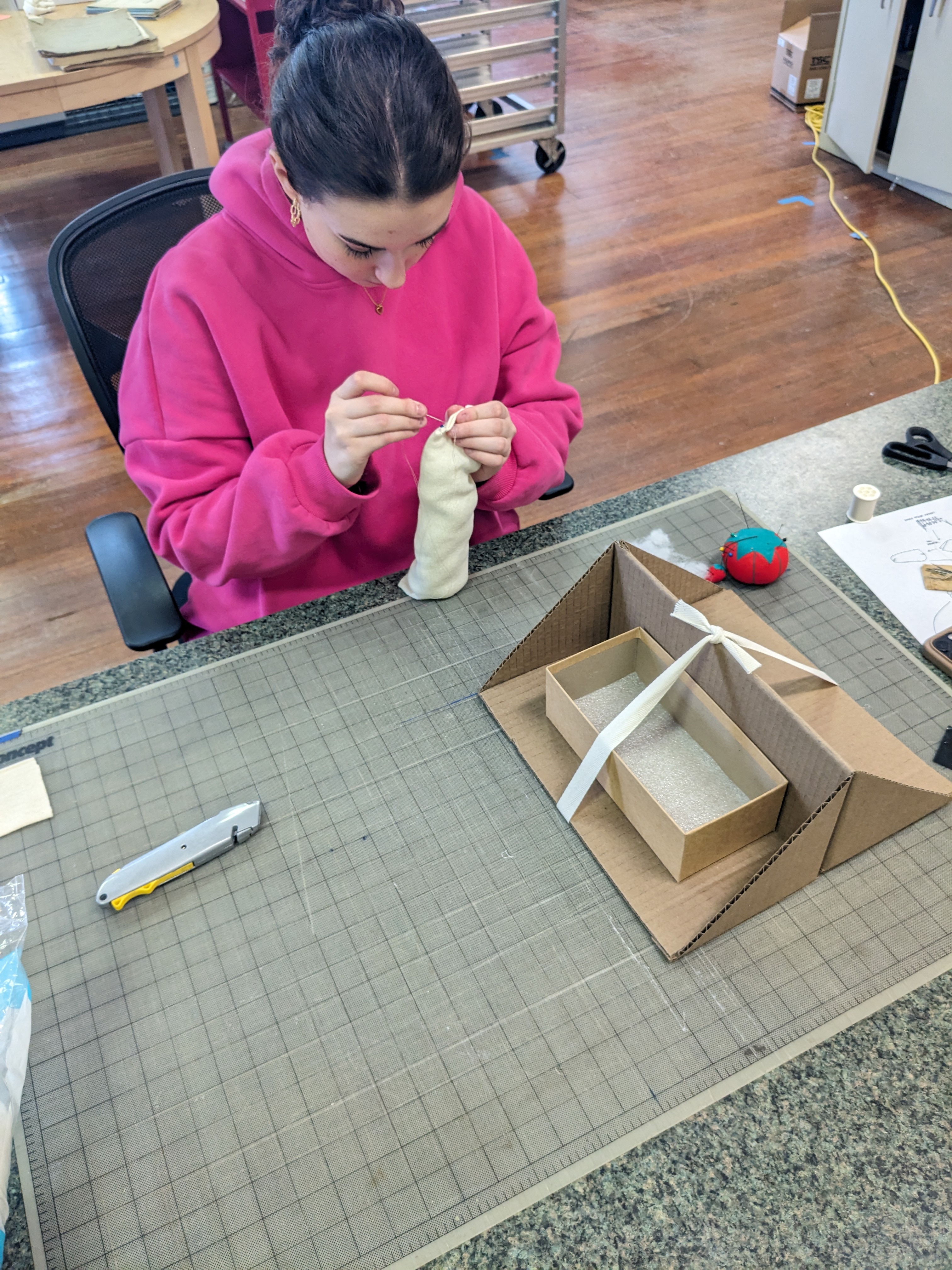
Internal supports for low and high moccasins
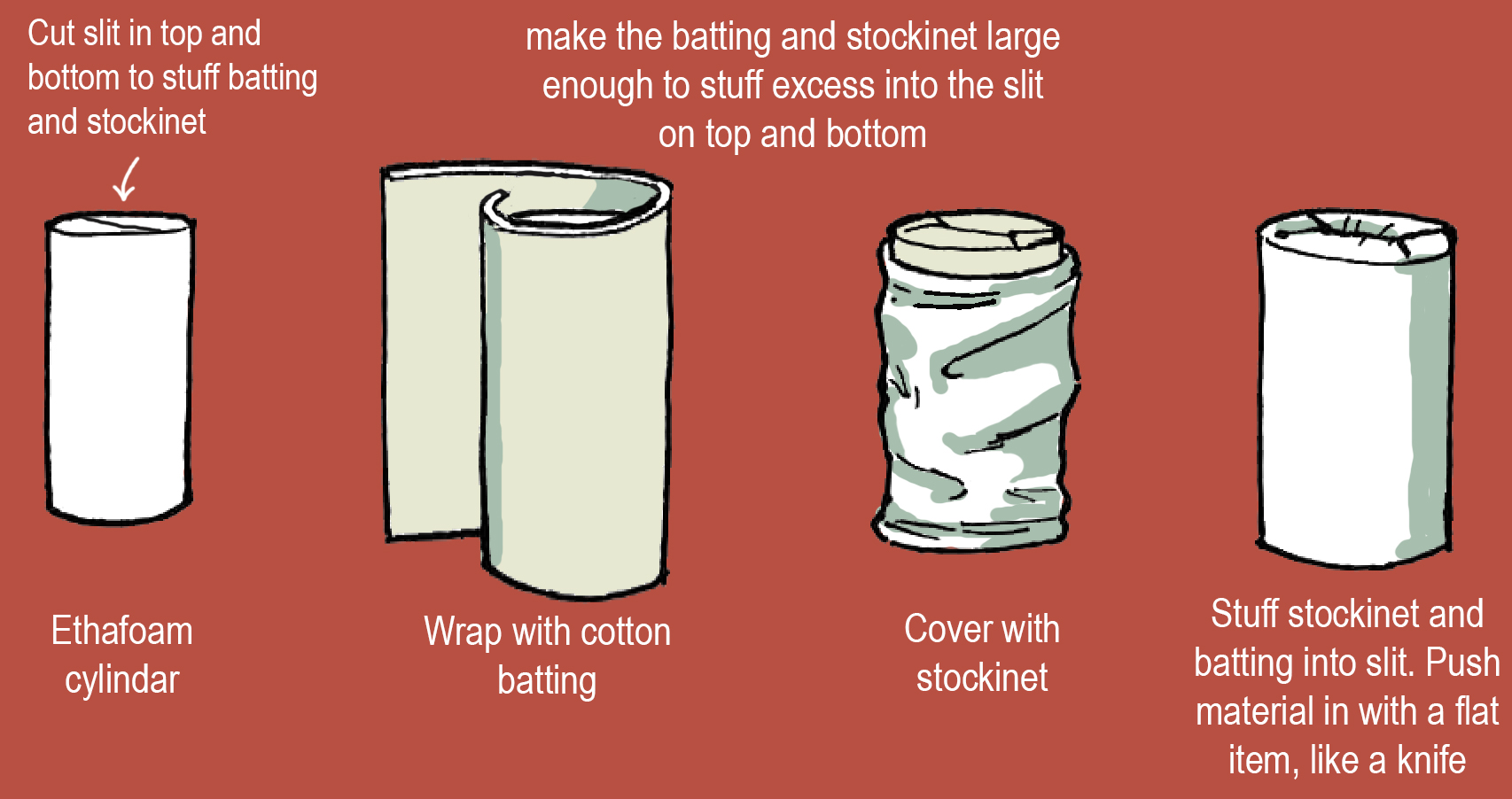
The stiff support is made from ethafoam planks cut into cylinders. The cylinders are wrapped with cotton batting to provide cushioning, then they are covered in stockinet. We measured the circumference of the area above one of the ankles and made sure the ethafoam, batting and stockinet added up to that dimension.
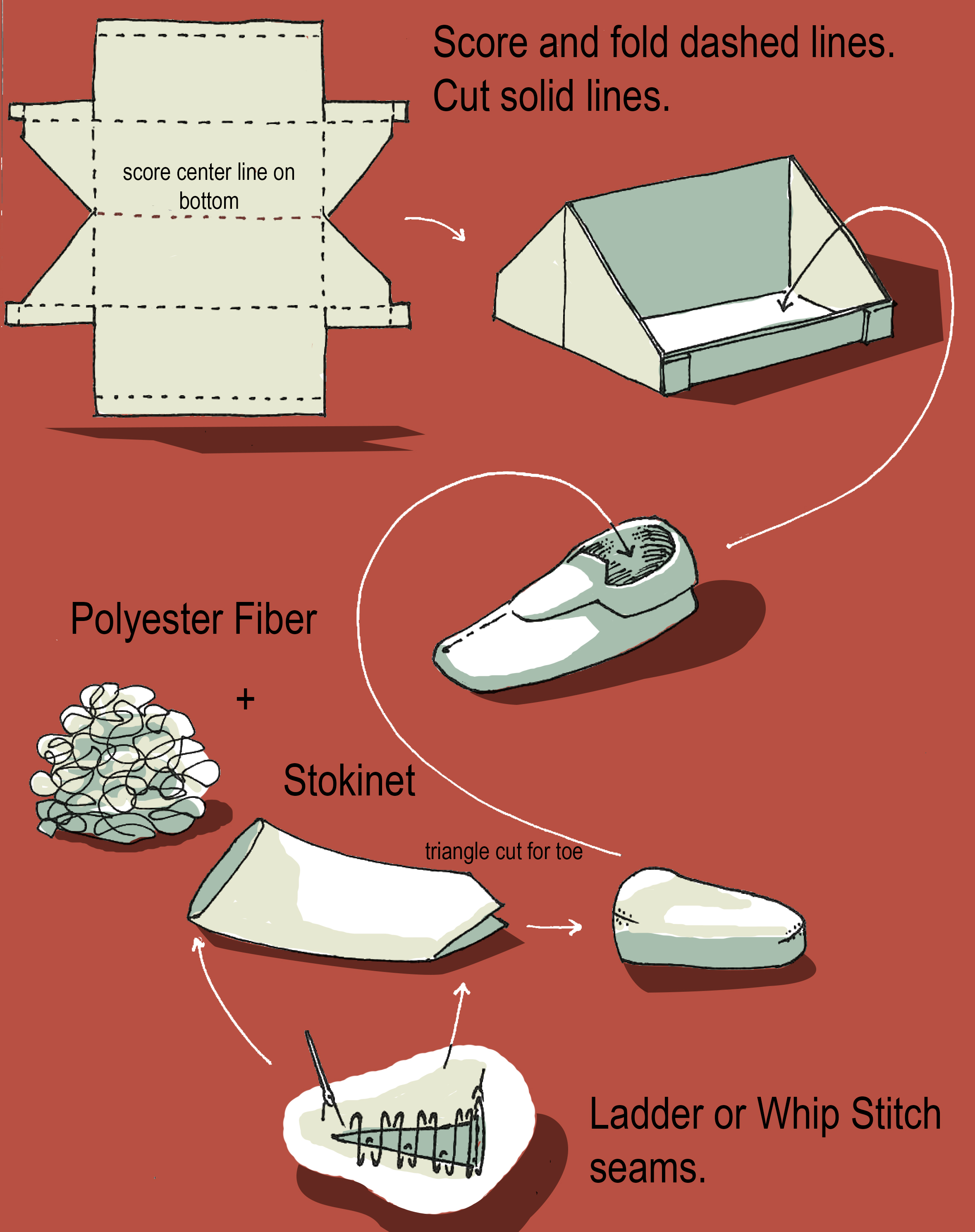
Steps for constructing a cushioned rigid support.It is important to use enough batting and stockinet to be able to push it into the slit.
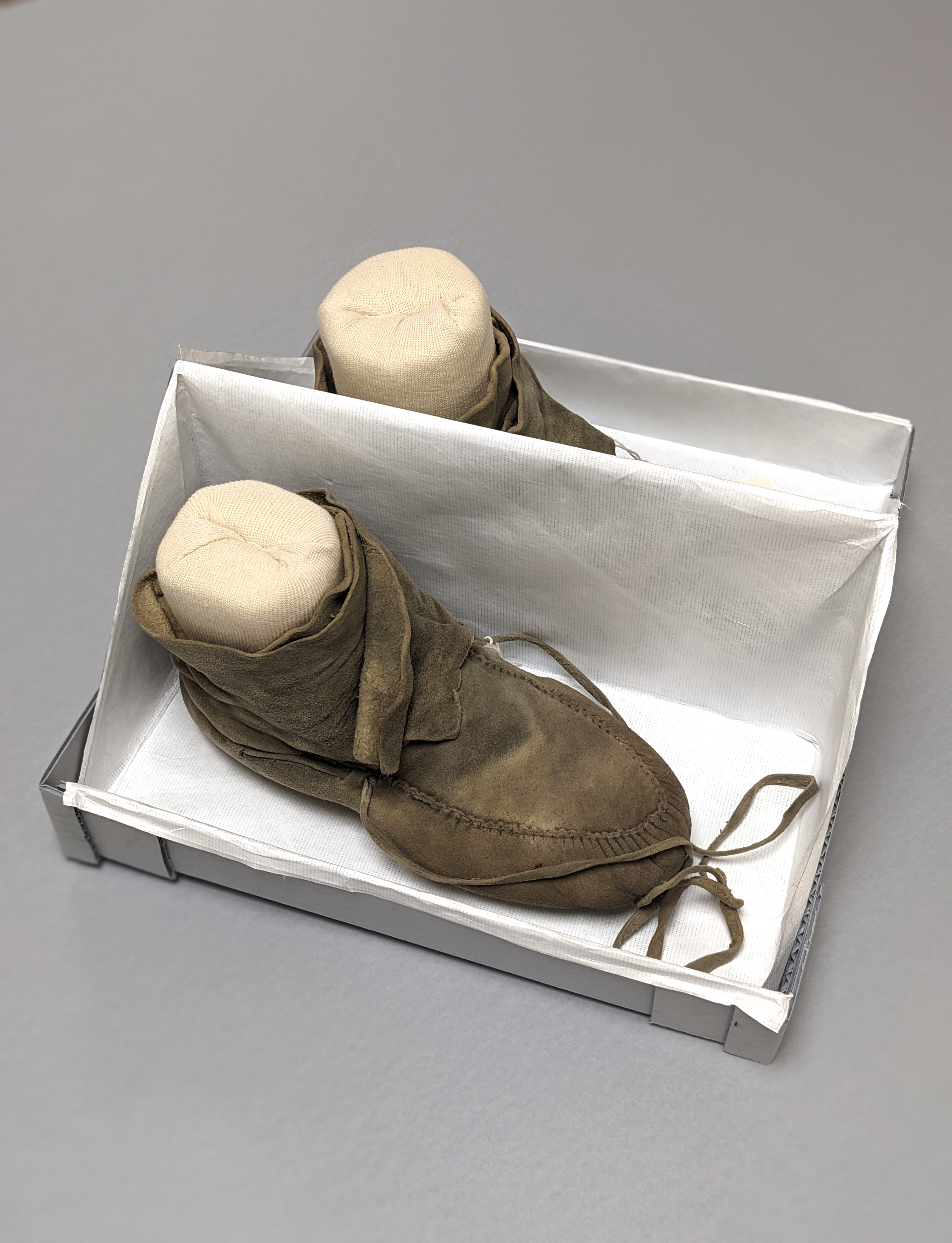
The final step involved covering the mount with soft Tyvek. With that, we have our first moccasin mount! Once students are back from spring break, we will continue our rehousing of moccasins.
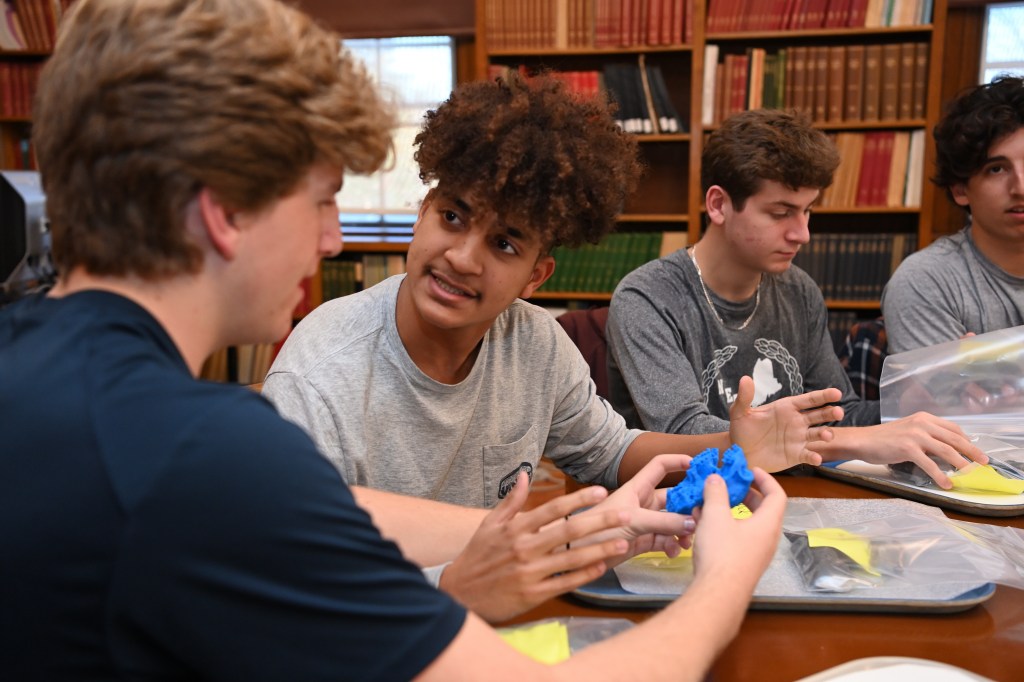
Here is the final mount. The students did a great job!
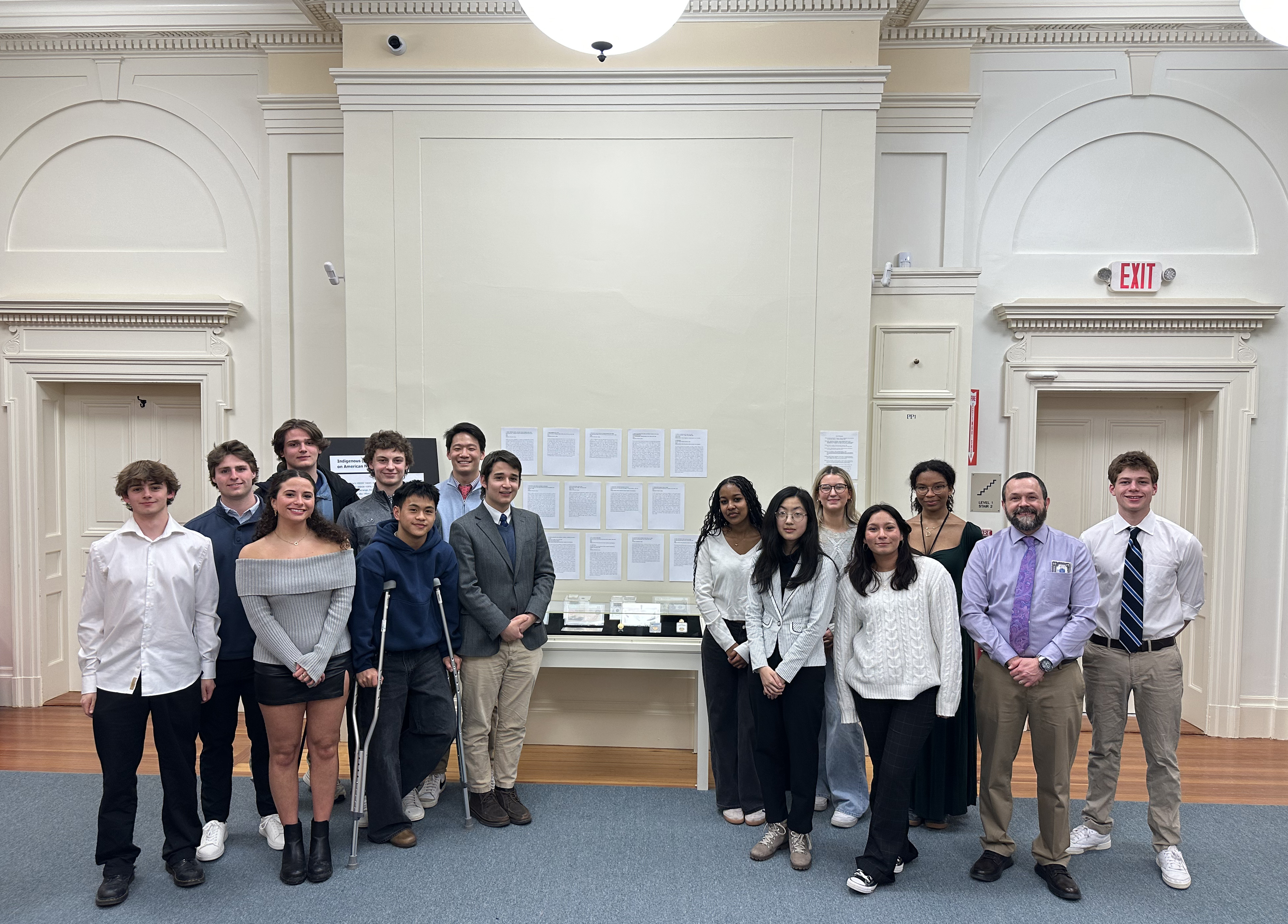
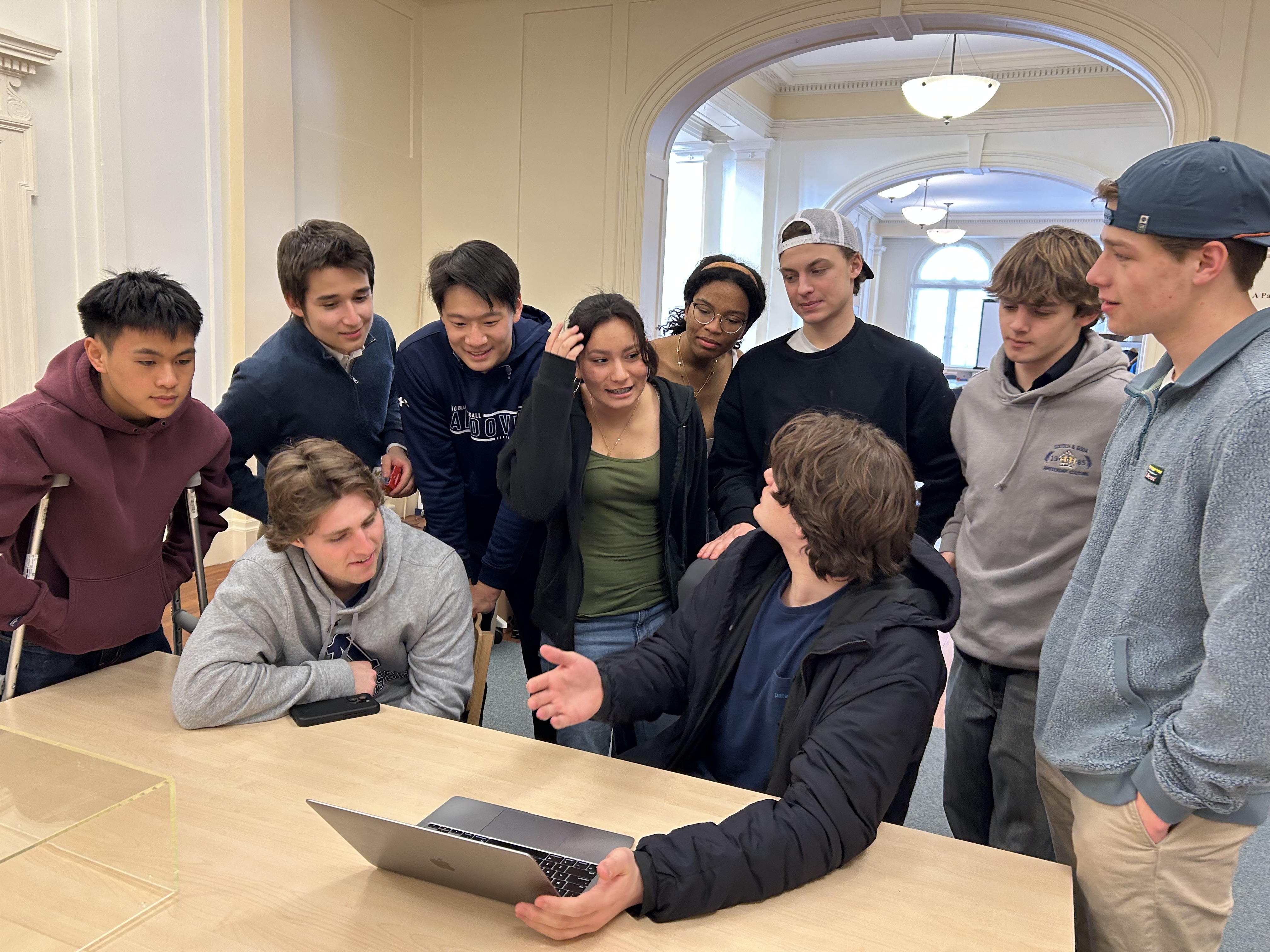
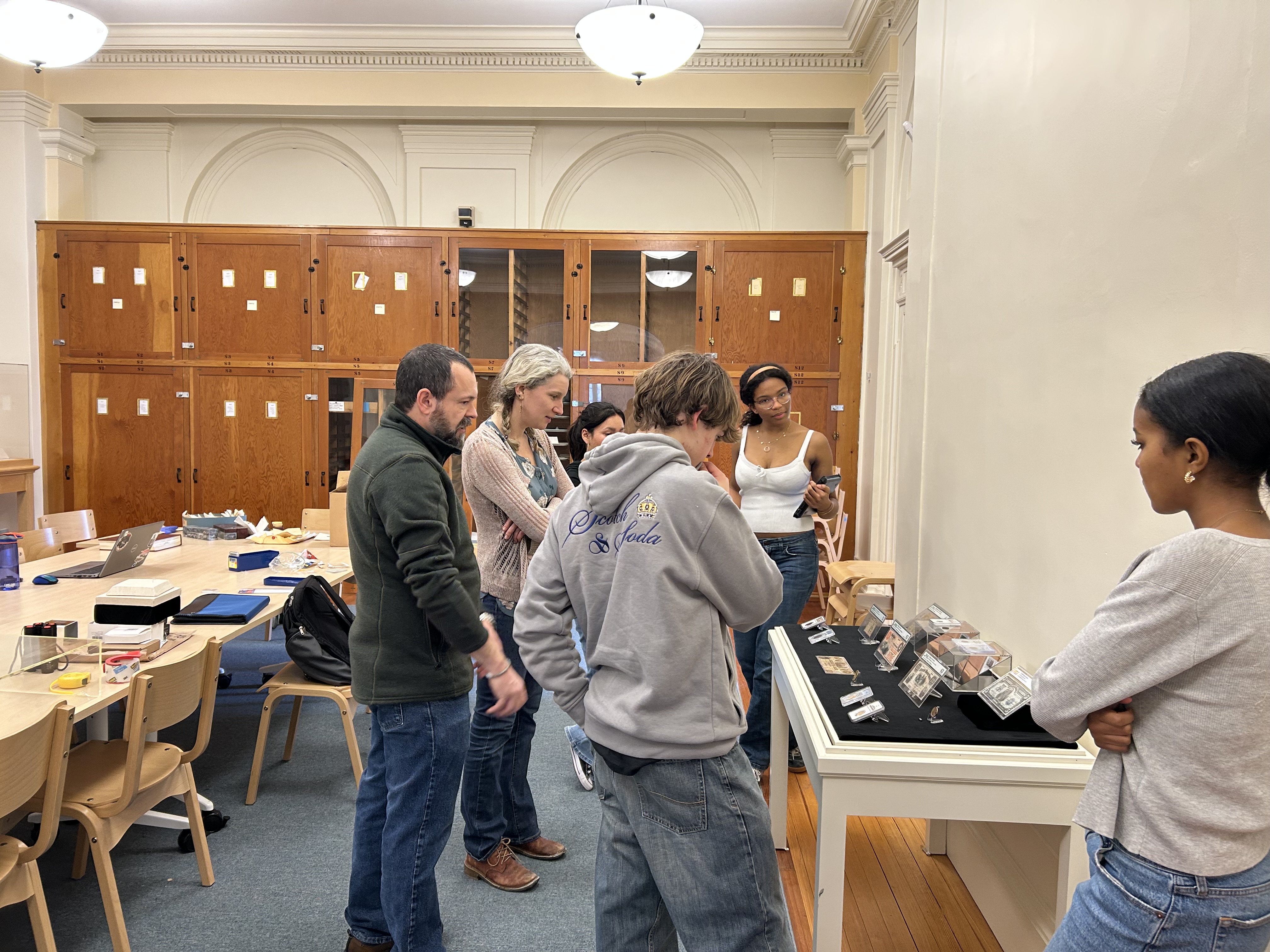
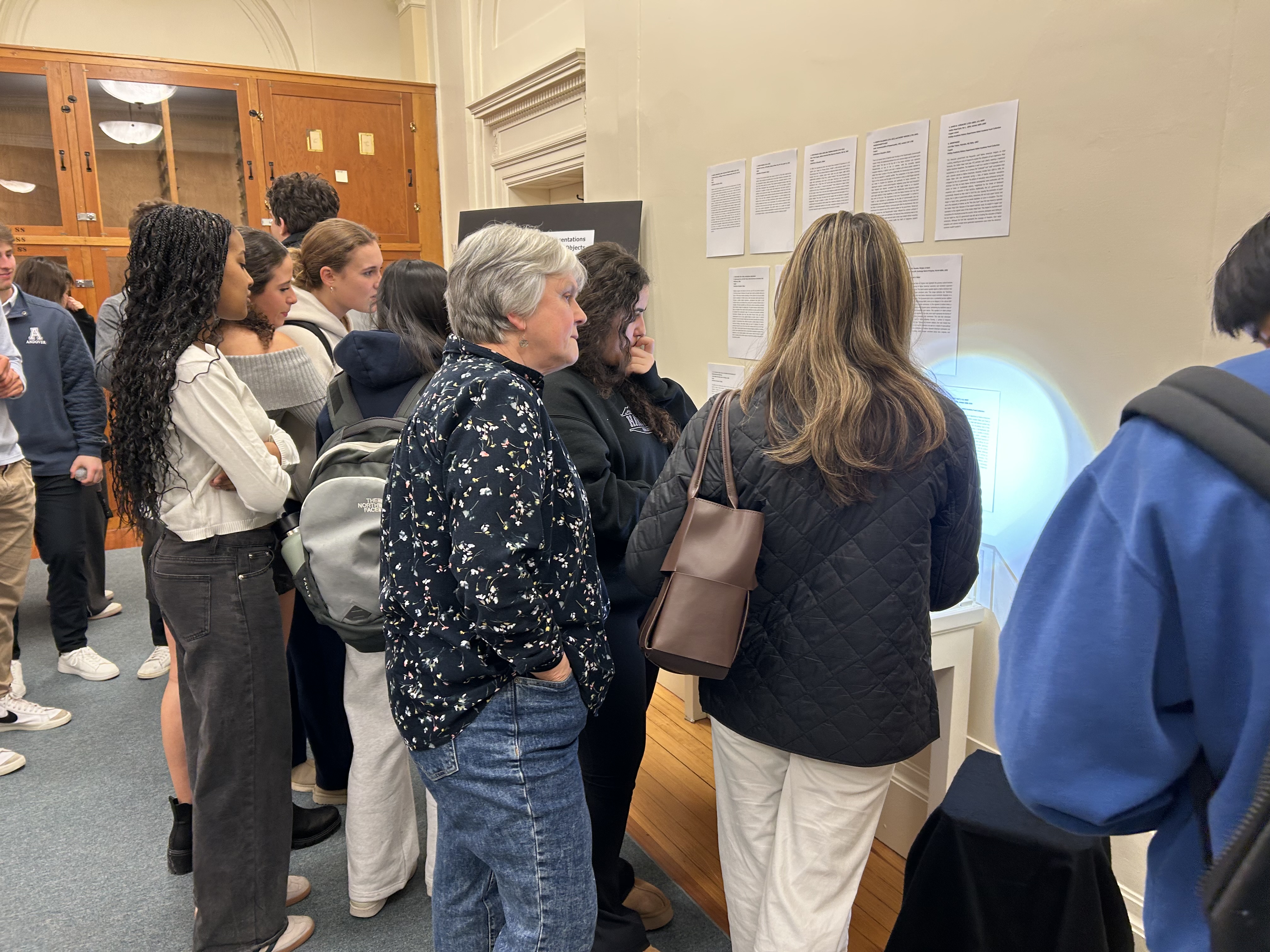
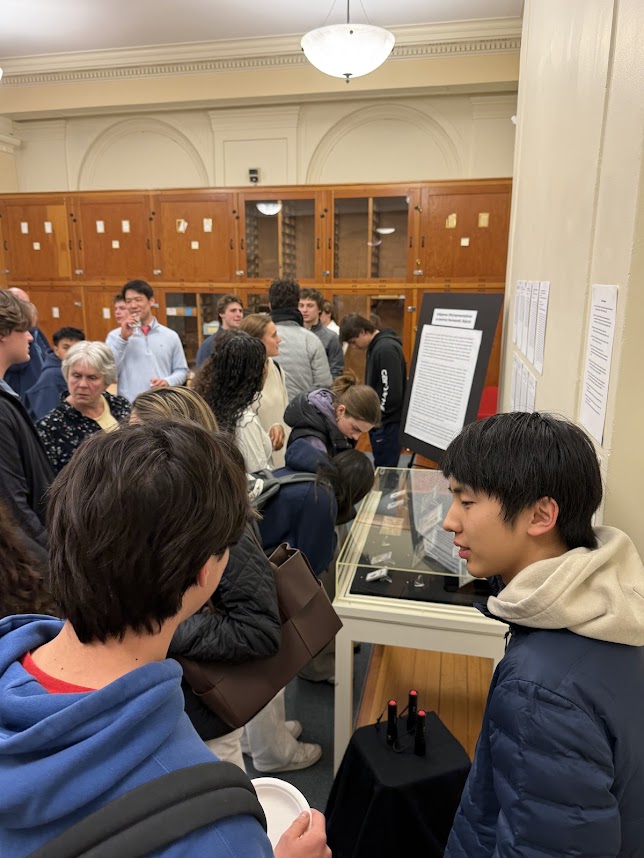
The Peabody Institute is currently host to the exhibit “Indigenous (Mis)representations on American Numismatic Objects,” displaying items from the History and Social Science department, the personal collections of Donny Slater, and the hard work of the students in his class HSS507: History in Your Pocket – American Stories, Ideals, and Economics as Told through Coins and Currency.
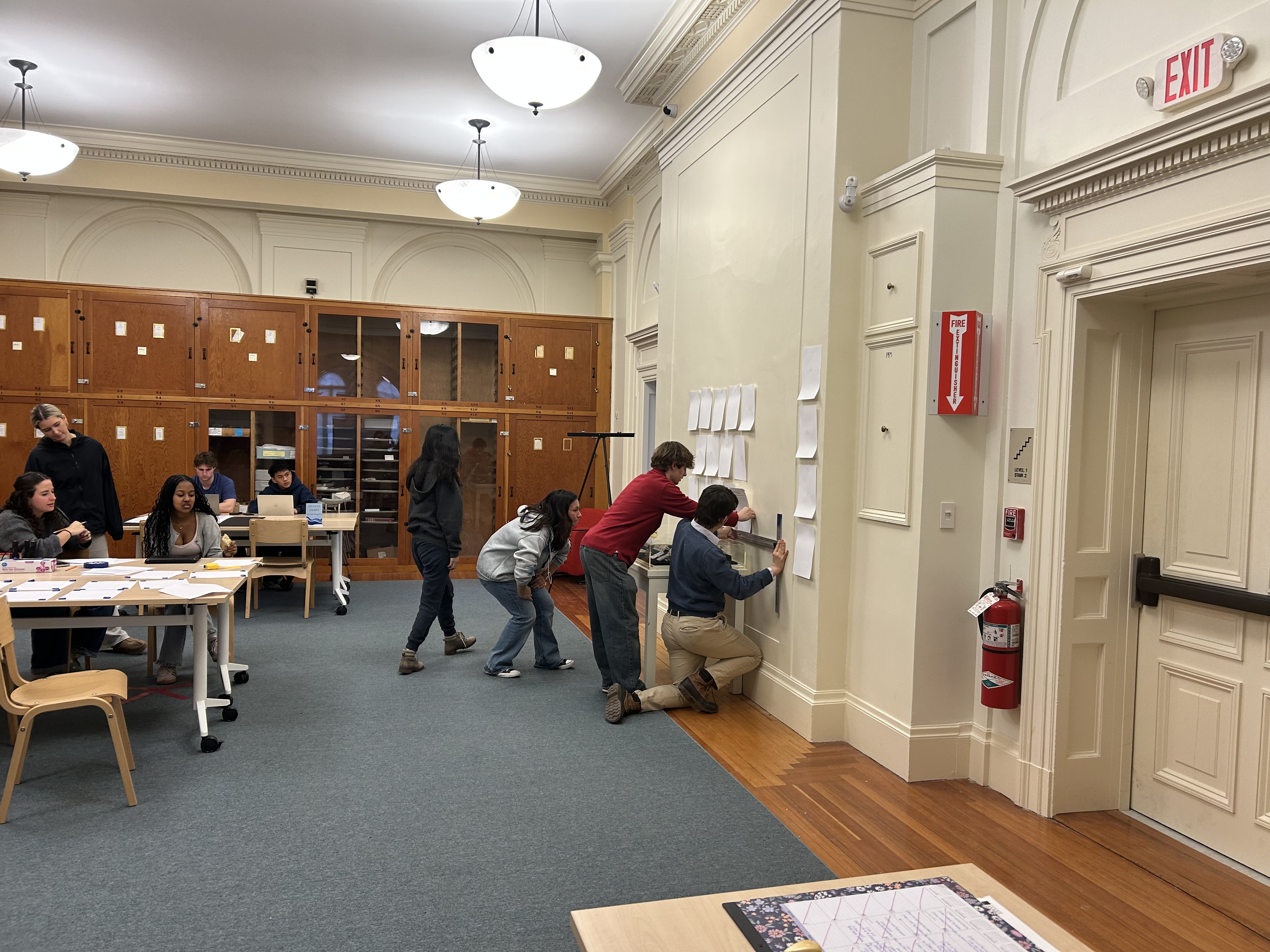
Combining historical investigation and close examination of the images depicted on American coins, bank notes, and tokens dating from 1744 to 2000, Donny’s students connected the use of Native American iconography on these objects of exchange to efforts to build a national identity that hid the violence of Westward Expansion at the country’s core, choosing this as the story they wanted to share with the Andover community. While the Peabody provided the class with the space and the display case, all the work of the design and installation came from the students themselves.
Everyone was deeply engaged in the process, and the results speak for themselves.
The exhibit will remain up through Alumni weekend, ending June 9, 2025.
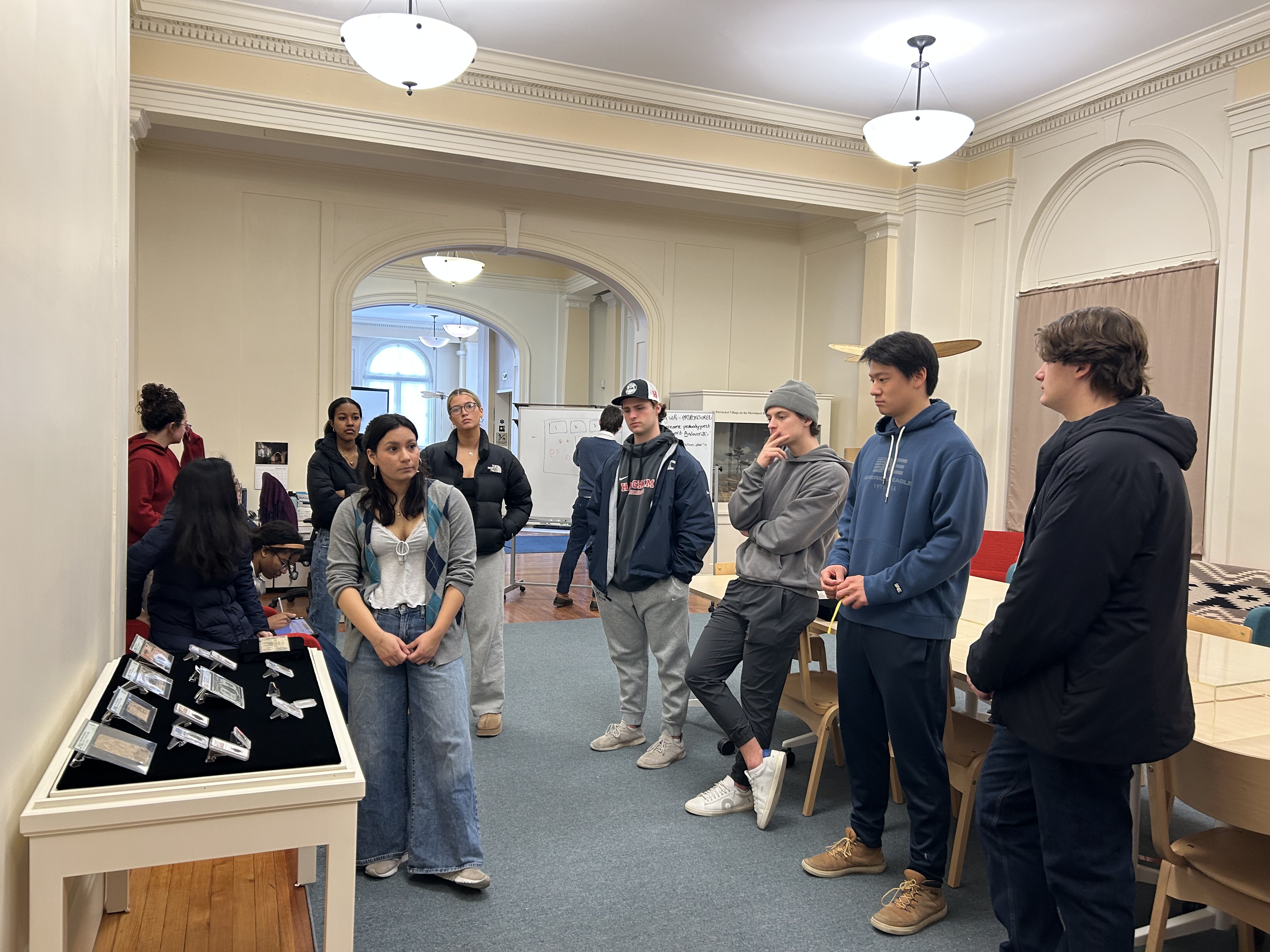
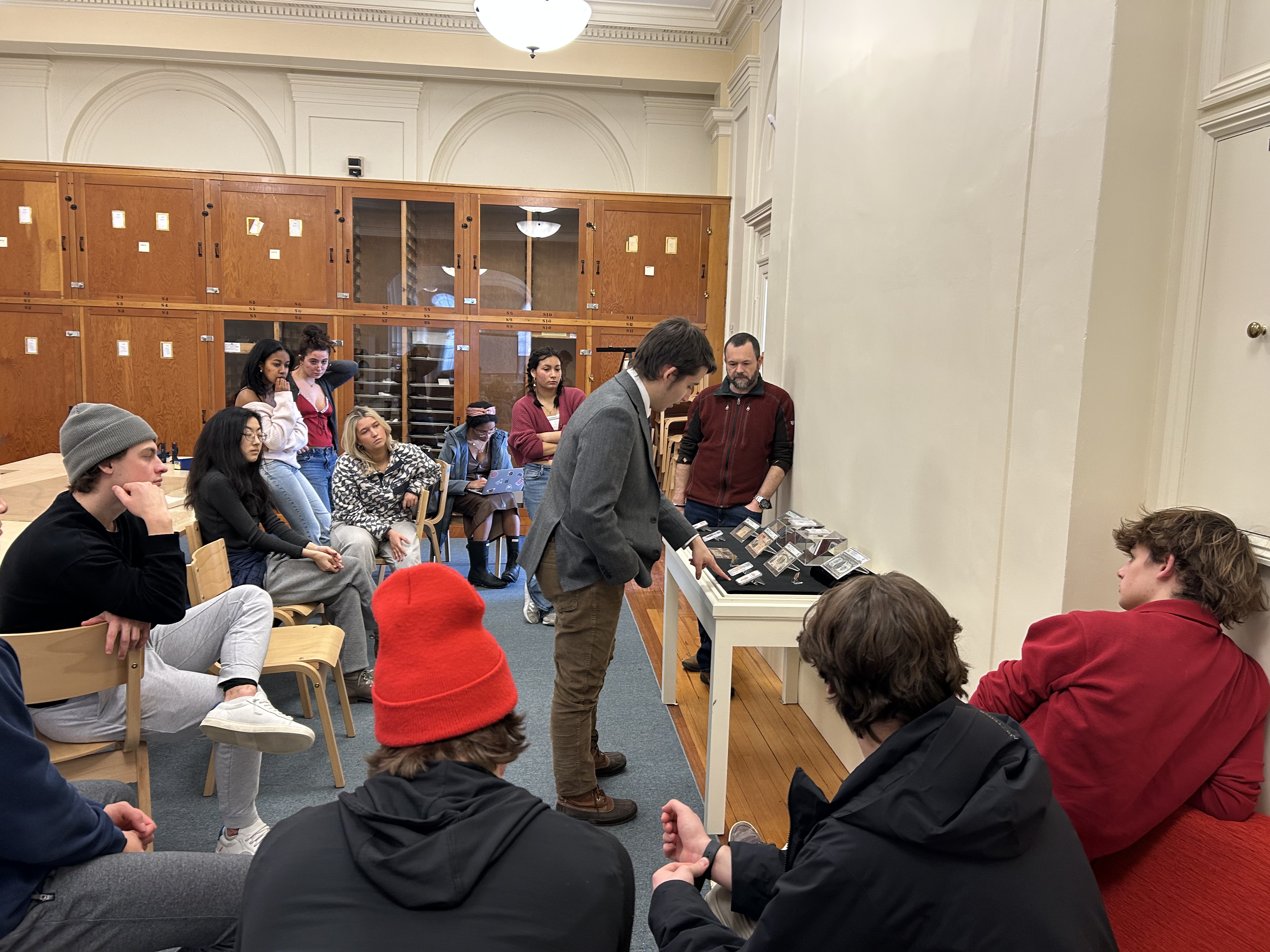
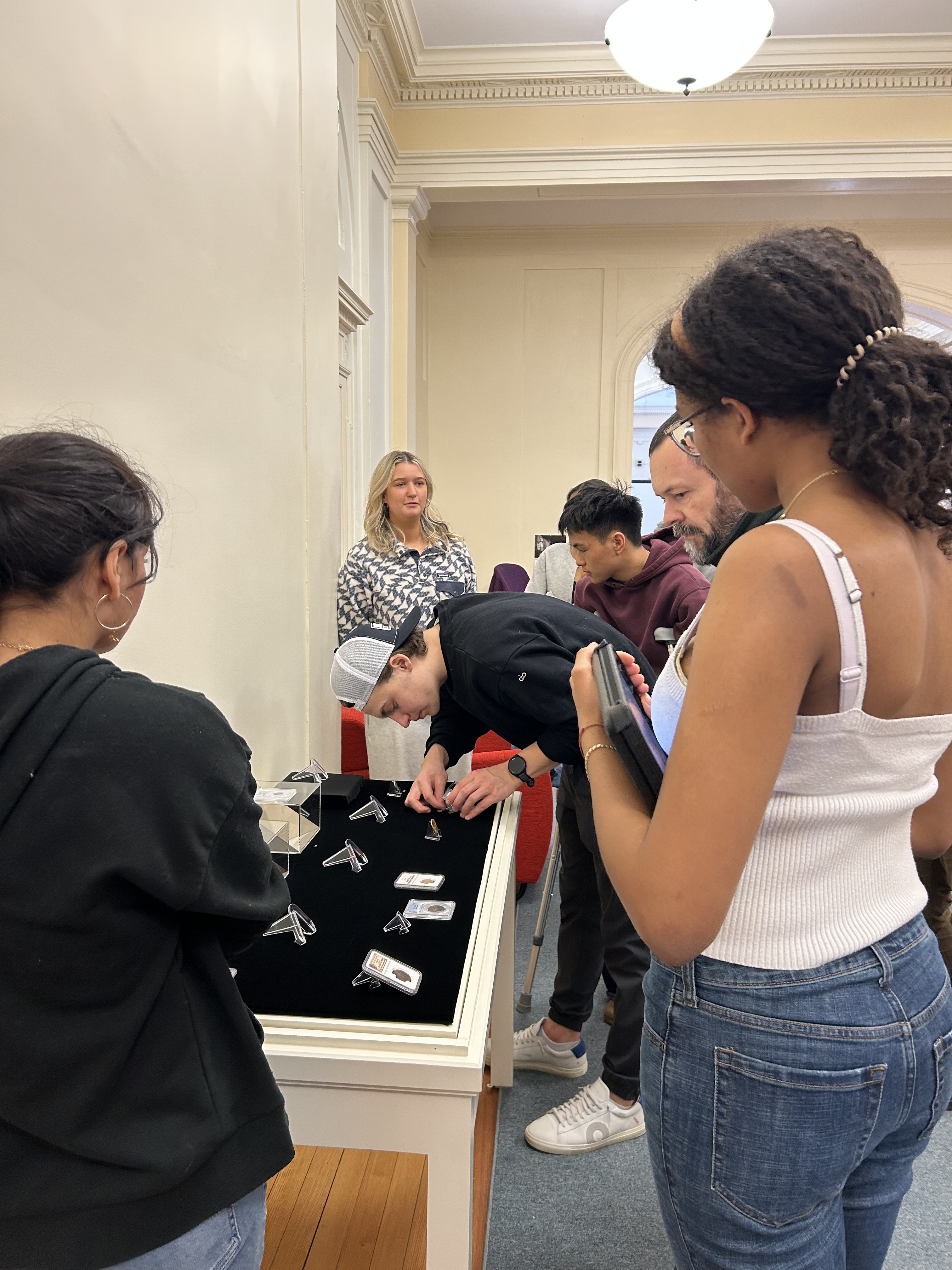
Pre-installation day 1: finding the layout to match the narrativePre-installation day 2: debating and finalizing arrangementInstallation day 1: setting the caseSelecting that just-right sans serif fontSharing with fellow-coin enthusiast Elena Dugan (PhilRel)Installation day 2: mounting labels and finishing touchesOpening night!
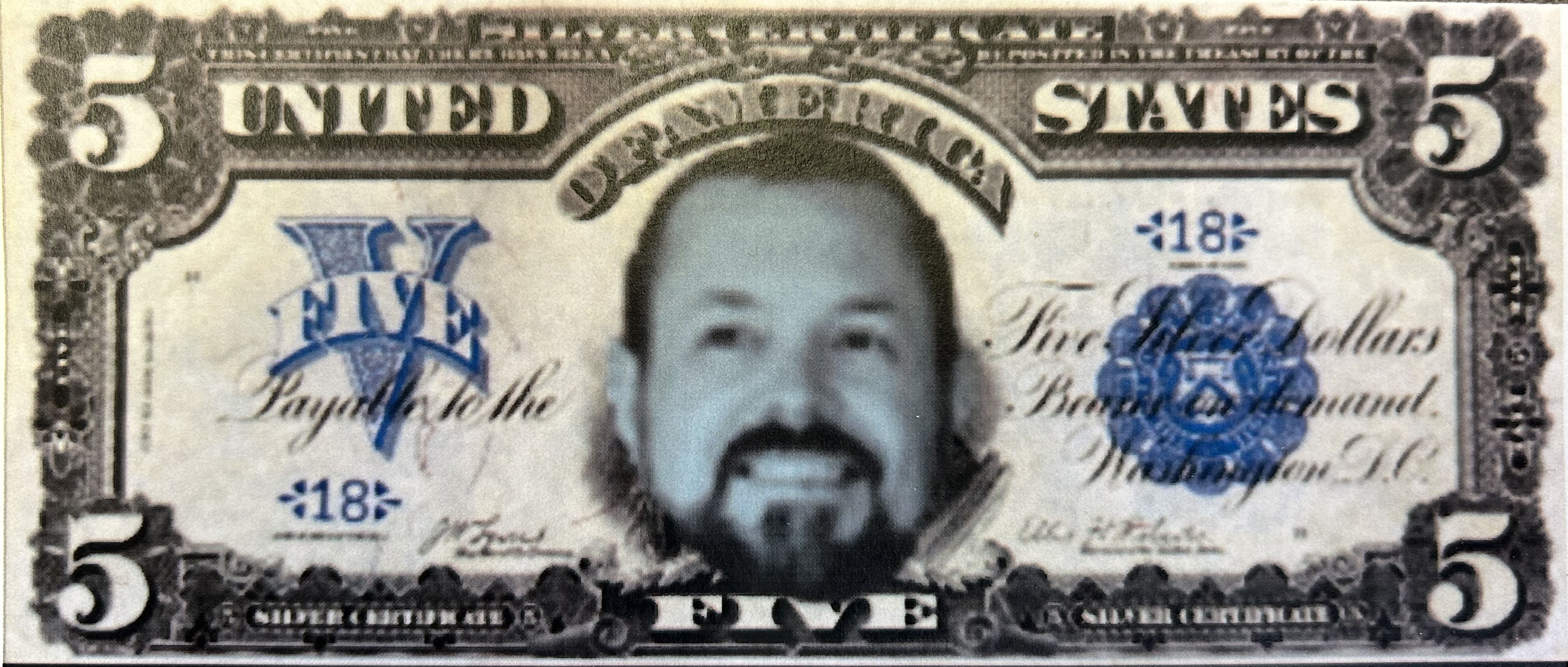
Student (Mis?)representations of Their Teacher Donny Slater
Mark your calendars! PA Giving Day is Wednesday, March 26, 2025!
PA Giving Day represents a critical milestone in our fundraising efforts for the Peabody. Last year we raised 65% of the Peabody’s annual support from 57 donors in just one day. This year our goal is to exceed previous success by engaging even more PA alumni and friends of the Peabody in this collective day of giving.
For those inspired to give early, please visit the PA Giving Day page here! Please be sure to select the “Peabody Institute of Archaeology” under the “designation” section. Any gift made in advance of the event will count toward PA Giving Day totals.
This year we hope to have more match challenges and even more support! Be sure to follow our social media on PA Giving Day for some inspiring posts from students who have been impacted by the Peabody.
A Dialogue Between Director for Advancement Initiatives, Jennifer Pieroni, and former Peabody Institute Work Duty student and current Peabody Advisory Board member, Ben William Burke ’11.
Archaeology isn’t just about uncovering and studying ancient items—at Andover, it’s about shaping a more informed, ethical, and engaged society. By learning archaeology, Andover students gain experiences to understand the world better, think critically, and contribute meaningfully to the future by better understanding the past.
At a recent Peabody Institute meeting, I met Ben William Burke ’11, whose enthusiasm for the Peabody was inspiring. As a new member of the Andover community, I wanted to understand why the Peabody had left such an indelible mark on Ben and why he continues to support it today.
By email, Ben shared: “As a work duty student at The Peabody, I received unparalleled access to its extensive collection and cultural immersion programs. These experiences brought me face to face with — and taught me the value of — perspectives different from mine. In those moments, I was challenged to understand before correcting, to empathize before judging, and to build on the past in a way that respects it.”
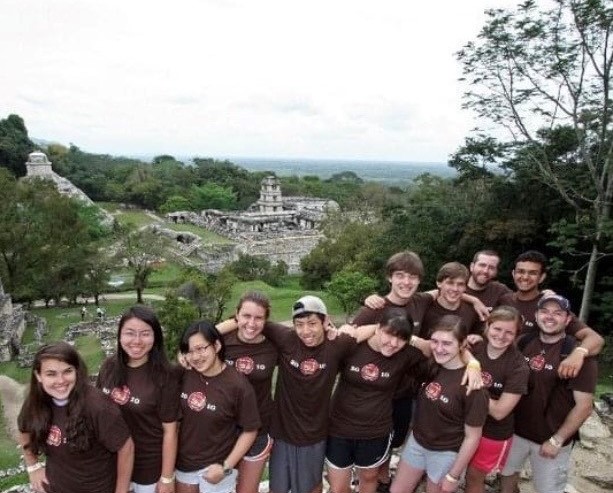
Ben Burke ’11 (Back row, third from the right) on the BALAM student trip. This was a multi-week cultural immersion and archaeological adventure through the greater Yucatán Peninsula sponsored by the Peabody Institute.
Today’s Andover students gain the transformational learning opportunity of being a part of an organization that leads in the field of repatriation and reflects Non Sibi by teaching students that archaeology is not just about personal discovery but about responsibility: to the past, to descendant communities, and future generations. Through hands-on study, students engage in meaningful, ethical work prioritizing respect over self-interest.
Ben noted, “There is not an avenue in my life that isn’t positively affected by The Peabody’s lessons in empathy and respect. I support The Peabody because I understand the value in learning to value other’s perspectives – especially when they are different from my own.”
Supporting the Peabody means investing in education that shapes responsible scholars and professionals. By supporting the Peabody with an annual gift, you can help elevate a place where teaching and learning are deeply connected to respect, collaboration, and cultural preservation. Join us in ensuring that the study of archaeology serves our Andover students and also society as a whole.
Among the newest student clubs on offer to the Phillips Academy community as of this term is the Andover Anthropological Society: a group of students of superior intelligence who recognized ahead of their peers that doing research with cultural materials is incredibly fun, and an excellent use of one’s free time.
Now with a membership of ten, club members selected as their inaugural project an accession of Arctic materials surface-collected by Patricia Hume near Utqiagvik (previously Barrow), Alaska during six summers between 1959-1969, and donated to the Peabody Institute in 1998. Meeting weekly at the Peabody, so far the AAS has received collections handling training and begun to build direct experience doing close-looking analysis of cultural materials; perused the Pat Hume accession file and visited storage, doing archival research AND learning some basics of museum practice (I’m very efficient); learned about the Bureau of American Ethnology and delved into 20th century ethnographies from the region (thank you, OWHL reference librarians!); and started to explore various themes and approaches for their group project. These have included connecting collections to Iñupiaq language, exploring notions of gender and household structures, and questioning anthropological terms like “effigy” to build more robust interpretations of people’s material expressions of spirituality and religion – just to name a few.
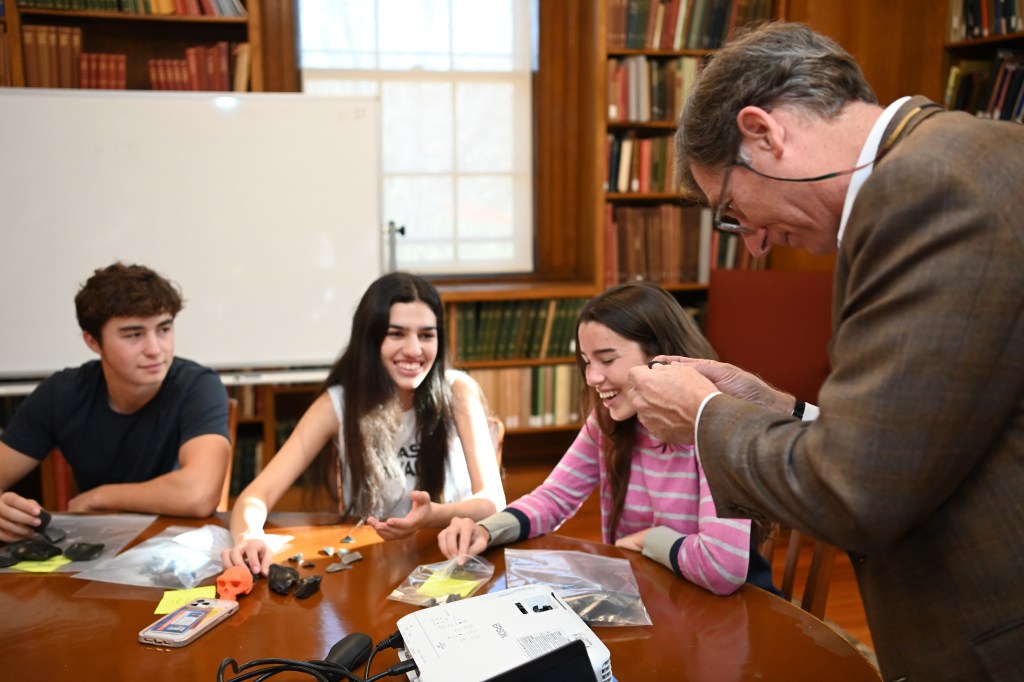
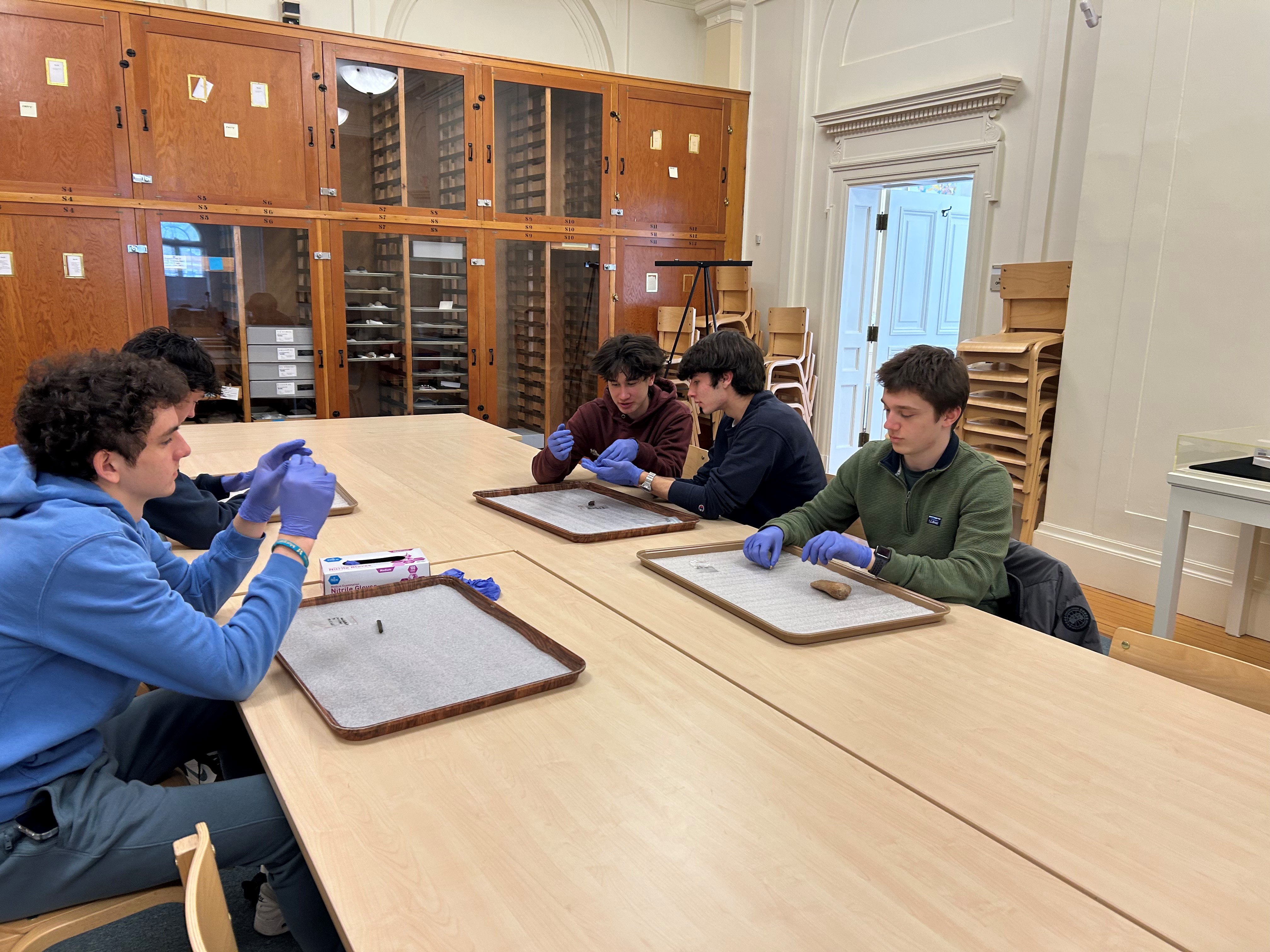
AAS members closely examining “household” items from the Pat Hume accession and debating whether I was messing with them in my claims for what they were. [Not pictured: all the female members of the club. I promise it was just unlucky they had to leave before I could take any photos…]
Whichever direction(s) the club ends up taking, what they learn will enter into the Peabody’s database, enhancing our own understandings of these collections here and the ways in which we’ll be able to connect others to them in the future.
I happen to have the privilege of serving as faculty advisor for this club, and it has been a joy getting to know these students, and having them teach me about Iñupiat culture. Bookmark this blog and stay tuned to learn more about the AAS from the AAS itself!
This term, the Peabody has a student volunteer workforce assisting us with making mounts for the moccasins that we care for. Currently, the moccasins are wrapped in tissue and housed in boxes. This housing situation is stable, but it can be improved. On the positive side, the boxes protect their contents from dust and debris. They are also stackable, which was a space-saving necessity prior to the renovation. Inside the boxes, the tissue prevents movement, but the moccasins are resting on their sides. In addition, some of the boxes are overfilled and need to be de-densified.
Workflow for Moccasin Mount.
Our goals for this project are two-fold. The first is to design and construct external supports for pairs of moccasins that prevent them from rolling on to their sides or off the mount.
The second goal is to create soft internal supports. Leather items, like moccasins, can be subject to flattening if they do not have additional support. Since the moccasins are laying on their sides in the boxes, the flattening can lead to additional deformation. If left unaddressed, flattening and deformation will cause permanent creasing which requires careful conservation to reverse.
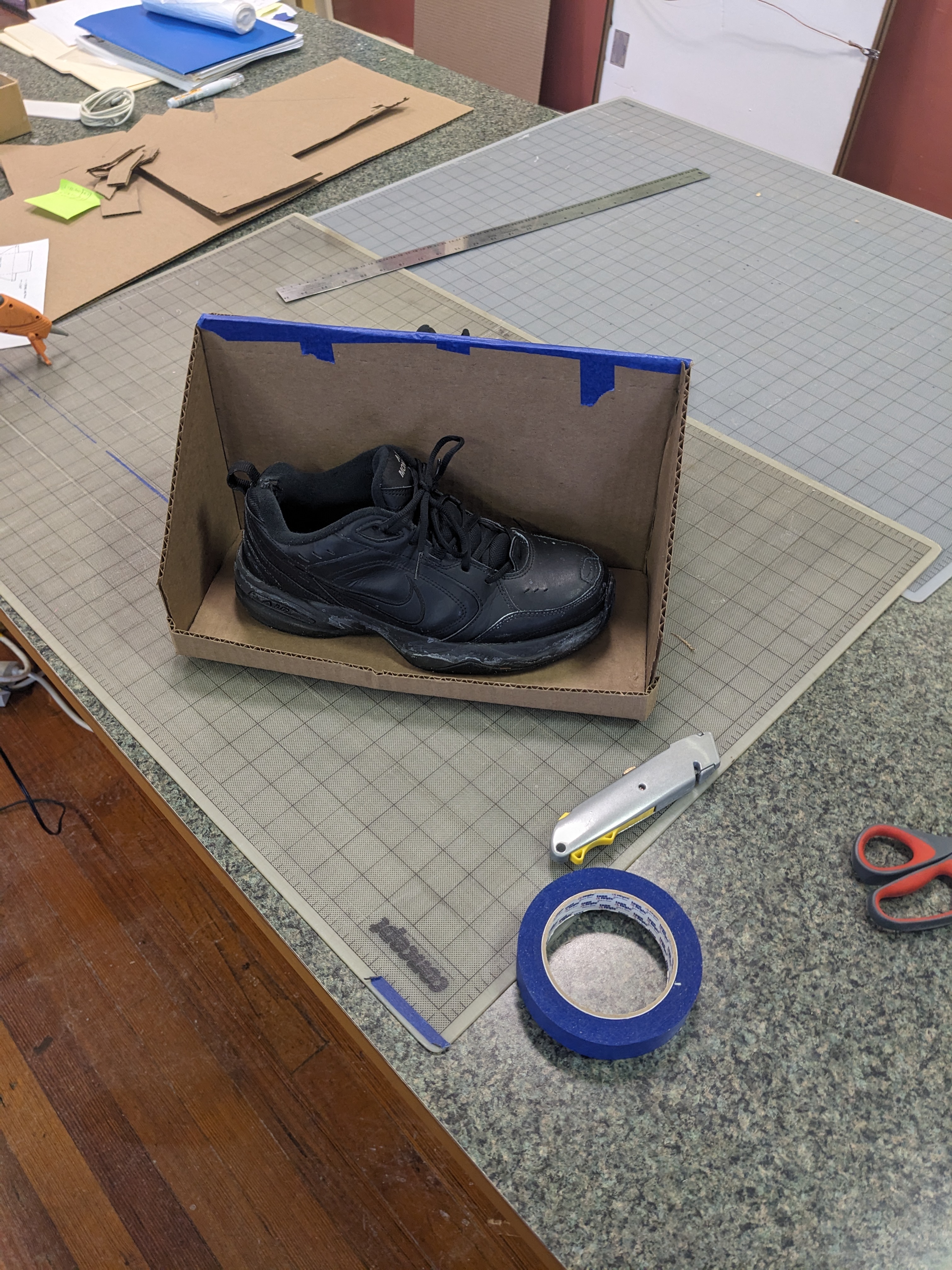
For the first step, the volunteers practiced making external mounts for their own footwear using cardboard. A few elements of the mount were altered after we saw the construction of the initial design. When the design is finalized, the volunteers will be using archival blue board covered in soft Tyvek fabric to house the moccasins.
The next step will be to practice making internal supports. These supports are essentially tubes constructed of stockinet filled with polyester fiber. The ends are stitched together to ensure the poly-fil doesn’t come out of the tube. Once fabricated, these will be inserted into the moccasin, helping keep their shape and resist the flattening effect of gravity.
The volunteers are making great strides with their practice work, which means they will soon start making mounts for the moccasins. We will keep you posted with an update in the future.
If you are interested in seeing what kinds of mounts your institution can make use of, please see this pdf from History Nebraska. It was an excellent source of inspiration.
Two months ago, I wrote about the process of moving the collection in advance of renovations to our building’s basement and moving it back after renovations were complete. In this blog, I thought I could briefly cover how we organized the collections when we moved back in.
Before embarking on any large-scale collections-based project it is a good idea to know what comprises the collection. As noted in the moving blog, the seeds of the renovation started with the 2017-2021 inventory and rehousing project. Understanding the size, weight, and material of the collection was instrumental for us to plan where it would all go. It also helped us select the appropriate type of furniture to best suit the items’ individual storage needs.
Quantify the collection
We worked with a design team from the storage furniture company we contracted to help us make the most of the space we had available. The designers needed to know how much space was required to house the items we steward. Thinking of the future, the figures we gave them included room for growth. We hoped we wouldn’t be at capacity as soon as the renovation was completed.
The dimensions for items held in standard sized boxes was straightforward. We provided more detailed dimensions of the large items and boxes. Shelving for these items would need to be more strictly planned to accommodate individual item and box dimensions.
Capacity, layout and review
The building renovation contractors provided the storage furniture design team with precise room dimensions that included height restrictions required by lighting, HVAC, electrical, and fire suppression systems.
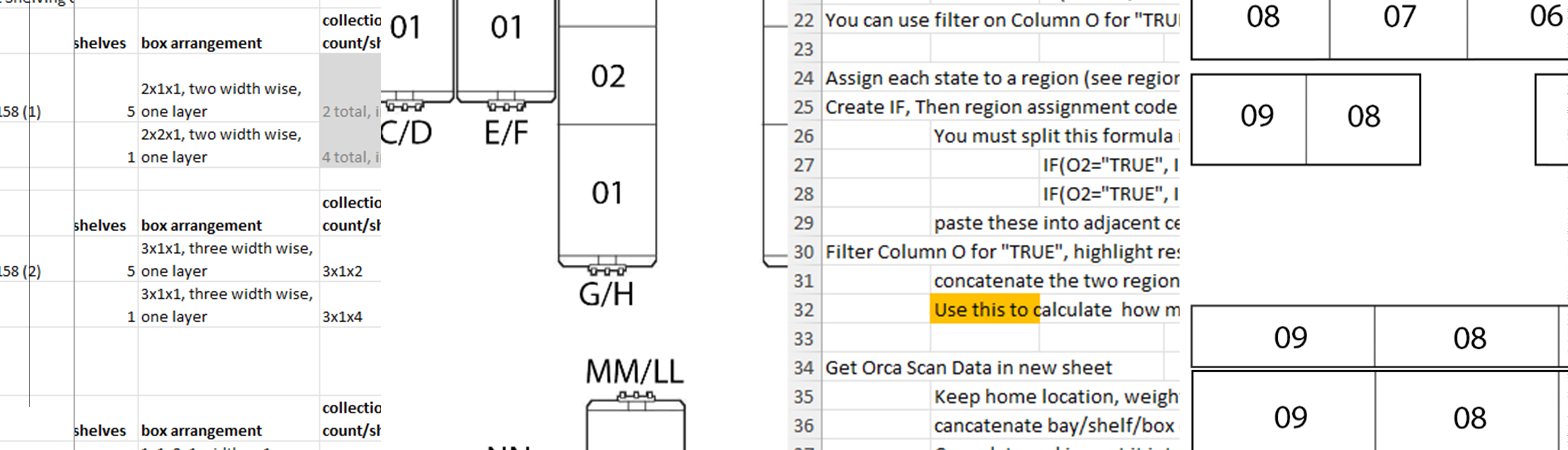
Based on our needs and the space available, the design team gave us a series of shelving layouts. We double checked the dimensions of shelving- length, depth and shelf heights- to ensure that the collections could fit. The design team and our collections team went through several drafts before we came to a finalized layout.
Organization
Once we knew the basement’s storage capacity, we set about creating an organizing principle for the collection. Collections in each space were organized by region. Unboxed items were organized first by type, followed by region. Space on fixed shelves was reserved for items at risk of rolling off mobile shelving.
Future
We’ve been living with the renovation for several months now and are very happy with the results. We have contemplated making a change to the organizational structure of the standard-sized archival boxes. In the future we may organize collections by site or collection area within their broader region. Understanding the scope of this project will require data manipulation to better understand. It may mean moving items between boxes, in which case we’d have to weigh the benefits against the resources required to see an organizational schema such as this carried out.
The change in season brings a time for storytelling and passing down traditions. The winter months are a prime time for sharing scary stories due to colder weather keeping people inside and gathered together.
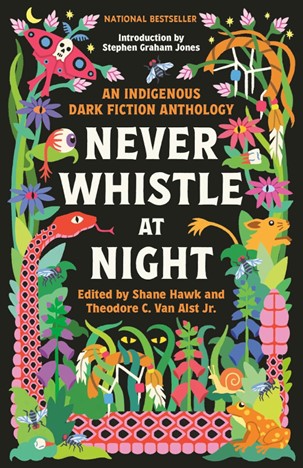
In honor of Indigenous Peoples’ Day (October 14) and upcoming National Native American Heritage Month (November), we’re highlighting some folklore inspired by the Indigenous dark fiction anthology, Never Whistle at Night. This book is comprised of 26 short stories that explore aspects of Indigenous horror, beliefs, traditions, and folklore. These stories are told by a variety of Indigenous authors (see complete list below), edited by Shane Hawk(Cheyenne & Arapaho Tribes of Oklahoma) and Theodore C. Van Alst Jr. (Mackinac Bands of Chippewa and Ottawa Indians), and introduced by Stephen Graham Jones (Blackfeet Nation).
Carson Faust(Edisto Natchez-Kusso Tribe of South Carolina)
Kelli Jo Ford(Cherokee Nation of Oklahoma)
Kate Hart(Chickasaw/Choctaw in Arkansas)
Shane Hawk(Cheyenne & Arapaho Tribes of Oklahoma)
Brandon Hobson(Cherokee Nation Tribe of Oklahoma)
Darcie Little Badger(Lipan Apache Tribe of Texas)
Conley Lyons(Comanche)
Nick Medina(Tunica-Biloxi Tribe of Louisiana)
Tiffany Morris(Mi’kmaw)
Tommy Orange(Cheyenne and Arapaho Tribes of Oklahoma)
Mona Susan Power (Standing Rock Sioux Tribe)
Marcie R. Rendon (White Earth Band of the Minnesota Chippewa Tribe)
Waubgeshig Rice (Wasauksing First Nation)
Rebecca Roanhorse (Navajo Nation)
Andrea L. Rogers (Cherokee Nation)
Morgan Talty (Penobscot Indian Nation)
D.H. Trujillo (Pueblo)
Theodore C. Van Alst Jr. (Mackinac Bands of Chippewa and Ottawa Indians)
Richard Van Camp (Dene Nation)
David Heska Wanbli Weiden (Lakota)
Royce Young Wolf (Hiraacá, Nu’eta, and Sosore, ancestral Apsáalooke and Nʉmʉnʉʉ)
Mathilda Zeller (Inuit)
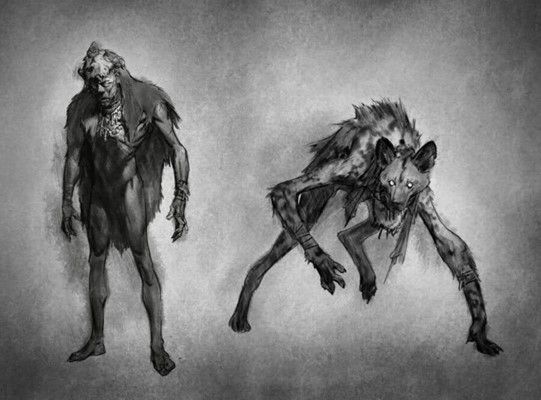
The title of the anthology refers to a belief common in many Indigenous cultures that whistling at night can attract malevolent entities. The act of night whistling is forbidden by many Native American cultures due to a shape-shifting entity, known as a “Skinwalker” or “Stekini” that responds to the call, causing harm to those who encounter it.
Skinwalker – Image courtesy of DoubleOurEfforts/reddit
Native cultures use storytelling to pass down knowledge and history, including folklore. Scary stories often carry deeper meanings, serving as lessons and warnings. Some of my favorite stories from this book were: Kushtuka, Quantum, Snakes are Born in the Dark, Before I Go, and Dead Owls.
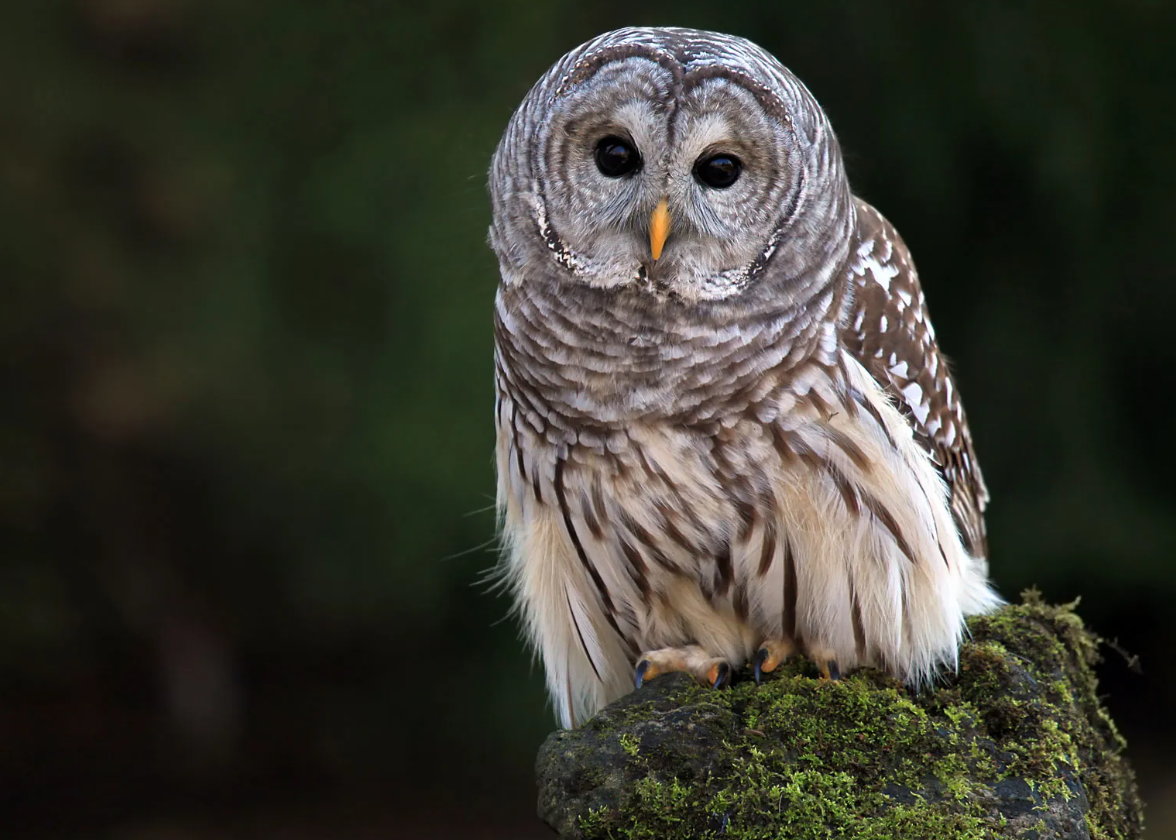
Several stories in the book share a common subject – the owl. Interpretations of owls can be found across different Native American tribes, with some viewing owls more negatively than others. There are several items in the Peabody collection that highlight the owl form, their meanings varying significantly between different Indigenous cultures and locations. Here are just a few for you to explore!
Owls are often associated with death and the spirit world, seen as messengers or harbingers of bad luck reflected in their nocturnal habits. Seeing an owl, particularly during the day can be a sign of death or misfortune. Some tribes consider owls as spirits of the deceased or that they might not be real birds at all, but shapeshifters. The sound of an owl’s hoot is seen as a call to the spirit world or a way to connect with ancestors.
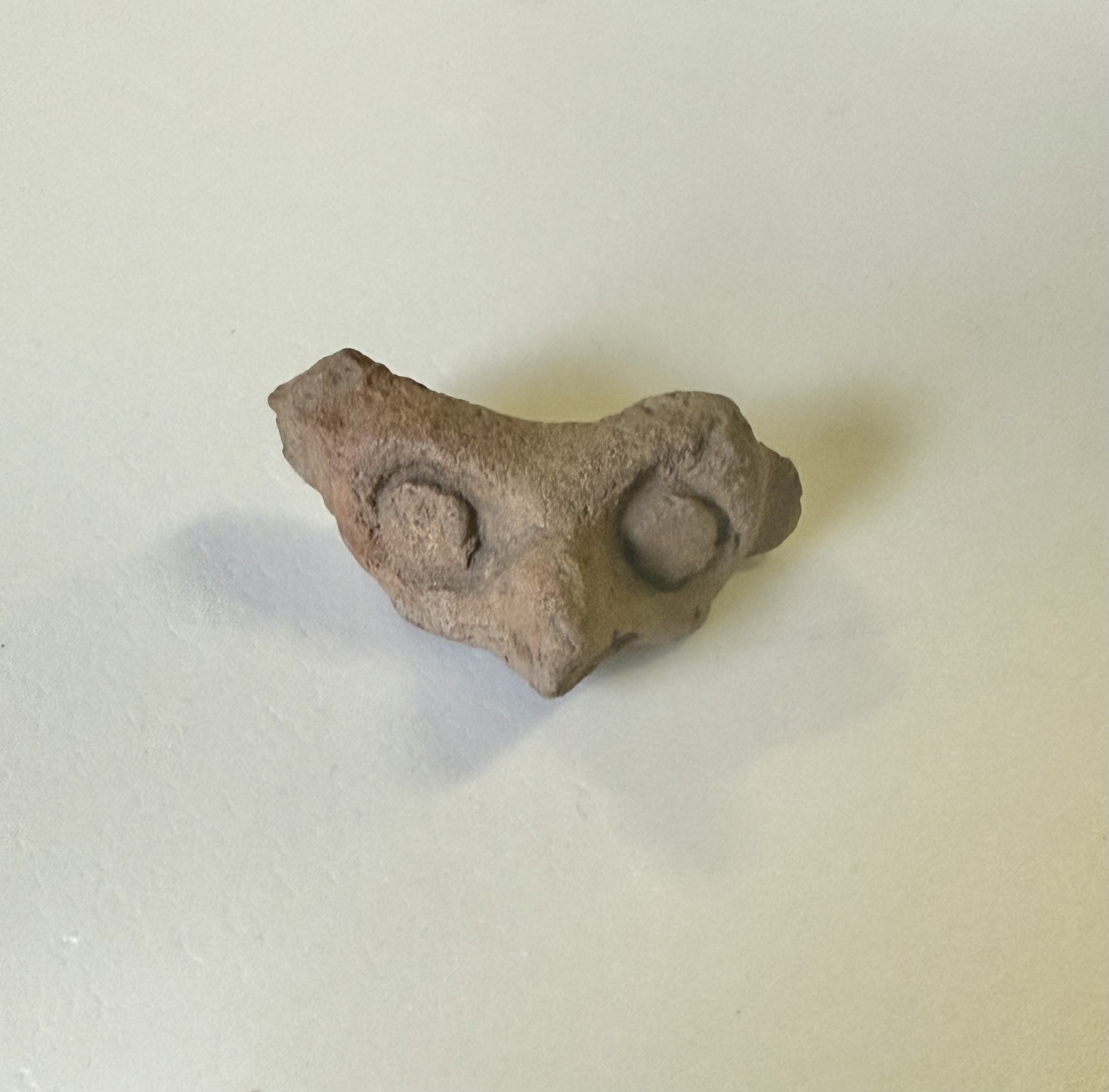
Owl Effigy (2018.2.1266) – Fragment of an owl effigy from the Valley of Mexico. Warren K. Moorehead compared this item to clay effigies from the Etowah village site in his 1932 book Etowah Papers: Exploration of the Etowah Site in Georgia.
Owl Effigy (2018.2.1266), Peabody Collections
Folklore of the Valley of Mexico believe in a witch known as “La Lechuza” who shapeshifts in the form of an owl that preys on people who are disobedient, unbaptized, or who harm others. Check out this episode on La Lechuza from the podcast, History Uncovered.
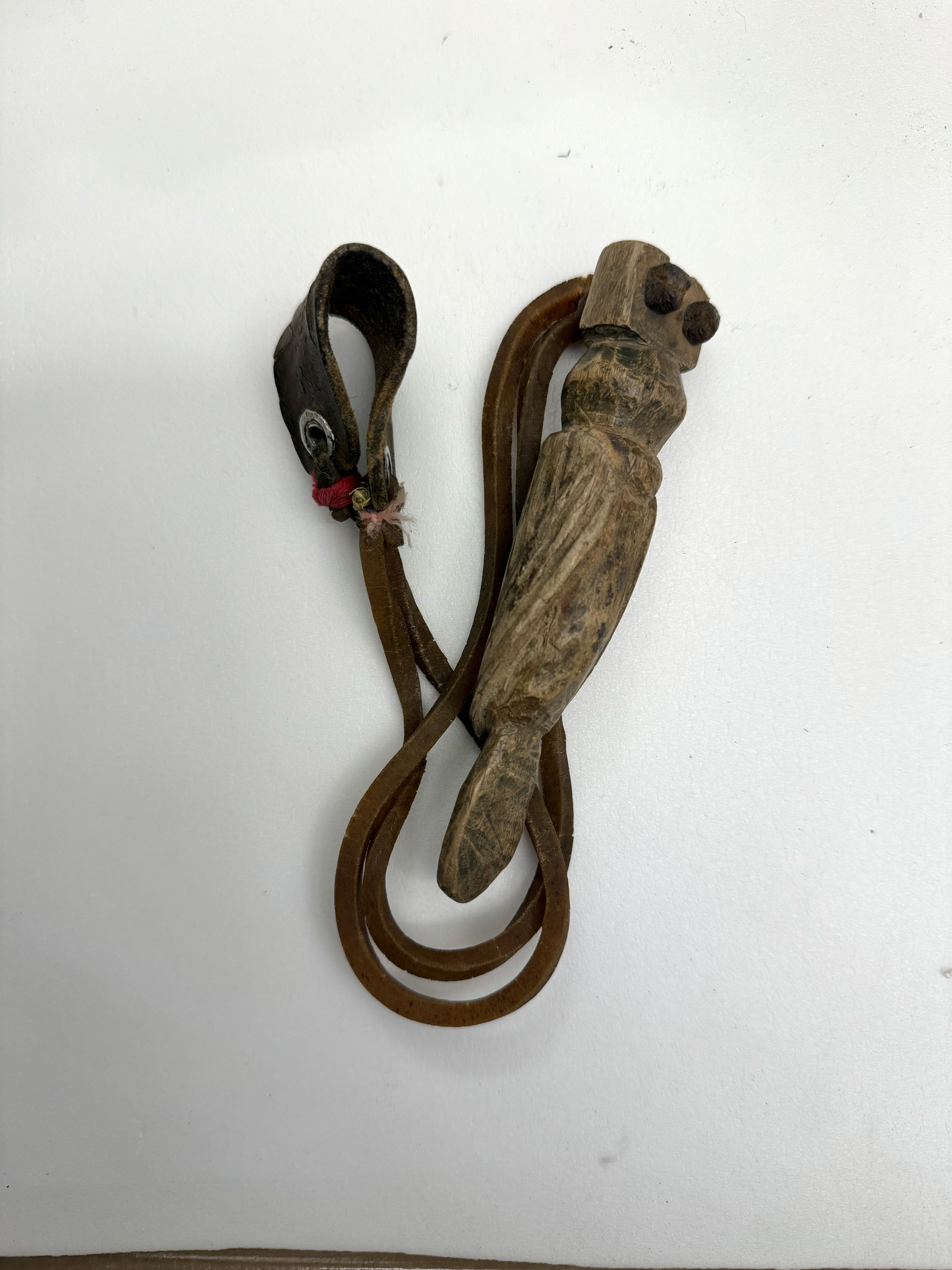
Owl Effigy Slingshot (97.1.53) – From the Ixil Maya community in Chajul, El Quiché, Guatemala. Used by men and boys to hunt birds, though it is common to hunt with a blowgun.
Other tribal beliefs revere owls as symbols of wisdom and intuition, as well as carriers of ancient knowledge and protection.
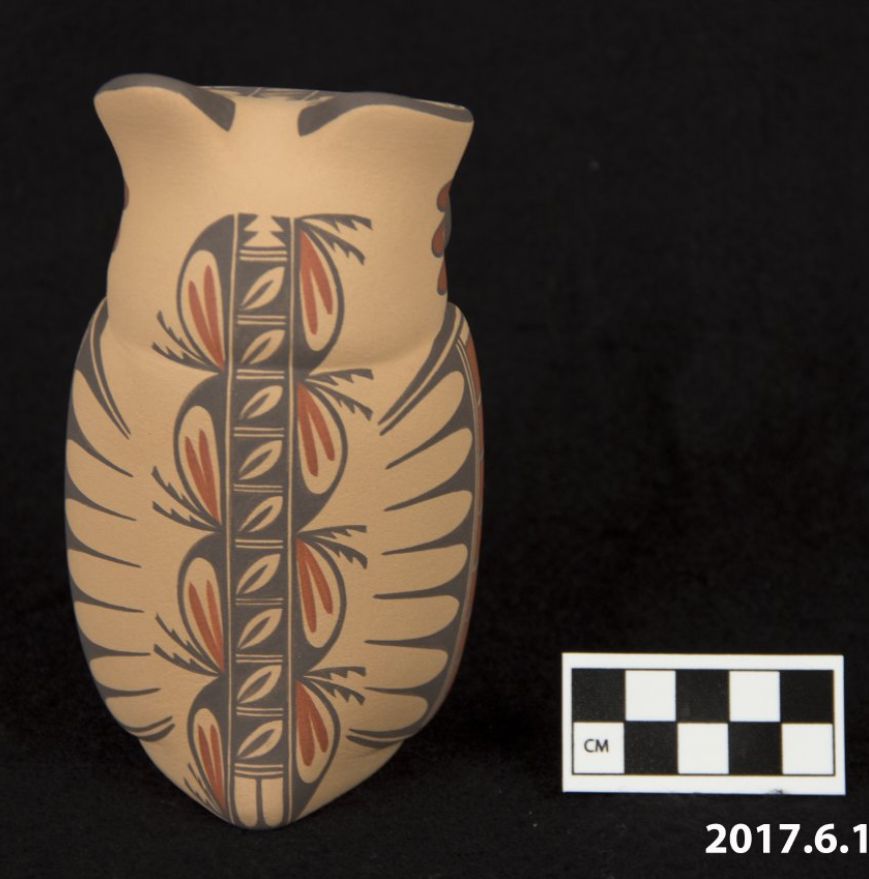
Ceramic Owl Figurine (2017.6.1) – Ceramic piece by Maxine Toya from the Pueblo of Jemez, New Mexico. In Pueblo culture, owls are seen as protectors. The ceramic owl design is built by stacking and smoothing hand coils of clay. The piece is both carved and painted, the feathers on the front being carved into the clay. Painted designs are intricate using symbols of rain, clouds, and feathers. These designs are all matte and painted with clay slips with only the eyes being polished.
Maxine Toya is well known for her figurative pottery (the first piece of pottery Maxine created was an owl!) Maxine is one of several pottery artists from the Pueblo of Jemez that visit Phillips Academy campus each spring to work with students in ceramic classes. You can read more about these visits here and here!
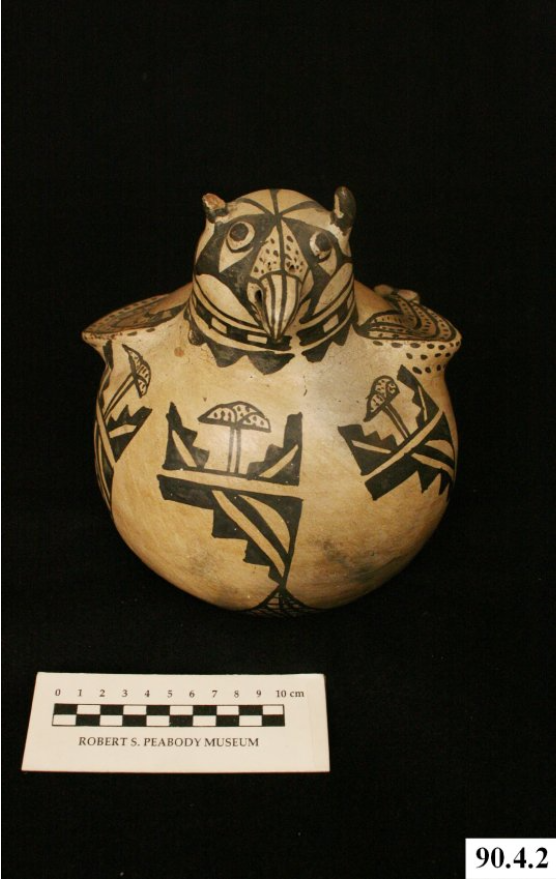
Ceramic Owl Effigy Jar (90.4.2) – Globular body in black on white design with vessel opening located at owl beak. Owl facial features at neck, wings at sides and tail at back. The globular shape is the most recognizable characteristic of pottery from Cochiti Pueblo, New Mexico.
Ceramic Owl Effigy Jar (90.4.2), Peabody Collections
Owls are featured in Cochiti Pueblo pottery, often associated with the god of death and spirit of fertility, Skeleton Man.
Exciting News! – Never Whistle at Night, Part II: Back for Blood is currently accepting submissions from emerging Indigenous writers. This is the second book in the Never Whistle at Night series.
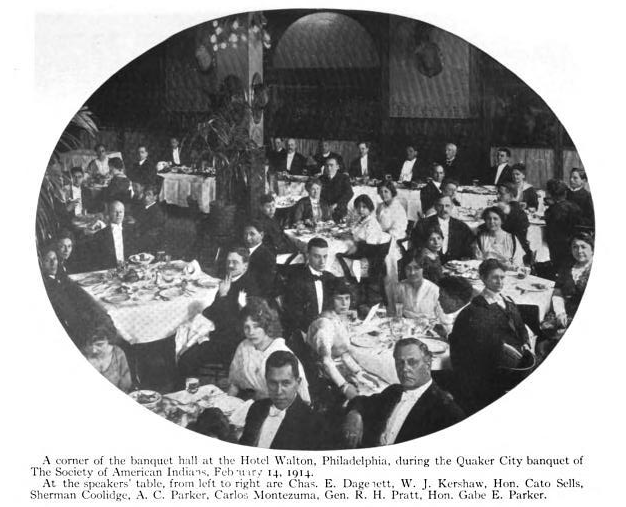
The Society of American Indians, Philadelphia, Pennsylvania, February 14, 1914. The Quarterly Journal of the Society of American Indians, Volume 2, 1914.
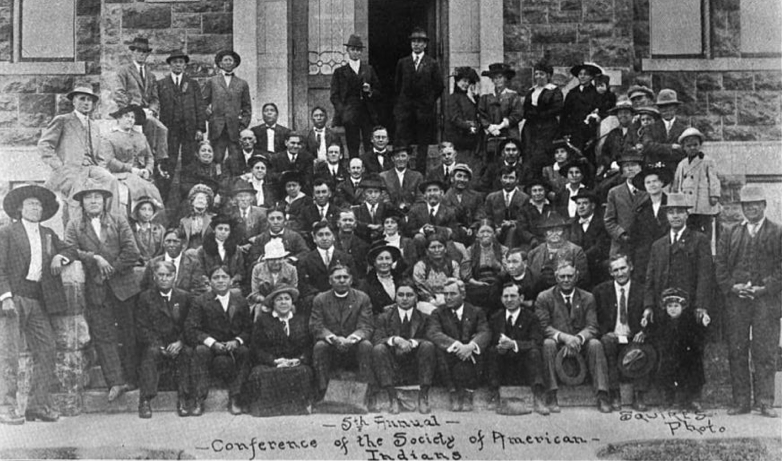
On the weekend before Columbus Day in Columbus, Ohio, 1911, a group of Native American leaders and activists joined together to attend what became the first annual meeting of the Society of American Indians, or SAI. For the next thirteen years, this pioneering Pan-Indian organization was a center for Native American political advocacy, lobbying Congress and the then-Office (now Bureau) of Indian Affairs; offering legal assistance to Native individuals and tribes; publishing a quarterly journal; and corresponding extensively with Native Americans, “Friends of the Indian” reformers, political allies, and critics across the country.
Members of the SAI were a veritable “who’s who” of early twentieth century Native history, representing activists, clergy, entertainers, professionals, speakers, and writers, from communities both on- and off-reservation. To namedrop just a few, these included (but were by no means limited to): attorney Marie Louise Bottineau Baldwin (Métis/Turtle Mountain Chippewa/French); musician and writer Gertrude Simmons Bonnin (Yankton Dakota); educator Henry Roe Cloud (Winnebago); Episcopal priest Sherman Coolidge (Arapaho); civil servant Charles Dagenett (Peoria); painter and illustrator Angel De Cora (Winnebago); Episcopal priest Philip Joseph Deloria (Yankton Dakota); physician Charles Eastman (Dakota); author and linguist Laura Cornelius Kellogg (Oneida); ethnologist Francis La Flesche (Omaha); physician Carlos Montezuma (Yavapai Apache); writer, editor, and journalist John M. Oskison (Cherokee); archaeologist Arthur C. Parker (Seneca); lawyer Thomas Sloan (Osage); and advocate Henry Standing Bear (Lakota).
Without sharing a singular vision of Native American identity, tribal self-determination, or what the place of Native Americans should be within US society, these individuals committed themselves to a shared purpose, striving firstly “To promote the good citizenship of the Indians of this country, to help in all progressive movements to this end, and to emulate the sturdy characteristics of the North American Indian, especially his honesty and patriotism.” Seeking to benefit the freedom and development of all Native Americans, the two primary platforms on which the SAI stood were U.S. birthright citizenship for Native Americans and tribal access to the U.S. Court of Claims, addressing the two major issues at the forefront of public debates on the “Indian problem” at the time – the ambiguity of Native American legal status and the Office of Indian Affair’s mismanagement of Native lands and resources.
The investment of people’s time and unpaid labor in the work of the Society and its journal was extraordinary but ultimately unsustainable, and the SAI dissolved in 1923. Disappointingly, it had achieved neither of its major goals. Congress passed the Indian Citizenship Act in 1924, granting birthright citizenship to Native Americans but maintaining their wardship status. The Indian Claims Commission took over twenty more years to come, in 1946, allowing tribes to bring claims against the US government through judicial arbitration, not a court, and successful claims could result only in monetary compensation, not regained lands. The SAI also could not succeed in delivering a unified expression of Native American opinion to the government and public – probably the most unrealistic aim of all.
Despite its “failures,” the Society of American Indians was the first organization of its kind, created by Native Americans to amplify a Native American voice across the country during a time when people’s lives were under siege and they battled to have their voices heard on multiple issues. It may not have lasted long, but the SAI left a legacy of political, legal, and intellectual activism, setting the course for the many Native professional organizations to follow, and standing as part of an ever-present, ongoing continuum of Native Americans advocating for their best interests; joining in the debate as to what that might look like or how to get there; and striving to build better, stronger, and healthier relationships with the rest of the nation.
Maybe consensus is less important than joining in the conversation. Whether you are celebrating Columbus Day, commemorating Indigenous Peoples’ Day, or just slogging through another Monday – that door is always open.
The Society of American Indians, 5th Annual Conference, on the steps of Engineering Hall, Kansas University, October 1, 1915. The Quarterly Journal of the Society of American Indians, Volume 3, 1915.
In January 2024 renovations to our collection housing were completed, finalizing a process that started in March 2023. To accommodate the demolition of existing shelving and installation of new condensing metal shelving, the collection was moved out of the basement in early 2023. With the project completed and several months of living with the move behind us, this seems like a good time for a brief recap. Perhaps some of our planning can help other institutions that have a collection move on the horizon.
During initial planning for the renovation, we faced two scenarios for moving the collection. The first was to move the collection offsite. The second, involved keeping the collection onsite within portions of the building that were not renovated. We needed to make viable plans for both options while decisions about construction phases and timelines were being made.
We identified several challenges to moving the collection offsite. Some of the largest hurdles included the high cost of offsite storage, the massive time commitment required for packing the collection for an offsite move and conducting a post-move inventory and condition reporting of the collection. A second round of inventory and condition reporting would need to be done after the collection was moved back into the building.
Keeping the collection onsite raised other concerns. Temporary housing would need to be big enough to house the collection. We would only be allowed in the building during designated windows when it was safe for us to enter, therefore the temporary housing area would need to be locked and monitored by cameras. The space would need to be environmentally controlled to the best of our ability. We also contemplated whether construction could lead to a catastrophic accident that would damage the building and collection.
The benefits and challenges of each scenario were taken into consideration within the larger framework of the construction plan. Ultimately, it was decided to keep the collection onsite in temporary housing. Although it came with some complications, it resulted in huge savings and a greater degree of control over the moving process when compared to moving the collection off-site.
Inventory and rehouse
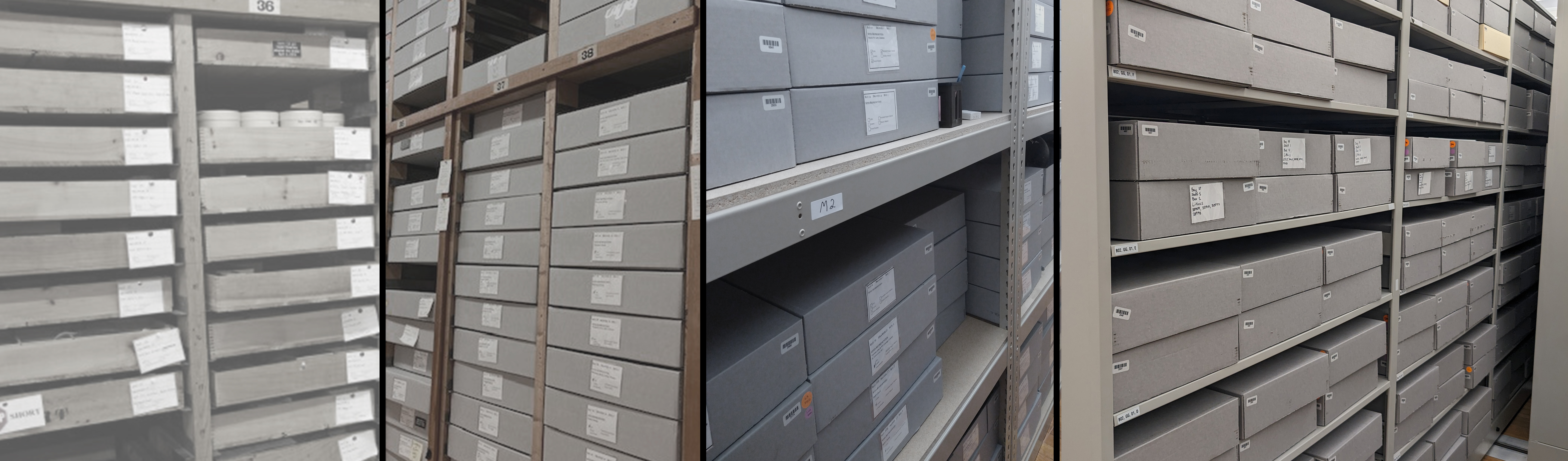
The move started with an inventory and rehousing project that was carried out between 2017 and 2021. The project has been covered in previous blog posts. To summarize, Peabody staff conducted a 100% inventory of collections housed in aging wooden drawers in our basement. The inventory collected basic information; a description, count and provenience. Once inventoried, the items were rehoused in archival boxes with lids. While the wooden storage bays didn’t allow for stacking, future storage could take advantage of the ability to stack boxes.
The archival boxes were about half the size of the wooden drawers. Boxes were therefore much lighter and in most cases two boxes existed where previously there was one drawer.
Barcode and Weigh
During the planning onsite and offsite moves, we identified the first floor as the likeliest location for temporary housing if we were moving the collection inside the building. We knew the collection was heavy, but in the basement the collective weight of the collection was never a concern. Now, the ability of the building to hold the weight of the collection boxes was an important question that needed to be answered.
Equally important was how we would maintain physical control (i.e. knowing where everything in the collection is) over the collection boxes and their contents. This portion of the collection comprises nearly 3,000 boxes containing roughly 500,000 items. It was necessary to come up with an efficient way of tracking each item’s movement. Updating records at the item level within our existing database would take an incredible amount of time. Our database at the time supported barcodes at the item level, a process that would be no different than updating each item individually. We decided to assign barcodes to each box and track the box locations using a separate barcode tracking program (Orca Scan).
Over the summer of 2020, with the help of two great interns the collection was weighed and barcoded. The barcode data included the original location within the wooden storage (home location), weight, how many spaces the box would occupy in temporary housing, and any additional notes.
Results
Armed with the weight data, we were able to organize the collection so that the weight was equally distributed over the entirety of the first floor. This information also helped us organize the collection in the newly renovated basement. Now, heavy boxes are located on shelves at waist height, making for safer lifting. Lighter boxes are housed on higher and lower shelves.
Tracking box locations with barcodes worked well for the most part and was a net positive over tracking individual item locations. A 5% inventory of barcodes after the move resulted in no errors. However, errors have been found in the system since we moved the collection back into the basement. These have resulted from location errors entered into the database, as well as errors and inconsistencies entered into Orca Scan. I would recommend checking for inconsistencies in the original location data before making the move.
Using the barcode program in addition to the database to find items on the fly was time consuming, but not unreasonable. Tracking movement has been more challenging. Some movements were simple, like moving a box from one location to another. Other moves involved unpacking dense boxes and giving the removed items their own barcodes or emptying an entire box, deleting the barcode, and giving each unpacked item a new barcode. Processing so much data has required the use of formulas in Excel, and it is hard to find and analyze errors when looking at 115,000 item records.
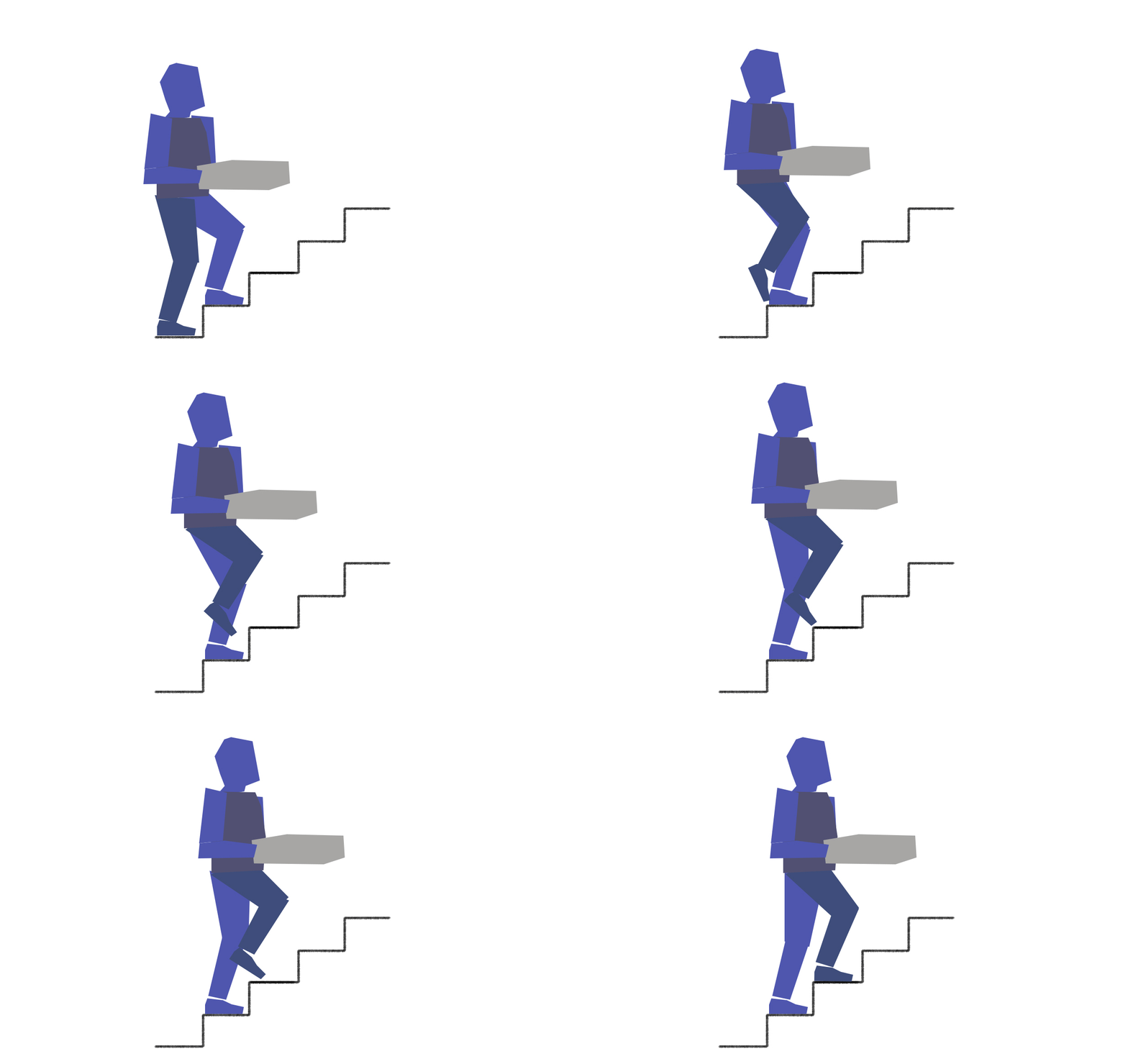
That wraps up this brief summary of our experience moving the collection. It was the culmination of years of planning and months of preparing and implementing. I’m happy to report that 600,000 items moved one or more times up and down one or two flights of stairs resulted in nothing being damaged. Hopefully some of the issues we encountered can help inform other institutions researching a move.


 The Peabody