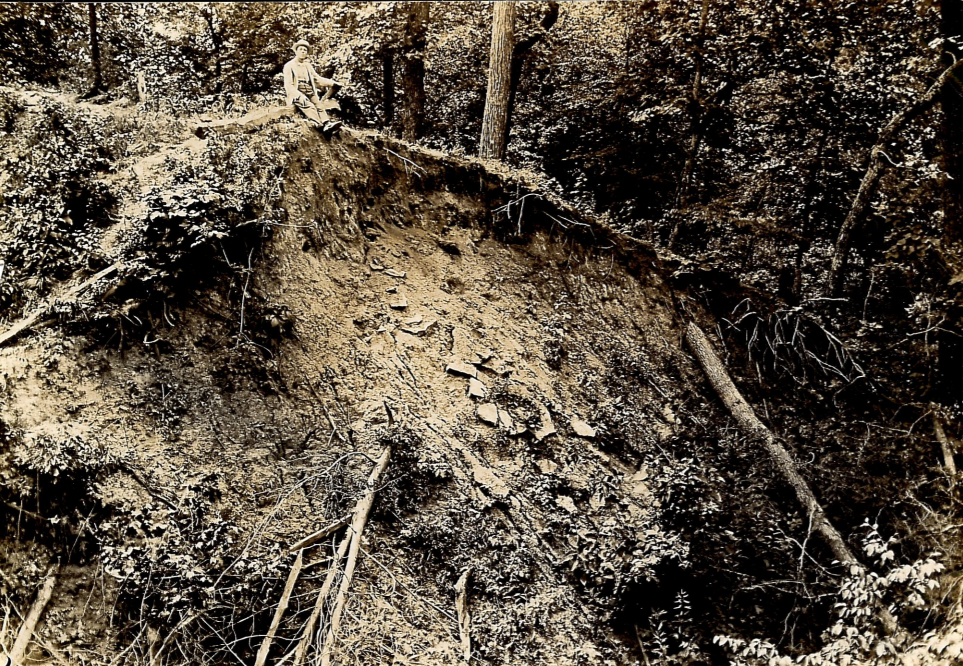
Example of the sheer size of an earthen wall and the dangers of excavating and tunneling into mounds. Washout on the wall, west side of new fort, Station 363, Fort Ancient site, Ohio. Peabody Photo Collections, Plate IX
Originally, I was going to share a blog about tuberculosis and its connection to the Peabody collections, but when this story came up in my research, it was too interesting to set aside to wait another month! For those who are intrigued by how consumption is tied to the Peabody and its collections, you’ll have to wait in anticipation for another month.
I must first give special thanks to the Peabody’s independent researcher, Adam Way, who found this story in an article from the Phillips Academy student newspaper, the Phillipian. This was hours after I asked him to keep his eyes peeled for specific details about Moorehead. What a happy coincidence this find made for my research. Thank you again Adam!
During his excavations in the summer of 1888, Warren K. Moorehead was buried by a cave-in which almost cost him his life. To best share this story, I think it would be best for you to hear some of the story from W.K. Moorehead yourself!
After all, the fall season is upon us and where many believe Moorehead’s spirit lives on within the Peabody’s walls, I couldn’t think of a more appropriate time for him to share this near-death experience in his own words. Enjoy!
“Here a serious accident befell me… as I bent down to examine a small bone uncovered in the process of undermining, a mass of earth equal to several cartloads suddenly dropped from above.”

– W.K. Moorehead, Field Diary of an Archaeological Collector (1902)
As Moorehead bent down to examine the bone, the workmen climbed out of the unit to cut down the undermined wall of the mound. As a result, the wall of earth fell upon Moorehead burying him alive.
“The rush of wind it causes I well remember. My head and shoulders were somewhat higher than my legs, possibly a foot. The feet were spread apart. There was little pain, only pressure, intense pressure. It forced the buttons of my light field costume partly inside the flesh; my watch-chain left a bright-red mark along my left side. I could feel the watch strongly pressed against two ribs (these were broken.) The skin over my forehead seemed being cut, but it was the pressure of my hat forcing the flesh between the laced straws. A knife in my pocket seemed burningly hot. Just under the small of my back lay a large clod. The pain at the point of contact was considerable at times, and my spinal column seemed slowly breaking. Then the pain stopped and I could feel nothing.”

– W. K. Moorehead, Buried Alive – One’s Sensations and Thoughts (1893)
Throughout this entire experience, Moorehead described being unable to move, unable to breathe, unable to even wink. He recounts how hot the earth was against his face as the pressure of the earth forced his last breath. The workmen said it took a minute or more to reach his head.
“I felt the earth move slightly above my head. That gave me hope. I had not thought much of rescue, but I gathered my remaining strength. A shovel passed across the top of my head, cutting the scalp; I remember feeling it as if a hot iron had struck me. Then they uncovered my head and removed the earth from my mouth and eyes.”

– W.K. Moorehead, Ibid.
After he had been removed, he was partially paralyzed for several days. An article in the Phillips Academy student newspaper, The Phillipian, stated that Moorehead was paralyzed for five to six weeks and later, at the order of a spinal expert, he was placed in a straightjacket to put the weight of his upper body on to his hips to relieve his spine.
“I neglected to state that the earth above my head was about three feet thick, that over my legs was much deeper. Many persons buried in gravel pits and in earth not nearly so deep have been taken out dead.”

– W. K. Moorehead, Buried Alive – One’s Sensations and Thoughts (1893)
The physical effects were quite severe, but it was the effects of the accident on Moorehead’s mind that remained with him throughout the rest of his life. Dreams of caving banks and recurring memories of the accident haunted Moorehead’s psyche.
“I cannot now enter a mine or cave, or stand near an overhanging bank without a feeling of horror.”

– W.K. Moorehead, Field Diary of an Archaeological Collector (1902)
The results of this accident continued to echo throughout Moorehead’s later life, affecting his mind and his health. In my next blog these echoes will be revealed.
For more information about this story, please visit the following sources.
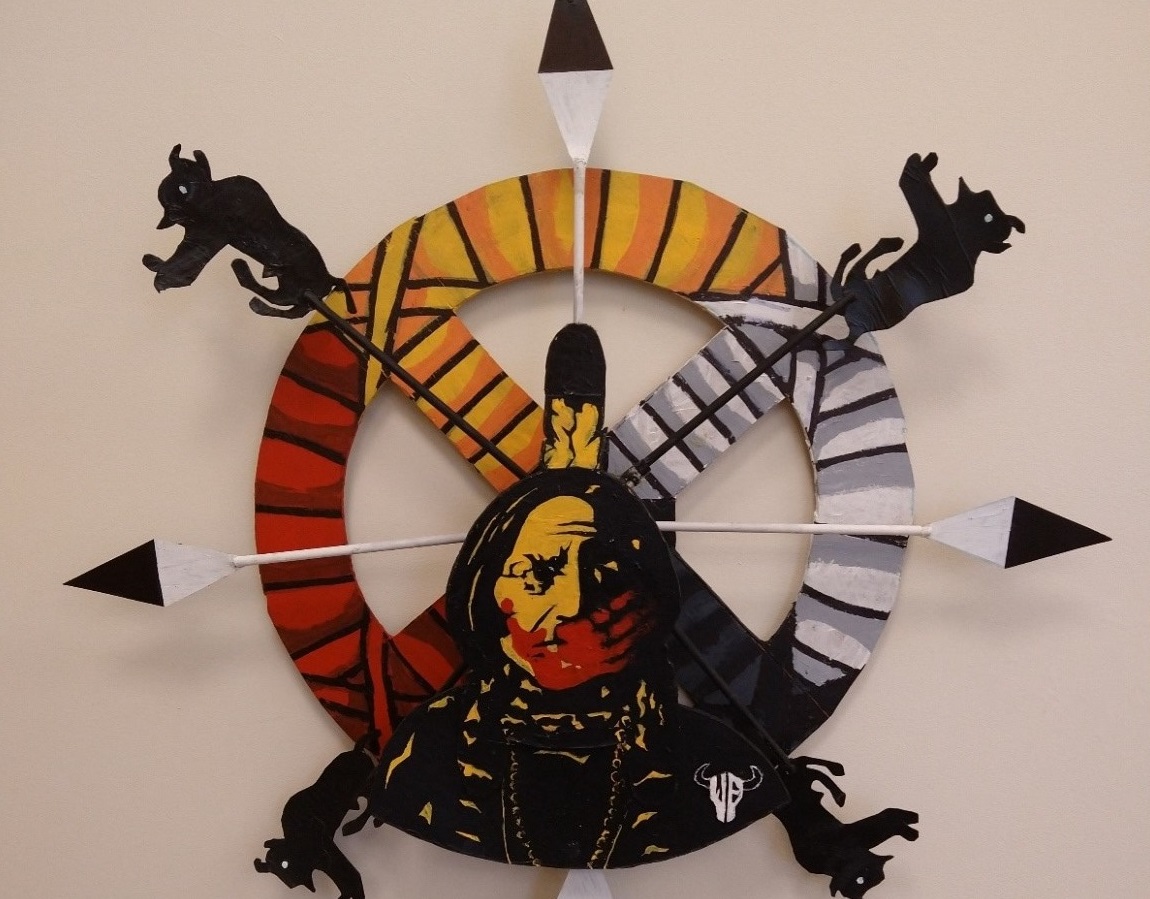
We are pleased to announce that the Peabody has installed an interactive artwork by Jonny Yates (aka Jonny White Bull). Jonny is a member of the Standing Rock Sioux Tribe and lives in McLaughlin, South Dakota. He is a talented jewelry maker, stylist, and chef, known for his own version of burger dogs, nachos with homemade chips, and other delicacies.
The piece, titled lalá, or grandfather, in the Lakota language, is a reference to Jonny’s ancestor Sitting Bull, who is depicted here. Jonny is the consummate “maker,” who loves creating carved and painted bone jewelry, drawings, and three-dimensional pieces made from cardboard, milk jugs, and other found materials.
Jonny invites everyone to spin his kinetic artwork and reflect on your own ancestors. You can find lalá in the Hornblower Gallery on the first floor of the Peabody.
CONTEMPORARY ART AT THE PEABODY
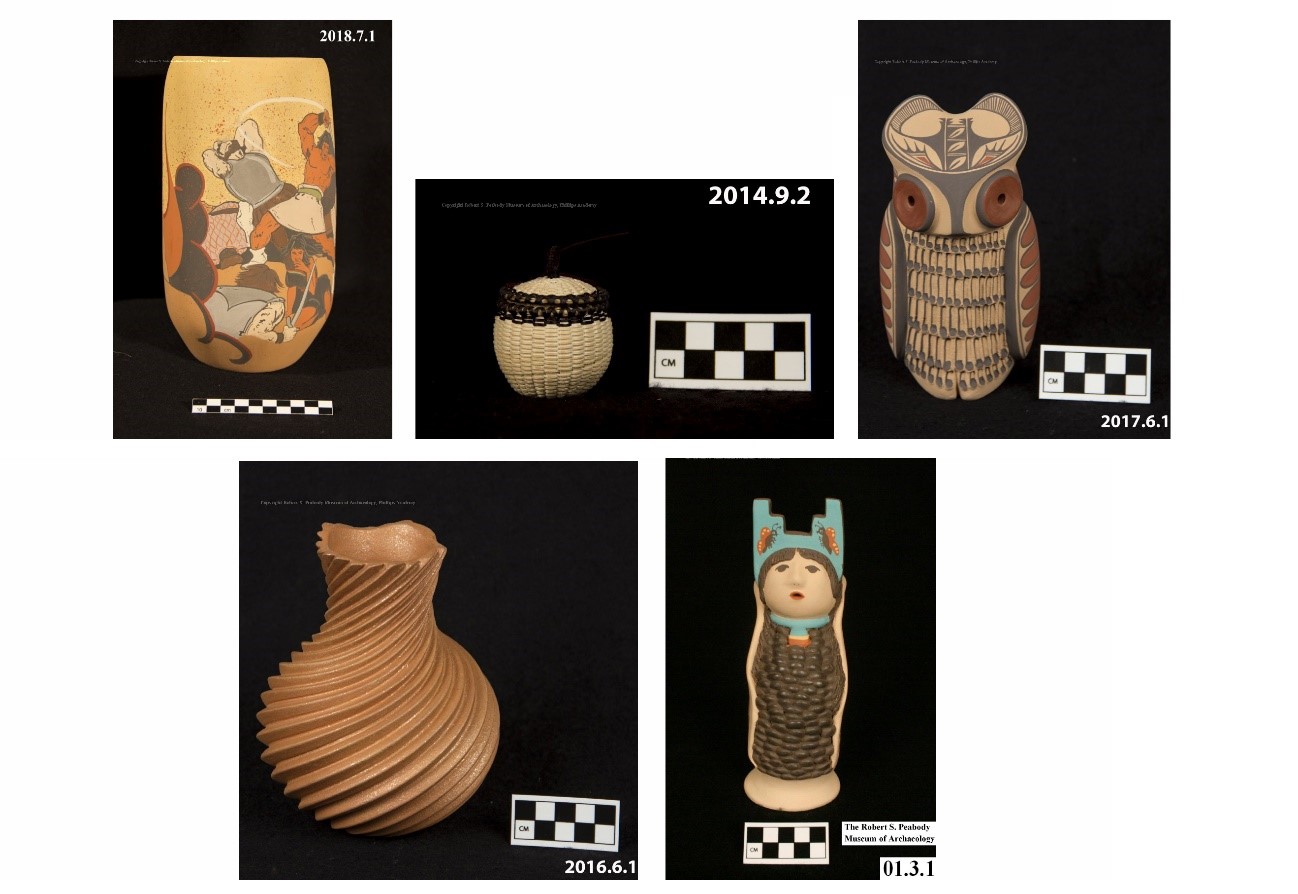
Jonny Yate’s piece joins a small but growing collection of contemporary Native art at the Peabody. When possible, the Peabody has purchased and commissioned artwork from Native artists with the support of donors and members of the Peabody Advisory Community. Artists with work in the collection include Dominique Toya, Maxine Toya, Bessie Yepa, Jeremy Frey, and Jason Garcia. These artists highlight some of the unique relationships that have developed between the Peabody and Native artists over the years. As an example, the Andover community has been fortunate to have several visits by Pueblo potters Dominique, Maxine, and Mia Toya over the years. During these visits, the Toyas share traditional pottery methods with students in Thayer Zaeder’s ceramics classes. They are very talented artists and quite passionate educators. You can read more about their most recent visit here.
Contemporary art in the Peabody Collection. From upper left: Jason Garcia, Jeremy Frey, Maxine Toya, Dominique Toya, and Bessie Yepa.
THE INSTALL
Hanging Jonny’s kinetic artwork presented a unique challenge; how could we make the piece available for a hands-on experience for students and visitors while keeping it safely installed. Research institutions, such as the Peabody, do not normally put collections on display, so we carefully considered our options. We chose to use cleats to secure the piece to the wall and a makeshift security clip to keep the piece from sliding out of the cleat. In place of a detailed narrative of the installation process, here are a series of photos of how we chose to approach the process. We hope you come by sometime and experience it for yourself.
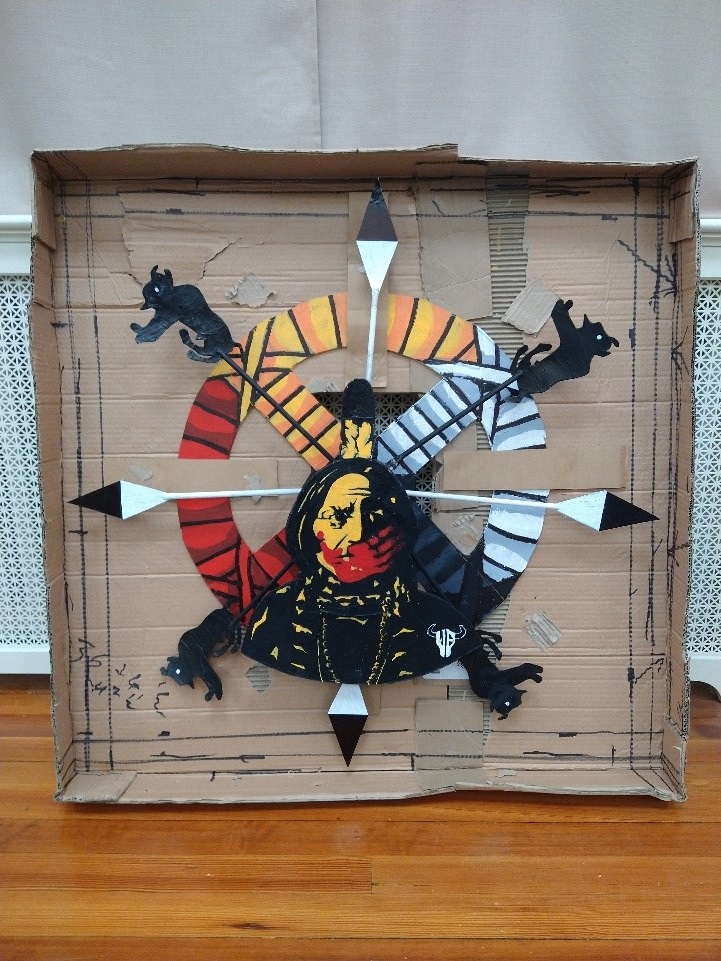
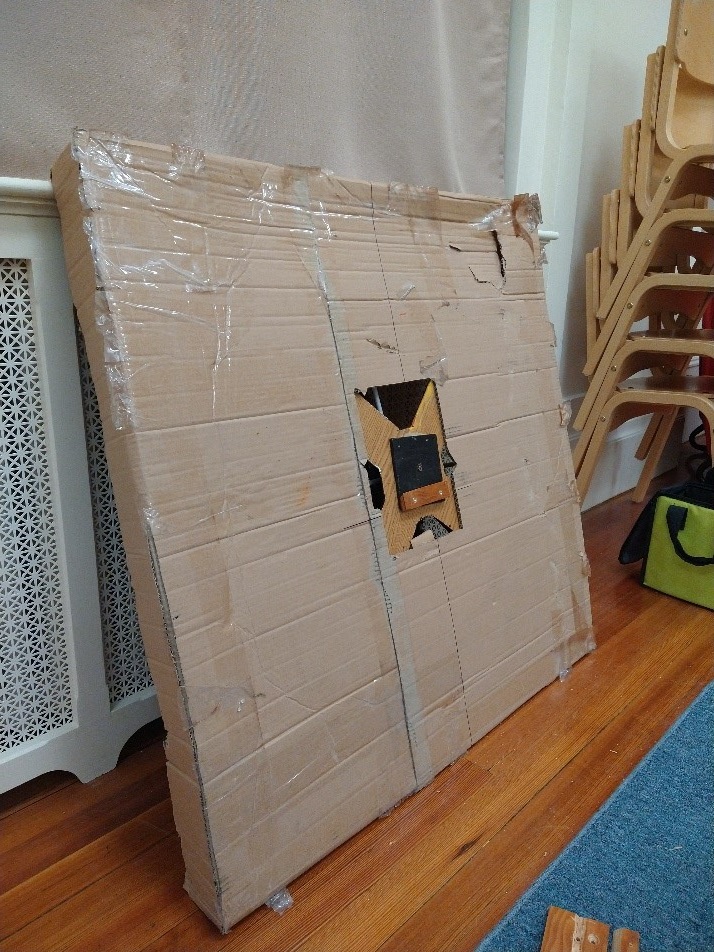
lalá arrived hanging in a travel case
Access to the back was necessary for adding hanging hardware. The piece was safely removed before cutting a hole in the travel case, it was then re-hung.
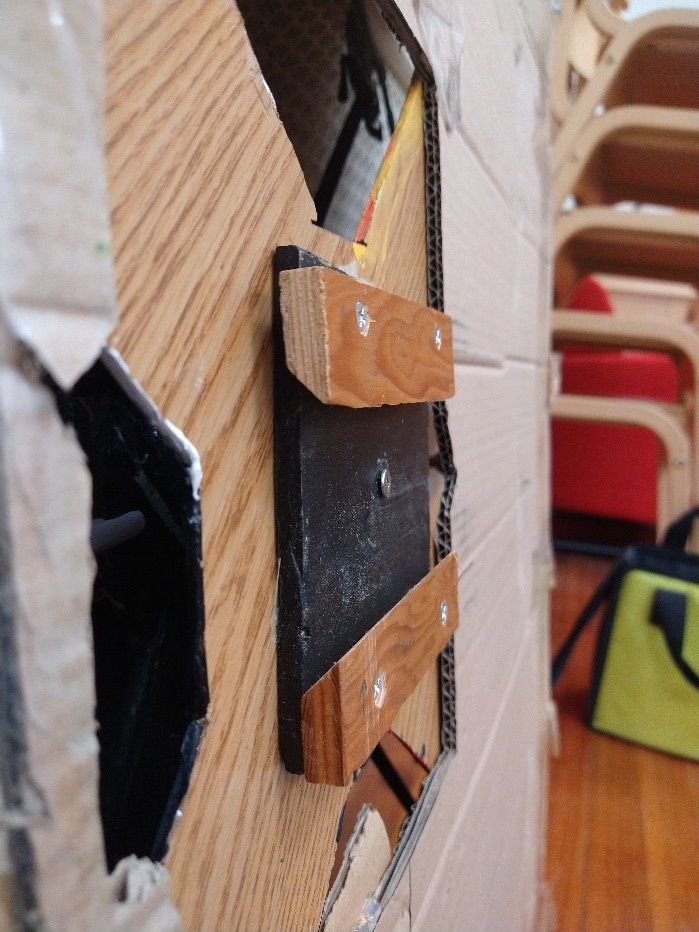
Cleats were installed on the back top and bottom.
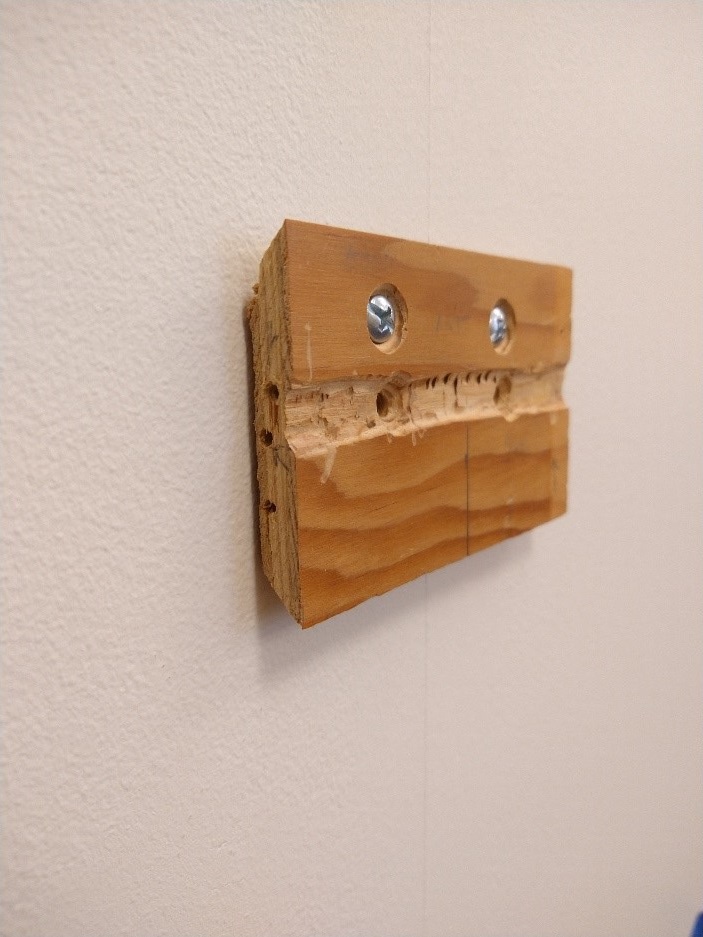
A receiving cleat was anchored to the drywall to secure the artwork.
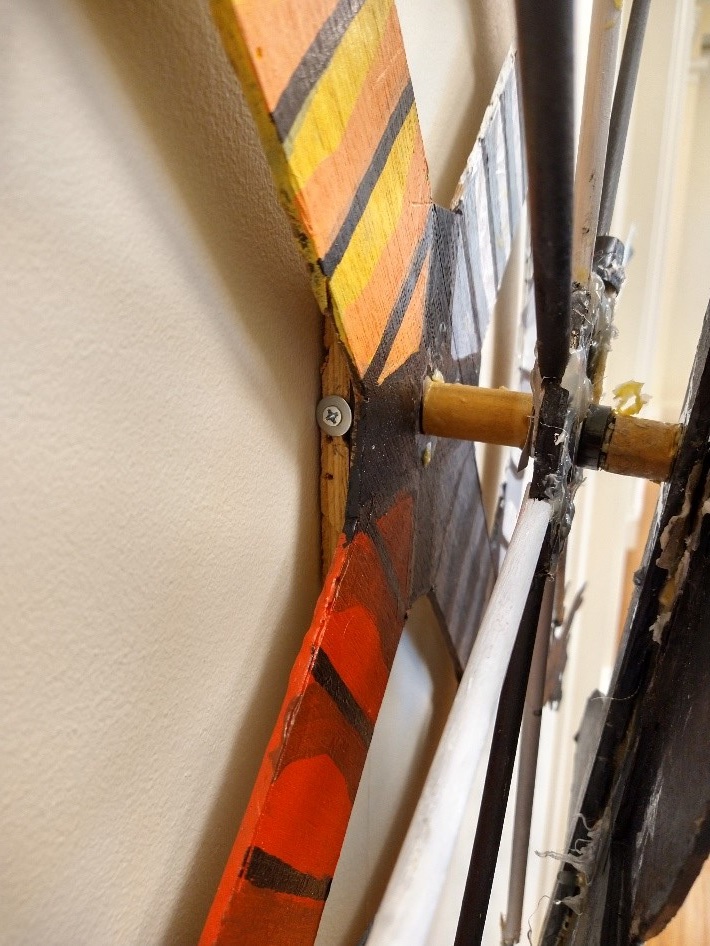
Security clip (screw and washer) ensures that the artwork won’t slip off the receiving cleat while being spun.
The return to in-person classes means that this fall’s Human Origins includes many of the hands-on project-based assignments that have become a hallmark of the course.
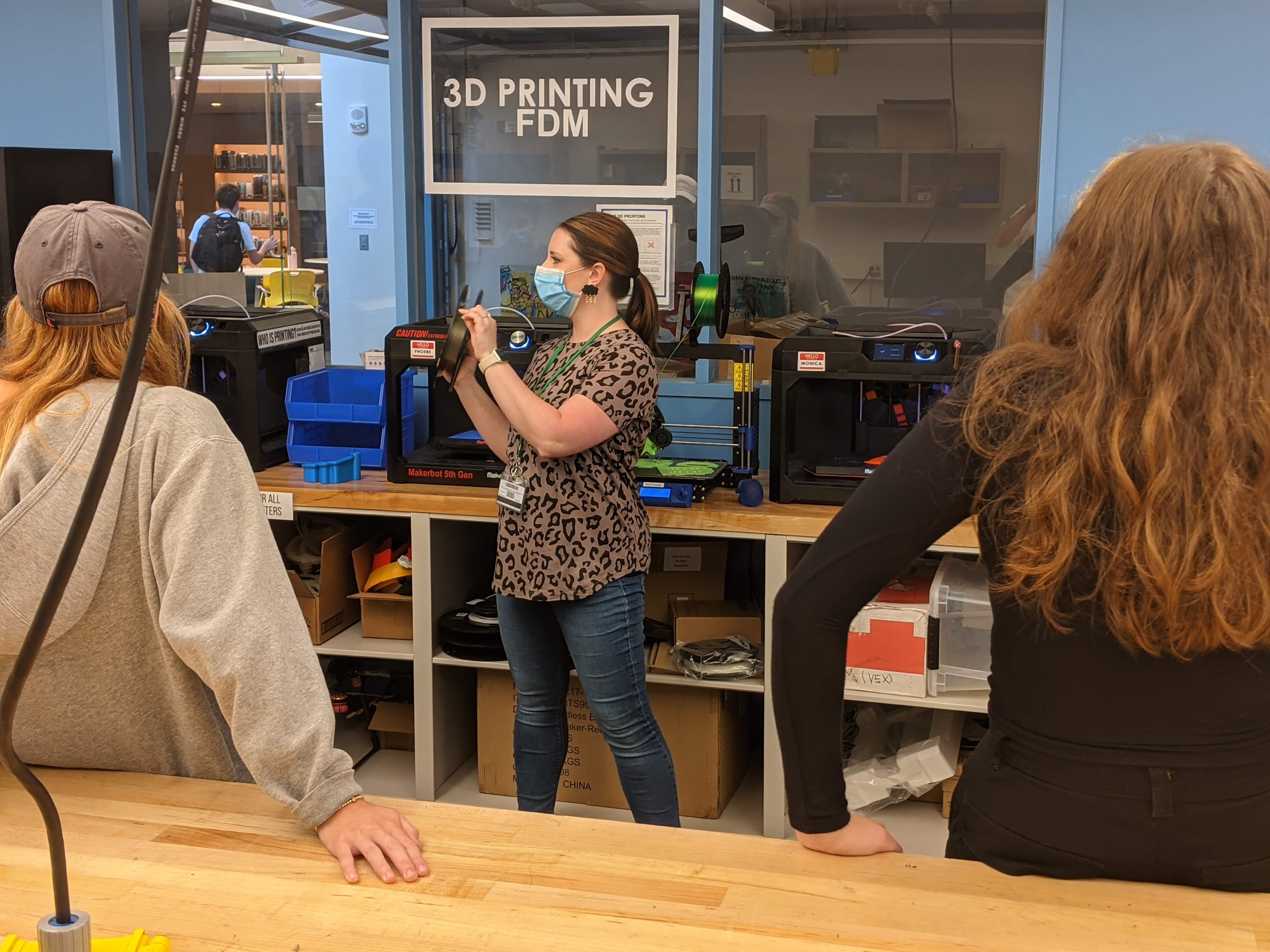
Makerspace guru Claudia Wessner introduces Human Origins students to 3D printing.
Students in Human Origins—an interdisciplinary science elective—visited with Claudia Wessner, Oliver Wendell Holmes Library Makerspace guru—who introduced the class to our hominin 3D printing project, including different 3D printing technologies, some of the ways that archaeologists use 3D printing and scanning, and Virtual Reality (VR) technology. Ms. Wessner also showed students how to use the Makerspace 3D printers for their projects.
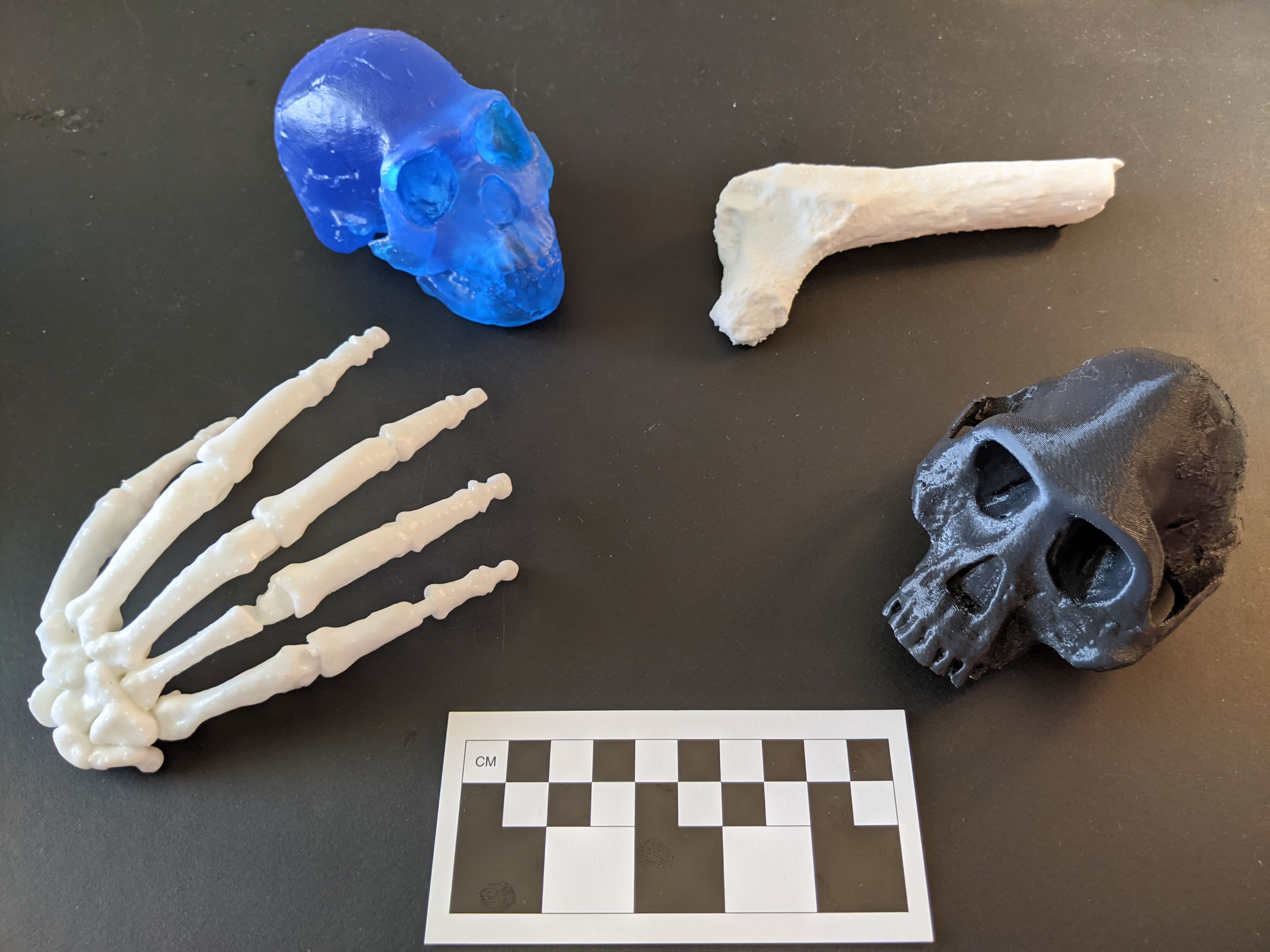
An assortment of 3D hominin prints.
Each project team will select a fossil hominin to 3D print in the Makerspace. Hominins are humans and their close extinct ancestors, including fossils dating back about 6 to 7 million years ago. Students will present their scaled prints, along with basic info on the fossil, during class in a few weeks. This project was inspired by the inclusion of 3D scans of Homo naledi in Morphosource, a database of 3D scans of fossils and biological specimens hosted by Duke University. Since the Homo naledi scans were made available in 2015, many additional fossil scans have been added, including other hominins.
CT scan of a Neanderthal from Duke University’s Morphosource databank.
During our September 2021 visit to the Makerspace, Ms. Wessner introduced us to Nefertari: Journey to Eternity-A Tombscale VR Experience. VR technology uses a headset interface so users can experience a virtual world, in this case an Egyptian tomb that has been scanned and recreated. We also discussed The Dawn of Art, Google’s VR version of Chauvet Cave in France, featuring some of the world’s oldest cave paintings.
Human Origins students got to explore Nefertari’s tomb in VR or Virtual Reality.
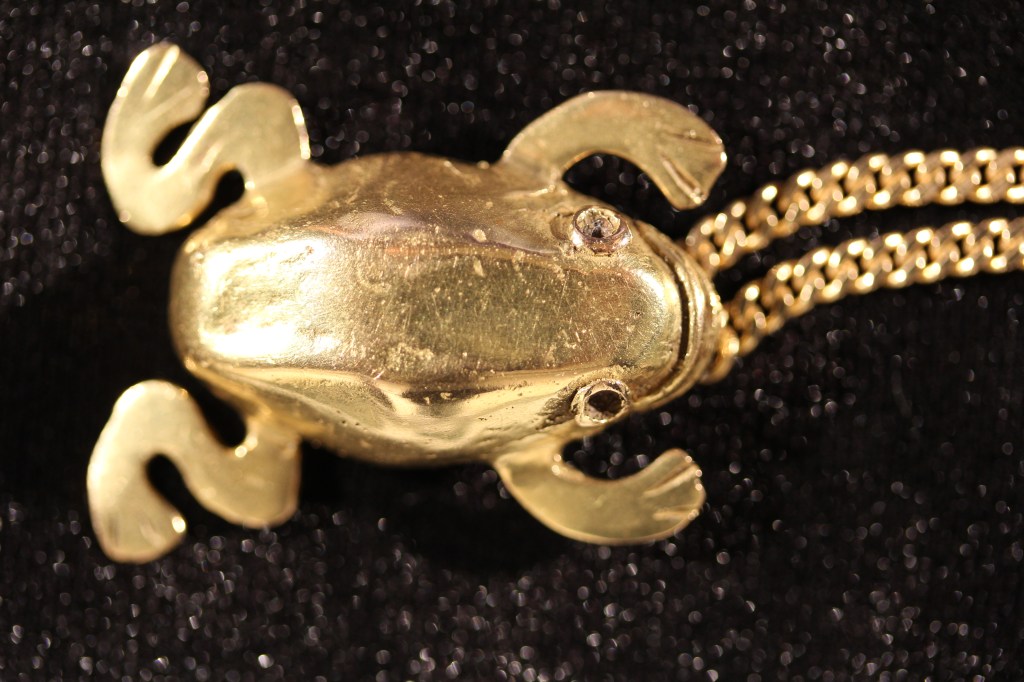
Several months ago, I was connected with a PA alum who wished to donate a piece of Pre-Columbian Mesoamerican jewelry to the Peabody Institute. It is a gold pendant in the shape of a frog with a slightly unclear origin. It had been passed down within the family and was variably attributed to the Maya, as well as cultures in Panama and Columbia. The owner had the pendant appraised for insurance purposes in the 1960s and again in the 1980s. Each appraisal identified a different culture of origin and left me a little confused.
Now, admittedly, I know relatively little about Pre-Columbian Mesoamerican jewelry and was out of my depth to evaluate this potential donation. Thank goodness for networking!
My first step was to reach out to a couple members of the Peabody Advisory Committee who have expertise in Mesoamerica and Peru. Even if they could not identify the cultural origin of the pendant, I knew they could point me in the right direction. In collaboration with the Peabody’s director, Ryan Wheeler, it was decided that I should reach out to a professor emeritus, Dr. John Scott, at the University of Florida for evaluation. That was a solid plan.
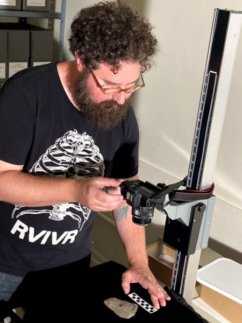
Lots of photos were taken of every part of the frog pendant.
The final piece of the puzzle was to determine if the frog was actually made of gold. Again, that is outside of my expertise and I needed to find some help. Fortunately, Andover is home to several amazing jewelry stores. The wonderfully helpful Vice President of Service at Royal Jewelers, Dina, came to my rescue. She hooked me up with a jeweler who had technology to identify the metallurgic components of the pendant without causing any damage. Technology is great!
The result is that the frog is a mixture of gold and copper that is typical of tumbaga. Tumbaga is the name for a non-specific alloy of gold and copper that is very common in Lower Central American manufacture. The frog is 1,200-500 years old and probably originated in the Central Highlands or Atlantic Slope of Costa Rica.
The next step is to present all this information to the Peabody Collections Oversight Committee (PCOC) in October. The PCOC will then vote on whether or not to formally accept it into the collection. Hopefully, this frog will be making an appearance in a classroom soon!
Note – if you would like to learn more about Latin American art, check out some of Dr. Scott’s publications:
In the June 17, 1938 issue of The Phillipian, it was announced that Dr. Warren King Moorehead would be leaving his post as Director of the Department of Archaeology. This brought about the end of a long and prosperous career that saw Moorehead become an integral part of the Phillips Andover community and a major contributor to the field of archaeology as a whole.
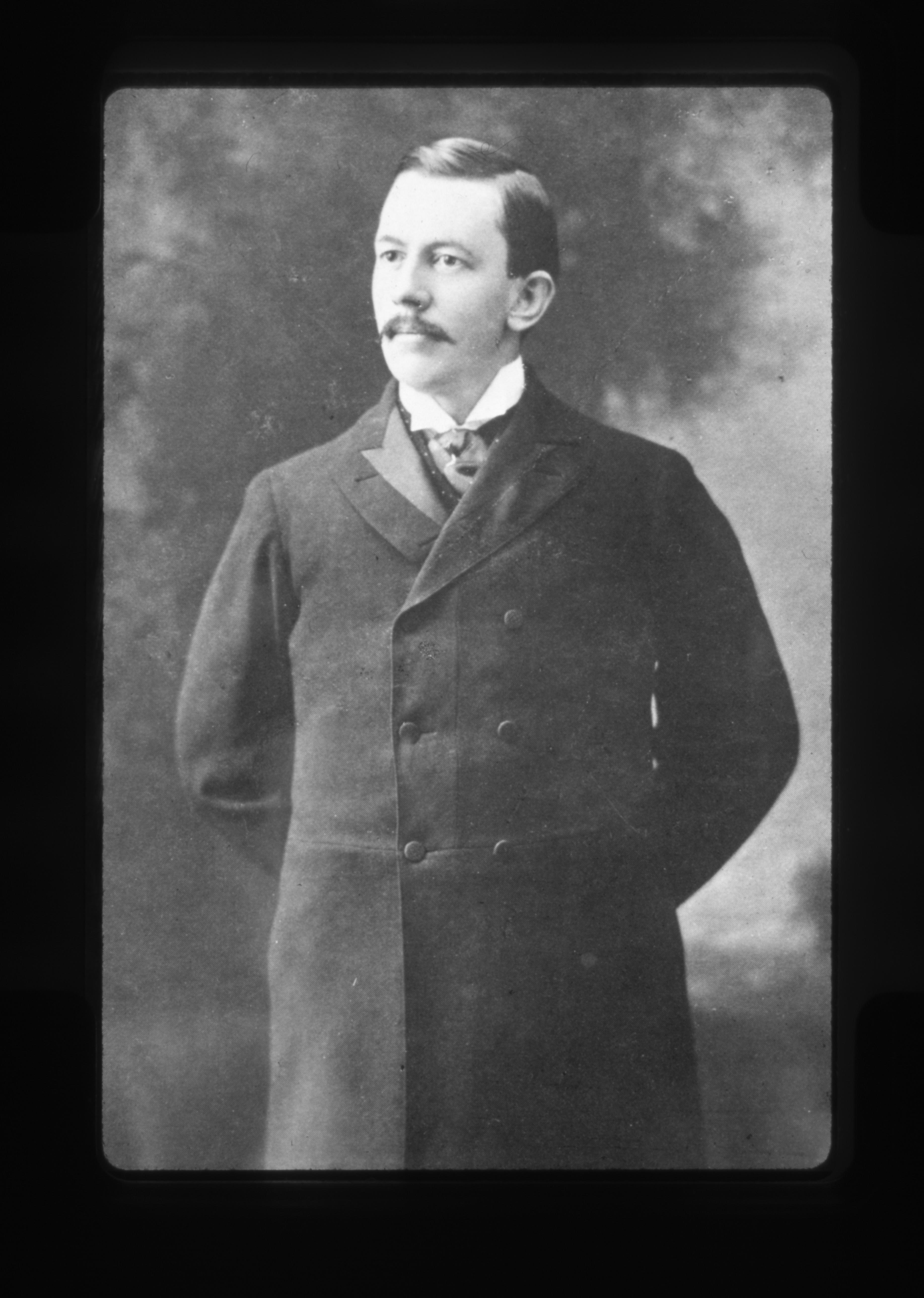
Portrait of Warren K. Moorehead, 1898
Moorehead began his career in the 1880s when he studied at Denison University before becoming an assistant at the Smithsonian Institution and later the curator of the Ohio Archaeological and Historical Society (now the Ohio History Connection). He joined the Department of Archaeology at Phillips Andover at its inception in 1901 and was appointed as the first curator. In fact, he worked closely with Robert S. Peabody, the Department’s founder, to develop the idea of such an institution. During his time as part of the Department, Moorehead received a Master of Arts from Dartmouth and was made a Doctor of Science in 1927 by Oglethorpe University and again in 1930 by Denison University. He became the director of the Department after Dr. Charles Peabody stepped down in 1924.
The article that announces Dr. Moorehead’s retirement is not particularly long but does highlight some of the important aspects of his career. The article spends a majority of its content on his education and on his path to becoming the director. The article does include some of his other accomplishments, such as a partial list of publications, and a mention about his work with the US Board of Indian Commissioners. The article concludes by saying that his position within the archaeology community is undisputed and that he will be travelling to Europe with his wife for the summer.
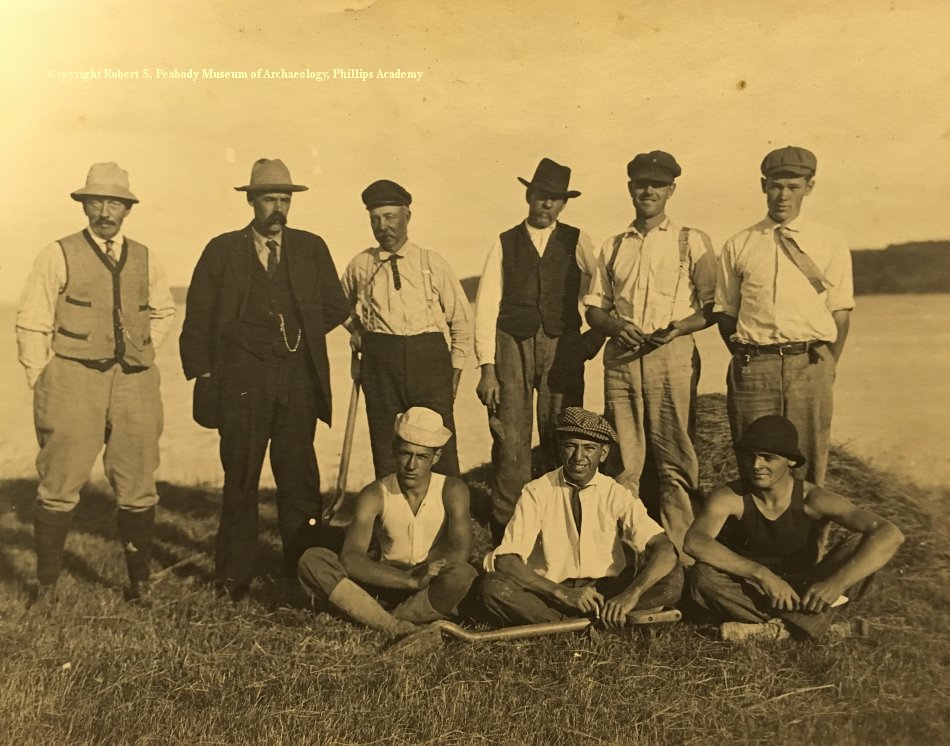
Warren K. Moorehead (far left) with an excavation group
Personally I was surprised with how Moorehead’s departure was presented in The Phillipian, particularly the brevity in which they describe his career. In the numerous issues of The Phillipian throughout the years that I have researched, it became clear just how much Moorehead fought for the rights of Native Americans and how he fought to bring the injustices committed against them to light. This was a frequently recurring topic for Moorehead and yet receives one sentence in his retirement article. This also occurs with his numerous archaeological discoveries from across the country. A significant aspect of Moorehead’s career was his participation in and leadership of numerous excavations and expeditions over the years and, unfortunately, that aspect receives little attention in this article, such as his work throughout New England, the Midwest, and Southeast. Although his methods do not meet today’s standards, Moorehead made multiple important contributions to the field that went unmentioned in his retirement article.
I think that the reason I was so surprised was that the reception that Moorehead received in this article differs from most of his other appearances in The Phillipian. Many of the articles that featured Moorehead over the years went into a fair amount of detail. Whether it was discussing a lecture or one of his expeditions, the reader was usually given more information. Moorehead was seemingly respected and well liked by the students, as evidenced in numerous articles praising his lectures, yet the announcement of his retirement is rather straightforward and relatively unemotional. One possible reason for this could be declining student interest in the Department over the few years prior to his retirement and his habit of giving very similar lectures every year. Moorehead’s sendoff did not mirror his depiction in previous issues of The Phillipian.
Warren King Moorehead was a staple of the Department of Archaeology from its inception in 1901 until his retirement in 1938 having served as both the curator and then as the director. He retired at the age of 72 and spent his brief retirement with his family before passing in January of 1939.
Check out the following Peabody blogs for more information and history about Warren K. Moorehead.
After I’ve spent nearly two years (minus five months of remote work) working to complete the inventory of the Peabody collection, we are so close to finishing! It has been a long process which wouldn’t have been possible without one thing: podcasts.
During those long hours cataloguing in the Peabody, it can get very quiet—and sometimes slightly creepy when you’re working alone in the basement of an old building which tends to make strange noises. Enter: podcasts, which not only help to pass the time but drown out any creepy noises or the sounds of disembodied footsteps coming from upstairs.
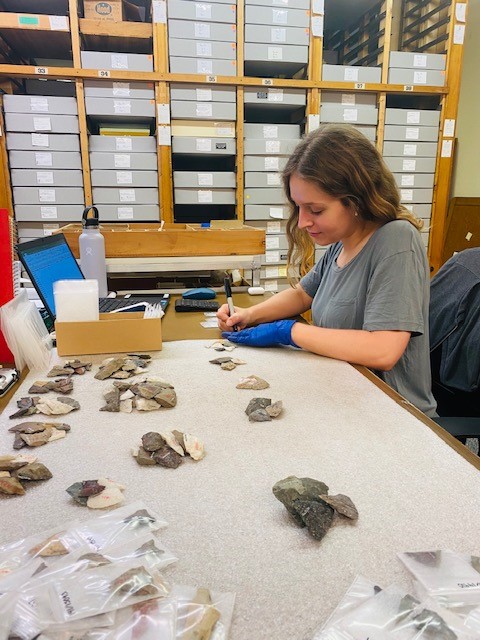
Here I am cataloguing and rehousing material in the Peabody Collection.
I had never listened to a podcast before working here, but now I can definitively say I am a podcast aficionado! I’ve spent the last two years listening to a wide variety of podcasts from beginning to end—some of which had six years’ worth of episodes to catch up on. I’d now like to share them with you in case anyone is in need of hundreds (possibly thousands, but I don’t want to do that math) of hours of listening material.
As a disclaimer, some of these podcasts do use explicit language so I have written an (E) next to each title which indicates that the podcast does use explicit language.
This podcast tells some of the darker stories from American history, from little known tales like the rainmaker who flooded San Diego to the only successful coup d’états to date. You’ll definitely learn some interesting stories that didn’t make it into our history books as kids.
Hosts Scott and Forrest investigate all things mysterious in this (sometimes very long) podcast. From strange disappearances to ghost stories to UFOs to Bigfoot and all things in between, they do incredibly deep dives to investigate evidence for and against these curious tales. The Peabody’s own Warren Moorehead was even mentioned in an episode exploring the legends of giants (if you haven’t already, check out the blog post I wrote about it). Two of my favorite topics they’ve covered are the disappearance of Amelia Earhart and the Dyatlov Pass incident.
This interview show features inanimate objects as guests, who tell their life stories and what it’s like to live like them. One of my favorite episodes is Lillian, a Song and Chioke, who was a grain of sand in his first episode, before being transformed into a pane of glass for his second episode.
This 12-episode immersive podcast series follows the investigation of Ryan Bailey, who is accidentally thrust into the secret world of mythical faeries. Join her as she unearths more of their secrets and the agency that is supposedly charged with protecting them.
In this weekly podcast, host Jonathan Van Ness (one of the hosts of TV show Queer Eye) sits down with an expert to talk about anything and everything he is curious about. Topics include politics, animals, social justice, history, and pretty much anything else you could think of. My favorite episodes are the ones where he explores the ancient histories of the Mediterranean, Egypt, China, and Mesoamerica. He has also done two very interesting episodes titled “How has the U.S. disrupted Native American food sources?” and “How are contemporary Native Americans thriving?”. With such a broad range of topics, there’s something for everyone and Jonathan’s hilarious quips and dynamic personality make it so fun to listen to.
This podcast tells the most entertaining and enraging stories from Greek and Roman mythology, told casually, sarcastically, and from a contemporary lens. Host Liv focuses on not only the wild things the Gods did, but also the rampant mistreatment of the women present in these stories. She also has very interesting conversations with authors and classicists to talk about their perceptions of the myths. Some of my favorite episodes are the series on Cupid and Psyche and the Medusa episodes.
In this bi-weekly podcast, host Aaron tells true-life scary stories. In these dark historical tales, he explores mysterious creatures, tragic events, and unusual happenings. Due to the success of the podcast, it was actually adapted into several books and a TV series!
From serial killers to disappearances, hosts John and Daryn break down these cases while Matt the Bartender mixes up drinks, making a heavy subject a little more palatable with their sense of humor. Unfortunately this podcast is no longer making new episodes, however there’s four years of weekly episodes for your listening pleasure!
This podcast features the stories of some of the most fascinating nobles and royals in history. Host Dana tells tales of tyrants, ill-fated love affairs, family drama, bad decisions, murder, and so much more. My favorite episode is titled “From Poland with Love” about noblewoman turned World War II spy, Krystyna Skarbek, but all of the episodes are incredibly interesting and paint a different picture of some royals than what you may have learned growing up.
In this weekly podcast, hosts Sara and Danny break down crimes of all kinds—murders, disappearances, cults, scams, and conspiracies—with a healthy dose of humor. My favorite episodes are the ones exploring cults, especially lesser-known cults, such as the Yellow Deli Cult and the Love Has Won Cult.
Hosts Katie and Nathan tell the stories of queens (and sometimes mistresses and other noblewomen) from history, from the well-known like Mary, Queen of Scots, to the lesser-known like Ranavalona. Their stories trace these women’s lives from birth to death, through tragedy and triumph, despite the unfortunate lack of information that was kept about some of these women. As a disclaimer, the first few episodes are actually very hard to listen to because of poor audio quality (they were still figuring things out!), so maybe skip ahead a few episodes if it bothers you. Some of the most interesting episodes in my opinion are on Sayyida Al Hurra, Boudica, and Victoria Woodhull.
In this true crime podcast, hosts John and Daryn (previously from Martinis and Murder) have rebranded and are back to tell more stories of disturbing crimes that leave us shaken, complete with their drinks and sense of humor.
Host Kate takes listeners on a time-travelling journey through history, one era at a time. She explores what life would have been like for women during these times, both the famous ones and the obscure. If you’ve ever wondered what ancient Romans ate for breakfast, what a day in the life of a Civil War nurse was like, or what the beauty routine of an ancient Egyptian was, then this is the podcast for you! I just finished all the episodes and am absolutely obsessed with it. I only wish there were more episodes for me to listen to!
In this immersive podcast experience set in a creepy old library, host Miranda Merrick and her dear friend Mr. Darling tell stories of the shadowy, mysterious, and macabre. From bog bodies to ancient books and curses, and from poison to demons, this podcast is perfect for anyone looking for something a little spooky.
In this eight-part series, host Anne travels to her hometown of Springfield, Missouri to follow up on an unsolved crime. On June 7, 1992, Sherrill Levitt, her daughter Suzie Streeter, and Suzie’s friend Stacy McCall all disappeared from Sherrill’s home, seemingly without a trace. Nearly thirty years later, there are still no answers for the women’s families. Follow Anne as she traces the stories of these women and how their disappearance changed this small town in the Ozarks forever.
This story-based podcast explores a new unexplained mystery each week, taking listeners on a journey through the strange and often eerie. Through bizarre tales of time-slips, mysterious disappearances, unexplained deaths, dabblings in the occult, and so much more, host Richard examines the nature of reality and the human condition. Some of the most interesting episodes in my opinion are “The Last Flight” about the disappearance of Frederick Valentich, and “When the Snow Melts” about the Dyatlov Pass incident (Astonishing Legends also did a deep dive on both of these topics in their podcast).
The Vanished (generally not explicit but some episodes do include explicit language)
This true crime podcast covers the stories of missing persons, generally lesser-known ones who may not have gotten much attention in the media. Going beyond conventional news reports, host Marissa dives into the story of each missing person, including interviews with family members, friends, and law enforcement. This podcast can be very sad to listen to but, like the host, I believe it’s important to keep the stories of these people alive so that hopefully one day their family can get closure.
Hosts Mike and Sarah reconsider past events or people that have been miscast or misrepresented in the public imagination and/or by the media, all with some sarcasm and a great sense of humor. This show has really changed my perception of so many things I thought I knew, from maligned women of the ‘90s to stranger danger. I love all of the episodes so it is very hard to pick any favorites, however some of the most interesting are “Human Trafficking”, “Tonya Harding”, “Political Correctness”, and the series on Princess Diana. I think this is probably my favorite podcast out of all I’ve listened to so I highly recommend it!
I hope that in sharing all of these with you, you can find something new and interesting to listen to and perhaps will learn some new things!
Like for so many of us, this summer has been a rather abrupt transition back to “normal” at the Peabody.
I returned to the office full time in July and had to hit the ground running to help support the other Peabody staff, welcome researchers, jump back into giving tours, and provide back up for Summer Session activities. It has definitely been a transition, but it feels good to have students, researchers, and volunteers back at the Peabody!
For the entire month of July, the Peabody hosted the Summer Session class Dig This! This Lower School initiative takes a closer look at different global case studies from across the ancient world to hone skills and understanding as a historian and archaeologist. Students then get to take part in excavating the lost Mansion House of Phillips Academy – the home of Samuel Phillips. It is always great to see these students get excited about archaeology every summer!
Dig This! students and faculty hard at work
Beyond that, it was a joy to welcome our Cordell Fellows for 2021 – Dr. Arthur Anderson and Dr. Gabe Hrynick. Their research is on the Peabody’s Northeast Archaeological Survey conducted partially in Down East, Maine in the late 1940s. I won’t try to summarize their work here, but will instead refer you to a blog they contributed a couple years ago. Their work in July focused on fully documenting one site, Thompson’s Point. A real plus to hosting researchers is that they do some of the collections documentation work for me – I am looking forward to receiving a copy of all the item photographs they took!
Cordell research fellows – Dr. Arthur Anderson and Dr. Gabe Hrynick
“Normal” at the Peabody Institute also requires our volunteers to be around. We have all missed them this past year and are thrilled to welcome back our regular collections volunteers (and new ones!)
I don’t know how the next few months will look – mask or no mask, virtual or in-person – but it has been a real pleasure to jump back into the hectic schedule of the Peabody. Stay safe and healthy, everyone!
Given the huge success of the initial seasons of Diggin’ In: Conversations with Archaeologists we are pleased to continue the digital offering through 2021! We launched the third season on Wednesday August 11th and it will run through the middle of December.
This season features ten speakers who will explore exciting topics such as maritime history, the archaeology of American protests, queer archaeology, and ableism in archaeology. The full list of speakers and topics is:
Episode 1: Reanalyzing a Mayflower Family Home Caroline Gardiner WEDNESDAY AUGUST 11, 2021
Episode 2: The Howard Street Cemetery Project and the Desegregation of American History in Salem, MA Rachel Meyer WEDNESDAY AUGUST 25, 2021
Episode 3: Oregon Chinese Diaspora Archaeology Jocelyn Lee WEDNESDAY SEPTEMBER 8, 2021
Episode 4: The Indigenous Paleolithic of the Western Hemisphere Dr. Paulette Steeves WEDNESDAY SEPTEMBER 22, 2021
Episode 5: First Baptist Church, Colonial Williamsburg Jack Gary WEDNESDAY OCTOBER 6, 2021
Episode 6: Ableism in Archaeology Dr. Laura Heath-Stout WEDNESDAY OCTOBER 20, 2021
Episode 7: Creole Maritime Archaeology Dr. Lynn Harris WEDNESDAY NOVEMBER 3, 2021
Episode 8: Using Queer Theory in Archaeology Gabriela Oré Menéndez WEDNESDAY NOVEMBER 17, 2021
Episode 9: Origins of Food Inequality and Equity Dr. Kimberly Kasper WEDNESDAY DECEMBER 1, 2021
Episode 10: Archaeology of American Protests Dr. April Beisaw WEDNESDAY DECEMBER 15, 2021
And, hot off the press is an article that I wrote with Massachusetts Archaeological Society Trustee Suanna Crowley for the New England Museum Association’s digital publication about the impact of Diggin’ In. You can read the article HERE.
My name is Adam Way. I am currently a graduate student at the University of New Hampshire and am working towards my Master’s Degree in Museum Studies. This summer I am working as an independent researcher for the Peabody Institute looking through old Phillipians to see how the Institution has been perceived and presented by Phillips Academy students over time.
This is me on the Cadir Hoyuk archaeological site located in central Turkey in 2018.
In the modern day, there are a number of factors that determine the best place for an artifact or specimen, whether it is in a museum, either private or public, or with the people for which the item has cultural significance. This, of course, has not always been the case. For a long time, the mentality regarding the storage, display, and ownership of artifacts was similar to that expressed in Indiana Jones and the Last Crusade: “It belongs in a museum.” This mind set and practice is certainly present during the early years of the Archaeology Department, now the Peabody Institute, and is reflected in the publication of its various acquisitions in the Phillipian.
There are numerous ways that a museum or institution, such as the Peabody, can increase the size of its collections. These methods include donations, purchasing and exchanging of collections, and conducting archaeological expeditions. Through these methods, the Peabody was able to amass a collection of around 81,000 specimens within its first twelve years of operation (according to the Founders’ Day issue of the Phillipian from Oct 11, 1913).
Phillipian Article, October 11, 1913
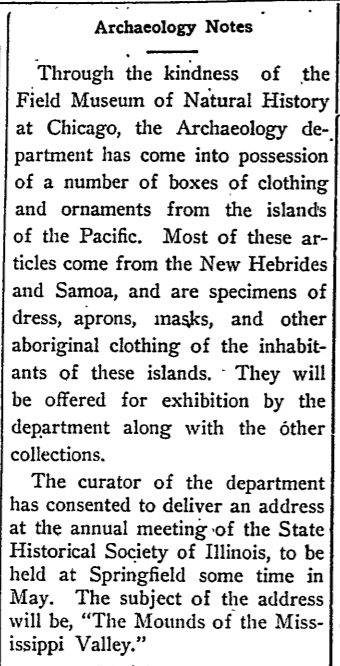
While looking through the issues of the Phillipian, it quickly became clear to me that two of these methods of acquisition occurred more often than the third – donations and purchases/exchanges. Donations played a key role during the early years of the Archaeology Department and its collections as they allowed for the collections to grow without draining their available funds. The Department received donations from both individuals with private collections as well as from other organizations. This can be seen in instances like the gift from the Field Museum of Natural History in Chicago, where a sizable donation of clothing and ornaments from the Pacific Islands was made in March of 1910 (although these are not currently present in the Peabody’s collection). While donations like this did occur, it was much more common for individuals to make donations from their own private collections. These gifts tended to be smaller in size but would still dramatically impact the total collections due to the overall volume.
Phillipian Article, March 12, 1910
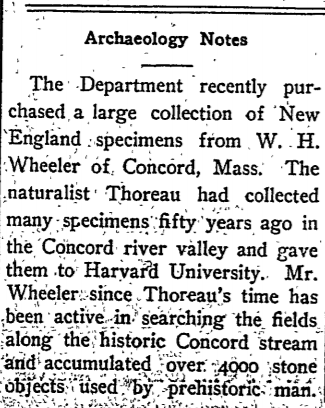
The other means of acquisition that occurred often was the act of purchasing collections or engaging in a trade. For example, In the Feb 1 issue of 1913, it was announced that Moorehead had traveled to Yarmouth, Maine to secure a collection from an Arthur Marks, Esq. By securing this collection, Moorehead added roughly 2000 specimens to the Department’s total collection. This was also only a few months after they had purchased another collection from W.H. Wheeler of Concord, MA. The Wheeler collection consisted of over 4000 objects from around New England and was the largest single purchase by the Department in the region.
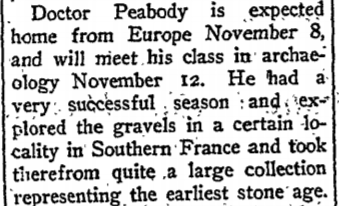
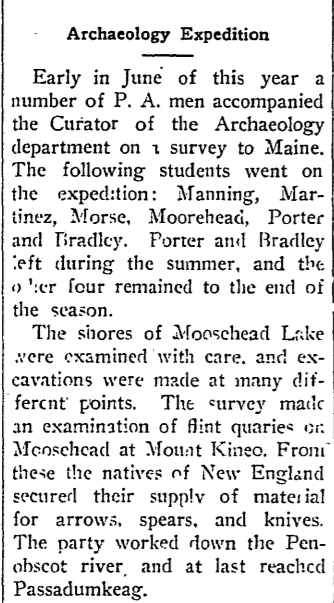
The last way that the Department expands their collection is through sponsored archaeological expeditions. This method of acquiring new specimens definitely occurs less often than the other two methods, especially at first, but becomes more frequent as time goes on. According to the articles in the Phillipian, the specimens retrieved from archaeological digs was fairly limited at first. They mainly came from Moorehead and Peabody’s research expeditions, both throughout the States and in Europe. It was mentioned several times that both men shipped collections of varying sizes back from Southern France. The number of domestic digs did increase as the years went on as Moorehead started a yearly expedition to Maine that brought in roughly 1000 specimens in the first year alone (1912). This specific expedition would prove fruitful for Moorehead as he returned many times in the coming years. In addition to Moorehead’s expeditions, there would also be collection trips where a member of the Department would be sent to a region, such as Eastern Massachusetts, and would be tasked with finding artifacts from old sites. These trips were quite common and could bring in up to 8000 artifacts in one year (1912-13).
From what I have seen in the Phillipian’s coverage of the ever-expanding collection, these methods of adding to the total collections of the Department contributed roughly the same amount. The amount of donations and purchases of collections far outnumber the number of archaeological expeditions; however, they are often much smaller in size. The balance of these three methods is subject to change as I have only read what has happened in the early years of the Department. It is nonetheless impressive how the Department was able to amass such a large collection in such a small amount of time.
In July, I start to think about the upcoming fall course Human Origins. Last year I spent most of the summer retooling the course into an online experience. I owe a lot to the advice of my spouse, who passed along many of her experiences teaching online in spring 2020. I was pleased with the result—an iterative, assignment driven course, taught exclusively online, that even managed to keep some hands on activities. In fact, I plan to keep many elements of the online course—students in the fall will use Padlet for many of their assignments, we will dedicate at least two weeks to flint knapping, and we will keep the three major themes: pseudoscience, human evolution, and race. I will continue to look for ways to decolonize the syllabus as well. Considering the frequency of new discoveries (Google “Dragon Man,” for example), the focus is more on how to think about human evolution, rather than the details. The frequent new discoveries in the field continue to challenge the two competing models of human evolution, making us wonder, maybe we really need a new theory?
3D prints of fossil hominin skulls made by students in Human Origins, fall 2019.
I hope that we can revisit 3D printing again in the fall. Once many of the skeletal elements of Homo naledi became available on Morphosource, 3D printing became part of the course. For a few years, we visited the campus makerspace and looked at prints of Homo naledi’s more unusual features, including the hand and femur. In fall 2019, students worked in teams to 3D print their own miniature versions of fossil human skulls, learning details about each find and species as part of the assignment. Those miniature 3D prints got me thinking about earlier models and teaching tools for this subject, and my own first interests in human evolution.
Part of the foldout “March of Progress” graphic from Time Life’s Early Man book, circa 1970.
My first inkling that human evolution was something to be interested in came from a mid-1970s rebroadcast of a documentary called Natural History of Our World: The Time of Man (first aired, December 14, 1969). I wanted to watch this for two reasons: 1) Richard Basehart, who played Admiral Nelson in one of my favorite TV shows, Voyage to the Bottom of the Sea, provided the narration, and 2) I wanted to know more about the fossils shown in the teaser ads! I think my parents were a little baffled, but they let me stay up and watch it. I don’t remember much about that show, but it included some pretty incredible shots of volcanic activity and, of course, Basehart’s distinctive voice. Not long after that, my dad brought home a set of the Time Life nature books, with the 1970 edition of Early Man right on the top (it looks like Early Man was first published in 1965, but there were many reissues). That book captivated me! Books on dinosaurs, fossils, and evolution (for someone who was a kid, or perhaps anyone, really), were in short supply in the 1970s. I still share that book with students in Human Origins, and we talk about the many errors of the “March of Progress” graphic that launched a thousand memes. For a kid in the ‘70s interested in evolution, that book—authored by a serious scientist, H. Clark Howell—was a treasure.
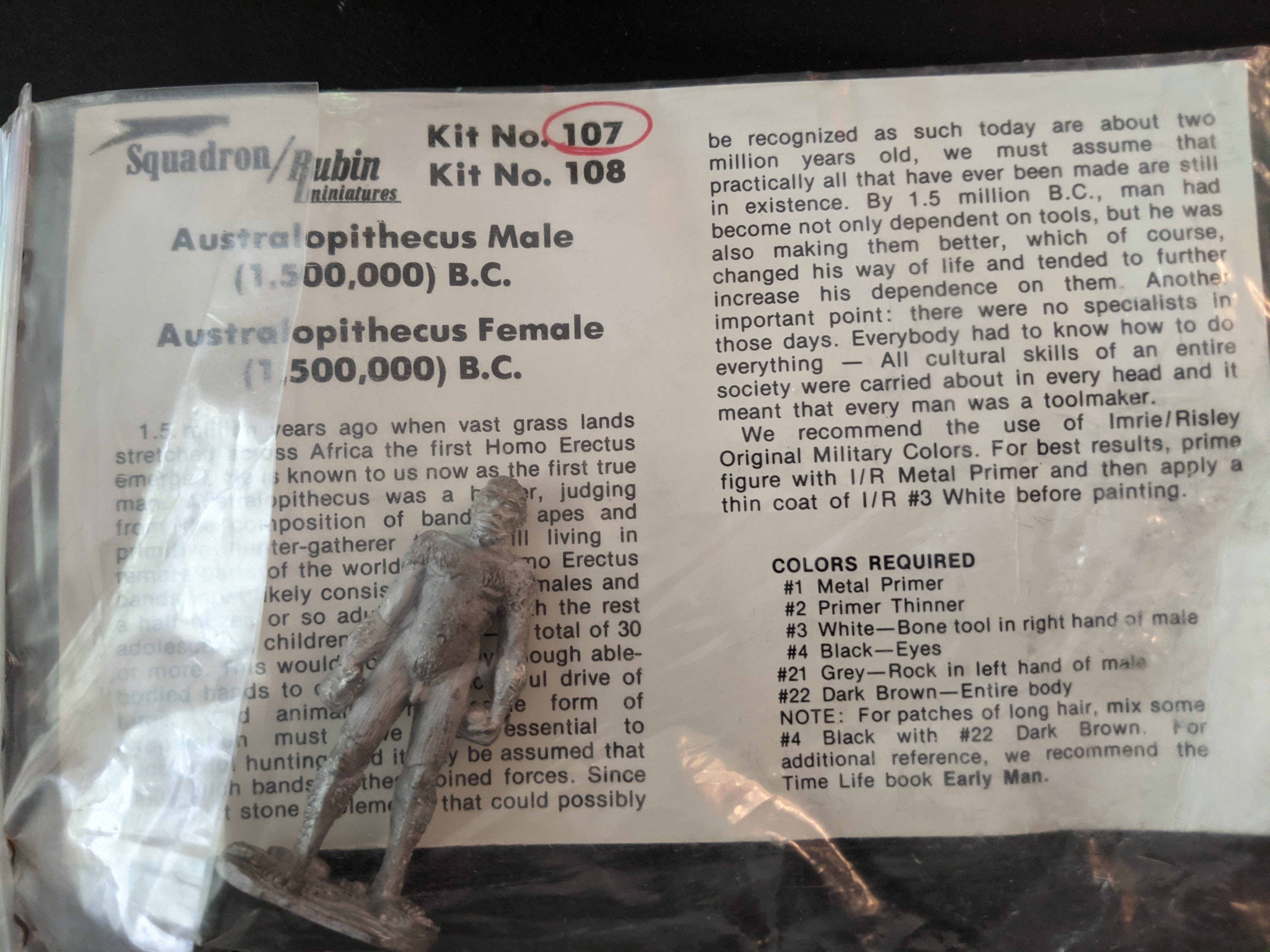
Squadron Rubin’s “Neanderthal man” figure with original packaging and color chart.
So imagine my delight when I found a tangible, material version of those fossil people. The discovery was in an unlikely place—the local hobby shop. I was interested in model kits, but the little metal figures of warriors, Vikings, and dragons were especially exciting. These were becoming more popular with the rise of the role playing game Dungeons & Dragons, and various alliances and licensing deals between the D&D publishers and companies like Grenadier who made these miniatures, or minis. There among the heros and monsters of D&D (think of the current TV show Stranger Things), were some old stock made by a company called Squadron Rubin. These were figures of all the fossil humans found in the pages of the Time Life Early Man book, and the color cards even referenced the book! Some Googling indicates that artist, sculptor, and businessperson Raymond Rubin was behind these figures. The main figures made by Squadron Rubin were of historical soldiers, spanning the Picts to Vietnam and every period in between. The idea was that you could buy these, glue as necessary, and paint following the color chart provided, building up your army. Eventually Rubin collaborated with others to launch Grenadier, the company that dominated the metal miniature business for a while. I wish I knew more of the story behind how the world of metal miniatures intersected with human evolution, but I was happy that it had!
The Squadron Rubin Australopithecus male figure with color chart!
The Squadron Rubin fossil people are 1:32 scale, so most are around or just under 2 inches tall. And, they aren’t frenzied savages like the “cavemen” depicted by Frank Frazetta or other artists around the same time. The artistic recreations in the Early Man book supplied the inspiration, and the figures are usually just posing, often in male-female pairs. I’ve managed to locate examples of Squadron Rubin Neanderthals, Australopithecines, and Cro-Magnon people, and I suspect there were other species depicted as well. Occasionally, they turn up on eBay.
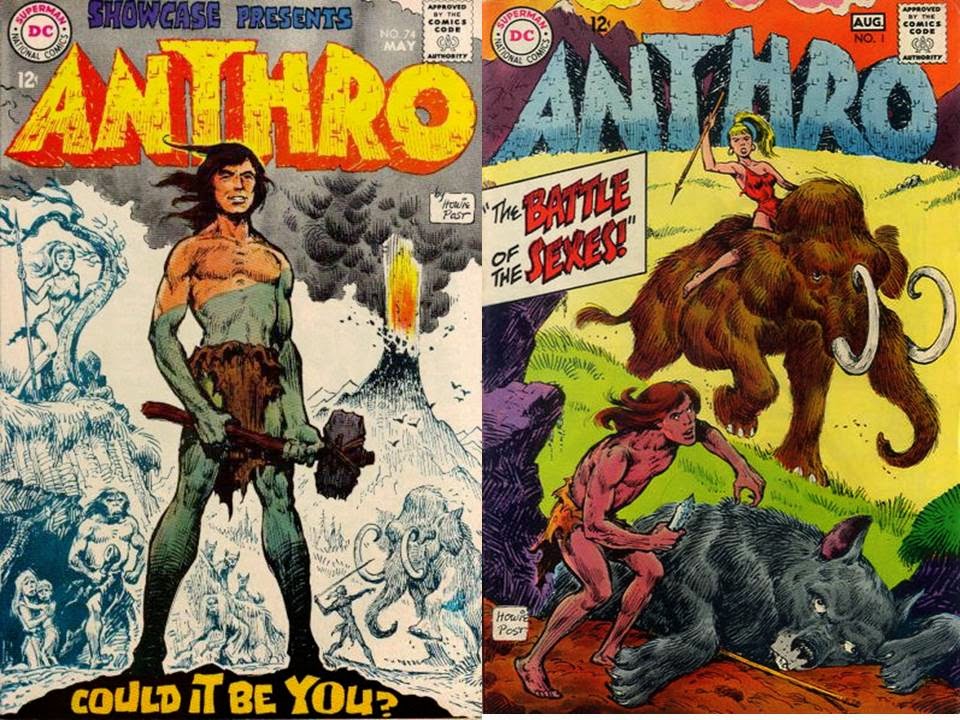
Covers from DC Comic’s “Anthro,” which pitted the first Cro-Magnon (or modern human) against an array of cave brutes and prehistoric monsters, late 1960s.
The Squadron Rubin figures, along with the many other depictions of fossil humans in popular writing, TV ads, comic books, movies, artwork, and sculptures give us a glimpse into thinking about human evolution and fossil people through time. I often ask the Human Origins students to find and research examples of how fossil humans were depicted in popular culture. Are the treatments sympathetic, savage, sexualized, or something else? Often this has to do with ideas about how closely modern humans are linked to these ancient people. The recognition of genetic connections between modern humans and Neanderthals in 2011 marked one shift in our relationship to “cavemen.” Once we understood there was a connection between us and them, depictions of ancient people began to shift, becoming more sympathetic and sensitive to our ancestors. But, it depends a lot on the artist, medium, and specific circumstances.













 The Peabody