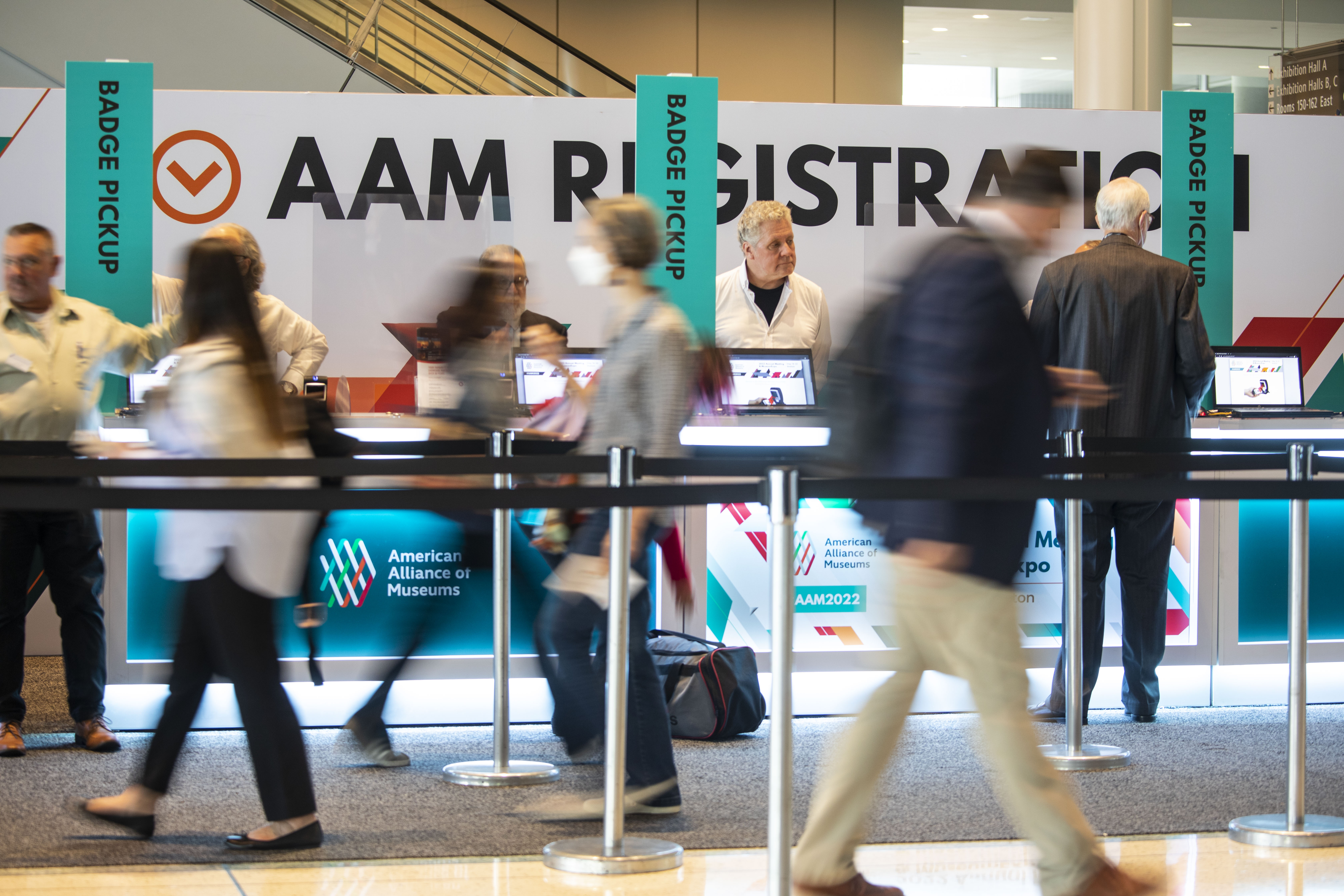
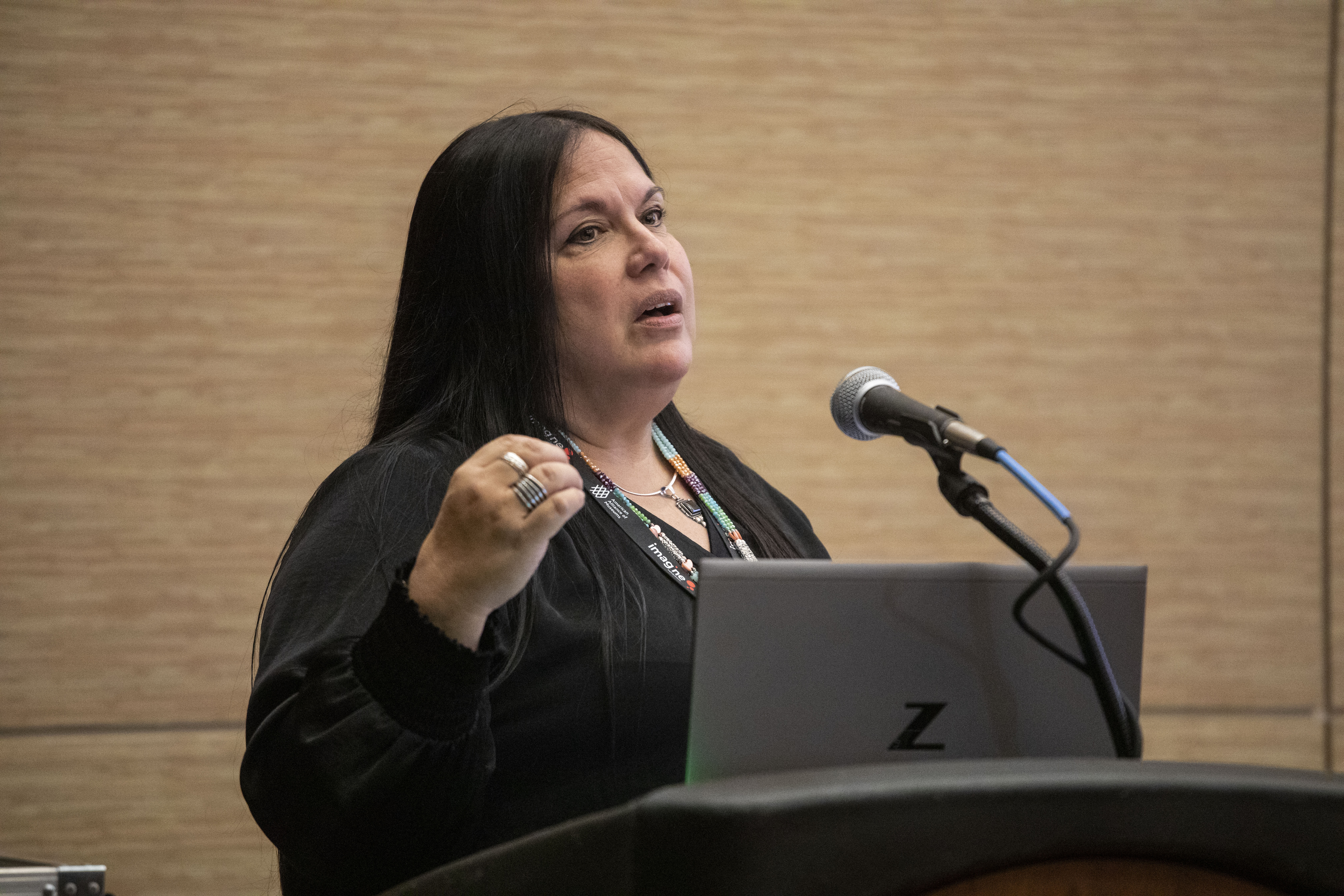
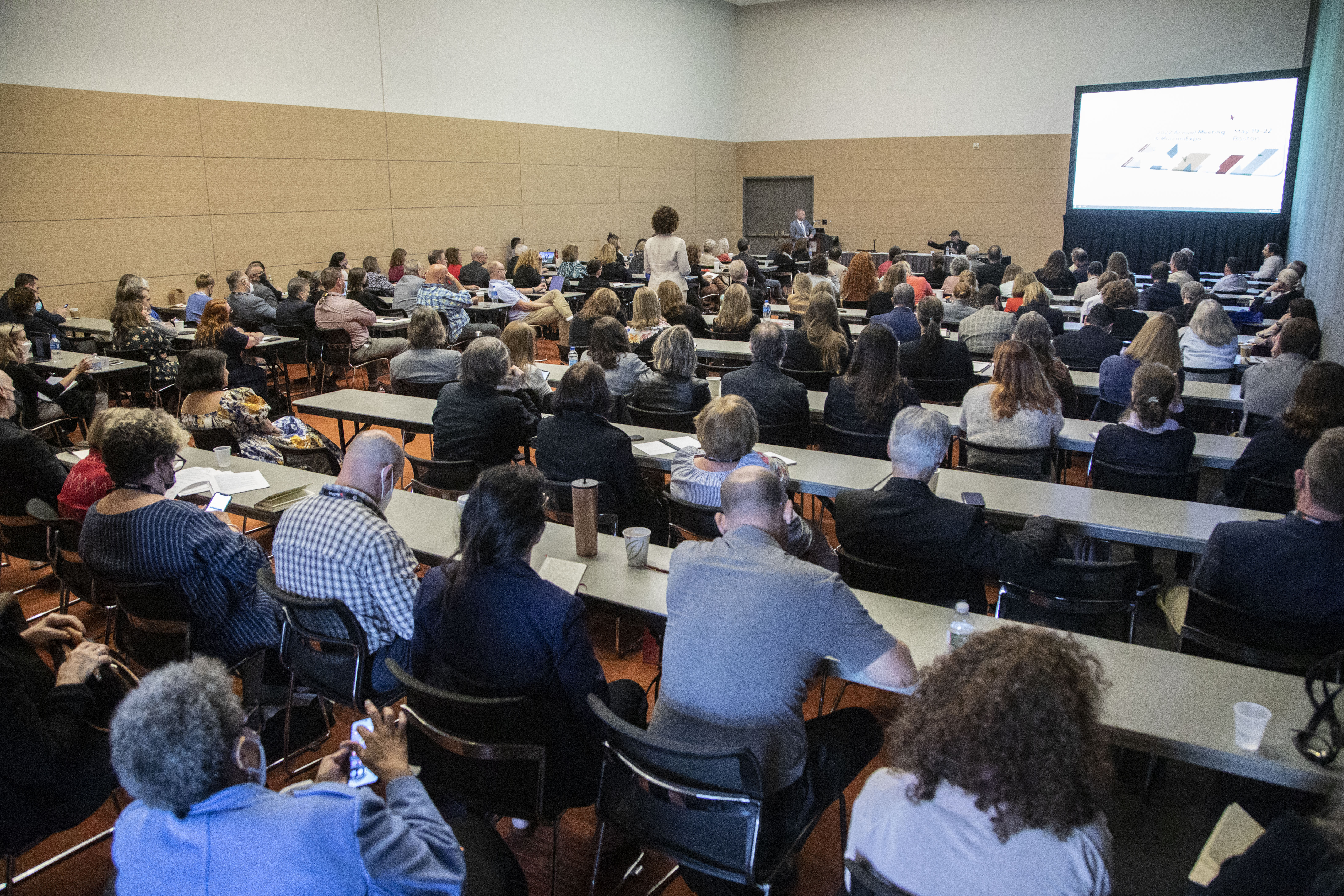
The American Alliance of Museums (AAM) held their Annual Meeting in Boston in May. Like many other conferences, this was the first in-person meeting in two years. The Peabody Institute was fortunate enough to present our work in a few different formats.
I was part of two sessions – Research Requires Consultation and Centering Culturally Appropriate Care: Re-examining Stewardship of Native American Cultural Items.
The session discussing research presented the Peabody Institute’s research policy that requires consultation and approval from an authorized tribal representative as part of any application for access to collections. You can find details about the policy here. My co-presenters were the NAGPRA Coordinator for the Osage Nation and the Senior Director of Heritage and Environmental Resources for the Seminole Tribe of Florida. Together we discussed the power of respecting tribal sovereignty by requiring these conversations about all levels of research into the cultural heritage of Native American communities.
Centering Culturally Appropriate Care presented the work of the Indigenous Collections Care Working Group (ICC) that I co-founded with my colleague Laura Bryant, Anthropology Collections Manager and NAGPRA Coordinator at the Gilcrease Museum in Tulsa, OK. The ICC has been working to develop a Guide as a reference tool for people (including museum professionals) who interact regularly with Native American collections, including those at all levels of experience and exposure. We are excited to be focusing on this conversation and developing a resource that is truly needed in the museum world. You can learn more about our work here.
Alt text: A busy registration deskAlt text: A speaker at a podiumAlt text: A full session roomAlt text: Attendees seated at tablesAlt text: Attendees in the poster hall
But I was not the only one from the Peabody Institute presenting at AAM!
Ryan Wheeler, Peabody Institute director, was part of a session called #NoMoreStolenAncestors: Repatriation and the NMAI Act. Facilitated by the Seminole Tribe of Florida, the session explored the issues with curating human remains, obstacles to repatriation, ways to improve the process. The Seminole have been pushing for policy change at the Smithsonian Institution’s National Museum of Natural History and has had some success. You can learn about their work here, here, and here.
Lindsay Randall, curator of education, co-authored a poster examining the explosive growth in digital technologies in small organizations and how it can be used to deliver high-quality content to museum audiences. The poster shone a spotlight on the Diggin’ In series produced by the Peabody Institute and the Massachusetts Archaeological Society. You can find all the Diggin’ In talks on the Peabody’s YouTube channel here.
It was an honor to share our work with our colleagues in the museum field and receive such supportive feedback. We look forward to presenting at many more conferences – hopefully in person!
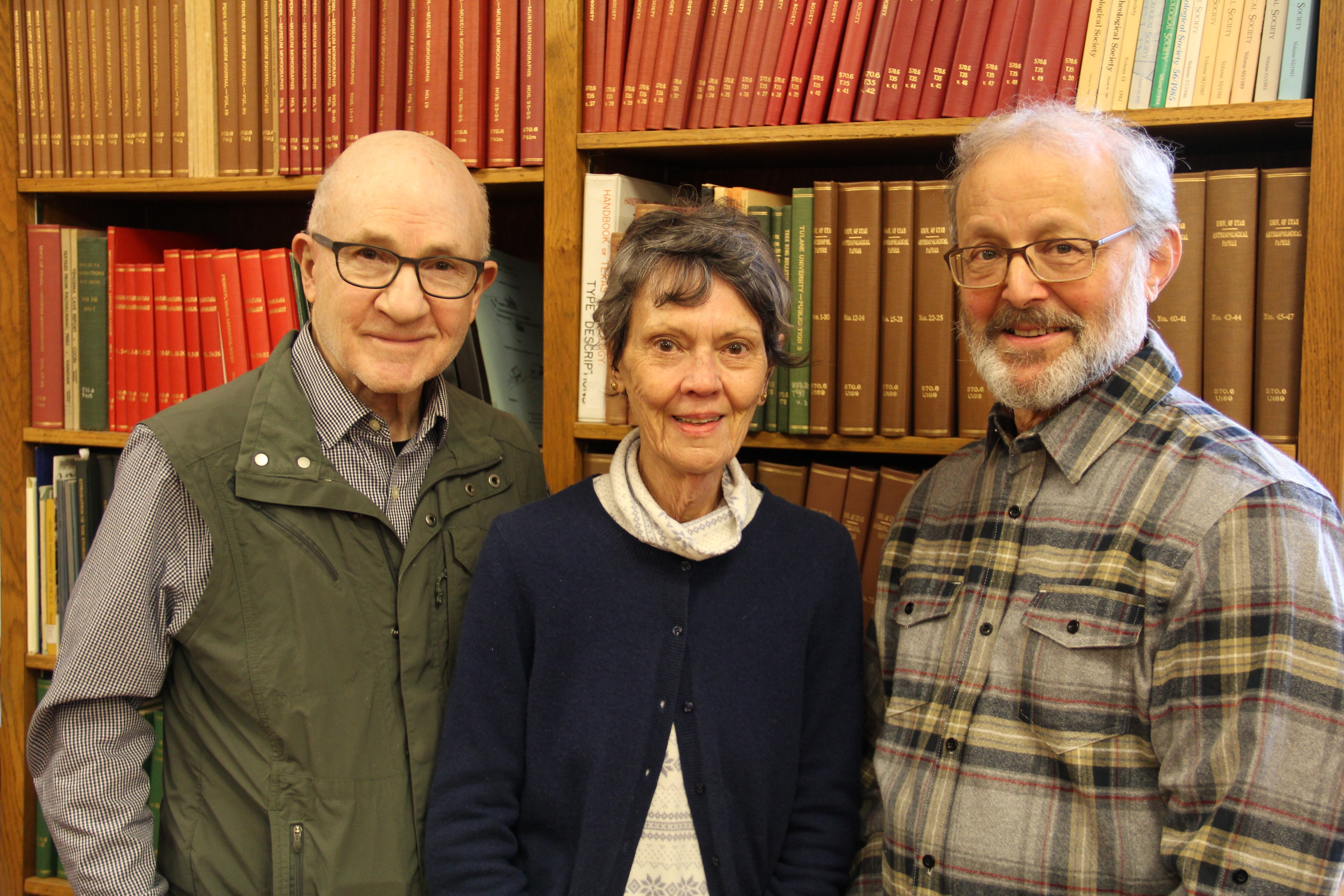
Museums are so often supported by behind-the-scenes volunteer labor and the Peabody Institute is no exception. Most of my fourteen years at the Peabody have been accompanied by two of the best volunteers you could ask for – Susan and Quinn Rosefsky.
Quinn is Phillips Academy class of 1959 and came to the Peabody for a reunion event in 2009 with his wife, Susan. There they met then director Malinda Blustain; offered their services as volunteers and have been with us ever since.
While a powerful team together, they often worked on separate projects. Quinn was a tireless force assisting with inventory of the collection. He became well versed in stone tool typology (well outside his previous career as a psychiatrist) and has never stopped learning. Quinn has also been a contributor to this blog with his perspective and thoughts on items in the collection. Here are some of my favorites that he has written:
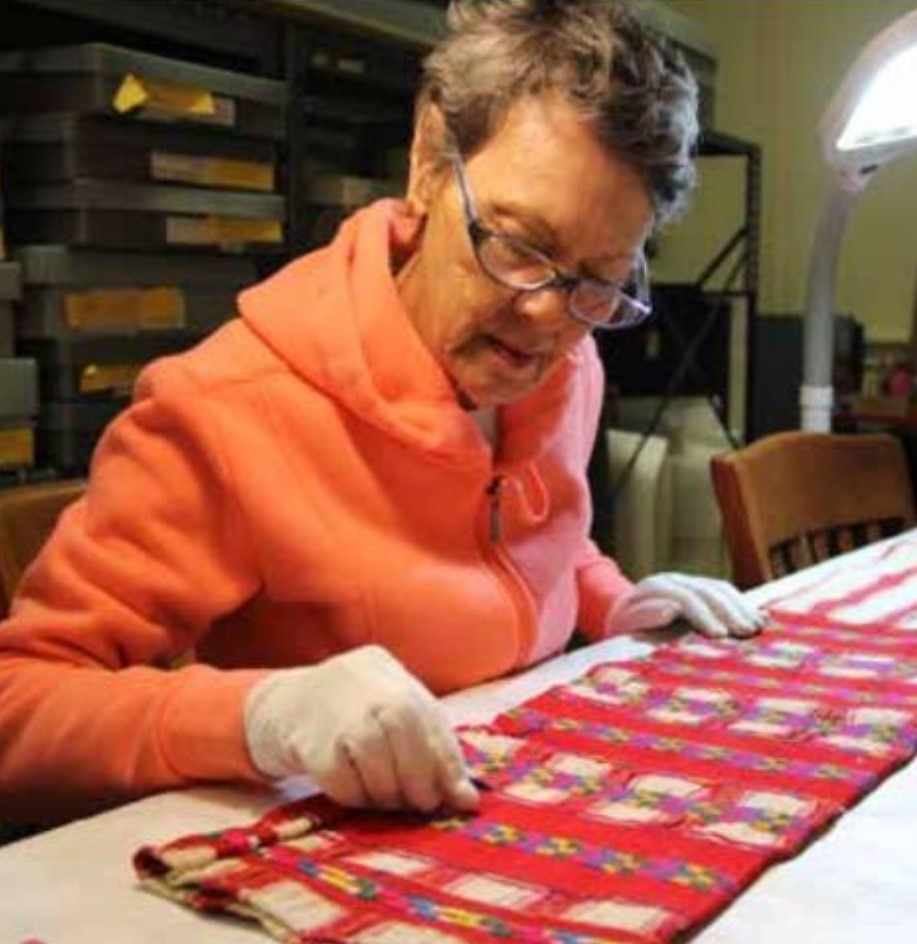
Susan, on the other hand, has been an invaluable part of the team cleaning and inspecting the Peabody’s textile collection for pest damage. Susan learned how to vacuum textiles from a local conservator and has spent years working her way through the textile collection. Her calm and focused dedication has ensured completion of this important project.
Susan at work inspecting a textile
I cannot express the gratitude that the Peabody staff have for these two wonderful people and their contributions to our work. I know that I will miss Quinn’s stories and jokes as well as Susan’s kindness and support. The Peabody Institute was lucky to have them, and we wish Susan and Quinn all the best in their “retirement!”
My name is Deirdre Hutchison, and I am currently studying for my B.A. in history at UMass Lowell. As part of a semester internship, I had the opportunity to research the provenance of several unidentified Native American photographs held by the Robert S. Peabody Institute of Archaeology. My first blog outlined initial findings and potential areas of investigation. To summarize that blog, the photos, mounted on board, illustrate a 1905 event at the 101 Ranch in Oklahoma.
As I navigated various connections, photographer James B. Kent became a more prominent fixture of my research. Kent was a regular photographer at the 101 Ranch, and the Millers tapped him to design and compile the souvenir booklet for “Oklahoma’s Gala Day” at the ranch on June 11, 1905. –. Kent, it seems, was an integral part of photography at the 101 Ranch, ultimately becoming the head of the moving pictures department by 1927.
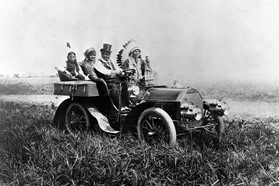
The 101 Ranch souvenir booklet is discussed by Michael Wallis in his book The Real Wild West. According to Wallis, it contains multiple images taken by Kent – including the picture of Geronimo skinning a buffalo held by the Peabody (discussed in my previous blog). The booklet also contains one of the most famous images of Geronimo, “Geronimo in an Automobile.” . Working with the archival staff at the Gilcrease Museum in Tulsa, I hope to view the images to confirm Kent’s pictures and perhaps discern other possible photo matches.
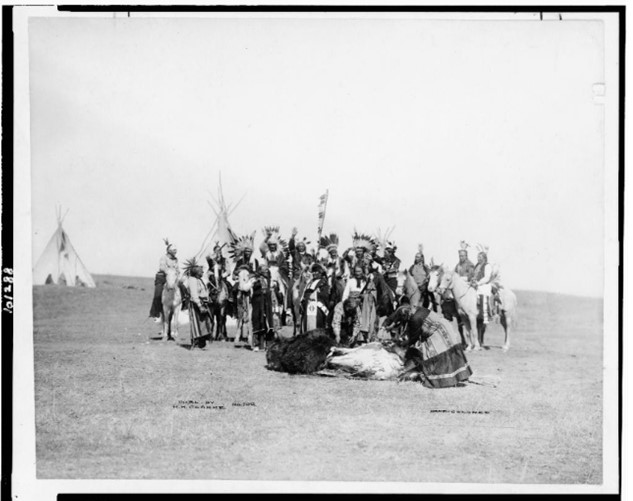
Isolating Kent’s work is relevant because he was not the only photographer working at the famous extravaganza on June 11, 1905. The Millers masterfully orchestrated spectacle – 65,000 people attended – could not be supported by just one photographer. Multiple photographers were present capturing various promotional images at the behest of the brothers. This is immediately evident in the Library of Congress photo of “Geronimo Skinning a Buffalo” that identifies O. Drum as the photographer. The strikingly similar images of the Peabody and the Library of Congress differ in only small ways. It seems a bank of photographers captured the same scene, each image similar, but slightly different: a person with a head facing a different direction, an extra person, women bending, or a western-clad gentleman caught talking with those being prepped for the publicity shoot.
Another name that kept popping up in my research and commonly associated with a broad range of images, including Kent’s, was the publisher H. H. Clarke. Not only did Clarke produce black and white photographs, but he also manufactured color versions for global distribution, and several of his postcards bear the notation Made in Germany. Clarke’s color versions are considered unique as he employed a hand-coloring technique rather than standard lithography. Other examples of this work are at the Cherokee Strip Museum (Cheryl DeJager, Cherokee Strip Museum, personal communication).
Printed in Germany , published by H.H. Clarke. Personal collection of Deirdre HutchisonUnidentified photograph from the Peabody Institute
Although Clarke published images by Kent and other photographers, establishing a direct link between them is difficult. However, sifting through metadata across several institutions, I discovered interesting connections that explore the publishing and manufacture of images onto postcards. For example, in the early twentieth century, professional and amateur photographers could sell their negatives directly to distributors such as Clarke or major publishing houses such as The Albertype Company. The Library of Congress cites Albertype and Clarke for one of two images listed of Geronimo in a car.
Clarke published three photos I initially matched with the Library of Congress. However, with only a thumbnail view available, I could not say with conviction they were identical to the Peabody images. After corresponding with the Prints and Photographs Division at the Library of Congress, enlarged views are now accessible online which allowed me to confirm that two photos were identical to those at the Peabody, but a discrepancy arose with the third. A close inspection reveals small but salient differences between the image at the Peabody and the one at the Library of Congress. For example, in the Peabody image, women are standing over the buffalo, but in the Library of Congress, they are bending over. Furthermore, in the Peabody image, a man stands to the buffalo’s left with his back to the camera, notable for his western-style suit, boots, and derby hat. Kent was known for always wearing his signature derby hat, leading me to speculate he was directing the people for the staged photograph and was caught on camera by another photographer.
Ponca Indian Scouts, Library of CongressPonca Indian Scouts, Peabody Institute
When I started this project, I naively thought I would find solid evidence pertaining to Warren Moorehead’s acquisition of the images. As the museum’s first curator and renowned Native American expert, I thought, how could there not be a connection? Yet, every avenue of research proved fruitless with Moorehead. The narrative unfolded around the Miller Brothers, James “Bennie” Kent, and H. H. Clarke. The interconnectedness of these people provided many answers; the photographs were staged publicity images, taken at the 101 Ranch and predominantly early 1900s. Unraveling this fascinating story has been immensely rewarding, yet it seemed unlikely I would find any correlation between the images and their arrival at the museum.
Despite this disappointment, potential connections with the Peabody Institute and theories of acquisition emerged when reviewing my data, though initially not with Moorehead. Ernest Whitworth Marland was in business with the Millers and became Governor of Oklahoma. Frank Phillips of Phillips Oil was also involved with the Millers and the 101 Ranch. Both men were natives of Pennsylvania, as was Robert S. Peabody. Each man was wealthy, prominent, and quite conceivably moved in the same upper echelons of society. It is possible either of these could have passed photographs to Moorehead or the Peabody. Considering the student body of Phillips Academy, any alum could have given the images as a donation to their alma mater. Equally so, any faculty member may have been gifted the photos. All of these are plausible scenarios. However, another tenuous link emerged, excitedly leading me back to Moorehead. The collections description for the three Library of Congress images mentioned earlier notes that they are mounted photographs, as are the ones at the Peabody.
Another facet that piqued my interest was the descriptions accompanying records at the National Archives. “Geronimo in a Car” is cited as taken on June 11, 1905, at the Millers’ Oklahoma Gala Day, along with other images; all are 8×10 or larger, just like the Peabody images. Although far from compelling, there are commonalities.
What I found most compelling with the National Archives photo of “Geronimo in a Car” was that it states a copy was sent to the Office of the Commissioner of Indian Affairs. The Office of Indian Affairs later became the Bureau of Indian Affairs. Moorehead was appointed to the board of commissioners for the Bureau of Indian Affairs by President Roosevelt in 1908.
Geronimo Driving a Car. Oklahoma Gala Day, June 11, 1905. Wall Street Journal
As an emerging historian, I like to focus on facts. Unfortunately, facts can be notoriously distorted by time, memory, and absent material evidence. However, the absence of proof does not equate to the absence of the action. Although I had discounted Moorehead as the conduit, I have circled back and believe he is a strong acquisition candidate based on my latest discoveries. That particular mystery may never be solved, but it does not detract from the powerful narrative of Native American presence and treatment in mainstream society in the early twentieth century.
A few months back I wrote about archaeogaming and my friend Bill’s foray into this unique branch of archaeology. Little did I know that I would be immersing myself into it even more. I have even learned to play a videogame during this new endeavor!
Tom Anderson, faculty in Computer Science at PA contacted me after reading my last blog post as he was interested in collaborating with the Peabody to do something related to videogames.
Okay then………. game on (literally!)
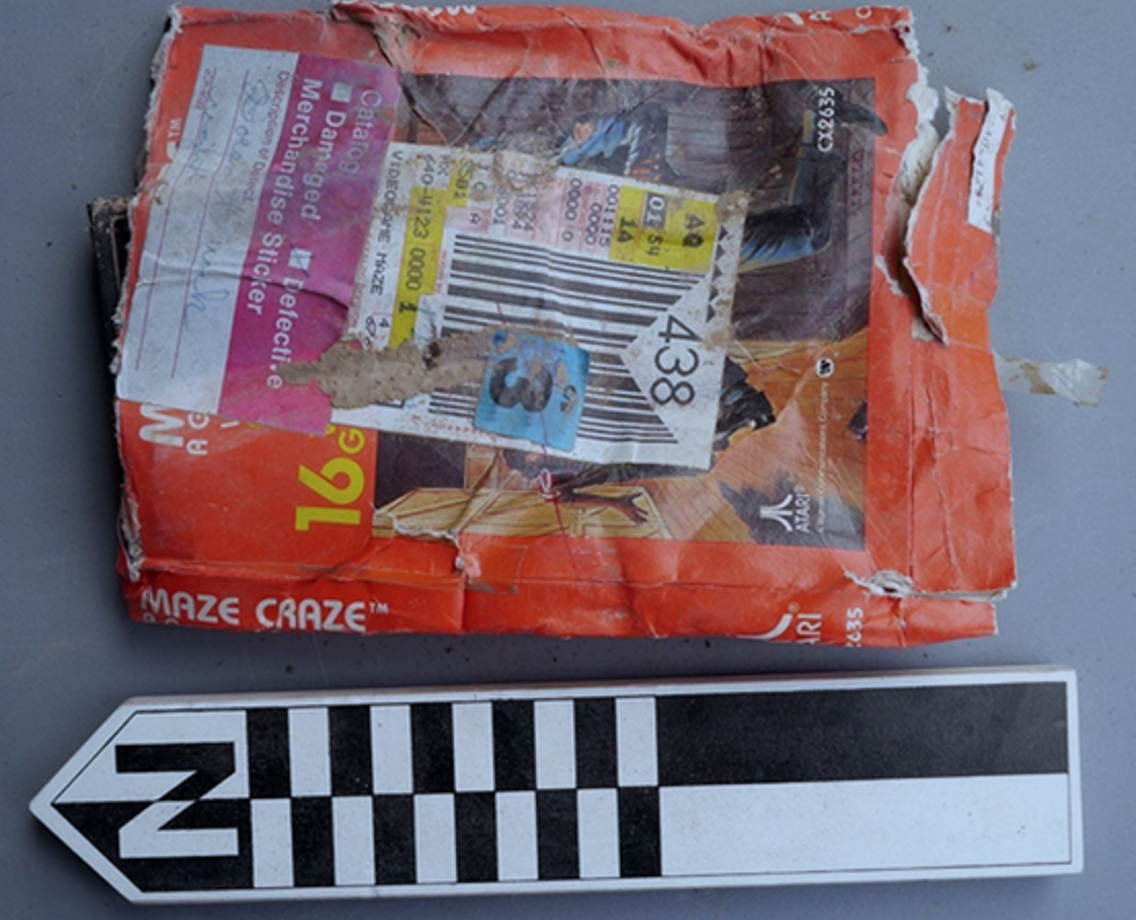
Game excavated from the ATARI burial site
While learning more about archaeogaming – defined as the archaeology in and of videogames – I learned about the ATARI video game burial and excavation, countless examples of the past being incorporated into the landscapes of games such as Zelda, and explored real pieces of material culture that could be found in games such as Minecraft.
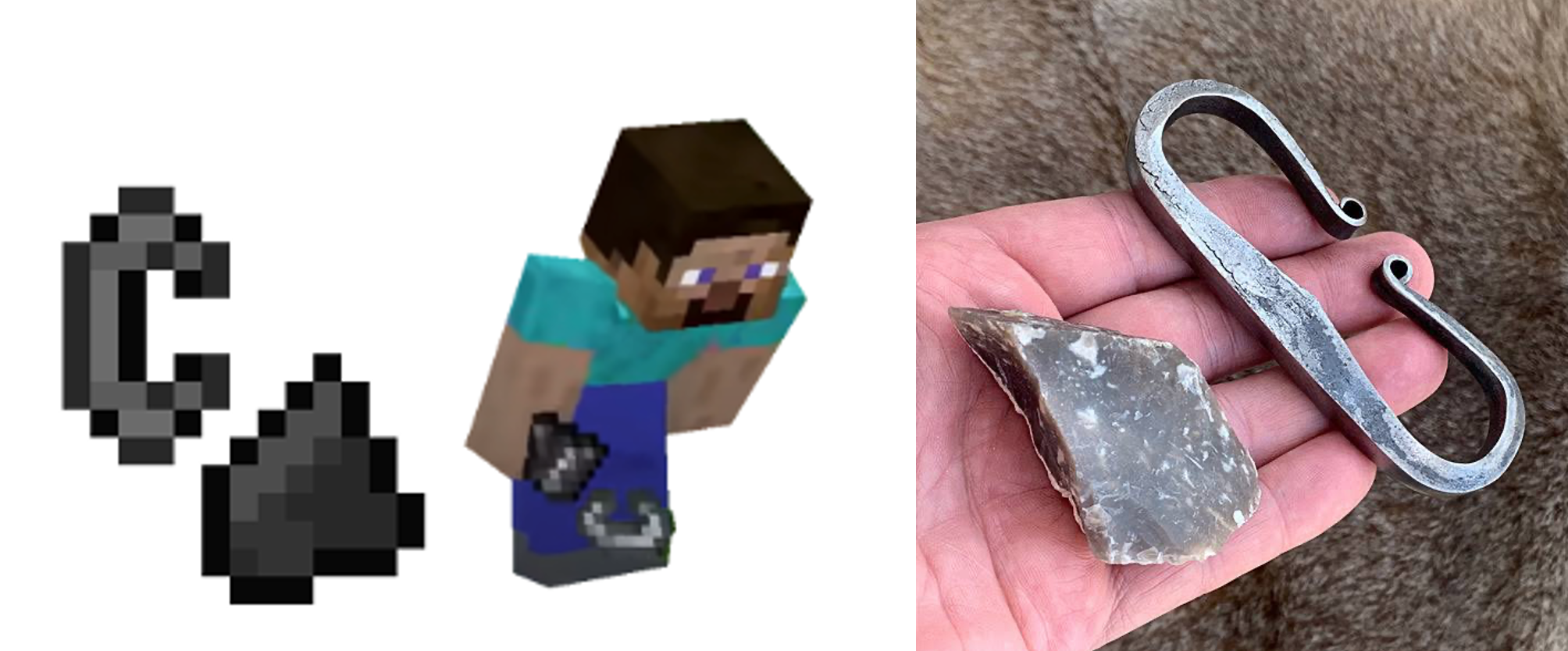
To make fire in Minecraft you need steel and flint. The graphics for the steel is often confused for a C when in fact it is a historically shaped steel fire starter.
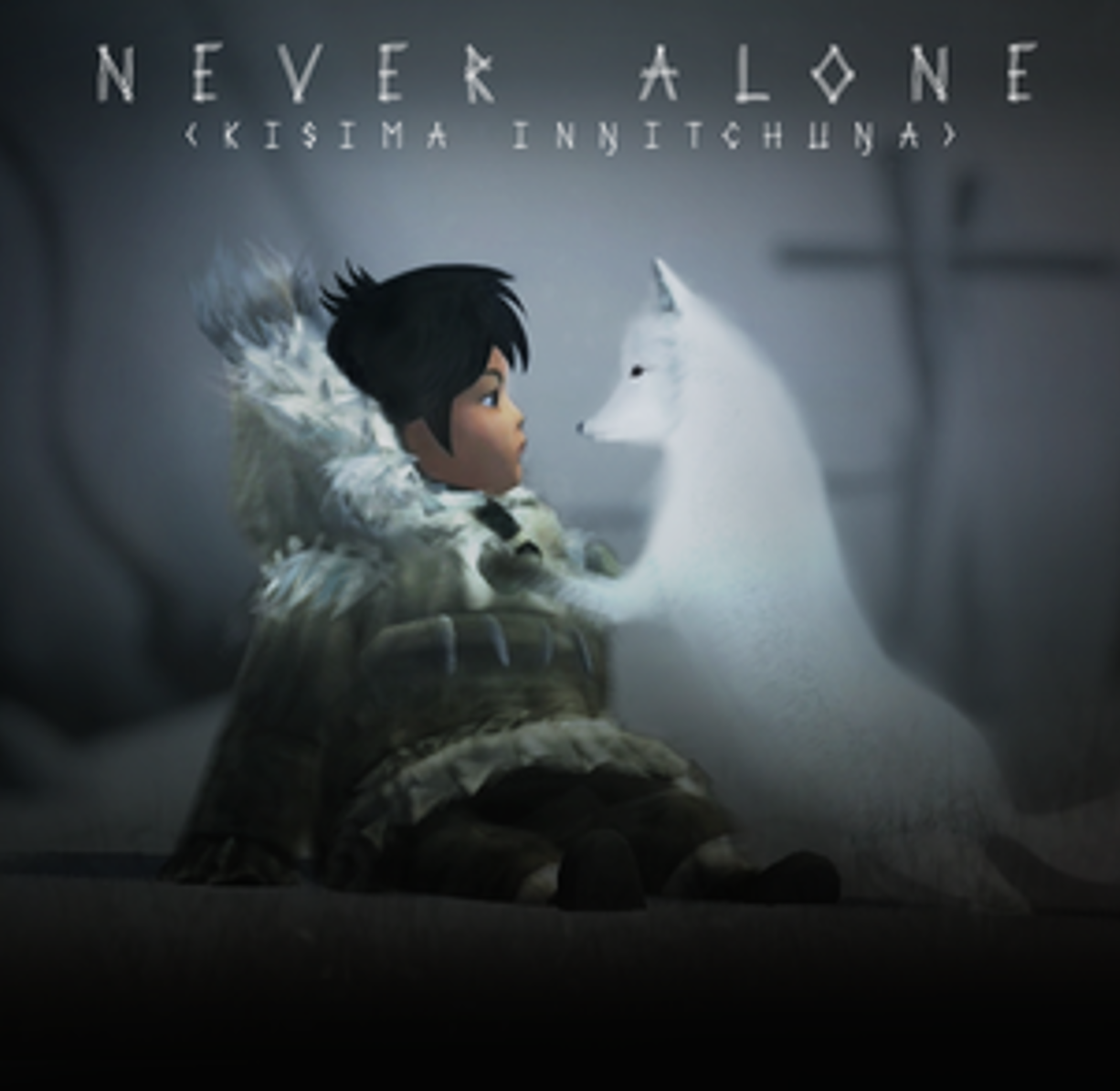
As I was researching different avenues that the class could focus on, I stumbled upon the most amazing game: Never Alone or Kisima Ingitchuna.
The game is centered on a traditional story of the Iñupiat people, and also a collaboration between the tribe and game developers.
The game structure of Never Alone is a puzzle platformer where in order to win you must play as both Nuna, a young girl, and her fox companion, highlighting the Iñupiat ideal of cooperation and community.
Adding depth is the inclusion of Cultural Insights throughout the game for the player to access and learn more.
For the Computer Science class, I pulled artifacts from our Arctic collections for the students to explore. The students were asked to not only work together to figure out what the artifacts are and how they were used, but to also identify which artifacts were depicted within the game.
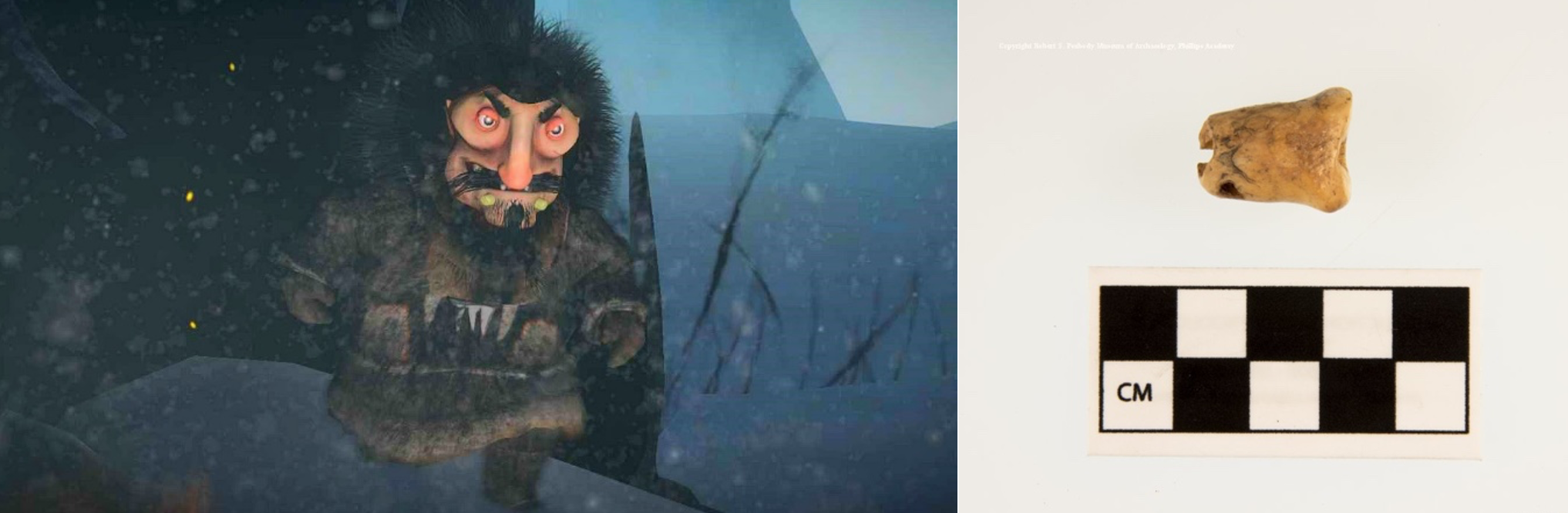
An example of an artifact from the Peabody collections found in the game are labrets – facial jewelry traditionally worn by men on either side of their mouth – as seen on the character Manslayer.
This was an exciting collaboration to work on and allowed me the opportunity to explore an aspect of archaeology that I only recently began thinking about.
And recently there was an exciting announcement of a sequel to Never Alone!
After two years and three rescheduled trips (thanks Covid), I finally was able to travel to Kauai, Hawaii. Of all the activities and sites to see on the island, I couldn’t miss visiting some of Kauai’s historical and archaeological sites. The Hawaiian Islands are rich with history and it was wonderful to learn about Hawaii’s culture and traditions during my time on Kauai. Here are a few of my favorite sites and some history that I learned while visiting the island of Kauai.
The island of Kauai is one of many islands that make up Hawaii. There are eight major islands commonly seen on maps, but that does not account for all of them. For many people, only the four largest of the islands usually come to mind – Big Island, Maui, Oahu, and Kauai. These islands are the most well-known, but there are actually 137 islands and 5 counties that make up the state of Hawaii.
Map of the Eight Major Islands of Hawaii
Kauai is nicknamed “the Garden Isle” for its lush green mountains and valleys and rich biodiversity. At the heart of this fertile land is Mount Wai’ale’ale. With average annual rainfall of 400+ inches, this mountain is a sustainable source of water for the island’s agriculture, drinking water, hydroelectric power, recreation, and numerous other public uses. Mount Wai’ale’ale is part of an ancient volcano that formed Kauai in its last eruption over 5 million years ago. The explosion not only gave the island its unique shape, it created the entire east side of Kauai. Today the mountain is a half moon-shaped depression (also known as a caldera). This shape combined with island trade winds, creates a large amount of fog, mist, clouds, and rainfall making this location one of the wettest places on earth!
Inside the caldera of Mount Wai’ale’ale In 1982, the caldera had a record-setting 683 inches of rain!
Kauai has a unique history being the oldest inhabited of the main Hawaiian Islands. It was the only Hawaiian island that was not conquered by King Kamehameha, entering a peaceful resolution with Kamehameha in 1810. Later in 1864, the Robinson Family purchased over 55,000 acres of Kauai and over 46,000 acres on the island of Niihau from King Kamehameha V for $10,000 in gold (about $170,000 today). In purchasing these lands, the family promised to protect the island and its residents from outside influences. Today, over five generations later, the descendants of the Robinson family have upheld their promise requesting that 76 percent of its non-conservation lands be designated as important agriculture lands, with protection from future development.
Sugarcane was Kauai’s primary economic resource, dominating the industry until the mid-20th century. Sugar was introduced to the island by the Polynesians and later the first sugar extracting operation and mill was established in the southern town of Koloa in 1835. Soon sugar plantations developed on the east side of the island – the Lihue Sugar Plantation expanding quickly due to its fertile land around the Wailua area fed by Mount Wai’ale’ale. By the 1960’s, the sugar industry began shutting down due to labor strikes, politics, and the statehood of Hawaii. The Lihue Sugar Plantation was one of the last operating plantations, shutting down in 2000.
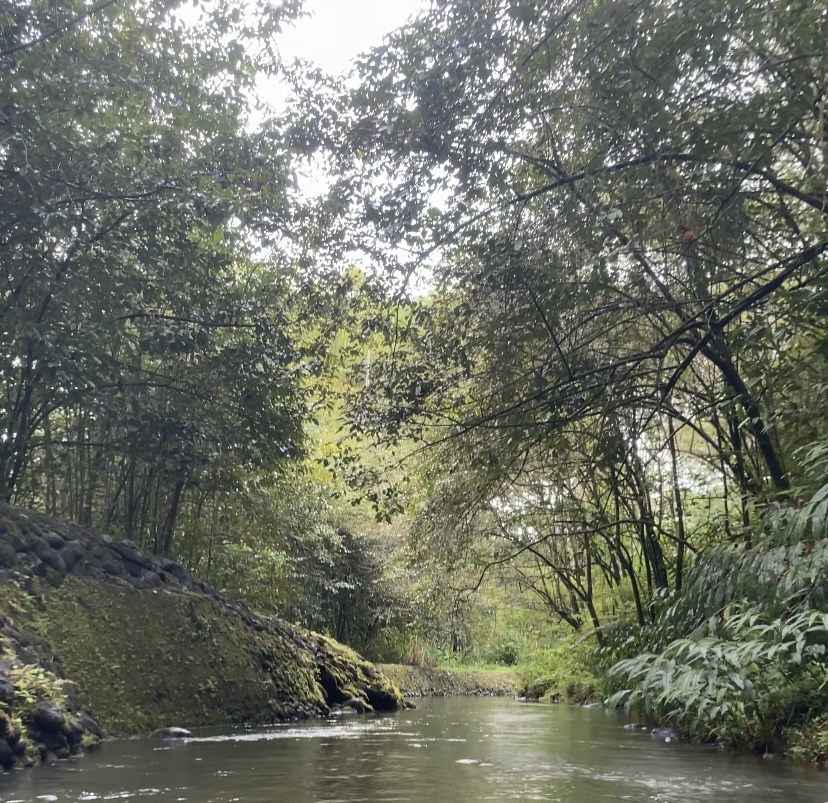
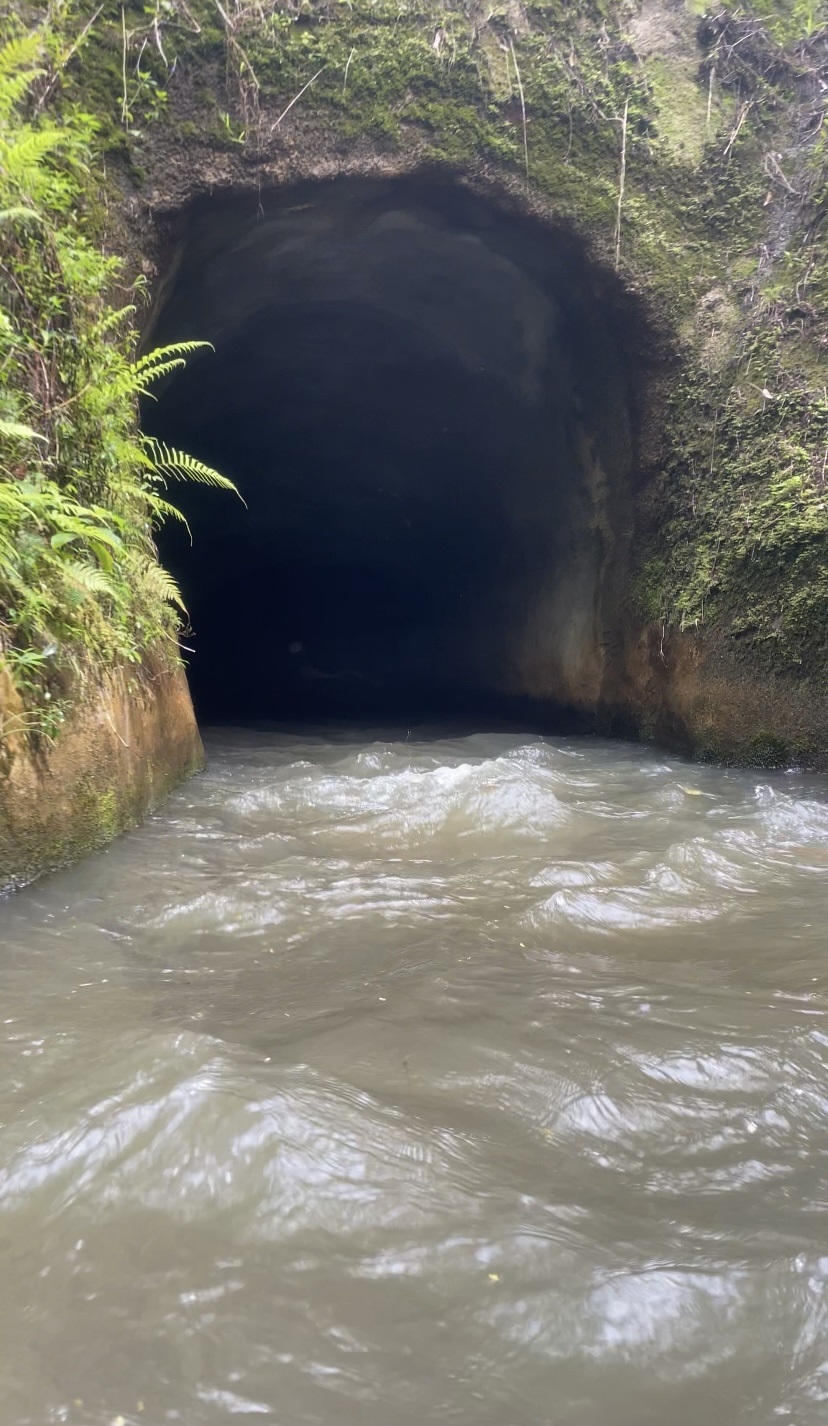
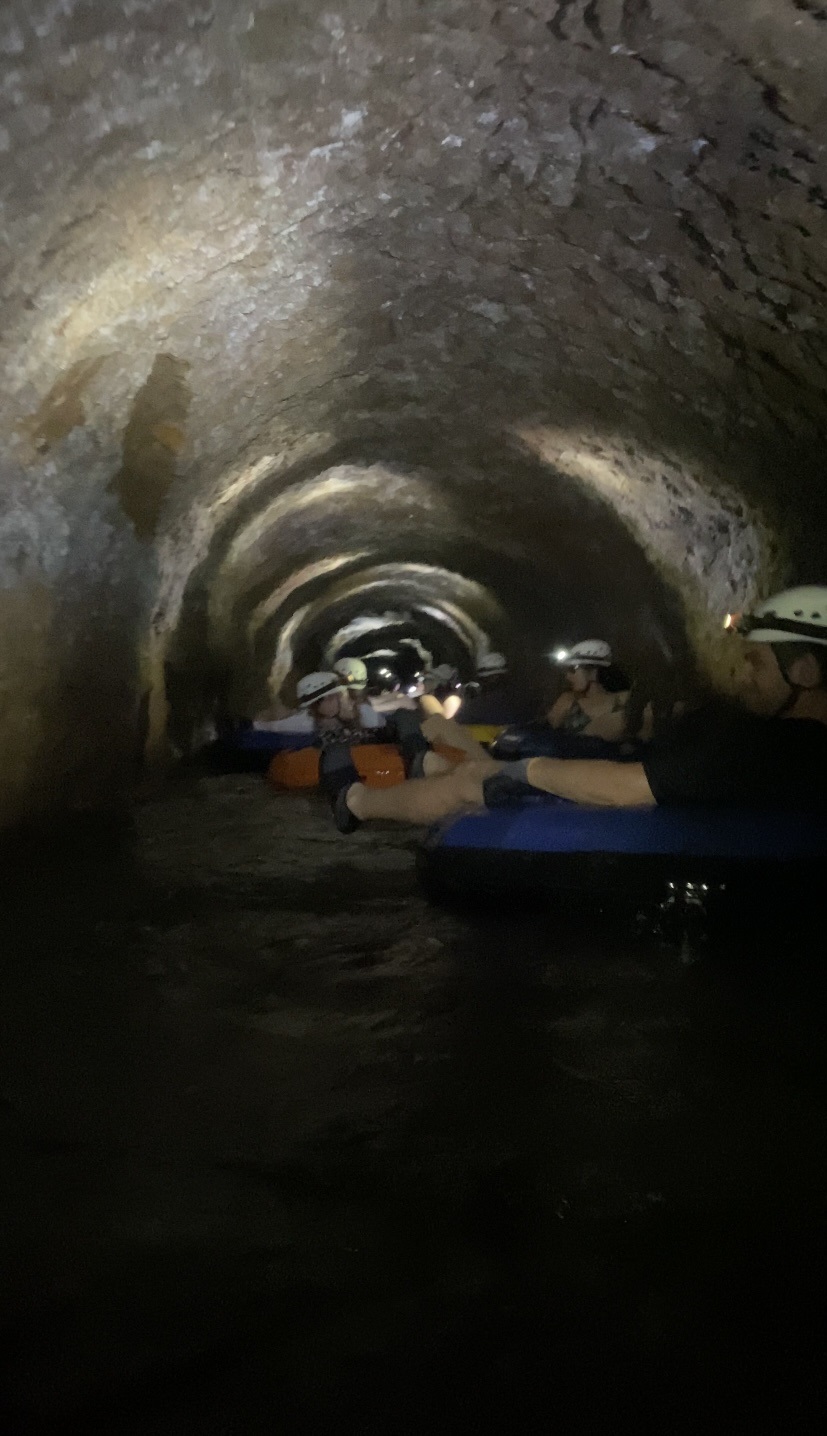
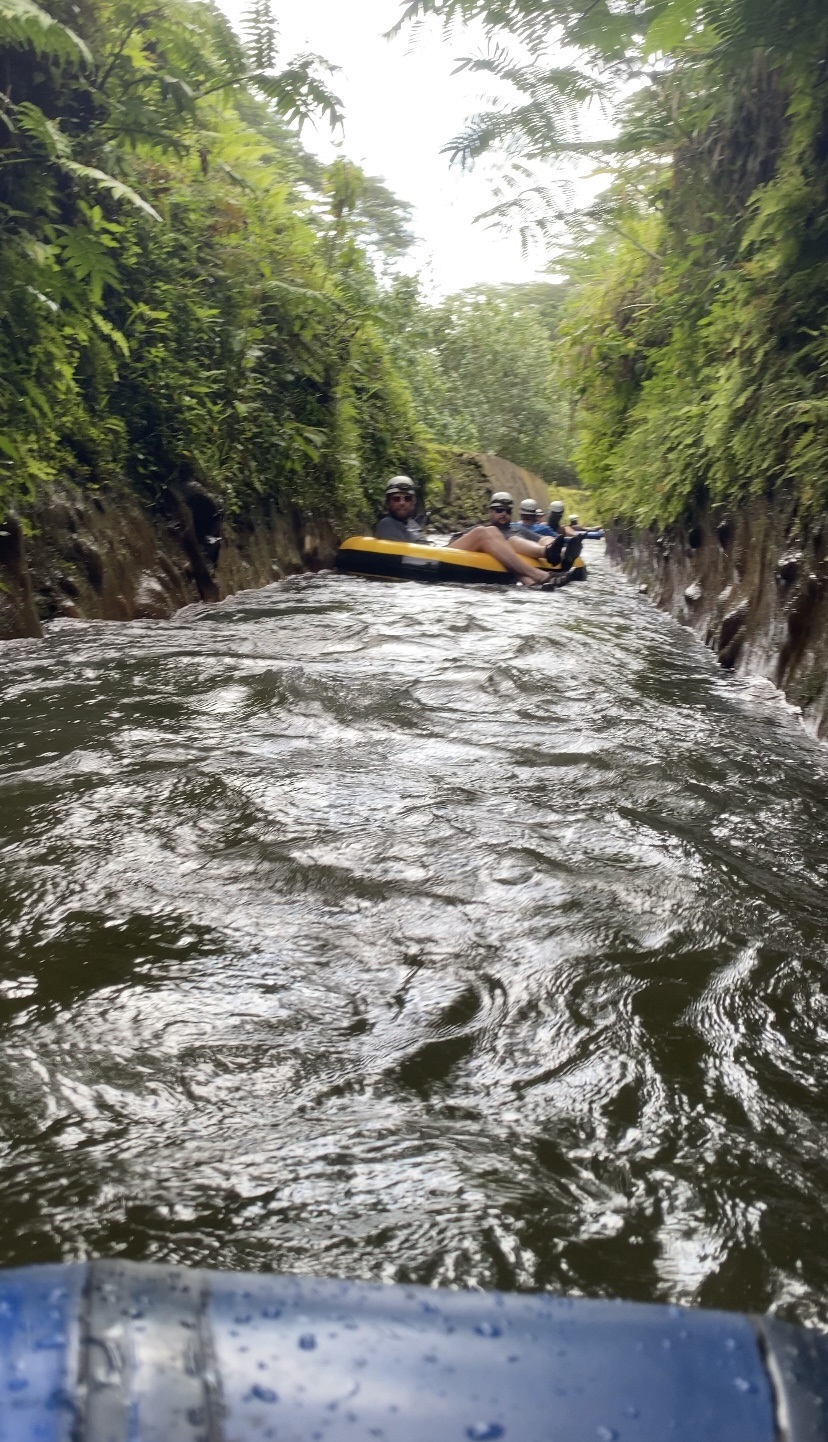
Although the sugar industry has since ended, many sugar plantation sites are still present. I had quite the adventure exploring the Lihue Sugar Plantation, as the site is now accessible by mountain tube. Mountain tubing?! You may ask – why of course! Picture a lazy river-experience (although not so lazy at times) down some of the plantation’s old hand-dug canals and tunnel systems circa 1870. In many of these tunnels, you can still see the marks from workers’ pickaxes. Workers tried to save time and extend one of the tunnels with dynamite. This technique was discontinued after their first try, but a large chamber in the tunnel ceiling remains.
Lihue Sugar Plantation Canal, circa 1870
Mountain tubing the Lihue Sugar Plantation canal and tunnel system
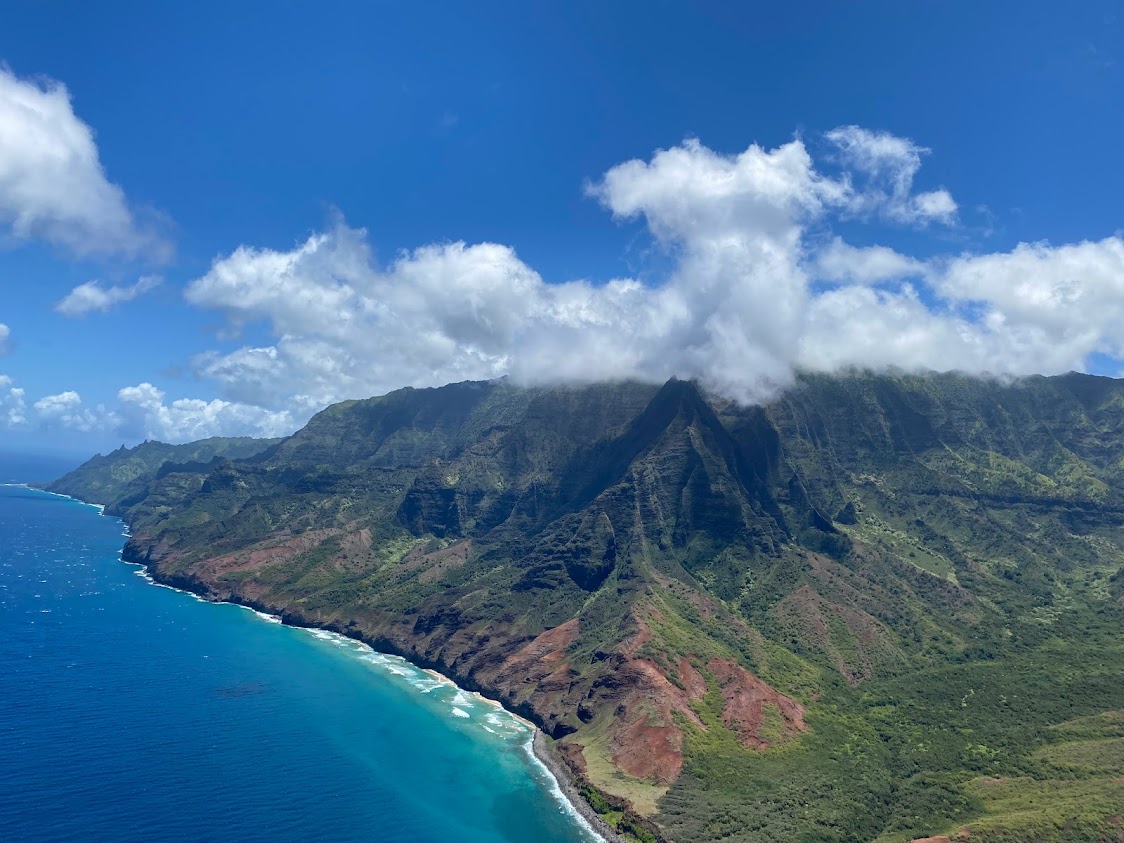
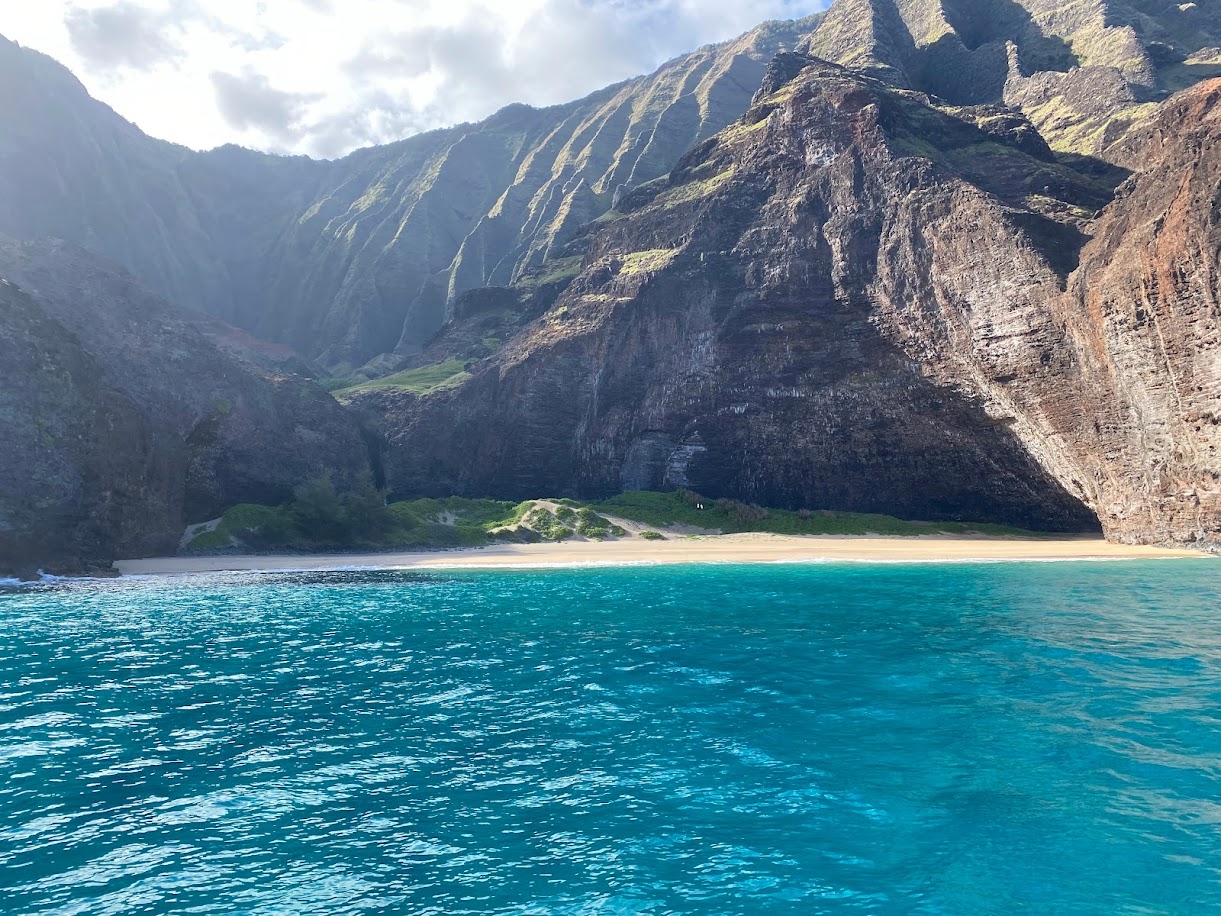
My favorite location on the island was the Honopu Valley, located along the Napali Coast. The Honopu Valley is one of the most beautiful and mysterious sites with cathedral cliffs that reach up to 1,200 feet. Much of this side of the island is inaccessible by road and is best visited by helicopter or boat. The Honopu Valley, also known as the Valley of the Kings, is the source of many Hawaiian legends. For this reason the site is the most remote and secluded along the coast, being extremely difficult and dangerous to access due to the spiritual significance of this burial site.
The Napali Coast on the island of Kauai
Legends aside, the Honopu cliffs were used as burial sites for ancient Hawaiian Ali’i (royalty) that ruled along the Napali Coast. Hawaiians believed that their chiefs were direct descendants of gods and their remains contained powerful mana (life force). To avoid the mana falling into the wrong hands, a chief’s remains needed to be buried in a secret location.
Honopu Valley (Valley of the Kings)
Warriors, chosen from birth, were designated to bury the chief’s remains in the cliff walls. They would either climb hundreds of feet up the steep cliffs or lower themselves down the cliff walls by rope in search of a suitable location for the chief’s remains. Once carefully buried in the cliff walls, the warrior would jump or cut their rope, falling to their death – securing the location’s secrecy forever.
The Department of Land and Natural Resources limits visitors to this site out of respect for the sacred history of the Honopu Valley, although there have been several exceptions to these regulations for Hollywood, with movie scenes of Honopu filmed in King Kong (1976), Six Days Seven Nights, Pirates of the Caribbean: On Stranger Tides, Raiders of the Lost Ark, Honeymoon in Vegas, and Jurassic Park 3.
It is quite remarkable to see these cliffs from air and water, knowing the honorable yet fatal task these warriors were selected for. It is said, to this day, the remains of these warriors can be seen in the sand dunes underneath the cliffs after being exposed to heavy rains or winds.
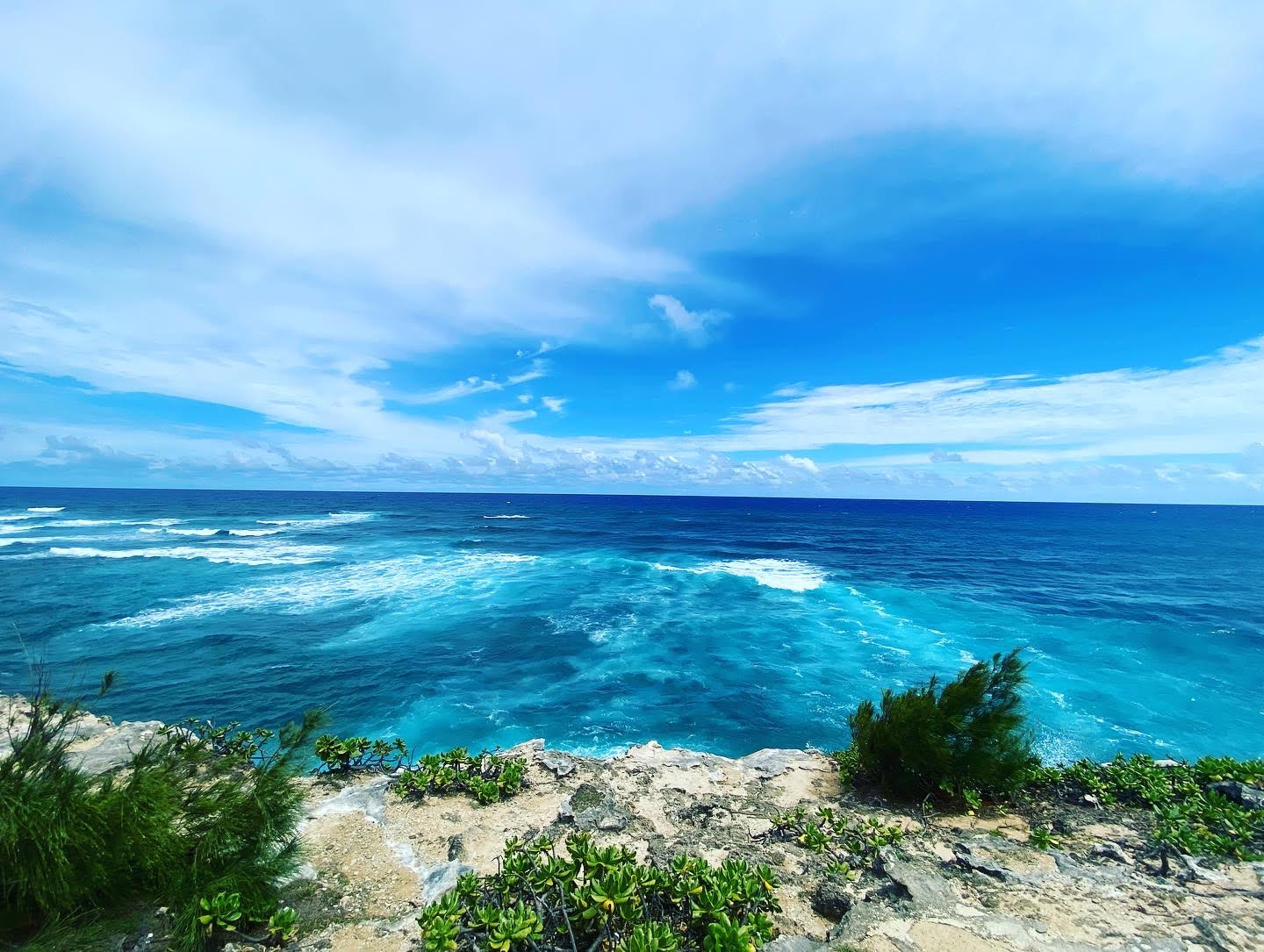
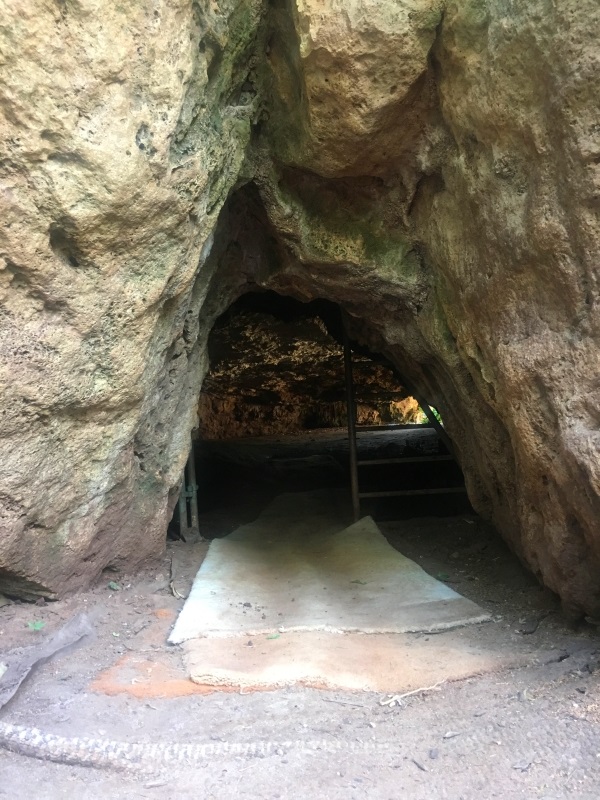
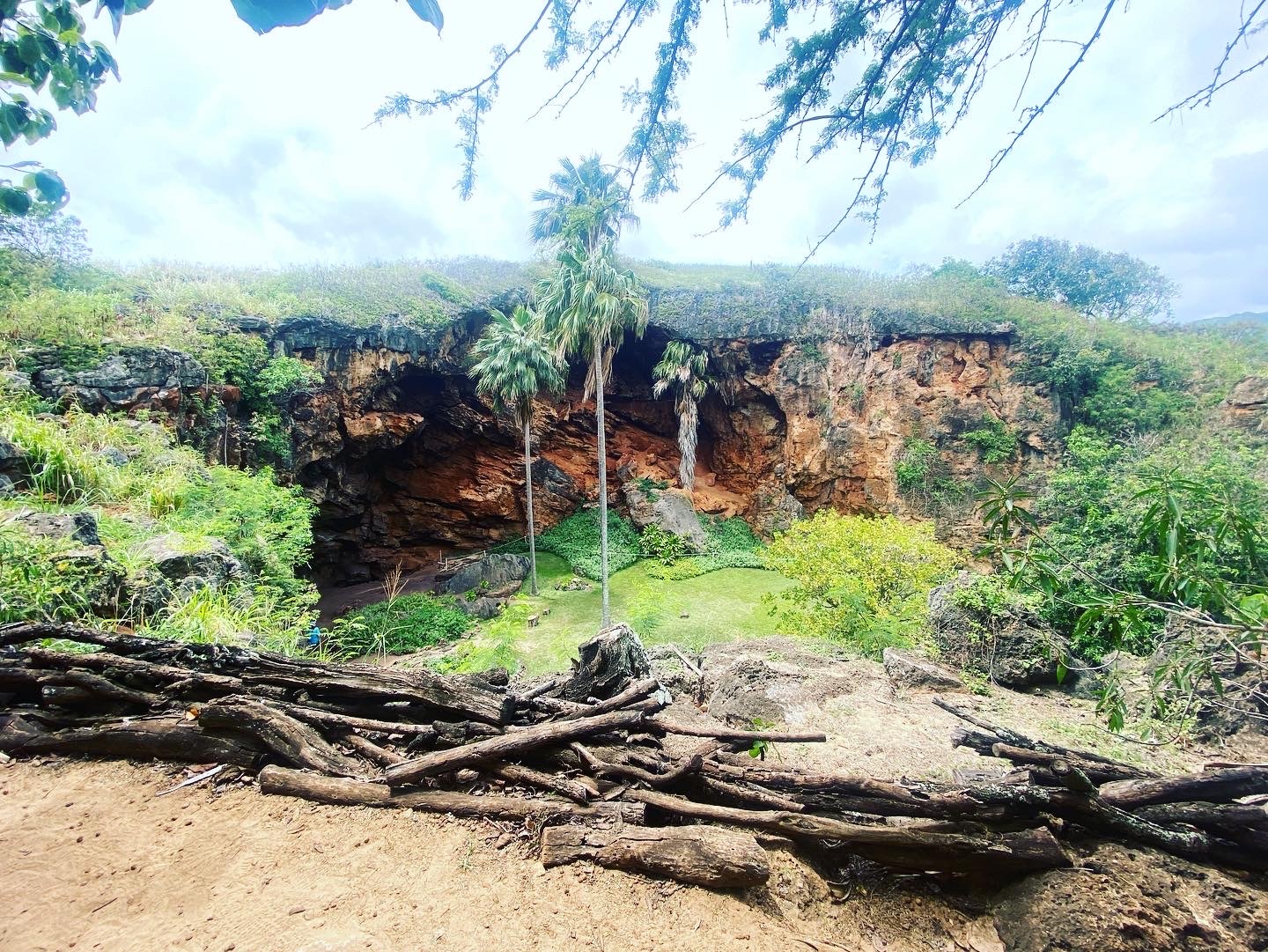
After a two mile hike along the coastal trail from Shipwrecks Beach, you’ll come across a site frozen in time – the Makauwahi Cave Reserve. From above, the reserve looks like a tropical oasis amongst the rocky, volcanic cliffs and dune vegetation. If you’re lucky enough to find the cave’s entrance you can expect to be greeted by a small hole in the cave wall that visitors must crawl through as their rite of passage into the cave. Once through, you’ll emerge from the dark, cavern entrance and step back in time to Hawaii’s largest limestone cave and fossil site.
Entrance to the Makauwahi Cave
For over 100,000 years, water has seeped into the cave and eroded the limestone. As a result, 7,000 years ago a large section of the cave ceiling collapsed, leaving behind a vast oval opening to the sky. This formation created a unique time capsule of geological change and biological occupation.
The thick walls of the Makauwahi Cave preserves over 10,000 years of animal fossils (shells and bones) and plant fossils (seeds, leaves, and wood.) From a 352,000-year-old lava flow to a Styrofoam cup washed in by Hurricane Iniki in 1992, the prehistoric sinkhole preserved everything and anything that fell into it.
The Makauwahi Cave Reserve from above
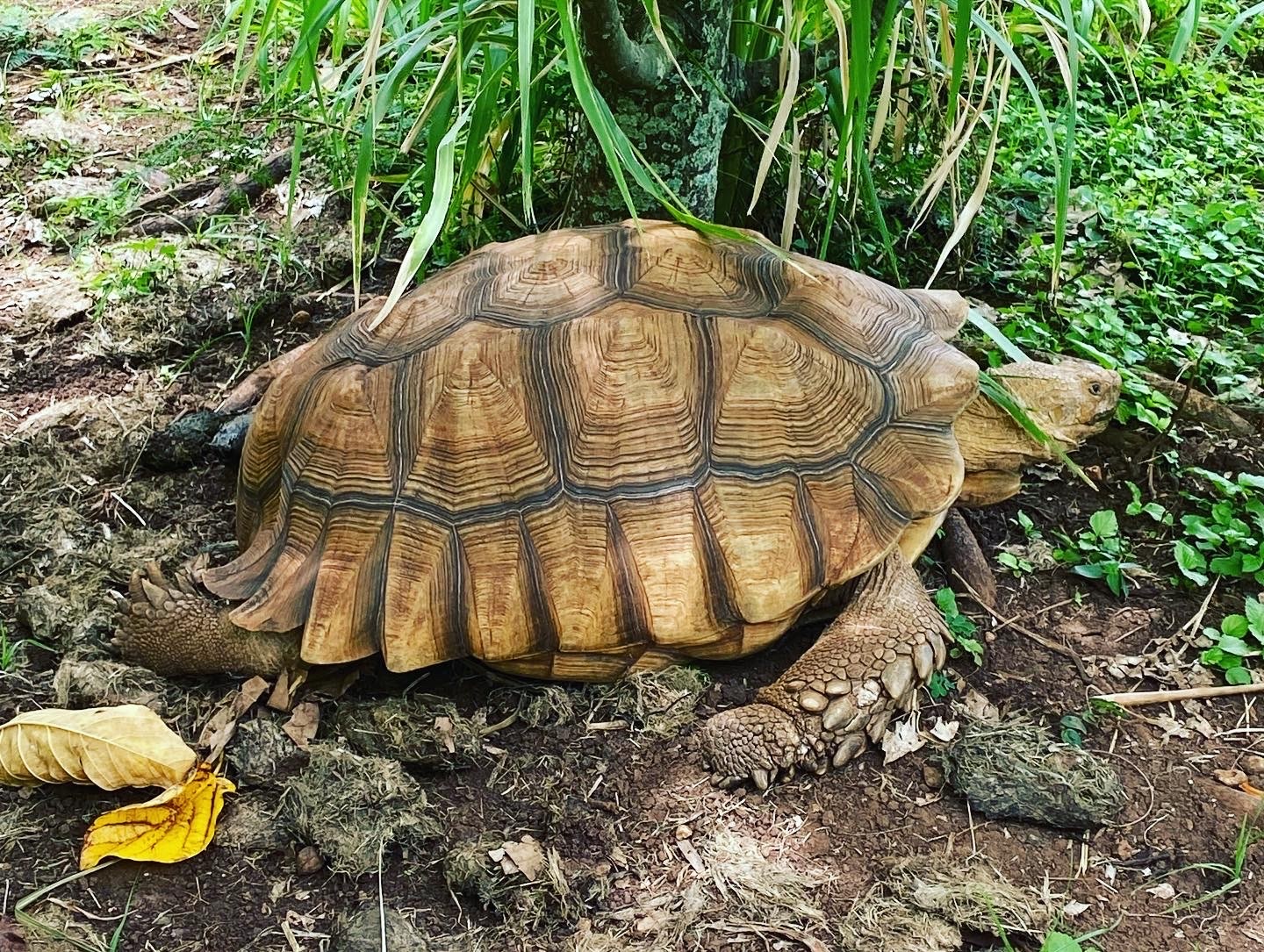
Today, archaeologists and paleoecologists study the cave’s sediment layers and fossils to understand the prehistoric landscape and its change overtime. Using innovative restoration techniques, researchers and scientists are experimenting in native species conservation with abandoned farms and quarry lands surrounding the site. Through this initiative, acres of forest land, dune vegetation, and wetlands are being restored, featuring many species of native plants and endangered species such as waterbirds and blind cave invertebrates. There’s even a giant tortoise sanctuary in one of the wetland reserves near the cave! Learn more about the Makauwahi Cave Reserve and its current restoration project here!
Meet Maurice, a 20+ year old giant tortoise from the Makauwahi Cave Reserve Tortoise Sanctuary
We recently commissioned Chase Kahwinhut Earles to create a pair of traditional Caddo style earspools for our permanent collection. We are thrilled with the result! Chase is a talented ceramic artist who works with traditional methods and materials to create vessels and other objects. Along with traditional forms and designs, Chase’s work also includes contemporary pieces and his own exploration of Star Wars through an Indigenous lens. His work has garnered numerous awards and accolades; private collectors and museums regularly commission and acquire his work. Check out his webpage for more of his work and videos of his process: https://www.caddopottery.com/
Ceramic and copper earspools by Chase Kahwinhut Earles, photograph by Chase Kahwinhut Earles.
These earspools were made with hand-dug clay, pit fired, with an embossed copper covering, much like examples found at archaeological sites in the southeastern United States. The star motif on this pair of earspools is reminiscent of designs known from Spiro, an ancient city in eastern Oklahoma, and from neighboring areas.
We look forward to seeing these earspools used in classes, especially curator of education Lindsay Randall’s Trade Connections lesson designed for History 100. Ear ornaments, made from a variety materials and styles, are well known throughout the western hemisphere, including jade and jadeite, wood, copper, shell, obsidian, and other stones.
Did you know that the Smithsonian is opening a new gallery – the Molina Family Latino Gallery of the National Museum of the American Latino – dedicated to highlighting Latino contributions to the United States?
I learned about this cool gallery about 18 months ago when the Peabody Institute was first contacted about potentially loaning an item from the collection for the inaugural exhibition that will open in mid-2022. The exhibition is the first to be presented by the National Museum of the American Latino. We were thrilled to contribute a small piece to the important story of how Latinos and Latinas inform and shape U.S. history.
What did they want to borrow?
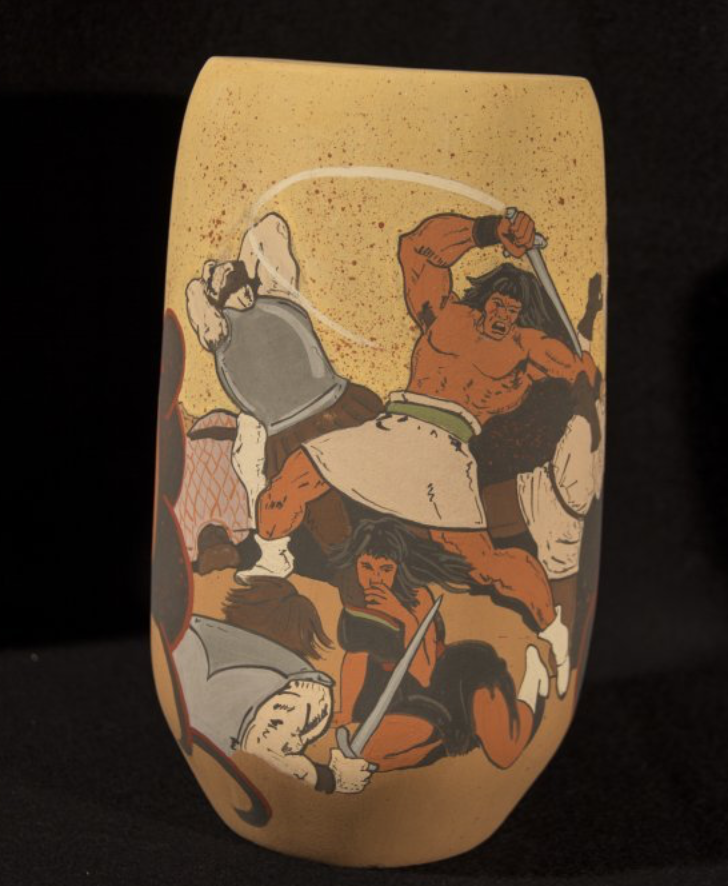
Vessel depicting the Pueblo Revolt by Jason Garcia
This amazing vessel by Jason Garcia (Okuu Pin), Santa Clara Pueblo, is an exploration of the Pueblo Revolt of 1680. Garcia is known for his mixture of traditional materials and methods with pop culture. Past blog posts have discussed this piece and his work.
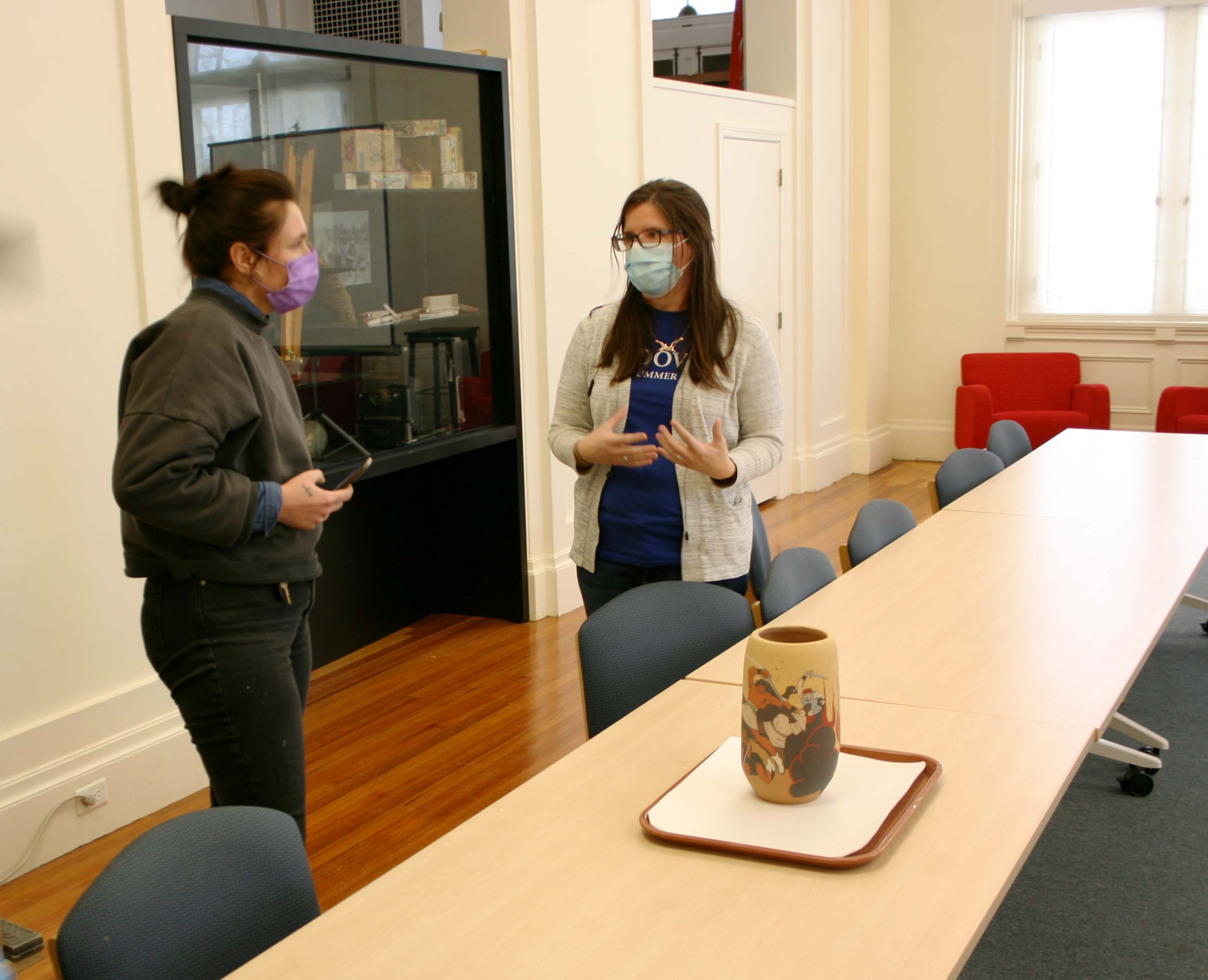
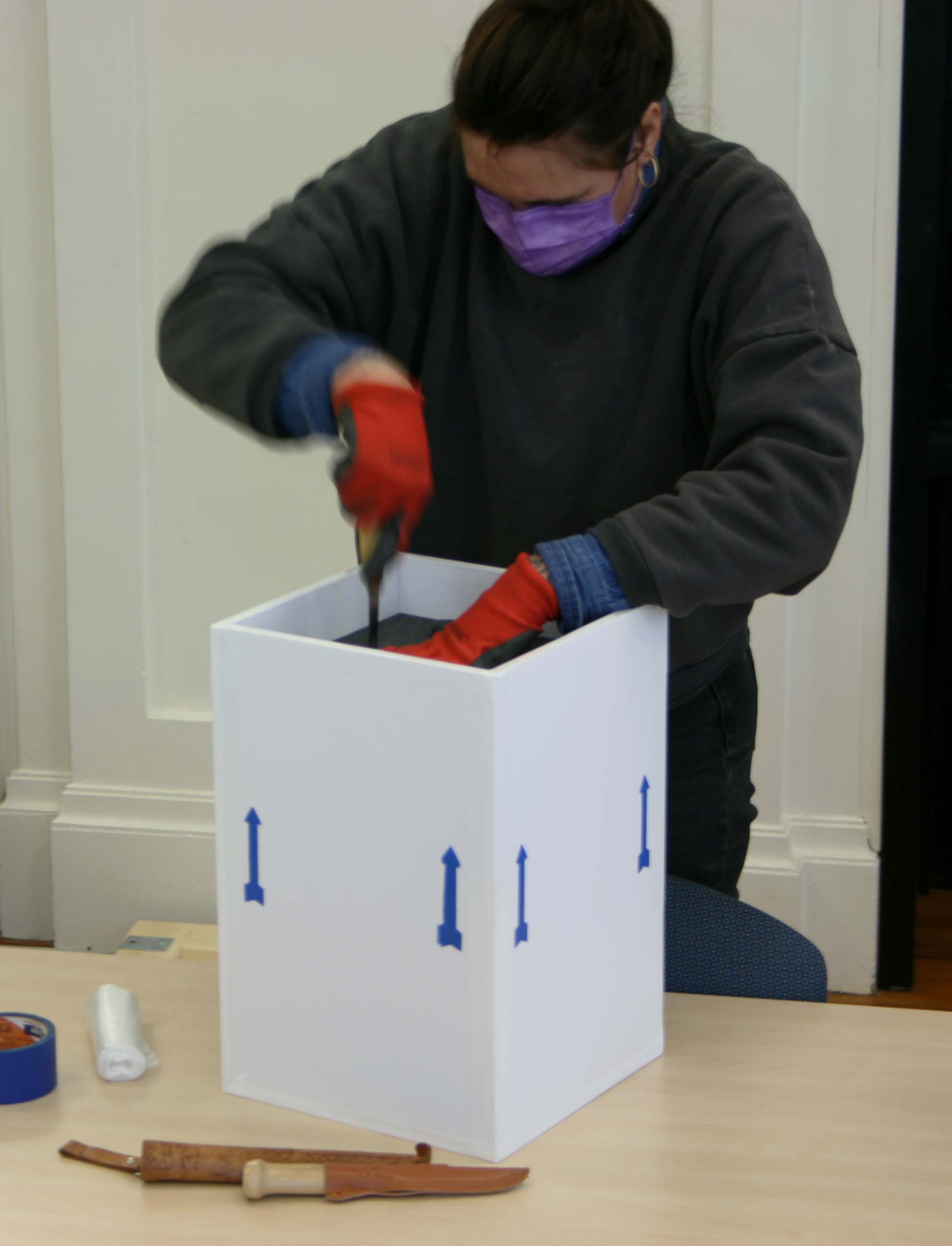
After months of correspondence and paperwork, the vessel was packed for transportation in mid-February of this year. It is always a pleasure to watch skilled art handlers create custom packaging and work to ensure that items make it safely to their destination. The team was great and the vessel is awaiting installation in its new temporary home.
I enjoyed learning more about the Molina Family Latino Gallery and the National Museum of the American Latino and encourage you to explore the newest branch of the Smithsonian. Keep your eyes peeled for an online version of the gallery later in 2022 for those who are unable to travel there in person.
[NOTE: This paper was published in the special issue “Indigenous Collections: Belongings, Decolonization, Contextualization” of Collections: A Journal for Museum and Archives Professionals, 2022, Vol. 18(1):8-17. We’ve reproduced the pre-press version here with pagination for those who do not have access to SAGE publications. Please cite as Wheeler, Ryan, Jaime Arsenault, and Marla Taylor. “Beyond NAGPRA/Not NAGPRA.” Collections 18, no. 1 (March 2022): 8–17. https://doi.org/10.1177/15501906211072916.%5D
Abstract
Institutions have been slow to respond to calls from Indigenous nations, organizations, and scholars to require free, prior, and informed consent before authorizing use of their cultural heritage materials in publications, exhibition, and research. In the United States, the Native American Graves Protection and Repatriation Act of 1990 fundamentally changed the relationship between museums, archaeologists, and Indigenous nations, requiring institutions to inventory their collections and consult with descendant communities on repatriation of specific Indigenous collections. In response, institutions and their personnel have come to view Indigenous collections as those subject to NAGPRA and those that are not—NAGPRA/Not NAGPRA. Many Indigenous nations, however, do not accept this demarcation, resulting in continued frustration and trauma for those descendant communities. This case study follows the evolving relationship between the White Earth Band of the Minnesota Chippewa Tribe and the Robert S. Peabody Institute of Archaeology. Beginning with repatriation, the relationship has expanded to consider how the museum and Indigenous nation can collaborate on the care and curation of cultural heritage materials that remain at the Peabody Institute. Most recently, White Earth and the Peabody have executed an MOU that governs how the museum will handle new acquisitions, found-in-collections materials, and donor offers. The relationship with the White Earth also has influenced how the Peabody Institute approaches its holdings of Indigenous cultural heritage materials more broadly, blurring the line between NAGPRA and Not NAGPRA collections. The Peabody Institute is working to revise its collections policy to require free, prior, and informed consent prior to use of Indigenous cultural heritage materials in publications, exhibitions, and research.
PAGE 9
Introduction
This case study is authored by Ryan Wheeler and Marla Taylor, who acknowledge that they are settlers of European descent in the unceded territories of many Indigenous nations in New Hampshire and Massachusetts, USA, including the Wabanaki Confederacy and the Wampanoag nations, and Jaime Arsenault, the Tribal Historic Preservation Officer (THPO) for the White Earth Band of the Minnesota Chippewa Tribe (White Earth). Wheeler and Taylor are employees of the Robert S. Peabody Institute of Archaeology (the Peabody), an archaeology museum that is part of Phillips Academy, a college preparatory school located in Andover, Massachusetts USA. Founded in 1901, the Peabody has a lot in common with other twentieth century museums in the United States, including amassing Indigenous collections from diverse areas with little or no consent from descendant communities. The Peabody currently holds nearly 600,000 objects of Indigenous material culture, primarily from the Arctic and Canada; the northeastern, southeastern, and southwestern United States, and Mexico and Peru, as well as photographs and archival materials.
The Native American Graves Protection and Repatriation Act (NAGPRA) was passed as federal law in 1990 and required that museums and federal agencies inventory their holdings for ancestral remains and funerary belongings, provide these inventories to descendant Indigenous communities, and consult with those communities on cultural affiliation and repatriation. NAGPRA has elements of property law and civil rights legislation, providing an opportunity for Indigenous nations to reclaim stolen ancestors and funerary belongings. NAGPRA fundamentally changed the relationship between Indigenous nations, archaeologists, and museums, creating an environment where representatives of each group were in regular contact with one another. Often this contact led to other programs and collaborations beyond NAGPRA. For examples, Nash (2021; also see Moore 2010) has recently revisited the concept of “propatriation,” collaborative undertakings that go beyond the legal requirements of the Native American Graves Protection and Repatriation Act (NAGPRA) or moral imperatives to return Indigenous cultural heritage to groups outside the United States. NAGPRA compliance, however, has been slowed by a variety of factors, including institutional reliance on archaeological and biological lines of evidence, even in the face of compelling oral history evidence or expert opinion supplied by Indigenous nations. At the time of this writing, over 100,000 ancestors remain in museum collections with little or no path to repatriation (Nash and Colwell 2020).
PAGE 10
Between 2013 and 2015, the Peabody developed a strategic plan that built on an earlier commitment to NAGPRA, prioritizing decolonial principles in all aspects of museum operations (Robert S. Peabody Institute of Archaeology 2015). With decolonization as a guiding principle, the plan acknowledged the harm caused by archaeological excavations and sought to shift the balance of power, giving Indigenous nations a greater voice in how their material culture is handled and interpreted. We argue that museums and institutions holding Indigenous cultural heritage must go beyond collaborative programming to instill change at the policy and procedure level. Work on NAGPRA compliance provides an opportunity to develop and implement those policy changes.
The Peabody Institute and the White Earth Band of the Minnesota Chippewa Tribe have collaborated to blur what we have been calling the NAGPRA/Not NAGPRA dichotomy. Though we have encountered other museums in the United States where staff are interested in instituting such changes, informal conversations have found few examples where official policies governing how Indigenous collections are accessed for exhibit, research, photography, or other purposes specifically require the free, prior, and informed consent of descendant communities. The United Nations Declaration on the Rights of Indigenous Peoples (UNDRIP) was adopted by the General Assembly on 13 September 2007. Part 2 of Article 11 specifically states:
States shall provide redress through effective mechanisms, which may include restitution, developed in conjunction with indigenous peoples, with respect to their cultural, intellectual, religious and spiritual property taken without their free, prior and informed consent or in violation of their laws, traditions and customs (UN General Assembly 2007).
Article 12 deals with the rights of Indigenous people to seek repatriation of ancestors and ceremonial objects. Revision of the Peabody’s collection policy specifically aligns with Articles 11 and 12 of UNDRIP, both in the way that NAGPRA is implemented, but also in going beyond NAGPRA compliance to insure the rights of Indigenous people regarding their tangible and intangible cultural heritage.
NAGPRA/Not NAGPRA
Co-authors Wheeler and Taylor, in their respective roles as director and curator of col- lections at the Peabody Institute, began using the phrase NAGPRA/Not NAGPRA sometime in the last few years to describe their own approach to Indigenous heritage collections. This articulation of our own institution’s approach to repatriation occurred in 2017 to 2018 when we first began to draft a broad repatriation policy, based on our existing practice. Consultation with Indigenous nations, especially White Earth, as well as the Osage Nation of Oklahoma, the Wabanaki Repatriation Confederacy of
PAGE 11
Figure 1. Tara Mason, beadwork artist and member, White Earth Band, examines Anishnaabe clothing at the Peabody Institute as co-authors Marla Taylor and Ryan Wheeler look on during a consultation visit, January 2017.
Maine, Pueblos in the American Southwest, as well as engagement with other repatriation practitioners in the NAGPRA Community of Practice began to erode our commitment to this approach (Figure 1). Taylor concisely stated that she believed that many institutions, in response to the passage of NAGPRA, began to distinguish those collections that they felt were subject to NAGPRA from those that were not. By firmly drawing boundaries between NAGPRA and Not NAGPRA collections, institutions preserve pre-NAGPRA decision-making structures regarding how they can access and use Indigenous cultural heritage. This discernment, whether intentional or not, reflects the imbalance inherent in a law that sought to balance the interests of museums with the rights of Indigenous nations to reclaim their stolen ancestors and make decisions regarding other tangible and intangible cultural heritage, including images, archives, and songs. If there is any doubt about this, responses from museums and archaeologists to the Department of Interior’s proposed changes to the NAGPRA rules support our assertion (see Seidemann 2008).
Blurring the Lines
While uncommon, there are some excellent examples where organizations and institutions have blurred the lines between NAGPRA and Not NAGPRA collections. The First Archivists Circle (2007) developed and shared The Protocols for Native American
PAGE 12
Archival Materials. Like NAGPRA, consultation with descendant communities is at the core of The Protocols. The Protocols stress that consultation and shared decision making about archival collections are in line with accepted ethical archive practices. Between 2016 and 2018, the Peabody Institute incorporated many of the principles and practices advocated for in The Protocols. For example, we agreed that digitizing paper and photographic records was inappropriate without consultation and explicit approval from Indigenous nations, especially as many of the museum records dealt with excavations of ancestral remains. It was not until more recently that we formally incorporated these practices into our collections policies and procedures. It is unclear, however, how many institutions have formally implemented the recommendations within The Protocols, though there are good examples and case studies at the website of the Society of American Archivists (2021a, 2021b).
The University of Maine (2018, Orono) executed a Memorandum of Understanding with the Penobscot Nation. The MOU formalizes principles and practices regarding how the university manages and shares Penobscot cultural heritage at the Hudson Museum, the Fogler Library, the University of Maine Press, and the Anthropology Department. University of Maine history faculty member Darren Ranco and Jane Anderson of New York University developed the University of Maine MOU. Anderson’s work on attribution, Indigenous archives, intellectual property, and Traditional Knowledge labels is critically important and informs the case study presented here (Anderson 2018; Christen and Anderson 2019).
Case Study
White Earth is one of seven Anishinaabe reservations in Minnesota, created in 1867 by a treaty between the United States and the Mississippi Band of Chippewa Indians. Unlike many lands set aside for Indigenous nations in the United States, the White Earth Reservation had abundant natural resources, including timber. Meyer (1994), a historian of mixed Irish, German and Eastern Cherokee heritage, published The White Earth Tragedy, telling the story of how unscrupulous companies and individuals defrauded the Anishinaabe people of their property, land, and natural resources (Bloch et al. 2008). The dispossession of the White Earth Anishinaabe also set in motion the loss of significant material culture, as anthropologists and collectors forced Indigenous nation members to sell or gift items they possessed.
Robert S. Peabody and Warren K. Moorehead founded the Peabody Institute in 1901, originally called the Phillips Academy Department of Archaeology, at Robert’s high school alma mater. The museum became involved in the major undertakings of twentieth century archaeology, including sponsorship of Alfred V. Kidder’s 1915– 1929 excavations of Pecos Pueblo, investigations across the Northeast and Southeast, with personnel holding leadership roles in major anthropological and archaeological
PAGE 13
organizations. Curator Warren K. Moorehead was also involved with the Bureau of Indian Affairs (Fritz 1985). Through his association with the BIA, he investigated the fraud being committed against the Anishinaabe people at White Earth. While at White Earth Moorehead obtained a number of cultural heritage materials, ranging from photographs to sacred items to elements of Anishinaabe clothing (Bacon 2009; Moorehead 1914).
Personnel at the Peabody Institute embraced repatriation after the passage of NAGPRA in 1990, perhaps largely due to the commitment and vision of Leah Rosenmeier, who served in a variety of roles at the museum from 1993 to 2002 (Bradley 2018). Starting in 2013, the leadership of the Peabody Institute recognized the importance of repatriation work conducted under NAGPRA and the need for broader theoretical underpinnings that could inform all collections and educational endeavors (see Lonetree 2012). As part of their strategic planning process, Wheeler invited Arsenault to present to the institute’s advisory committee, following an earlier meeting in 2011. Coincidentally, Arsenault was assisting in the development of the White Earth’s Tribal Historic Preservation Office (THPO) repatriation program, and was actively searching for Indigenous cultural heritage that had originated at White Earth.
Warren K. Moorehead’s activities at White Earth in 1909 had led to the accession of a number of items, including glass plate photographs of his investigation, Anishanaabe clothing and bandolier bags, as well as pipes, a war flag, and birch bark scroll meeting the definition of cultural patrimony and sacred objects under the NAGPRA law and rules. Arsenault and other White Earth representatives aided in the repatriation of some of these Indigenous collections, and provided informal guidance on the care of the remaining materials (National Park Service 2016, 2017). For example, White Earth representatives asked that the museum not share the photographic images made by Moorehead without permission from the THPO.
Arsenault, serving as the White Earth’s Tribal Historic Preservation Officer, pro- posed in 2020 that the Peabody Institute enter into a more formal agreement regarding future acquisitions of Indigenous cultural heritage originating from the Indigenous nation. The agreement would cover offers of donations or sale made to the museum, or purchases of contemporary artwork from Indigenous nation members. Arsenault collaborated with Jane Anderson of NYU and provided a draft agreement document, and Wheeler, Taylor, and the Phillips Academy legal counsel made revisions and updates. A copy of the final document—ultimately called Memorandum of Understanding (MOU) between White Earth Band of the Minnesota Chippewa Tribe Historic Preservation Office and the Robert S. Peabody Institute of Archaeology—is available from the authors or the Peabody Institute. Major elements include:
The MOU addresses all tangible and intangible materials (photographs, field- recordings, maps, archaeological collections, films, field-notes, legal papers,
PAGE 14
artwork, biographical material, and like materials) that relate or may relate to White Earth. There are provisions for the tribe to aid the institution in making cultural identifications if the materials cannot be sourced to White Earth specifically.
The MOU specifies that it is part of Peabody Institute efforts to adhere to CARE Principles for Indigenous Data Governance (Global Indigenous Data Alliance 2019). Among other things, the CARE Principles recognize that current efforts to digitize and widely share scientific data often fail to involve descendant com- munities in these decisions.
There is a focus on communication between the Peabody Institute and White Earth, especially in cases where there are potential purchases or donations of cultural materials that originated from White Earth. This includes contemporary artwork, so that the White Earth THPO can track all White Earth cultural heritage. There are provisions for regular contact and exchange of information between the tribe and museum, and revisions to the MOU as needed.
The MOU specifies that the Peabody Institute will encourage potential donors and sellers to work directly with White Earth to transfer tangible and intangible cultural heritage materials to the tribe as the descendant community.
White Earth is the primary cultural authority over their cultural heritage materials in perpetuity. This includes provisions that the White Earth THPO must approve all requests to publish, research, disseminate, image, or exhibit said cultural heritage materials before the museum grants permission to the requestor.
The Peabody Institute and White Earth will collaborate to develop Traditional Knowledge (TK) labels for White Earth heritage materials held by the institution, formalizing some of the practices already in place (Local Contexts 2019).
Recommendations
Work with your institutional leadership to revise collections policies and procedures to center Indigenous voices. This should include policies that govern loans, exhibits, and research, updated to require descendant community approvals. At the Peabody Institute we have revised the documents that relate to loans and researcher access, making it clear that descendant communities must be involved at all stages of a project and that those communities must approve how Indigenous cultural heritage is used or exhibited.
Add Indigenous members to your museum leadership board or committee, and col- lections subcommittees. Members with particular geographic or cultural affiliation with collections that you hold will bring invaluable expertise.
If your institution is working on NAGPRA compliance or repatriation in general, consider having conversations with consulting tribes about MOUs that would vest
PAGE 15
cultural authority and decision making on collections with those descendant communities.
Develop and implement a Care-and-Trust Agreement with the descendant communities represented in the collection to dictate the care, access, handling, and housing of collections while in the physical control of the institution. An agreement like this should apply to all relevant material within the collection regardless of repatriation status. Update webpages to indicate that your institution is open to collaboration with Indigenous communities, especially if the collections you hold are geographically and culturally diverse.
Educate staff and board members to help build a broad base of support for your efforts. This can include readings and coursework, as well as informal conversations about decolonizing work at all levels of the institution.
Acknowledgments
We thank Rose Buchanan for her help in understanding ongoing work to implement the Protocols for Native American Archival Materials.
Bradley, James. 2018. “Negotiating NAGPRA: Rediscovering the Human Side of Science.” In Glory, Trouble, and Renaissance at the Robert S. Peabody Museum of Archaeology, edited by Malinda Stafford Blustain and Ryan Wheeler, 159–72. Lincoln: University of Nebraska Press.
Fritz, Henry, E. 1985. “The Last Hurrah of Christian Humanitarian Indian Reform: The Board of Indian Commissioners, 1909-1918.” Western Historical Quarterly 16 (2): 147–62.
Global Indigenous Data Alliance. 2019. “CARE Principles for Indigenous Data Governance.” Accessed July 1, 2021. https://www.gida-global.org/care.
Lonetree, Amy. 2012. Decolonizing Museums: Representing Native America in National and Tribal Museums. Chapel Hill: University of North Carolina Press.
Meyer, Melissa, L. 1994. The White Earth Tragedy: Ethnicity and Dispossession at a Minnesota Anishinaabe Reservation, 1889–1920. Lincoln: University of Nebraska Press.
Moore, Emily. 2010. “Propatriation: Possibilities for Art after NAGPRA.” Museum Anthropology 33 (2): 125–36.
Moorehead, Warren, K. 1914. The American Indian in the United States: 1850-1914. Andover: Andover Press.
UN General Assembly. 2007. “United Nations Declaration on the Rights of Indigenous Peoples: Resolution Adopted by the General Assembly, 2 October 2007, A/RES/61/295.” Accessed October 12, 2021. https://www.refworld.org/docid/471355a82.html.
Ryan Wheeler is the director of the Robert S. Peabody Institute of Archaeology, a museum at Phillips Academy, Andover MA. At the Peabody, he has advanced a strategic vision focused on collections, education, and repatriation. In 2017, Ryan co-founded the Journal of Archaeology & Education, the only academic journal devoted to the intersection of these two fields. Ryan lives with his family in Medford, MA.
Jaime Arsenault is the Tribal Historic Preservation Officer (THPO), Repatriation Representative, and Archives Manager for the White Earth Band of the Minnesota Chippewa Tribe. Ms. Arsenault has worked with Indigenous communities for over twenty years. Currently, she is a member of the Minnesota Historical Society Indian Advisory Committee and the Repatriation Working Group with the Association on American Indian Affairs (AAIA) and a member of the Smithsonian Institution’s National Museum of Natural History Repatriation Review Committee. She is a Community Intellectual Property Advisory Board Member for the Penobscot Nation and sits on both the Advisory Committee and the Collections Committee of the Peabody Institute of Archaeology. Ms. Arsenault also serves as a MuseDI Partner on decolonization practice for the Abbe Museum.
Marla Taylor is the curator of collections at the Robert S. Peabody Institute of Archaeology at Phillips Academy in Andover, MA. She has worked in all facets of collections management from cataloging to conservation to repatriation. Marla currently splits her time between leading an effort to conduct a full inventory of the collection and facilitating access to the Peabody’s collection for Indigenous nation partners, researchers, and educators.
My name is Deirdre Hutchison and I am currently studying for my B.A. in history at UMass Lowell. One of the things I love most about college is delving into archival research, unraveling forgotten stories, and the thrill when making connections that reveal new pieces of information, or even reshape the original context.
Recently I came across Warren K. Moorehead through his publication “The Merrimack Archaeological Survey.” Intrigued by this contradictory personality, I was excited to get the opportunity to do an internship at the Peabody and expand my knowledge on his work. Given my previous exposure and interest, curator Marla Taylor suggested I work on identifying information on approximately 30-50 photographs at the Peabody. The collection depicts ethnographic images of Native Americans. My objective was to discover how these images came to the museum, what was the purpose of the photos, and who may own the copyright. Given the magnitude of the search, it made sense to focus initially on only a few photographs. Several images had dates (early 20th century), captions with “101 Ranch, Oklahoma”, tribal names, and even a photographer name. Collectively, this seemed to occur during Moorehead’s tenure, and thus the investigation began with the Peabody’s first curator.
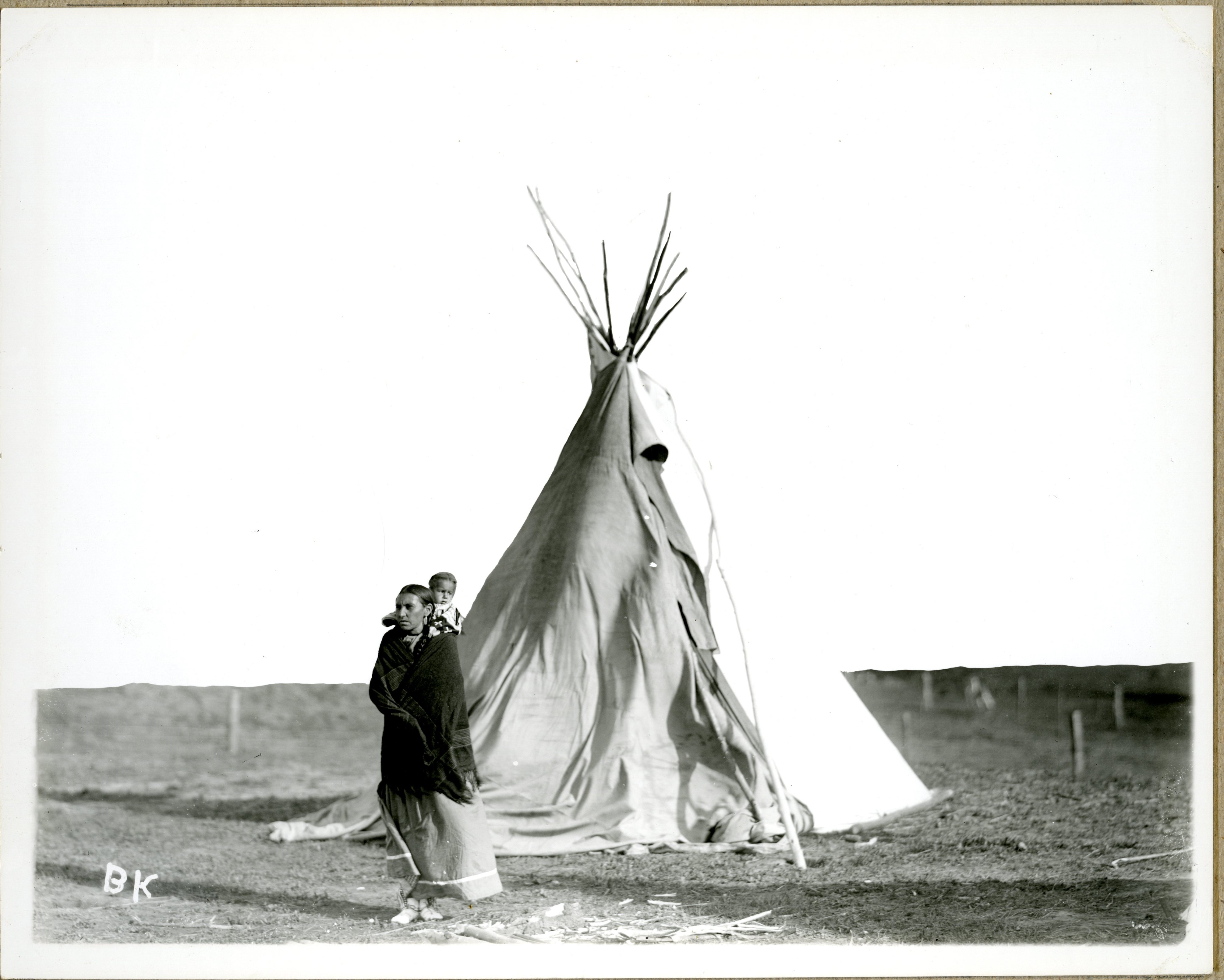
An example of one of the photographs being researched
As I eagerly navigated box after box of Moorehead records, I felt sure it was only a matter of time before I would make a connection between the man and the photos. After combing through his publications, correspondence centered on Oklahoma and the early 1900s, and hundreds of lantern slides later, a different narrative was emerging, though no less intriguing. Despite the vast array of articles, records and collections at the museum, disappointingly, no connection could yet be found between Moorehead and these early images. Details on the named photographer, Kent Chandler of OK, proved equally elusive. However, as we all learn in high school, never underestimate the importance of a comma. With no comma between Kent and Chandler on the photograph mount, I assumed it was his full name. Further digging finally revealed a gentleman named James Kent who lived in Chandler and worked with the 101 Ranch in OK.
Miller Brothers 101 Ranch (19276.76, Oklahoma Historical Society)Pawnee Bill and Zack Miller on Horseback at the Miller Brothers 101 Ranch, Oklahoma.
My next investigative step was the Library of Congress. For three of the photos held at the Peabody I found a match. Excitedly I noticed the details confirmed those at the Peabody – the photos were of the Ponca tribe and taken at the 101 Ranch in Bliss, OK. However, I now had another new piece of key information, the publisher was H.H.Clarke. Investigation into the 101 Ranch revealed the Miller Brothers, famed for their wild west shows for decades, as the brainchild behind the images. Further insight came from a bio on the Oklahoma Historical Society of photographer James B. Kent, revealing he was a resident photographer for the Miller Brothers.
Despite making headway, H.H. Clarke, the publisher of the images, also proved difficult to trace. Finally, I found a reference to publishers H.H. Clarke on the Cherokee Strip Museum website in Perry, Oklahoma. Clarke and his wife operated a small newspaper and native curio store but also had a sideline in publishing postcards. Once again, up popped the 101 Ranch as the backdrop for many of their postcards. All roads keep circling back to the Miller Brothers. It seems they had quite the operation! The Oklahoma Historical Society has an interesting documentary from c.1950 that highlights the magnitude of the activities of the brothers and the ranch which can be watched here.
At the “Oklahoma Gala day” exhibit in 1905, the Millers had their ranch hands and Native Americans demonstrate their skills and featured the incarcerated Geronimo killing a buffalo as a special attraction.
Geronimo skinning a buffalo from the Peabody’s image collection – a similar image to the one in the Library of Congress yet with notable differences
It appears the brothers showcased many Native Americans performing a range of similar publicity stunts. Kent was one of their preferred photographers for these staged events and H.H. Clarke often published them.
How the images came to the Peabody is still not clear. However, I hope I can uncover more information from the archives of the Oklahoma Historical Society which has a great deal of information on the Millers and the ranch.
There is no doubt headway has been made on the purpose of the photos. As I navigate the vast empire of the Miller brothers, propaganda, and unashamedly, profit, seem to be the key factors in their relationship with Native American photos. The question stills remains of how the images came to the Peabody. As I move through the next few weeks, I am hoping to find a link between the Miller brothers, 101 Ranch, and the Peabody. At the same time, establishing who has reproduction rights on the images that I have identified will be key to achieving my goals. As with any historical research, and in the absence of records, there are no guarantees. However, I hope to get as close to the truth as one can and there is no doubt that this journey is as exiting as the destination. More to come…
Mark your calendars! PA Giving Day begins Wednesday, March 30, 2022! This year, the PA Giving Day event will run from Wednesday, March 30, 9 a.m. to Thursday, March 31, 12 p.m. EDT.
For those inspired to give early, please complete the PA Giving Day form here! Please be sure to select the Robert S. Peabody Institute under the “designation” section. Any gift made in advance of the event will count toward PA Giving Day totals.
Last year the Peabody Institute garnered 70 gifts! This year we hope to have more challenges and even more support! Keep a look out for exciting posts and takeovers across our social media channels leading up to PA Giving Day!
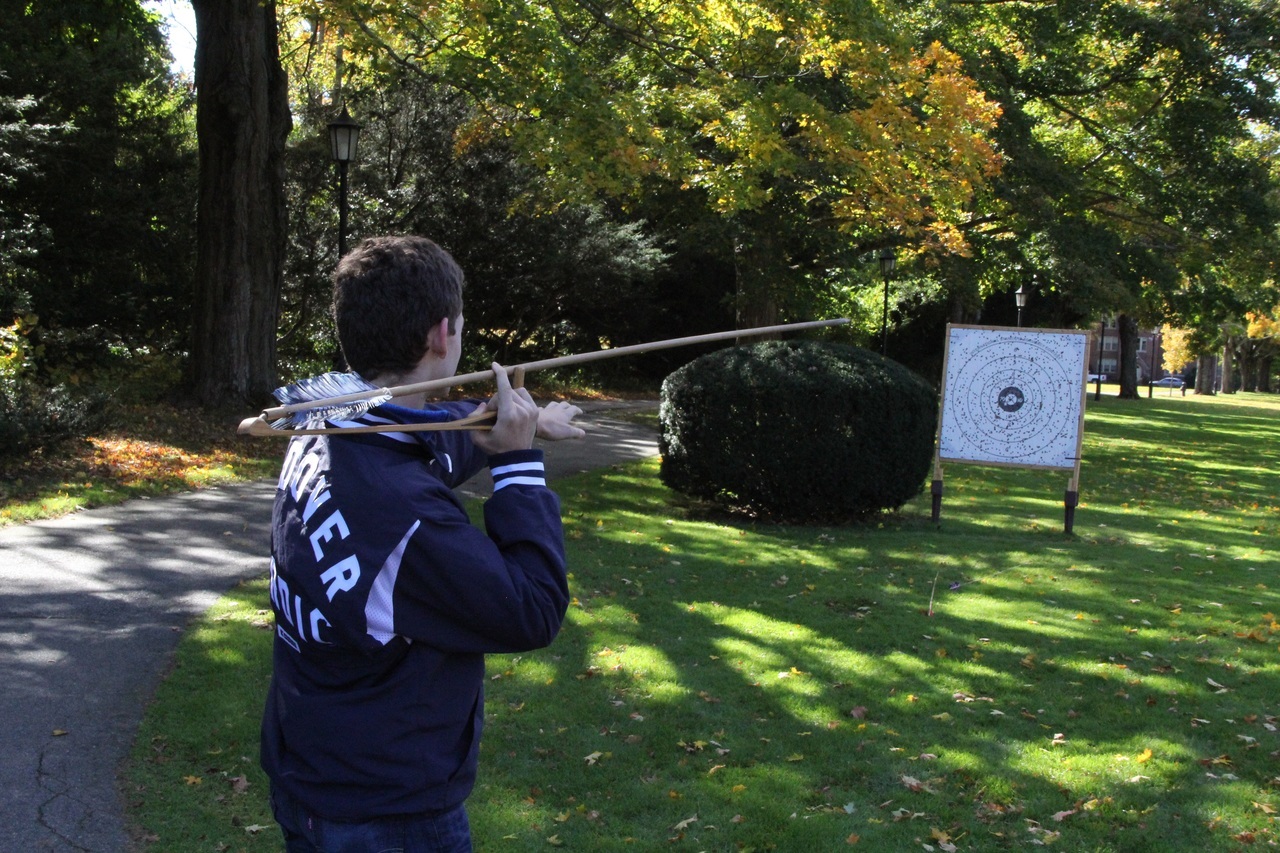
PA student preparing to throw an atlatl on the Vista