Petroglyph National Monument

Contributed by Ryan Wheeler

This summer included a family vacation to parts of Arizona and New Mexico. That meant a drive and some short hikes in Petrified Forest National Park and the Painted Desert, as well as time in Albuquerque and Santa Fe and points in between. Unfortunately, COVID preempted our attendance at the Santa Fe Indian Market, but we are already planning a short visit next summer!

Image of human hand petroglyphs carved on dark volcanic rock at Petroglyph National Monument, New Mexico.
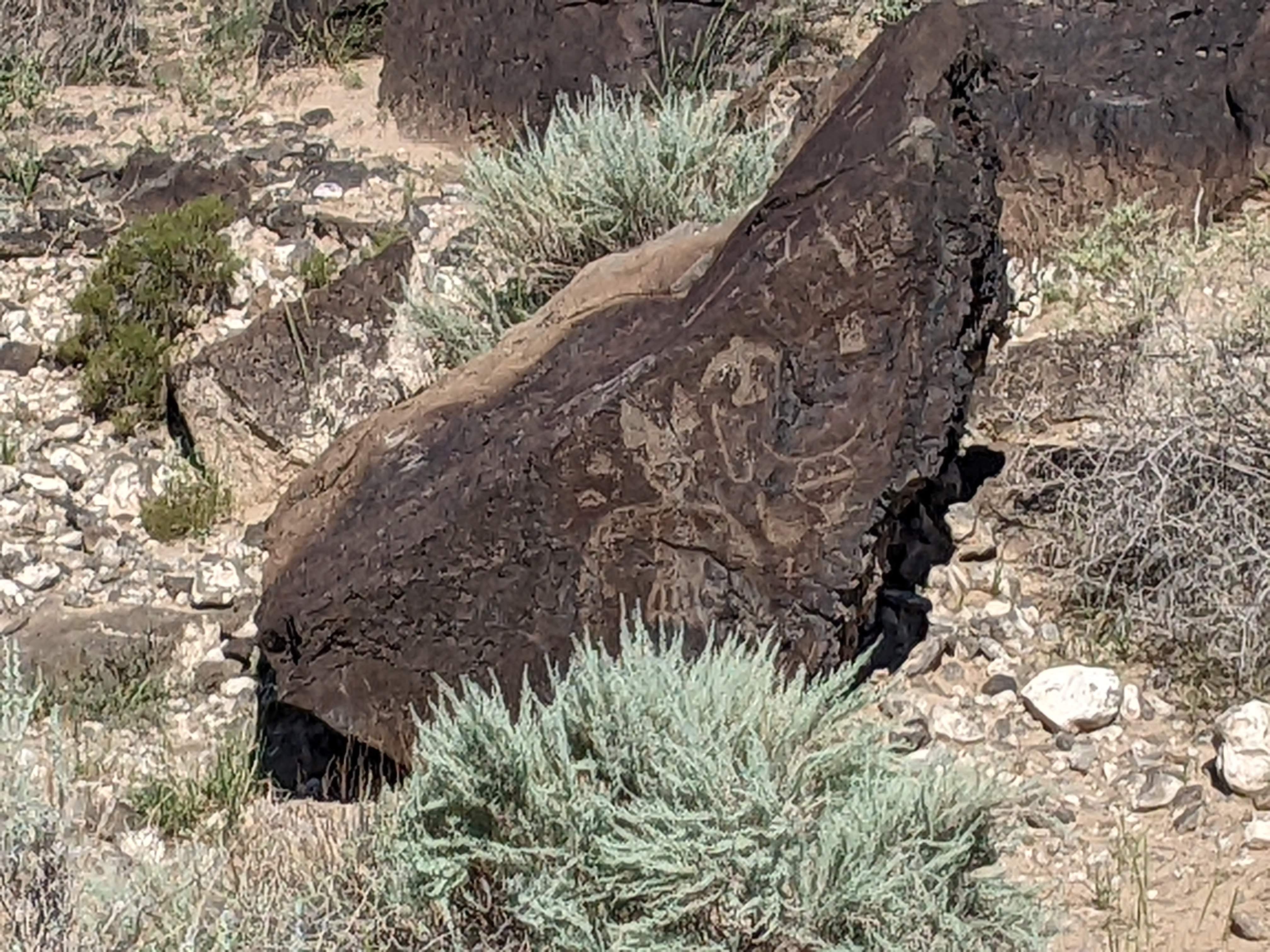
Petroglyphs at Piedras Marcados Canyon, part of Petroglyph National Monument, Albuquerque, New Mexico. Photo by Ryan Wheeler, April 12, 2019.

Petroglyph National Monument is one of the places that I was looking forward to revisiting with my family. Most of the petroglyphs here were made by Native Americans, but there are some added by the Spanish, cowboys, or other visitors. I had a chance to make a visit during the Society for American Archaeology’s annual meeting in 2019, but at that time I had only went to the interpretive center (no actual petroglyphs there, but a great introductory film) and one of the canyons with petroglyphs—Piedras Marcadas, literally “marked stones.” According to the National Park Service, there are about 400 petroglyphs visible at Piedras Marcadas, but that’s only one of three separate locales within the monument. What struck me most during that 2019 visit was the proximity to suburban Albuquerque. The canyon is literally in the backyard of a residential neighborhood! What we learned during our recent visit was that community activism in the 1980s had helped save the petroglyphs and create the monument in 1990—not all that long ago.

View of Albuquerque from Boca Negra Canyon, August 2022.

This summer we decided to visit Rinconada Canyon, which is only about a mile from the Petroglyph National Monument interpretive center. The park service says you can see about 300 petroglyphs at Rinconada. Despite being right off Unser Boulevard, this site doesn’t have a residential development right next door, so it feels a little bit wilder. The loop trail took us past the canyon wall, which is littered with volcanic boulders. The boulders have a desert varnish of blacks and dark browns, making a good surface for the inscribed petroglyphs that expose the lighter colored rock below the surface. One of the most interesting parts of the monument is the decision not to interpret the meanings of the glyphs, though you can learn a little about this from Native Americans interviewed in the interpretive center film. We went early enough that we didn’t get baked.

Macaw and geometric petroglyphs, Boca Negra Canyon, August 2022.

On a bit of a whim, we decided to visit Boca Negra Canyon, the third petroglyph site in the monument. While apparently only having 100 or so petroglyphs that can be viewed by visitors, this was really the most spectacular of the three locales. At Boca Negra you climb up the mesa and really have an opportunity to get close to the petroglyphs. It’s a little more up and down of a hike, but worth it for the views and the chance to see the petroglyphs close up. The geology of the area is fascinating too. The inscribed boulders are the product of a volcanic eruption around 130,000 years ago. Magma poured out of vents and fissures in the area, creating a sheet of basaltic rock over the softer Santa Fe Formation. The softer sediments on which the volcanic rocks were deposited slowly eroded away, leaving the broken boulders.

Petroglyphs at Rinconada Canyon, August 2022.

The petroglyphs at all three monument locations were made by ancestors of the modern Pueblo people, dating between 400 and 700 years ago, though some are much older. The petroglyphs have been dated based on weathering, but also variations in style and content. There are birds, insects, animals, hands, humanoids, spirals, and other geometric forms. The petroglyphs remain culturally significant to Pueblo people and other Native Americans in the region.

Summer Reading List: Our Peabody Staff Picks

Contributed by Emma Lavoie

Ah, summertime. The Andover Summer session has ended, students have left campus, the weather is warm (too warm at times), and it’s time for some relaxation and rejuvenation before we start the new school year. What better way to enjoy the rest of your summer than with a good book! But with so many books out there, how do you choose?

Thankfully, members of the Peabody staff are here to share their “Peabody Picks” with you dear readers! Below are some of our favorite reading recommendations based on what our staff is currently reading or has read this summer. Enjoy!

Ryan Wheeler, Director – Decolonizing “Prehistory”: Deep Time and Indigenous Knowledges in North America

Decolonizing “Prehistory” combines a critical investigation of the documentation of the American deep past with perspectives from Indigenous traditional knowledges and attention to ongoing systems of intellectual colonialism. It’s a 2021 collection of essays edited by Gesa Mackenthun and Christen Mucher. I was initially pointed to the first chapter by a colleague—that’s by the late Annette Kolodny and titled Competing Narratives of Ancestry in Donald Trump’s America and the Imperatives for Scholarly Intervention. The other essays are equally provocative and engaging! It can be read online for free here!  

“This book packs a double revelation and, with it, an important message for the environmental movement.” – Heather Menzies, Watershed Sentinel

Marla Taylor, Curator of Collections – The Invisible Life of Addie LaRue by V.E. Schwab

In a moment of desperation, a young woman makes a Faustian bargain to live a life of freedom.  But, the deal is not what she expected.  Thus begins the extraordinary life of Addie LaRue, and a dazzling adventure that will play out across centuries and continents, across history and art, as a young woman learns how far she will go to leave her mark on the world.

“Completely absorbed me enough to make me forget the real world.” – Jodie Picoult, Washington Post

John Bergman-McCool, Assistant Curator – The End of Everything: (Astrophysically Speaking) by Katie Mack

The Universe had a beginning, and it will have an end. Modern cosmology — the study of the nature and evolution of the cosmos itself — has allowed physicists to explain the history of the Universe from the first tiny fraction of a second until today. But what’s next? We now have the tools to extend our knowledge into the distant future and speculate about the ultimate fate of all reality.

“A thrilling tour of potential cosmic doomsdays….Mack’s infectious enthusiasm for communicating the finer points of cosmological doom elevates The End of Everything over any other book on the topic.” –The Wall Street Journal

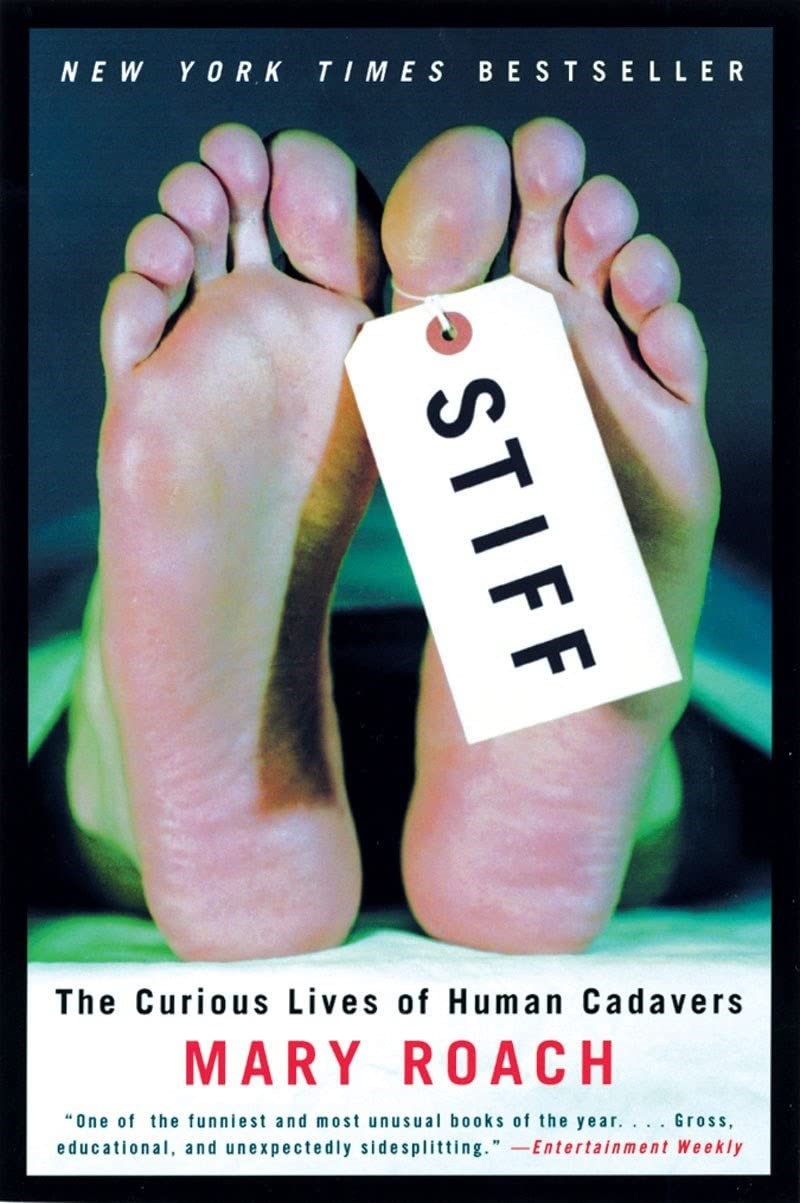
Lindsay Randall, Curator of Education and Outreach – STIFF: The Curious Lives of Human Cadavers by Mary Roach

While it has no right to be – given the topic – Mary Roach has written a book that is hilariously funny as she takes the reader on a tour of what can happen to human bodies after death. I enjoyed 99.99999% of the book, with the only downside being the part that describes what maggots sound like when feeding… Now I am forever like Ron, the poor unsuspecting media relations guy who was only trying to be nice as he drove Mary around, as I too used to like Rice Crispies.

“One of the funniest and most unusual books of the year….Gross, educational, and unexpectedly sidesplitting.” – Entertainment Weekly

Emma Lavoie, Administrative Assistant – The Mystery of Mrs. Christie by Marie Benedict

The New York Times and USA Today bestselling author of The Only Woman in the Room returns with a thrilling reconstruction of one of the most notorious events in literary history: Crime novelist, Agatha Christie’s mysterious 11-day disappearance in 1926. History and true crime lovers, this book is for you!

“A stunning story… The ending is ingenious, and it’s possible that Benedict has brought to life the most plausible explanation for why Christie disappeared for 11 days in 1926.” – The Washington Post

Beth Parsons, Office of Academy Resources, Director for Museums and Educational Outreach – The Personal Librarian by Marie Benedict and Victoria Christopher Murray

A remarkable novel about J. P. Morgan’s personal librarian, Belle da Costa Greene, the Black American woman who was forced to hide her true identity and pass as white in order to leave a lasting legacy that enriched our nation. An interesting tie to Andover, she is the daughter of Richard T. Greener (Andover alumnus, ‘1865), the first Black graduate of Harvard and a well-known advocate for equality.

“Historical fiction at its best…The Personal Librarian spins a complex tale of deceit and allegiance as told through books.” – Good Morning America

David Spidaliere, Collection Project Assistant – Engaging Archaeology: 25 Case Studies in Research Practice by Stephen W Silliman

Bringing together 25 case studies from archaeological projects worldwide, Engaging Archaeology candidly explores personal experiences, successes, challenges, and even frustrations from established and senior archaeologists who share invaluable practical advice for students and early-career professionals engaged in planning and carrying out their own archaeological research.

“Unique and thoughtful, Stephen W. Silliman’s guide is an essential course book for early-stage researchers, advanced undergraduates, and new graduate students, as well as those teaching and mentoring. It will also be insightful and enjoyable reading for veteran archaeologists.” – Wiley-Blackwell Publishing

Jessica Dow, Collection Project Assistant – Uprooted: On the Trail of the Green Man by Nina Lyon

Who, or what, is the Green Man, and why is this medieval image so present in our precarious modern times? An encounter with the Green Man at an ancient Herefordshire church in the wake of catastrophic weather leads Nina Lyon into an exploration of how the foliate heads of Norman stonemasons have evolved into today’s cult symbols.

“Lyon’s search for the meanings of the folk image and symbol of rebirth take her from neopagan Cornish festivals to the forests of south-west Germany. She is both political and sardonic.” – The Guardian

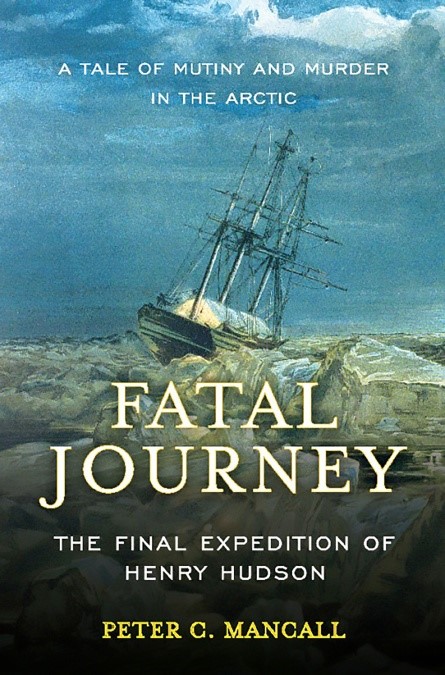
Richard Davis, Peabody Volunteer – Fatal Journey: The Final Expedition of Henry Hudson by Peter C. Mancall

The English explorer Henry Hudson devoted his life to the search for a water route through America, becoming the first European to navigate the Hudson River in the process. In the winter of 1610, after navigating dangerous fields of icebergs near the northern tip of Labrador, Hudson’s small ship became trapped in winter ice. Provisions grew scarce and tensions mounted amongst the crew. A story of exploration, desperation, and icebound tragedy, Fatal Journey vividly chronicles the undoing of the great explorer, not by an angry ocean, but at the hands of his own men.

“Mancall’s account of the doomed voyage is exciting, tense, and tragic…. This is an excellent re-examination of [Hudson] and his final, sad effort.” – Booklist Magazine

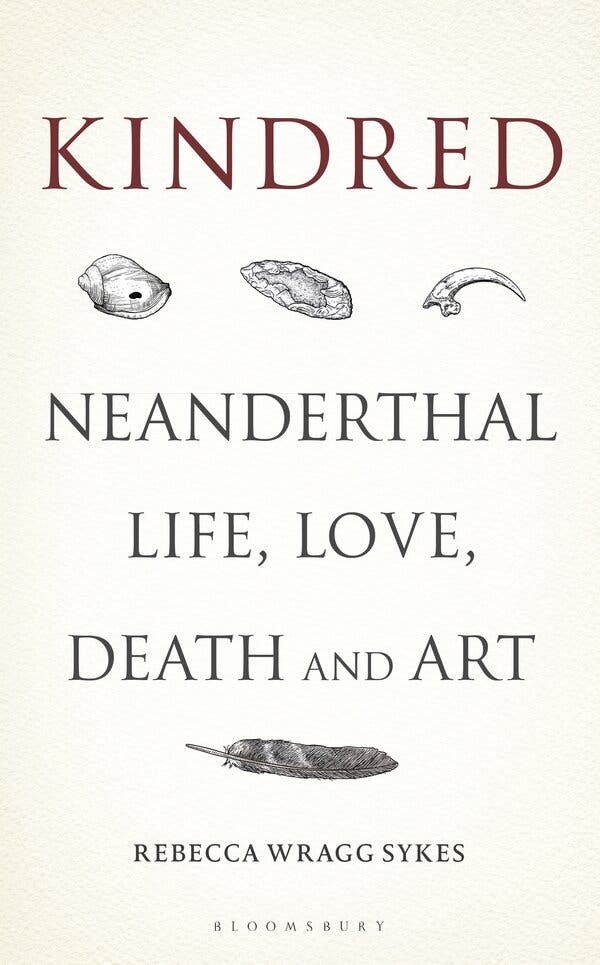
Michael Agostino, Peabody Volunteer – Kindred: Neanderthal Life, Love, Death and Art by Rebecca Wragg Sykes

A wonderful non-fiction book where the author assembles many decades of Neanderthal research into a clear description of how they lived, survived challenges, and created art. I especially like the detail she provided on how the many stone artifacts were sourced and created. This fueled my imagination as I work with the many pieces in the Peabody collection.

“‘Kindred’ is important reading not just for anyone interested in these ancient cousins of ours, but also for anyone interested in humanity.” – The New York Times

Gearing Up for Human Origins

Contributed by Ryan Wheeler

The fall 2022 term at Phillips Academy is a little less than a month away and this time every summer my thoughts turn to Human Origins. Human Origins is the interdisciplinary science elective that I have been teaching since 2016 (the course originated with Jere Hagler and Peabody Institute staff in 2007).

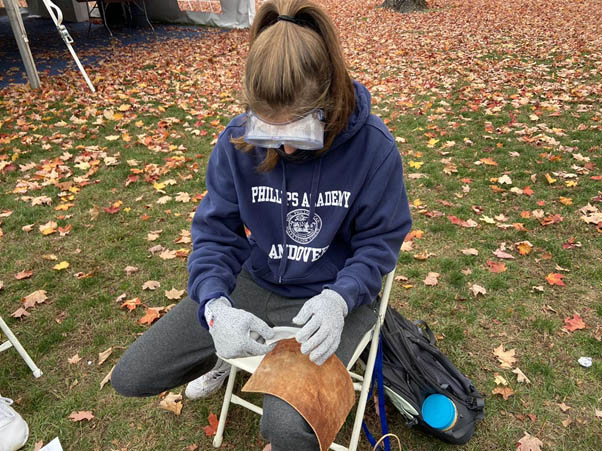
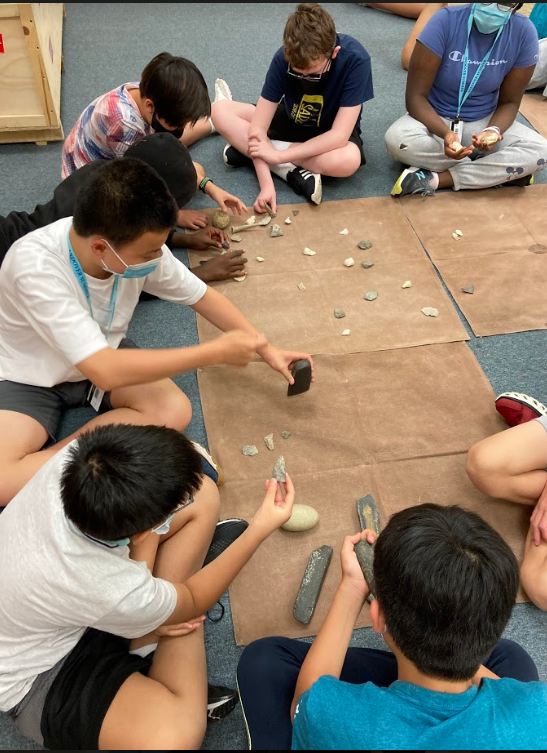
Hands on activities are a mainstay of Human Origins, including work with our collection of fossil human casts and models, spear throwing, ancient paint making, fire making, and stone tool making. Many of these activities explore ancient human technologies and give students a glimpse into life in the Upper Paleolithic.

Human Origins student crafting a stone tool during fall 2020.

Stone tool making—or flint knapping—requires a little preparation each summer to make certain that we have the necessary safety gear, equipment, and raw stone for the students in the fall. In fall 2020, during the COVID-19 pandemic when all courses moved online, we continued to flint knap in Human Origins by sending out kits with all the needed materials. This gave students a few weeks to familiarize themselves with the tools and techniques (after watching my safety video), rather than just one class period. Pedagogically this seemed like a good shift, so I’ve kept this as part of the course.

Knapping safety gear and tools for Human Origins.

I’ve also had a few colleagues ask about how I assemble the flint knapping kits. It is possible to find ready made kits online, these often don’t have the greatest materials, and lack safety gear like gloves, goggles, and leather pads. Here’s a list of some of the items that we typically put together in a Human Origins flint knapping kit:

  • Safety goggles
  • Leather gloves or cut proof gloves
  • A six-inch leather pad (helps protect legs and grip the flint spall)
  • An antler billet as a soft hammer
  • A river cobble as a hard hammer
  • A copper topped “bopper” for percussion flaking
  • A deer antler flaker (for pressure flaking)
  • A copper tipped flaker (for pressure flaking)
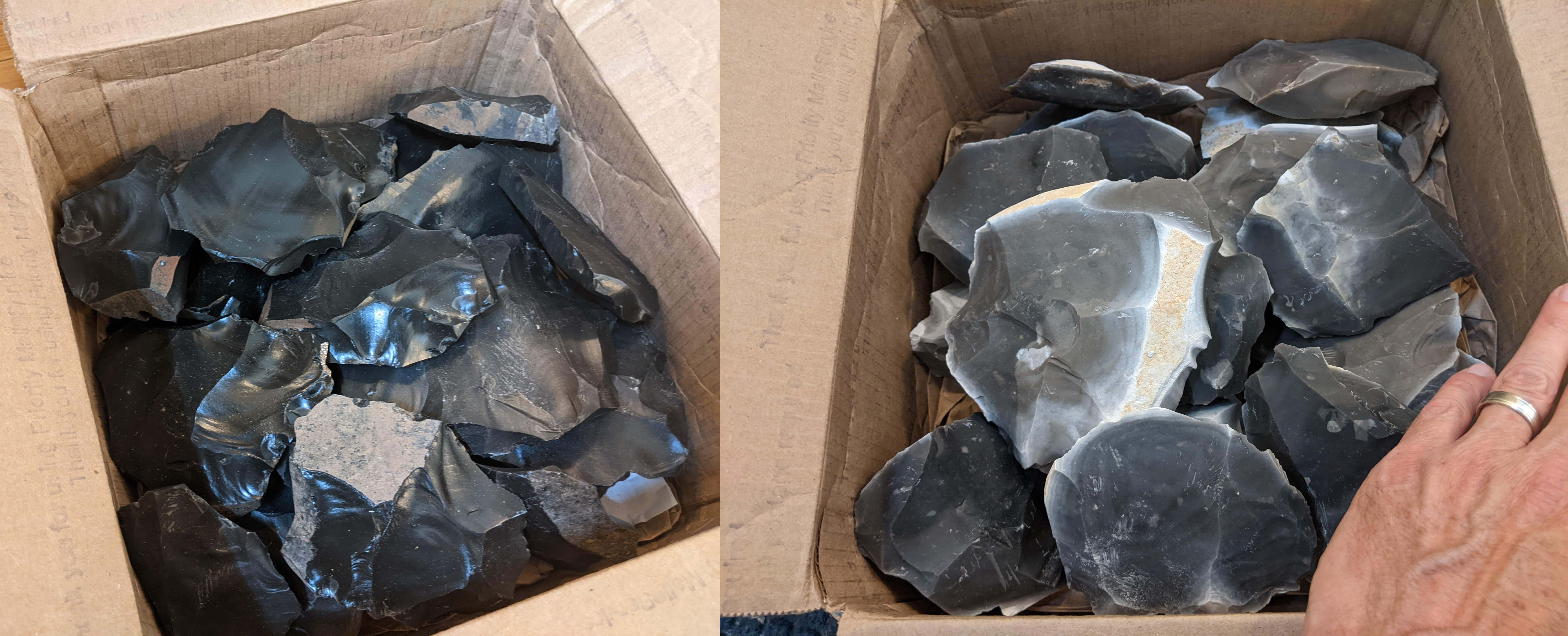
  • Large spalls of dacite and Georgetown flint (I’ve found these two materials work best for students—they knap uniformly, have few irregularities or inclusions, and can be readily obtained on online)
Dacite (left) and Georgetown flint spalls are good raw materials for beginners.

A variety of YouTube videos are available that introduce the techniques, which we also discuss in class. Students are encouraged to experiment with both percussion and pressure flaking, the different tools and materials, and making tools solo or in a group. As an instructor, I consider it a success if students are able to produce flakes (and name the different parts of a flake)!

Bifacial stone tools made by Human Origins students in fall 2020.

An Archaeologist and a Museum Professional walk into a basement…

Contributed by David Spidaliere and Jessica Dow

Hello! We are the new temporary collections project assistants for the Peabody’s upcoming collections move. Our combined knowledge of archaeology and museum studies helps us assess the needs of the collection and to find efficient ways to track the collections. Here’s a little about each of us:
My name is David Spidaliere. I am currently pursuing my master’s in Historical Archaeology at UMass Boston, finishing up my thesis on trade in Plimoth Colony. I was drawn to this role at Robert S. Peabody because my background is in seventeenth and eighteenth century New England archaeology and history, but I have very little knowledge of Indigenous archeology. This position has afforded me the opportunity to work with Native materials and to learn more about the importance of repatriation legislation.

My name is Jessica Dow, I recently completed my Masters in Museum Studies at Harvard’s Extension School, with a focus on collections management, Indigenization and public service. I currently work in the Visitor Services Department of the Harvard Art Museums, and I was drawn to this role because it offered me a chance to learn more about Archaeology and the care and planning that goes into Archaeological collections management. I’m passionate about ethical stewardship and repatriation, and Marla has been a fantastic resource as I continue to learn more about this field!

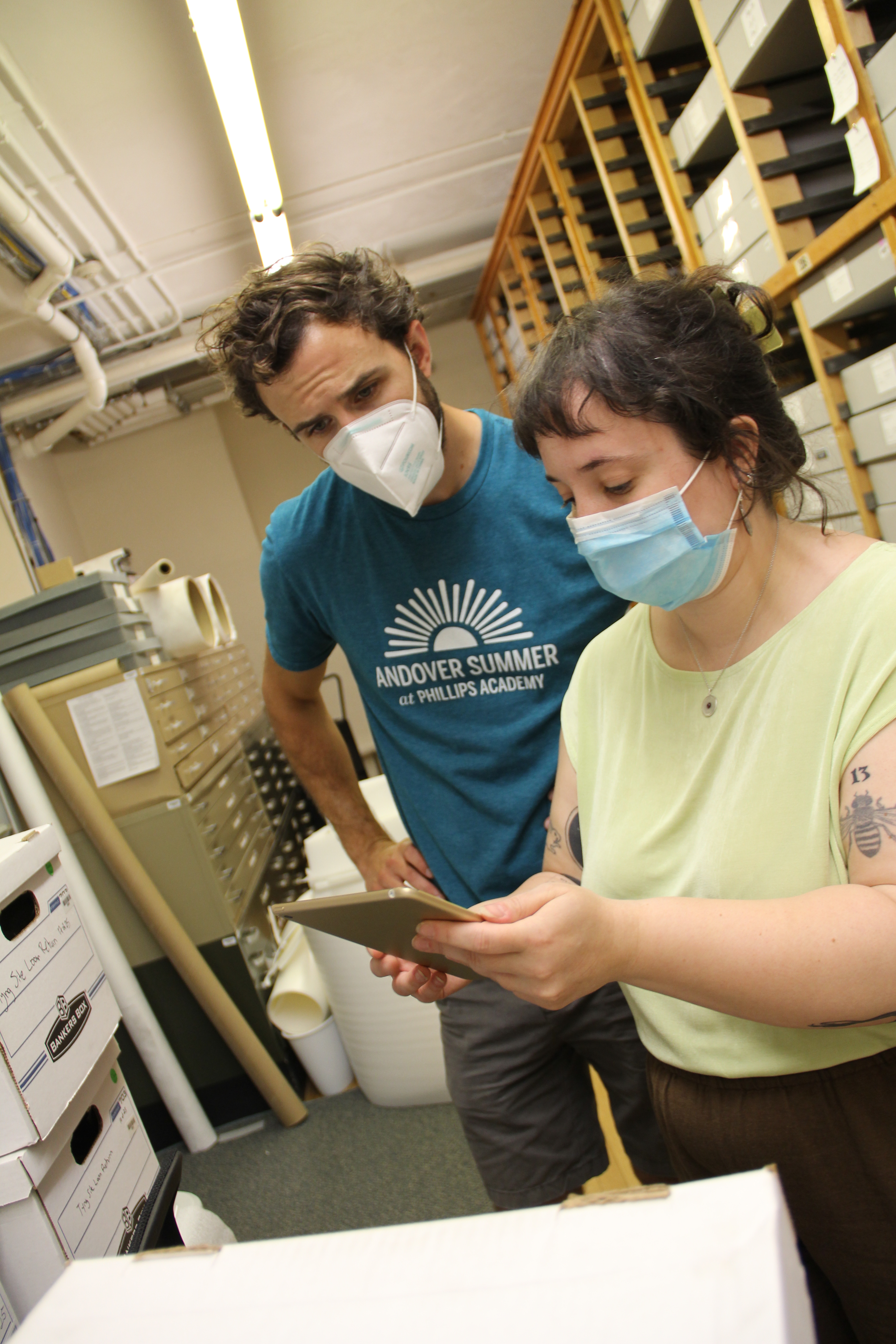
Dave and Jess hard at work

We were brought on to help the Peabody create a system by which they could track collections as they move throughout the building. This type of system is crucial for day-to-day movement of collections for research and teaching purposes, as well as for larger projects that require the collections to be moved, such as construction or pest and mold remediation. Our work is concerned with the types of data that determine risk factors such as vibration, and factors that dictate how objects are stored, such as size, weight, and cultural sensitivity.

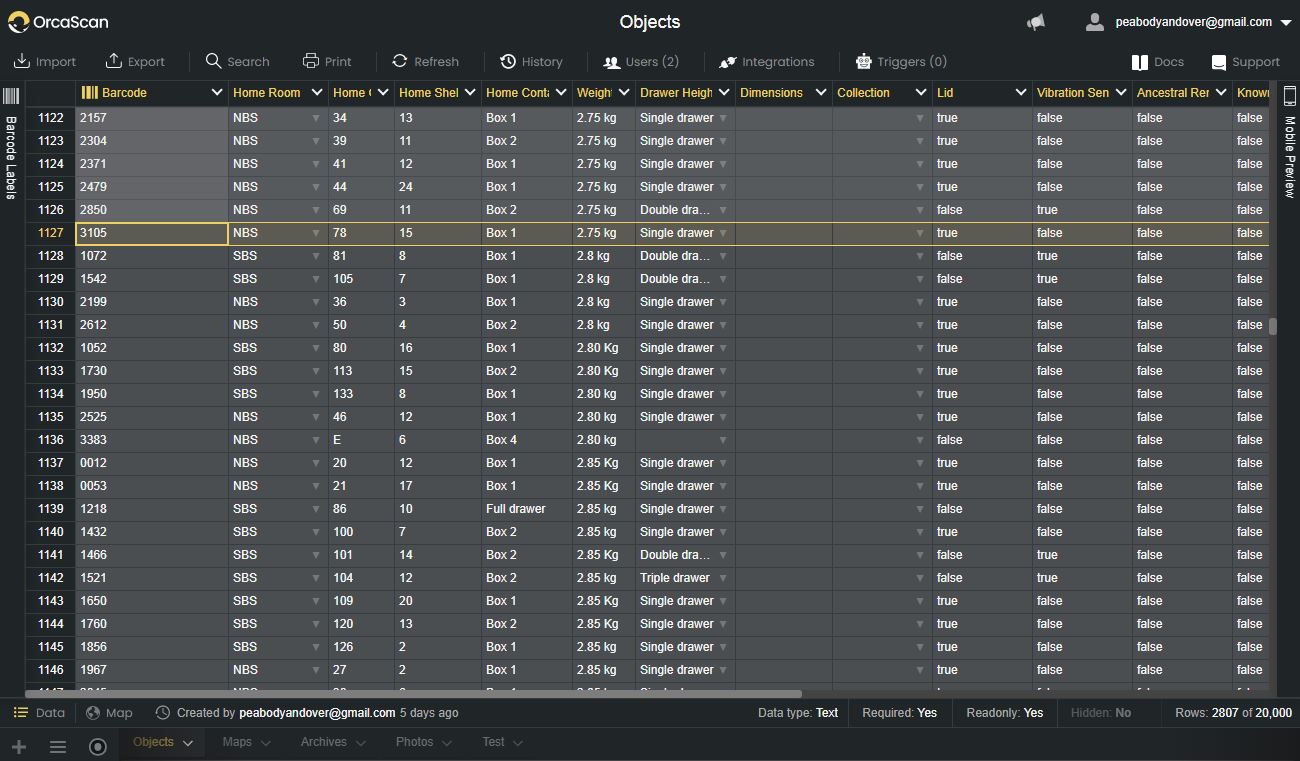
To track this data, we are using software that was designed for retail use and allows us to barcode boxes and items and assign information to each barcode using iPads. We can then review all of that data on a desktop computer in order to help Peabody staff assess collections needs on a larger scale.

In the picture below you can see the desktop view that we use to review the data we have collected as we barcode the collection. We can easily see which boxes have lids, the dimensions of items that are too large to be boxed, and other factors like weight and cultural sensitivity.

Example Orcascan screen shot

While our roles here at the Peabody are temporary, the work we are doing will continue to be useful to Peabody staff in the future. We are honored to be a part of this stage of the Peabody’s growth and hope to continue our relationship with the museum and its staff as we step into whatever is next in our respective careers!

Cats and Bears

Contributed by John Bergman-McCool

Lately, the process of fully cataloging Adopt-A-Drawers has resulted in some interesting discoveries. The most recent of these comes from artifacts collected by Richard “Scotty” MacNeish in Tamaulipas, Mexico.

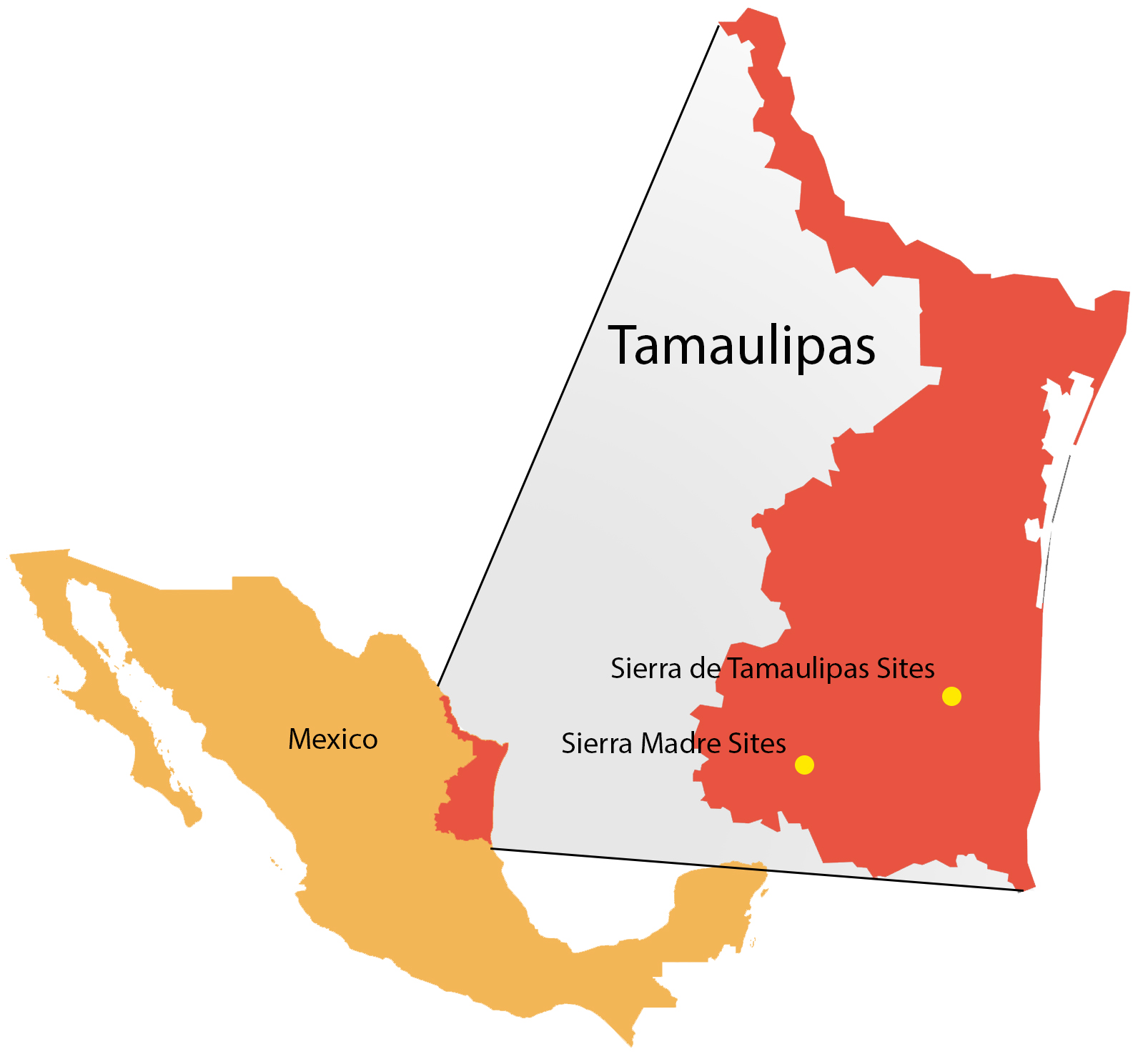
MacNeish went to Tamaulipas in 1945 hoping to find sites that predated the production of ceramics. In particular, he was searching for sites with long cultural sequences that he could use to tell the story of the development of human culture in Mesoamerica. During three field seasons, spanning  ten years, MacNeish identified and excavated several village and cave sites in the Sierra de Tamaulipas and the Sierra Madre Oriental, two mountain ranges in Tamaulipas.

MacNeish’s Tamaulipas excavation areas.

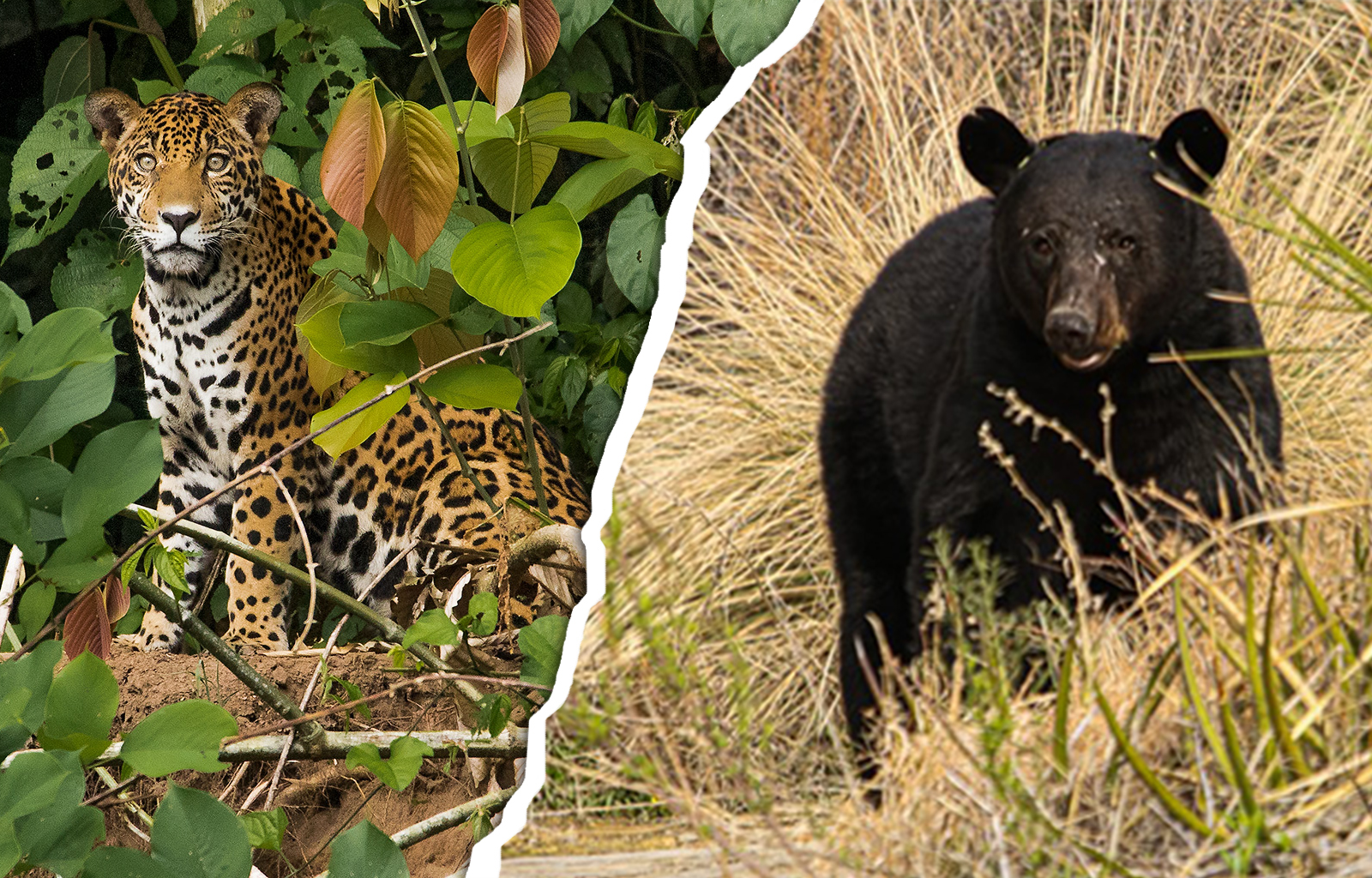
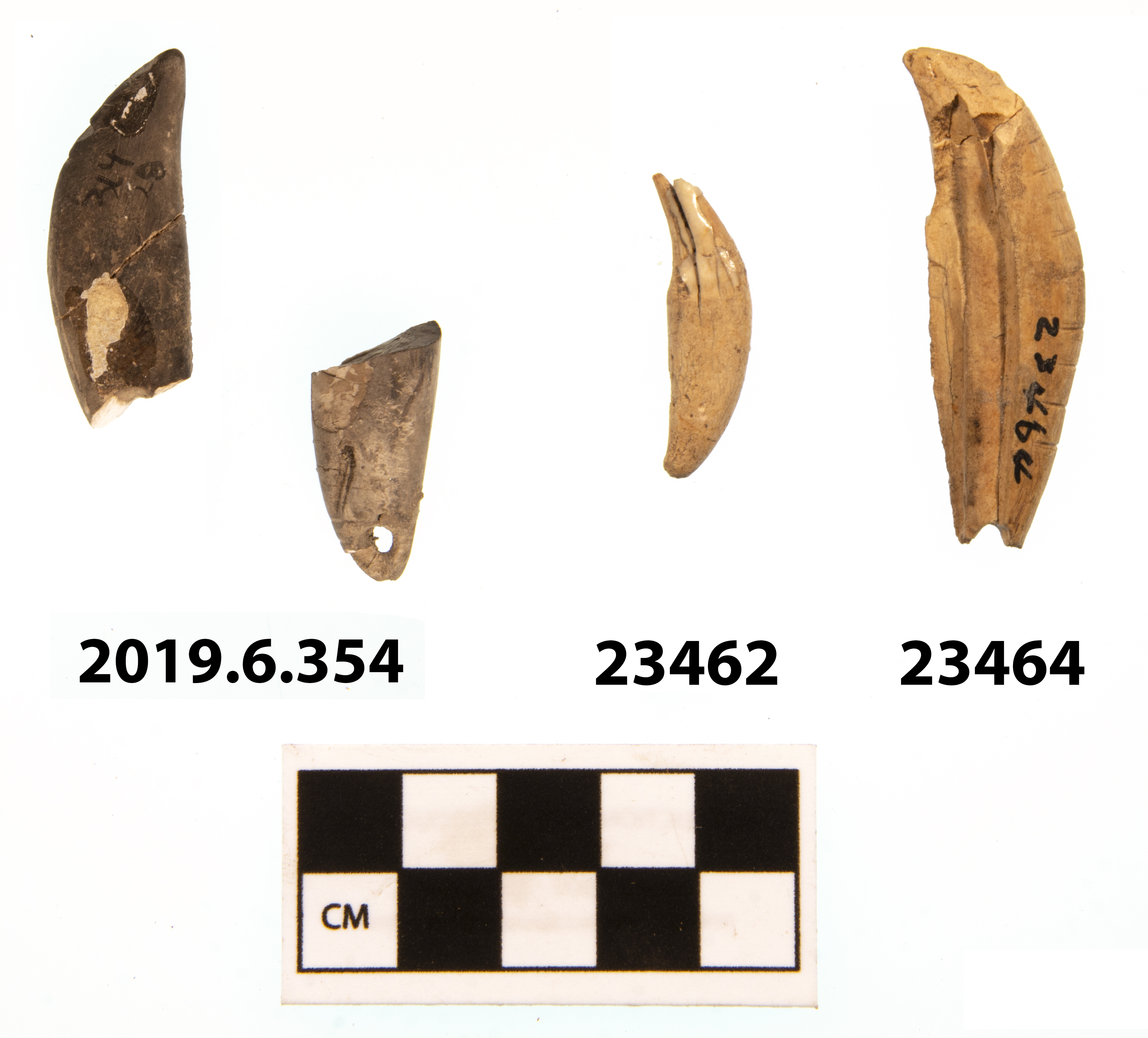
MacNeish recovered a wide variety of items from the well-preserved cave deposits in Tamaulipas. Of these were two fragmentary bear canine-shaped pendants recovered from Armadillo Cave in the Sierra de Tamaulipas. They appear to have been burnt and MacNeish believed that they were fashioned from sandstone. When compared with real canines from a bear and unknown canid, it is clear that they are an imitation. For example, the Tamaulipas pendants have no enamel and they lack the same degree of detail. However, they do approximate the shape very effectively.

Left: Two Tamaulipas bear canine-shaped pendant fragments. Middle: Dog or coyote canine pendant from Ohio. Right: Bear canine pendant from Ohio.

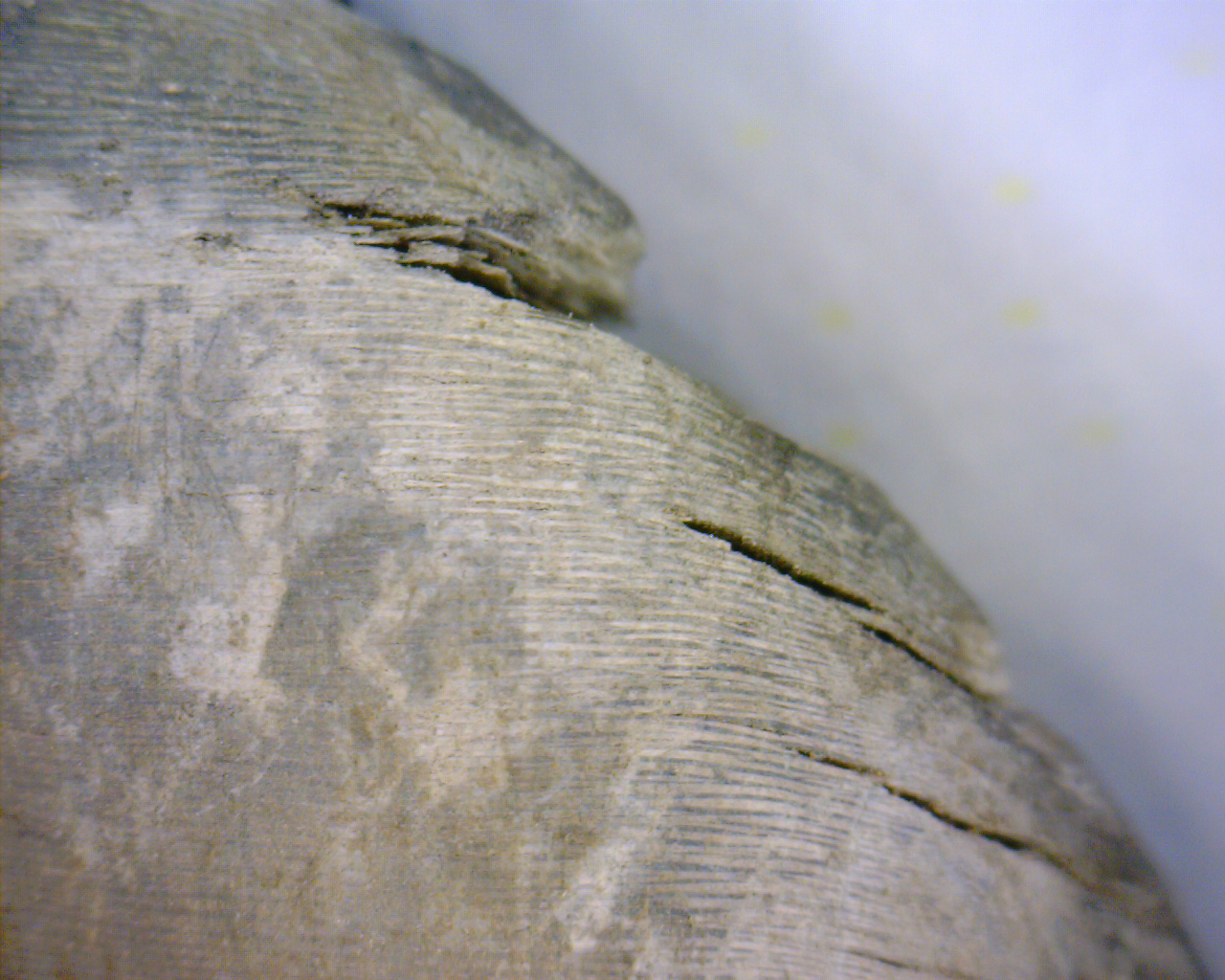
One of the pendants was fractured below a possible enamel layer so they were both inspected under magnification. Surprisingly, they show signs of very thin layering more reminiscent of the annuli of shell. I asked our Director, Dr. Ryan Wheeler to take a look at them. Among those who work here at the Peabody, he is the resident expert on shell artifacts. Dr. Wheeler agreed they were shell.

Magnified View of bear canine-shaped pendant from Tamaulipas, showing annuli.

The fact that the pendants were made of shell led us to think about a possible connection with the Hopewell Culture. Several shell imitations of bear canines have been recovered from Hopewell mound sites. Additionally, the Hopewell developed a very large interaction sphere, traveling far and wide for trade materials. The Hopewell procured copper from Lake Superior, silver from Canada, obsidian from Wyoming, mica from the Blue Ridge Mountains and shell from the Gulf of Mexico.

We wondered if these pendants could have been a Hopewell trade object. Fortunately, the Peabody archives include MacNeish’s Tamaulipas excavation paperwork (digitized here). The first step to establishing a possible link was to determine the items’ age. Using charcoal from distinct layers excavated from the cave deposits, MacNeish was able to radiocarbon date the deposits. The layer containing the shell pendants dates to the Almagre Phase, roughly 2,200 to 1800BCE. This correlates to the Archaic period in the Ohio valley, about 2,000 years before the Hopewell developed. The Hopewell connection was out.

I also searched for bear remains found in northern Mexican archaeological contexts. A very quick review of available resources indicated that bear remains are not all that common in the region. The only positive return came in the form of bear long bones found at Casas Grandes in Chihuahua, Mexico. This was interesting, because the historical range of both Mexican grizzly and black bears include much of northern Mexico, including Tamaulipas state. It is very likely that humans and bear interacted in the past.

At Dr. Wheeler’s suggestion I reached out to Dr. Brad Lepper, Senior Archaeologist with the Ohio History Connection and José Luis Aguilar Guajardo, archaeologist in Tamaulipas, Mexico. They both responded with helpful information. Dr. Lepper was interested in the presence of the shell pendant and was unaware of anything similar coming from Archaic sites. He suggested consulting Cheryl Claassen’s book Beliefs and Rituals in Archaic Eastern North America for possible archaic examples, which I haven’t yet had a chance to read.

Dr. Lepper provided several examples from the Ohio History Connection’s collection of Middle Woodland Hopewell bear canine pendants (here and here) and their imitations (here and here). Some of the canines were split, or contained fresh water pearls from the Ohio River. Imitations were made from mica, copper, shell, bone, ceramic and stone.

José Luis Aguilar Guajardo was also very interested in the bear canine-shaped pendants. He was unaware of anything similar coming from sites in the Sierra de Tamaulipas mountains. He indicated that shell was a semi-precious material used for making ornamentation by the Indigenous people in the area. The Sierra de Tamaulipas mountains are quite close to the Gulf of Mexico, a source for shell materials.

José was clear that black bears can still be found in the Sierra de Tamaulipas, and supported the possibility that they were bear-shaped. However, he suggested the possibility that they were inspired by the jaguar instead. According to José, jaguar were abundant in the area and were revered by the Indigenous people.

How to assign an animal label to the pendants becomes an interesting problem. Bear and jaguar canines can look similar in size and appearance. Understanding what the maker of the pendants intended them to represent is difficult when they cannot be asked about them directly. Both animals’ habitats overlapped in northern Mexico.

Though they don’t provide a definitive answer, some helpful articles, and their authors, that explore the importance of bear and jaguar imagery in north and Mesoamerica include: Bear Imagery and Ritual in Northeast North America, Thomas E. Berres, David M. Stothers and David Mather; Predators of Culture: Jaguar Symbolism and Mesoamerican Elites, Nicolas J. Saunders; and Rohonas and Spotted Lions: The Historical and Cultural Occurrence of the Jaguar, Panthera onca, among the Native Tribes of the American Southwest, Steve Pavlik. There are probably many, many others.

Perhaps, as José Luis Aguilar Guajardo has suggested in personal communications, Sierra de Tamaulipas falls into an area in which jaguars were strongly revered. In a very simplistic summary of the above articles, cranial remains of bears in archaeological contexts in North America have been considered a sign of bear ceremonialism. They don’t appear in MacNeish’s Tamaulipas excavations. Jaguar hides were an element of Aztec royal clothing and one of the accoutrements used by Aztec shamans. A small fragment of possible jaguar hide was recovered from the Sierra Madre excavations in Tamaulipas.
Future excavations in the area will likely bring more evidence to bear on the ritual and symbolic practices of the people of Tamaulipas.

Resources:

Archaic Bear Tooth Pendants and other related artifacts

Donaldson, William S. and Stanley Wortner

1995      The Hind Site and the Glacial Kame Burial Complex in Ontario. Ontario Archaeology 59:5-95.

Bear Imagery and Ritual

Berres, Thomas E., David M. Strothers and David Mather

2004      Bear Imagery and Ritual in Northeast North America: An Update and Assessment of A. Irving Hallowell’s Work. Midcontinental Journal of Archaeology 29(1):5-42.

Jaguar Imagery and Ritual

Pavlik, Steve

2003      Rohonas and Spotted Lions: The Historical and Cultural Occurrence of the Jaguar, Panthera  onca, among the Native Tribes of the American Southwest. Wicazo Sa Review 18(1):157-175.

Saunders, J. Nicolas

1994      Predators of Culture: Jaguar Symbolism and Mesoamerican Elites. World Archaeology  26(1):104-117.

Archaeological (Career) Explorations 

Contributed by Lindsay Randall

Back in May, I was approached by Peabody education volunteer and Triton Regional High School History teacher Lisa Herzl about a student of hers who was interested in going to college for archaeology. She asked if there were any opportunities this summer for the student to learn more about what exactly archaeology is before committing her life (and $$$$) to studying it.

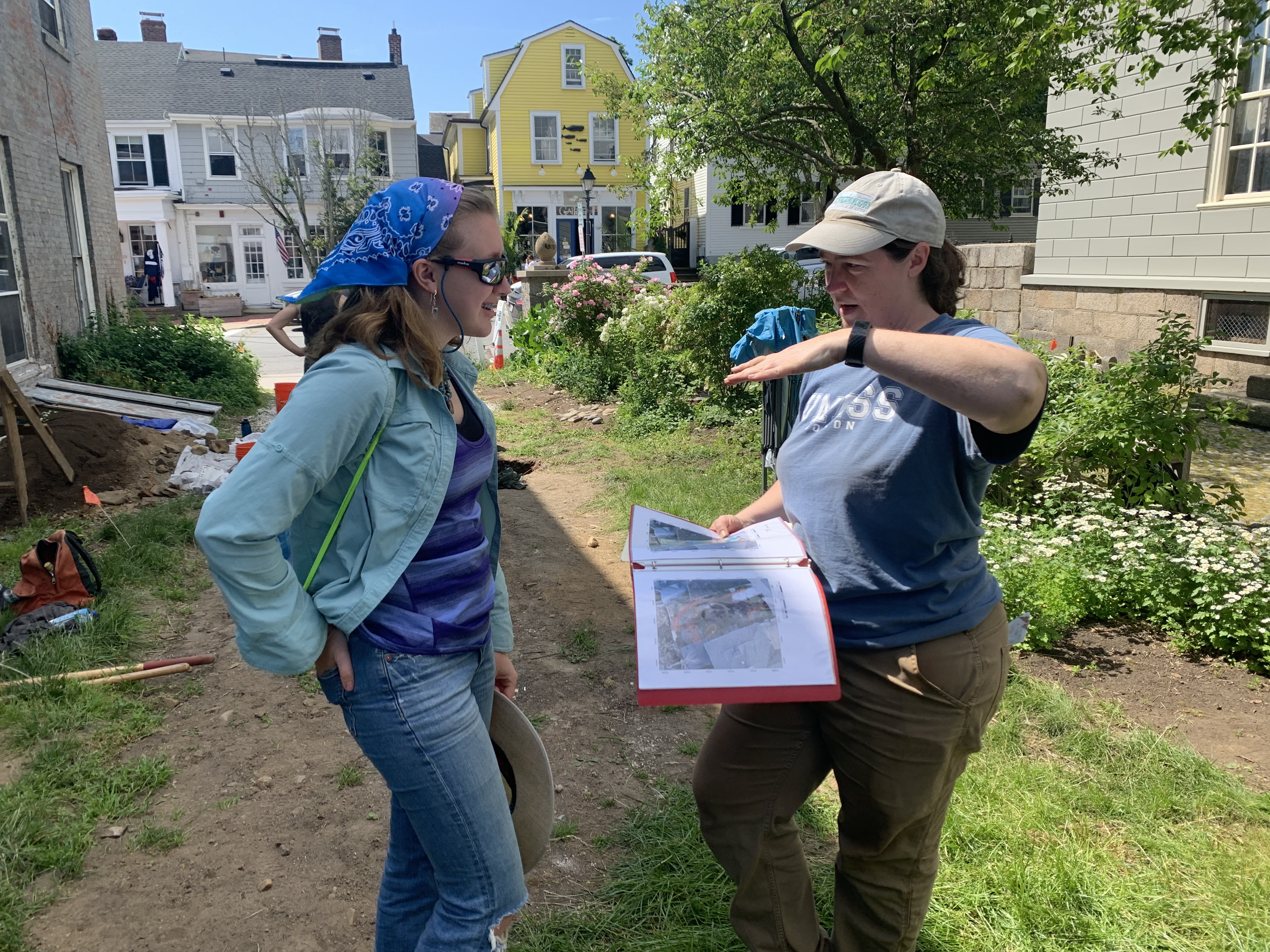
I reached out to my network of archaeologists to see what might be available. And, the outpouring of support of the student’s interest was amazing. My former thesis committee member Dr. Christa Beranek wrote to me that she would be happy to give the student a tour of the site she was working on at the end of June.

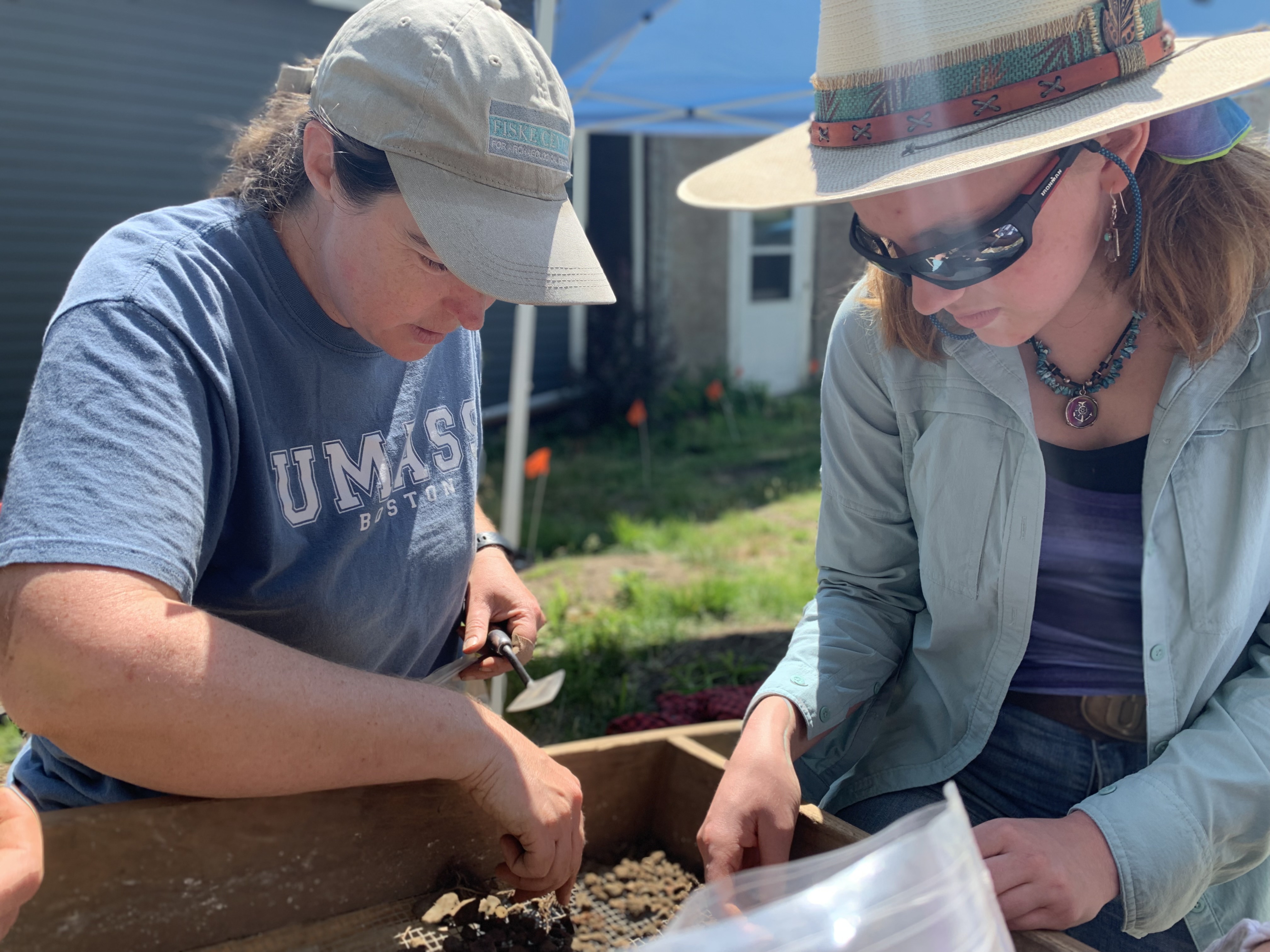
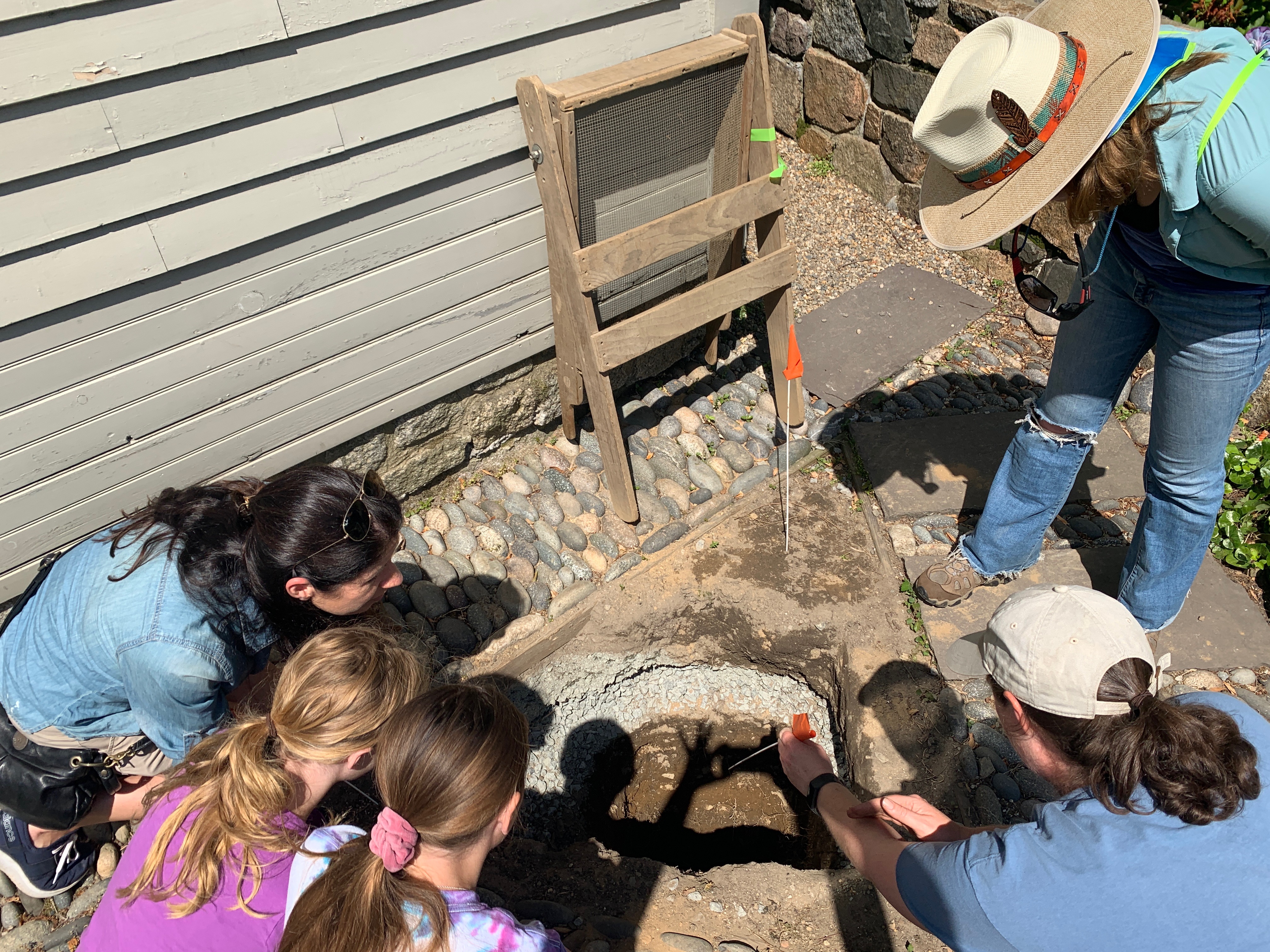
The Fiske Center UMass Boston was hired to investigate the property that the Marblehead Museum recently acquired. The property sits adjacent to the Jeremiah Lee Mansion, owned and operated by the Marblehead Museum, and was the former brick kitchen and possible slave quarters owned by the Lee family. This would make the site the SECOND known, still standing, extant slave quarters in New England. 

The house and brick kitchen/possible slave quarters were built in 1766 for the Lee family. When Jeremiah Lee built his property, he made extensive changes to the land, including tearing down the Bartholomew Jackson house and leveling the land. This work essentially “capped” the previous archaeological deposits – a gold mine for the team.

Once word got to Dr. Bethany Jay (long-time Peabody collaborator) that I was going to be touring the site, she jumped at the opportunity to tag along.

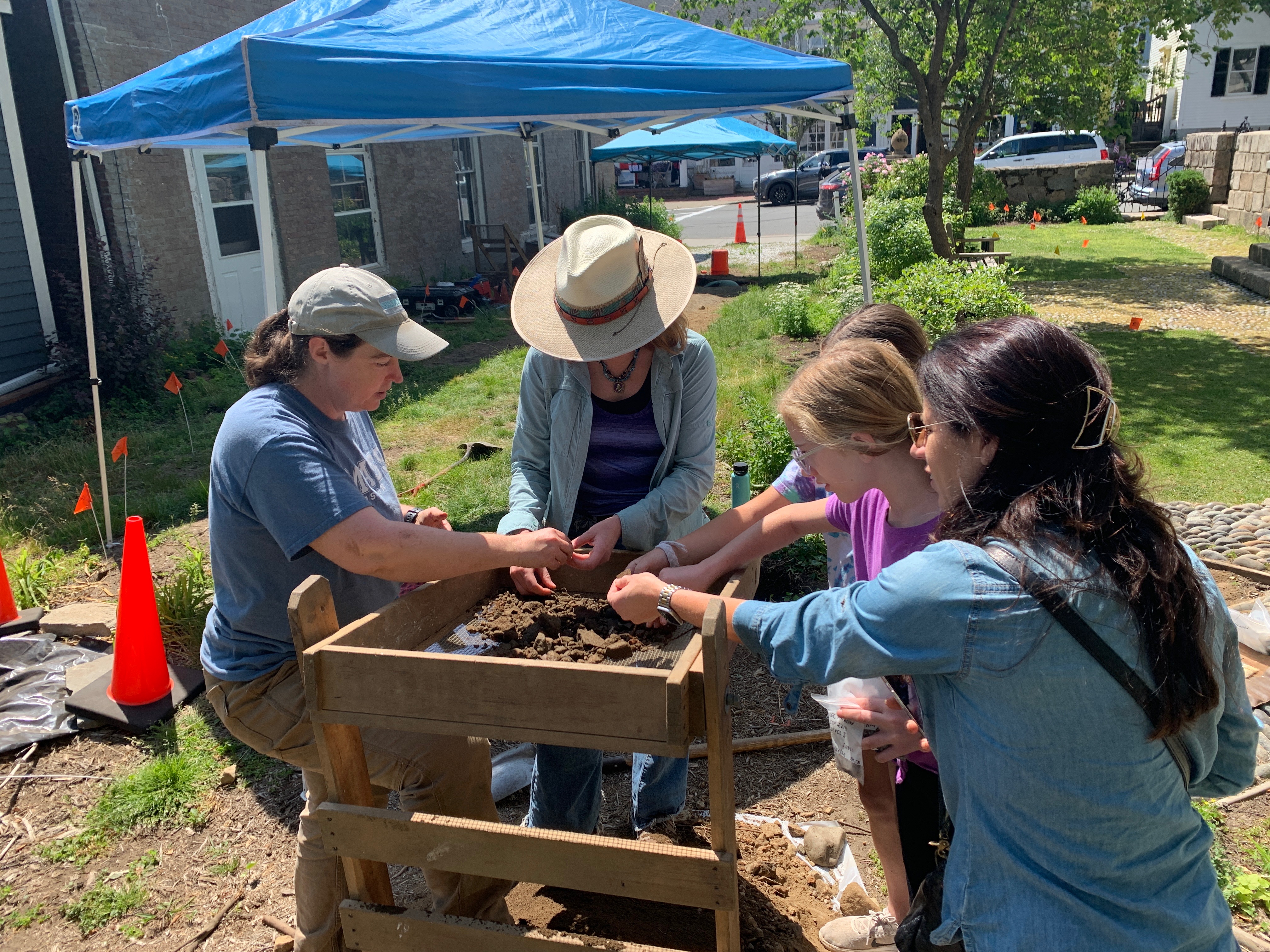
Dr. Beranek was kind enough to spend over an hour with our group, not only giving us a tour of the different test pits and the artifacts being found, BUT also letting us get our hands – literally – dirty!

I have been following the investigation via the social media pages of both the Fiske Center and the Marblehead Museum and you should too! And in typical archaeology fashion, they found an amazing deposit on the second to last day. Can’t wait to see where the next stages bring them!

Ms. Herzl’s student had the time of her life and is now even more set on archaeology as a career path. Here’s to the next generation of archaeologists!

Andover Summer Returns: Dig This! class at it again

Contributed by Emma Lavoie

The Peabody is keeping busy this summer with volunteers, interns, events and visits, researchers, and of course hosting the Andover Summer Session class, Dig This!

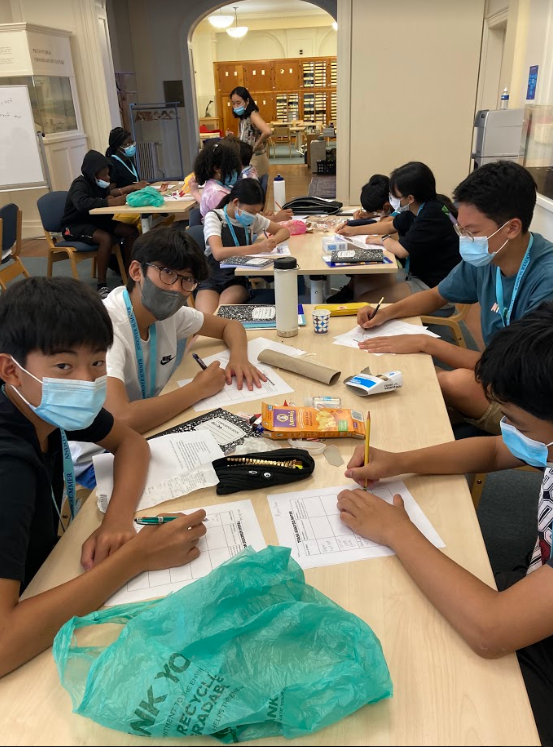
Dig This! students in class and learning to read an excavation site.

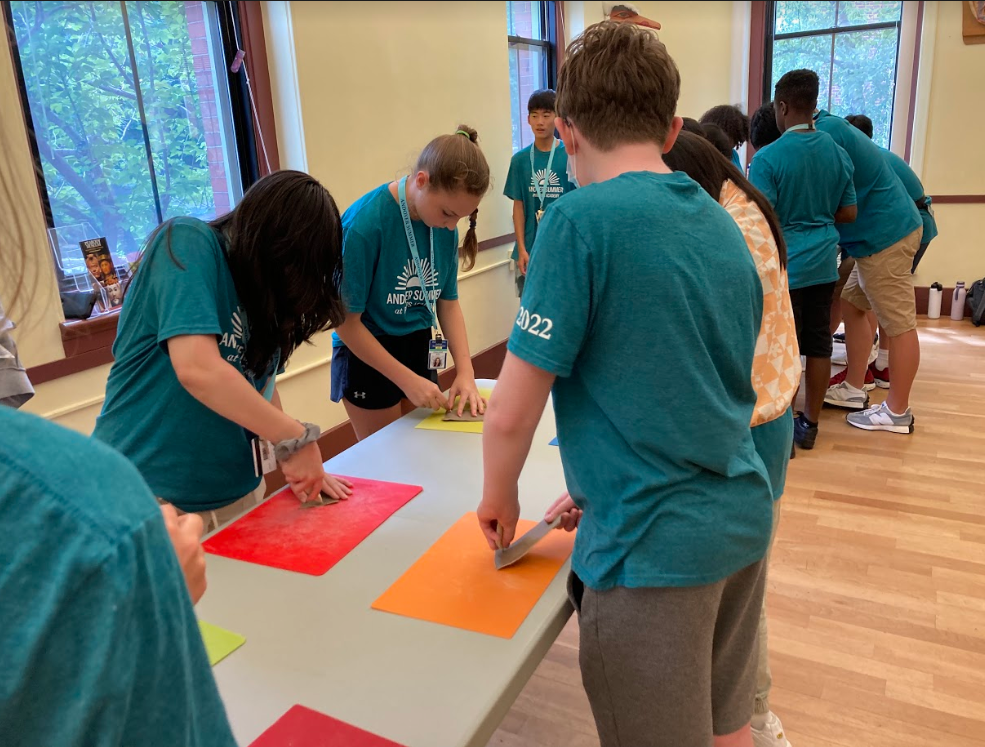
During the month of July, the Peabody hosts the Dig This! class, a course offered by Phillips Academy’s Andover Summer Session. This Lower School initiative takes a closer look at some crucial episodes in the development of this country to hone skills and understanding of dynamic interactions that took place between Native peoples and European newcomers, which continue to shape the United States to this day.

Using the Peabody Institute’s collections, together with extensive library and internet materials, students actively explore a series of case and character studies to understand the minds and strategies of important individuals from some of the most significant events in history. In addition, students attend field trips to nearby historical sites that bring these stories to life.

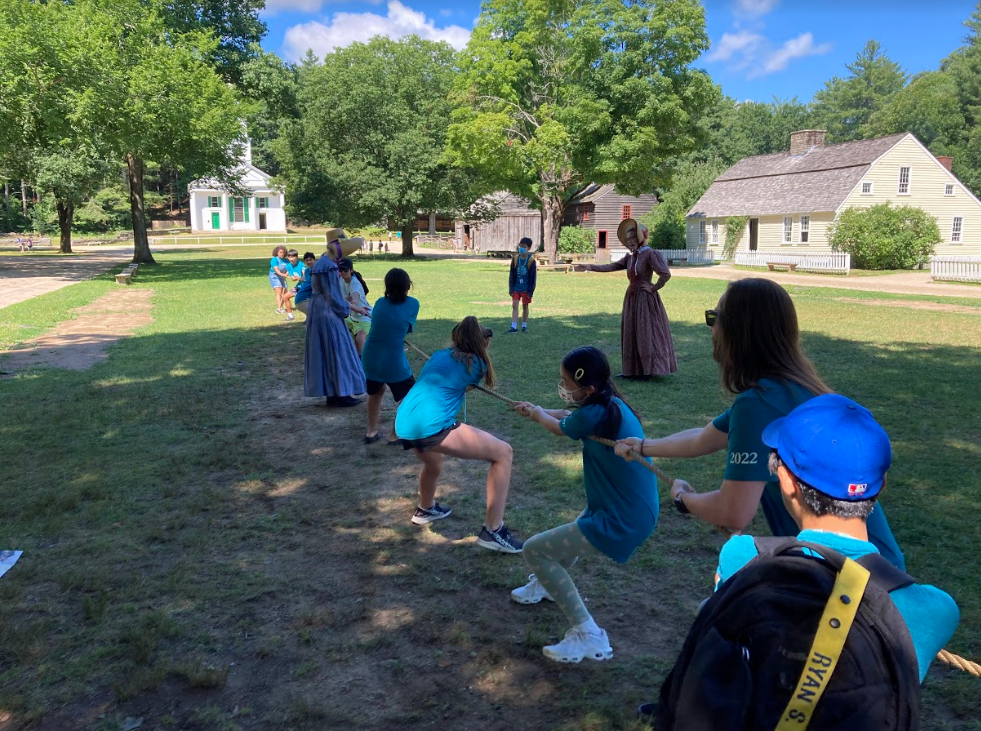
Dig This! students on field trips to the Peabody Museum of Archaeology & Ethnology at Harvard and Old Sturbridge Village

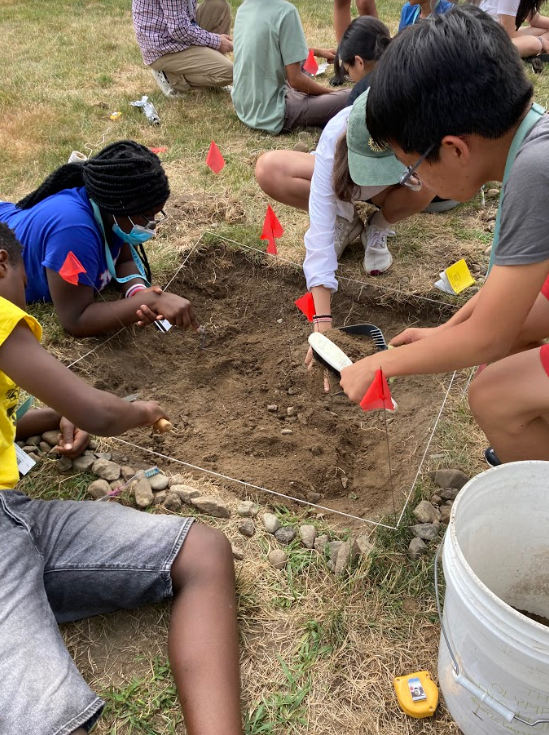
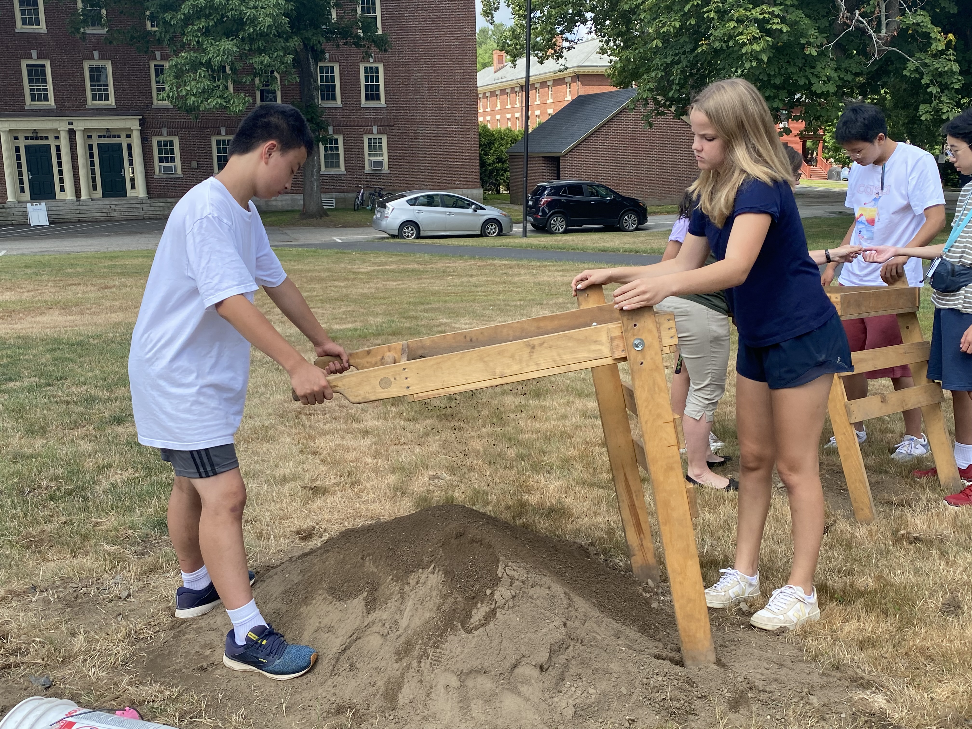
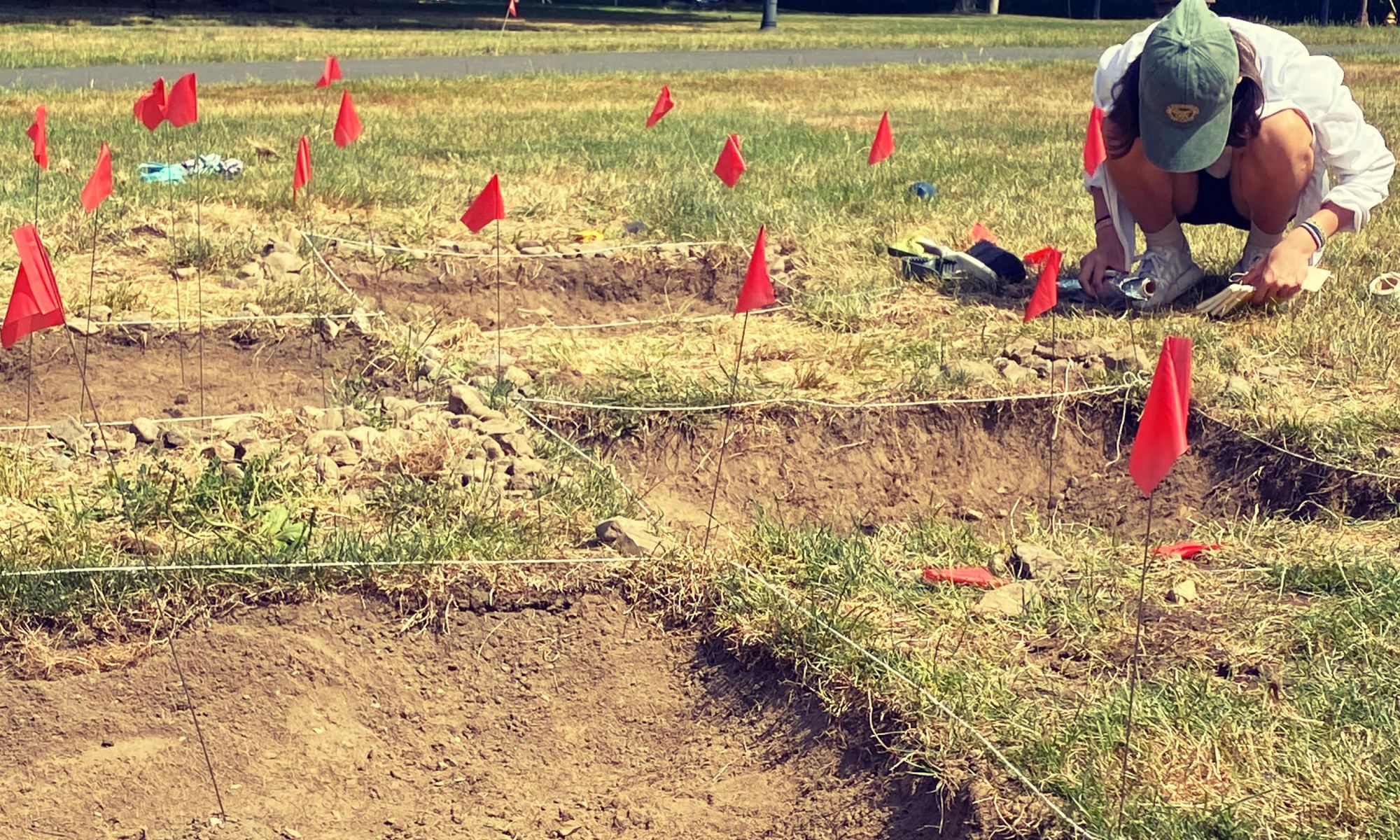
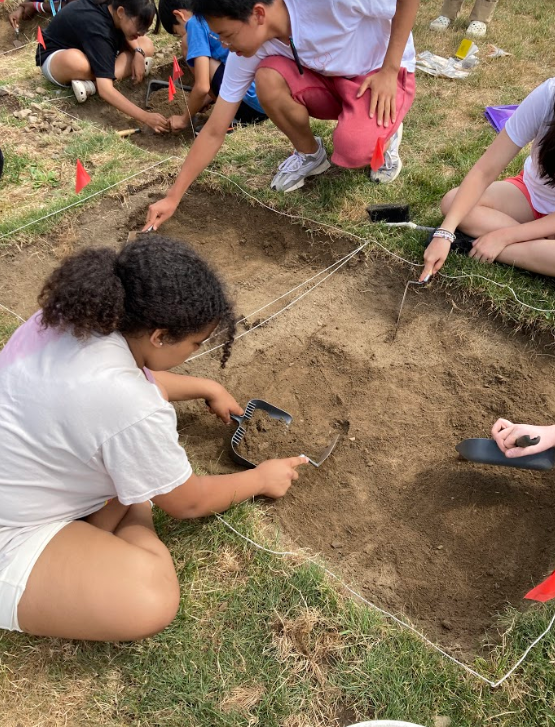
Students then get to participate in their own archaeological excavation of the Mansion House at Phillips Academy – the home of PA founder, Samuel Phillips, Jr. It’s always so exciting to see what these students discover as they take part in this unique opportunity to witness history.

Dig This! students excavating the Mansion House site

Be on the lookout for more updates on students’ findings through our social media this month and maybe even a blog from one of our Dig This! class instructors!

We hope you all are having a wonderful summer!

American Alliance of Museums Annual Meeting

Contributed by Marla Taylor

The American Alliance of Museums (AAM) held their Annual Meeting in Boston in May. Like many other conferences, this was the first in-person meeting in two years. The Peabody Institute was fortunate enough to present our work in a few different formats.

I was part of two sessions – Research Requires Consultation and Centering Culturally Appropriate Care: Re-examining Stewardship of Native American Cultural Items.

The session discussing research presented the Peabody Institute’s research policy that requires consultation and approval from an authorized tribal representative as part of any application for access to collections. You can find details about the policy here. My co-presenters were the NAGPRA Coordinator for the Osage Nation and the Senior Director of Heritage and Environmental Resources for the Seminole Tribe of Florida. Together we discussed the power of respecting tribal sovereignty by requiring these conversations about all levels of research into the cultural heritage of Native American communities.
Centering Culturally Appropriate Care presented the work of the Indigenous Collections Care Working Group (ICC) that I co-founded with my colleague Laura Bryant, Anthropology Collections Manager and NAGPRA Coordinator at the Gilcrease Museum in Tulsa, OK. The ICC has been working to develop a Guide as a reference tool for people (including museum professionals) who interact regularly with Native American collections, including those at all levels of experience and exposure. We are excited to be focusing on this conversation and developing a resource that is truly needed in the museum world. You can learn more about our work here.
But I was not the only one from the Peabody Institute presenting at AAM!

Ryan Wheeler, Peabody Institute director, was part of a session called #NoMoreStolenAncestors: Repatriation and the NMAI Act. Facilitated by the Seminole Tribe of Florida, the session explored the issues with curating human remains, obstacles to repatriation, ways to improve the process. The Seminole have been pushing for policy change at the Smithsonian Institution’s National Museum of Natural History and has had some success. You can learn about their work here, here, and here.

Lindsay Randall, curator of education, co-authored a poster examining the explosive growth in digital technologies in small organizations and how it can be used to deliver high-quality content to museum audiences. The poster shone a spotlight on the Diggin’ In series produced by the Peabody Institute and the Massachusetts Archaeological Society. You can find all the Diggin’ In talks on the Peabody’s YouTube channel here.

It was an honor to share our work with our colleagues in the museum field and receive such supportive feedback. We look forward to presenting at many more conferences – hopefully in person!

Retiring Volunteers

Contributed by Marla Taylor

Museums are so often supported by behind-the-scenes volunteer labor and the Peabody Institute is no exception. Most of my fourteen years at the Peabody have been accompanied by two of the best volunteers you could ask for – Susan and Quinn Rosefsky.

Quinn is Phillips Academy class of 1959 and came to the Peabody for a reunion event in 2009 with his wife, Susan. There they met then director Malinda Blustain; offered their services as volunteers and have been with us ever since.

While a powerful team together, they often worked on separate projects. Quinn was a tireless force assisting with inventory of the collection. He became well versed in stone tool typology (well outside his previous career as a psychiatrist) and has never stopped learning. Quinn has also been a contributor to this blog with his perspective and thoughts on items in the collection. Here are some of my favorites that he has written:

Quinn (on left) hard at work

Susan, on the other hand, has been an invaluable part of the team cleaning and inspecting the Peabody’s textile collection for pest damage. Susan learned how to vacuum textiles from a local conservator and has spent years working her way through the textile collection. Her calm and focused dedication has ensured completion of this important project.

Susan at work inspecting a textile

I cannot express the gratitude that the Peabody staff have for these two wonderful people and their contributions to our work. I know that I will miss Quinn’s stories and jokes as well as Susan’s kindness and support. The Peabody Institute was lucky to have them, and we wish Susan and Quinn all the best in their “retirement!”

Thank you to all our volunteers!

Ethnographic Photographs – Greater Understanding

Contributed by Deirdre Hutchison

My name is Deirdre Hutchison, and I am currently studying for my B.A. in history at UMass Lowell. As part of a semester internship, I had the opportunity to research the provenance of several unidentified Native American photographs held by the Robert S. Peabody Institute of Archaeology. My first blog outlined initial findings and potential areas of investigation. To summarize that blog, the photos, mounted on board, illustrate a 1905 event at the 101 Ranch in Oklahoma.

As I navigated various connections, photographer James B. Kent became a more prominent fixture of my research. Kent was a regular photographer at the 101 Ranch, and the Millers tapped him to design and compile the souvenir booklet for “Oklahoma’s Gala Day” at the ranch on June 11, 1905. –. Kent, it seems, was an integral part of photography at the 101 Ranch, ultimately becoming the head of the moving pictures department by 1927.

101 Magazine/The 101 Ranch Official Souvenir. BLISS, OKLA. 5127.1000. Tulsa: Gilcrease Museum, https://collections.gilcrease.org/object/51271000 (08/03/2017)

The 101 Ranch souvenir booklet is discussed by Michael Wallis in his book The Real Wild West. According to Wallis, it contains multiple images taken by Kent – including the picture of Geronimo skinning a buffalo held by the Peabody (discussed in my previous blog). The booklet also contains one of the most famous images of Geronimo, “Geronimo in an Automobile.” . Working with the archival staff at the Gilcrease Museum in Tulsa, I hope to view the images to confirm Kent’s pictures and perhaps discern other possible photo matches.

Isolating Kent’s work is relevant because he was not the only photographer working at the famous extravaganza on June 11, 1905. The Millers masterfully orchestrated spectacle – 65,000 people attended – could not be supported by just one photographer. Multiple photographers were present capturing various promotional images at the behest of the brothers. This is immediately evident in the Library of Congress photo of “Geronimo Skinning a Buffalo” that identifies O. Drum as the photographer. The strikingly similar images of the Peabody and the Library of Congress differ in only small ways. It seems a bank of photographers captured the same scene, each image similar, but slightly different: a person with a head facing a different direction, an extra person, women bending, or a western-clad gentleman caught talking with those being prepped for the publicity shoot.

Another name that kept popping up in my research and commonly associated with a broad range of images, including Kent’s, was the publisher H. H. Clarke. Not only did Clarke produce black and white photographs, but he also manufactured color versions for global distribution, and several of his postcards bear the notation Made in Germany. Clarke’s color versions are considered unique as he employed a hand-coloring technique rather than standard lithography. Other examples of this work are at the Cherokee Strip Museum (Cheryl DeJager, Cherokee Strip Museum, personal communication).

Although Clarke published images by Kent and other photographers, establishing a direct link between them is difficult. However, sifting through metadata across several institutions, I discovered interesting connections that explore the publishing and manufacture of images onto postcards. For example, in the early twentieth century, professional and amateur photographers could sell their negatives directly to distributors such as Clarke or major publishing houses such as The Albertype Company. The Library of Congress cites Albertype and Clarke for one of two images listed of Geronimo in a car.

Clarke published three photos I initially matched with the Library of Congress. However, with only a thumbnail view available, I could not say with conviction they were identical to the Peabody images. After corresponding with the Prints and Photographs Division at the Library of Congress, enlarged views are now accessible online which allowed me to confirm that two photos were identical to those at the Peabody, but a discrepancy arose with the third. A close inspection reveals small but salient differences between the image at the Peabody and the one at the Library of Congress. For example, in the Peabody image, women are standing over the buffalo, but in the Library of Congress, they are bending over. Furthermore, in the Peabody image, a man stands to the buffalo’s left with his back to the camera, notable for his western-style suit, boots, and derby hat. Kent was known for always wearing his signature derby hat, leading me to speculate he was directing the people for the staged photograph and was caught on camera by another photographer.

When I started this project, I naively thought I would find solid evidence pertaining to Warren Moorehead’s acquisition of the images. As the museum’s first curator and renowned Native American expert, I thought, how could there not be a connection? Yet, every avenue of research proved fruitless with Moorehead. The narrative unfolded around the Miller Brothers, James “Bennie” Kent, and H. H. Clarke. The interconnectedness of these people provided many answers; the photographs were staged publicity images, taken at the 101 Ranch and predominantly early 1900s. Unraveling this fascinating story has been immensely rewarding, yet it seemed unlikely I would find any correlation between the images and their arrival at the museum.

Despite this disappointment, potential connections with the Peabody Institute and theories of acquisition emerged when reviewing my data, though initially not with Moorehead. Ernest Whitworth Marland was in business with the Millers and became Governor of Oklahoma. Frank Phillips of Phillips Oil was also involved with the Millers and the 101 Ranch. Both men were natives of Pennsylvania, as was Robert S. Peabody. Each man was wealthy, prominent, and quite conceivably moved in the same upper echelons of society. It is possible either of these could have passed photographs to Moorehead or the Peabody. Considering the student body of Phillips Academy, any alum could have given the images as a donation to their alma mater. Equally so, any faculty member may have been gifted the photos. All of these are plausible scenarios. However, another tenuous link emerged, excitedly leading me back to Moorehead. The collections description for the three Library of Congress images mentioned earlier notes that they are mounted photographs, as are the ones at the Peabody.

Another facet that piqued my interest was the descriptions accompanying records at the National Archives. “Geronimo in a Car” is cited as taken on June 11, 1905, at the Millers’ Oklahoma Gala Day, along with other images; all are 8×10 or larger, just like the Peabody images. Although far from compelling, there are commonalities.

What I found most compelling with the National Archives photo of “Geronimo in a Car” was that it states a copy was sent to the Office of the Commissioner of Indian Affairs. The Office of Indian Affairs later became the Bureau of Indian Affairs. Moorehead was appointed to the board of commissioners for the Bureau of Indian Affairs by President Roosevelt in 1908.

Geronimo Driving a Car. Oklahoma Gala Day, June 11, 1905. Wall Street Journal

As an emerging historian, I like to focus on facts. Unfortunately, facts can be notoriously distorted by time, memory, and absent material evidence. However, the absence of proof does not equate to the absence of the action. Although I had discounted Moorehead as the conduit, I have circled back and believe he is a strong acquisition candidate based on my latest discoveries. That particular mystery may never be solved, but it does not detract from the powerful narrative of Native American presence and treatment in mainstream society in the early twentieth century. 

Further Reading

Bordewich, Fergus M. “Fierce Echoes from the Frontier.” Wall Street Journal, April 19, 2013, sec. Life and Style. https://www.wsj.com/articles/SB1000142412788732334630457842 6634203336120

Collings, Ellsworth, and Alma Miller England. The 101 Ranch. Norman: University Of Oklahoma Press, 1987.

Wallis, Michael. The Real Wild West: The 101 Ranch and the Creation of the American West. New York: St. Martin’s Press, 1999.