Congratulations Emma!

The Peabody’s own Emma Lavoie was recognized with Phillips Academy’s Beyond the Call of Duty Award at the spring staff and administrators award celebration on May 20!

Emma shows off her Beyond the Call of Duty Award.

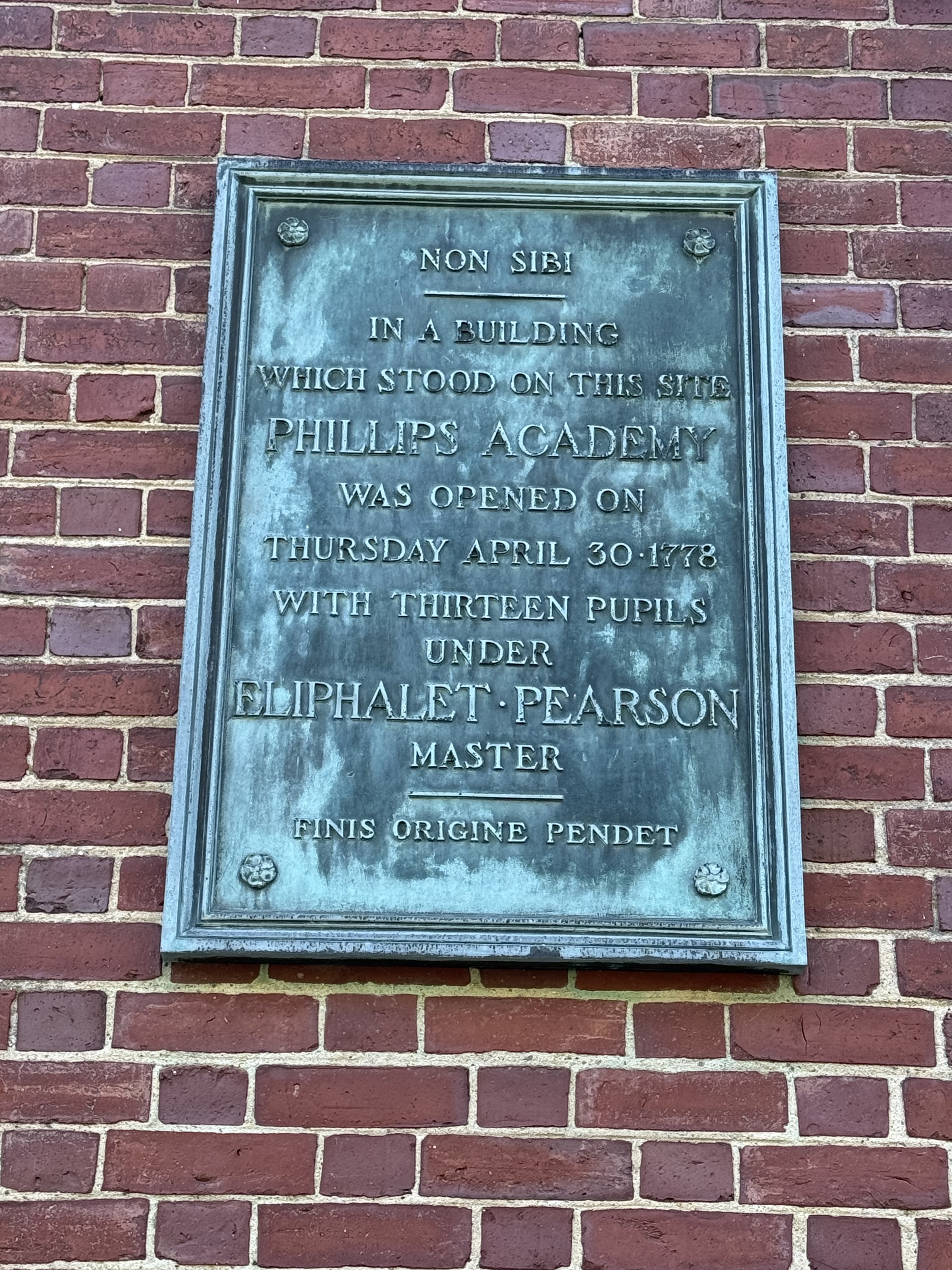
The award announcement states, “The Beyond the Call of Duty Award is designed to acknowledge and celebrate staff who demonstrate exceptional support/customer service to colleagues within their own department, across campus, our students, parents or alumni.  All nominees should embody the non-sibi spirit!”

This describes Emma precisely! Emma’s job title is staff assistant, responsible for business and communication here at the Peabody, but she does so much more–Emma has taught lessons and helped with lessons, produces beautiful communication and social media pieces, cataloged material culture, organizes travel for staff members and visitors, keeps us organized, networks with other programs and departments on campus, comes early or stays late to help with events (which she has often planned and organized), serves on the Phillips Academy staff council, and much, much more.

Emma decorating her ceramic creation under the watchful eye of Maxine Toya–Emma makes all the travel arrangements for visiting Native artists, like the Toya Family, Pueblo of Jemez.

Award recipients will receive two days added to their vacation bank as well as a gift of PA apparel from the Campus Closet.

Congratulations Emma!

PA Pueblo Pottery-Making Workshops

Contributed by Emma Lavoie

Ceramic students participating in pottery-making workshops

We were honored to have the Toya family back this Spring term for their annual visit to conduct week long, hands-on workshops on Pueblo pottery-making with Thayer Zaeder’s studio ceramic students.

Each year students have the opportunity to make their own pieces using native clays and temper from New Mexico and traditional decorative techniques of painting and polishing. The workshops culminate in a traditional Jemez firing.

Students walk away with an unforgettable keepsake of their time as well as a greater appreciation for contemporary Indigenous art and culture.

We are so grateful for all the time and expertise the Toya family has shared with PA students!

Check out this video by PA’s Communications team highlighting the Toya’s work on campus.

Maxine Toya working with a student on painting their piece.
Mia Toya working with a student on polishing their piece.

The Wrestler and the Calf

Submitted by John Bergman-McCool

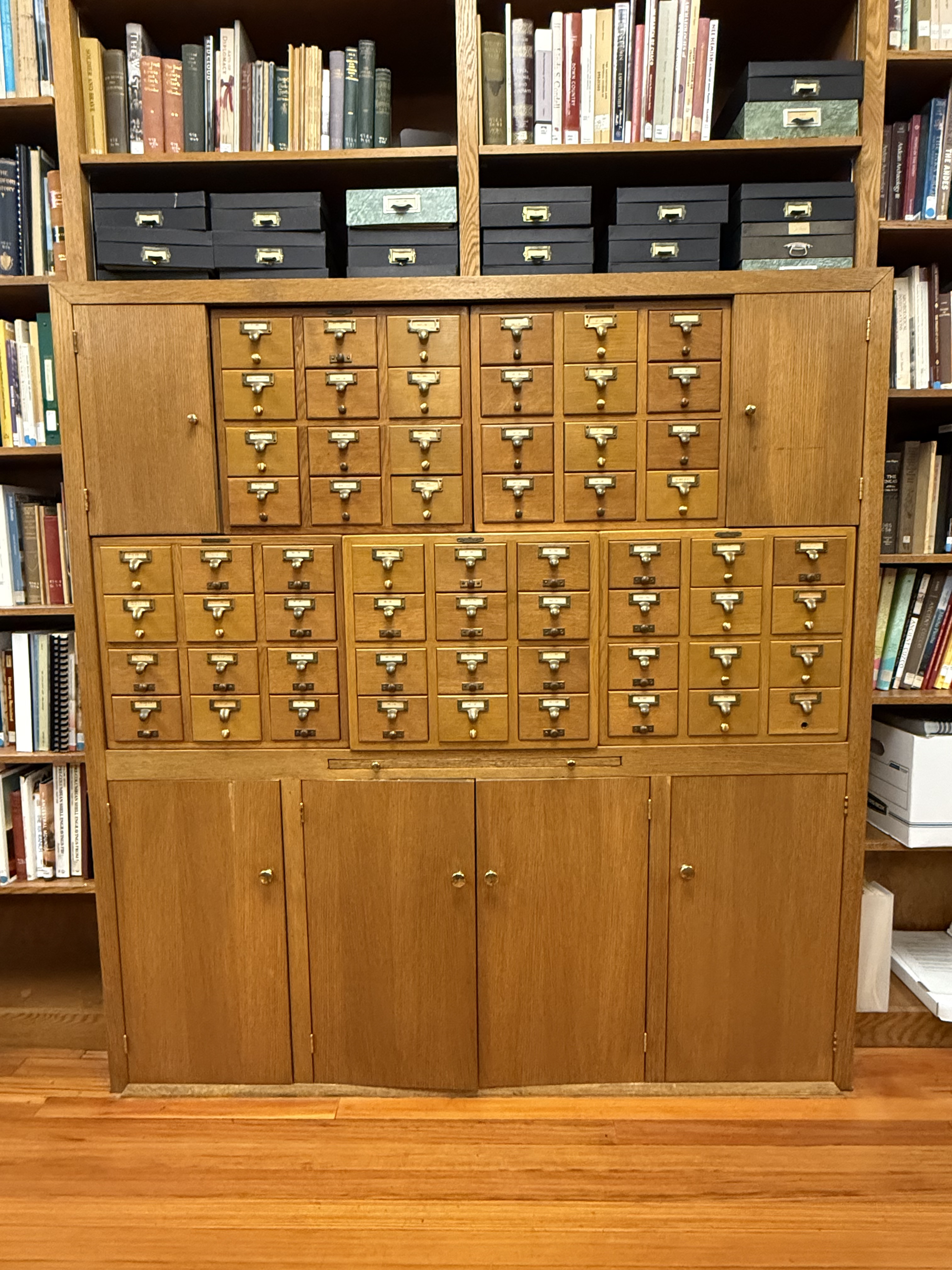
A few years ago, I came across a catalog card with an interesting account in the remarks section. The card read “W. K. Moorehead used this in 1931 in an attempt to see if a professional wrestler could kill a calf. The experiment was unsuccessful.” There is a lot to unpack from this card. It references experimental archaeology, professional wrestling, and, judged by today’s standards, ethically questionable behavior. I figured that there had to be a story to unearth, but with more pressing work to do, I filed this note away for another time.

The catalog card describing the handaxes.

The catalog card describes two hafted European ‘fist axes’ (or handaxes). The provenience of the items is unknown. The Peabody acquired a collection of similar European tools shortly before these items were cataloged. It’s possible that the hafted handaxes are somehow related.

The handaxes used in Moorehead’s experiment.

Over the past few years this card occasionally comes to mind, or I will see the handaxes. When they do, I will do a quick search of the internet for any related newspaper articles, journals, or archival clues. I’ve looked through our institutional records but haven’t found anything that appears to be related.

A breakthrough came when I found the minutes from the combined 1931 Annual Meeting of the American Anthropological Association (AAA) and American Folk-Lore Society. The meeting was held at Peabody House at Phillips Academy on December 28-29. The minutes included a description of a talk given by Warren K. Moorehead titled “An account of some experiments in the practical use of eoliths and Chellean tools.”

Selected pages from the program for the 1931 American Anthropological Association annual meeting.

The Chellean tools Moorehead references belong to what is today known as the Acheulean stone tool industry. They are named after a site in Saint-Acheul, France where their classification as a prehistoric tool was first broadly accepted. Acheulean handaxes are distinct and have come to define Acheulean stone tool technology overall. The hafted hand axes in question are unquestionably Acheulean in form, with the hafting being a recent addition.

A few examples of other Acheulean handaxes the Peabody stewards.

The distribution of these tools is wide-ranging geographically and temporally. The oldest examples date to 1.76 million years ago. An end date for their use has been placed between 300,000 and 100,000 years BP. Some handaxes are very large, measuring 2 feet, while others are quite small, just 6 inches.

They have been found in Africa, Europe and west, south and east Asia. They are very old examples of stone tool technology and would have been made by hominids, such as Homo erectus.

-A quick note about eoliths. These were once thought to be stone tools and were subject to heated debate for many decades. They have been found in deposits that vastly predate the Acheulean. They are now recognized as naturally occurring geofacts and are not of human origin.

Finding the meeting minutes describing Moorehead’s presentation seemed to be one step closer to an account of the experiment-gone-wrong mentioned in the catalog card. Armed with more information and a date to work with, I did another round of searching on the internet and within our archives.

Eventually, I contacted the Ohio History Connection (OHC). Moorehead was the first curator at the Ohio Archaeological and Historical Society (OAHS) before coming to Phillips Academy. After his death in 1939, Moorehead’s family gave many of his papers to OAHS. Our two institutions share some of the same correspondences and we have reached out to them in the past.

Amazingly, OHC responded with a newspaper clipping from the New York Times that provided more context about the talk Moorhead gave at the 1931 AAA meeting. The article mentions that the tools were used by butchers in a slaughterhouse on carcasses and one living animal. The butchers declared the tools to be ineffectual, and Moorehead proposed that sticks or clubs would have been better suited as hunting tools.

The New York Times article from December 30, 1931 describing Moorhead’s experiement (fourth paragraph through to end).

Today, experimentation of this nature on live animals would be ethically inconceivable. Scientific research is meant to manipulate variables in controlled situations to study factors relevant to the proposed question. Moorehead’s experiment didn’t take into account the many varied sizes of handaxes and whether they should be hafted or simply held in hand. Testing a range of sizes and handling methods might lead to better results. However, this and any future replication or refinement of Moorhead’s conditions would certainly lead to increasing levels of harm to animals.

A researcher who has engaged in experimental archaeology shared via correspondence some of the alternatives and ethical considerations of modern experimentation in the field. Colleagues testing projectile point penetration utilized targets made from meat and meat substitutes, such as ballistic gel and clay. The meat used for the targets needed to be ethically sourced (from a hunter or butcher for example) and would otherwise have been discarded if it not used in the experiment.

Sometimes substitutions for animal remains are unavoidable. An article on the topic of animal resources in experimental archaeology outlines concerns of sample procurement. Scientific studies often require large sample sizes. Animal remains are non-renewable resources that have limited availability. These samples are linked to the death of animals, no matter how they are procured. In these situations, modern researchers must strike a balance between scientific rigor and ethical integrity.

Returning to the catalog card and newspaper article concerning this experiment; it is interesting to note that the professional wrestler in one, is a slaughterhouse butcher in the other. I was hoping any notes Moorehead used to prepare his presentation or other related correspondence could provide more information, but I have yet to find them. 

Both the card and article declare the experiment to be a failure, seemingly as tools for hunting and maybe butchery. To be sure, the hafting has left very little of the cutting edge of one of these tools available for penetration.

Subsequent experiments with Acheulean handaxes have found them to be effective tools for a wide range of tasks aside from hunting including butchering animals, stripping wood, processing plants and digging. These experiments are supported by surface wear pattern studies. It is unclear whether these tools were ever used for hunting, which Moorehead’s sensational experiment somewhat confirms.

Websites with more information on Acheulean culture:

Museum of stone Tools

University of Missouri

Becoming Human

Journal article outlining challanges associated with animal experiments in archaeology:

Steele, Teresa E., Guilia Gallo, Naomi L. Martisius et. al. 2025. Animal resources in experimental archaeology: A reflection on standards and ethics. Journal of Archaeological Science: Reports 61

Pecos Eagle Bone Flutes: Past, present, and future

Contributed by Alberto Agudo (’25)

I stumbled upon the Pecos bone flutes on a bright September afternoon that was supposed to be about beaver pelts and fur trade ledgers. My history class had followed Ms. Doheny to the Robert S. Peabody Institute for a lecture, but after the talk I lingered and asked the speaker, Dr. Lainie Schultz, whether the museum kept any musical instruments. That single question carried me into the archives, where Curator Marla Taylor opened a drawer and revealed two slender bones—one golden eagle, one hawk—pierced and polished, flutes waiting in perfect silence.

Music has framed my life since I was four in Madrid: first as a hobby, then as devotion, from my early passion for Romantic music to the shimmering modernism of Debussy, whose Masques I played at fifteen beneath the stone arches of Dubrovnik’s Rector’s Palace. Yet nothing in my previous musical experience had prepared me for the quiet authority of these flutes. Their accession records were almost empty, their makers unnamed, but the Tribal Historic Preservation Officer of Jemez Pueblo had granted permission for their study. Phillips Academy’s Abbot Independent Scholar program let me transform my curiosity into a full-term research project under the supervision of Dr. Schultz and Dr. Elizabeth Aureden from the music department.

The work began with patient looking. The eagle bone flute—just under twenty centimeters—bears four clean finger-holes; the hawk bone flute is shorter, its stops conical and ringed by three tiny oblique grooves. My initial efforts left me frustrated—despite my solid musical background, I couldn’t answer any of my research questions. Guided by Indigenous scholars, I began to understand the silence and endless questions as a wise teacher. By combining archival materials with present-day Indigenous resources, chiefly from Jemez musician Marlon Magdalena, I built a relationship with the eagle bone flute and experienced the music as something much deeper than pure sound.

In his song “Eagle’s Blessings,” which I shared during my presentation to the Massachusetts Archaeological Society in April, Marlon brings the flute to life. When I first heard it, I was nearing the end of my research, which had been mostly historical and archival. I had tried to learn about other Indigenous music, but this performance tied everything together. Throughout the term, I feared profaning the cultural or religious significance of the eagle bone flute. I understood its sacredness, and as a religious person involved in interfaith activities, I recognize the importance of respecting religious artifacts.

Marlon’s explanation before he played brought everything into focus. He explained that eagle bones are sacred, held only by tribal members and used to lift prayers skyward. When he played, I felt how, through his breath, he gave life back to the eagle and honored her. Suddenly, the silence became understandable. Even though I could not draw solid scientific conclusions, I forged a connection I will never forget.

This project has awakened a passion for ethnomusicology that I am now exploring with the music department, under the guidance of Ms. Ángela Varo-Moreno, studying the presence of LGBTQ+ subcultures in techno music. I would like to end by thanking everyone at the Peabody, at Phillips Academy Andover, and at Pecos and Jemez Pueblos—and other Indigenous communities—who have safeguarded the knowledge that reached me and made this project possible. It has been a gift I will always keep in my heart.

Alberto presenting his final project at the Peabody, finishing up his independent study.

More Than Metal: What’s Really on a Coin?

Contributed by Patrick Zheng ‘28

Every Wednesday, I come to the Peabody Institute to be in the company of pharaohs and emperors, not through books but from 2000-year-old coins held in the institute’s collections. I help to identify these coins and record observations into the Peabody’s catalogue system. I’m extremely fortunate to experience “living history” from these remnants of ancient Rome, Hellenistic Egypt, and the Byzantine world.

As the mass media of the ancient world, coins carried big messages. The images depicting rulers, gods, animals, or symbols were carefully chosen and deeply meaningful. Every coin has a story to tell about culture and politics. Together, they offer new perspectives on historical events that we thought we already understood.

From my notes. Left: sketches and notes of a coin showing Rome’s foundation myth to commemorate Constantinople’s founding under Constantine (Rome reborn). Right: Roman coin minted in Egypt during Hadrian’s reign depicting the River Nile as a reclining deity.

I first became involved in this research when I met Dr. Elena Dugan, who teaches Religion and Philosophy at Phillips Academy Andover, and was researching Jewish coins that dated back 2,000 years. These coins were struck for only four years, 66-70 CE, during which time, the Jewish population in modern-day Israel rebelled against their Roman occupiers. Long after their war against the Romans and their eventual defeat, their cry of freedom endured as inscriptions on these coins, surpassing even the Romans themselves. Dr. Dugan quite literally held the legacies of these men and women in her hands. How extraordinary is that!

Top: Coins with inscriptions calling for the “Freedom of Zion,” along with coins minted during the times of King Herod Agrippa I and Yehonatan the High Priest. Bottom: Biblical coins of Pontius Pilate and Emperor Tiberius.

I would soon uncover such stories myself. Through Byzantine coins within the Peabody’s collections, I came to appreciate the story of Justinian, a Roman emperor bold enough to dream big. He dreamed of restoring the Roman Empire, which by his time was territorially less than half of its former glory. He dreamed of a reunified Mediterranean and the spread of Christianity. Fueled by determination, he led years of campaigns until the city of Rome was once again truly part of the empire.

But the dream didn’t last. Enemies in the East drew his attention away from Rome and the West, which was soon lost again. Any last hope was swept away by a devastating plague, which killed half of the Roman population (now every time I pick up one of Justinian’s coins, I feel an urge to wash my hands!). Rome’s wealth was drained, and Justinian lost his new territories as quickly as he gained them. In the end, he sadly died believing his dream had failed.

But it hadn’t. Though Justinian didn’t expand Rome’s borders, he redefined her identity. His image on coins, boldly facing his audience and clad in armor, was copied by every emperor who followed. He had inspired others to dream. Alongside his portrait appeared Christian symbols, marking Rome’s turn from her pagan past toward new ideals. Never again would she reach the heights Justinian had brought her to.

If all that remains of him and his dream are coins and a few lines in a textbook, then so be it. But let’s not forget them!

Left: Emperor Anastasius depicted in traditional imperial dress with a diadem and toga. Right: Depiction of Emperor Justinian facing the audience, fully in armor, and holding the globe and cross. While Anastasius followed strong traditions, Justinian was more than eager to distinguish himself.

This experience has strengthened my love for history. It has brought me closer to people in the distant past and their values. Their love of liberty. Their audacity to dream. These values stir a certain nostalgia in me, and suddenly, these people don’t feel so distant after all. Their worlds may have disappeared, but they are far from forgotten. It’s hard to believe that such an experience can come from objects that measure less than my pinky finger. But, after all, conveying messages is also a coin’s purpose, alongside economic ones. 

This journey has truly expanded my curiosity and built my understanding of history. I’m incredibly grateful to the Peabody Institute for not only allowing an inexperienced ninth grader to interact with these priceless artifacts but also for patiently teaching me the research process, providing the right tools, and encouraging me to share my story. 

What a highlight this has been as part of my school year! I’ll be sure to return on many more Wednesdays!

The Beginnings of the Andover Anthropological Society

Contributed by Isabel Djerejian ‘26

Last spring, I was new to Phillips Academy. I’d just arrived on campus, still figuring out where I fit in, still mapping the place out in my head. One thing that kept catching my eye was this mysterious building I passed every week on my way to the music department. It looked… important. But quiet. Tucked away. That building was the Peabody Institute.

It was mid-renovation then and closed to visitors, but every time I walked by, I’d find myself wondering what was inside. What kind of objects were hidden away behind those walls? What kind of people once used them? It sent me spiraling in the best way.

I started doing some research and realized that while the Peabody is this incredible institution with a deep collection of cultural material, it wasn’t very connected to student life. Almost hidden in plain sight. And that just felt like a missed opportunity. I wanted to find a way to change that.

This idea took deeper root over the summer, especially after I visited Egypt. I’ve always been interested in anthropology, but that trip sparked something new in me: an obsession with archaeology. There’s something magical about holding, or even just seeing, an artifact that someone used hundreds of years ago. Imagining their life, their world, their hopes or rituals. In those moments, I feel connected to something bigger: a lineage of humans that came before and will come after. It feels like time folds in on itself.

So I reached out to the Peabody over the summer and asked if there was a way students could get more involved. We came up with the idea for a club, and when I returned to campus in the fall, I asked my friend Elliot Weir to help me lead it. That’s how the Andover Anthropological Society was born.

But the story doesn’t really start there. My fascination with culture and human behavior goes way back. I grew up in a family of nomads—the product of two people who seemed to be in constant motion. I’m an Armenian New Yorker, but I moved to Hong Kong when I was young, then to Miami, and spent years bouncing between Brazil, Europe, and the U.S. These days, my dad is based in Riyadh, so Saudi Arabia feels like another kind of home.

All this movement, this third culture existence, has taught me that “home” isn’t always a place. It’s a mindset, a perspective, a lens you carry with you. It’s made me deeply curious about how people live, how they think, and how history shapes identity. Whether it’s thinking about how Armenians process collective trauma, or how gender roles are shifting in Saudi Arabia, I’m drawn to the stories that sit under the surface. Anthropology, to me, is a way of making sense of it all.

And that’s what the Andover Anthropological Society is about. Yes, we work with artifacts. Yes, we meet weekly at the Peabody and dig into real collections and archival files. But more than anything, we’re trying to connect—to the past, to different worldviews, and to each other.

If you’re someone who finds joy in questioning things, in imagining the lives behind the objects, or in just getting a little lost in the mysteries of human culture, you’re always welcome. The Peabody may have looked quiet last spring, but it’s anything but.

Why some of our members joined:

“I decided to join the Andover Anthropological Society because studying anthropology yields a greater understanding of yourself and the world around you. In the same way that books can inform you on lives you’ve never lived, anthropology enables you to understand cultures you have never interacted with, providing perspective on your own culture and appreciation for others’.” – A.J. McQuide ‘26

“I am a junior [9th grader] from Miami, and I joined the Anthropological Society because I am interested in learning and understanding how human societies and cultures develop. I was inspired to join this club by my visit to my country-of-origin, Armenia. In Armenia, I traveled across the country visiting and seeing historical landmarks and ancient artifacts. This visit sparked a desire to understand what role these places and items played in my ancestors’ lives as well as other peoples’.” – Sebastian Djerejian ‘28

“I am an upper [11th grader] from North Andover. I knew that the Peabody was an amazing resource with many Native American artifacts that I had never seen before. I wanted to explore these collections through the Andover Anthropological Society.” – Elliot Weir ‘26

“In middle school we had a guest speaker come in to talk about how humans developed technologically, and to me that was such an interesting idea. How did we discover so much of what we know? So, for a long time, I have been interested in anthropology but hadn’t had any spaces to pursue it, which is why I was happy to join the anthropology club here at Andover.” – David Frahm ‘26

“I am a new upper [11th grader] from Verona, Italy. I joined the Anthropology club because I wanted to develop skills to be able to identify artifacts more efficiently. I’m especially interested in exploring how specific objects were used differently across the United States, and what they can reveal about the daily lives of the people who made and used them.” – Amelie Piergentili ‘26

“I am an upper [11th grader] from London, UK, and I am thrilled to say that I am a part of Andover Anthropology club. I frequently looked at the Peabody Museum as an incredible resource that I longed to explore – Anthropological Society gave this to me.” – Isabella Mazzi ‘26

“I am an upper from London, England and was always interested in History and discovering how we got to where we are now. I love connecting with different cultures and meeting new people interested in the same things I am so the Anthropology club offered an incredible way to do just this.” – Katerina Browder ‘26

Mount Up, follow up.

Contributed by John Bergman-McCool

In January I wrote about a student volunteer project aimed at improving housing for moccasins that we steward at the Peabody (link). The purpose of the project is to give moccasins at the Peabody more space and internal support to maintain their shape. At the time of posting the blog, the project was in an initial design phase with students making practice mounts and internal supports. Since then the students and I worked through iterations of mounts and with feedback from our Curator of Collections, Marla Taylor, we arrived at the final design.

Top: evolution of mount design. Bottom: changes to the interior support pillow from a “v” toe to one that matches the shape of the moccasin.

With the mount finalized we selected a pair of moccasins to rehouse and moved on to solve how to make interior mounts. We intended to make an internal support “pillow” of stockinet filled with polyester fiber. However, the height of the moccasins meant that the pillow alone couldn’t support the ankle area.

We consulted a great presentation at the 2017 Association of Tribal Archives, Libraries, and Museums (link) on making internal moccasin supports, for ideas on how to provide stability. We landed on making a support pillow for the toe area and a stiff tube for the heal and ankle area.

Internal supports for low and high moccasins

The stiff support is made from ethafoam planks cut into cylinders. The cylinders are wrapped with cotton batting to provide cushioning, then they are covered in stockinet. We measured the circumference of the area above one of the ankles and made sure the ethafoam, batting and stockinet added up to that dimension.

Steps for constructing a cushioned rigid support. It is important to use enough batting and stockinet to be able to push it into the slit.

The final step involved covering the mount with soft Tyvek. With that, we have our first moccasin mount! Once students are back from spring break, we will continue our rehousing of moccasins.

Here is the final mount. The students did a great job!

The Making of a Student Exhibit

Contributed by Lainie Schultz

Donny Slater and the students of HSS507

The Peabody Institute is currently host to the exhibit “Indigenous (Mis)representations on American Numismatic Objects,” displaying items from the History and Social Science department, the personal collections of Donny Slater, and the hard work of the students in his class HSS507: History in Your Pocket – American Stories, Ideals, and Economics as Told through Coins and Currency.

Combining historical investigation and close examination of the images depicted on American coins, bank notes, and tokens dating from 1744 to 2000, Donny’s students connected the use of Native American iconography on these objects of exchange to efforts to build a national identity that hid the violence of Westward Expansion at the country’s core, choosing this as the story they wanted to share with the Andover community. While the Peabody provided the class with the space and the display case, all the work of the design and installation came from the students themselves.

Everyone was deeply engaged in the process, and the results speak for themselves.

The exhibit will remain up through Alumni weekend, ending June 9, 2025.

Student (Mis?)representations of Their Teacher Donny Slater

Annual Repatriation Conference in Louisiana this Year

Contributed by Ryan J. Wheeler

This year marked the 10th annual repatriation conference organized by the Association on American Indian Affairs (AAIA). The conference was hosted at the end of February by the Tunica-Biloxi Tribe’s Paragon Resort in Marksville, Louisiana. The Peabody Institute of Archaeology was one of several co-sponsors, celebrating ten years of the conference, dedicated to learning and sharing our work in repatriation.

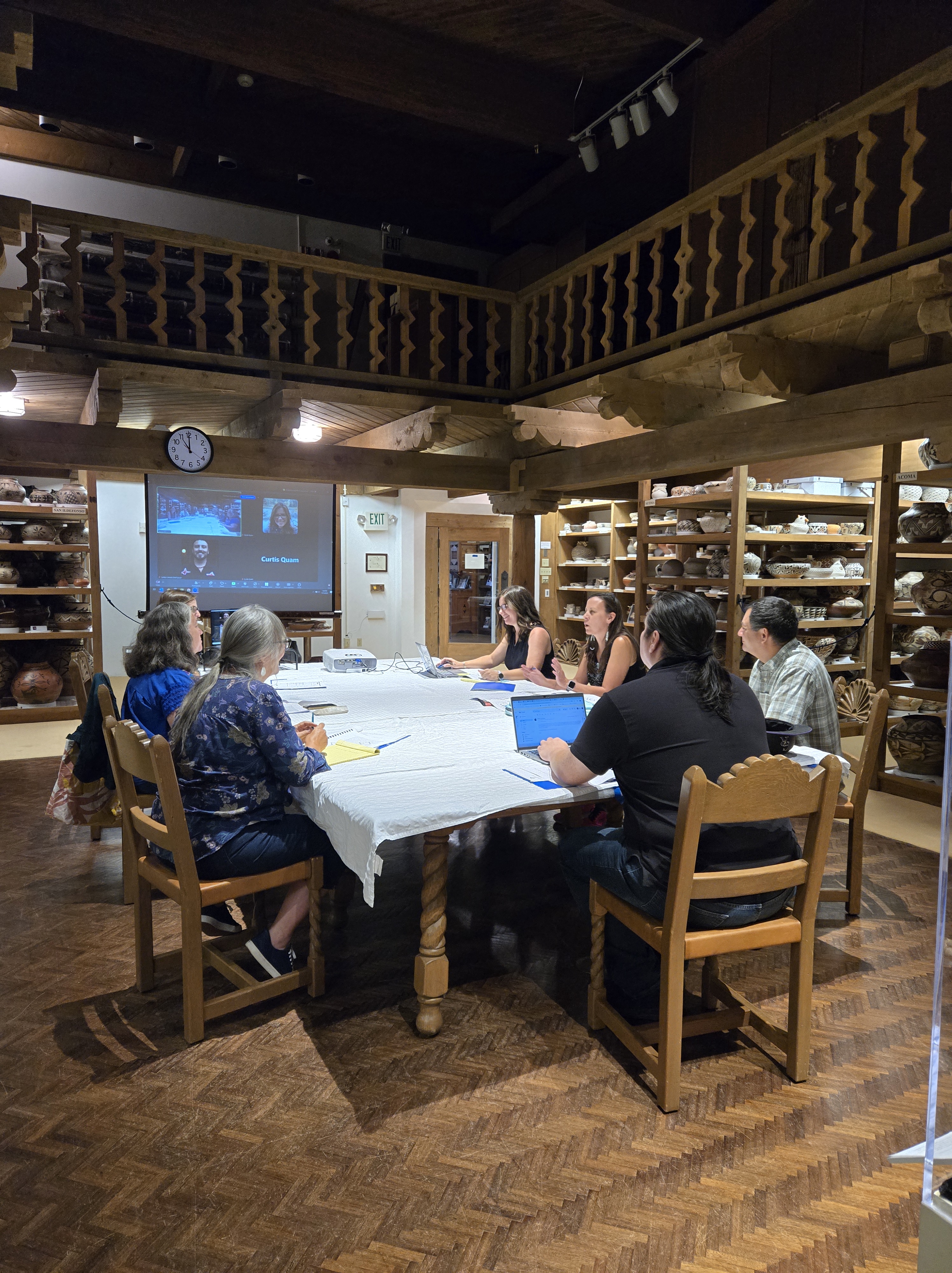
Melanie O’Brien, program manager of the National Park Service NAGPRA program, leads training at the annual repatriation conference.

A highlight of the conference is spending time with friends and colleagues from Tribes, federal agencies, and museums who all share in the day to day work of repatriation. While NAGPRA and repatriation have made headlines over the course of the last year, with reporting by ProPublica and many local news outlets, as well as the attention garnered by the new regulations and duty of care provisions, most people don’t completely understand the behind the scenes and day to day work involved in repatriation. Spending time with other engaged in the work is really meaningful. It’s also a great opportunity to meet new people and learn new things.
A fun feature of the Tunica-Biloxi Tribe’s resort and casino is a replica bayou in the lobby complete with about twenty alligators (we counted, or tried to).

Another highlight was an opportunity to visit the Tunica-Biloxi Tribe’s museum and cultural center, which features the Tunica Treasure. The Tunica Treasure was found by looters in the late 1960s who disturbed a Tunica cemetery in West Feliciana Parish. The treasure included late eighteenth century trade goods and Native-made items, including one of the largest caches of glass beads in the Western Hemisphere. The Tribe’s success in recovering the historic belongings in state court helped them regain federal recognition, which had been lost during the federal government’s termination era. While some might be surprised to see burial items displayed, its important to remember that each Tribe makes their own decisions about what happens with their cultural heritage, reflecting their sovereignty.

Conservation lab built and operated by the Tunica-Biloxi Tribe in their work to preserve the Tunica Treasure.

Save the Date! 2025 #PAGivingDay

Contributed by Emma Lavoie

Mark your calendars! PA Giving Day is Wednesday, March 26, 2025!

PA Giving Day represents a critical milestone in our fundraising efforts for the Peabody. Last year we raised 65% of the Peabody’s annual support from 57 donors in just one day. This year our goal is to exceed previous success by engaging even more PA alumni and friends of the Peabody in this collective day of giving.

For those inspired to give early, please visit the PA Giving Day page here! Please be sure to select the “Peabody Institute of Archaeology” under the “designation” section. Any gift made in advance of the event will count toward PA Giving Day totals.
This year we hope to have more match challenges and even more support! Be sure to follow our social media on PA Giving Day for some inspiring posts from students who have been impacted by the Peabody.