Have you ever heard of the Abbot Academy Fund? (if you said “yes” from one of our earlier blog posts – Gold Star!) If not, please allow me to introduce them.
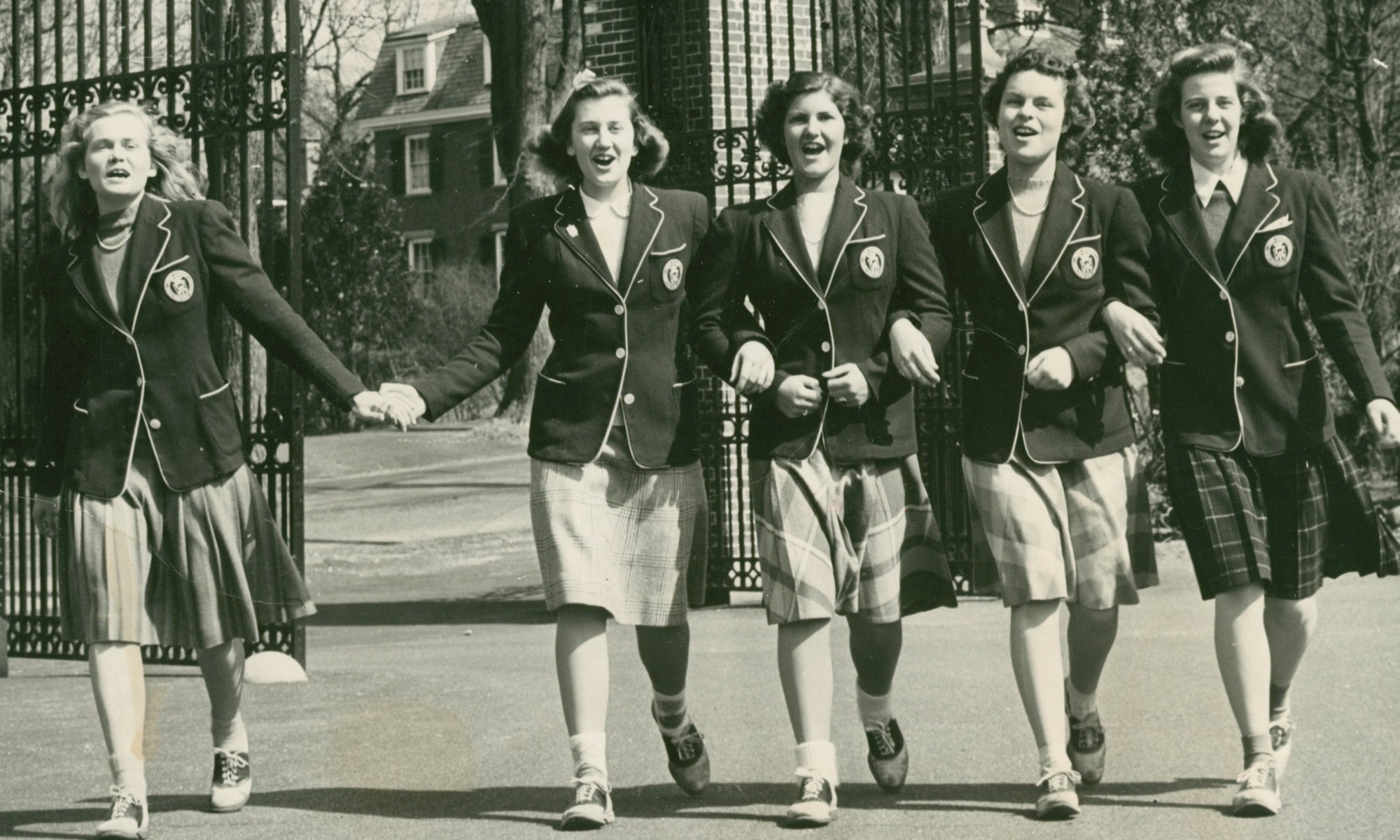
One of the first educational institutions in New England founded for girls and women, Abbot Academy opened its doors in 1829 and flourished until Abbot Academy and Phillips Academy merged on June 28, 1973. At that point, the Abbot Academy Fund (AAF) was established with $1 million from the Academy’s unrestricted funds. The fund operates as an internal foundation with its own board of directors. Its goal is to preserve the history, standards, tradition, and name of Abbot Academy by funding new educational ventures at the combined school.
The Abbot Academy Fund has been a foundational supporter of the Peabody Institute, especially in recent years. With grants going back to 1990, the AAF has given the Peabody over $250,000! I was recently reminded of this incredible generosity when the AAF once again provided support to complete the transcription of the Peabody’s original accession ledgers.
Looking back over all the successful grants, the AAF has supported a real variety of projects at the Peabody – everything from exhibition support to object conservation to equipment purchase to expeditionary learning trips. However, the largest portion of their patronage has gone to support cataloging and rehousing the collection. They provided funds to purchase a server in 2014 to allow for an online catalog. And again in 2016-2018 to acquire the boxes needed to rehouse the artifacts and gain physical control over the collection. All told, the AAF has awarded us over $100,000 in the last ten years!
Basically, the Peabody Institute would not look or operate the way it does now without the incredible support from the Abbot Academy Fund. I can’t thank them enough!
So much work at the Peabody is brought to you bya grant from the Abbot Academy Fund, continuing Abbot’s tradition of boldness, innovation, and caring.
Since the early 1990s the Robert S. Peabody Institute of Archaeology has been searching for objects missing from its collection. Among the missing items are carved and decorated stone, shell, and ceramic pieces from sites in Georgia and Maine.
The Peabody has celebrated the return of four missing artifacts, most notably the Etowah monolithic axe. The Boston Globe recently covered the story.
At least two engraved shell disks remain at large. A $2,500 reward is being offered for information that leads to the recovery of the missing artifacts.
These objects were excavated at the Etowah and Little Egypt sites in Georgia between 1925 and 1928 by Warren K. Moorehead, then-director of the Peabody Institute. The Etowah and Little Egypt sites date from AD 1000 to AD 1550. Southeastern sites of this period are linked to modern-day Native American tribes through the Creek language. Many of the objects are funerary belongings and subject to repatriation under the Native American Graves Protection and Repatriation Act (NAGPRA).
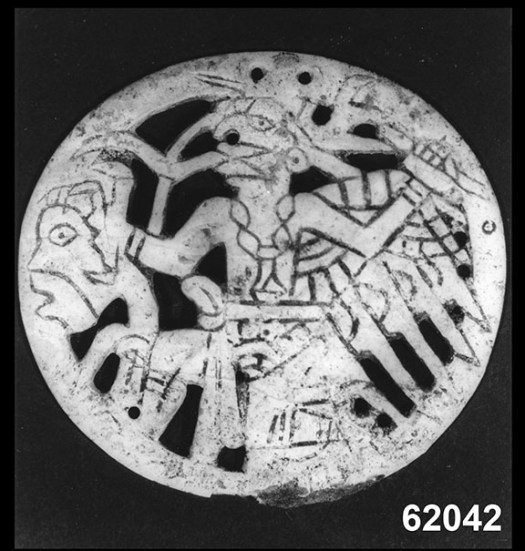
Object: Hightower or Big Toco style shell gorget
Provenance: excavated by Warren King Moorehead in 1926 from Burial 37, Mound C, Etowah site (9BR01), Cartersville, Bartow County, Georgia, USA
Description: a small engraved and excised disk cut from marine shell depicting a dancing human figure with decapitated head; approximately 2.5-inches in diameter; Native American Mississippian culture circa A.D. 1250-1375
Catalog #: 62042
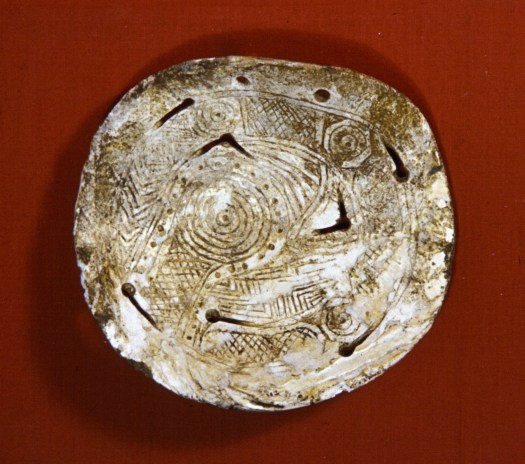
Object: Carters Quarter style shell gorget
Provenance: excavated by Warren King Moorehead, 1925-1927, from either the Etowah site (9BR01), Bartow County, Georgia, or Little Egypt site (9MU102), Murray County, Georgia, USA
Description: highly stylized rattlesnake design incised and cut-out of marine shell disk with perforations for suspension as a pendant or gorget. Approximately 5 inches maximum width. Native American Mississippian culture circa A.D. 1400-1600.
Catalog #: 61440
If you have information about these objects please contact Peabody director Ryan Wheeler at 978 749 4490 or rwheeler@andover.edu.
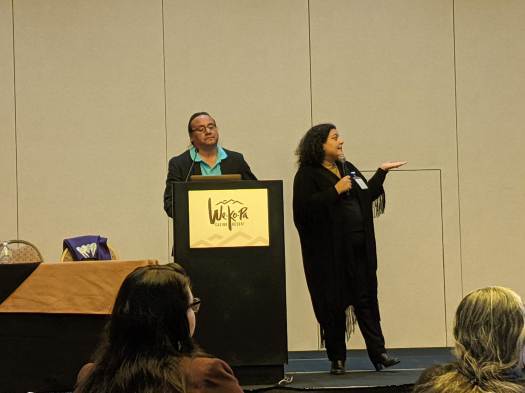
This was the second year I participated in the Association on American Indian Affairs annual repatriation conference. The Fort McDowell Yavapai Nation hosted the conference at their hotel and casino complex just north of Phoenix, Arizona. Healing the Divide was the theme—with a focus on mind-body wellness and collaborative work between tribes and museums, both domestically and abroad. A real highlight was the session Healing the Divide from Trauma to Transformation, led by Dr. Noshene Ranjbar and Dennis Yellow Thunder. Noshene and Dennis had everyone up and moving, and Dennis was called on throughout the rest of the conference to supply encouragement, songs, prayers, and jokes. Presentations ranged from The Cost of Theft and Looting to Healing Auction Practices.
Bad weather prevented some folks from joining in person–here Shannon Martin, director of the Ziibiwing Center of Anishinabe Culture and Lifeways, and Jaime Arsenault, tribal historic preservation officer of the White Nation, share their work. Jaime also is a member of the Peabody Advisory Committee.
Attendees had an opportunity to sit with NAGPRA program manager Melanie O’Brien, who shared some of the ways that the National Park Service was planning to revise and improve the federal repatriation regulations. Despite nearly three decades of repatriation work, 58 percent of the ancestral remains held by museums and federal agencies are still classified as culturally unidentifiable, with only a limited pathway to repatriation. Conference attendees acknowledged that the term “culturally unidentifiable” was troubling and inaccurate. Language is important, and there was a lot of discussion about how to best refer to ancestral remains–there was agreement that human remains and funerary objects were better called people, ancestors, and belongings. We also learned about international repatriation efforts, including the similarities and differences with work by indigenous Australians to reclaim ancestors.
Dr. Noshene Ranjbar and Dennis Yellow Thunder share important ways to interrupt cycles of trauma. Return of ancestors, funerary belongings, and sacred objects is one way to intervene.
Next year’s conference will be October 27 and 28, 2020—marking the thirtieth anniversary of the Native American Graves Protection and Repatriation Act (NAGPRA)—and held at the University of Denver Museum of Anthropology. If you are engaged in repatriation work this is an important event—it would be great to see more museum representation next year!
In 2017, the Peabody welcomed Dr. Laura Kelvin to examine the William Duncan Strong collection from Labrador. You can learn all about that visit in a previous blog post here.
Recently, Dr. Kelvin reached out for permission to share some of the images she took in a video that is part of a larger project – the Agvituk Digital Archive Project, which is part of the Agvituk Archaeology Project (AAP). The AAP is a community-based archaeology project that was initiated by the Hopedale community through the Tradition and Transition Research Partnership between Memorial University and the Nunatsiavut Government.
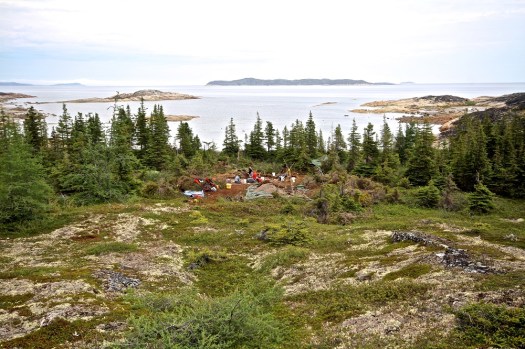
An Agvituk Archaeology Project excavation. Image from Tradition and Transition website.
Every summer, students are hired (high school, college/university, or upgrading) from Hopedale to help conduct traditional knowledge interviews with community members (and sometimes archaeologists) and help with survey and excavation if needed. The interviews were originally going to focus on specific objects that Dr. Kelvin documented, or those recovered through AAP activities. However, due to the high volume of material, the students have been picking topics inspired by the artifacts and interviewing people about those subjects. This past summer the students chose to discuss sewing.
Short videos are created that blend conversations with community members and images of relevant artifacts and historical photos. The videos can then easily share traditional knowledge with the larger community.
Dr. Kelvin and her students used several artifacts from the Peabody’s collection in the sewing video. You can see it in its entirety here.
To learn more about the project, check out their Facebook page.
My name is Emily and I have been working as the new Inventory Specialist at the Peabody Institute for about a month now. My job is to assist with the current inventory and rehousing project. My day to day work consists of moving artifacts from their old wooden storage drawers into new archival boxes which better preserve the objects.
I grew up in a small town called Andover, New York (I know, how ironic) before moving to Buffalo to pursue my Bachelor’s degree in Anthropology. From there, I spent a year in Florence, Italy doing coursework for my MA in Museum Studies which I completed this past August. During my time in Italy, I learned collections care and management from some of the most famous museums in the world including the Uffizi Gallery and the Vatican Museum. This is only my first position working in a museum but I have completed museum internships back home in Buffalo as well as in Santa Fe, New Mexico.
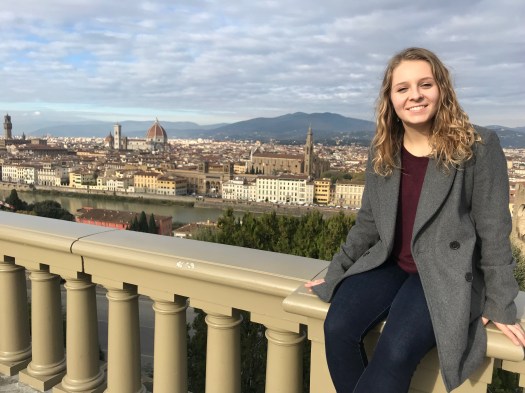
This is me overlooking the beautiful city of Florence!
I have always been passionate about archaeology and indigenous studies so I am excited to be in a position where I can apply my knowledge of both and continue to learn more. Even though I have only been here a few weeks, I have learned so much already. It is amazing to be able to work with and handle objects every day which are hundreds of years old and come from all over the continent. Objects that I have been studying for the past five years are now a part of my everyday life and it is truly such a rewarding experience.
Overall I am very excited to be in this position and can’t wait to see what else I will learn and do during my time at the Peabody!
We were delighted that Dominique, Maxine, and Mia Toya were able to visit this fall and spend a week making traditional Pueblo pottery with students in Thayer Zaeder’s ceramics classes. By our reckoning, this is the fifth year that the Toyas have visited PA. Each visit brings lots of excitement in Thayer’s classes, as well as raw materials from New Mexico, including hand-dug clay, polishing stones, micaceous slip, and fuel for the open air firing.
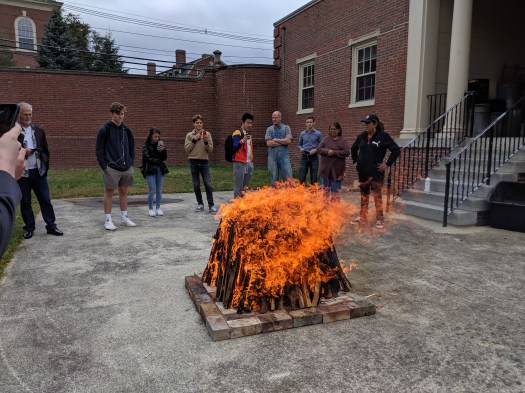
PA students look on during an open air firing. Maxine and Dominique Toya are on the far right.
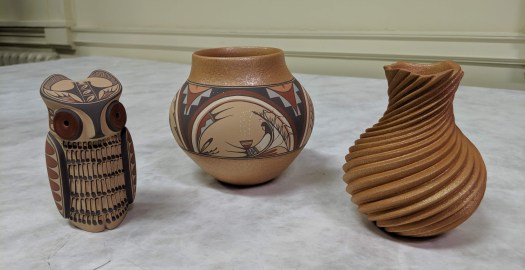
Dominique, Maxine, and Mia are talented artists and educators from the Pueblo of Jemez, also known as Walatowa. Dominique is known for her micaceous spiral vessels, Maxine makes beautiful hand painted figurines of owls and town criers, and Mia makes vessels adorned with butterflies on their lids. All of their pieces are made and fired using the traditional techniques of Pueblo pottery making and include their own distinctive innovations. Collectively they have won numerous distinctions and regularly show their pieces at the Santa Fe Indian Art Market and other juried venues. They also are terrific educators with a passion for sharing Pueblo pottery making.
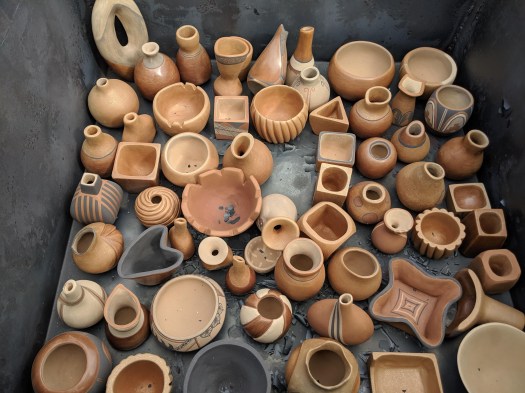
Student work emerges after the firing. Many of the pieces incorporate techniques like fine line painting, polishing, as well as a mix of traditional and innovative forms.
The Peabody and PA have a long history with the Pueblo of Jemez. From 1915 through 1929 the Peabody sponsored Alfred V. Kidder’s excavations at Pecos Pueblo, one of the ancestral communities of Jemez. In the 1990s Peabody personnel were involved in repatriation of ancestors and funerary objects from Pecos and began the Pecos Pathways program, a forerunner of today’s Learning in the World programs.
Owl figurine made by Maxine Toya (left); collaborative pottery, Dominique and Maxine Toya (center); micaceous swirl bottle by Dominique Toya.
We are very fortunate that several donors and members of the Peabody Advisory Committee have helped us acquire some of the Toyas’ stunning pieces and provide underwriting for their visits. We are so grateful for the time that the Toyas have dedicated to working with PA students and faculty!
The Peabody is continuing to undergo its Inventory and Rehousing Project to make way for more sustainable storage in the future. As a result, the Peabody Collections Team is giving away their original wooden drawers as the Peabody no longer has any use for them.
The wooden drawers were a part of the original storage for the Peabody collections, housing over 600,000 artifacts. The wooden storage originated in the early 1930s consisting of bays, shelves, and drawers. Currently, about 30% of the collection has been rehoused from its original storage. This means there are many drawers becoming available and many more to come in the future!
Those who have taken drawers have re-purposed them into various things ranging from tea trays to accent walls! Below are some examples of how our drawers were reused by friends of the Peabody.
Peabody Drawers used for storage
Peabody drawers stained and painted
Jewelry, wall storage and table made from Peabody drawers
If you have re-purposed some of the Peabody drawers, we would love to see your creations! Please share your photos with us at ecook@andover.edu.
One of the early topics covered in the interdisciplinary course Human Origins is science vs. pseudoscience. Students watched a short video by Craig Foster, who talks about his experience attending a Bigfoot research conference. Archaeology has long contended with claims for ancient aliens, lost continents, and cryptids, like Bigfoot, Yeti, and the Abominable Snowman. While seemingly fun and harmless diversions, these things can muddy thinking about what science is and how it is done, and contribute to misperceptions about the accomplishments of indigenous people. The nineteenth century Moundbuilder Myth suggested that the ancient earthen monuments of the Ohio Valley had not been built by the ancestors of contemporary Native Americans, but rather by a mysterious lost race. This was used to justify the United States’s expansion westward, as exhibited in the doctrine called Manifest Destiny. If Native people were not responsible for creating the Ohio Valley monuments it called into question their rightful occupation of this territory and empowered American expansion.
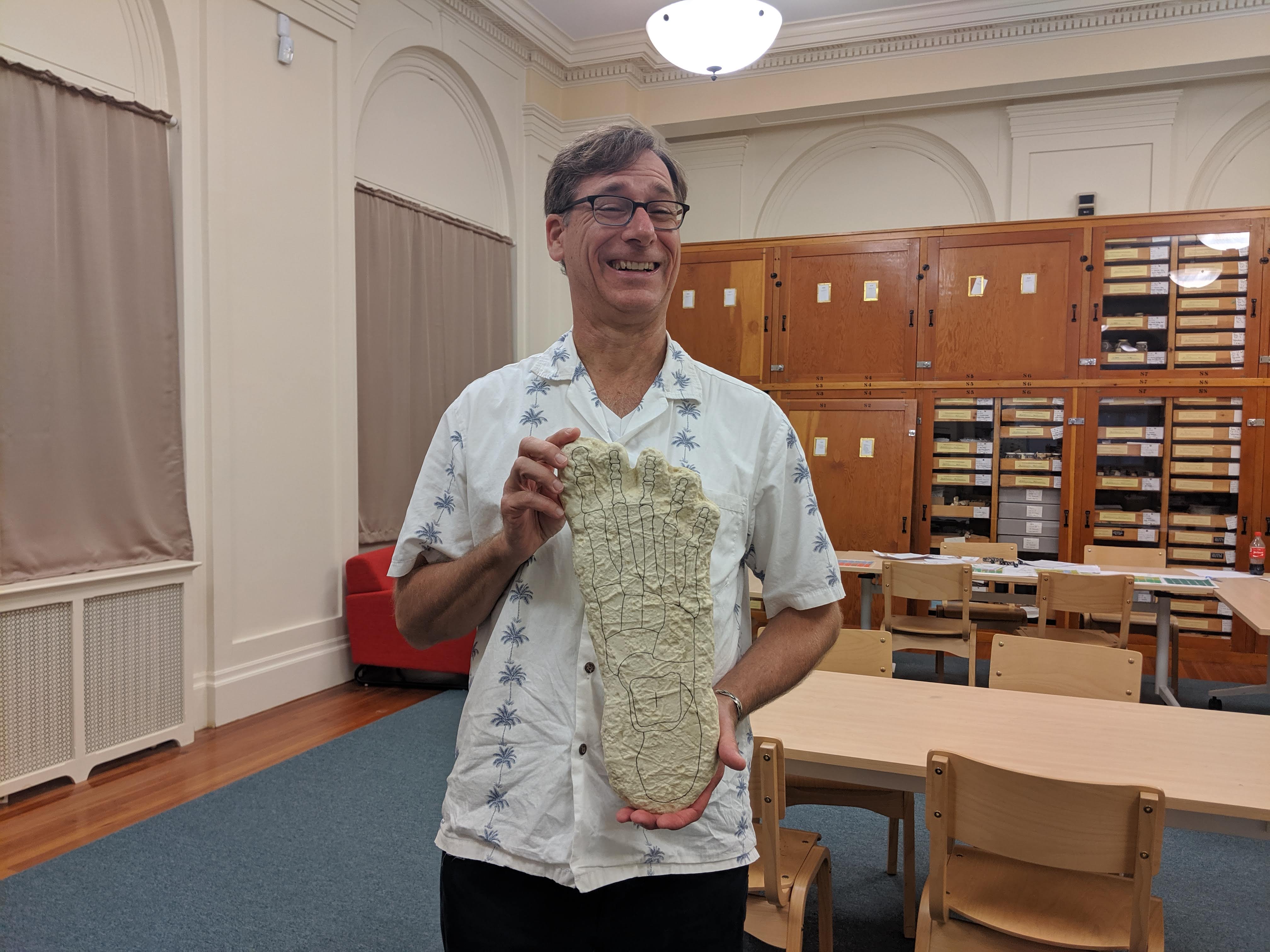
Peabody director Ryan Wheeler with the supposed cast of Bigfoot. The late Dr. Grover Krantz has marked the position of the foot bones. This copy was obtained from BonesClones, though there are many casts available for sale.
Paranormal and cryptid researchers often use technology and techniques that approximate science. They represent an investigation of the unknown and the possible. During class we discussed perceptions of science and philosopher Karl Poppers’s recognition that falsifiability is the hallmark of scientific investigation. The classic example is Arthur Eddington’s check of Einstein’s theory of relativity. Einstein had noted that it should be possible to observe the gravitational deflection or bending of starlight during as eclipse; if the starlight wasn’t deflected, it meant that his postulates had been proven false. Eddington made a series of photographs during the 1919 eclipse that demonstrated that the Sun did, in fact deflect starlight. Ancient aliens, Bigfoot, and Lost Tribes can never be subject to real scientific investigation like this because the claims can never be tested and proved false.
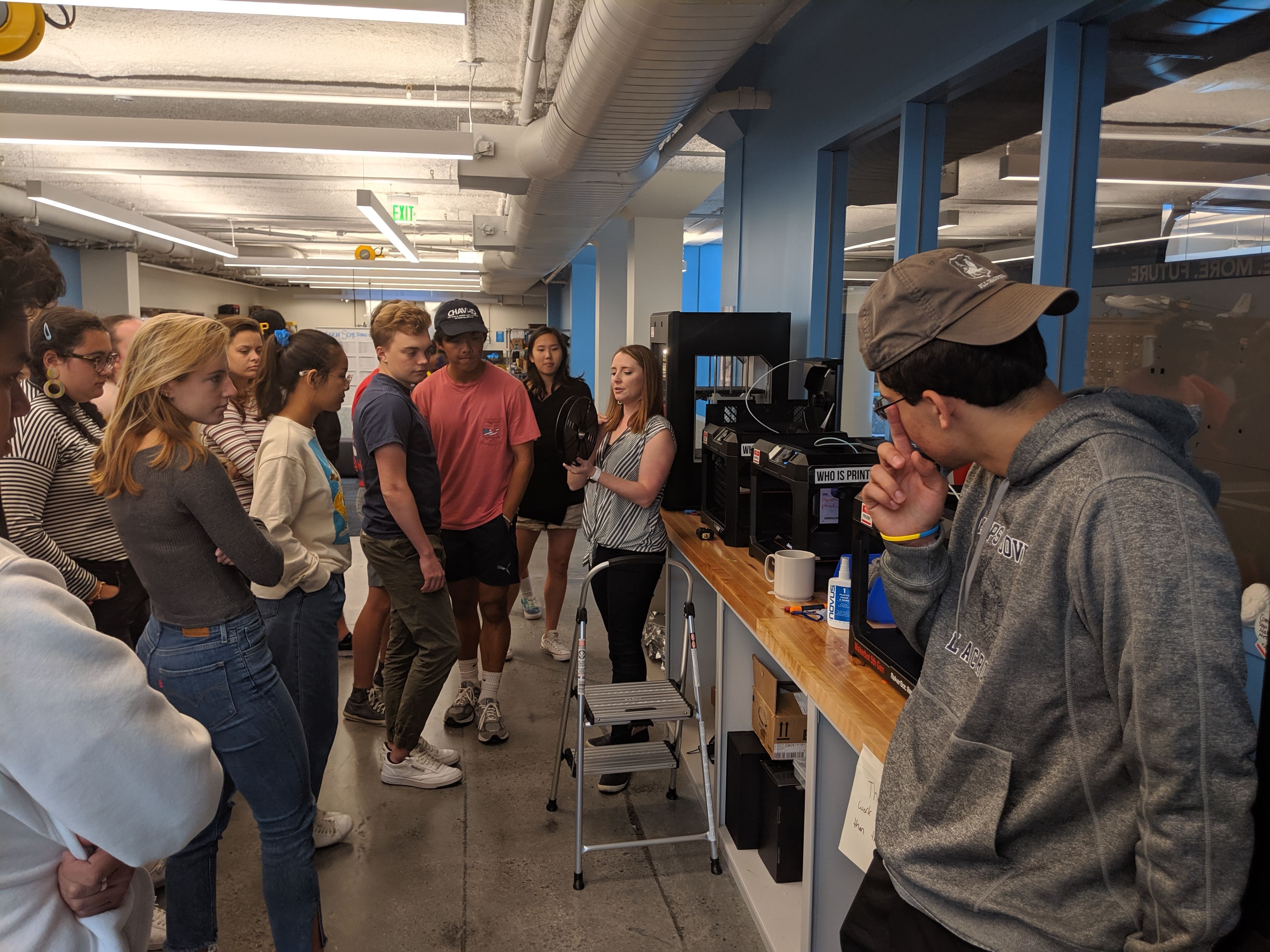
Students in Human Origins are printing 3D versions of fossil hominins this term. Here they are learning about the equipment from Claudia Wessner, Oliver Wendell Holmes Library Makerspace guru.
We revisited Foster’s video and his thoughts on the Bigfoot adherents. Why do people believe these outrageous claims? For one, it has to do with context. If you spend time with other Bigfoot believers it reinforces your own thinking. We also discussed belief as a continuum. Some people don’t believe in cryptids or aliens, but are willing to consider the possibility of ghosts. Foster also notes that we are all susceptible to pseudoscientific claims and that the people who believe are perfectly rational and pleasant individuals who will remain unconvinced by arguments or contradictory evidence.
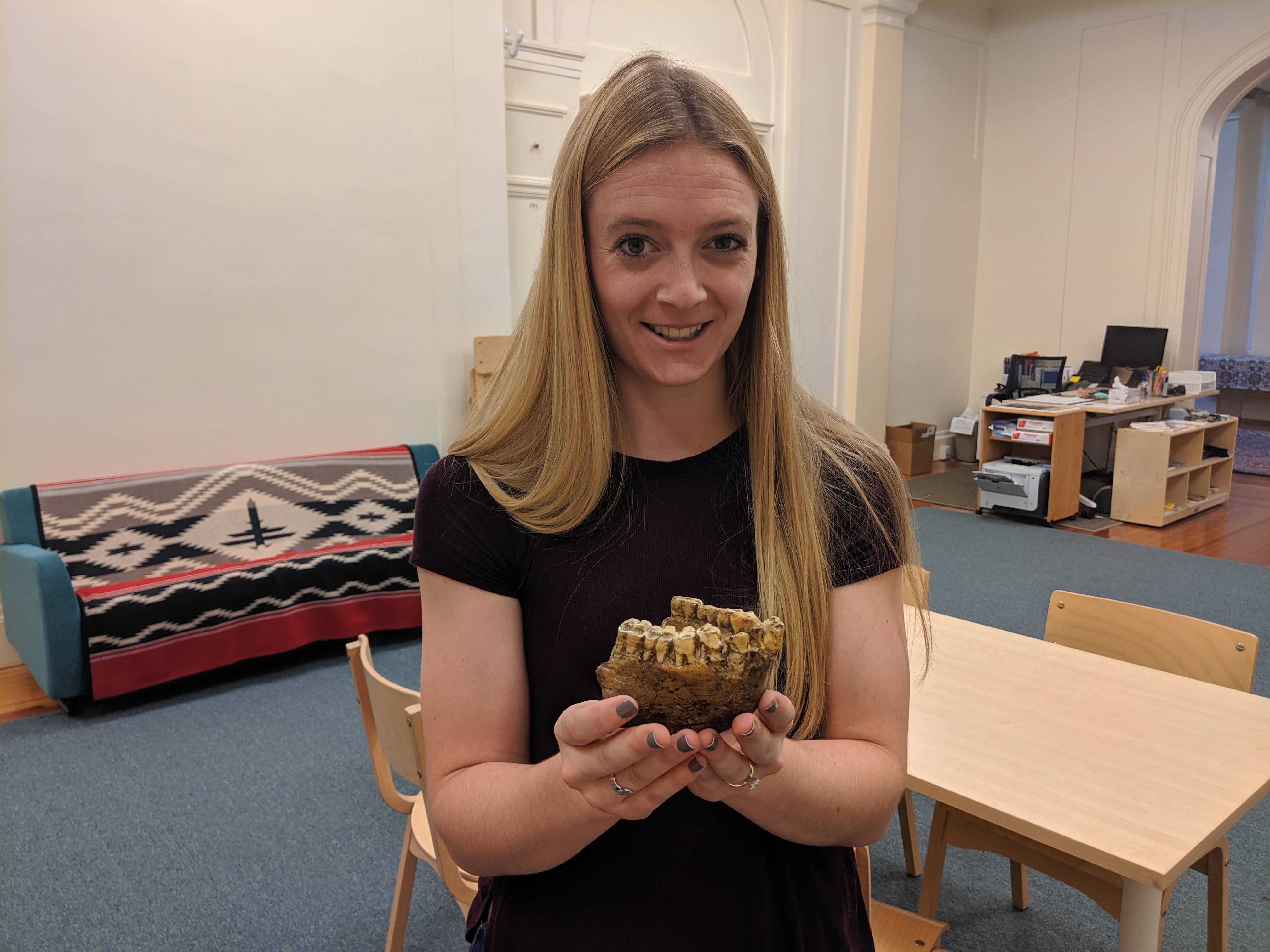
Peabody administrative assistant Emma Cook with our cast of the Gigantopithecus blacki mandible.
During class we also examined a cast of a jaw of Gigantopithecus blacki, a very large primate known from around 9 million years ago in parts of Asia; paleontologists believe Gigantopithecus became extinct around 100,000 years ago. Gigantopithecus is often offered as the real creature behind cryptids like Bigfoot and Yeti. As the claim goes, perhaps the large ape has persisted in remote areas into modern times. Relatively harmless thinking, right? But if we accept claims like this, we are effectively denying Darwin’s theory of evolution. And if we believe that evolution isn’t operating it opens the door for a host of other, more insidious thinking, especially ideas about race.
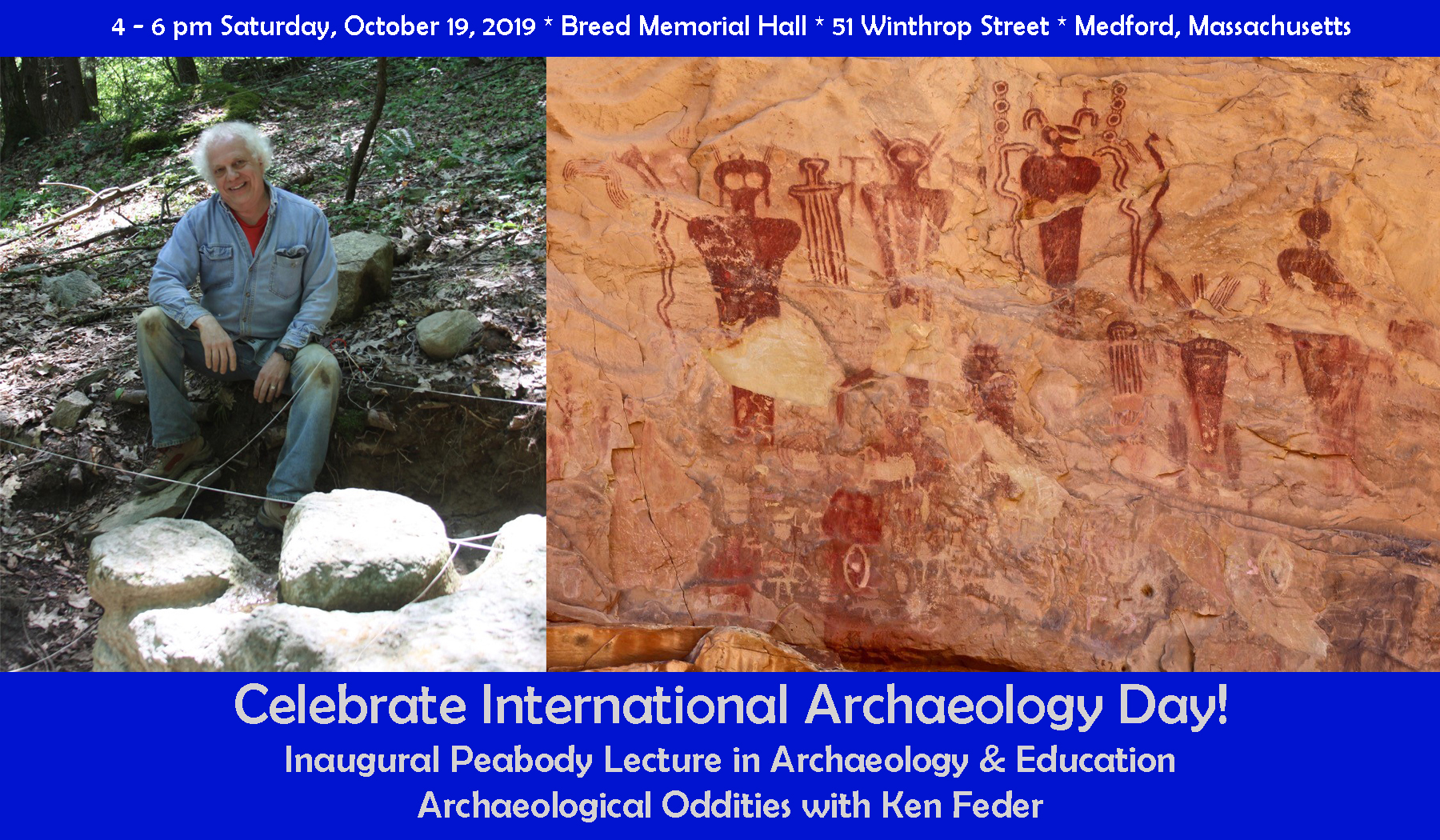
If you want to learn more about archaeology, science, and pseudoscience please attend our inaugural Peabody Lecture in Archaeology & Education, featuring archaeologist and author Ken Feder. Feder will talk about his newest book, Archaeological Oddities: A Field Guide to Claims of Lost Civilizations, Ancient Visitors, and other Strange Sites in North America. Ken will sign copies of the book after his talk. 4-6pm, Saturday, October 19, 2019, Breed Memorial Hall, Tufts University, 51 Winthrop Street, Medford MA. The event is free and open to the public, but we ask that you RSVP: https://events.attend.com/f/1383789424#/reg/0/
Hot off the presses – the Peabody’s annual report for academic year 2018-2019 has just been released! Interacting with nearly 2,000 students (yes, some PA students keep coming back for more) and dozens of researchers, another wonderful year is under our belt.
The Addison Gallery of American Art is across the street from the Peabody at Phillips Academy. While I am happy to gently tease that the Peabody is cooler, the Addison is a pretty amazing institution as well. Founded in 1931, the Addison’s collection of American art is one of the most comprehensive in the world, including more than 20,000 objects spanning the eighteenth century to the present. I strongly recommend that you take the time to check out their awesome collection online.
Several months ago, Gordon Wilkins, the Robert M. Walker Associate Curator of American Art, requested a loan of several objects from the Peabody for an exhibition. We were thrilled to be able to help out and loan ten objects to the Addison for their show A Wildness Distant from Ourselves: Art and Ecology in 19th-Century America. The exhibition considers how the evolution of the European-American understanding of the natural world fundamentally altered the ecology of North America. From the Puritans’ seventeenth century “errand into the wilderness” to the present, the perceived dichotomy between man and nature has defined the European-American experience in the so-called “New World.” A Wildness Distant from Ourselves focuses on the nineteenth century, an era that witnessed both the extreme exploitation of the land and its peoples and the birth of a modern conservation movement.
I have been over there to check it out, and the exhibition looks great! It is wonderful to see the objects from the Peabody seamlessly integrated with other examples of American art to contribute to an important story.
If you are in the Andover area, I strongly recommend taking in the exhibition. And don’t miss the opening reception on Friday, October 4th from 6-8pm.






 The Peabody