Back in the Peabody archives

I was so pleased to learn this summer that the Oak River Foundation had decided to fund another year of the archives project at the Peabody! This continuation of the project will allow me to focus on the photographic and map collections, excavation records from the Tehuacán Archaeological-Botanical Project and the Ayacucho Archaeological-Botanical Project, among others. I also hope to begin developing sustainable digitization workflows for some of the archival material, help with reference requests, and continue an oral history project about Scotty MacNeish. I am very happy to be back at the Peabody, continuing this work.

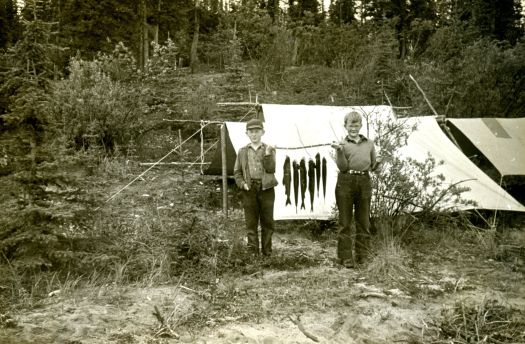
This black and white photograph depicts two sons of Hugh Raup, who participated in the Andover-Harvard Yukon Expedition of 1944.
A photograph from the archives that caught my eye: Karl and David Raup (sons of Hugh Raup) with fish caught in stream. Big Arm, Kluane Lake. 8/21/44. Andover-Harvard Yukon Expedition.

Since starting back up here in early September, I have mostly been working on organizing and inventorying internal museum records like loan, exhibition, and NAGPRA records. These records might not have huge interest for outside researchers (and, as is common for institutions, are typically restricted for 25 years after creation for privacy concerns), but are important for staff members in the course of day-to-day collections management and ongoing repatriation efforts. Now that I am more familiar with the museum’s institutional history, I am finding that I can categorize material more quickly – I don’t have to repeat the learning curve of my first year.

On a personal note, I spent most of the summer between Boston (where I live) and western Massachusetts, where my sister and I own what used to be our grandparents’ house. My French, North African-born grandmother met my American grandfather (from a Scottish family who emigrated to the Boston area in the 1920s) during World War II while he was stationed in Algeria. The house is full of photographs, letters, books, and interesting objects documenting their lives – essentially, my family’s archives. I also spent two weeks working at the Phillips Academy Archives and Special Collections, helping Director of Archives and Special Collections Paige Roberts prepare for an upcoming move of the collections associated with the Oliver Wendell Holmes Library renovation. So, I didn’t stray too far from the work I do here, even while I was away.

The Temporary Archivist position is supported by a generous grant from the Oak River Foundation of Peoria, Ill. to improve the intellectual and physical control of the museum’s collections. We hope this gift will inspire others to support our work to better catalog, document, and make accessible the Peabody’s world-class collections of objects, photographs, and archival materials. If you would like information on how you can help please contact Peabody director Ryan Wheeler at rwheeler@andover.edu or 978 749 4493.

Principles of Editing

Contributed by Lindsay Randall

A few weeks ago I began trekking down to Cambridge every Tuesday evening for the class Principles of Editing, offered through Harvard Extension School. I signed up for the class as I was looking for something that would help me to improve and polish our lesson booklets and other educational materials as we share them with the public. Christina Thompson, editor for the Harvard Review, has structured the class to teach lay people how to produce good, clean copy when editing material such as blogs, newsletters, websites, brochures, and other text.

PE2

Christina has a quirky personality one expects in a writer and the other adult students frequently use humor to make points about the homework. My type of people! The camaraderie in the class certainly makes the late nights enjoyable.

I am looking forward to learning more about editing and to see what other rousing debates we will engage in. (Last week was about when to use Em dashes and En dashes. WARNING: they can elicit strong – occasionally violent – emotions in individuals!)

r.ed in residence: r.ed monde visits the Peabody

r.ed holding a sherd that will be part of the upcoming exhibit

Contributed by Marla Taylor

Exhibits and exhibitions are not the focus of the Peabody.  However, once in a while a unique opportunity presents itself.

Visual artist Angela Lorenz (’83, P’14) reached out in early 2017 to suggest a collaboration with the Peabody. Angela’s newest art book, r.ed monde in r.ed engender.ed, explores the world around us through pointy-shapes and r.ed.

After spending decades in a drawer in the artist’s studio, r.ed steps out on a journey of self-identity.  r.ed identifies with pointy-shaped objects and images from around the world – many of which are similar to pieces in the Peabody’s collection.

Angela and I surveyed collection and collaborated to create r.ed in residence: r.ed monde visits the Peabody. This short exhibition will have an opening reception on Saturday, October 21st from 1-4pm.  Angela will discuss r.ed and her work from 1-2pm and be available to talk with visitors. Refreshments will be served and we will have hands-on activities for all ages.

Come by to explore a new way to examine archaeological artifacts through the lens of contemporary art!

Summer collaboration with Salem State University

more excavating
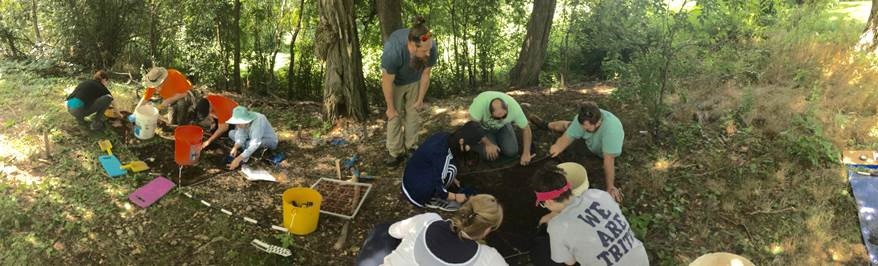
Excavating at RNH

Contributed by Lindsay Randall

The Peabody Museum once again partnered with Dr. Bethany Jay, professor of history at Salem State University, to run the graduate summer institute class, Preserving the Past: Using Archaeology to Teach History.

The week long class focuses on how archaeology can be used in middle and high school classrooms as a way to talk about minorities who are often left out of the historical record.  Each day was focused on a different minority group such as Native Americans, women, enslaved people, and free blacks.

Each day gives students background content to ground them in the topic, a tour of a historic or other site, and hands-on lesson plans. This year’s lesson plans included the Peabody’s “Maps and Dreams,” which utilizes Native American petroglyphs as well as a map in Phillips Andover’s Knafel Map Collection and “Little Spots Allow’d Them,” which focuses on the archaeology of the Royall House and Slave Quarters. They also were able to see the mock excavation activity about Katherine Nanny Naylor which the Commonwealth Museum hosts as part of their Archaeology of the Big Dig.

The last day is always the highlight of the class. Dr. Nate Hamilton of University of Southern Maine generously lenthis time and expertise to the class, allowing the students to participate in a real excavation at the Rebecca Nurse Homestead in Danvers MA.

Also this summer, Dr. Brad Austin of Salem State University brought his class Teaching Difficult Topics: Native American History to the Peabody. The class spent the day working with the Peabody’s History 300 lessons “alterNATIVE uses” and “Trail Where They Cried.”

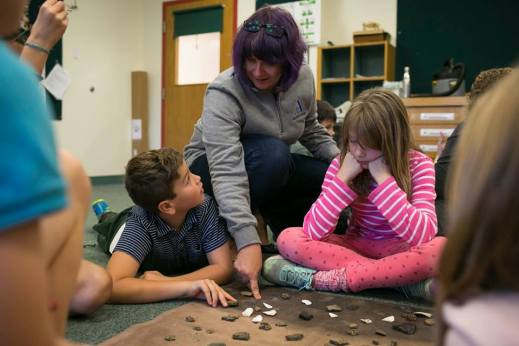
In “alterNATIVE uses” students examine both a stone and metal projectile point to better understand how iron and trade affect both Native and European communities during the 1600 and 1700s. Each student was given a replica stone and metal projectile point along with the lesson plan.

Brad Austin's class working on analyzing points in the 'alterNATIVE uses' lesson
Brad Austin’s class working on analyzing points in the ‘alterNATIVE uses’ lesson

In the “Trail Where They Cried” the students learned how to make the complex history of Cherokee Removal more accessible to students through a Choose Your Own Adventure style activity.

Both activities were a big hit and the students have asked to use more of the Peabody’s teaching resources.

The Peabody Collaborates with the Robbins Museum on NAGPRA Inventory

Contributed by Lindsay Randall

Robbins Museum
Robbins Museum

On Monday July 17 the Peabody staff joined volunteers at the Robbins Museum of Archaeology in Middleboro, MA to help with an ongoing collections inventory project. The Robbins Museum is an all-volunteer organization that is currently working on their NAGPRA obligations and repatriation. In addition to Ryan, Marla, Samantha, and Lindsay, others who came out to help were professional archaeologists with ties to the Robbins Museum along with Jim Peters, Massachusetts Commissioner of Indian Affairs and Mashpee Wampanoag tribal member who is also part of the Wampanoag Repatriation Confederacy.

The Robbins and Peabody museums are working together on the repatriation of related collections from the Mansion Inn site, split between the two institutions. The site, located in Wayland MA, was excavated by J. Alfred Mansfield and Leslie Longworth, members of the Massachusetts Archaeological Society (the parent institution of the Robbins Museum) in 1959; Doug Byers and Fred Johnson of the Peabody also became involved with the site at that time. For that reason, both institutions have collections and have decided to work together as the process moves forward.

Throughout the day everyone worked diligently in an effort to create a streamlined checklist that will assist with the transfer of custody of the human remains and associated funerary objects. It was a very eventful and fun day and we look forward to working with the Robbins Museum again on the process!

Report from the Advisory Committee on Archaeology, 1914

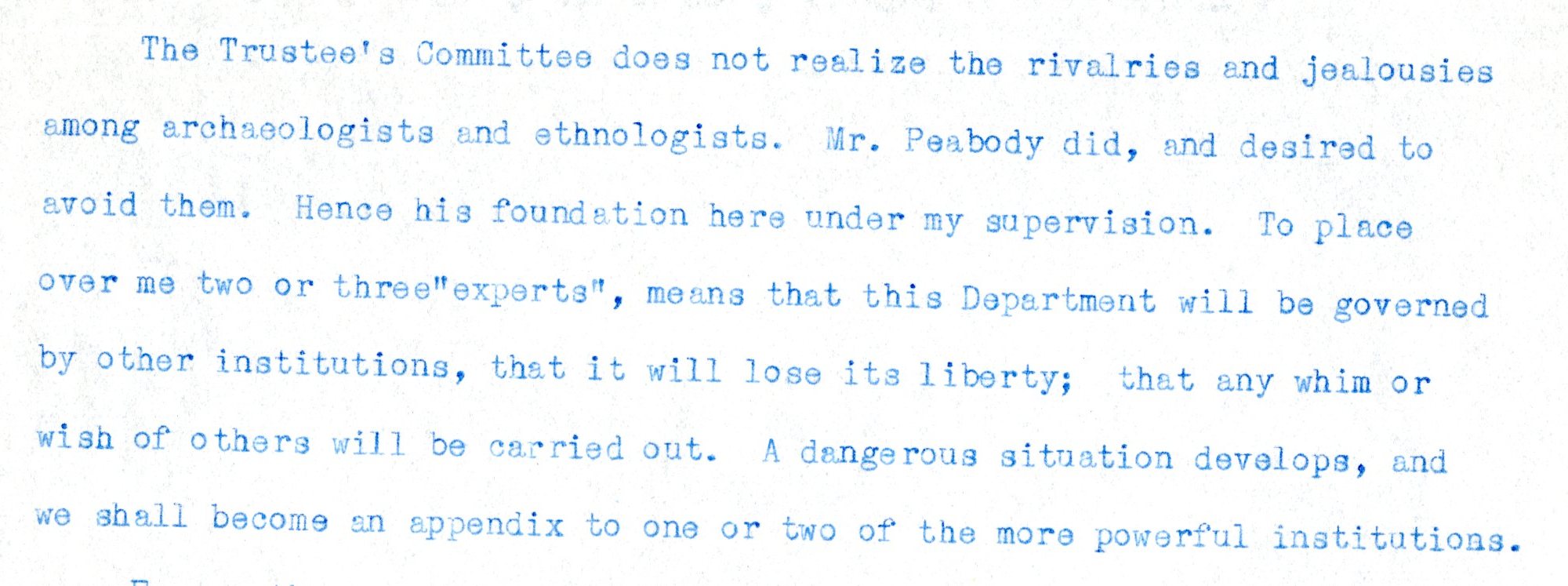
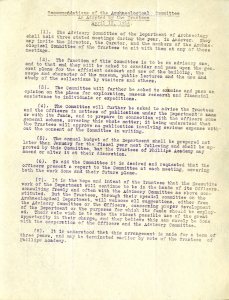
Warren Moorehead complains about a special advisory committee in a letter to the Headmaster.

This blog represents the ninth entry in a blog series – Peabody 25 – that will delve into the history of the Peabody Museum through objects in our collection.  A new post will be out with each newsletter, so keep your eyes peeled of the Peabody 25 tag!

Bureaucracy and oversight committees are not modern phenomena.  In the earliest years of the Peabody, contemporaneously known as the Department of Archaeology, the work done was overseen by a subcommittee of the Trustees of Phillips Academy. However, the Trustees recognized the limitations of their own knowledge in the world of archaeology and appointed a Special Advisory Committee on Archaeology in 1914.

The special committee was tasked with assessing mundane logistical needs of the Department as well as providing direction and feedback on proposed research.  Composed of five prominent anthropologists; Franz Boas, William Henry Holmes, Roland Dixon, Hiram Bingham, and Frederic Ward Putnam, the committee made the following suggestions:

  1. Install a synoptic exhibit, strictly limited in size and scope, of the life of man from geological time to the beginnings of history
  2. Limit public lectures to no more than 4 each year
  3. End formal classes in archaeology for the students at Phillips Academy and instead encourage individual students as their interests dictate
  4. The work of ‘research’ should include two separate divisions; one to investigate large definite problems of archaeology, and the other to aid competent archaeologists in the execution of such of their plans
  5. Appoint a small permanent advisory committee of experts of easy access, whose duty it shall be to report to the Trustees upon all plans for exploration, organization of study collections, museum research, and publication.

These recommendations were received with mixed feelings by curator Warren K. Moorehead.  He appreciated many of the committee’s suggestions, but strongly objected to the creation of a permanent oversight committee.  Convinced that they would meddle in his research plans and enmesh him in red tape, Moorehead clearly expressed his displeasure:

August Blog scans004

Warren Moorehead complains about a special advisory committee in a letter to the Headmaster.


However, the committee composed of Dixon and Bingham, existed for several years.  They limited Moorehead to his ongoing work in Maine and simultaneously decided to embark on an expedition in the Southwest.  This decision directly led to the appointment of Alfred V. Kidder as the Director of Southwest Explorations and his seminal work at Pecos Pueblo, New Mexico.

Oak River Foundation continues support of Peabody collections

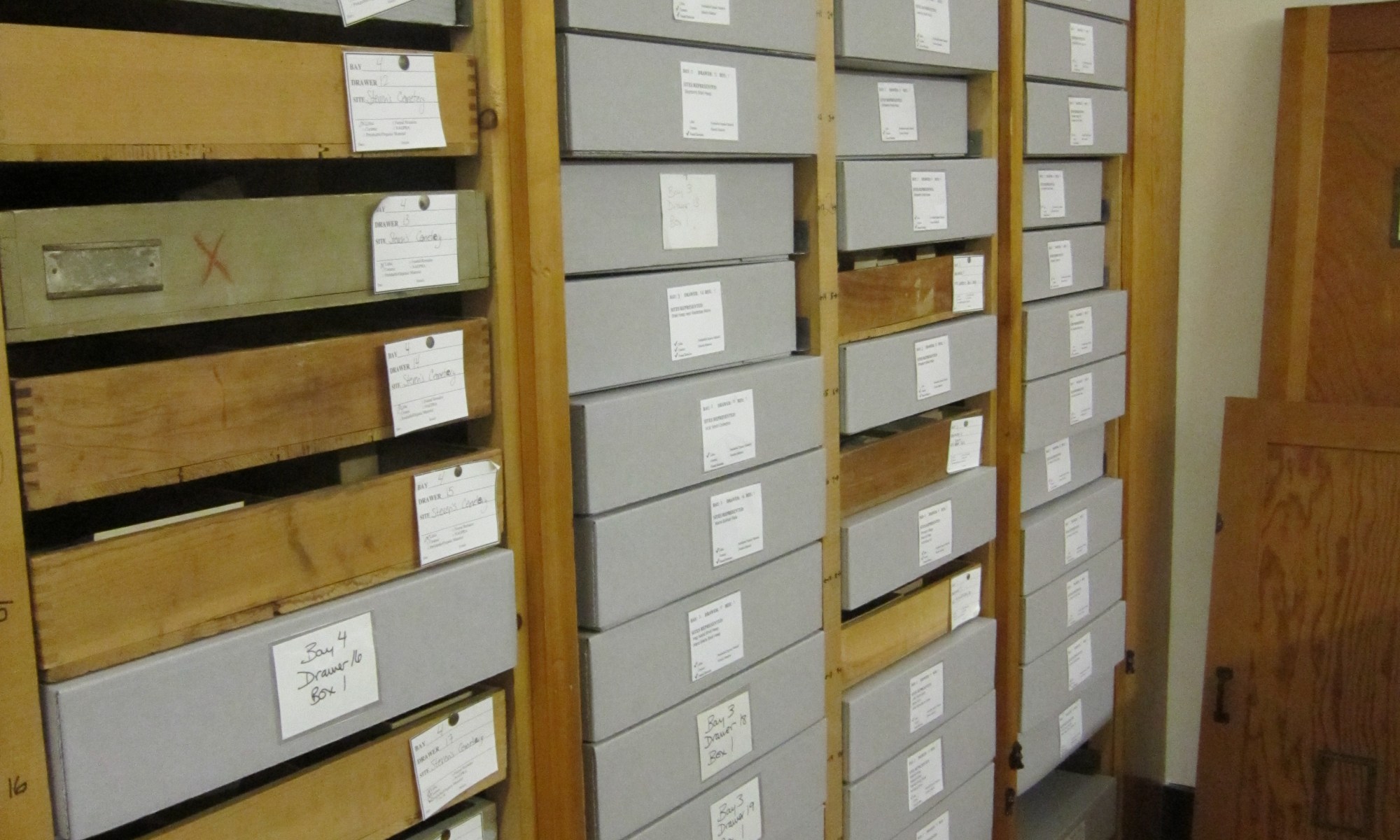
A storage bay with a mixture of drawers and boxes

Contributed by Marla Taylor

In 2016, the Peabody Museum received a generous grant of $100,000 from the Oak River Foundation of Peoria, Ill., to support work pertaining to the intellectual and physical control of the museum’s collections.

The grant was spread across two years and initially supported the work of an archivist to whip the Peabody’s 100+ years of archives into shape.  With that funding, Irene Gates was able to share archival collection records online and process over 140 linear feet of material.  She also created three finding aids to the material belonging to prominent directors of the Peabody’s past.

The second year of funding is designated to supporting the work of a temporary inventory specialist – Rachel Manning.  Rachel will be spending her time inventorying drawers of artifacts and rehousing them into archival boxes as part of our larger collections storage project.  While she only began her work in early August, Rachael has already been making steady progress.

Rachel inventories a drawer from Massachusetts.

And we are pleased to announce that the Oak River Foundation has stepped up again and provided additional funding for Irene to return and spend another year in the Peabody archives!  This second year will facilitate processing the remaining 150 linear feet of material as well as addressing the photographic and map collections.

Our deepest appreciation goes to the Oak River Foundation for their continued generosity and support of the Peabody’s goal to improve the intellectual and physical control of the museum’s collections.

We hope this gift will inspire others to support our work to better catalog, document, and make accessible the Peabody’s world-class collections of objects, photographs and archival materials. If you would like information on how you can help please contact Peabody director Ryan Wheeler at rwheeler@andover.edu or 978 749 4493.

More to Xi’an than terracotta warriors

Contributed by Ryan Wheeler

In June 2017 I had the opportunity to visit China in preparation for a potential student trip—part of the Phillips Academy Learning in the World program. My traveling companions included Anne Martin-Montgomery and Jingya Ma, who aided in developing the itinerary, which delves into China’s ancient past. With a dizzying number of UNESCO World Heritage Sites (52 on the list, with even more proposed sites), our goal was to create a student travel experience that blends adventure, archaeology, and learning.

One destination was Xi’an in Shaanxi Province. Xi’an boasts lots of historical and archaeological sites, most notably the mausoleum of Qin Shi Huang. The mausoleum is best known for Emperor Qin’s terracotta army, which doesn’t disappoint. Pictures don’t do it justice and it is fun to look at the sea of soldiers lined up, ready to march up ramps and out the false doors. The site—located in Bingmayong outside of Xi’an, was mobbed with visitors, all ready to pose for a selfie with some of the emperor’s immortal warriors. Xi’an, however, includes other ancient sites, which can be found in other suburbs like Bànpō.

Bànpō Neolithic Village is tucked into a neighborhood of this Xi’an suburb. It was found in the 1950s during construction for an industrial site, and if you peek over the fence today you will see a factory complex, including a billiard table manufactory.

Image of interior, Banpo excavation hall, with features like the moat and postholes from structures.
Interior of Banpo excavation hall–the moat is in the foreground, posthole outlines of structures can be seen as well.

Bànpō was the oldest site on our itinerary, dating to the Neolithic Yangshao culture, with occupation going back to 6,500 years ago. Like Emperor Qin’s mausoleum, the excavation site is covered by a fairly substantial structure, so visitors can observe the outlines of houses, the moat, burials, and in place features. Exhibit halls showcase artifacts from the site, along with dioramas of Yangshao life. Markings on the early pottery from the site have suggested to some precursors to the writing systems known from the Bronze Age.

At the rear of the museum property are the remains of the Bànpō Matriarchal Clan Village, which apparently offered a living history interpretation of Neolithic life. This has been replaced with a newer area that showcases Neolithic activities on the weekend, including thatching your hut, fire making, and other early technology and skills.

Marxist ideology has heavily influenced the interpretation of Bànpō, emphasizing that this was a matriarchal culture. This is not surprising, since in Marxist thought matriarchal clan based society was a hallmark of early stages in a unilinear social evolution that moved inevitably toward patriarchal family based society. These ideas have been largely abandoned today, though the site is replete with signage that emphasizes this interpretation.

Image of Peabody director Ryan Wheeler with reconstructions of Banpo woman and man.
Ryan Wheeler with Banpo woman and man.

A cute 2015 graphic novel style guide book tells the story of the site and the Yangshao culture. The matriarchal focus is still there (one of the main characters is Bànpō girl), but there is lots of accessible info on foodways, pottery making techniques, and the layout of the village.

We are looking forward to visiting Bànpō again and catching some of the Neolithic lifeways demonstrations. Interactive and hands on activities have become the norm in US museums, but we encountered few such programs in China.

Summer time = Research time

The collections team remains busy at the Peabody during the summer time, following an already packed school year. Instead of working with PA students, we spend much of our time working to catalog the collections and hosting outside researchers.

The summer has started off strong with one of the Linda S. Cordell Memorial Research Award recipients , John Andrew Campbell.  John is documenting artifacts from the period of first contact between Native Americans and European settlers along the maritime region of eastern Canada and northern New England.  ”What does that mean?,“ you may ask.

Basically, John is identifying copper, glass beads, and glazed ceramic artifacts that were found intermingled with traditional native tools and artifacts.  The first appearance of these ”foreign” materials indicates that contact between the cultures had been made.  Their use and modification by tribes is the direct result of trade with the European settlers and can be revealing of those early interactions.

The Peabody is John’s first stop for collections research as he begins to build data for his dissertation work at Memorial University in Newfoundland.  He will be visiting for most of June and documenting hundreds of items.

The rest of the summer is chock full of research appointments and we are happy to share our collections to contribute to the field of archaeology!

Dapper Digging

Contributed by Lindsay Randall

This blog represents the eighth entry in a blog series – Peabody 25 – that will delve into the history of the Peabody Museum through objects in our collection.  A new post will be out with each newsletter, so keep your eyes peeled of the Peabody 25 tag!

Excavations at the Etowah Mound site in Georgia have revealed a great deal about the Mississippian culture. Based on the archaeological materials found at the site, it is likely that during its occupation about 1,100 to 500 years ago,  it was one of the most significant and influential cities in southeastern North America. A hallmark of the Mississippian culture, is the linkage through economics, politics, and other societal influences of large villages, such as Etowah, with smaller communities that surround it.

Due to its historical prominence, the Etowah Mound site is considered an important archaeological site in the United States.

The site has three large platform mounds in addition to a plaza and smaller mounds. The largest of the mounds towered over the landscape, reaching the height of a six-story building.  The mounds were used in a variety of ways: platforms that supported buildings, ceremonial sites, as well as burial locations for elite members of the society.

1115
Images of some of the Etowah mounds from the Peabody collections

In 1925 the Trustees of Phillips Academy sponsored the first systematic excavation under the direction of Warren K. Moorehead. This three year investigation occurred during a transitional time in the history of archaeology when excavators were moving away from an antiquarian focus on objects and developing more scientifically rigorous methods.  Moorehead’s interest in Etowah may have been a reaction to Alfred V. Kidder’s stratigraphic excavations at Pecos Pueblo in New Mexico, where new ideas about chronology and multidisciplinary work were tested.

Despite new methodologies and practices in archaeological investigations, many excavations were still carried out in ways that would make any archaeologist today cringe.  The importance of stratigraphy was still not fully understood or appreciated by all archaeologists, including Moorehead, when the Etowah excavations were being undertaken. Modern attempts to sort out and understand Moorehead’s excavations have proved challenging. In their 1996 book Shell Gorgets: Styles of the Late Prehistoric and Protohistoric Southeast archaeologists Jeffrey Brain and Philip Phillips lament Moorehead’s lack of precision, poor recordkeeping, and disregard for context and stratigraphy. Perhaps it’s best that Moorehead announced in 1930 that he had decided “to abandon further field operations and concentrate on a study of type distributions in the United States during the next six years.”

As we reviewed Moorehead’s photographs of the 1925-1928 excavations at Etowah, we were often incredulous about the images of a tractor bulldozing a mound or workers (dressed in 3 piece suits no less!) hacking away at the side of a large mound. We understand today that a great deal of contextual information was lost using these clumsy techniques.

Although these images affect our sensibilities, it cannot be denied that they are also important. These photographs help to document just how much the field of archaeology has changed and grown in the past 100 years. What started out as a gentlemen’s pastime has transformed into a profession associated with state-of-the art scientific techniques and theories that allow investigation of “hidden histories.” We understand that in another hundred years the images of our pristine and scientifically driven investigations might too cause heartburn in those archaeologists looking back on our work!

The site is now a Georgia state park and is designated as a National Historic Landmark (1964) and is listed on the National Register of Historic Places (1966)