In June 2017 I had the opportunity to visit China in preparation for a potential student trip—part of the Phillips Academy Learning in the World program. My traveling companions included Anne Martin-Montgomery and Jingya Ma, who aided in developing the itinerary, which delves into China’s ancient past. With a dizzying number of UNESCO World Heritage Sites (52 on the list, with even more proposed sites), our goal was to create a student travel experience that blends adventure, archaeology, and learning.
Distinctive pointed bottomed water jar from Banpo site.
Painted Neolithic pottery from Banpo, showing an anthropomorphic fish or “mermaid.”
Holographic exhibit at Banpo.
Burials at Banpo site.
One destination was Xi’an in Shaanxi Province. Xi’an boasts lots of historical and archaeological sites, most notably the mausoleum of Qin Shi Huang. The mausoleum is best known for Emperor Qin’s terracotta army, which doesn’t disappoint. Pictures don’t do it justice and it is fun to look at the sea of soldiers lined up, ready to march up ramps and out the false doors. The site—located in Bingmayong outside of Xi’an, was mobbed with visitors, all ready to pose for a selfie with some of the emperor’s immortal warriors. Xi’an, however, includes other ancient sites, which can be found in other suburbs like Bànpō.
Bànpō Neolithic Village is tucked into a neighborhood of this Xi’an suburb. It was found in the 1950s during construction for an industrial site, and if you peek over the fence today you will see a factory complex, including a billiard table manufactory.
Interior of Banpo excavation hall–the moat is in the foreground, posthole outlines of structures can be seen as well.
Bànpō was the oldest site on our itinerary, dating to the Neolithic Yangshao culture, with occupation going back to 6,500 years ago. Like Emperor Qin’s mausoleum, the excavation site is covered by a fairly substantial structure, so visitors can observe the outlines of houses, the moat, burials, and in place features. Exhibit halls showcase artifacts from the site, along with dioramas of Yangshao life. Markings on the early pottery from the site have suggested to some precursors to the writing systems known from the Bronze Age.
At the rear of the museum property are the remains of the Bànpō Matriarchal Clan Village, which apparently offered a living history interpretation of Neolithic life. This has been replaced with a newer area that showcases Neolithic activities on the weekend, including thatching your hut, fire making, and other early technology and skills.
Marxist ideology has heavily influenced the interpretation of Bànpō, emphasizing that this was a matriarchal culture. This is not surprising, since in Marxist thought matriarchal clan based society was a hallmark of early stages in a unilinear social evolution that moved inevitably toward patriarchal family based society. These ideas have been largely abandoned today, though the site is replete with signage that emphasizes this interpretation.
Ryan Wheeler with Banpo woman and man.
A cute 2015 graphic novel style guide book tells the story of the site and the Yangshao culture. The matriarchal focus is still there (one of the main characters is Bànpō girl), but there is lots of accessible info on foodways, pottery making techniques, and the layout of the village.
We are looking forward to visiting Bànpō again and catching some of the Neolithic lifeways demonstrations. Interactive and hands on activities have become the norm in US museums, but we encountered few such programs in China.
The collections team remains busy at the Peabody during the summer time, following an already packed school year. Instead of working with PA students, we spend much of our time working to catalog the collections and hosting outside researchers.
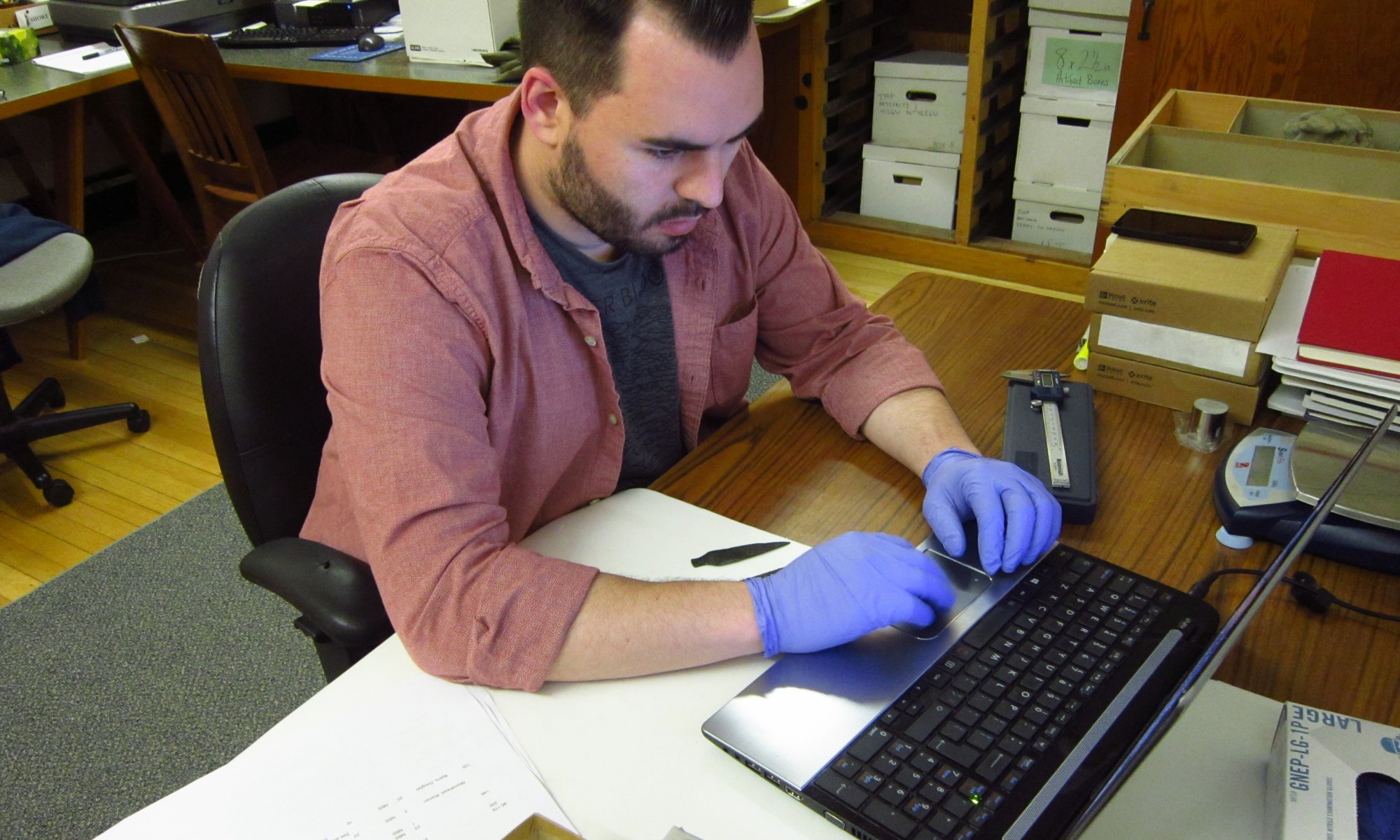
The summer has started off strong with one of the Linda S. Cordell Memorial Research Award recipients , John Andrew Campbell. John is documenting artifacts from the period of first contact between Native Americans and European settlers along the maritime region of eastern Canada and northern New England. ”What does that mean?,“ you may ask.
Basically, John is identifying copper, glass beads, and glazed ceramic artifacts that were found intermingled with traditional native tools and artifacts. The first appearance of these ”foreign” materials indicates that contact between the cultures had been made. Their use and modification by tribes is the direct result of trade with the European settlers and can be revealing of those early interactions.
The Peabody is John’s first stop for collections research as he begins to build data for his dissertation work at Memorial University in Newfoundland. He will be visiting for most of June and documenting hundreds of items.
The rest of the summer is chock full of research appointments and we are happy to share our collections to contribute to the field of archaeology!
Drawers pulled for research
Researcher John Andrew Campbell recording details about objects in the Peabody collection
This blog represents the eighth entry in a blog series – Peabody 25 – that will delve into the history of the Peabody Museum through objects in our collection. A new post will be out with each newsletter, so keep your eyes peeled of the Peabody 25 tag!
Excavations at the Etowah Mound site in Georgia have revealed a great deal about the Mississippian culture. Based on the archaeological materials found at the site, it is likely that during its occupation about 1,100 to 500 years ago, it was one of the most significant and influential cities in southeastern North America. A hallmark of the Mississippian culture, is the linkage through economics, politics, and other societal influences of large villages, such as Etowah, with smaller communities that surround it.
Due to its historical prominence, the Etowah Mound site is considered an important archaeological site in the United States.
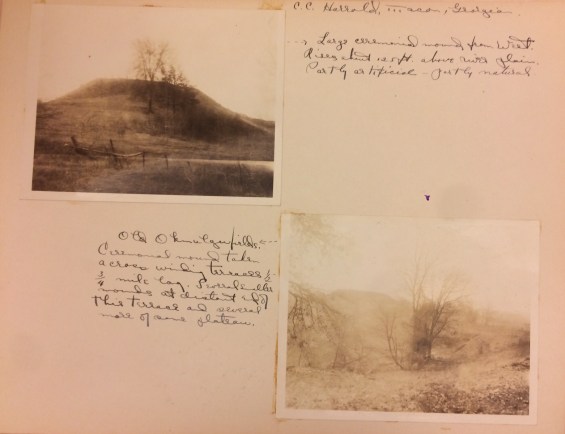
The site has three large platform mounds in addition to a plaza and smaller mounds. The largest of the mounds towered over the landscape, reaching the height of a six-story building. The mounds were used in a variety of ways: platforms that supported buildings, ceremonial sites, as well as burial locations for elite members of the society.
Images of some of the Etowah mounds from the Peabody collections
In 1925 the Trustees of Phillips Academy sponsored the first systematic excavation under the direction of Warren K. Moorehead. This three year investigation occurred during a transitional time in the history of archaeology when excavators were moving away from an antiquarian focus on objects and developing more scientifically rigorous methods. Moorehead’s interest in Etowah may have been a reaction to Alfred V. Kidder’s stratigraphic excavations at Pecos Pueblo in New Mexico, where new ideas about chronology and multidisciplinary work were tested.
Despite new methodologies and practices in archaeological investigations, many excavations were still carried out in ways that would make any archaeologist today cringe. The importance of stratigraphy was still not fully understood or appreciated by all archaeologists, including Moorehead, when the Etowah excavations were being undertaken. Modern attempts to sort out and understand Moorehead’s excavations have proved challenging. In their 1996 book Shell Gorgets: Styles of the Late Prehistoric and Protohistoric Southeast archaeologists Jeffrey Brain and Philip Phillips lament Moorehead’s lack of precision, poor recordkeeping, and disregard for context and stratigraphy. Perhaps it’s best that Moorehead announced in 1930 that he had decided “to abandon further field operations and concentrate on a study of type distributions in the United States during the next six years.”
As we reviewed Moorehead’s photographs of the 1925-1928 excavations at Etowah, we were often incredulous about the images of a tractor bulldozing a mound or workers (dressed in 3 piece suits no less!) hacking away at the side of a large mound. We understand today that a great deal of contextual information was lost using these clumsy techniques.
Tractor being used to excavate mound
Digging into the side of a mound
Workers at Etowah
Although these images affect our sensibilities, it cannot be denied that they are also important. These photographs help to document just how much the field of archaeology has changed and grown in the past 100 years. What started out as a gentlemen’s pastime has transformed into a profession associated with state-of-the art scientific techniques and theories that allow investigation of “hidden histories.” We understand that in another hundred years the images of our pristine and scientifically driven investigations might too cause heartburn in those archaeologists looking back on our work!
The site is now a Georgia state park and is designated as a National Historic Landmark (1964) and is listed on the National Register of Historic Places (1966)
On Monday May 22nd students and teachers from Brookwood School came to the Peabody Museum to kick off their “Steep Week.” During Steep Week, students immerse themselves in an intensive program related to an area of interest, in this case archaeology.
When the students arrived they were very proud to announce that archaeologists “DON’T DIG DINOSAURS!” Clearly their two teachers (one of whom is a trained archaeologist) had worked VERY hard to prep them for their visit to the Peabody, as well as for the rest of the week’s activities.
The students began by learning how to “read” modern trash to make a biography about an individual based solely on the objects that the person had thrown away. The clean trash that the students looked through was mine that I had split into three different bags related to different activities that I do: kayaking and running, cooking, quilting and reading. The group that had the container with an old Doritos bag declared that their person (me!) was a guy who was either “failing at adulting” or “had student loans” – very interesting assumptions they were making!!! They were then shocked to learn that the person who had the Doritos was also the same person who had run a half marathon and made quilts. This allowed us to have a great conversation about assumptions that we make and how that can impact our understanding and interpretation of the past.
The next two activities were mock excavations of a prehistoric site as well as a historic one. Both helped the students prepare for the real archaeological dig that they were going to conduct on their school property later in the week, particularly the historic example, since they had already been looking at old maps of the school’s property to see what they could learn about it before putting a shovel into the ground.
Students looking at a mock excvation unit that has evidence of pottery making
Students working in the “lab” to identify artifacts found from the mock Katherine Nanny Naylor site
The rain mostly held off for the group and we were able to conclude the day with a fierce atlatl competition!
A little rain could not sop us from our atlatl competition.
“Our introduction to Archaeology at the Peabody Museum at Phillips Academy, Andover successfully prepared our students to investigate archaeological problems at a high level by concentrating on the conceptual basis of archaeological thought and filtering it through readily understandable, local examples. Our students enjoyed themselves while having their minds opened to a different way of investigatory thought that they relied on heavily to ask questions and achieve understanding.” – Mike Wise, Brookwood teacher
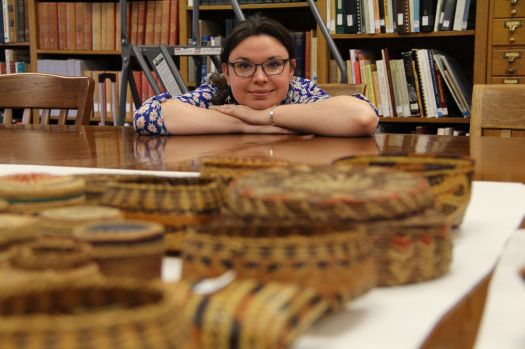
Though the Peabody is small by museum standards we are mighty, especially when it comes to our baskets. With close to 400 baskets, the Peabody collection covers all major geographical regions and tribal communities of North America, and spans over 200 years. Baskets from notable artists like Molly Neptune Parker (Maine) and Clara Darden (Louisiana) help to support and curate these artists’ work, and are examples of continued and evolving traditions within Native communities.
Molly Neptune Parker
Clara Darden
One of my first large projects at the Peabody was to completely catalog, inventory, and rehouse this great collection. The purpose of this was twofold:
First, it was important to consolidate our records regarding these baskets. Museums are full of information, and it’s usually in five different places! By gathering what we know, and putting it all in one place, we not only gain better control over this knowledge, but we make it more accessible to museum staff, researchers, and students. The convenience of this newfound accessibility encourages more use in the classroom and more research by professionals, giving these baskets the attention they deserve.
Secondly, by revamping the basket organization and rehousing, we are better able to care for these objects and their specific needs. Although baskets aren’t usually as fragile as most people fear, they still require some TLC. By creating storage mounts that are custom designed to each basket, we are able to provide more support to the object, especially when it is being moved and shifted around during handling. Within our ethnographic storage, space is at a premium, so another byproduct of the rehousing was the space it opened up. We were able to clear seven shelves!
Basket Elf in natural habitat
Happy baskets, happy collection staff.
To see previous work done with the baskets by Catherine Hunter, check out these previous blogs!
Next Thursday marks the final day at the Peabody for Temporary Archivist, Irene Gates. Irene was hired for a year to tackle the organizational challenge that was the Peabody archives and she has succeeded beyond our expectations.
Irene carried out a full collections survey and created 65 collection level catalog records – 33 of which are now available via our collection online. She wrapped her arms around the archives of previous director (and the man who saved everything) Richard ‘Scotty’ MacNeish and processed 92 linear feet of material. You can see the incredible finding aid for MacNeish’s material here.
In total, Irene has processed 140 linear feet of material, developed 3 finding aids, and written policies and procedures. Her work has directly benefited the accessibility of collections, the efficiency of current museum functions, and our transparency as an institution.
Irene’s quiet and steady presence will be missed around the Peabody and we have been incredibly fortunate to call her colleague and friend over the past year. Wishing her the best of luck in her next adventure!
Irene Gates
The Temporary Archivist position is supported by a generous grant from the Oak River Foundation of Peoria, Ill. to improve the intellectual and physical control of the museum’s collections. We hope this gift will inspire others to support our work to better catalog, document, and make accessible the Peabody’s world-class collections of objects, photographs, and archival materials. If you would like information on how you can help please contact Peabody director Ryan Wheeler at rwheeler@andover.edu or 978 749 4493.
Did you know that the Peabody curates ancient poop?
Coprolites are the fossilized remnants of excrement – animal or human. While it may sound gross, curating these materials is invaluable for the archaeological community. You may be asking yourself ‘what could you possibly learn from poop?!’ and while I understand your incredulity, allow me to share the incredibly fascinating information that you can learn.
A coprolite from an unknown site in Arizona.
Coprolites are the snapshot of one day of one individual’s life thousands of years ago. They can reveal what that person ate – whether or not that food was cooked first, was that food local to the area or the product of trade, what time of year that food would be available. Is there evidence of disease or illness? Did different individuals from the same site have radically different diets? If so, what does that say about social status? Coprolites are also viable sources of ancient DNA!
The Peabody curates only a couple dozen coprolites in the collection. And we are always thrilled when researchers come to get the scoop on the poop!
There were no classes on Tuesday May 9th to allow students to take AP exams and to give faculty dedicated time to meet within their departments. Knowing that we would not have students in the Peabody for classes or work duty I took that day as an opportunity to spread my crafting chaos throughout the museum.
I began by painting some of the fabric squares that will serve as mock excavation units for our Privy to the Past lesson about Katherine Nanny Naylor. The excavation was of her privy, or outhouse, and so I painted the brick wall that enclosed it, as well as the darker night soil.
Lindsay Randall hard at work painting
The finished canvas square
In addition to the squares, I have created bags of artifacts that represent objects that were found during the original excavation. Later this summer I will be collaborating with Liza Oldham of the OWHL to create a multi-day lesson for older students to further their historical literacy, as the archaeological and documentary records related to Katherine Nanny Naylor seemingly contradict one another.
If the idea of privies intrigues you, please check out the Iowa State Archaeology program as they have some excellent information about why archaeologist just LOVE privies!
The other crafting project that I undertook was some paper repair work. After numerous classes and events our models of the Royall House and Slave Quarters site has begun to show its age (3 years!). Using double sided tape, an x-acto knife, and hands that a surgeon would envy, I managed to make all the necessary repairs to ensure the longevity of the models.
I’ve been interested in indirect cooking technology since the early 1990s when I worked with archaeologists Barbara Purdy and Ray McGee in an excavation of an Archaic period site in central Florida where we found evidence of this ancient American Indian culinary technique. At the site, submerged beneath the waters of Lake Monroe and not too far from Orlando, in levels pre-dating ceramic pottery, we found fragments of fired-clay objects. Ray and I were fascinated by the shapes—balls, patties, cylinders, and biconical forms—and speculated about their purpose. They were similar to clay and stone objects found at other early sites and thought to be used in a variety of indirect cooking, either for boiling or steaming. Ray ultimately studied the clay objects for his 1994 University of Florida master’s thesis, which combined aspects of experimental archaeology and materials science. I was lucky enough to be around to help with his study, which began with replicas of the Lake Monroe clay objects. We dug clay from near the site, it was processed to remove impurities, and used to make numerous clay object replicas, which were then subject to extensive experimental trials. Ray demonstrated that not only could the clay objects be used for boiling, but that the different shapes had different thermal properties. And, not only did the clay objects survive successive heating and drenching cycles, the objects fragmented to closely match the fragments we had found in archaeological deposits. Thousands of years before the first pottery was made and used in the Southeastern United States, the clay ball chefs understood how to manipulate clay into ceramic objects and the distinct differences between shapes with greater and lesser surface area and other details. In a final experiment Ray and I tried to cook with the clay objects, heating water in wooden bowls to boil shrimp and corn meal. The meal was successful!
Several shapes of fired-clay cooking objects: balls, patties, biconical forms, and cylinders.
During spring term 2017 I’ve been fortunate to mentor a senior independent research project, or IP. The student’s spring project is a continuation of a project begun in winter term, which investigates ancient pottery making technology, with a particular focus on temper—additives to clay that help with making pottery vessels, firing survivability, and use life after firing. I shared Ray McGee’s thesis with the IP student, who was equally fascinated by the clay objects and their use in cooking. Much of the student IP focused on collecting and using native clay sourced from West Newbury, MA, and then experimenting with firing vessels made using a variety of traditional tempers, including sand, crushed shell, and decomposed granite, as well as untempered clay. The almost innumerable variables have presented some real challenges, but also open a tiny window into pottery making thousands of years ago. We agreed too that part of the project this spring would include making, firing, and using replicas of the fired-clay objects, using the varying tempers and shapes described above. An article in Indian Country Today indicates that hot stones were used by American Indians in the Northeast in both steaming pits and boiling.
Our attempt today to use the fired-clay objects in boiling followed much like the experiment that Ray McGee and I conducted during his thesis research in the early 1990s. The clay objects had been prepared, dried, and pit fired several weeks earlier. We noted that the cylinder-shaped objects were rather delicate, and many of the objects had small cracks. In general, the ball and biconical forms were intact, while the patties had more cracks. A supply of the fired-clay objects were added to a small oak wood fire, which quickly climbed in temperature, ultimately leveling off around 1500 degrees Fahrenheit. After objects had been in the fire a small number were cycled through a wooden bowl containing about a quart of water. The water temperature rose quickly, though it got a bit murky from charcoal. We decided that we had the capability to boil water. We prepared a fresh bowl of water and corn meal grits—three cups of water and one cup of grits—as directed by the package. We cycled fired-clay objects in and out of the bowl until the water was absorbed and the grits were cooked—about five minutes. A little salt and butter made the grits a tasty treat. Next we replicated the experiment with about half a pound of shell-on shrimp. More water was used and by this point we had become more proficient at cycling the clay objects from the fire to the bowl and back. The water boiled and shrimp were quickly cooked. Lemon and butter completed this course. For the most part the clay objects were holding up, though more of the cylinders broke and some of the patty shapes also cracked and split in the fire. Some broke while they were in the wooden bowl. The ball and biconical shapes seemed to hold up the best and were perhaps best suited to our purpose—getting the water boiling quickly. After the shrimp, we were a bit more ambitious and agreed to try a handful of spaghetti pasta. This would be a real test, since the water would have to boil continuously for 9 to 10 minutes. We added more clay objects to the fire, recognizing that we might need more to keep the water going. Quickly cycling the clay objects in and out of the fire produced a rolling boil that easily cooked the noodles. Our wooden bowl, however, suffered, and we had two pretty substantial cracks that developed on either side. Adding more water and fewer cooking objects may have helped—it seemed like 2 or 3 at a time in the wooden bowl were enough to keep the boil going.
Phillips Academy senior adding heated fired-clay objects to his cooking pot.
Data crunching and correlating is ongoing in this student project, and at least one additional outdoor firing is planned in order to test a few additional variables and observations gleaned from experiment and research. The fired-clay cooking objects, however, are evidence of indirect cooking in antiquity, long before the creation of pottery vessels. It’s not clear if fired-clay cooking objects were made and used in the Northeast in the long distant past, and the more recent accounts mention cooking with hot stones. Pottery was adopted in the Northeast around 3,000 years ago, perhaps introduced from neighboring areas. In Florida and other parts of the Southeast, pottery is much older—made and used at least 5,000 years ago—and appears to be an in situ development. Perhaps the fired-clay cooking objects were precursors of pottery and gave people insights into manipulating clay and the properties of fired-clay. As this student project has demonstrated, making pottery by hand and firing it in the open air presents considerable challenges that could only be overcome with significant knowledge of clay, temper, fuel, weather conditions, and more.
When you think of the binary search algorithm you immediately think an archaeology museum is the perfect place for students to get a hands on example. Right?
Well it certainly was not what students in Nick Zufelt’s Computer Science 500 class expected when they showed up at the museum. To many of the students who had been to the Peabody with their history or science class to look at objects, it was a bit perplexing how they could be combining archaeology with computer science.
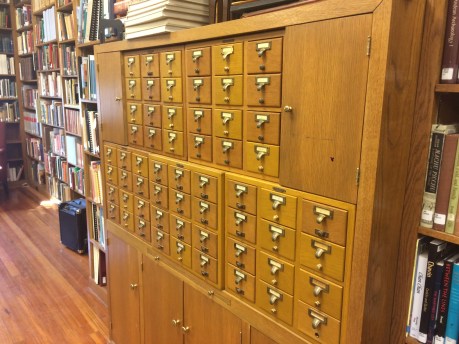
What many do not know is that the Peabody has many other resources that PA faculty can tap into. Mr. Zufelt discovered something that Peabody Museum still had that no other place on campus (not even the OWHL!) still had: our card catalog.
The card catalog at the Peabody Museum
When Nick first came up with the idea to use our card catalog in an interactive lab activity for his students, we were ecstatic. We love when Peabody resources are utilized for learning in such out of the box ways. The card catalog was a perfect hands on example for students to understand the binary search algorithm.
To those who are not familiar with this concept (and I was certainly one of them!) Nick began the class with this simple introduction:
When you look up a word in the dictionary, do you start at page 1, look for the word, then move onto page 2, etc.? No, of course not. You have a more sophisticated way of searching through the massive list of words. This activity hones in on the algorithm underlying this process: the binary search algorithm. The basic idea is: chop in half, go to the half that will have your item in it; repeat.
Nick Zufelt, computer science faculty, explaining the project to the students
Each student was then given a page listing 23 different cards from our card catalog system and told to pick one of them. Then they had to find the card and write down the process of how they found it, but in a manner that a computer could follow.
At this point, you might be saying to yourself, “wow that seems like a pretty easy project….” WRONG!
While this activity may strike us as simple, it actually turned into a battle of the wills for many students as they struggled throughout the period to create a very simple process that was also accurate. And when some students had a friend try their process, they often found that what they had devised was incorrect (Arrrgggg!!! The FRUSTRATION!!!!)
This type of learning helps to make abstract concepts more accessible for students as they begin learning something that forces them to think in a completely new and different manner.
Mr. Zufelt has already talked about bringing future students back for the activity and we look forward to working with him and his students on this and other computer science adventures at the Peabody!
NOTE: Despite still having a card catalog, the Peabody library is completely cataloged in the system used by the Oliver Wendell Holmes Library. Our librarian Mary Beth Clack is currently updating records to make monographic series more accessible.










 The Peabody