
Contributed by Kyra Smith and Cyrus Marion
Hi my name is Kyra Smith and I was one of the curatorial assistants at the Peabody this summer! I’m a recent archaeology master’s graduate from Boston University where I focused on Indigenous archaeologies, food sovereignty, and the archaeology of the South Pacific Islands. Having previously worked in the archaeology department of another museum in undergrad, I was thrilled to apply for this position as a curatorial assistant, especially at an institution that is so dedicated to NAGPRA. I was so invested in the position I had my family ship me my sister’s 1998 Toyota Camry from Washington State- which in the state of Massachusetts counts as an Antique Vehicle!
Working at the Peabody over these last ten weeks has been an exercise in flexibility, learning as we go along, and exposure to things we’ve never seen or interacted with before. There are so many things I could write about, but the story I want to share as my time here comes to an end is how the Peabody got its own pet mammoth.
On a particularly hot and humid Friday, I finally got to use an atlatl for the first time. Ever since undergrad I have heard professors and archaeologists talk about atlatls, and even how they used to take students to try throwing them in previous years. Ever since then I have been biding my time until the opportunity arose- and oh was it worth the wait.
John, Cyrus, and I went out onto the Vista bright and early before it got too hot, and John took us through the basics. If you have ever used one of those plastic arms to play fetch with your dog- it’s nothing like that at all, which I learned very quickly. I imagine it was quite the sight for the construction workers on break in the shade of a nearby tree to see us attempting to throw the arrows taller than we were with varying degrees of success. After Cyrus and I (sort of) got the hang of it we were going to do target practice at the international standard target, but sadly that had to wait as the aforementioned construction workers were still under that tree which was too close to the target for comfort.
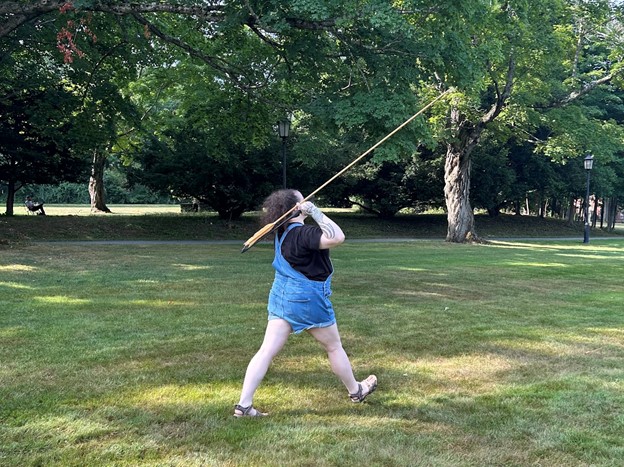
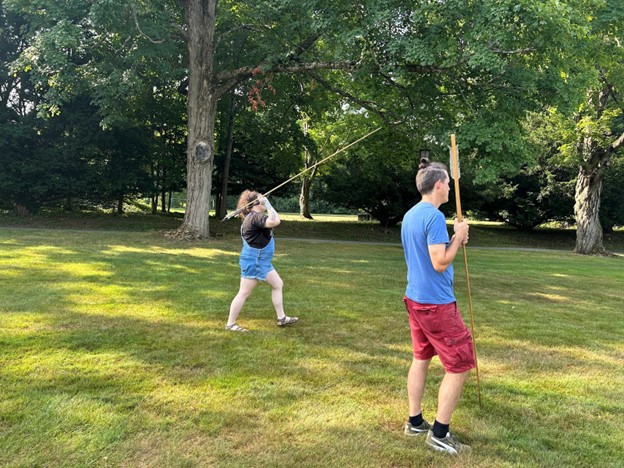
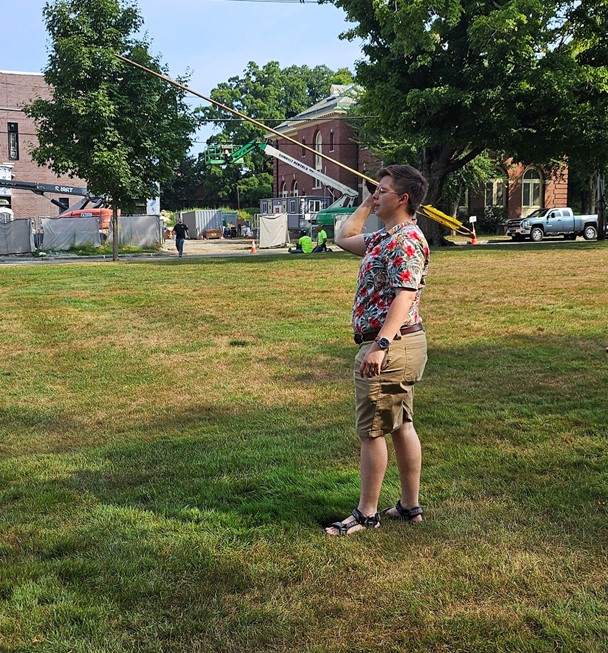
So, we went back inside to rest our arms and cool down, and by then an idea had begun to form. One that was inspired by our conversations about whether we were successful hunters of our theoretical mammoth/mastodon. That idea would have to wait because about an hour later we went back out to try aiming the arrows instead of attempting to throw them as far as humanly possible. It is much easier to attempt to throw them as far as humanly possible than it is to hit a large, completely still target. Still, Cyrus and I were able to land a couple hits each on the actual target and not into the bush next to it, and we called that a win. We may never know if we were skilled enough at throwing the atlatl to take on a mammoth, so instead I made a mammoth for the museum.
In my free time, when I’m not at the Peabody, I learned how to crochet amigurumi, which is a Japanese name for a style of stuffed crochet animals. That weekend after we threw the atlatls, I found a pattern online and spent some time crocheting a mammoth to be a mascot and companion at the museum. And thus, Josie was born! She was named by Marla, and now lives at the Peabody, where Marla promises she will never be used as target practice when throwing atlatls. For anyone else interested in crocheting or amigurumi, I got the pattern for Josie from CrochetGrove on Etsy.
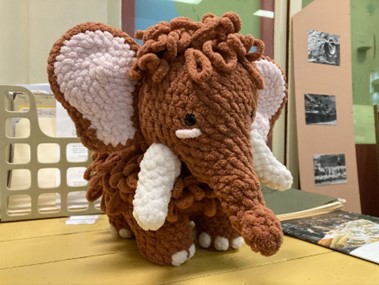
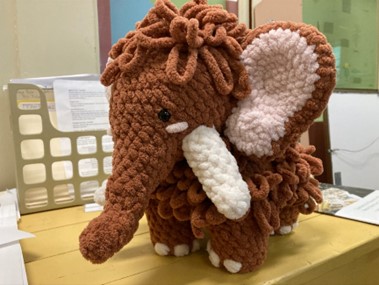
Josie also represents one of my favorite aspects of working in a museum, as they are fundamentally institutions created for the purpose of preserving and storing information, things, and stories for perpetuity, there will always be a record of my impact whether it’s the work I did, the things I made, or the stuffed mammoths I created. Sure, the things I’m doing may not be monumental, but they are fundamental things that have left a trail of my action on parts of the museum like the catalog, or the new housing for artifacts with my initials on it, and the drawers in the collections storage where Cyrus and I curated and displayed artifacts from all over the world so that the museum and its staff can better tell the stories of the materials they care for. It’s a reminder of how much the little things mean in the greater scheme of things.
*******************************************
As Kyra aptly said in their post above, the Peabody Institute provided plenty of opportunities to expand our creative and intellectual spirit. As a Historical Archaeology graduate student at UMass Boston, I had minor collections experience and applied to the summer curatorial assistant position to undergo formal museum collections training. Having admired the Peabody Institute’s commitment to NAGPRA and tTribal relations for years, I was eager to witness the processes and procedures that go into the day-to-day work. However, what I was not expecting was the range of creations and artifacts I would be interacting with. My archaeological background is rooted in the Northeast United States and focuses on environmental analysis, so my mind was blown when one of our first tasks was rehousing ancient botanical remains from Tehuacán Valley, Mexico. Coming face-to-face to some of the world’s oldest domesticated maize was an experience I will never forget.
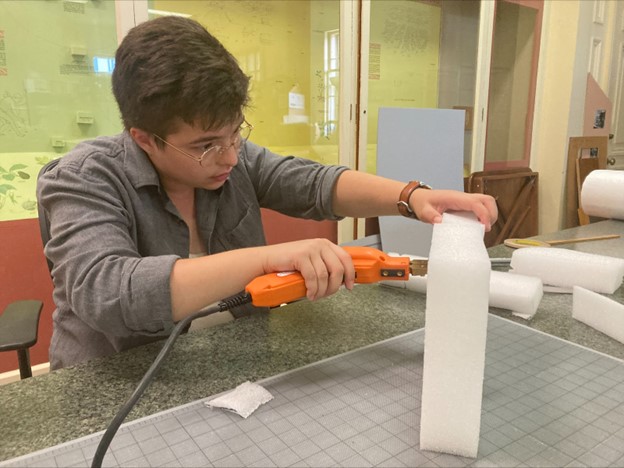
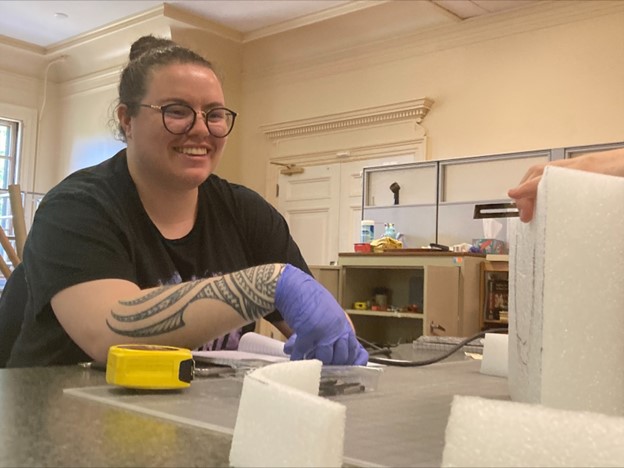
Kyra and I spent a lot of time with ceramics, lithics, and textiles from regions we were pretty unfamiliar with. Despite our lack of regional understanding, the Peabody staff always provided context and demonstrated deep respect for all creations. As we created mounts for modern Guatemalan and ancient Peruvian textiles we learned their patterns and language; as I rehoused lithics I would consider the generational knowledge and studied craftsmanship it would take to form them. Creating spaces to house and display archaeological and ethnographic creations ranging from the Lucy Foster household in Andover to Meso-America to Paleolithic Europe was an honor and I am proud to have contributed to the updated collection spaces and stories the Peabody staff can tell.
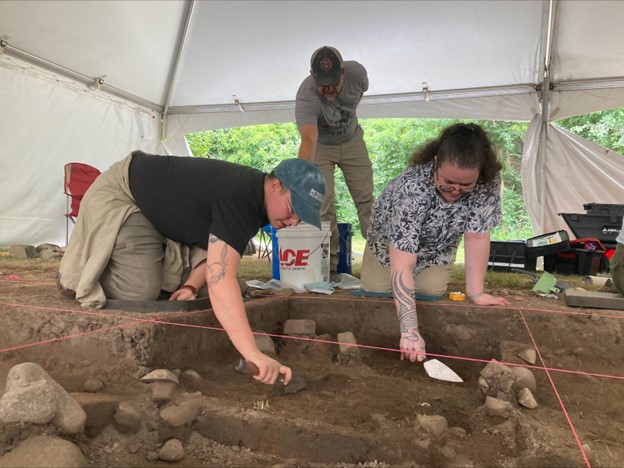
The Peabody Institute has a very storied past that was illuminated through organizing both the library and Eugene Winter’s archive. As it was founded in 1901 with contributions from many different kinds of archaeologists, the library seems to contain the entire history and complicated legacy of North American archaeology. In addition to the library, Eugene Winter, Honorary Curator and lifelong contributor to the Peabody, had left behind an archive after his passing. Kyra and I spent some time exploring his legacy through the resources, photographs, and ephemera he had designated important enough to keep. Interacting with both the collections, library and archives created an meta-institutional feedback loop as a reminder that working in archaeology requires positionality, empathy, and acceptance of “not-knowing.” We will never be able to alter the decisions made in the past, but we can always alter our perspectives in the present and contribute to a future that centers people and not only their “things.”
As Kyra noted, working at the Peabody for the past ten weeks might not have been monumental to its legacy, but the work that has been completed by the longer-term staff is monumental to the field. The Peabody staff have taught me fundamental collection management skills that are coated in careful consideration, empathy, and a desire to create a better future that I am extremely grateful to inherit.
 The Peabody
That was such a warm and honest post! I love how you reflect on summer through personal growth, service, and memory-making. Your stories are relatable and inspiring — thanks for sharing that journey so openly!
LikeLike