No one invited us to the party but we’ve stayed for over nine years. And the desserts keep getting better. Not that what we do would come under the category of party. What should be obvious to readers of this blog is that I am talking about what it is like to volunteer at the Peabody Institute. First of all, who can volunteer? Being a graduate of Phillips Academy helps in passing the rigorous entrance examination but there are exceptions, such as my wife, Susan, whose qualifications, while many, started with marriage. This automatically reduces the interview process (but does not eliminate the background check.) And what do volunteers do?
Some of you might get the wrong impression that all we do is what the staff shy away from. Far from it. There have been plenty of occasions where it was all we could do to pry staff apart from a project to allow us to either dig into the unknown (such as categorizing about one hundred yards of unclassified photos) or finish it off (such as one hundred yards of labels.)
Of course, I am exaggerating. (No point in frightening you.) I have handled (and often read) documents from the nineteenth and twentieth centuries; paleolithic artifacts from 10,000 B.C.E; ledgers with tens of thousands of entries. I can picture specific bifaces, sherds and feathers.
What my wife, Susan, and I have been doing has varied considerably over the years as staff have come and gone, priorities have shifted, and time frames have expanded. I like to think that volunteering has allowed the Peabody to think in terms of decades, not centuries. This might come as a surprise until you consider that the Peabody is home to somewhere in the vicinity of 600,000 artifacts.
For quite a number of the past nine years, Susan and Leah (another spectacular volunteer) have been inspecting, vacuuming and protecting textiles from Guatemala. Although the end of the project has been in their sights for the past year, Einstein’s theory of special relativity keeps getting in the way (time slowing, distances shortening…easy stuff.) Eager to try my own hand at a multitude of projects, my time has been slowed as well. Despite Einstein’s slowing of time as we operate at the speed of light, sadly, all of us working as an extended family inside the Peabody’s walls have grown somewhat older (but not by much and not at the same rate.)
Most recently, I had the task of filling out labels to put on a few of the 1,500 drawers containing a variety of artifacts. It was a matter of necessity, not just my dexterity and eye coordination. When I completed that task, it was my honor to look for the “absence” of items. It all started with the discovery that an item had been “mislabeled.” That’s akin to looking through a haystack and saying you didn’t find the needle. And winning means you did not find the needle.
Sometimes I write blogs. I’ll stop here because my limit is 500 words. (Only staff can do more!)
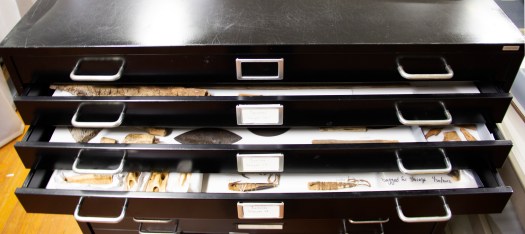
In addition to working on the Inventory Rehousing Project, I survey the artifacts and ethnographic materials held in our flat file storage units. While all artifacts at the Peabody Institute require special attention, the objects stored in our flat file storage need extra TLC, such as pest protection, monitored temperature, and custom storage mounts.
Let’s take a journey through the process! Each drawer in our flat file storage is first emptied for an inventory and inspection of objects. Once emptied, the drawer is vacuumed and relined with clean Volara® foam. Volara® is a closed cell polyethylene foam that has applications in medicine and museums. Objects that are particularly susceptible to movement or damage in storage are measured for custom mounts. Custom cavity mounts provide a rare opportunity to do work outside, to enjoy the weather while carving foam with a hot knife. Next, I assess each item’s condition and photograph it for our database records. Once complete, the artifacts are returned to their newly created foam padding and/or mounts for safe resting. My most recent work includes this small cavity mount for a Thule ivory figurine of a polar bear.
It is important to revisit these objects, not only to make sure all are accounted for, but to bring them up to today’s standards in terms of care and condition. After all, one of the most important goals of collections management is to preserve these objects to the best of our ability for future generations.
Before I officially became a staff member here at the Peabody, I was a volunteer and work duty student. I started volunteering at the Peabody about nine years ago, and when I came to Phillips Academy as a student I immediately signed on to do work duty. As a volunteer and work duty student, I worked to catalogue and inventory returned artifact loans, set out class activities, digitize records, and photograph artifacts. Since going to college out of state about two years ago, I have not been back at the Peabody, other than for brief visits. Reflecting on my time working here, it is fascinating, and somewhat nostalgic, to look back at what the Peabody was like when I started all those years ago and how it has changed so much since then!
When I started volunteering here, the Peabody was still officially a museum and still had standing exhibit space on the first floor. Some of those exhibit cases displayed artifacts, others dioramas or archaeology-related activities done by some Phillips Academy classes. Down in the collections, we used white cotton gloves to handle artifacts, rather than the purple nitrile gloves we use now. The reboxing project had not begun, so much of the work I did was cataloguing and inventorying in preparation for when that project might get funding. While I was doing work-duty, I sat in on some meetings about how to make the Peabody more accessible to Phillips Academy students, both in terms of the collections and the building space as a whole. Since then, the Peabody has initiated student study hours, during which the building is open to students as a study space, and renovated the first floor to make it more class-friendly!
It has been just over two years since I graduated from Phillips Academy, and I am so happy to be back working here! I study archaeology in college, and so working here, albeit temporarily, is an opportunity not only to continue learning how to preserve archaeological collections, but also to put into practice what I have learned at school, namely how to make archaeology more accessible for everyone.
Welcome to my inaugural blog post. I have been working at the Peabody Institute for three months, so it is high time I introduce myself. I am the new Inventory Specialist. It is my job to inventory and rehouse the collections in storage for the next year.
I am a graduate student at UMass Boston and am passionate about Indigenous studies, both in and outside of archaeology. I interned for National NAGPRA last fall where I learned the importance of employing ethical daily practices at museums, especially when looking through the lens of civil rights issues. I have also worked on various archaeological projects in New England, New Mexico, California, and Iceland.
I have learned a lot in my time here so far, the diversity of regional material culture across North America, the importance of preservation, the most effective rehousing practices…even how to throw an atlatl. (Although my success rate is nothing to brag about.)
While most of my work experience is with freshly excavated archaeological collections, I am excited to transition my focus to the preservation of older collections, including collections on which the foundations of Native American archaeology were built. At least once a week, I am blown away by the Peabody’s collections. Objects I have only had the pleasure of reading about appear in their drawers. Needless to say, I am happy to be here and happy to help with the rehousing inventory project.
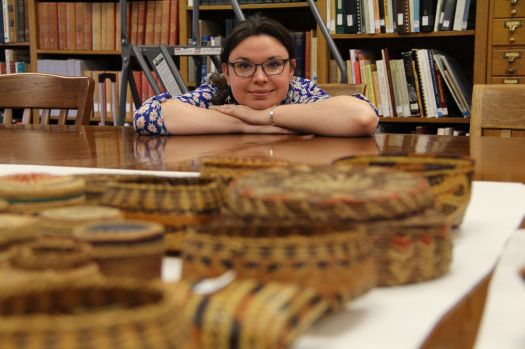
Native American basketry was the subject of a special research visit on June 4th. Ralph Shanks, Research Associate at University of California, Davis, and Lisa Woo Shanks are experts in identifying and analyzing Native American California basketry. Together, they produced an outstanding 3-volume series on California basketry that has been indispensable in examining the Peabody collection. The goal of their visit was the examination of over 100 Californian baskets for cultural identification. The visit developed into a tutorial for staff as the discussions addressed ethnobotany, physical structure, and design elements found on the baskets.
Immersion in basketry required a specialized vocabulary for structures and materials such as twining, coiling, plaiting, overlay, double interlacing, foundation, willow, red bud, juncos and more. The forms of baskets were confirmed as bowls, hats, seed beaters, burden baskets, winnowing trays, toys, and cooking vessels. Many Californian Indians cooked in water-tight water-filled baskets by adding heated stones; and examples of these were identified in the Peabody collection.
The visit was facilitated by Marla Taylor, Curator of Collections, and Catherine Hunter, Research Associate, who inventoried the collection of 300+ Native American baskets in 2015-16. Hunter returned to the Peabody recently to continue research for a paper “Indian Basketry in Yosemite Valley, 19th-20th Century: Gertrude ‘Cosie’ Hutchings Mills, Tourists and the National Park Service” to be presented at the Textile Society of America Symposium in September 2018. After Hunter consulted Shanks last month, he extended an East Coast vacation to include a visit to Andover.
Ralph and Lisa examining the intricate design on a CA basket
Ralph viewing part of the collection
Ralph and Lisa examining the intricate design on a CA basket
Hunter selected this topic because of the Hutchings Mills Collection of baskets. Collector and donor Gertrude “Cosie” Hutchings Mills (1867-1956) was one of the first Anglo-American children born in Yosemite Valley to early settlers James Mason and Elvira Hutchings. She collected Native American baskets in the Yosemite Valley region before 1900, recording many acquisition sites and the names of three weavers. Such documentation is very rare; thus, the collection was of special interest to Ralph Shanks.
After marriage to William Elligood Mills in 1899, they lived in New England and their son attended Phillips Academy. In 1937 the collection of fifty-six baskets was donated by Mrs. Mills to the Peabody Institute.
Shanks was enthusiastic about the quality of the basketry, contributed significantly to our interpretation of the collection, and identified rare baskets that would enhance his own research. We were thrilled to host his visit!
The past five years have been a busy time for museums- most notably in the image department. Following a number of high profile controversies, a lot of people–audiences, and museum professionals alike–asked what role museums play in our society? Here are a couple of recent articles dealing with this subject head on.
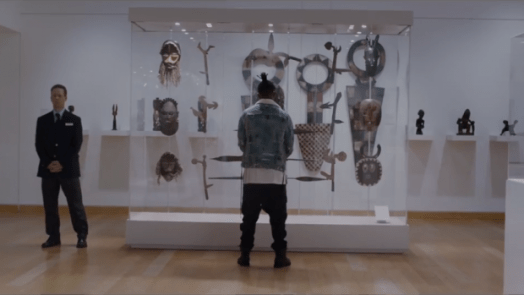
Killmonger in the Museum (Photo courtesy of article)
Last month saw the release of Marvel’s newest blockbuster, Black Panther. Besides being a fantastic movie, this film offers a unique chance to open dialogues on a large scale about many topics- least of which are museums as mechanisms of colonialism. This article discusses how and why museum professionals especially should look at their roles in this and the effects they have on the audiences we try to reach. The piece ends by laying out suggestions for how museums can move forward incorporating and working towards more diverse and open dialogues between communities.
Gover and Bunch at Symposium (Photo courtesy of Smithsonian Magazine)
This article opens with the quote, “history matters because it has contemporary consequences,” and it just gets better from there. Directors Kevin Gover (National Museum of the American Indian) and Lonnie Bunch (National Museum of African American History and Culture) participated in a day long symposium titled, “Mascots, Myths, Monuments and Memory,” in which they talked about confronting the historic and continued racist ideologies that are entrenched in contemporary American society and the role of museums. They specifically discuss the example of the concurrent rise of confederate statues and racist mascots.
Chronicling a series of high profile controversies, this article looks at the combination of factors that have led to these, as well as the changes they are bringing to museums and their operation. It also discusses why museums have become ground zero for explosive cultural encounters stating, “We’re in a time when these issues are real, these controversies are part of public space and public discourse, and museums are going to become the places where these issues get played out.”
Students using NK360 (photo courtesy of Smithsonian Insider)
This article showcases the role museums have within their respective walls and how they are branching out to have far reaching impacts in classrooms all over the nation. Similar to classes taught at the Peabody by Curator of Education, Lindsay Randall, this article follows the creation and implementation of National Museum of the American Indian’s newest initiative, Native Knowledge 360. NK360 is a “long-term initiative to integrate the Native American experience into social studies, language arts and other curriculum in kindergarten through 12th-grade classrooms across the country.” This program works with the inclusion and cooperation of Native communities and educators as well as provides educational materials for teachers.
Though the Peabody is small by museum standards we are mighty, especially when it comes to our baskets. With close to 400 baskets, the Peabody collection covers all major geographical regions and tribal communities of North America, and spans over 200 years. Baskets from notable artists like Molly Neptune Parker (Maine) and Clara Darden (Louisiana) help to support and curate these artists’ work, and are examples of continued and evolving traditions within Native communities.
Molly Neptune Parker
Clara Darden
One of my first large projects at the Peabody was to completely catalog, inventory, and rehouse this great collection. The purpose of this was twofold:
First, it was important to consolidate our records regarding these baskets. Museums are full of information, and it’s usually in five different places! By gathering what we know, and putting it all in one place, we not only gain better control over this knowledge, but we make it more accessible to museum staff, researchers, and students. The convenience of this newfound accessibility encourages more use in the classroom and more research by professionals, giving these baskets the attention they deserve.
Secondly, by revamping the basket organization and rehousing, we are better able to care for these objects and their specific needs. Although baskets aren’t usually as fragile as most people fear, they still require some TLC. By creating storage mounts that are custom designed to each basket, we are able to provide more support to the object, especially when it is being moved and shifted around during handling. Within our ethnographic storage, space is at a premium, so another byproduct of the rehousing was the space it opened up. We were able to clear seven shelves!
Basket Elf in natural habitat
Happy baskets, happy collection staff.
To see previous work done with the baskets by Catherine Hunter, check out these previous blogs!
This blog represents the sixth entry in a blog series – Peabody 25 – that will delve into the history of the Peabody Museum through objects in our collection. A new post will be out with each newsletter, so keep your eyes peeled for the Peabody 25 tag!
Overview of Chaco Canyon, New Mexico
At the Robert S. Peabody Museum, it seems as though there is almost no limit to the range of phenomena one can explore. When the topic Chaco Canyon was suggested, I thought looking at trade routes would be interesting. It quickly became clear that what I was about to enter was the world of a great culture which I thought had mysteriously “disappeared” about 800 years ago. What I quickly learned was that these people, the “Ancestral Puebloans,” had not disappeared. Research has shown that the Puebloans had adapted to climate change in the area by dispersing. “Today, twenty Puebloan groups in New Mexico, as well as the Hopi in Arizona, claim Chaco as their ancestral homeland and are tied to this place through oral traditions and clan lineages. A number of Navajo clans are also affiliated with Chacoan sites through their traditional stories.” (National Park Service: https://www.nps.gov/chcu/faqs.htm)
Chaco Canyon, located on a section of the Colorado Plateau in northwest New Mexico, was home to the Chacoan culture which flourished from AD 1000 to 1150. A UNESCO World Heritage Site, the people who lived there were very sophisticated. They used astronomical alignments, geometry, and impressive building techniques, allowing for multi-storied masonry houses. They had a complex road system stretching hundreds of miles, linking Chaco to other communities. One of their buildings, four or five stories high, Pueblo Bonito, contained about 650 rooms.
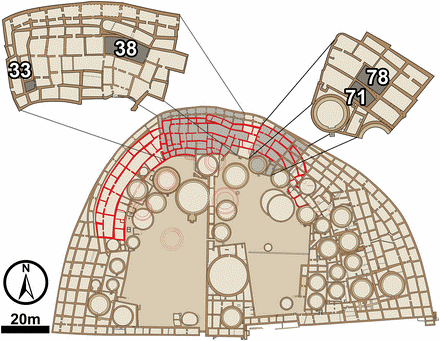
Plan view of Pueblo Bonito with the earliest construction highlighted in red. The locations of the elite burial crypt, room 33, and the three rooms with dated macaw samples are highlighted. From Adam Watson and colleagues’ article on Chaco macaws in Proceedings of the National Academy of Sciences Vol. 112(27): http://www.pnas.org/content/112/27/8238)
The Chacoans traded with people in the Mongollon and Hohokam regions to the south and with people from Mexico and Central America. Long-distance travel by Ancestral Puebloan people was common and among the goods they acquired were turquoise, seashells, copper and chocolate, none of which were found locally. They also traded for scarlet macaws, a bird with a natural habitat 1000 miles to the south.
Scarlet macaw
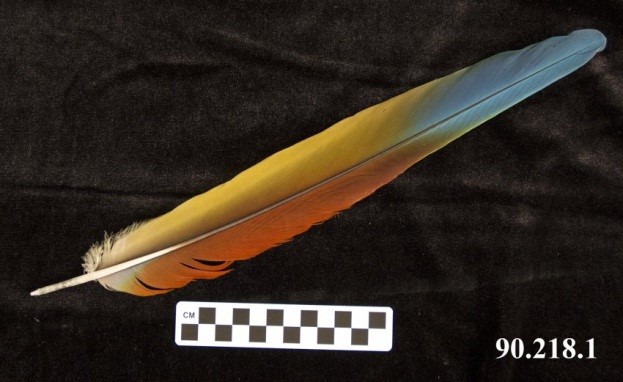
Macaw feather from the Peabody collection
The Robert S. Peabody Museum has several “modern” macaw tail feathers in its collection, one of which is shown below. Preserved feathers from 1000 years ago would be quite rare.
Scarlet macaws measure about thirty-two inches long, of which more than half is a pointed tail. They can live up to seventy-five years and eat mostly fruits, nuts and seeds. We know macaws, essentially large parrots, as intelligent birds that are quick to echo our deepest secrets using speech, a magical quality, especially because macaws have no vocal cords. That parrots are rated among the top five in the animal world for intelligence and cognition should come as no surprise. It is likely that the people of Chaco Canyon would have been awed by such an animal.
Scarlet macaws are native to the gulf coast of Mexico, Central America, and South America. The question to ask is for what purpose macaws were brought back to Pueblo Bonito?
Thirty four macaws were recovered from Pueblo Bonito and other sites in Chaco Canyon. Room 33 (see illustration above) was used as a burial crypt for 200-250 years. Macaws were found in rooms 38, 71, and 78. Archaeologist Adam Watson and his colleagues postulated that scarlet macaws were a powerful cosmological symbol and that their presence from the early tenth century reinforced and stimulated a rising social inequality. Those who possessed the birds had access to key cosmological beings and forces as well as links with far distant cultural groups. There is little doubt that the ability of the birds to speak played into this perception.
What is currently exciting is how recent radiocarbon dating of scarlet macaw skeletons from Chaco Canyon has given further insight into the question of their presence. What has been shown is that, based on acquisition and control of valued items such as chocolate and macaws, an elite class at the top of a social and political hierarchy dominated Chacoan life. (Watson et al. 2015)
What the elites achieved and their importance is amply demonstrated in their “great houses” and the acquisition of “exotic” goods from distant regions (ibid.) Included in these exotic goods were macaws. Feathers from macaws were found on prayer sticks, costumes, and masks. According to Watson and his colleagues,“…the flight of or just the appearance of certain birds or the use of their feathers is believed to motivate the fall of rain or snow, as well as the seasons, the sunshine, and the heat.”
Originally, it was believed that trade in items such as macaws at Chaco dated from around AD 1040. With radiocarbon dating done in 2010 on skeletal remains of the macaws from Pueblo Bonito, the dates of the florescence have been moved back to AD 775-875.
Whether or not the macaws were brought back to Pueblo Bonito in single journeys or in successive stages has been debated extensively. Some have raised the possibility that macaws were also bred locally in Chaco Canyon itself, although the arid region is not a natural habitat for such birds. The discovery of breeding pens, perches, bones, and eggshell fragments has led to speculation about on site breeding, but evidence suggests such macaws did not reach maturity.
“There are no indications that the people of Pueblo Bonito bred scarlet macaws. Only one of the sample birds was of breeding age and none were exceptionally young. There is also no mention of eggshells in any of the excavation notes, although one room where many of the bird remains were found was probably an aviary.” (“Scarlet macaws point to early complexity at Chaco Canyon.” A’ndrea Elyse Messer, 2015: http://news.psu.edu/story/361255/2015/06/22/research/scarlet-macaws-point-early-complexity-chaco-canyon).
One of many phenomena to explore at the Peabody, the scarlet macaw feathers represent a tangible example of extensive trade routes present in the New World prior to European contact.
Once again DNA analysis of sites is opening up our understanding of how societies operated historically. By testing bone samples from Room 33 in Pueblo Bonito of Chaco Canyon, scientists were able to shed more light on the inner workings of power, class, wealth and status of ancestral Puebloans, and the major role women played within these.
Mound 72 of the Cahokia culture complex, when originally excavated in 1967, was thought to be a shining example of a burial of elite male warriors. Fast forward almost 50 years and imagine archaeologist’s surprise when one third of the skeletons found were in fact female! These findings call into question the idea that Cahokia was a male warrior-led patriarchy.
The excavation of young Hohokam woman’s grave is an example of what the excavators and author call the “Bioarchaeology of care.” The young woman, who lived about 800 years ago had scoliosis, rickets, and tuberculosis. Through looking at this site, archaeologists are able learn more about the community in which the girl lived, and how they supported and cared for her, giving a decidedly human lens to a science that can sometimes become disconnected.
This week it seemed there were a lot of great links discussing new and exciting things happening within the world of archaeology. Here are just a few that we found:
This article talks about the role of diseases in shaping the genetic diversity of contemporary Native American communities. Historically these effects were documented by written accounts with little to no physical evidence since most European introduced diseases leave no evidence on bone. Recent breakthroughs in DNA markers, however, have been able to physically prove the evolutionary effects of these pandemics.
This article is a great example of how archaeologists are able to create and test hypothesis when attempting to solve puzzles encountered while excavating.
An interesting article that not only highlights the use of modern science in investigating historic traumas, but a great example of how important cultural context is both historically and in a contemporary lens.
Not only is this a super cool article talking about the first example of in situ beer making in China, but also a great example of how archaeologists are able to extrapolate larger and further reaching conclusions from a small snap shot of the past.