Since November, I’ve been focused on better organizing and rehousing the Peabody’s photographic collections (a rough extent estimate: 10,000 prints, 35,000 slides, 230 rolls of film, 500 glass plate negatives and 1,500 lantern slides). These consist of excavation, ethnographic and museum object photographs. Some were created during the course of the Peabody’s activities; others were donated to the museum. There are some wonderful images here, many unknown to Peabody staff members even. In keeping with the archives project’s mission to make the Peabody’s archival collections more accessible, contract librarian Mary Beth Clack has begun cataloging photographs in our Past Perfect collections management database. For many photographs, some type of bibliographic record such as a catalog card or an index already exists, so adding a record to the database is a question of transcribing and consistently formatting existing information. Work duty students and I have been scanning photographs so that a digital image can then be attached to the catalog records, which are then easily published online via our Past Perfect web portal. In addition to the benefits of making these publically available, cataloging them in the database makes them infinitely more findable for staff members.
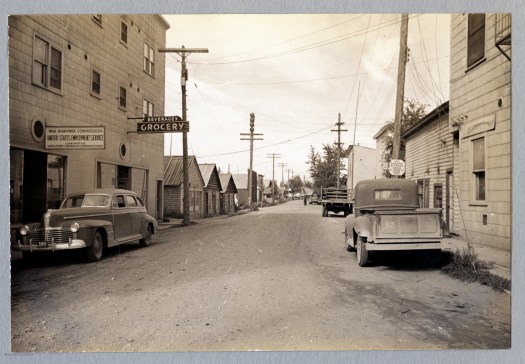
L-28-28. Fairbanks, Alaska. Snapshots of Chena Slough, streets and houses. 7/30/44
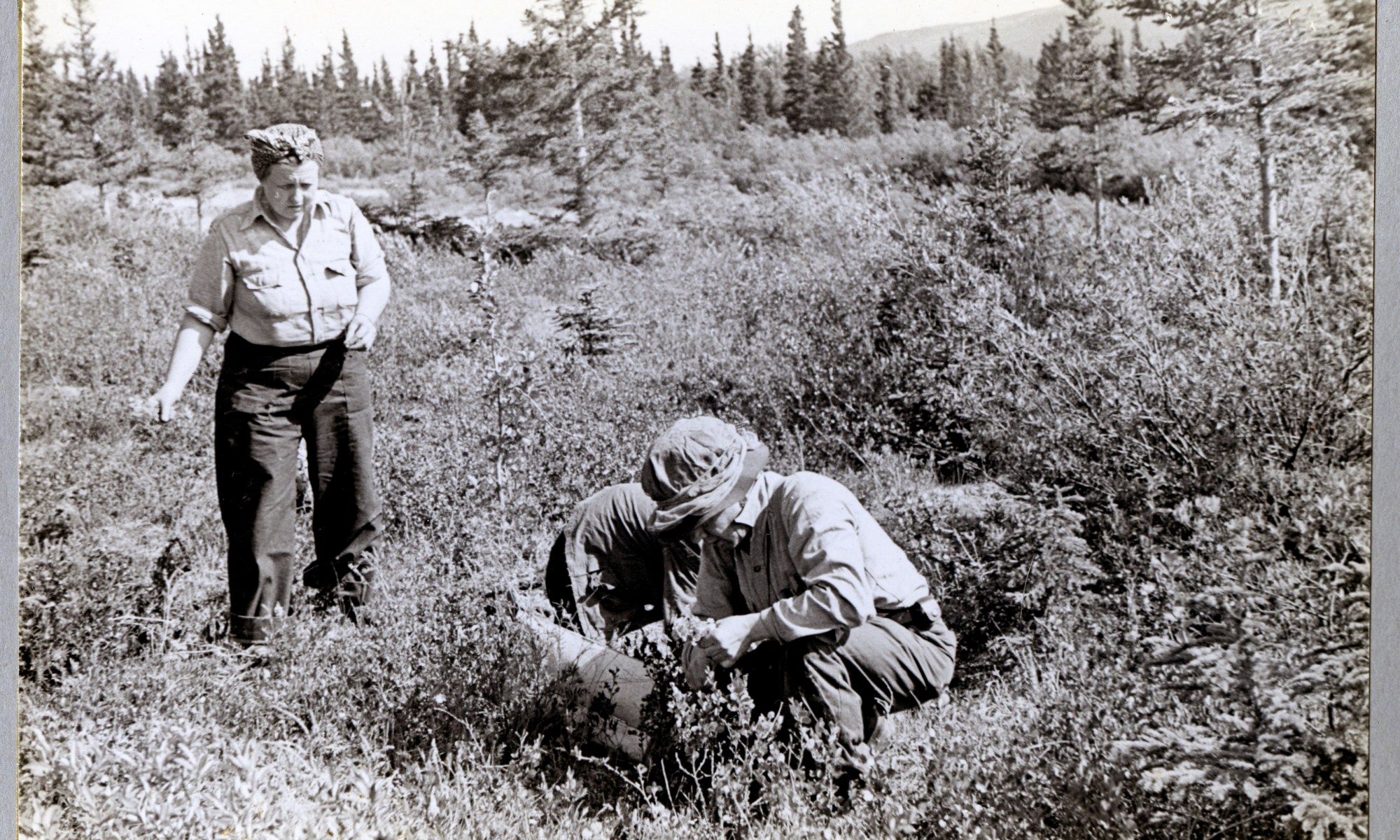
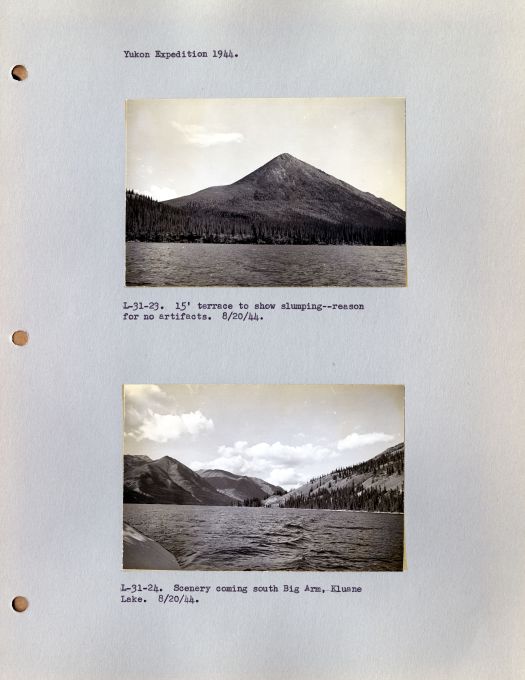
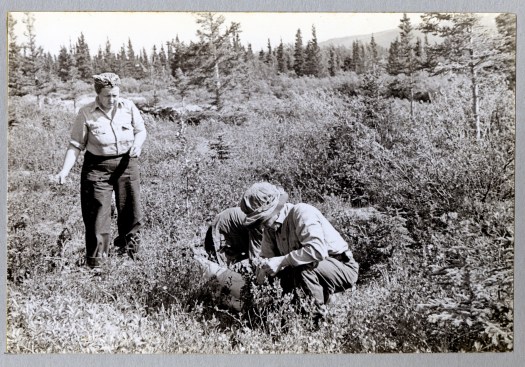
Mary Beth is currently working on the 1944 and 1948 Andover-Harvard Yukon Expedition print photographs. These approximately 1,500 images document the archaeological and geobotanical expeditions carried out jointly by the Peabody and Harvard University (and funded by additional sources, including the Wenner-Gren Foundation) in parts of the Shakwak and Dezadeash Valleys, in southwestern Yukon. The photographs, taken by Fred Johnson, Hugh Miller Raup and John H.H. Sticht, are mounted on stiff paper, typically two to a page, with typewritten captions below each image. Many of them, in addition to being important documentation of the expeditions, are very beautiful. Included here a few examples. The first batch of records have just been published online, and more will be added soon: please browse them here.
Example of an Andover-Harvard Yukon Expedition photographs page, with images from 1944.L-25-5. Collecting Primulas on muskeg between beaches west of Mile 1020-21. Near Pine Creek Camp. Alaska Highway. 6/23/44.
The Temporary Archivist position is supported by a generous grant from the Oak River Foundation of Peoria, Ill. to improve the intellectual and physical control of the institute’s collections. We hope this gift will inspire others to support our work to better catalog, document, and make accessible the Peabody’s world-class collections of objects, photographs, and archival materials. If you would like information on how you can help please contact Peabody director Ryan Wheeler at rwheeler@andover.eduor 978 749 4493.
This blog represents the eleventh entry in a blog series – Peabody 25 – that will delve into the history of the Peabody Institute through objects in our collection. A new post will be out with each newsletter, so keep your eyes peeled for the Peabody 25 tag!
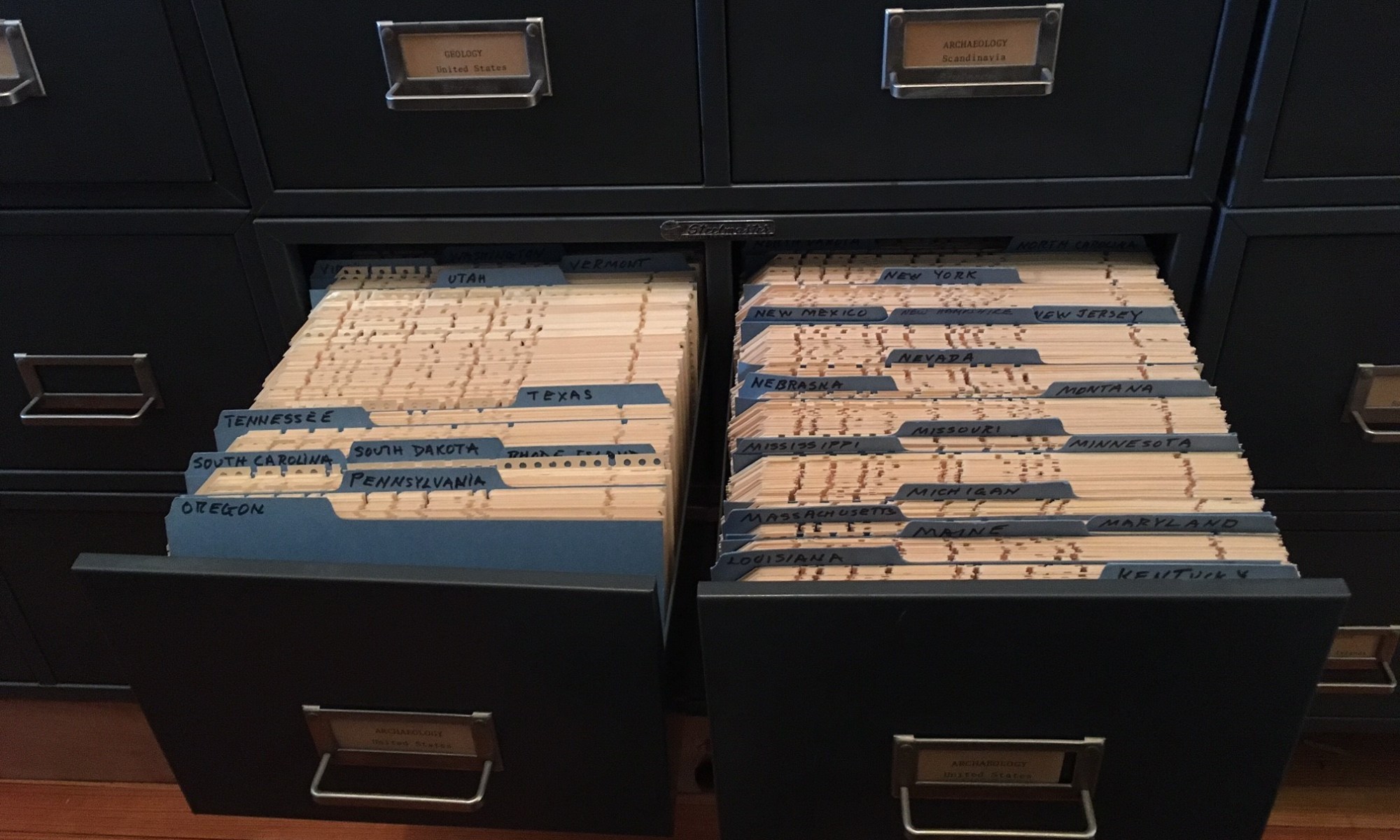
One of the more unusual collections I came across during my survey of the Peabody’s archives last year was a group of notched 5×8-inch cards containing radiocarbon dating information. It took me a while to figure out what these cards were, and as it turns out, both the format and the content have interesting back stories. These “punch cards,” widely used as a form of data storage in the late nineteenth to twentieth century, represent an endeavor to create a data set of known radiocarbon dates from sites around the world and share it with researchers.
Radiocarbon Dates Association, Inc., punch card – one of tens of thousands at the Peabody
File card cabinets full of the punch cards
Dr. Willard Frank Libby, a chemist who studied radioactivity and worked on the development of the atomic bomb during World War II, invented radiocarbon dating in the 1940s. He recognized its potential for fields such as archaeology and geology (and received a Nobel Prize in Chemistry in 1960 for these efforts). His research quickly came to the attention of Doug Byers and Fred Johnson at the Peabody, who were already using scientific dating techniques such as pollen analysis and dendrochronology. When the American Anthropological Association formed the Committee on Radioactive Carbon 14 in 1948, to liaise between the archaeological community and Libby and provide him with archaeological samples on which to test his method, Johnson was appointed its Chairman.
(See the additional resources below for publications on radiocarbon dating authored or edited by Johnson, who became so involved with this subject that in a 1958 letter he wrote, “… now I wish to heaven that I had never heard of radiocarbon”)!
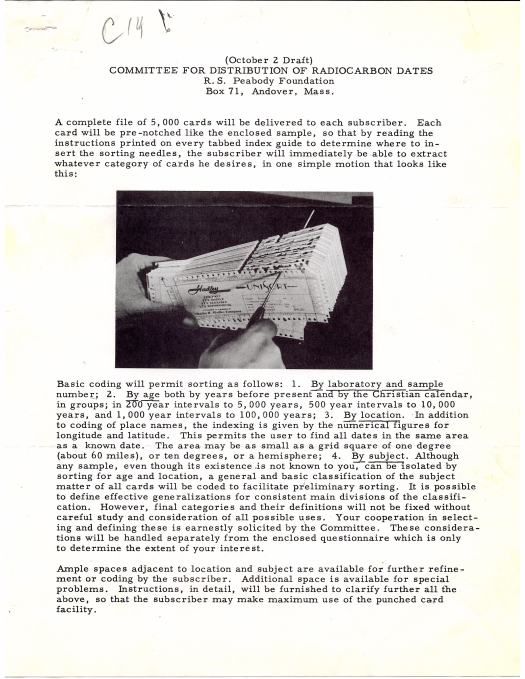
Beginning in 1953, conferences on radiocarbon dating began to be held at the Peabody. In October 1956, the Committee for Distribution of Radiocarbon Dates was established at one such conference. The R.S. Peabody Foundation was listed as the committee’s address. A $1,500 grant by the Wenner-Gren Foundation in 1957 was used to finance a survey sent to 1,500 scientists to gauge interest in radiocarbon dates punch cards. Enough interest was shown that the enterprise moved forward. In 1958, Radiocarbon Dates Association, Inc., was established, with Johnson as President and Byers as Secretary-Treasurer. Subscriptions were purchased by museums and universities across the world.
Committee for Distribution of Radiocarbon Dates informational page accompanying surveyMockup of radiocarbon dates punch cards
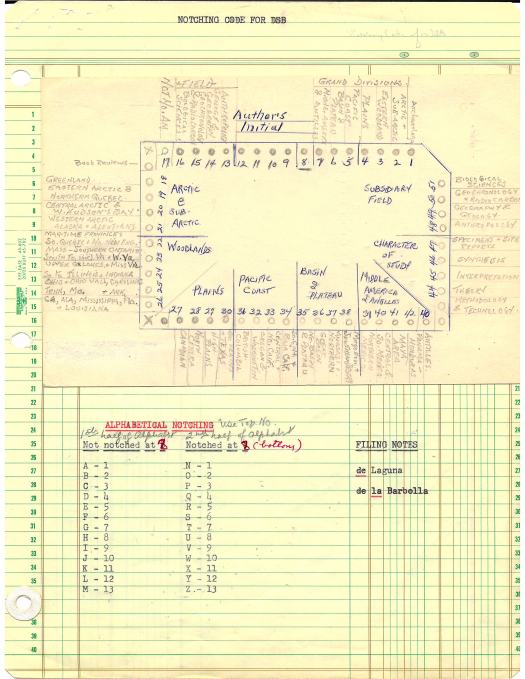
The cards were published and sent to subscribers in batches, along with sorting and coding equipment, and index guides. Each card contained information about a sample, such as its geographic location, its material (plant remains, oak, i.e.), where it was processed, its date, a citation if published, and occasionally a narrative description of where it was collected. This information was collected from the approximately forty laboratories carrying out this type of dating. Through the notches on the cards, using the sorter, subscribers could parse out samples having a common trait, like doing a search of records through a computer database with a particular term.
Punch card with sorter
Sorting punch cards with the sorter
Punch cards were inspired by notched papers designed in the eighteenth century for looms, to help automate patterns in weaving. By the late nineteenth century, the idea had been adapted to other uses. Herman Hollerith, working at the United States Census Bureau, applied his Electric Tabulating System invention to census data processing. This game-changing system led to the formation of IBM, and punch cards dominated data processing for most of the twentieth century, and were used with early computers until about a generation ago.
After the launch of Radiocarbon Dates Association, Inc., in the late 1950s, the production and distribution of the cards are not mentioned as much in the Peabody’s Annual Reports (my main source of information for this post!). A 1973 letter shows that the name had been shortened to Radiocarbon Dates, and that the main address had been moved to Braintree, MA, c/o John Ramsden. That is the last trace of the project that I’ve found here, besides the cards themselves. Fred Johnson donated his radiocarbon dating-related papers to the University of California, Los Angeles, where Willard Libby taught for a substantial amount of his career (and which hold his papers as well). More information about the project exists in those records, which were used by Keith Baich in his 2010 Portland State University master’s thesis, American Scientists, Americanist Archaeology: The Committee on Radioactive Carbon 14, which heavily features Fred Johnson.
Johnson, Frederick, et al. “Radiocarbon Dating: A Report on the Program to Aid in the Development of the Method of Dating.” Memoirs of the Society for American Archaeology, no. 8, 1951, pp. 1–65. JSTOR, JSTOR, www.jstor.org/stable/25146610.
Johnson, Frederick. “Radiocarbon Dating and Archeology in North America.” Science, vol. 155, no. 3759, 1967, pp. 165–169. JSTOR, JSTOR, www.jstor.org/stable/1721124.
The Temporary Archivist position is supported by a generous grant from the Oak River Foundation of Peoria, Ill. to improve the intellectual and physical control of the museum’s collections. We hope this gift will inspire others to support our work to better catalog, document, and make accessible the Peabody’s world-class collections of objects, photographs, and archival materials. If you would like information on how you can help please contact Peabody director Ryan Wheeler at rwheeler@andover.edu or 978 749 4493.
I’ve been thinking about archives and recordkeeping in relation to Native American communities since our Collections Assistant Samantha returned from the International Conference of Indigenous Archives, Libraries and Museums, and shared some resources she learned about there. One of these resources was the 2006 Protocols for Native American Archival Materials, a series of recommendations for non-tribal institutions holding Native American archival material. These are relevant to the Peabody because the archives here contain records documenting excavations of Native American sites, and more recently, repatriations, as well as ethnographic photographs.
The Protocols were created by a group of 19 Native American and non-Native American librarians, archivists (including the then President of the Society of American Archivists), museum curators, historians and anthropologists, and address how institutions can be culturally responsive stewards of these materials and provide culturally appropriate services to the communities with which they are affiliated. Essentially, the protocols speak to the fact that Native American archival records (textual, photographic, audio-visual, etc.) should be treated with as much sensitivity as other cultural objects in a museum’s collection, and may require rethinking a non-Native institution’s policies about access, description and control. Consulting with affiliated tribes to let them know these materials exist, inquiring about any access restrictions or changes in the way materials should be preserved, and not artificially extending the life cycle of a documentary record upon request are examples of recommendations in the Protocols. While archival materials do not currently fall under the jurisdiction of NAGPRA, apparently some institutions, in the spirit of the law, have repatriated them.
A fundamental question to ask about archives and current recordkeeping practices in general is what records get kept, and by whom: historically, it’s been a question of control. The Protocols essentially advocate for non-Native institutions to let go of some of the control they have over Native American archival material, even if this might go against the usual policies of their institution. A contemporary example in the news resonates with this practice: the recent Canadian court ruling allowing First Nations people to destroy testimonies of the abuse they endured at boarding schools: read an article about this here. The destruction of these testimonies means that they will not survive in the form of documentary evidence, accessible to the general public, even at a center that is committed to social justice. However, the victims of this abuse now control their stories, rather than, as quoted in the article, the government “which caused or contributed to the horrible harms to those survivors in the first place.”
I was so pleased to learn this summer that the Oak River Foundation had decided to fund another year of the archives project at the Peabody! This continuation of the project will allow me to focus on the photographic and map collections, excavation records from the Tehuacán Archaeological-Botanical Project and the Ayacucho Archaeological-Botanical Project, among others. I also hope to begin developing sustainable digitization workflows for some of the archival material, help with reference requests, and continue an oral history project about Scotty MacNeish. I am very happy to be back at the Peabody, continuing this work.
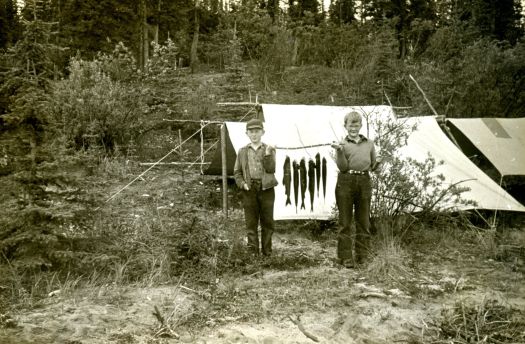
A photograph from the archives that caught my eye: Karl and David Raup (sons of Hugh Raup) with fish caught in stream. Big Arm, Kluane Lake. 8/21/44. Andover-Harvard Yukon Expedition.
Since starting back up here in early September, I have mostly been working on organizing and inventorying internal museum records like loan, exhibition, and NAGPRA records. These records might not have huge interest for outside researchers (and, as is common for institutions, are typically restricted for 25 years after creation for privacy concerns), but are important for staff members in the course of day-to-day collections management and ongoing repatriation efforts. Now that I am more familiar with the museum’s institutional history, I am finding that I can categorize material more quickly – I don’t have to repeat the learning curve of my first year.
On a personal note, I spent most of the summer between Boston (where I live) and western Massachusetts, where my sister and I own what used to be our grandparents’ house. My French, North African-born grandmother met my American grandfather (from a Scottish family who emigrated to the Boston area in the 1920s) during World War II while he was stationed in Algeria. The house is full of photographs, letters, books, and interesting objects documenting their lives – essentially, my family’s archives. I also spent two weeks working at the Phillips Academy Archives and Special Collections, helping Director of Archives and Special Collections Paige Roberts prepare for an upcoming move of the collections associated with the Oliver Wendell Holmes Library renovation. So, I didn’t stray too far from the work I do here, even while I was away.
The Temporary Archivist position is supported by a generous grant from the Oak River Foundation of Peoria, Ill. to improve the intellectual and physical control of the museum’s collections. We hope this gift will inspire others to support our work to better catalog, document, and make accessible the Peabody’s world-class collections of objects, photographs, and archival materials. If you would like information on how you can help please contact Peabody director Ryan Wheeler at rwheeler@andover.edu or 978 749 4493.
This blog represents the ninth entry in a blog series – Peabody 25 – that will delve into the history of the Peabody Museum through objects in our collection. A new post will be out with each newsletter, so keep your eyes peeled of the Peabody 25 tag!
Bureaucracy and oversight committees are not modern phenomena. In the earliest years of the Peabody, contemporaneously known as the Department of Archaeology, the work done was overseen by a subcommittee of the Trustees of Phillips Academy. However, the Trustees recognized the limitations of their own knowledge in the world of archaeology and appointed a Special Advisory Committee on Archaeology in 1914.
The special committee was tasked with assessing mundane logistical needs of the Department as well as providing direction and feedback on proposed research. Composed of five prominent anthropologists; Franz Boas, William Henry Holmes, Roland Dixon, Hiram Bingham, and Frederic Ward Putnam, the committee made the following suggestions:
Install a synoptic exhibit, strictly limited in size and scope, of the life of man from geological time to the beginnings of history
Limit public lectures to no more than 4 each year
End formal classes in archaeology for the students at Phillips Academy and instead encourage individual students as their interests dictate
The work of ‘research’ should include two separate divisions; one to investigate large definite problems of archaeology, and the other to aid competent archaeologists in the execution of such of their plans
Appoint a small permanent advisory committee of experts of easy access, whose duty it shall be to report to the Trustees upon all plans for exploration, organization of study collections, museum research, and publication.
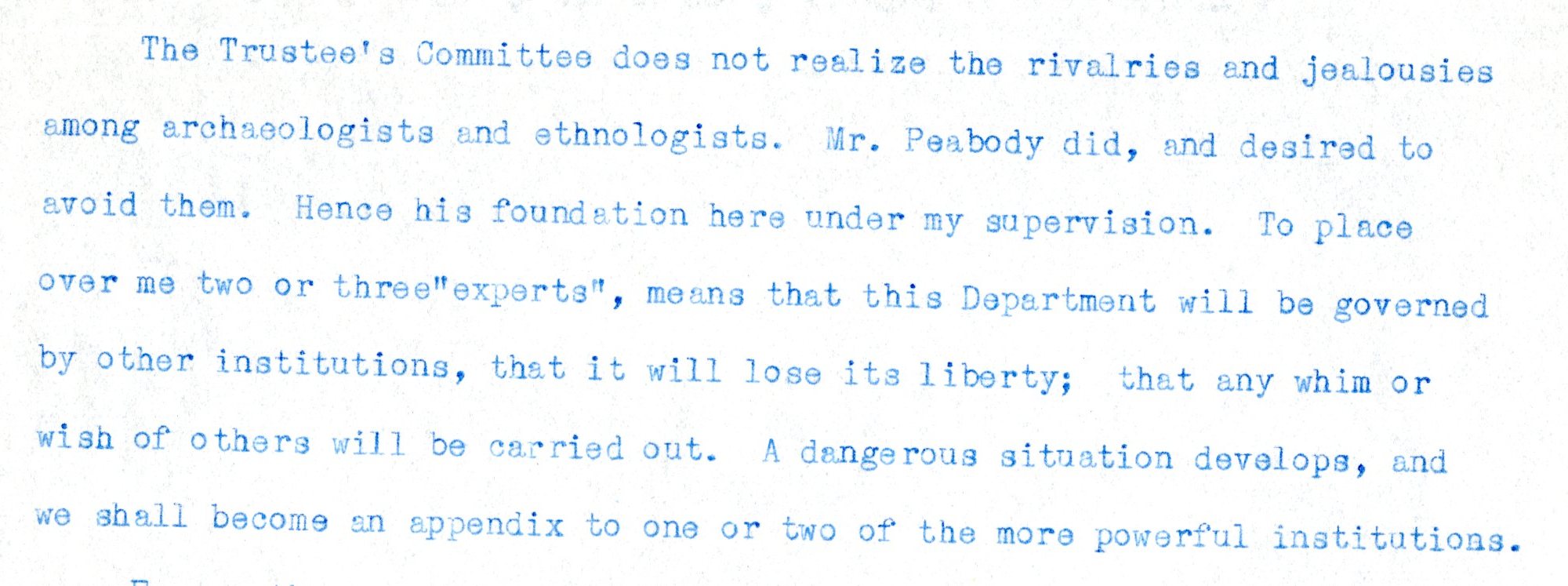
These recommendations were received with mixed feelings by curator Warren K. Moorehead. He appreciated many of the committee’s suggestions, but strongly objected to the creation of a permanent oversight committee. Convinced that they would meddle in his research plans and enmesh him in red tape, Moorehead clearly expressed his displeasure:
Warren Moorehead complains about a special advisory committee in a letter to the Headmaster.
However, the committee composed of Dixon and Bingham, existed for several years. They limited Moorehead to his ongoing work in Maine and simultaneously decided to embark on an expedition in the Southwest. This decision directly led to the appointment of Alfred V. Kidder as the Director of Southwest Explorations and his seminal work at Pecos Pueblo, New Mexico.
In 2016, the Peabody Museum received a generous grant of $100,000 from the Oak River Foundation of Peoria, Ill., to support work pertaining to the intellectual and physical control of the museum’s collections.
The grant was spread across two years and initially supported the work of an archivist to whip the Peabody’s 100+ years of archives into shape. With that funding, Irene Gates was able to share archival collection records online and process over 140 linear feet of material. She also created three finding aids to the material belonging to prominent directors of the Peabody’s past.
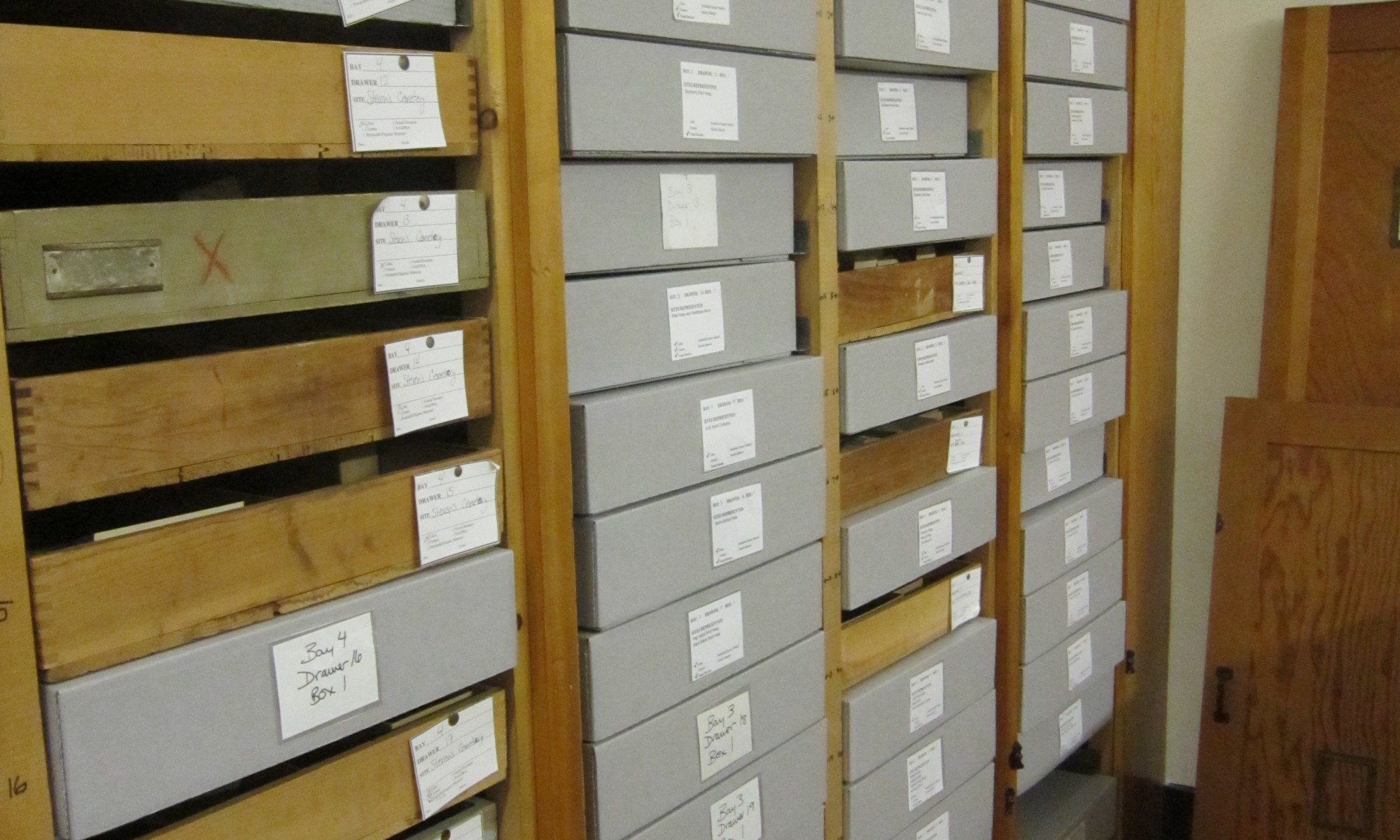
The second year of funding is designated to supporting the work of a temporary inventory specialist – Rachel Manning. Rachel will be spending her time inventorying drawers of artifacts and rehousing them into archival boxes as part of our larger collections storage project. While she only began her work in early August, Rachael has already been making steady progress.
Rachel inventories a drawer from Massachusetts.
And we are pleased to announce that the Oak River Foundation has stepped up again and provided additional funding for Irene to return and spend another year in the Peabody archives! This second year will facilitate processing the remaining 150 linear feet of material as well as addressing the photographic and map collections.
Our deepest appreciation goes to the Oak River Foundation for their continued generosity and support of the Peabody’s goal to improve the intellectual and physical control of the museum’s collections.
We hope this gift will inspire others to support our work to better catalog, document, and make accessible the Peabody’s world-class collections of objects, photographs and archival materials. If you would like information on how you can help please contact Peabody director Ryan Wheeler at rwheeler@andover.edu or 978 749 4493.
Next Thursday marks the final day at the Peabody for Temporary Archivist, Irene Gates. Irene was hired for a year to tackle the organizational challenge that was the Peabody archives and she has succeeded beyond our expectations.
Irene carried out a full collections survey and created 65 collection level catalog records – 33 of which are now available via our collection online. She wrapped her arms around the archives of previous director (and the man who saved everything) Richard ‘Scotty’ MacNeish and processed 92 linear feet of material. You can see the incredible finding aid for MacNeish’s material here.
In total, Irene has processed 140 linear feet of material, developed 3 finding aids, and written policies and procedures. Her work has directly benefited the accessibility of collections, the efficiency of current museum functions, and our transparency as an institution.
Irene’s quiet and steady presence will be missed around the Peabody and we have been incredibly fortunate to call her colleague and friend over the past year. Wishing her the best of luck in her next adventure!
Irene Gates
The Temporary Archivist position is supported by a generous grant from the Oak River Foundation of Peoria, Ill. to improve the intellectual and physical control of the museum’s collections. We hope this gift will inspire others to support our work to better catalog, document, and make accessible the Peabody’s world-class collections of objects, photographs, and archival materials. If you would like information on how you can help please contact Peabody director Ryan Wheeler at rwheeler@andover.edu or 978 749 4493.
Curious about the scholarly depth of the Peabody collections? Looking for material from a particular site for your research? Interested in simply browsing through the artifacts?
The site’s new and improved format is more user-friendly and provides easier access to our object records. Enter a key word to search, browse a full list of sites, and click through random images of artifacts.
In addition to a streamlined interface, the updated website also includes information about the archival collections housed at the Peabody. Temporary Archivist Irene Gates’s recent blog post highlights the completion of the first step in processing our archives. Or, explore the archival collections here.
While we do not yet have our full collection online, we add new records regularly – so come back often. I hope that you enjoy exploring the Peabody’s collections as much as I do!
The Peabody Collection Online is made possible in part by a grant from the Abbot Academy Association, continuing Abbot’s tradition of boldness, innovation, and caring.
Collection records for the Peabody’s archival collections are now online, via the museum collections management database’s online portal: take a look.
I am also very happy to announce that the processing work on the MacNeish archives is complete and that this material is now open for research. These archives have been processed as two collections, the Richard S. MacNeish papers and the Richard S. MacNeish records. The papers were donated by MacNeish in 2000, shortly before his death, while the records resulted from his directorship of the Peabody, 1968-1983, and had not left the museum since then. A finding aid with a folder-level inventory can be accessed via the link at the bottom of each collection record. There is parallel content in the two collections, so researchers are advised to consult both.
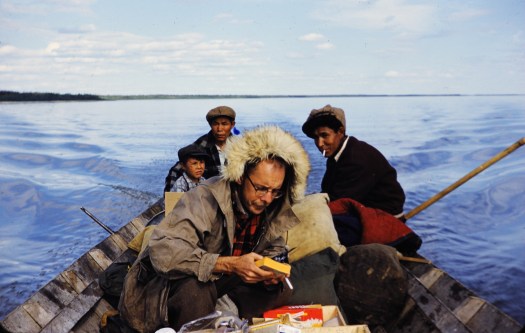
Here is one of my favorite photographs of MacNeish, from his papers – I think it exemplifies what an adventurer he was.
Richard MacNeish in canoe in the MacKenzie River, Canada, during his survey work there in the 1950s
The Temporary Archivist position is supported by a generous grant from the Oak River Foundation of Peoria, Ill. to improve the intellectual and physical control of the museum’s collections. We hope this gift will inspire others to support our work to better catalog, document, and make accessible the Peabody’s world-class collections of objects, photographs, and archival materials. If you would like information on how you can help please contact Peabody director Ryan Wheeler at rwheeler@andover.edu or 978 749 4493.
Since October, I’ve been focusing on the largest collection at the Peabody, the Richard S. MacNeish papers. MacNeish donated about 220 linear feet of his papers and books to the museum in 2000, soon before he died. These papers span the length of his life and career, from childhood scrapbooks on the Maya to his MA and PhD theses, to field records and administrative files from his Tamaulipas, Ayacucho, Pendejo Cave and China projects, to research files on a variety of geographical regions and subjects, to records from his positions at Boston University, as head of the Andover Foundation for Archaeological Research (AFAR), and as director of the Peabody Museum itself. MacNeish, known as Scotty, was such a significant figure in American Archaeology in the 20th century that his papers are likely to have a high research value.
Scotty MacNeish, around 1980
An extensive amount of work was already carried out on this collection since it arrived at the museum. An item-level inventory was done, and about half of the boxes had their contents rehoused into acid-free folders (papers) and mylar sleeves (photographs). More recently, the museum decided to separate out the large number of books from the papers, many of which will be added to the Peabody library. Volumes that were annotated by MacNeish or bear a personalized dedication to him are being retained in the archives. After separating books from the archival materials the remaining papers now measure only 90 linear feet – a huge difference in terms of storage space.
Boxes of MacNeish papers
A typical box before sorting out the books
I’m now working on a few remaining steps: foldering loose items in boxes, determining date ranges for folders, updating the inventory to reflect those changes as well as the removal of the books, rearranging the materials into logical groupings, and rehousing contents into acid-free record cartons. Lastly, I’ll integrate within the guide to this collection the other Scotty MacNeish materials we have at the museum, his director’s records. MacNeish left about 20 linear feet of material at the museum at the end of his directorship in 1983. To preserve the provenance of these two groups of material, we decided to process them as separate collections – even though there is a lot of overlap between the two. I’m looking forward to having all of this material be easily accessible to researchers soon, and anticipate that this work will be completed and the collection guide available by mid to late January 2017.
The Temporary Archivist position is supported by a generous grant from the Oak River Foundation of Peoria, Ill. to improve the intellectual and physical control of the museum’s collections. We hope this gift will inspire others to support our work to better catalog, document, and make accessible the Peabody’s world-class collections of objects, photographs, and archival materials. If you would like information on how you can help please contact Peabody director Ryan Wheeler at rwheeler@andover.edu or 978 749 4493.