Another summer is nearly gone and the school year is about to begin. Sometimes, I get asked “what do you do when the students aren’t here?” Well… everything!
In the past couple of months, the collections department has inventoried and rehoused over 100 artifact drawers! This included an ambitious project (and maybe a little bit crazy) to reorganize the ceramics from the Scotty MacNeish collection. MacNeish stored the ceramics by typology – useful for analysis, but really unhelpful for collections management. Objects with the same catalog number were spread out over 8 to 12 different drawers and were not easy to locate for researcher or class use. It took over a week to empty, consolidate, and inventory 55 drawers. But now everything is easy to access!
Sherds from the MacNeish collection removed from storage and placed into numerical order
Sherds spread around the room
I have also been teaching Annie Greco, inventory specialist, and Rachel Manning, our new collections assistant, the basics of pest management and mitigation. We inspected artifacts for insect activity and damage and then learned how to properly clean objects that have been affected. Fortunately, nothing serious was found and it was a valuable exercise for all of us.
Annie and Rachel examine an artifact for pest activity.
Also, outside research does not follow the school year patterns. I have been working with several professors to facilitate access to Peabody collections for a variety of projects.
Summer at the Peabody is a different pace than the school year, but not any slower!
To the uninformed, the Peabody Institute of Archaeology is just a building on the Phillips Academy campus that houses old artifacts and sherds of pottery from long ago archaeological expeditions. They would be very mistaken! The Peabody provides incredible academic enrichment opportunities to the student body across all disciplines.
In a unique approach to education, the Peabody collections are used to demonstrate the practical applications of history, language, mathematics, science and sociology. This year celebrates the fifth year the Peabody has arranged for pottery artists from the Pueblo of Jemez to come to campus to work with students.
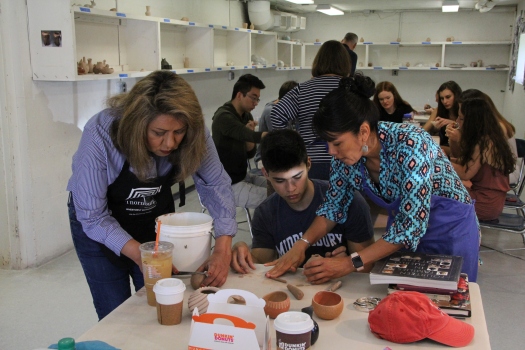
In collaboration with Thayer Zaeder’s ceramics classes the potters spent the week working with 48 students teaching the ancient techniques of transforming clay into pottery. I had the rare opportunity to not only observe these artists work with the students, but to actually work with them myself. Maxine, Dominique and Mia worked with students individually on both shape and decorative painting to create unique pieces of art.
Dominique Toya (left) and Mia Toya (right) work with a student.
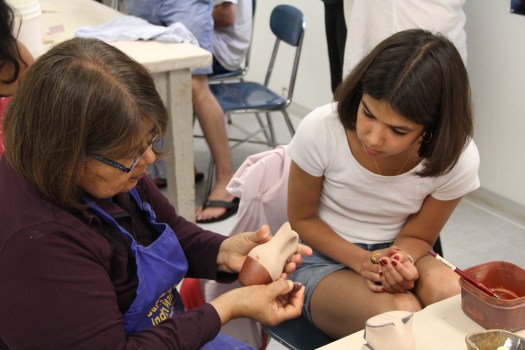
Glazing is not used in Pueblo pottery. Any glossy surfaces are achieved by polishing the area with smooth stones. The process is delicate and time consuming and if you mess up, as one student found out, the Potters would show you how to fix the problem – sand it all off and start again!
Maxine Toya demonstrates how to polish the red slip.
Dominique, Mia and their mother, Maxine Toya come from a multi-generational family tradition of Pueblo Potters. Each is known for their unique style, Dominique for her mellon designs, Mia for her signature butterfly designs and Maxine for her animals and figures. Their work is highly collectible and sought after. Nancy Youngblood, another prominent Pueblo potter, has joined them the last three years. These four ladies are the “Super Stars” in the Native American world of ceramic art.
Maxine Toya working on one of her famous owls.
Mia Toya talks about her butterfly swirl jar, in process.
Dominique Toya begins the spiral ribs on a miniature swirl pot.
Mia’s friend Ward Weppa helps sand the ribs on her butterfly swirl bowl.
Maxine Toya’s completed owl figurine–all the fine line painting is done with Maxine’s masterful hand-eye coordination!
Dominique Toya’s distinctive swirl vessels with micaceous slip, collection of the Robert S. Peabody Institute of Archaeology.
When speaking with the Potters, one theme stood out. They love bringing the ancient methods to this generation to instill a knowledge of their culture and heritage. They each spoke of how polite the Andover students were as well as the appreciation shown to them by each student for the opportunity to learn this ancient art form.
Students look on as Dominique tends the fire.
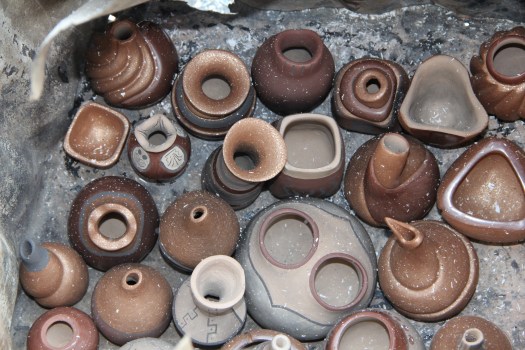
The culmination of each of their visits is the “firing.” They still use the ancient method of firing the pottery outdoors, which usually draws a large crowd. A huge bonfire is built to bake all the pieces the classes have created. The end result brings pride and a sense of accomplishment to both students and teachers alike.
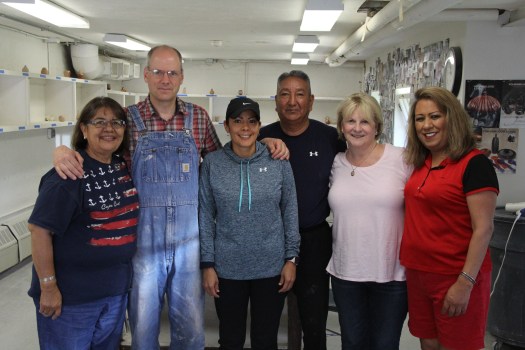
From left to right: Maxine Toya, Thayer Zaeder, Mia Toya, Ward Weppa, Barbara Callahan, and Dominique Toya.Vessels as they emerge from the fire.
*Guest contributor Barbara Callahan is Secretary of the Peabody Advisory Committee. She and her husband Les Callahan (Phillips Academy Class of 1968) provided the generous support for the Pueblo Potters program in 2017 and 2018.
Native American basketry was the subject of a special research visit on June 4th. Ralph Shanks, Research Associate at University of California, Davis, and Lisa Woo Shanks are experts in identifying and analyzing Native American California basketry. Together, they produced an outstanding 3-volume series on California basketry that has been indispensable in examining the Peabody collection. The goal of their visit was the examination of over 100 Californian baskets for cultural identification. The visit developed into a tutorial for staff as the discussions addressed ethnobotany, physical structure, and design elements found on the baskets.
Immersion in basketry required a specialized vocabulary for structures and materials such as twining, coiling, plaiting, overlay, double interlacing, foundation, willow, red bud, juncos and more. The forms of baskets were confirmed as bowls, hats, seed beaters, burden baskets, winnowing trays, toys, and cooking vessels. Many Californian Indians cooked in water-tight water-filled baskets by adding heated stones; and examples of these were identified in the Peabody collection.
The visit was facilitated by Marla Taylor, Curator of Collections, and Catherine Hunter, Research Associate, who inventoried the collection of 300+ Native American baskets in 2015-16. Hunter returned to the Peabody recently to continue research for a paper “Indian Basketry in Yosemite Valley, 19th-20th Century: Gertrude ‘Cosie’ Hutchings Mills, Tourists and the National Park Service” to be presented at the Textile Society of America Symposium in September 2018. After Hunter consulted Shanks last month, he extended an East Coast vacation to include a visit to Andover.
Ralph and Lisa examining the intricate design on a CA basket
Ralph viewing part of the collection
Ralph viewing part of the collection
Ralph and Lisa examining the intricate design on a CA basket
Hunter selected this topic because of the Hutchings Mills Collection of baskets. Collector and donor Gertrude “Cosie” Hutchings Mills (1867-1956) was one of the first Anglo-American children born in Yosemite Valley to early settlers James Mason and Elvira Hutchings. She collected Native American baskets in the Yosemite Valley region before 1900, recording many acquisition sites and the names of three weavers. Such documentation is very rare; thus, the collection was of special interest to Ralph Shanks.
After marriage to William Elligood Mills in 1899, they lived in New England and their son attended Phillips Academy. In 1937 the collection of fifty-six baskets was donated by Mrs. Mills to the Peabody Institute.
Shanks was enthusiastic about the quality of the basketry, contributed significantly to our interpretation of the collection, and identified rare baskets that would enhance his own research. We were thrilled to host his visit!
Kevin Porter, the Vice Chairman and Overseer Coordinator for the Andover Conservation Commission, invited me to be the Keynote Speaker for their annual meeting on April 19. Mr. Porter was looking for someone who could speak to their group about the Native history of the area, and my name had been given to him by Stephanie Aude, a former OWHL librarian who now works at Andover’s Memorial Hall Library.
The reason for his interest in a speaker on Native Americans is that they have begun working on making Retelle Reservation in Andover more accessible to the public, and that includes creating informational panels about the landscape.
Map showing the location of Retelle Reservation
While the volunteers who are managing Retelle Reservation have created panels to highlight the different environments and animals one might encounter while enjoying the area, they want to include one about the Native people who use to live there.
Image of the Peabody’s diorama of the Shattuck Farm site.
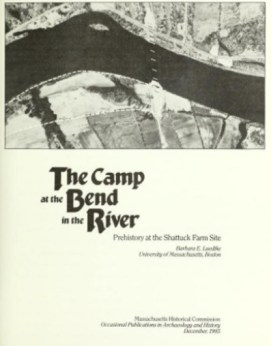
The Overseers and other volunteers recognized the importance of this history and sharing it with visitors because Retelle Reservation is on the western edge of the Shattuck Farm site. This site is very important to understanding the Native history of the Merrimack Valley and was excavated by Warren Moorehead, Alfred Kidder, and others who worked at the Peabody, in addition to Barbara Luedtke’s investigation of the site in the 1980s.
Since the presentation, Willow Cheeley of the Merrimack River Watershed Council (MRWC) has reached out regarding their property, Pine Island. Pine Island is situated near Retelle Reservation, in the middle of the Merrimack River, and has the potential to be archaeologically important because there was a small camp site located on it. It is believed that the camp was used to monitor those who traveled on the river and to keep them away from the larger village that was on the mainland.
As the MRWC begins to think about ways to preserve and tell the history of Pine Island and the surrounding area, they are also investigating the collaboration possibilities between MRWC, the Town of Andover, and Phillips Academy. Their interest in partnering with PA stems from the records and expertise the staff at the Peabody have and from their previous work with faculty member Mark Cutler.
This timing could not be more perfect since Mark will be taking a sabbatical for the 2018-2019 academic year to work on creating a bilingual experiential curriculum on the cultural history of the Merrimack Valley. This work will be an extension of his class Confluence: Environment, Culture, and Community. Mark also hopes that the materials he creates will be utilized by area schools and institutions, and possibly even adapted as an interdisciplinary class at PA in the future.
And having heard that I was giving the Keynote Lecture, Mark attended the talk, and has already roped me into helping him with the development of the Native history part of his curriculum. This will certainly be an interesting partnership and an amazing way for the Peabody to contribute to both the PA and Andover (and more!) communities. We look forward to keeping you updated as these projects progress!
I was recently invited, along with my frequent collaborator (also known as my partner-in-crime), Dr. Bethany Jay, to present at University of Southern Maine’s inaugural symposium, Race, Power, and Difference: A symposium for Maine Educators.
Conference program and other documents from the symposium.
The symposium featured Dr. Tiffany Mitchell who kept the audience laughing throughout her keynote address that focused on how educators could go beyond one-dimensional narratives about people of color in the classroom, using her own experiences to emphasize points.
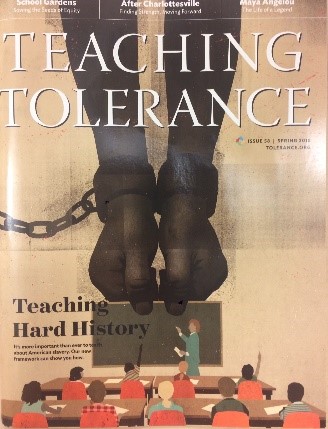
Bethany and I were there to present our work on how to incorporate practical strategies and hands-on learning regarding slavery. Our work with the Southern Poverty Law Center’s Teach Hard History program and lessons that we each use with our own students served as the basis for our discussion with the participants.
The Teaching Tolerance magazine focusing on teaching American Slavery.
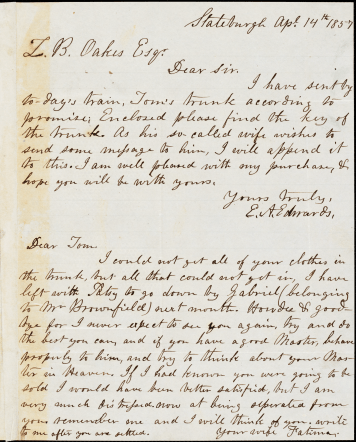
One of the documents from the ZB Oakes collections that Bethany used for her documentary analysis activity.
***Interestingly, ZB Oakes was a slave auctioneer who lived in Charleston, SC in the 1800s. His papers are part of the collections at the Boston Public Library because they were seized during the Civil War by a Massachusetts regiment comprised of free blacks and brought back to Frederick Douglass – as almost a trophy about what he helped accomplish!
Our session was one of the most attended of the day, with some participants having to stand and a continual stream of adding more chairs to the already cramped room. It clearly demonstrated that educators KNOW that this is an important topic and yet struggle for finding appropriate resources. Throughout the presentation and activities the participants were continually engaged and asking great questions – of us and other attendees – about strategies that they might use or modify to fit their unique student populations.
Bethany setting the stage about what the session will cover and how the activities will run.
And to make things even MORE exciting – one of the fellow presenters was Dr. Nate Hamilton! Nate frequently collaborates with Bethany and me and has been a part of the Peabody extended family for years. It was nice to see him in his “natural habitat” of Maine for once!
Nate and I enjoyed running into each other after our session.
Sitting on my office shelf in a red binder is the Peabody disaster plan. No institution ever wants to use it, but it is essential to be prepared. Our plan is in need of its regular update, and fortunately for us, the Addison Gallery of American Art (also part of Phillips Academy) hosted a three-day seminar and full-scale emergency response disaster training for the protection of cultural assets in March. Over 100 people took part in the workshop, including several members of Peabody staff.
The workshop included presentations from conservators, companies who specialize in disaster clean-up, and organizations that can help think through the disaster plan with us. We learned the basics of painting conservation, how to mitigate water damage, how to dry/salvage wet books and papers, and how to identify and deal with pests in the collection. Training stations were presented so that we could try all of these methods ourselves and have the opportunity to ask specific questions relating to our own collections.
Triaging damaged books from the disaster scenario.
Faux smoke damaged gallery during disaster scenario
Packing damaged books from the disaster scenario.
Marla and Rachel prepare for a disaster
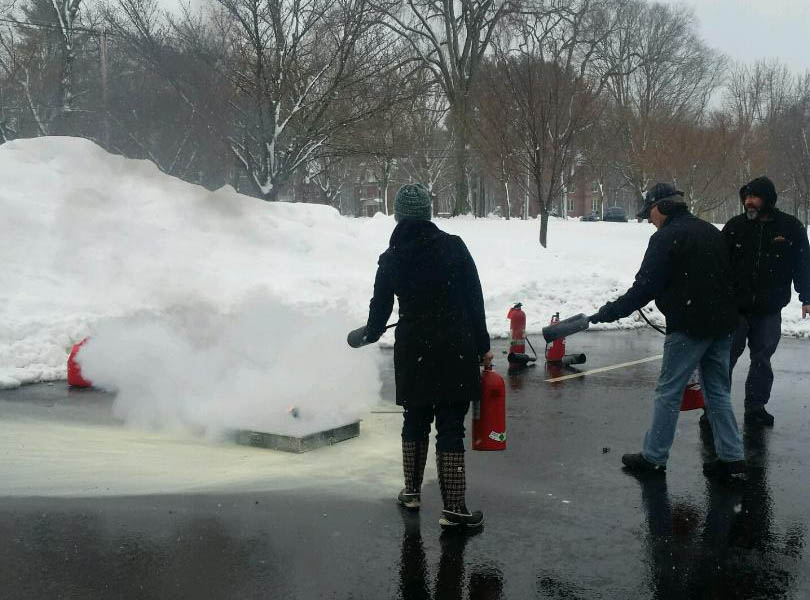
That’s me in the hat using the fire extinguisher
The big highlight for me was the triage scenario meticulously installed at the Addison. The Addison repainted one of their temporary galleries to appear smoke damaged, and they displayed pieces of art that had been previously damaged to replicate how fire damage may present itself in a museum. As a team, we were given only 10 minutes to remove the damaged artwork (without additional damage!), set up work flow to begin cleaning objects, and isolate the most damaged pieces. This was fun and realistic.
Now comes the hard work – applying all of this new knowledge to our own disaster planning process.
The emergency response and disaster planning workshop was generously made possible by a grant from the Abbot Academy Fund, continuing Abbot’s tradition of boldness, innovation, and caring.
The past five years have been a busy time for museums- most notably in the image department. Following a number of high profile controversies, a lot of people–audiences, and museum professionals alike–asked what role museums play in our society? Here are a couple of recent articles dealing with this subject head on.
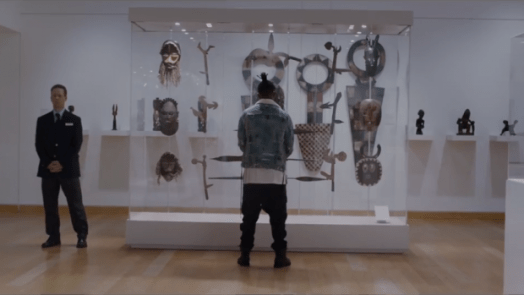
Killmonger in the Museum (Photo courtesy of article)
Last month saw the release of Marvel’s newest blockbuster, Black Panther. Besides being a fantastic movie, this film offers a unique chance to open dialogues on a large scale about many topics- least of which are museums as mechanisms of colonialism. This article discusses how and why museum professionals especially should look at their roles in this and the effects they have on the audiences we try to reach. The piece ends by laying out suggestions for how museums can move forward incorporating and working towards more diverse and open dialogues between communities.
Gover and Bunch at Symposium (Photo courtesy of Smithsonian Magazine)
This article opens with the quote, “history matters because it has contemporary consequences,” and it just gets better from there. Directors Kevin Gover (National Museum of the American Indian) and Lonnie Bunch (National Museum of African American History and Culture) participated in a day long symposium titled, “Mascots, Myths, Monuments and Memory,” in which they talked about confronting the historic and continued racist ideologies that are entrenched in contemporary American society and the role of museums. They specifically discuss the example of the concurrent rise of confederate statues and racist mascots.
Chronicling a series of high profile controversies, this article looks at the combination of factors that have led to these, as well as the changes they are bringing to museums and their operation. It also discusses why museums have become ground zero for explosive cultural encounters stating, “We’re in a time when these issues are real, these controversies are part of public space and public discourse, and museums are going to become the places where these issues get played out.”
Students using NK360 (photo courtesy of Smithsonian Insider)
This article showcases the role museums have within their respective walls and how they are branching out to have far reaching impacts in classrooms all over the nation. Similar to classes taught at the Peabody by Curator of Education, Lindsay Randall, this article follows the creation and implementation of National Museum of the American Indian’s newest initiative, Native Knowledge 360. NK360 is a “long-term initiative to integrate the Native American experience into social studies, language arts and other curriculum in kindergarten through 12th-grade classrooms across the country.” This program works with the inclusion and cooperation of Native communities and educators as well as provides educational materials for teachers.
During Fall Term I worked with Meg Bednarcik and Nick Zufelt – both Instructors in Mathematics, Statistics, and Computer Science – to create a class that would focus on the computer science concepts of looping and parameters.
We decided to utilize the extensive Guatemalan textile collection at the Peabody, as they are brightly colored and engaging and most have repeating, or looping, motifs. We also liked the idea of incorporating clothing made and worn exclusively by indigenous women into a subject where they are woefully underrepresented.
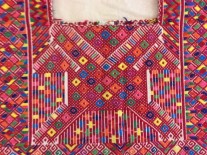
Eighteen huipils (wee-peels) were pulled for the class, with the images of another twelve scanned. A huipil is a traditional Maya women’s shirt.
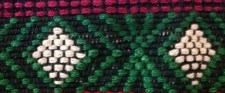
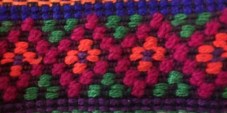
The first activity was a matching game to show students how huipils had silent information encoded into them about the wearer’s home community. Each village has its own distinctive design. The students were given twelve cards with images of other huipils in our collection and asked to match them to huipils that were laid out in the room. The following images are from three villages, highlighting how the differences between villages, as well as the variation within a particular village.
Huipil from San Mateo
Huipil from San Mateo
Huipils from San Mateo
Huipil from San Ildefonso
Huipil from San Ildefonso
Huipils from San Ildefonso
Huipil from Almolongo
Huipil from Almolongo
Huipils from Almolongo
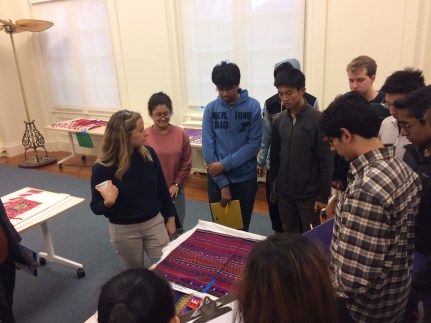
Students participating in the village sorting game.
Then students worked with either Meg or Nick to find designs that had looping designs, or nested loops. Then they worked on creating parameters for the designs they had found.
Meg Bednarcik points out looping patterns to her students.
The third activity was asking students to identify certain motifs that are common in Maya imagery. Some, such as a deer, were more literal then others, such as the feathered water serpent or portals.
And as you learn in the write up bellow by Meg, this class served as the starting point for a term long project the students will be working on:
My AP CS A students ventured to the Peabody Institute to learn of Guatemalan huipils and the stories these women’s clothes tell of personal identity. The students will complete follow-up assignments to program their own design defining their personal identity here at the academy and beyond utilizing programming concepts learned in class such as objects and repetitions. Though many students were shocked to be at the Peabody for a CS class, they left reflecting on the many ways these programming ideas apply to other aspects of our world. I am eager to continue to utilize these resources at our fingertips to allow students the space to ponder their place in our interconnected world beyond PA, and consider the beneficial impact their work as computer scientists can have on others outside of the classroom.
~ Meg Bednarcik, Instructor in Mathematics, Statistics, and Computer Science
This has been one of the most interesting and fun classes for me to develop. I really enjoyed working with and learning about part of our collection that is underutilized. But most of all, I have been thoroughly engrossed by the current action Maya women are taking to ensure that their designs are protected and not appropriated. Based on the information I gleaned from my research, I included a huipil from Santiago Sacatepéquez, which is the only community so far that has been able to give legal protection to their woven intellectual property.
To learn more about huipils and their images, visit Guatemala City’s Ixchel Museum of Indigenous Textiles and Clothing website.
Below are symbols found in some of the huipils in the Peabody’s collection:
Serpent motif –geometric designs known as “kumatz’in”. “The Kaqchikel term kumatz means snake, or the feathered serpent.
Deer – Deer held particular significance in Maya mythology and the Dance of the Deer, originating from pre-Conquest times, is still performed at festivals today.
The Double Headed Eagle – The double headed eagle in Maya mythology represents the Great God with two faces, one looking to good and the other to evil, or to heaven and earth. Double-headed birds are motifs frequently used for decorating ceremonial garments. The image to the right outlines the shape of the double headed eagle.
Sky bands – represents the path of the sun with the Xs formed in the “empty” space refers to the end of the solstices.
Offering plate / Portal – “portal” or “door” was the Maya name for the entrance into the “other world” (spirit world). The dot in the center represents the door through which an ancestor can travel.
The Star That Proceeds The Sun – This motif has been a part of Mesoamerican cosmology since Olmec times. It can be seen in celestial bands along with the sun, the moon, and particularly Venus. It is also featured in codices, such as the Popol Vuh.
Bird – At the beginning of the rains, and when maize is sowed, they can be seen in large quantities on the rivers and lakes.
Sun – A sun is embroidered around the neckline. If a woman in the village just became a widow, she would wear her huipil without the sun around the neck, because she would have lost her sun
Lightning – Vertical zigzag lines are associated with rain and lightning.
Lion / Jaguar – The animal has been given a mane, indicating European influence. The cougar or American lion has no mane.
In 1990 President George H. W. Bush (Phillips Academy Class of 1942) signed into law the Native American Graves Protection and Repatriation Act (NAGPRA). The passage of NAGPRA signaled a major shift in the relationship between Native Americans and museums, requiring that the latter inventory collections and identify human remains, funerary objects, sacred objects, and objects of cultural patrimony and contact the appropriate tribal groups to arrange repatriation. For tribal peoples this represented major human rights legislation.
Former Peabody director James Bradley and repatriation coordinator Leah Rosenmeier embraced the new law and worked diligently through the 1990s and into the early 2000s to identify NAGPRA collections, to determine tribal affiliations, and to ensure timely repatriation. Much of the focus during this time was on human remains and associated funerary objects. Major consultations include those that involved Alfred V. Kidder’s excavations at Pecos Pueblo in the early twentieth century, Warren Moorehead’s excavations at the Etowah and Little Egypt sites in Georgia, and excavations at sites in Maine.
Today the Peabody continues its commitment to working with tribes and indigenous peoples to ensure that ancestral remains, funerary objects, sacred objects, and objects of cultural patrimony are repatriated in a respectful and timely fashion. Much work has been done and much remains to be done.
The Peabody supports the United Nations Declaration on the Rights of Indigenous Peoples and is committed to the repatriation provisions outlined in that document. The United Nations Declaration on the Rights of Indigenous Peoples explicitly affirms that indigenous people have a right to repatriation of ceremonial objects and human remains.
We look forward to hearing from the representatives of tribes in the United States or indigenous groups abroad to answer questions, to schedule visits to view collections, to receive guidance on care and storage of collections, or to begin the consultation process. We also are happy to discuss NAGPRA and repatriation with staff members from other institutions. Please contact Peabody director Ryan Wheeler (rwheeler@andover.edu or 978 749 4493) to begin a conversation today.
Since the announcement of Homo naledi’s discovery in 2015, this South African fossil hominin has made an appearance in the multidisciplinary science course Human Origins, taught at the Peabody and offered as a senior science elective by Phillips Academy.
Over 100 specimens of Homo naledi have been scanned and made available via Duke University’s MorphoSource website. This represents unprecedented access to the fossils. Typically, we rely on older casts (our plaster casts from Wenner-Gren’s twentieth century casting program have become quite fragile!) or models made from photos and measurements.
Reconstruction of Homo naledi hand from MorphoSource website.
Last year in Human Origins Phillips Academy Makerspace guru Claudia Wessner helped us 3D print Homo naledi’s femur, which includes some unusual features, including a distinct sulcus or furrow on the femoral neck that is not known in other hominins. Students and instructor alike puzzled over the femur, and compared it to other casts and models in the Peabody collection.
This year Ms. Wessner was kind enough to host us again and discuss different types of 3D scanning and printing and help us think how these might be useful in paleoanthropology and physical anthropology.
Human Origins students look on as Claudia Wessner prepares the resin print of Homo naledi’s hand for a bath in alcohol.
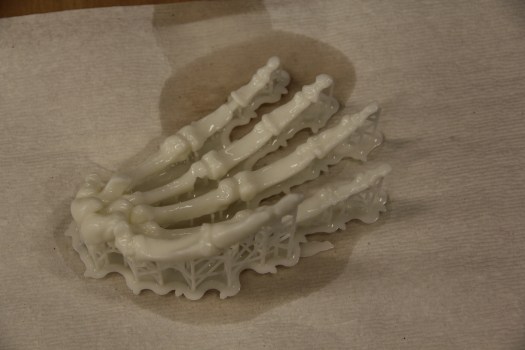
Instead of the femur, we chose to do a 3D print of Homo naledi’s hand, also available via the MorphoSource website. We were treated to side by side 3D prints using the Makerspace’s filament and resin printers. While the prints with the filament printer were interesting, the resin print is at a level comparable with a cast or model, in terms of finish and detail. Lee Berger and his colleagues, involved in discovery and study of Homo naledi, have pointed out that the hand is quite similar to that of a modern human, but also has curved bones likely related to tree climbing. Students in Human Origins 2017 got a chance to see Homo naledi’s hand up close and compare with bones of a modern human, noting the similarities and differences.
Resin 3D hand print.
In the intervening months between the 2016 and 2017 Human Origins classes we’ve learned a lot more about Homo naledi. Lee Berger’s book, Almost Human, was published, adding lots of exciting details to the discovery and quest to date the remains, and perhaps most important, we now understand the dating of the fossils. In May 2017 we learned that Homo naledi dates between 236,000 and 335,000 years ago, making them a cousin, rather than great-grandparent of modern humans. It is fascinating to imagine, however, that a hominin that combined aspects of Australopithecines and much more modern features existed around the same time as the earliest anatomically modern humans.
Comparison of hands, from upper left, clockwise: 3D resin print of Homo naledi; plastic anatomical model, modern human; 3D filament print, Homo naledi; real bone anatomical model, modern human.
An end of the term assignment, Human Origins in the News, asks students to find recent and relevant news stories and share them with the class. One story—from September 2017—reports on new fossils found at the Rising Star Cave system. Also members of the new genus and species, these fossils may help understand how Homo naledi accessed the cave and if they were being interred there.
Beyond the classroom, Homo naledi inspired some excitement in one of the seniors who took the course in 2016. I was delighted when she wrote to me in May 2017 to report that Lee Berger’s Almost Human book was out–she had pre-ordered on Amazon and her copy had arrived. A few months later she had a chance to hear Dr Berger deliver a lecture on Homo naledi at the Chautauqua Institute in New York.

















 The Peabody