No “Orphaned” Artifacts

This blog represents the first entry in a blog new series – Peabody 25 – that will delve into the history of the Peabody Museum through objects in our collection.  A new post will be out with each newsletter, so keep your eyes peeled for the Peabody 25 tag!

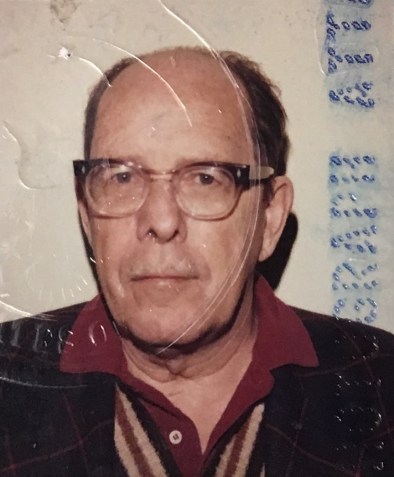
Contributed by Quinn Rosefsky  (Phillips Academy Class of ’59)

Robert Singleton Peabody (1837-1904) grew up in Muskingum County, Ohio—just outside of Zanesville—but attended an eastern boarding school—Phillips Academy—to graduate in 1857. After law school at Harvard he established a lucrative legal practice in Vermont before relocating to the Germantown area of Philadelphia. During much of his life, Robert nurtured an interest in archaeology and Native Americans and worked to amass a personal collection of artifacts. In 1866, Robert’s uncle, George Peabody (known as the father of modern philanthropy) gifted PA with funds to establish a “scientific department” to encourage scientific discourse be incorporated into the curriculum. At the turn of the 20th century, Robert sought to revitalize his uncle’s good intentions by re-establishing a program for the sciences, specifically archaeology.

The archives of the Peabody Museum contain the letters and documents that reveal the evolution of Robert’s intentions. The primary correspondence is between Robert Peabody and Warren K. Moorehead. Moorehead was the man responsible for building, cataloging, and maintaining Robert’s artifact collection and would ultimately become the first curator of the Department of Archaeology at Phillips Academy.

Peabody then wrote in a letter dated March 3, 1898, that he was impressed with Moorehead’s cataloguing of the substantial collection Peabody had amassed (nearly 50,000 artifacts), which were “of sufficient value, to be cared for.” Adding, “I have known too well the fate of those Orphaned collections placed at the Mercy of a cold world…” Although what Peabody then proposed was to establish a department of archaeology, he also wrote that the financial situation at the time was not good. He was likely referring to the Panic of 1893, during which 500 banks closed and 15,000 businesses failed. The ensuing financial depression lasted from 1893 to 1898. Peabody’s conclusion was: “…I will not deliberately, add another to the list of failures…I want to make assurance doubly sure, if I go into it at all.”

Nevertheless, Moorehead’s letter to Peabody on April 4, 1898, continued to press the issue. He had spoken to the wife of Dr. Wilson, a Curator of Anthropology at the Smithsonian Institute, and conveyed her response to Peabody: “…It is fortunate for Andover and the public at large that you conceived the idea of preserving archaeological relics.”

The archives have a gap in the sequence of letters, but it is clear that Robert S. Peabody had been having discussions with Dr. Cecil F. P.  Bancroft (1839-1901), Andover’s fifth headmaster. Bancroft agreed to help push the project forward with the school’s Board of Trustees. By November 11, 1900, planning was well-advanced.

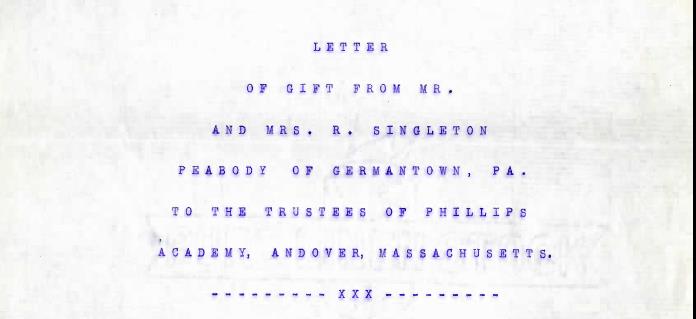
In a letter dated March 6, 1901 from Peabody to the Trustees of Phillips Academy, the amount and purpose of the donation were laid out. Specifically, Peabody wished his collection to have a home for preservation, the establishment of a Department of Archaeology which would be “self-supporting and independent.” Furthermore, this Department should be “disconnected from any other branch of Phillips Academy.” As for the museum itself, “…(it) should be, as far as consistent, tasteful and attractive on its exterior, with good proportions, not too high, and within, light and cheerful as possible, with some simple and tasteful decoration—as tinted walls, etc.” Peabody went on to propose that Moorehead be the first curator because “…Professor Moorehead knows every specimen in the collection, and its history.” Peabody also stipulated, “…that the building/museum be a pleasant place where students might find an agreeable relaxation during the broken events which occur in the lives of the most closely pressed.” In other words, the building would serve not only as a museum but as a social center.

It was no surprise that the amount of the gift to Andover, indicated in a letter dated March 8, 1901 from Peabody to Bancroft, was related to the amount given previously by his uncle in 1866. George Peabody had also dedicated the same amount—$150,000—to aid in founding the Peabody Museum of Archaeology and Ethnology at Harvard and the Yale Peabody Museum of Natural History. To differentiate himself from his uncle, Robert pointed out that his gift would also include a collection of artifacts. These artifacts amounted to one hundred thirty-two boxes containing nearly 50,000 items insured for $35,000 at the time of transportation by rail on July 10, 1901 from Philadelphia to Warren K. Moorehead in Andover. The actual endowment, anonymous by design, included $100,000 for the Peabody Foundation and $50,000 for the building. This amount would grow substantially at Peabody’s death, as he willed the residue and remainder of his estate to Phillips Academy in March, 1902. The total gift amounted to at least $500,000—approximately $12 to $13 million by today’s standards.

What did $50,000 buy in 1901? The future architect for Boston’s Museum of Fine Arts, Guy Lowell, was hired and he submitted plans for the projected museum at Phillips Academy. By the end of October, 1901, ground-breaking began on the site where formerly the First Classroom Building, the Farrar House, and then the Churchill House had been located. The building was completed in less than two years and was dedicated on March 28, 1903, the event was  memorialized in the mid-April 1903 edition of The Phillipian.“The building was tastefully decorated with potted palms and flowers…Mr. Frederick W. Putnam, L.L.D, professor of Ethnology and Archaeology at Harvard, said that students would learn to reason more for themselves, and would depend more upon their own powers than upon text books.”

The art of collecting

“Briefly stated, the history of archaeology in the Northeast has been in no way different from the history of archaeology elsewhere: its birth was as relic collecting, for the pure and simple interest of the objects recovered. It was soon recognized that without supporting data such objects were little more than curios, and that even with supporting data as to provenience – all too frequently so vague as to be of little value—they still were closely akin to curiosities and the undertaking little more than antiquarianism.” (Douglas Byers, Peabody Annual Report, 1948)

Since beginning my project at the Peabody, I’ve been intrigued by how American Indian artifacts were collected in the first few decades of the 20th century. At the time, the practice ranged from small-scale hobby collecting to commercial-minded efforts to acquire and sell artifacts for profit, to museums collecting for “scientific study.” The Peabody archives offer a glimpse of how artifact collecting, mostly on a small scale, was conducted, documented and perceived. That distinctions were made between “collectors” and professional archaeologists seems clear, even in the early 1900s. And yet, as the quote from Byers above indicates, relic collecting is part of the story of archaeology in the United States. What role did it play in this story, and what common purposes and/or divides developed between the various actors interested in archaeology and artifacts?

I first noted documentation of avocational artifact collecting in Warren K. Moorehead’s records (1890s-1930s). Moorehead, the Peabody’s first curator and subsequent director (1901-1938), was well known to amateur collectors; he wrote publications catered to them, such as Prehistoric Relics (1905), purchased artifacts from them, sold artifacts to them, and included images of collector artifacts in his two-volume The Stone Age of North America (1910) (which he then marketed back towards those same collectors). Collectors wrote him, seeking his expertise, as well as those seeking to sell larger collections. He was criticized by his professional peers for being overly focused on artifacts and not exercising rigorous archaeological science. Years later, in 1973, retired Peabody Curator Fred Johnson wrote in a letter to a graduate student: “Moorehead was very definitely not an archaeologist even in the frame of reference of his times. He has never published an important archaeological book or paper. He was a collector, a confirmed looter of archaeological sites and he had no other purpose in life than to secure by any means, regardless of any kind of ethics, specimens which were the ‘best,’ unique, unusual, etc.”

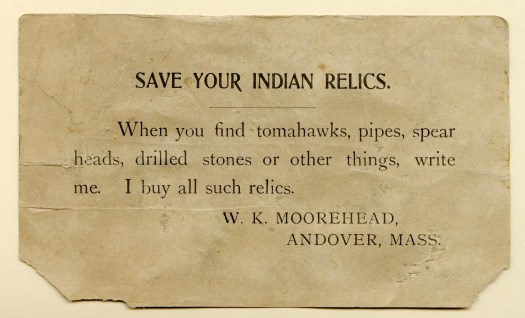
A small card bearing the following text: "Save your Indian relics. When you find tomahawks, pipes, spear heads, drilled stone or other things, write me. I buy all such relics. W.K. Moorehead, Andover, Mass."
Warren Moorehead’s “Save your Indian relics” card, circa 1900-1920

Despite those accusations, and the appearance he gave at times of being a salesman, Moorehead denounced those who destroyed sites to acquire artifacts, and had advocated for the preservation of archaeological sites in the past. In “Commercial vs. scientific collecting” (1905) he wrote: “.. [commercial collectors] have ransacked the graves, mounds and cliff houses, dragged forth the humble arts of simple aborigines long dead and sold them for a few paltry dollars. The destruction of archaeological testimony wrought by these vandals is something beyond compute” (114). In contrast, he describes the simple joys of avocational collecting: “For the local student who collects for his own pleasure, we should have nothing but commendation, for at some future date his cabinet may be preserved. His expenditures, his trips to favorite localities that he may personally roam over freshly ploughed fields, his hours spent in arranging his cabinet during winter evenings are all labors born of love” (114). He also notes that these small collections are “gradually drifting to the permanent museums,” rejoining collections obtained through professional excavations.

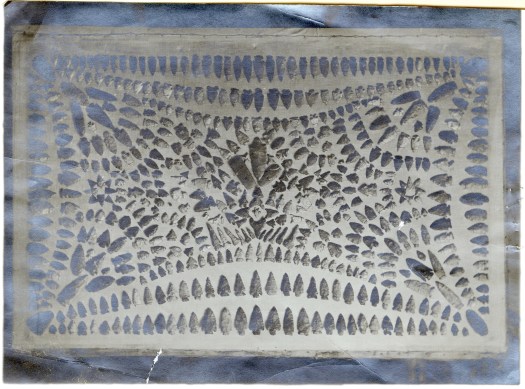
While looking through the photographs of artifacts sent to him, I was struck by the “arrangement of the cabinet,” how collectors artfully arranged their artifacts into patterns or staged them to be photographed. Current Peabody Director Ryan Wheeler told me the practice continues to this day. It’s almost as if the deliberate act of collecting is put on display through these creative arrangements: the hand of the collector in accumulating these collections is manifest.

Black and white photograph of of American Indian artifacts arranged into a pattern
Photograph sent to Warren Moorehead of American Indian artifacts from the collection of Inez A. Hall, Pennsylvania, circa 1900-1910

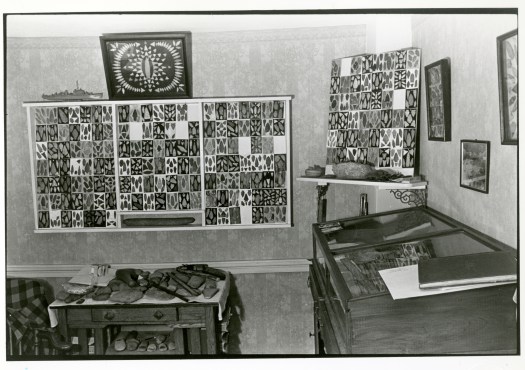
A fuller portrait of one such collector emerges in the Peabody archives. Massachusetts native Roy Athearn, born in 1895, began collecting artifacts as a boy in the early 1900s. He collected over 13,000 artifacts during the course of his lifetime, within a five mile radius of his home in Fall River. He took extensive notes on the circumstances of his finds, ensuring  his collection was well documented. He was a member of the Massachusetts Archaeological Society. Below is a photograph of his home, taken in conjunction with an analysis and assessment of his collection carried out by the Massachusetts Historical Commission in 1982.

This black and white photograph depicts several cabinets in the home of Massachusetts native Roy Athearn, whose 13,000 object collection was significant.
Artifact cabinets from Massachusetts collector Roy Athearn’s 13,000 object collection, circa 1982, photograph by T.C. Fitzgerald

To learn more about avocational and professional archaeology in the United States in the early 20th century, Ryan pointed me to a few books, one of which was Setting the Agenda for American Archaeology : The National Research Council Archaeological Conferences of 1929, 1932 and 1935 (2001). Within the NRC, the Committee on State Archaeological Surveys was founded in 1920 under the Division of Anthropology and Psychology. One problem the committee sought to address was “.. the fact that a nation’s fascination with the past was leading to a rapid destruction of archaeological sites and the commercialization of antiquities.” This had less to do with individual collectors than with state-level museums and historical societies, who carried out excavations with little training or expertise, and “had no guiding voices on how to explore the past without destroying the very record being examined” (x). The committee decided that one solution to this problem might be in reaching out to and educating non-professional archaeologists in standards-based archaeological method, through distribution of instructional literature and organization of seminars on the topic. To really appreciate these efforts, one must read the rest of the book, but a common purpose between disparate actors begins to take shape through the idea that avocational archaeologists could be enlisted in preserving contextual information of sites. How did this play out over the rest of the century? And what was the position of museums during this time, such as the Peabody? What divides continued to exist and what relationships evolved? These are all questions I’m curious to investigate further.

The Temporary Archivist position is supported by a generous grant from the Oak River Foundation of Peoria, Ill. to improve the intellectual and physical control of the museum’s collections. We hope this gift will inspire others to support our work to better catalog, document, and make accessible the Peabody’s world-class collections of objects, photographs, and archival materials. If you would like information on how you can help please contact Peabody director Ryan Wheeler at rwheeler@andover.edu or 978 749 4493.

Reorganizing the archives storage alcove

For the past two weeks, the museum staff (and one volunteer — thank you Quinn Rosefsky!) all pitched in to make the archives storage area neater and more manageable. This physical reorganization had been anticipated and discussed since I began my work here in May. At that time, many materials were still in filing cabinets, with boxes piled on top.

Though most of these cabinets and boxes were labeled, the exact nature of the materials and the period of the museum’s history to which they belonged were not necessarily obvious. Related materials could be spread out among different boxes and cabinets without that intellectual integrity being apparent. If a museum staff member was looking for a specific piece of information in the archives, say when a particular exhibit was on display at the museum, it could be challenging to find it!

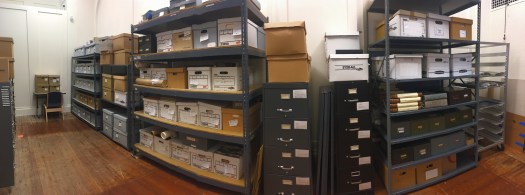
As I reached the end of my collections survey, I began to understand which materials belonged together as collections. I boxed up several collections that were in filing cabinets, carefully labeling them as discrete groups of material: the Warren K. Moorehead records (1890s-1930s), the Douglas S. Byers and Frederick Johnson records (1920s-1960s), the Richard S. MacNeish records (1950s-1980s), the Tehuacan Archaeological-Botanical Project records (1959-1960s) and the Coxcatlan Project records (1960s-1970s). Other record groups such as the museum’s Education Department files were physically grouped together, and consolidated into fewer boxes. Empty filing cabinets were removed, new shelving was set up and boxes were arranged deliberately on the shelves.

Panorama of one side of the rearranged archives storages area.
West wall of the rearranged archives storage area.
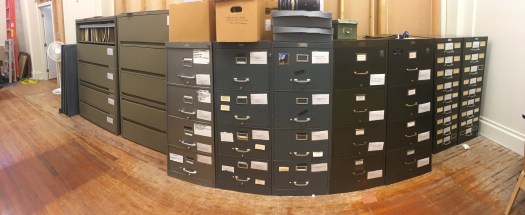
Panorama of the east wall of the rearranged storage area.
East wall of the rearranged archives storage area.

Records that are still being consulted regularly by museum staff such as accession files and site files were left in filing cabinets. Other material, such as the Ayacucho Archaeological-Botanical Project records (1969-1980s), was left in filing cabinets because we don’t have enough shelf space to accommodate more boxes at this time. There are also a few stray boxes that don’t yet have a home. Further tinkering of the space and rehousing of material will likely occur throughout the year. For now, the focus of the archives project will turn to creating inventories for individual collections, so that the material within them is easily findable for museum staff and outside researchers.

The Temporary Archivist position is supported by a generous grant from the Oak River Foundation of Peoria, Ill. to improve the intellectual and physical control of the museum’s collections. We hope this gift will inspire others to support our work to better catalog, document, and make accessible the Peabody’s world-class collections of objects, photographs and archival materials. If you would like information on how you can help please contact Peabody director Ryan Wheeler at rwheeler@andover.edu or 978 749 4493.


Dipping a toe into the Peabody’s archives

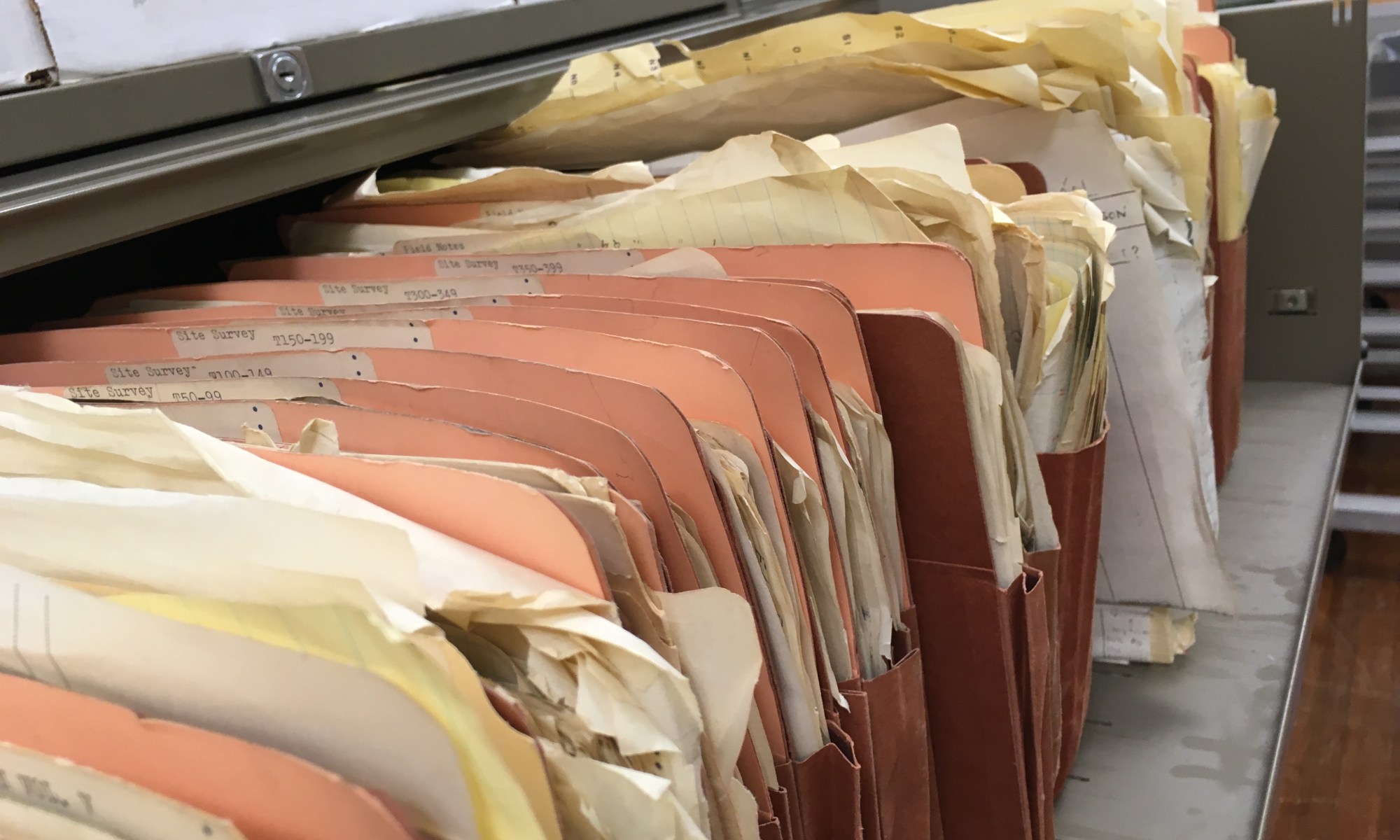
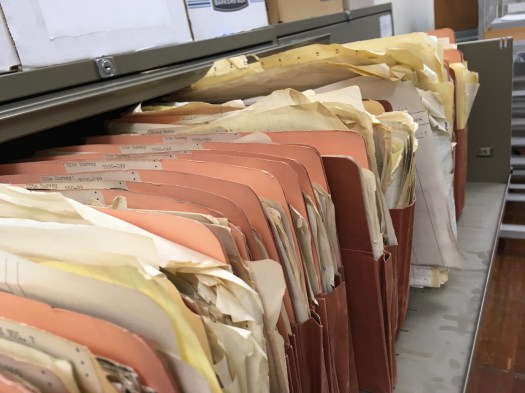
Folders full of Scotty MacNeish's Tehuacan survey records from the 1960s

In my first few weeks at the Peabody, I’ve been surveying the museum’s archival material to gain a better sense of the collections before proceeding to more detailed cataloging and processing work. It’s been fascinating to begin to piece together the history of the Peabody through the materials I’m coming across, and to learn about 20th century American Archaeology in the process. For this first blog post, I thought I’d share a few items that illustrate the types of collections found here at the Peabody.

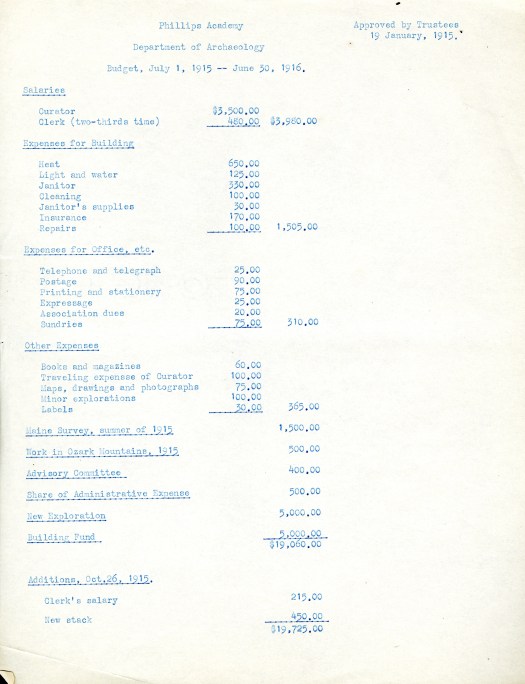
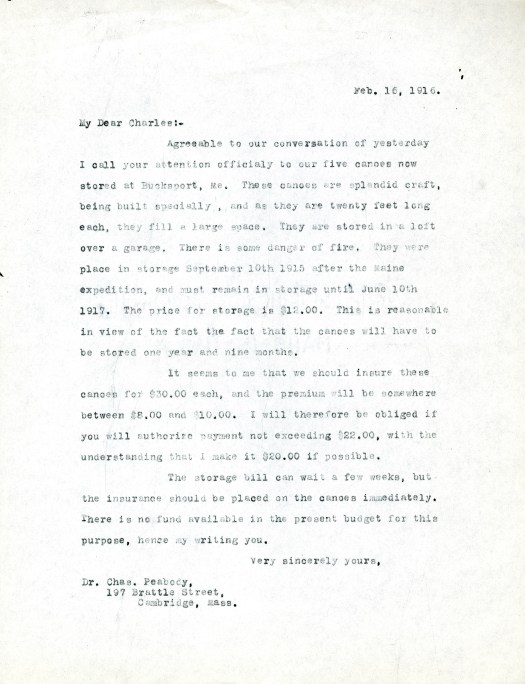
This 1916 budget and letter from Curator and subsequent Director Warren Moorehead to Director Charles Peabody discussing canoes are examples of routine records found in the museum’s organizational archives: they document the operation of the institution at a given time, and often provide as much information about the time period in question as they do about the institution. Organizational records can include correspondence, museum publications, annual reports, meeting minutes, grant files, and any other material produced in the course of the museum’s administration.

Phillips Academy Department of Archaeology budget, 1915-1916
Letter from Warren K. Moorehead to Charles S. Peabody, February 16, 1916
Letter from Warren K. Moorehead to Charles Peabody, February 16, 1916

Another significant amount of archival material here is comprised of excavation and field records. The Peabody carried out and funded numerous projects under the curatorship and directorship of Warren Moorehead, Douglas Byers and Fred Johnson, and Richard “Scotty” MacNeish, from the museum’s founding up until the early 1980s. Some of these projects were carried out locally in New England (note the canoes mentioned above, and Fred Johnson with expedition gear below), while others were carried out in the Southwest, the Yukon, and under Scotty MacNeish, Mexico and South America.

Fred Johnson in front of the Peabody Museum, 1948
Folders full of Scotty MacNeish's Tehuacan survey records from the 1960s
Folders full of Scotty MacNeish’s Tehuacan survey records from the 1960s

As some of the museum’s artifact collections were accumulated during these excavations, the records provide contextual information about the finds through their documentation of the sites in question, in addition to their significance for archaeological research more generally.

Another critical component of museum records are collection and registrar files, which document objects and their provenance. The museum’s accession files contain acquisition or gift information, correspondence about the object/collection, and other relevant documentation. Object ID images also fall under this category, and the Peabody has over 10,000 slides of object images alone. Occasionally, supplemental materials accompany gifts or acquisitions by the museum, providing additional context of an object or a collection. One such example are the 500 or so color slides taken by Copeland Marks in Guatemala during the 1970s, where he collected textiles that are now part of the Peabody’s collection. These beautiful, bright images may include shots of these textiles being made or worn by their original owners.

Coban, Guatemala, color slide by Copeland Marks, 1970s

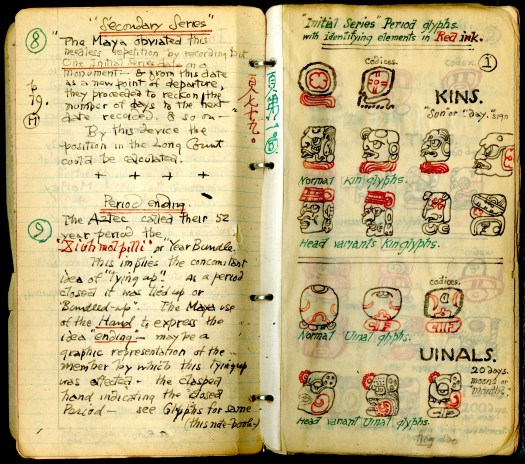
Another colorful find are six small notebooks belonging to Stuart Travis, who painted the large “Culture Areas of North America” mural at the Peabody. These notebooks are full of illustrations and information Travis recorded about the indigenous communities represented in the mural. A collection like this offers a glimpse into how Travis presumably conducted research for the mural and conveys how meaningful this project was for him. Several other collections here were donated by individuals who carried out specific projects for the museum, or volunteered here, such as Eugene Winter, who donated his large collection of personal papers.

Stuart Travis notebook, 1942

That’s all for now – I hope to delve more deeply into individual collections in the blog in the coming months. Thank you for following the project!

The Temporary Archivist position is supported by a generous grant from the Oak River Foundation of Peoria, Ill. to improve the intellectual and physical control of the museum’s collections. We hope this gift will inspire others to support our work to better catalog, document, and make accessible the Peabody’s world-class collections of objects, photographs and archival materials. If you would like information on how you can help please contact Peabody director Ryan Wheeler at rwheeler@andover.edu or 978 749 4493.