Changing Spaces

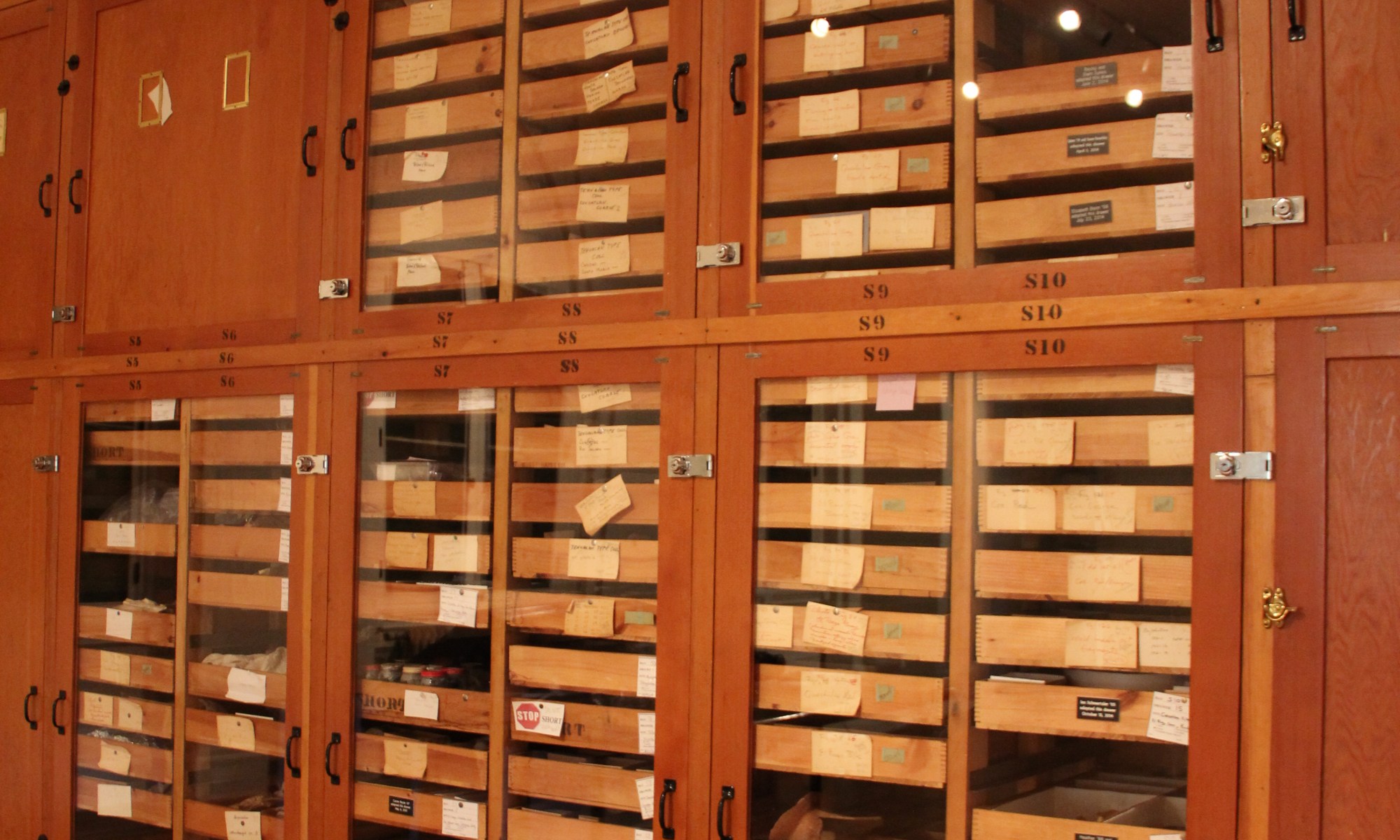
Collections with new plexi-glass doors

Contributed by Marla Taylor

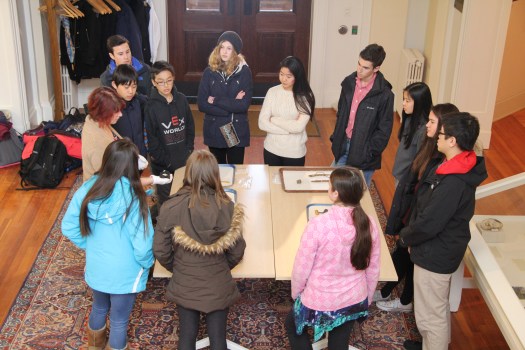
Updating spaces at the Peabody is like playing with a giant sliding puzzle. In order to rearrange one room, you have to make space in another for everything that will be displaced. We wrestled with this puzzle as we recently updated two major spaces at the museum – our basement work room and our main exhibit gallery.

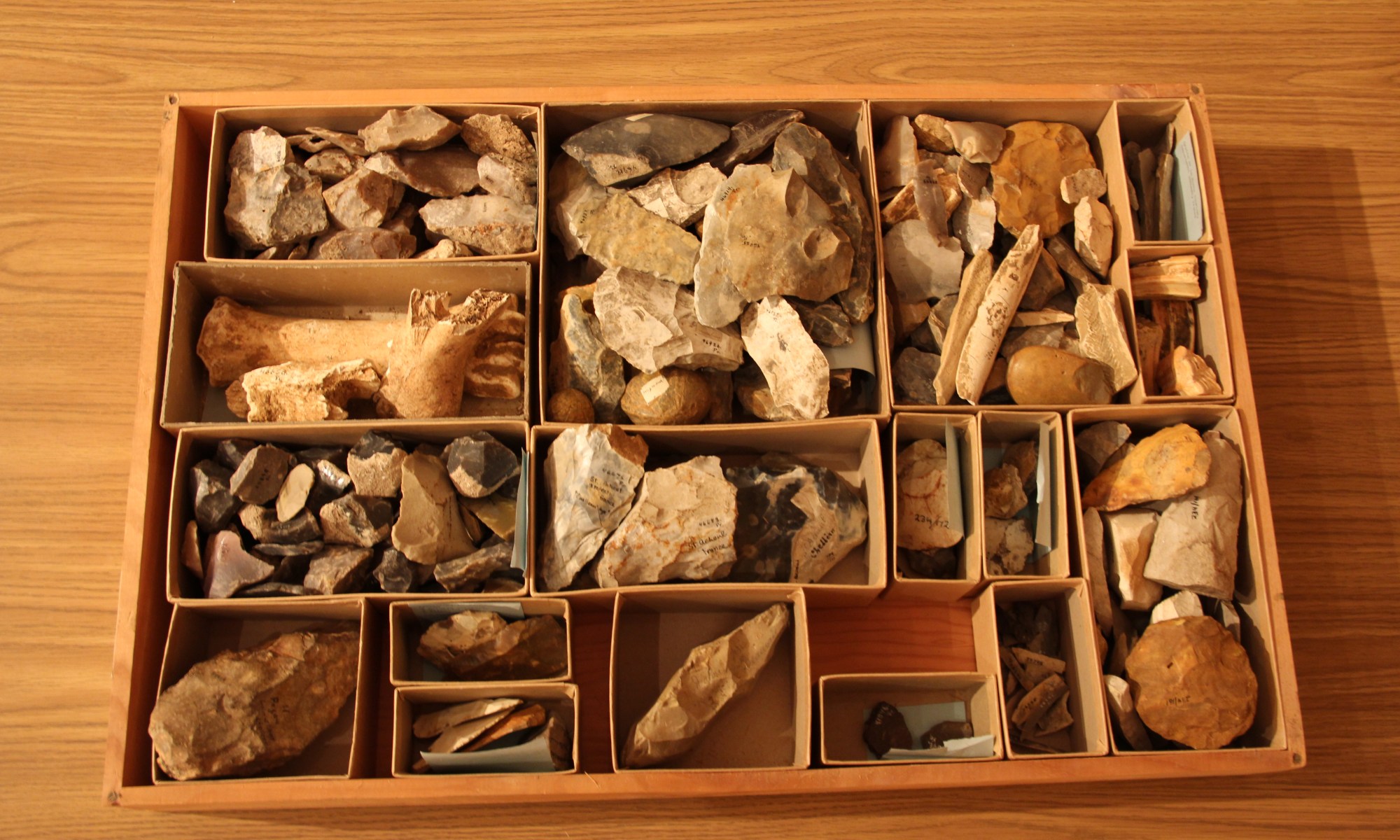
The basement work room is the center of most of the collections work at the Peabody. It is where work duty students, volunteers, and collections staff spends most of their time. And, until recently, it was home to several staff work spaces too. But it was time to refresh the space and make room to spread out the collection as we transfer artifacts from the old wooden drawer to new archival boxes.


Updating the gallery space was no small task! First, all the old exhibit was dismantled and objects were returned to storage. Then the exhibit cases were removed. And finally, the false walls that confined the space were demolished. Patching and painting is now underway. Future projects will see updated lighting and restoration of the windows.


Conversations are on-going about how to utilize this newly empty gallery space. The added space has already benefited our community family days and will hopefully provide space for student curated exhibits and larger student and alumni events.

If you haven’t been over to the Peabody for a while, now is the time!

Masks at the Peabody

Contributed by Lindsay Randall

Masks are one of the most visual elements of a culture, often used to transform the wearer during rituals, ceremonies, or other events. The use of masks dates back thousands of years, at least to the Neolithic period some 9,000 years ago or much earlier. Many of our masks are believed to be from Mexico. Two years ago work duty students began researching some of the masks in our collection.  While not complete, their work has been invaluable for the classes we teach. Recently the Peabody pulled all the masks from our collection to share with students in Therese Zemlin’s art classes.

One class has an assignment to make a 3 dimensional clay gargoyle. By studying the Peabody’s masks students investigate how artist’s created expressions, developed the proportions of facial features, and how human and animal features were melded together. The other class is learning to perceive minute details that are otherwise missed when we assume we understand what we see.

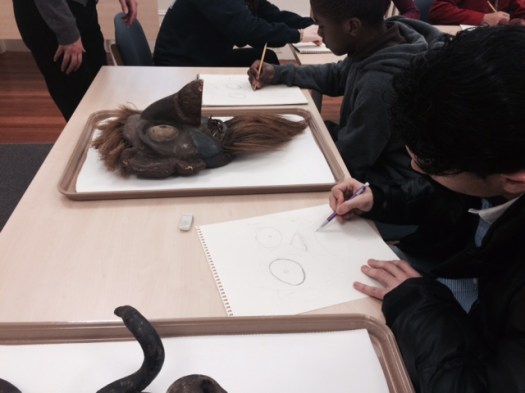
After looking at the masks and talking with me, the students are given time to begin sketching a mask of their choosing. This helps them to focus their attention even more and to gain a more intimate appreciation of the object in front of them, which will in turn aid them with their art projects.

FullSizeRender
A student sketches a mask of unidentified origin

To see some of the masks that the Peabody has visit our online catalog: http://peabody.pastperfect-online.com/40391cgi/mweb.exe?request=record;id=5114D1BC-AAD1-4BF5-A8B7-271626649170;type=101

Sharing what you learn – Student presentations

Image of student presenter

Contributed by Marla Taylor

On the third Tuesday of every month, the Massachusetts Archaeological Society – Gene Winter Chapter invites a guest speaker to their meeting at the Peabody Museum.  For the past six years, Phillips Academy students have been invited to speak about their experiences with archaeology at one of these meetings.

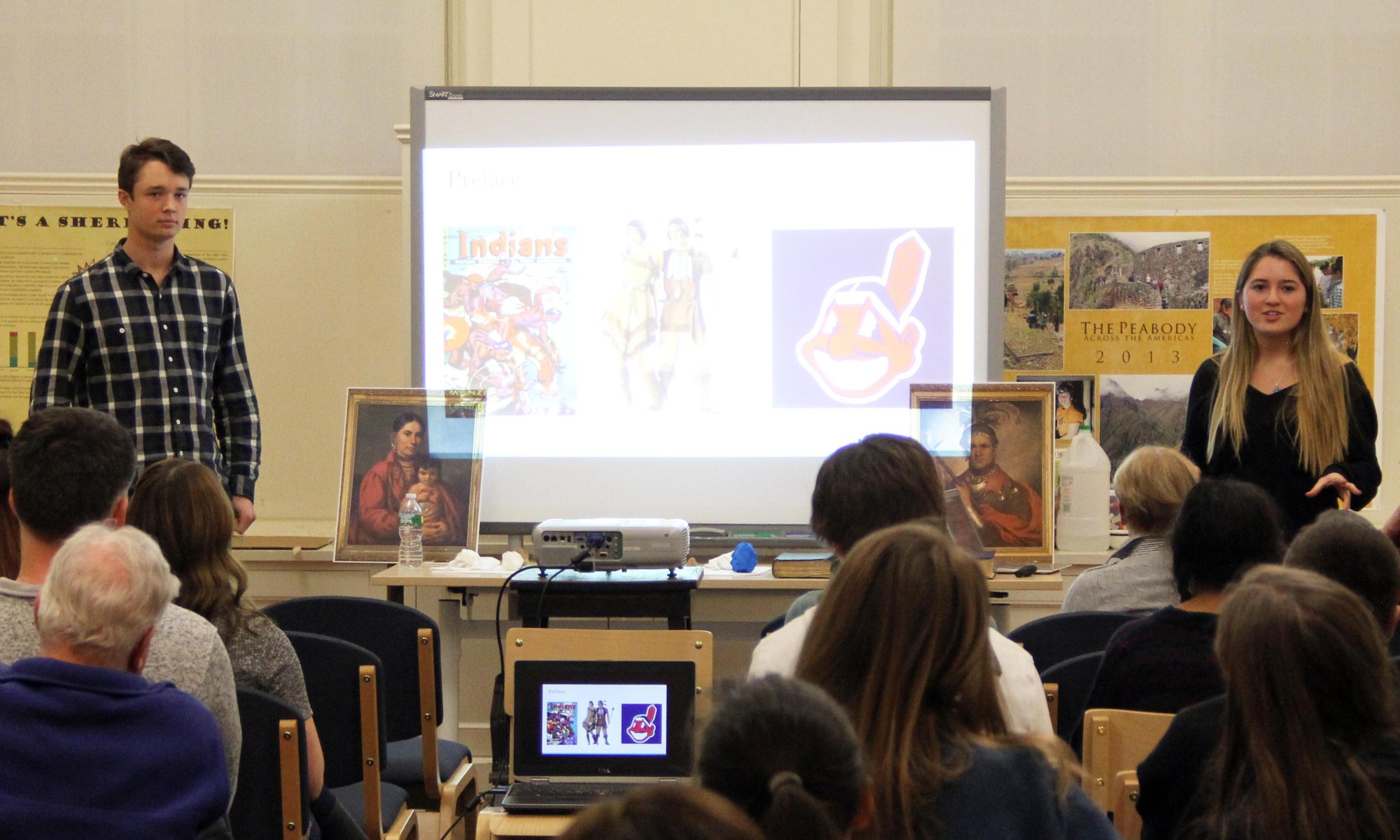
On February 16th, seven students, in three groups, shared their research and work on a variety of topics.

Youth for Restoration: Preserving Local History

Viraj Kumar’s ’17 interest in local history led him to create a non-profit organization that works to preserve and restore local history in Poughquag, New York. He discussed his experiences working with the community on a 19th century grist mill.

Printing History: 3D Rendering of Artifacts

Four students, Alana Gudinas ’16, Jacob Boudreau ’16, Mia LaRocca ’16, and Sarah Schmaier ‘16, were challenged to scan three artifacts from the Peabody Museum’s collection and print them as 3D models.  They discussed the process and highlight some of the implications of this technology for museums and other institutions.

More than Meets the Eye:  19th Century Portrayals of Native Americans

In the 1830s, the first director of the Bureau of Indian Affairs launched an ambitious effort to collect over one hundred portraits of Native Americans.  Veronica Nutting ’16 and Alex Armour’16 investigated three of these paintings at the Peabody–how and when they got here, why they’re important, and how they compare to contemporary depictions of Native Americans.

Speaking to an audience of nearly 50 chapter members, professional archaeologists, and members of the PA community, all the presentations were very well received.  Congratulations to all the students for their hard work!

Check out this article from the Phillipian to learn even more.

Where the Past Meets the Future–The Peabody’s 2015-2020 Strategic Plan

We are happy to share the Peabody Museum’s draft strategic plan for 2015-2020, which charts the course for significant projects ranging from improvements to the historic museum building to enhanced physical and intellectual control over archive, photographic, and object holdings.

The plan emphasizes elements of Phillips Academy’s 2014 strategic plan, especially around the pillars of Creativity and Innovation and Equity and Inclusion. Many of the most requested class units at the Peabody explicitly deal with issues of race, ethnicity, and gender, often in the context of Native American history. The new plan underscores the importance of anthropological perspectives in teaching in these areas and encourages continued good partnerships with Native American communities. The pedagogy of collaborative learning is central to the Peabody’s strategic plan, which stresses hands on learning, project- and problem-based learning, experiential learning, and informed discussion in all of the Museum’s student focused programs. Plans to significantly improve collections storage will increase accessibility and ensure that collections are available for use well into the future. Centralized storage of collections within the Peabody building will set the stage for expanded classroom space in the future and allow us to better care for our significant collections.

To read the plan please visit our website  http://www.andover.edu/Museums/MuseumOfArchaeology/Documents/PeabodyPlan2015_2020.pdf

Feedback is welcome! Please contact museum director Ryan Wheeler to share and discuss your ideas. E-mail: rwheeler@andover.edu or Phone: 978.749.4493

Blubber: It’s what’s for dinner

Contributed by Lindsay Randall

The end of Winter Term has arrived and with it the bitter New England cold, which is fitting given our most popular lesson during this time is our Inuit focused activity, Blubber: It’s What’s for Dinner.

The lesson is part of the History 100 theme related to nomadic people. In the fall 9th graders learn about the Bedouins who travel throughout a desert landscape. During winter term students continue that theme by learning about the Mongols, a nomadic group who live in the Asiatic steppe. Classes examine the Peabody’s arctic collections as a way to support their learning about nomadic societies, giving them a chance to apply concept they have learned in class and applying them to another nomadic culture.

The three extreme environments; desert, temperate grasslands, and the frozen north help to highlight the similarities of the three groups. This allows students to pick out important key aspects that are central to any nomadic group, no matter the landscape they inhabit.

Students move between four stations that are set up around the Peabody and work in groups to determine answers to the following questions:

  • What is each object? How was it used?
  • What is the object made from?
  • Why are the objects grouped together?

As class begins we review what it means to be nomadic and how that might be reflected in material culture. An initial activity emphasizes that everything a nomadic person carries has a purpose and the heavier an item, the more important it might be.

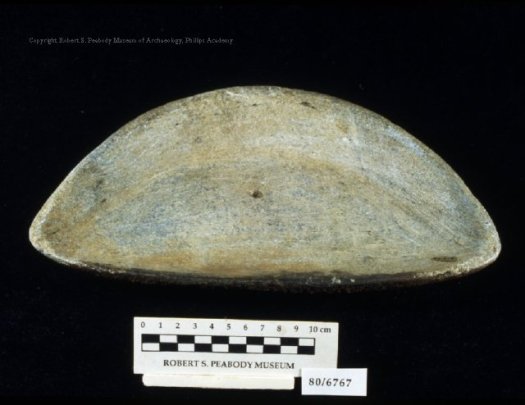
This is illustrated by the object depicted below. Students quickly determine that it is made from stone, which automatically demonstrates its importance.  The shape suggests that it was made to hold something, similar to a bowl. They know that whatever it held had to be extremely important. Some students notice that each bowl has some black markings around the rim. It is usually this revelation that helps students to work towards the correct assumption – the bowl held fire, which in the arctic is central to survival.

This stone blubber lamp was collected by William Duncan Strong in Hopedale, Labrador Canada. You can see charring along the edge as well as a hole in the center to hold the wick.

This is one of my favorite lessons to do because it gets students to look at objects as cultural markers and to understand how they can be “read” for information about the people who made and used them.

The class is also a source of enjoyment because of how deeply engaged students get, particularly when I give them frustrating answers. “Yes but no” or “no, but close” are two of the phrases I often tell students when they share with me their hypotheses about the objects.

To many students these answers are a challenge. However, the most enjoyable moment is when the entire group rushes across the room to conspiratorially whisper their new answers to me  – least their classmates hear – and jump around in joy to find out they are, in fact, correct.

Best. Part. Of. Teaching. EVER.

Lindsay Randall revealing to the entire class the names and uses of objects at one of the stations.


3D Scanning Artifacts: How Does it Work?

Image of 3D scan in the 3D printing software

Contributed by Claudia Wessner, Makerspace Coordinator and Library Experience Designer

Huge progress has been made in the collaborative project between The Nest, the makerspace at Phillips Academy, and the Peabody Museum! From the first day we received the Next Engine 3D Scanner, we had hopes of testing out this new technology in a fun and interesting way. After talking to Marla Taylor, we both thought it was a no brainer to form a collaboration between the museum, the makerspace and a group of work duty students (Alana Gudinas ’16, Jacob Boudreau ’16, Mia LaRocca ’16, and Sarah Schmaier ’16) to further explore the scanning possibilities.

In a previous post, Marla discussed the parameters in which the artifacts were selected. Once we brought the artifacts over to the Nest, we were able to make custom stands for two of the three artifacts so that they would be stable on the scanner. Then we got to work!

So, how does it work?

Before the scanning starts, we set up preferences such as resolution, color mode, and the number of incremental scans, as well as positioning the object in the camera’s field of view. The higher the desired resolution, the longer the scanning process will take.  Most of the objects we scanned took around one hour.

Collage of photos showing the lasers during the scanning process
Lasers scan the artifact

The scanner begins by taking a 2D image of the object then shoots out an array of red laser beams to capture the depth and texture of the object. Next, it completes a series of slow incremental rotations, based on the level of resolution selected, and performs the same 2D/3D rendering for each increment.  The Next Engine software slowly builds the 3D model before your eyes as it layers the data captured by the scanner.

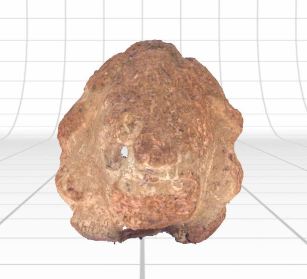
Image of 3D scan of artifact
Fully rendered 3D model from the scan

After the scanning is complete, the 3-dimensional model of the artifact appears in the Next Engine software. Depending on how the artifact is scanned, there may be some holes in the model. This would be where the lasers may not have been able to reach, such as the top or the bottom of the artifact. There are ways to avoid holes by completing several scans of the same object (top, bottom, full 360) and then fusing them together. This is something I am looking forward to experimenting with in the future, but for our initial exploration we did a single scan.

In order to fill the holes in our model, I “polished” it using the Next Engine software. The program will automatically find and select holes in the model. Then you can use a paintbrush tool to select the areas in which you’d like to fill.  This can also take some time and experimentation, especially with very high resolution scans where image rendering can use a lot of computing power.

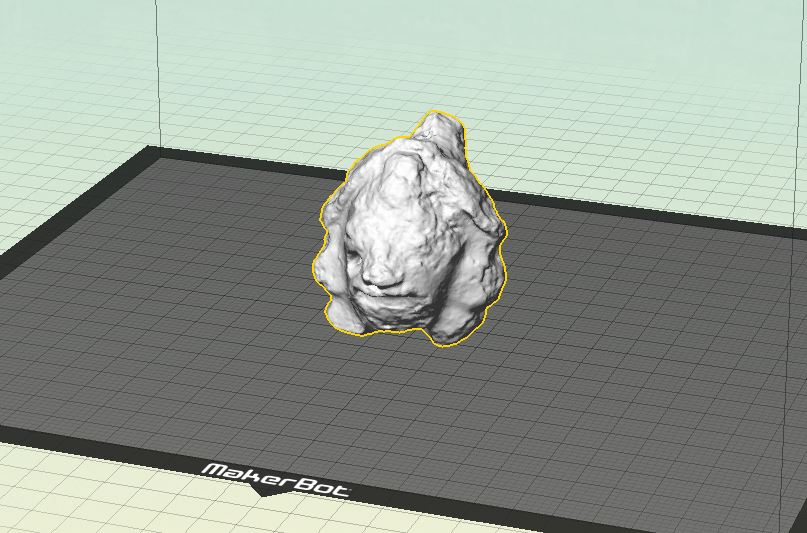
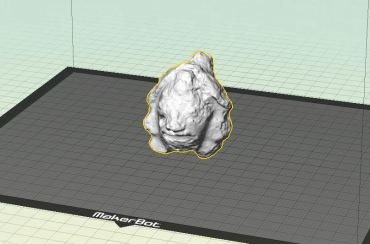
Once the editing of the model is complete, it is ready to prepare for printing by saving it as a .stl file and opening it in the Makerbot Desktop software. In the software you can scale, rotate, and place your object in the desired location on the build plate. You can also preview how long the print will take.  This artifact, which was approximately four inches tall, took about 5 hours to print.

Image of 3D scan in the 3D printing software
The 3D scan is ready to print

The Makerbot 3D printer uses a material called PLA that is stored in a spool in the back of the machine. The PLA is heated in an extruder and lays down very thin layers of material to build the object from the bottom up. Think of it like a glorified glue gun! The makerbot will automatically add “support material” that will support the object as it is printing so that everything stays intact. Once it is finished printing, any support material easily breaks off from the print.

Image of the 3D printed artifact
The 3D printed artifact!

We are so excited about the results of our project! We are looking forward to scanning more artifacts in the Peabody collection and refining our skills with this new technology! Stay tuned!

3D Artifact Collaboration

Contributed by Marla Taylor

An exciting new project is taking shape this winter at the Peabody Museum. Work duty students Alana Gudinas ’16, Jacob Boudreau ’16, Mia LaRocca ’16, and Sarah Schmaier ’16 and I are collaborating with the folks at the Nest, the makerspace at Phillips Academy, to scan three artifacts from the Peabody’s collection and print them as 3D models.

The students were challenged to identify artifacts that were stable enough to be transported to the OWHL, which is where the Nest is located; had interesting textural details; and would not be limited by a 360-degree scan along a single plane (i.e., the top and bottom would not be “seen” by the scanner). The three artifacts they selected are from the Tehuacán Valley of Mexico and were excavated by Richard “Scotty” MacNeish in the 1960s. Two of the objects are whistles—we hope their 3D replicas will be playable!

The first scan has been completed, and more are scheduled. The students will clean and manipulate the scans before they print them.

An exhibition about the process and the implications of 3D scanning and printing technology on cultural heritage preservation will be installed in the OWHL at the end of winter term.

A major thank-you to Claudia Wessner, makerspace coordinator and library experience designer at the OWHL, and the Nest work duty students for all their help!

I will keep you updated as work progresses.

Peabody Student Symposium

IMG_9042_editedJoin the Peabody and the Gene Winter Chapter of the Massachusetts Archaeological Society for a night highlighting student work and research. Three groups of students will present their research ranging from historic preservation to 3D printing artifacts to 19th century portrayals of Native Americans.

Tuesday, February 16, 7:00pm

Robert S. Peabody Museum of Archaeology, corner of Main and Phillips streets, Andover, Mass.

Peabody Strengthening Relationship with Pueblo of Jemez

Contributed by Lindsay Randall

The Peabody Museum has begun the collaborative process of reexamining our relationship with the Pueblo of Jemez. The Peabody’s involvement with the Jemez dates back 100 years—to the period from 1915 through 1929 when Alfred V. Kidder and his colleagues conducted excavations and ethnographic studies of the Pecos and Jemez pueblos. Consultations under the Native American Graves Protection and Repatriation Act (NAGPRA) in the 1990s rekindled the relationship and launched the Pecos Pathways expeditionary learning program at Phillips Academy. Pecos Pathways has been the centerpiece of the Andover-Jemez relationship since 1998, but we’ve seen a host of other collaborative efforts since then, including the recent visits by potters Dominique and Maxine Toya and their friends.

10336852_10154112165645034_6780009494536355039_n

Dominique Toya works with PA students in Mr. S. Thayer Zaeder’s ceramics class.

The goal of this critical assessment is to ensure that the partnership is maintained in a coherent and consistent manner, despite the changing needs and desires of the partners through time. We want to focus on sustaining and growing the relationship and enhancing its impact through the exchange of knowledge, resources, and individuals from each community. Initially we are working with the Education Department at Jemez, but we will expand the conversations to include other members of the tribe, such as those in the Department of Natural Resources who oversee all tribal archaeological work.

We recently began conversations with Janice Tosa, research associate and student program outreach manager for Jemez Pueblo, and Leander Loretto, student outreach coordinator for Jemez Pueblo, about how we might modify and expand our joint educational offering. A main focus in the conversations has been on creating programming that supports and advances our learning objectives in a more tangible manner, while also being sustainable. Looking at unique and creative ways in which adult members of each community can be engaged and utilized is another area that we are exploring.

We look forward to working with our friends at Jemez Pueblo on this exciting project!

Above Clockwise: Janice Tosa shows off her love of the Boston Red Sox’s; Leander Loretto screens for artifacts on the Mashentucket Pequot Reservation; A Pecos Pathways group prepares to hike up San Diego Mesa.

Family Drop-in Days at the Peabody

25_IMG_7969_edited

Drop in for a fun-filled morning of archaeology activities at the Peabody!

Build a LEGO model of your favorite ancient ruin, examine stone tools close up, play Native American musical instruments, and make your own Hohokam style etched shell. All families are welcome to join us; there’s something for every age!

Friday, February 19 from 9:00am to 12:00 noon and Friday, March 25 from 9:00am to 12:00 noon.

Robert S. Peabody Museum of Archaeology, corner of Main and Phillips streets, Andover, Mass.

Call 978.749.4490 or e-mail rspeabody@andover.edu for more information.