My name is Adam Way. I am currently a graduate student at the University of New Hampshire and am working towards my Master’s Degree in Museum Studies. This summer I am working as an independent researcher for the Peabody Institute looking through old Phillipians to see how the Institution has been perceived and presented by Phillips Academy students over time.
This is me on the Cadir Hoyuk archaeological site located in central Turkey in 2018.
In the modern day, there are a number of factors that determine the best place for an artifact or specimen, whether it is in a museum, either private or public, or with the people for which the item has cultural significance. This, of course, has not always been the case. For a long time, the mentality regarding the storage, display, and ownership of artifacts was similar to that expressed in Indiana Jones and the Last Crusade: “It belongs in a museum.” This mind set and practice is certainly present during the early years of the Archaeology Department, now the Peabody Institute, and is reflected in the publication of its various acquisitions in the Phillipian.
There are numerous ways that a museum or institution, such as the Peabody, can increase the size of its collections. These methods include donations, purchasing and exchanging of collections, and conducting archaeological expeditions. Through these methods, the Peabody was able to amass a collection of around 81,000 specimens within its first twelve years of operation (according to the Founders’ Day issue of the Phillipian from Oct 11, 1913).
Phillipian Article, October 11, 1913
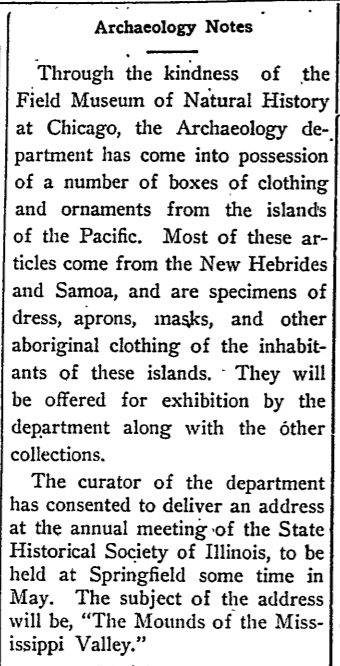
While looking through the issues of the Phillipian, it quickly became clear to me that two of these methods of acquisition occurred more often than the third – donations and purchases/exchanges. Donations played a key role during the early years of the Archaeology Department and its collections as they allowed for the collections to grow without draining their available funds. The Department received donations from both individuals with private collections as well as from other organizations. This can be seen in instances like the gift from the Field Museum of Natural History in Chicago, where a sizable donation of clothing and ornaments from the Pacific Islands was made in March of 1910 (although these are not currently present in the Peabody’s collection). While donations like this did occur, it was much more common for individuals to make donations from their own private collections. These gifts tended to be smaller in size but would still dramatically impact the total collections due to the overall volume.
Phillipian Article, March 12, 1910
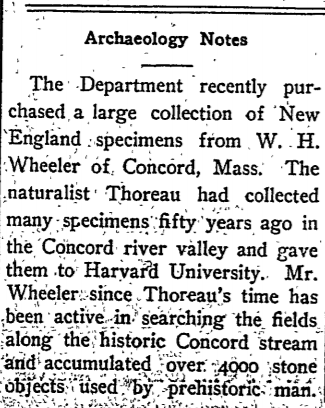
The other means of acquisition that occurred often was the act of purchasing collections or engaging in a trade. For example, In the Feb 1 issue of 1913, it was announced that Moorehead had traveled to Yarmouth, Maine to secure a collection from an Arthur Marks, Esq. By securing this collection, Moorehead added roughly 2000 specimens to the Department’s total collection. This was also only a few months after they had purchased another collection from W.H. Wheeler of Concord, MA. The Wheeler collection consisted of over 4000 objects from around New England and was the largest single purchase by the Department in the region.
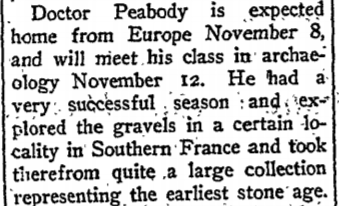
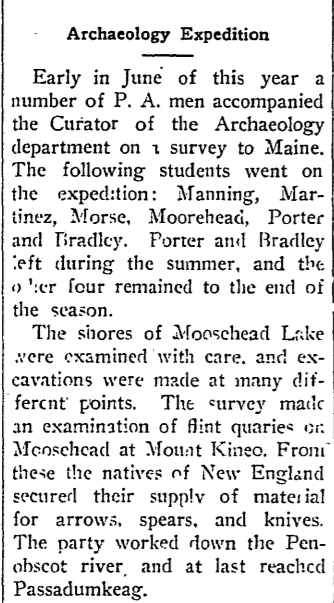
The last way that the Department expands their collection is through sponsored archaeological expeditions. This method of acquiring new specimens definitely occurs less often than the other two methods, especially at first, but becomes more frequent as time goes on. According to the articles in the Phillipian, the specimens retrieved from archaeological digs was fairly limited at first. They mainly came from Moorehead and Peabody’s research expeditions, both throughout the States and in Europe. It was mentioned several times that both men shipped collections of varying sizes back from Southern France. The number of domestic digs did increase as the years went on as Moorehead started a yearly expedition to Maine that brought in roughly 1000 specimens in the first year alone (1912). This specific expedition would prove fruitful for Moorehead as he returned many times in the coming years. In addition to Moorehead’s expeditions, there would also be collection trips where a member of the Department would be sent to a region, such as Eastern Massachusetts, and would be tasked with finding artifacts from old sites. These trips were quite common and could bring in up to 8000 artifacts in one year (1912-13).
From what I have seen in the Phillipian’s coverage of the ever-expanding collection, these methods of adding to the total collections of the Department contributed roughly the same amount. The amount of donations and purchases of collections far outnumber the number of archaeological expeditions; however, they are often much smaller in size. The balance of these three methods is subject to change as I have only read what has happened in the early years of the Department. It is nonetheless impressive how the Department was able to amass such a large collection in such a small amount of time.
The last lesson that I taught for the 2020-2021 academic year was unbelievably interesting and completely unlike anything I have ever taught about.
So. Much. BLOOD Fun.
Dr. Miriam Villanueva, faculty in the History department, taught a course during Spring term on understanding history through zombie films. She used films such as Ojuju and Zombi Child to explore various cultural, social, and economic issues impacting the cultures that the films center on.
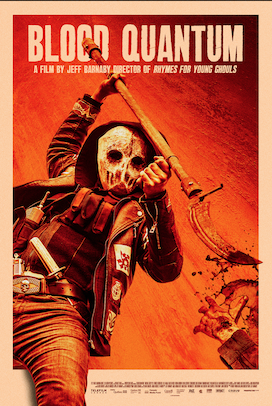
The film that I got to collaborate with Dr. V on was Blood Quantum by director Jeff Barnaby.
The indigenous people in the isolated reserve of Red Crow are immune to the zombie plague that has taken over the nation, but that doesn’t mean their lives aren’t at risk. It’s up to Traylor (Michael Greyeyes, “Fear the Walking Dead”), the tribal sheriff, to protect the families residing on the reserve and a flood of desperate refugees from the hordes of bloodthirsty, walking white corpses that are closing in.
The term “blood quantum” refers the racist concept that one’s “Indianness” can be quantified by the amount of “Indian blood” that one possesses. Historically, the idea of blood quantum emerged as a way to construct racial identity to benefit the dominant white society. The idea was as the blood of indigenous people became “diluted” that they would disappear – and with them any legal obligations the government had or any obstacle that they represented for the growth of white society.
The premise of Blood Quantum –that the Indigenous people of Red Crow are immune to becoming zombies–seems to be incredibly positive (as much as anything can be in a zombie film), students in Dr. V’s class were quick to pick up on the quote from the movie that being “immune to the plague doesn’t mean immune to being eaten alive.” They saw how the immunity actually served as another method to ensure the destruction of Native people – there would be no Indigenous people left while hordes of white zombies still roamed everywhere. However, their immunity did give members of the Red Crow reservation a power that was denied to all others in the movie.
As you can see, there was a lot for the students to unpack while watching the film. Below are just a few of the issues/metaphors that students investigated.
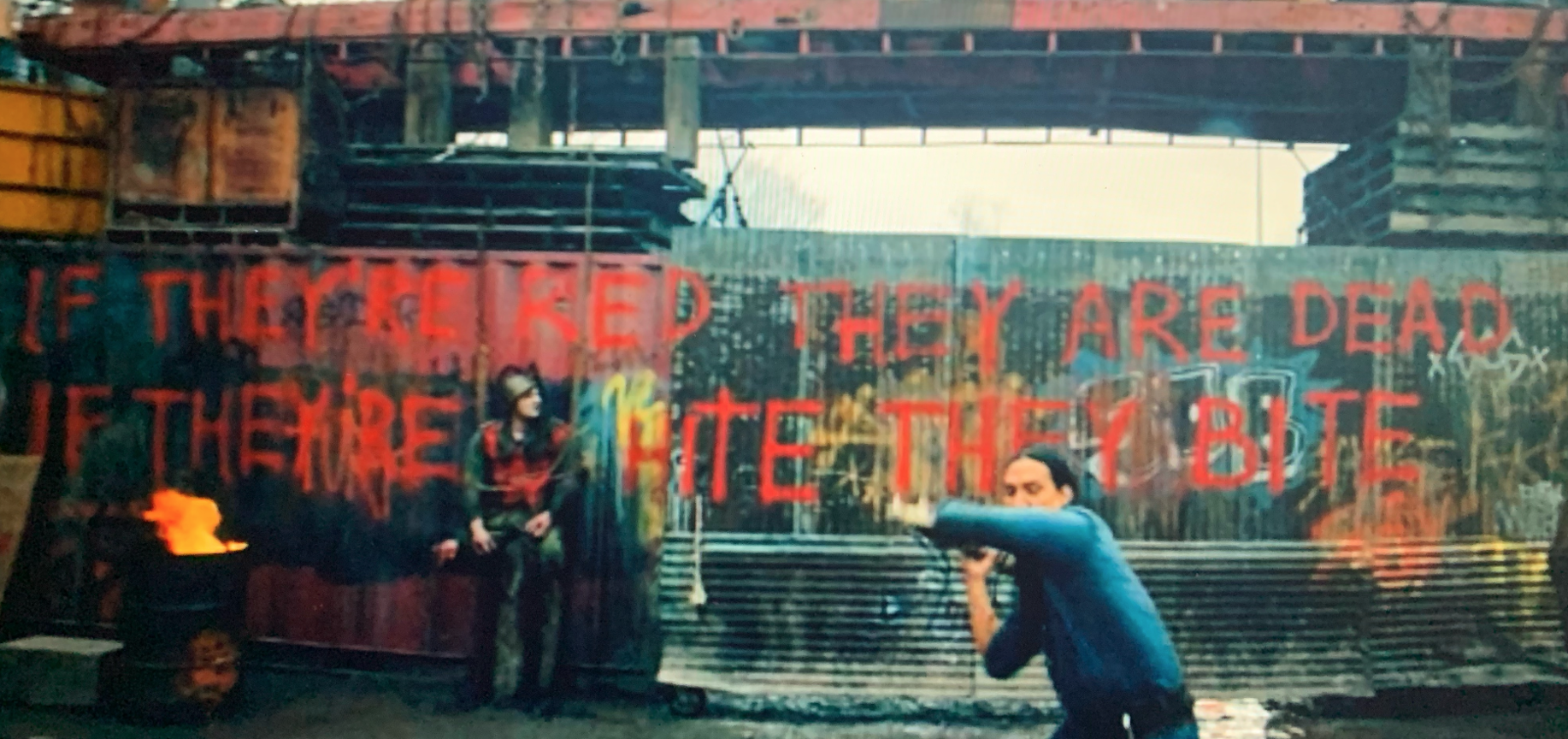
If they’re red, they are dead. If they’re white, they bite.
By no means are these all the ways that the movie serves as commentary regarding historical and contemporary issues in Indian Country nor are the examples given below the only ones that can be found in the movie.
Current conditions of Native reservations
Early on in the movie, there is a discussion about how all the tetanus shots in the clinic have been taken by the emergency department. Students saw this scene as connected to reservations given the historical and contemporary actions of resources being taken by the government and other for profit industries.
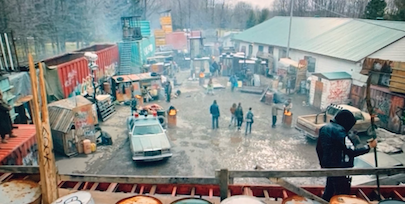
Students also discussed that how the compound was set up to protect against zombies was similar to modern reservations given its lack of electricity, heat, sanitation, and other vital supplies.
Red Crow Reservation during the zombie apocalypse.
Dishonesty towards Native people(s) and communities
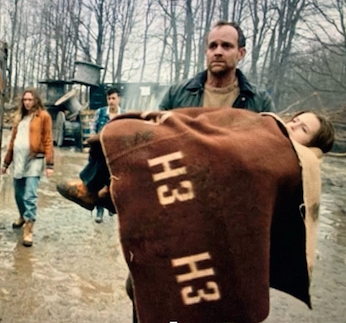
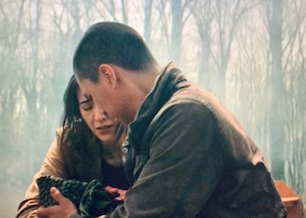
There is a scene where a father is trying to bring his clearly sick/injured daughter into the compound. When asked if she had been bitten the father denied it, however the bite mark was easily found on her neck.
There was also a character named Lilith who showed up with the father and daughter who also had a bite wound on her stomach, which she never disclosed while accepting the help and security being offered.
The dishonesty by the father and Lilith in their attempt to get what they wanted – no matter the cost to those who were trying to help them – reminded the students of both the historical and contemporary treatments of Indigenous people where information was intentionally kept from them and did not allow them to make informed decisions (such as the abhorrent lying that took place when Indian Health Services forcibly sterilized young women in the 1970s)
Father holding his infected daughter.
Destruction of Native families
The deaths of numerous characters throughout the movie is not the only way that the destruction of Indigenous families is portrayed within the film. One of the aspects of the movie that students noticed in connection to this was the fact that the character of Lysol had been placed within the foster care system. The statement in the movie that “he left an Alan and came back a Lysol” also demonstrates the trauma that is prevalent within the system and how it can change the entire personality of a child.
Placing Native children into the foster care system is a direct result of the same federal policies which lead to the creation of native boarding schools. The foster care system has played such a destructive role in the harming of Native families and communities that the state of Maine convened the Wabanaki-State Child Welfare Truth and Reconciliation Commission to investigate the trauma that resulted from decades long policies related to Native children in the state of Maine. (Dawnlandis an award winning documentary about the Commissions work)
Joss, Joseph, and Joseph’s newborn daughter on the run from zombies.
Missing and murdered indigenous women
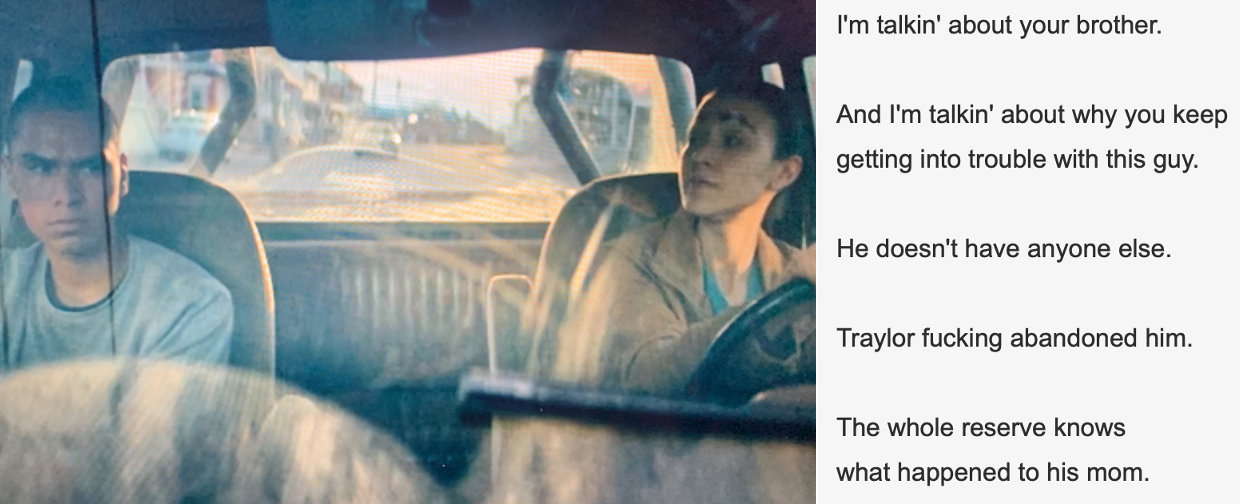
The absence of a person makes it easy for them to be overlooked, however students in the class were very aware that the mother of the character Lysol was mentioned a few times but never seen. One part of dialogue that the students brought up was when Joseph says, “The whole reservation knows what happened to his mom” but then nothing more about what happened is said.
The fact that the audience never learns the name of Lysol’s mother is another connection to missing and murdered Indigenous women. While the shooting of unarmed Black men is a crisis within society, at least we know the names of George Floyd, Michael Brown, Trayvon Martin and countless others. It is a sad commentary on our society that the average person cannot name even one Indigenous woman who has been murdered or who is currently missing.
Joseph and Joss talking about Lysol
Biological warfare
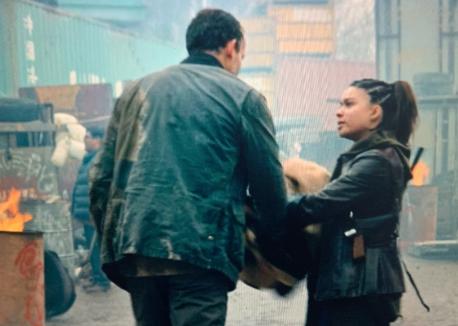
There is a scene where the father of the daughter who died outside of the camp due to a zombie bite brings in the blanket that she had been wrapped up in. When Kawennáhere Devery Jacobs’ character Charlie notices the blanket she grabs it from the man and throws it into a fire while yelling at him that he cannot bring that into the reservation.
One of the topics with which students were already familiar was protests against the destruction of the environment and areas of cultural significance by the construction of gas and oil pipelines. Many Indigenous communities have set up blockades, particularly on bridges, to stop the movement of workers and machines.
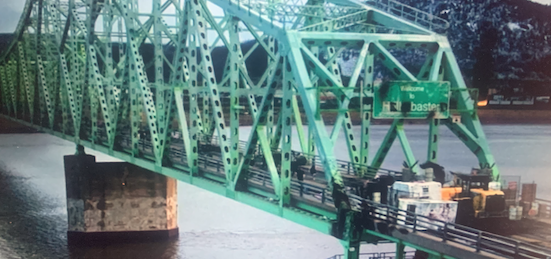
The imagery created by the barricade on the bridge to stop zombies from crossing into the reservation is incredibly similar to the pictures from protest sites such as DAPL/Standing Rock.
Barricade on bridge to stop zombies from entering Red Crow Reservation
Christian God used to defend the treatment of Native people(s) and communities
The use of biblical words and the concept of God has been used for centuries to rationalize the inhumane treatment of native people.
“For it pleased God to visit these Indians with a great sickness, and such a mortality that of a thousand above nine hundred and a half of them died, and many of them did rot above ground for want of burial” – Gov. William Bradford
“For the natives, they are near all dead of the smallpox, so the Lord hath cleared our title to what we possess.” – Gov. John Winthrop
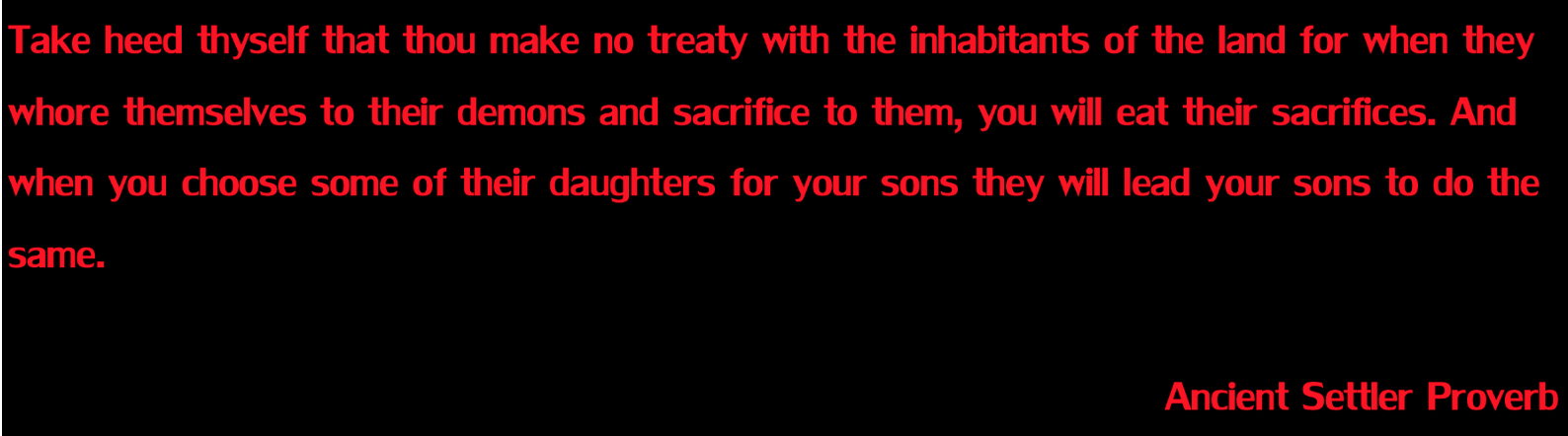
In the first moments of the movie an “Ancient Settler Proverb” appears:
“Take heed thyself that thou make no treaty with the inhabitants of the land for when they whore themselves to their demons and sacrifice to them, you will eat their sacrifices. And when you chose some of their daughters for your sons they will lead your sons to do the same.”
Some of the students were aware that the “Ancient Settler Proverb” was in fact Exodus 34:12.
Ancient Settler Proverb
Another interesting connection the movie made was to something that director Jeff Barnaby experienced as a child.
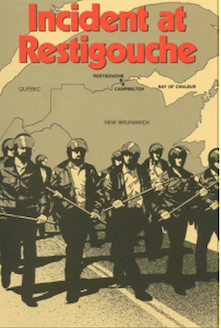
In June of 1981, Lucien Lessard, Quebec Minister of Recreation, Hunting, and Fishing instigated conflict with Mi’kmaq living on Restigouche (now Listugui) by demanding that they remove all nets from their traditional fishing waters. Salmon fishing was vital to the survival of those on the reservation there were, unsurprisingly there was intense pushback from community members. Instead of dealing with the issue peaceably, Lessard sent about 400 Quebec Provincial Police to engage in a brutal raid on the reservation.
Documentary “Incident at Restigouche”
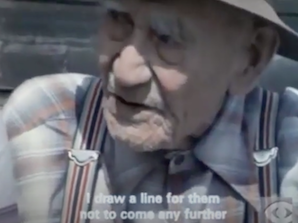
These events were captured in the documentary “Incident at Restigouche” and Barnaby has commented numerous times on how this film influenced his career. One of the scenes is that of an elder talking about how he took an ax and drew “a line for them not to come any further.”
Elder speaking about how he stood up to the forces illegally entering Restigouche.
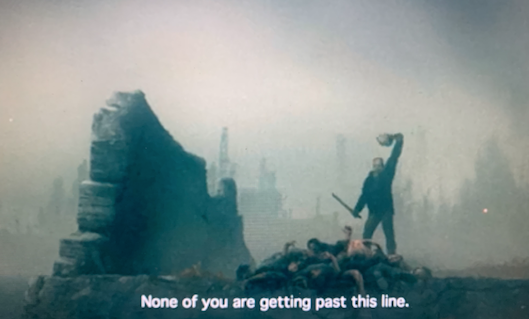
A hyper-specific homage to the violent events of 1981 at Restigouche and this elder in particular is found in the animated scene were Gisigu takes a sword to defend against zombies.
Scene from movie that references the attack on Restigouche
So, if zombie movies are your thing, you might consider watching this particular movie and I hope that this blog post will make your viewing richer in your understanding of how it serves as a commentary on issues within Indian Country.
Pets have always played an important part throughout history and there is regular evidence of this in the archaeological record. We’ve seen pets as companions, guides, and emotional support animals as well as hunters, messengers, and aids in transportation, security, and various other work.
Many archaeologists have found evidence of pets in their excavations of ancient sites, and some even study the history of pet-human bonding and to find the earliest evidence of these relationships. Some of the most recent sites with pet discoveries include a burial in Lima, Peru, an Ancient Egyptian port site that holds one of the oldest pet cemeteries (about 2,000 years old!), and a discovery of a prehistoric puppy that is about 14,000 years old (making it the earliest evidence of pets.)
May 2021 marks National Pet month and what better way to celebrate than to feature the furry friends of the Peabody’s staff!
Meet Scotty
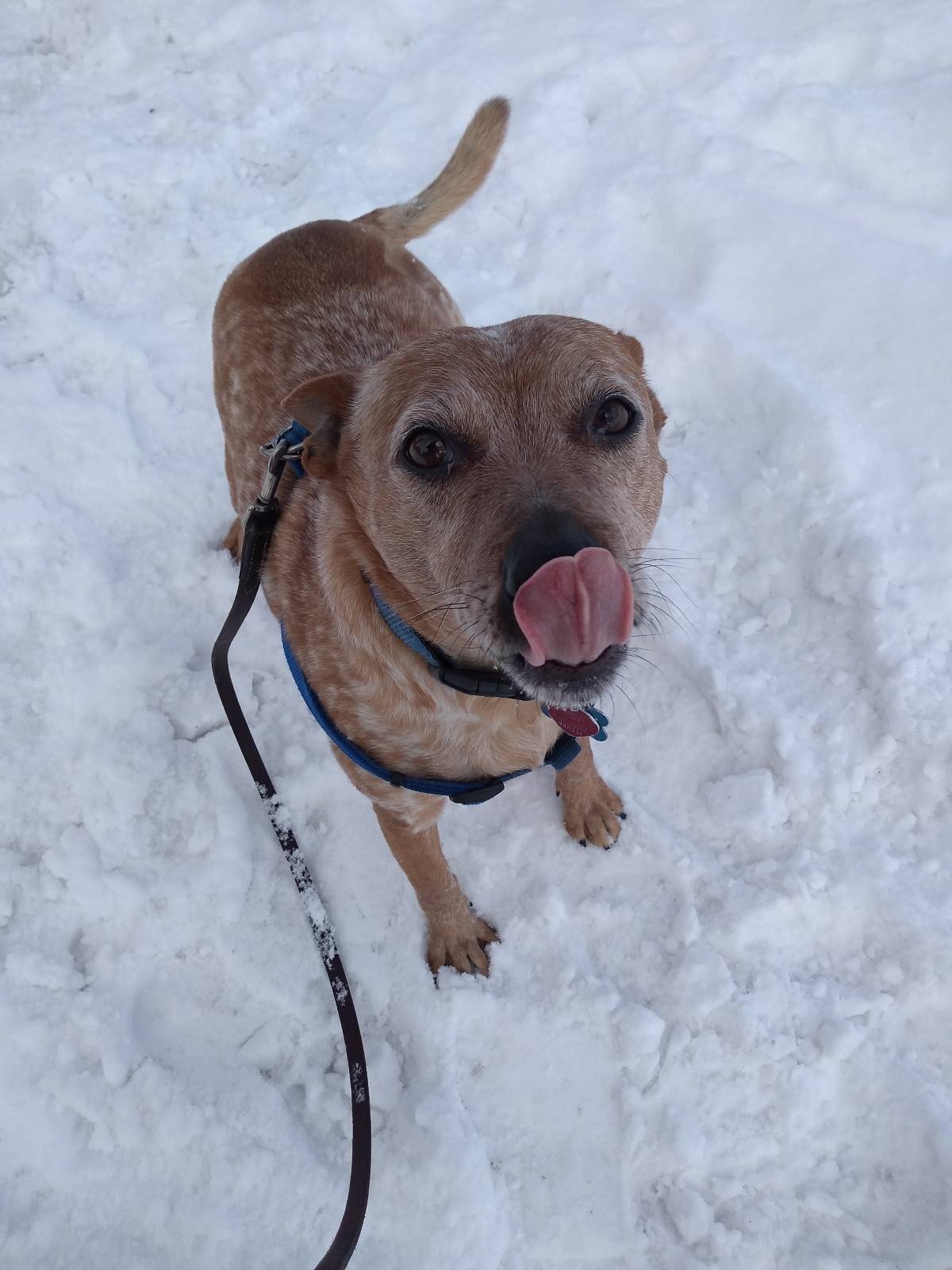
Here’s Scotty enjoying the New England snow
Scotty is a 6-year-old Australian cattle dog mix, rescued from Tennessee by the Great Dog Rescue New England in 2016. Scotty loves to make appearances in Dr. Wheeler’s Human Origins course, where he guest stars during discussions on dog origins and evolution.
Scotty is named for a number of favorite Scottys. These include Scotty from Star Trek and our own Richard “Scotty” MacNeish. In fact, he is often referred to as Scotty MacLeash!
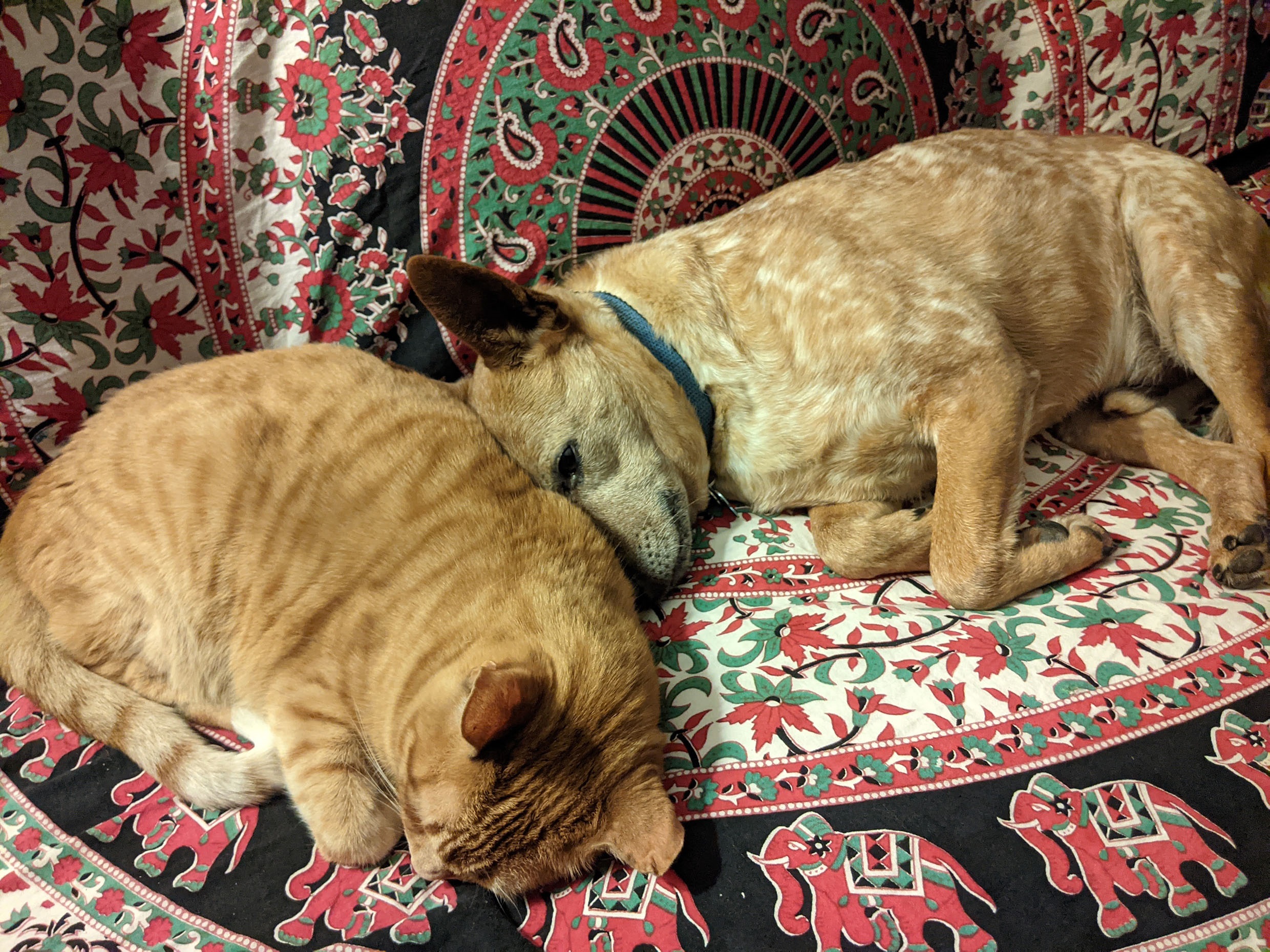
Scotty’s best friend is his pet-mate, Martin – an orange cat who loves to play and wrestle with Scotty, especially during mealtimes.
The best of friends – Scotty and Martin taking a post-play nap
Meet Banjo
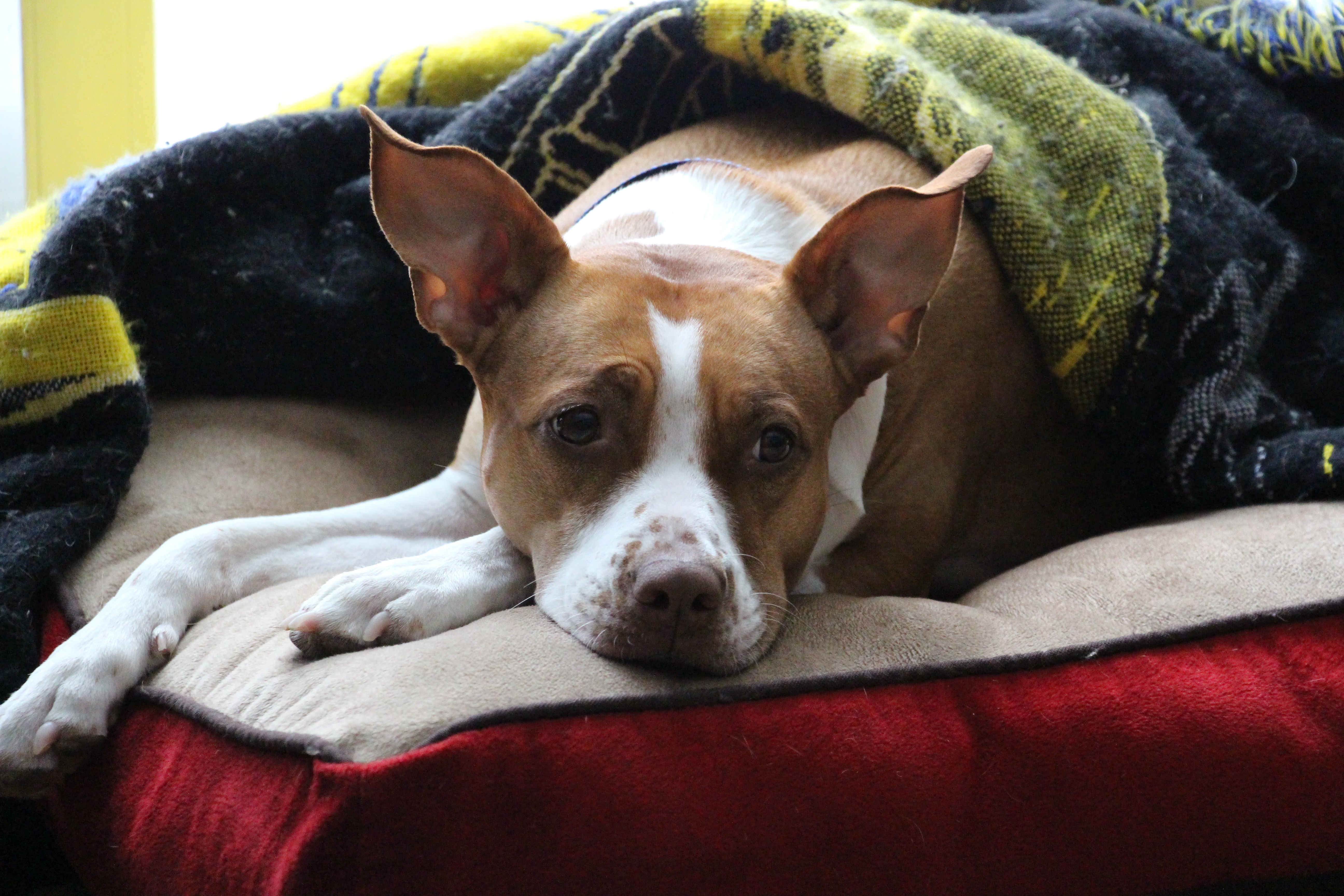
Banjo posing for a picture – just look at those cute ears!
Banjo is a 5-year-old pit-bull mix who loves playing fetch, tug, and snuggling with her family. While she loves a vigorous game of tug, she is super gentle with younger and smaller opponents even letting them win.
Banjo also loves being under a blanket to sleep. She sleeps best at night when a blanket is put on her before bed. If she gets up for a stretch at night, you can find her at the side of your bed waiting until you get up to cover her with a blanket in her bed again. On the rare occasion she would sleep in her family’s bed, she would wiggle down to the bottom and spend all night in a blanket cocoon.
Banjo in bed covered up with her blanket
Meet Rourke
Rourke at the beach
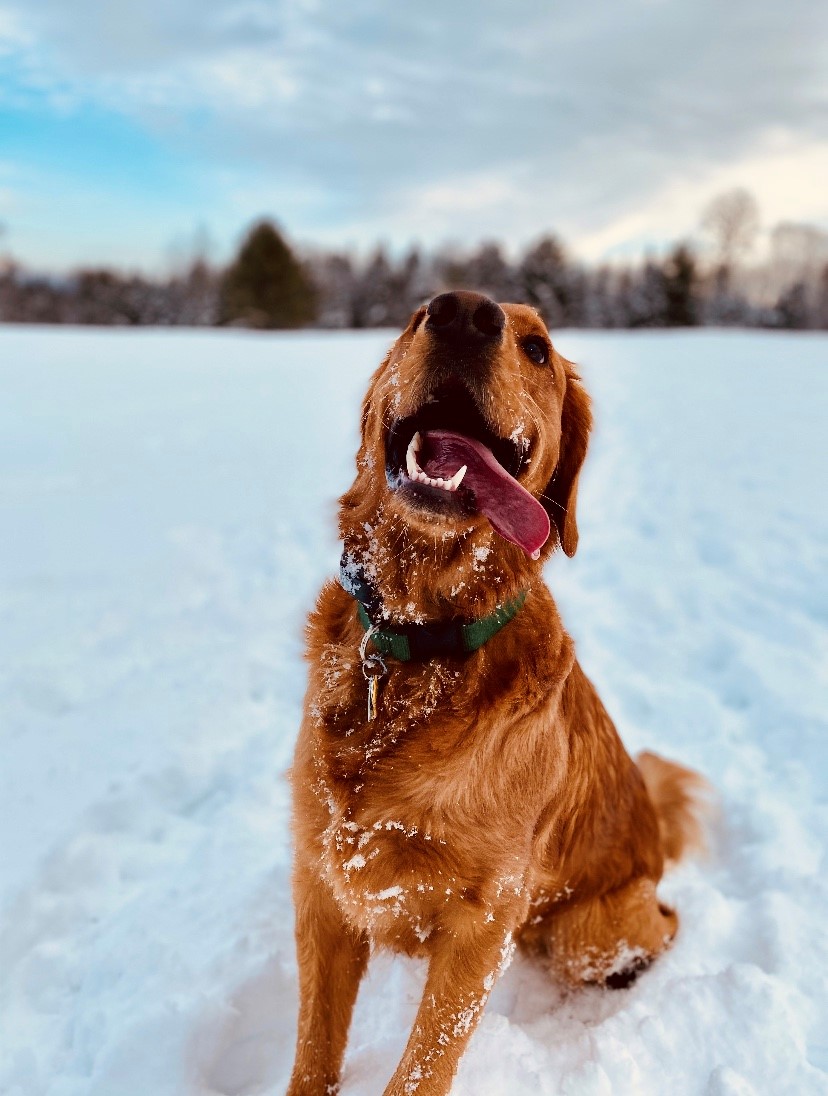
Rourke is a 2-year-old golden (ginger) retriever. There may be some Irish setter in there too. Rourke was named after his family’s old Irish name (O’Rourke.) He loves hiking, naps, and the snow, but his favorite place is the water. He loves the beach and lounging in his very own kiddie pool.
By day, Rourke wrestles with his big Bernese mountain dog cousins, and by night he’s a lap dog. He loves peanut butter and the smell of butter and steak. Fun fact – Rourke has his own way of purring and loved sleeping on the backs of couches before he got too big for it… he might have been a cat in a past life.
Rourke always has his tongue out for a photo
Meet Duncan
Duncan lounging in the grass
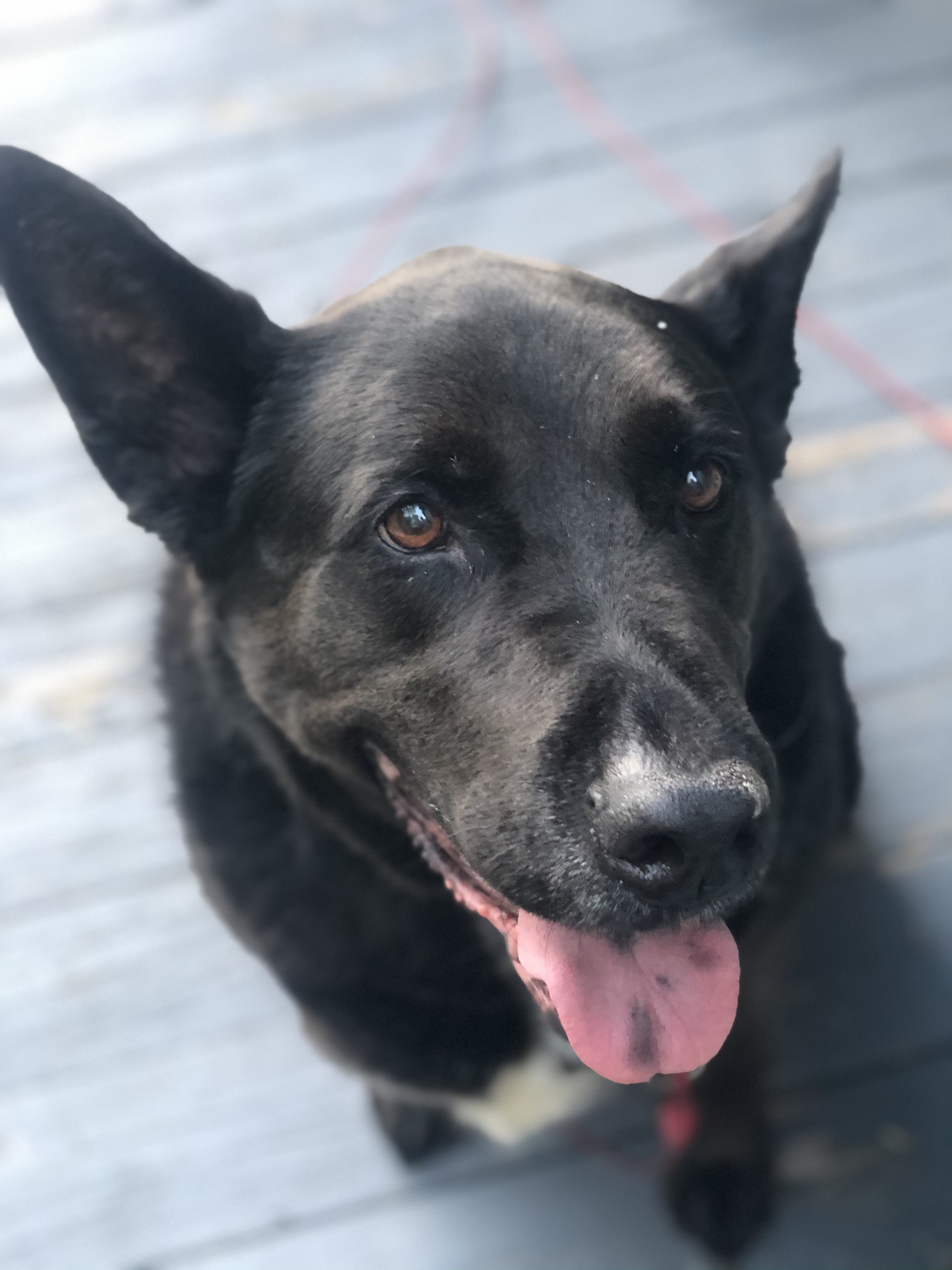
Duncan is a 9-year-old German shepherd, chow, and boxer mix who was adopted from the SPCA when he was three months old. He loves running and going on car rides with his family. Duncan’s favorite treats are popcorn and peanut butter. He is super strong and has lots of energy, immediately ripping any toys that he’s given to shreds.
Duncan got his name on the way home from being adopted. His family drove past a Dunkin’ Donuts and the rest was history!
Just look at that smile!
Meet Nimbus and Baz
Nimbus and Baz taking a nap – they’re so fluffy!
Nimbus is a white, Himalayan and Siamese mix. She is about 18-20 years old. Baz is a brown, Maine Coon mix. He is 13 years old. Both love taking naps and are a cosmic duality that govern their family’s daily lives.
Nimbus is noisy and skittish while Baz is quiet and affectionate. These two often seem to be composed of contrary forces, but they usually settle into a détente of furry cuddliness.
Recently I collaborated with Dr. Miriam Villanueva of the Department of History and Social Science at Phillips Academy to create a new lesson that focused on both the American Indian Movement and the takeover of Alcatraz Island in 1969 by Native activists.
Our focus was to have students understand how Native protests are centered around issues regarding tribal sovereignty, treaty rights, and meaningful intergovernmental consultation. We also sought to highlight how the ignorance of the American public regarding these issues perpetuates misconceptions about these protests while also connecting them to modern issues.
To do this we examined two protest signs; one from the 1969 Alcatraz Occupation and one from the recent Dakota Access Pipeline (DAPL)/Standing Rock protests.
We asked the students to investigate the two types of meaning perceived in each of the signs:
1.) the general public’s understanding of the sign.
2.) the message the originator of the sign intended to convey.
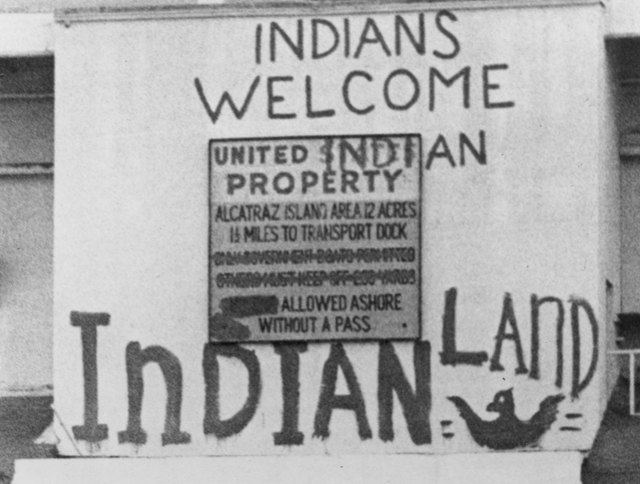
During the activity the students worked together to create the following interpretations of each of the protest signs we examined, based on other contextual information that we used.
Incorrect Response: Native Americans are welcomed at the Island because it has always been Indian Land.
Correct Response: It is a commentary on how white people have simply taken what they wanted and Native people are now just simply playing by the same rules.
The students came to the conclusion that this particular sign is meant more as a commentary on the method used to claim Native land in the past – and less about saying all land was once Native land – when they read the following passage from the Proclamation written by Richard Oaks and other protesters at Alcatraz.
Proclamation to the Great White Father and All His People

We, the native Americans, re-claim the land known as Alcatraz Island in the name of all American Indians by right of discovery.
We wish to be fair and honorable in our dealings with the Caucasian inhabitants of this land, and hereby offer the following treaty:

We will purchase said Alcatraz Island for twenty-four dollars ($24) in glass beads and red cloth, a precedent set by the white man's purchase of a similar island about 300 years ago. We know that $24 in trade goods for these 16 acres is more than was paid when Manhattan Island was sold, but we know that land values have risen over the years. Our offer of $1.24 per acre is greater than the 47¢ per acre that the white men are now paying the California Indians for their land. We will give to the inhabitants of this island a portion of that land for their own, to be held in trust by the American Indian Affairs [sic] and by the bureau of Caucasian Affairs to hold in perpetuity—for as long as the sun shall rise and the rivers go down to the sea. We will further guide the inhabitants in the proper way of living. We will offer them our religion, our education, our life-ways, in order to help them achieve our level of civilization and thus raise them and all their white brothers up from their savage and unhappy state. We offer this treaty in good faith and wish to be fair and honorable in our dealings with all white men.
Next we turned our attention to the recent protests around the Dakota Access Pipeline and the Standing Rock Sioux community. For background information on the DAPL/Standing Rock protests.
Incorrect Response: The protesters are violent!
Correct Response: The sign is satire and a play on “Kill the Indian, Save the Man” policy.
To interpret this particular sign the students drew upon their knowledge of Indian Boarding Schools that we covered in Fall Term. They remembered the program of “Kill the Indian, Save the Man” that lead to the creation of the Indian boarding schools.
The students thoughtfully came to the conclusion that the protester was mimicking the phrase “Kill the Indian, Save the Man” to imply that if one removes the capitalist nature of the “Pilgrim” (or white man) that the water and environment will be saved.
We then ended the lesson with a group discussion about how these protests are all connected to each other while at the same time connected to sites and ancestors that are thousands of years old. The students also came up with possible solutions to ensure that the public has a better understanding of the reasons behind the protests so that their ultimate goals are not misinterpreted, thus undermining the power of the protest.
The conversations and points that the students in each of Dr. V’s three classes were incredibly thoughtful and perceptive. Both Dr. V and I thought that this was one of our best lessons that we have created because it seamlessly brought together modern and historical issues while engaging students in close reading of primary sources, mirroring the exact process that students are currently working through for their History 300 research papers.
Throughout history we have used images to tell a story and to document a period or memory in time. Today our society continues to find ways to connect and communicate through social media and digital platforms, using images to share their lives and stories more than ever.
The Peabody collection contains more than 600,000 artifacts, photographs, and documents. The Peabody’s photograph collection, specifically, is extensive and contains many interesting, yet untold stories. To bring these stories and photographs to light, we would like to share them with YOU, fellow readers, in our new blog series, Behind the Photograph.
Our inspiration for this new series of blogs was a photograph of Warren K. Moorehead and the Fort Ancient excavation in Ohio. You can view this story here! To kick off the Behind the Photograph blog series, we’d like to share a second photograph from the Peabody collections.
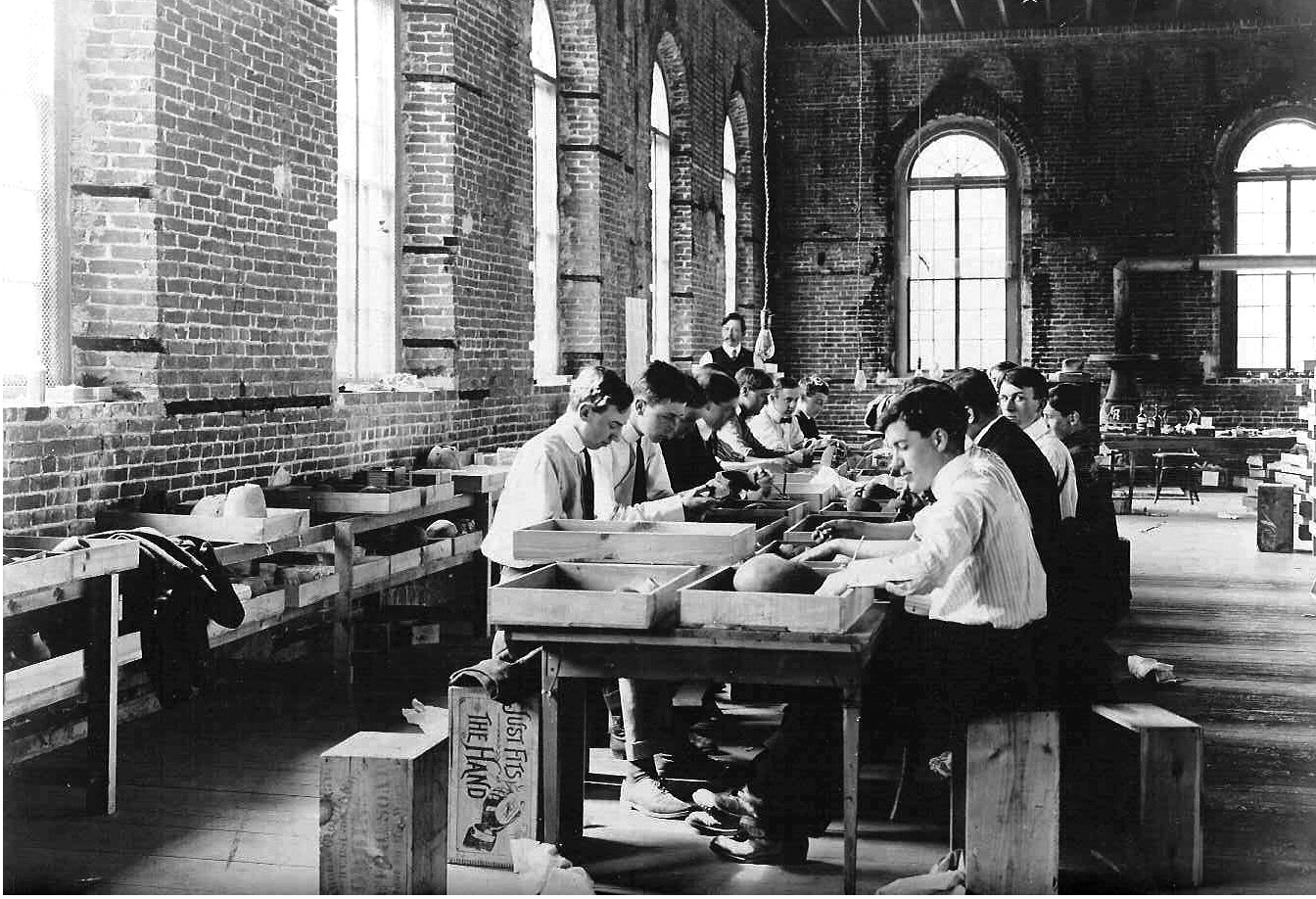
Students unpack Robert S. Peabody’s collections in the school gymnasium, circa 1901. Lantern slide, from the photographic collections, Robert S. Peabody Institute of Archaeology
This photograph is a lantern slide from the Peabody’s photographic collections. The photograph depicts Phillips Academy students in 1901 unpacking Robert S. Peabody’s donated collections in the school’s old gymnasium. The old gymnasium was located in the Brick Academy – the gym incarnation of Bulfinch Hall. At the time, a new gym (Borden Gymnasium) and the Archaeology Department (later known as the Robert S. Peabody Institute of Archaeology) were in the process of being designed and built on the Phillips Academy campus. In June 1896, fire had gutted the gym leaving the brick walls intact. Although the building was re-roofed, it went largely unused until the Peabody collection was sorted and stored there in 1901.
Earlier in this same year, the Archaeology Department was founded on March 21st at a Trustees meeting held in Boston. An endowment and collection were given from an anonymous donor, now known to be Robert S. Peabody. The school chose Principal Bancroft of the Academy, Professor Warren K. Moorehead, and Dr. Charles Peabody (founder’s son) as the officers of the Archaeology Department. Warren K. Moorehead served as the curator and chief executive officer of the department, while Charles Peabody served as honorary director. For more information on the founding of the Peabody Institute, check out this article from the Phillips Academy student newspaper, the Phillipian.
As the development and construction of the Archaeology Department building was underway, archaeology classes and the Archaeology Department’s collections were held in the old gymnasium. An article from the Phillipian states that Dr. Peabody and Professor Moorehead wished to unpack certain specimens and students would not attend lectures for some weeks. Instead, students met in the old gym to unpack Robert S. Peabody’s founding collection and begin preliminary sorting of the artifacts before they were relocated to the completed Archaeology Building several years later. The 1901 article states that “students found the laboratory work unique and interesting.”
If you look closely in the image, you will see a man standing in the background to the left of the long work table. It certainly looks like Warren K. Moorehead overseeing the sorting and work of the students. Also in the image are the very wooden drawers that are still located at the Peabody today!
In an effort to maintain the sustainability and integrity of the Peabody’s collections, the Peabody collection team is working to rehouse all artifacts from these wooden drawers to acid free collection boxes to better preserve and protect the collection materials. It is our hope in the future to provide proper storage space and conditions that match the preservation needs of our collections.
As more and more wooden drawers are emptied through our inventory and rehousing project, we no longer have use for them. As a result of this, we recently began giving away these wooden drawers to those who may find ways to repurpose them through various DIY projects. You can check out these projects here, here, and here!
If you are interested in having your very own historic drawer, you can contact me at elavoie@andover.edu to schedule a safe and socially distanced pickup. (Who knows… you may even get one of the drawers that were originally in this photograph!)
This image marks a significant time in the Peabody’s history, representing the introduction of archaeology to PA students and the birth of the Peabody Institute and its collections. To learn more about archaeology at Phillips Academy check out Peabody Director, Dr. Ryan Wheeler’s blog and article, Archaeology in the Classroom at a New England Prep School.
After months of cold temperatures and snow storms I’m sure we’re all looking forward to spring and warmer weather! This year the first day of spring, or the spring equinox, takes place on March 20th. To some, equinoxes mark nothing more than seasons passing by. But to others, they were and still are an important time for celebration.
For many Indigenous cultures around the world, the spring equinox is an important time for not only practical, but also ceremonial purposes. Equinoxes were traditionally used to determine what animals would be available for hunting, when to plant and harvest crops, and they marked periods of migration for nomadic groups.
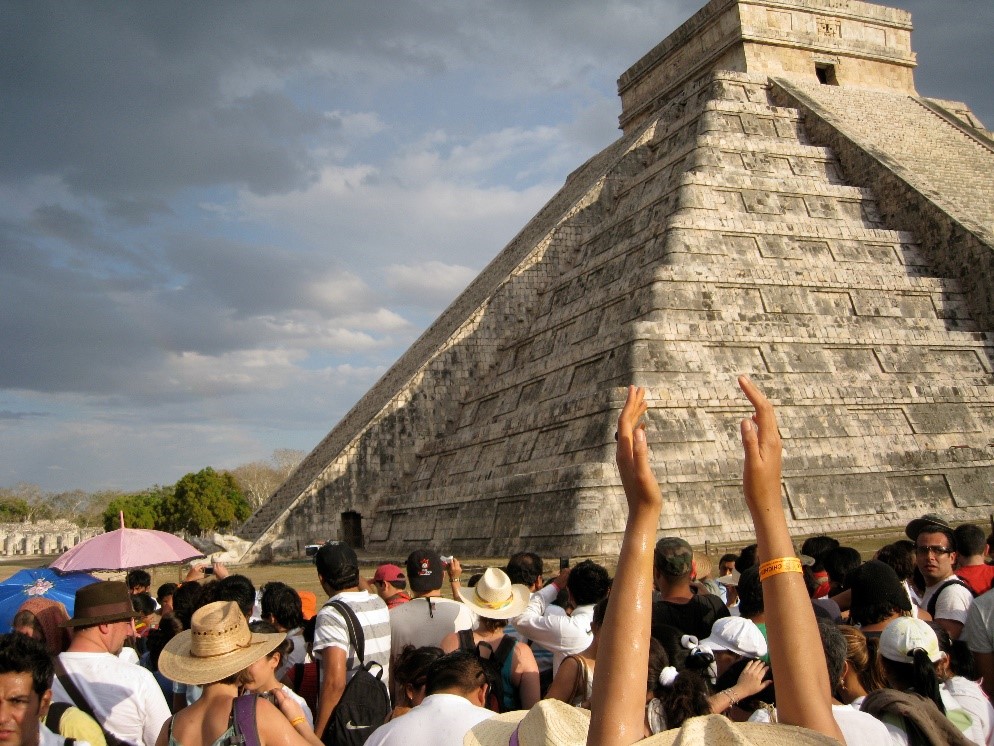
The equinox is marked differently by Indigenous nations around the world, but because tracking the sun’s movements was essential for survival, some cultures found ways to do so in the form of solar calendars. The Maya calendar is perhaps the most well-known of these but there were many others. The Mayans also created other ways to track the sun. The Pyramid of Kulkulkan (or El Castillo) at the site of Chichén Itzá in the Yucatán Peninsula, displays a serpent along the staircase during the equinox. Many still flock to the site on the equinox to see the serpent today.
Image showing the descent of Kulkulkan at Chichén Itzá, March 21st 2009. Image courtesy of Bmamlin, Public Domain, via Wikimedia Commons.
At the prehistoric site of Cahokia in Illinois, archaeologists in the 1960s discovered pits arranged into five large circles. Fragments of wood inside the pits indicated that sacred red cedar wood had been used as posts. Archaeologists dubbed this area as “Woodhenge” after realizing that some of the posts act as seasonal markers, marking the solstices and equinoxes. On the day of the spring equinox, the post marking this event aligns with Monk’s Mound (the largest Pre-Columbian earthwork in the Americas and the residence of the leader of Cahokia), where the sun emerges from behind the mound.
An artist’s conception of Woodhenge at sunrise, circa 1000 CE. Image courtesy of Herb Roe, Public Domain, via Wikimedia Commons
The reconstructed Woodhenge at the site of Cahokia, 2010. Image courtesy of Ryan Wheeler.
Ryan Wheeler visiting the reconstructed Woodhenge at the site of Cahokia, 2010. Image courtesy of Ryan Wheeler.
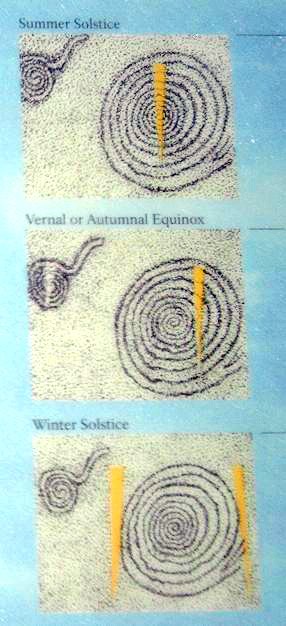
Another example of using the sun to create certain images is found at the site of Chaco Canyon in New Mexico. At the top of the Fajada Butte are two spirals etched into the rock which on the equinox, are sliced by a dagger of sunlight, called the “Sun Dagger.” Unfortunately the rocks on the butte have shifted, possibly due to human traffic at the site, and now the sunlit images no longer appear. At other areas of the Chaco Canyon site, interred bird bones have been discovered, and archaeologists believe these were the result of sacrificing scarlet macaws during the equinox. Due to their red and yellow feathers, these birds were associated with the sun and fire, and it is thought that sacrificing them during the equinox was a symbolic way of ending the winter season. This was also a common practice among groups throughout the Southwest and Northern Mexico.
Fajade Butte in 2015. Image courtesy of Rationalobserver, Public Domain, via Wikimedia Commons.
A diagram of the sunlit areas that were present during equinoxes and solstices at Fajada Butte. The spring, or vernal equinox, is in the center. Image courtesy of Nationalparks, Public Domain, via Wikimedia Commons.
In the Anishinaabe tradition, spring is celebrated as the beginning of their new year. Known as the Sugar Moon, this was the time when maple sap would start to run from the trees. Maple sap is considered to have important medicinal properties to the Anishinaabe as it balanced the blood.
Spring traditions in many native cultures are inextricably linked to the sun and moon, as the beginning of spring is marked by the equinox. It was a time symbolic of balance, because during the equinox day and night are of equal length. Spring has also historically symbolized rebirth and growth. It is the time when the earth is awakening from its winter slumber, and the life cycle is beginning again. Animals come out of hibernation and plants begin to bloom and grow again. Many traditions that have grown out of the equinox are based around this idea of balance and new beginnings.
Spring was also recognized by many Native American groups as a time to gather together and make decisions about their communities. It was a time to discuss which groups travelled where, what to do about hostile tribes, and where they could find resources. Today, many Indigenous groups still hold spring equinox gatherings and celebrations, which generally include music, dancing, ritual ceremonies, arts and crafts, and a feast of traditional dishes.
While spring traditions may look different to everyone, I think most can agree that it is a time of growth and fresh starts. With the upcoming season we have a lot to look forward to. We get to smell the fresh, clean air after a spring rain and watch flowers start to bloom. And let’s not forget about spring cleaning! Hopefully warmer weather and fun spring activities are right around the corner!
To celebrate Valentine’s Day this month, the Peabody would like to highlight some love-related objects from our collection. From heart-shaped designs to meanings of love, we hope these featured artifacts give you that “loving feeling.”
Venus – the goddess of love and beauty – is a common figurine found in museums and archaeological excavations. Venus figurines such as those in the Peabody collection, were used in various ways such as offerings, ritual practices, and as grave goods in burials. For more on these figurines and their history check out this article from Current Anthropology by the Wenner-Gren Foundation for Anthropological Research.
This artifact is a dark green plaster cast reproduction of a Venus figurine. The original figurine was made of crystalline talc and was excavated from the Grimaldi Caves in Italy. The figurine, known as Pulcinella or the Venus of Polichinelle, is dated to the Aurignacian or Upper Paleolithic period (about 40,000 – 10,000 BCE). The cast figurine was acquired by Warren K. Moorehead in 1925 on one of his trips to Europe. The figurine reproduction is a part of the Peabody’s education collection.
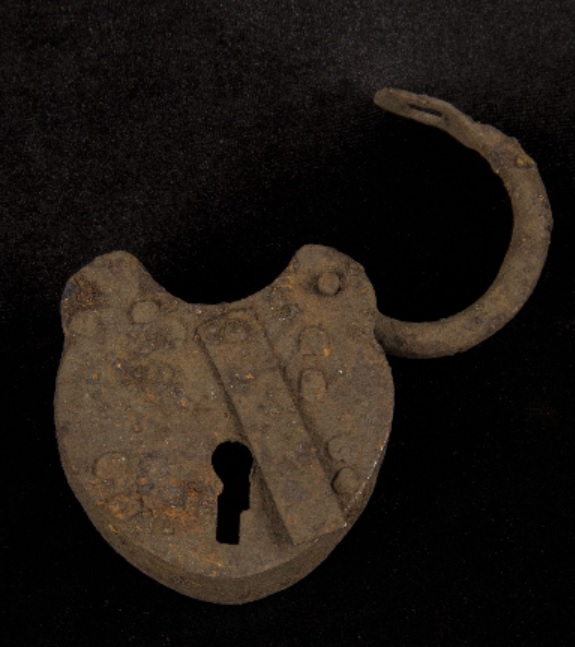
Heart-shaped locks have their origins in a Scandinavian-style padlock. These locks were made with various metals such as brass, bronze, and cast iron. The two key characteristics of a traditional heart lock were a spring-loaded keyhole cover called a “drop” that would keep dirt and insects out of the lock (not present on this specific artifact) and a metal loop so a chain could be placed through it to prevent the lock from getting lost or stolen. Source: “The History of Padlocks,” Lock Blog. United Locksmith. 2021.
This large metal padlock was excavated by Adelaide and Ripley Bullen in the summer of 1943. The padlock was found in a dump pile southwest of the cellar hole at the Lucy Foster site, the nineteenth century Andover homestead of an emancipated African American woman. Ripley was employed as a student assistant at the Peabody during the 1940s, and Adelaide helped with the library and other tasks; both of their sons graduated from Phillips Academy. You can learn more about Adelaide Kendall Bullen and the Lucy Foster site from the following blogs: Women of the Peabody, Peabody at the Smithsonian, and Lucy Foster’s Ceramic Collection.
These heart-shaped locks remind me of the Pont des Arts, the famous Lock Bridge in Paris, France. I had first visited this bridge in high school on a study-abroad trip where I fell in love with the story of the Love Lock Bridge (no pun intended). The Pont des Arts is right near the Louvre and crosses the Seine River. The tradition is for lovers to attach personalized padlocks to its railing and throw the keys away in the Seine River. While the tradition did not originate in Paris, it is the most famous destination and is today a UNESCO World Heritage Site. In 2015, the French government began to remove the padlocks (45 tons in total!) from the bridge in order to protect the historical structure. For more on this tradition and the efforts for its removal, visit here.
One large heart-shaped padlock excavated from the Lucy Foster Site in 1943.
The hand painted, ceramic vessel is a Jemez wedding vase made by artist Andrea Fragua, from the Pueblo of Jemez, New Mexico. The wedding vase plays a significant part in traditional marriage ceremonies. The two spouts represent the separate lives of the to-be married couple. The bridge at the top unites the two spouts. The vase is filled with holy water or herbal infused tea and the couple drinks from their respective side. If the couple manages to drink from the vase together without spilling, they will have a strong relationship. This ceremony is similar to the exchanging of wedding rings. Source: “Pueblo Wedding Vases,” Toh-Atin Gallery. Durango, CO. 2021.
Friend of the Peabody, Dominique Toya, fired a wedding vase in summer 2020. Dominque is an artist and educator from the Pueblo of Jemez. For five years now, the Toya family (Dominque, Maxine, and Mia Toya) have visited Phillips Academy to make traditional Pueblo pottery with PA students through Thayer Zaeder’s ceramic classes. To learn more about these visits check out this blog. To view the live firing of a wedding vase by Dominique Toya check it out here!
As children who anxiously wait for the first snowfall each winter season, we find ourselves looking forward with anticipation to a brand new year. The winter months begin to take hold, bringing not only cold weather, snow storms, and shorter days, but also the excitement of snow days, fresh snow landscapes, and winter activities! In the spirit of the winter season, I would like to highlight some winter artifacts in the Peabody’s collection. I included each object’s ID number for you to find in our online collections catalog. As you explore these objects, think about whether you have seen or used anything similar to these objects in your life and during your winter activities. How have some of these objects changed through time? You may be surprised by what you discover!
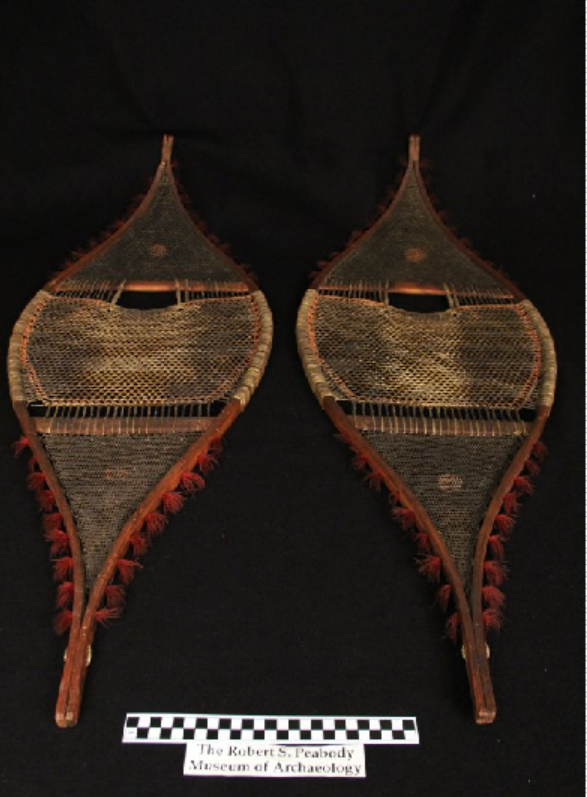
Snowshoes are a classic winter activity, but also a necessity for survival and travel in Arctic regions. Historians believe snowshoes were created about 4,000-6,000 years ago, however the exact origin and age of snowshoes is unknown. The invention of snowshoes may even be inspired by animals such as the snowshoe hare and the Canadian lynx, whose oversized feet give them the ability to move quickly through the snow. The snowshoes pictured here are made of wood, sinew, rawhide, cloth, and yarn. The tear drop shape makes these snowshoes well suited for distance travel in more open environments, especially in deep snow.
A pair of snow shoes in the ‘Siouan’ style from the Great Lakes Area, 1850-1950. Object #99.35.1
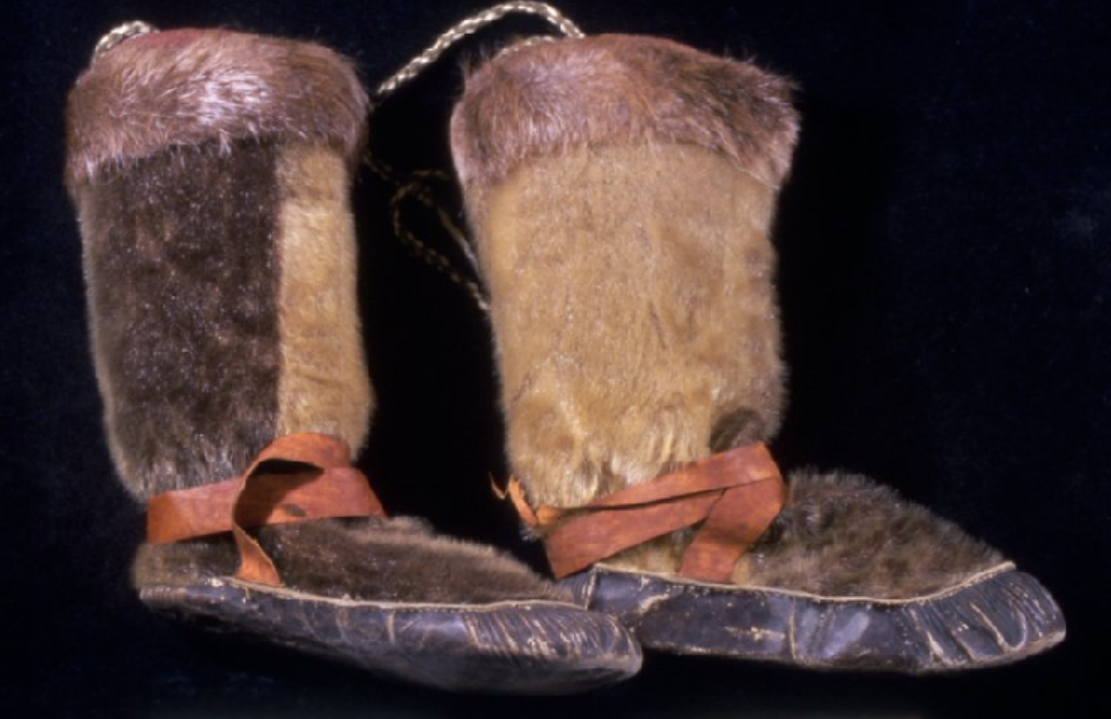
Boots are an essential accessory for winter wear and many who have experienced a snowy climate have owned more than one pair of winter boots. Mukluks are a soft, watertight boot traditionally made of seal or caribou skin. The sole of most mukluks are made of sealskin, which is sewn to tops of caribou skin with sinew thread to produce watertight seams. Mukluks are worn by Arctic native cultures such as the Inuit,Iñupiat, and Yupik. The term “mukluk” is of Yupik origins (from maklak), meaning “bearded seal.” The Mukluks pictured here were made by Inuit seamstress Anna Etegeak, from Unalakleet, Alaska.
A pair of women’s seal Mukluks from Unalakleet, Alaska. Object #99.7.1
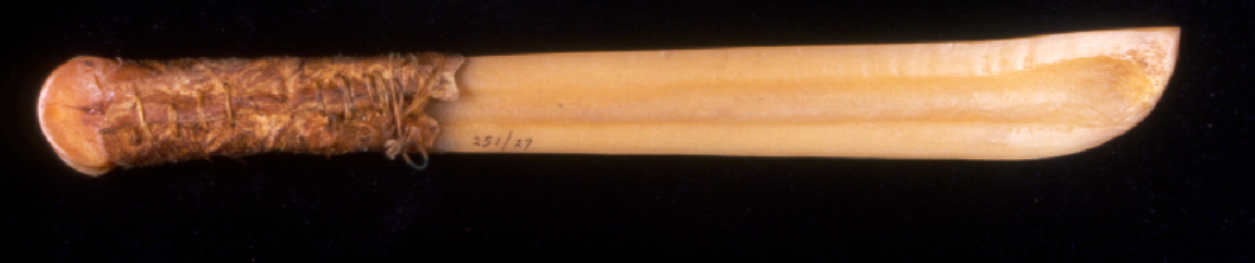
Snow knives were designed as a multi-purpose tool between 1800 and 1925 by the Inuit, a cultural group inhabiting Arctic areas of Alaska, Canada, and Greenland. These knives were made of ivory, horn, or bone. Snow knives are used for cutting and trimming blocks of snow for building Inuit snow houses known as igloos. Snow knives were also used to cut snow for drinking water.
Bone snow knife with handle wrapped in hide from Kotzebue, Alaska. Object #251/27
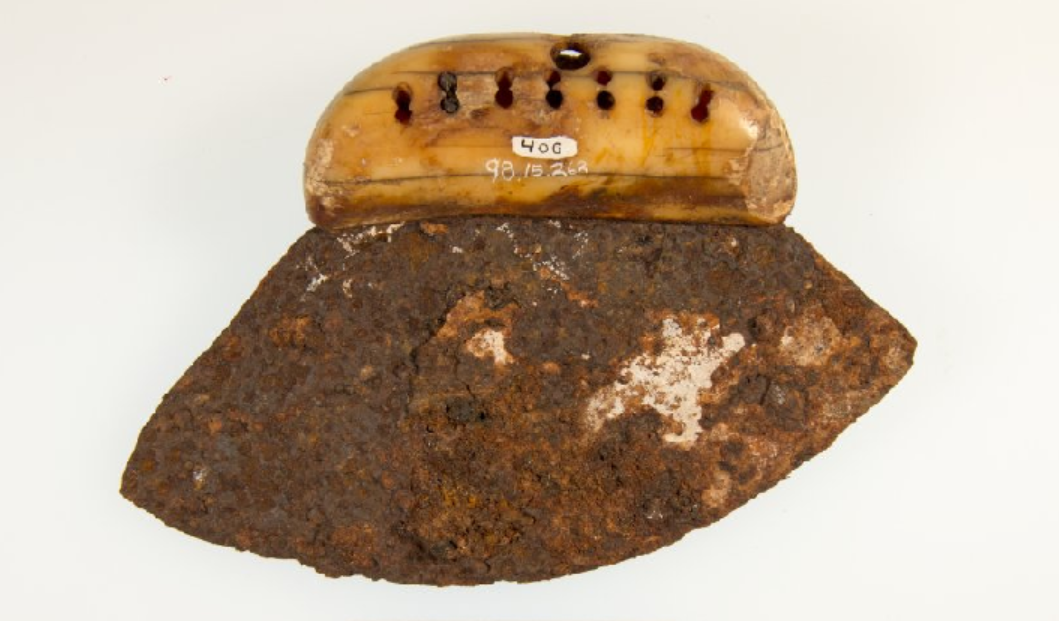
The Ulu or “woman’s knife,” was used by Inuit women as an all-purpose tool. Ulu’s could be used to skin an animal, cut food, trim ice blocks for igloos, or to give a haircut. Early Ulu’s were made from flat, thin rock or slate. Handles were made out of wood, ivory, or bone. Later, as whaling became more common in Alaska, the Inuit took advantage of steel to make their Ulu’s sharper and more varied in design. Ulu’s are still made and used today – there is even an Ulu factory in Alaska! This particular Ulu is of a later design from the Nuwuk site, an unincorporated Inuit village known as “Kokmullit.” This site is located in Point Barrow or Nuvuk, a headland on the Arctic coast of Alaska.
Metal Ulu with ivory handle from the Nuwuk site, Alaska. Object #98.15.262
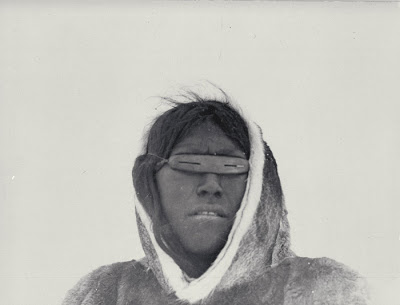
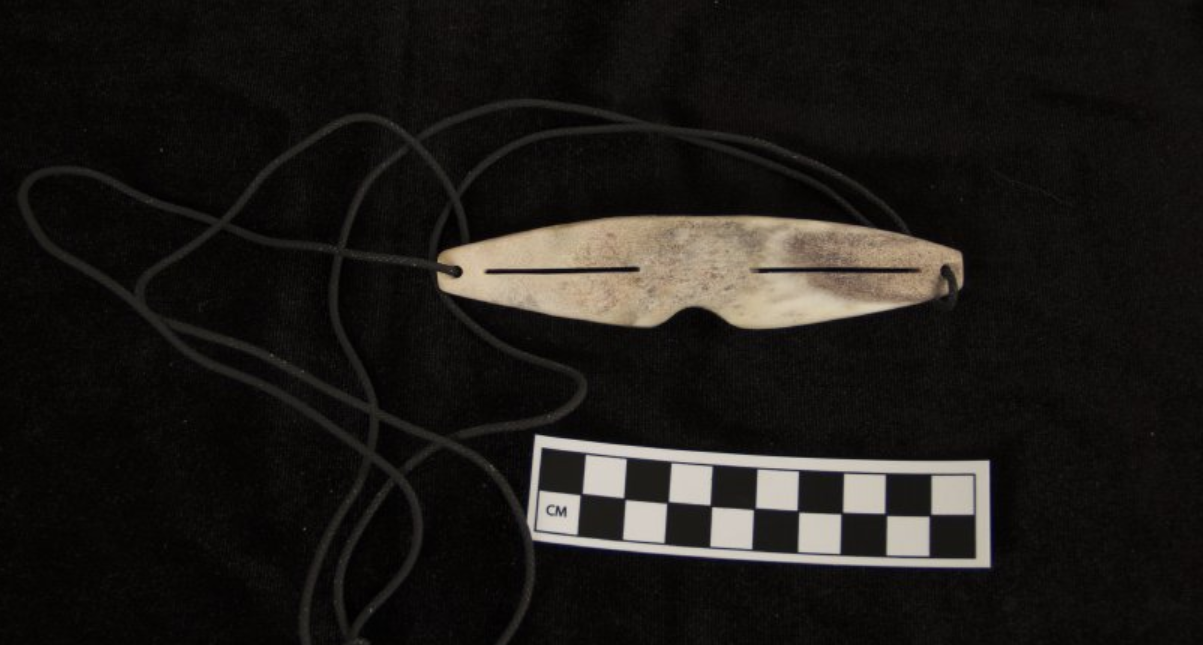
Snow goggles functioned as sun glasses for the Inuit. These were used to protect the eyes against the harsh Arctic sun that would blindingly reflect off a landscape of snow and ice.
Anavik wearing snow goggles made of wood. Photo by Rudolph M. Anderson, May 1916, Canadian Museum of Civilization.
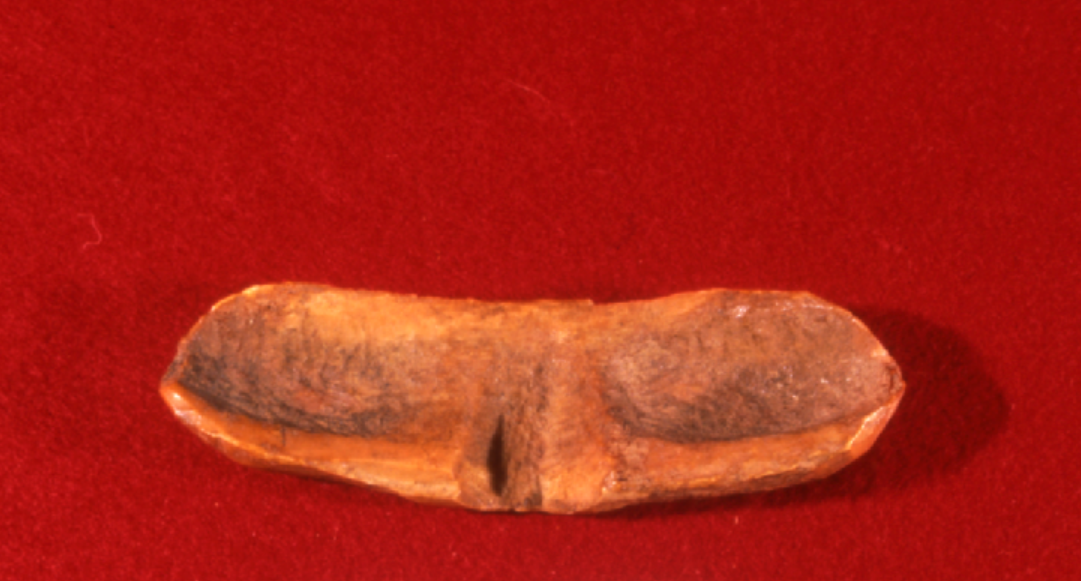
Below are some examples of snow goggles within our collection. One is an incomplete pair of snow goggles made from walrus ivory. The eye and nose areas have been carved, but no slits were cut for the eyes. The other is a complete pair of snow goggles made by contemporary indigenous artist, Sandy Maniapik, from Pangnirtung, Nunavut on Baffin Island. These snow goggles were purchased in Vancouver at the Inuit Gallery of Vancouver to be used in our teaching collections where students examine the Peabody’s arctic collections to support their learning about northern societies. Check out more of this lesson here.
Pair of unfinished snow goggles made from walrus ivory: Alaska, 1800 AD. Object #98.25.2
A complete pair of Inuit style snow goggles made of caribou antler with black cordage as a strap. Object #2017.4.2
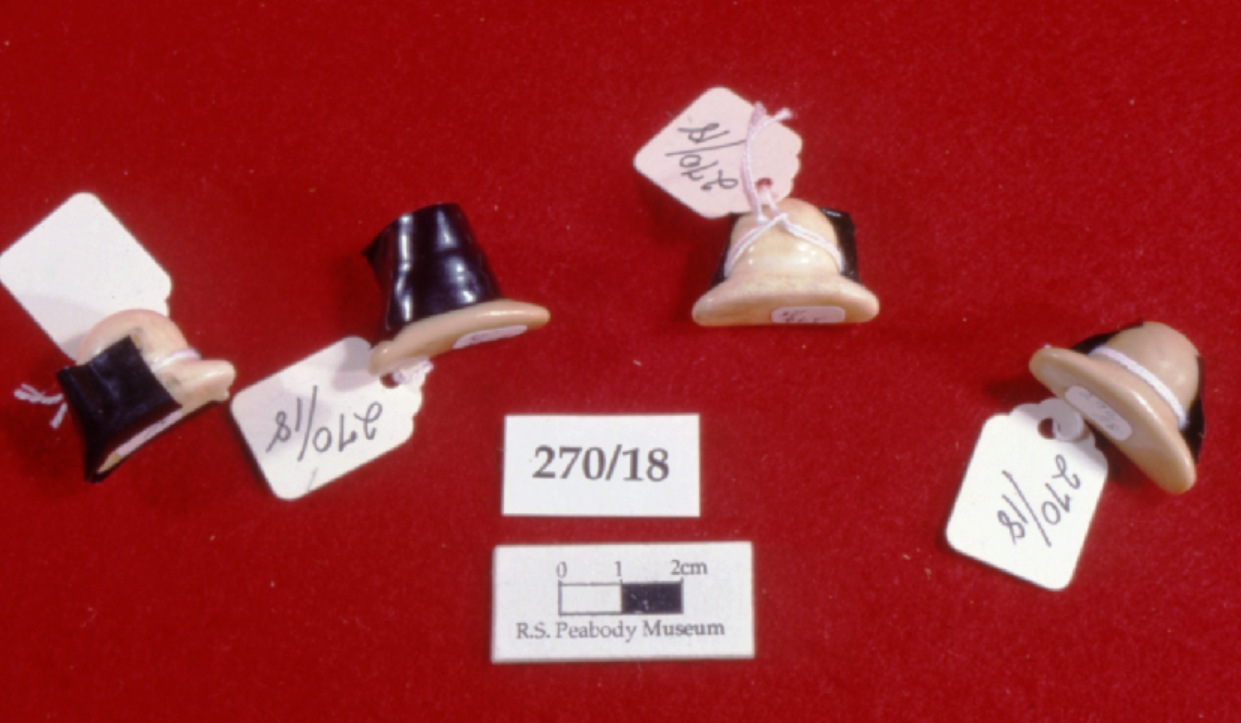
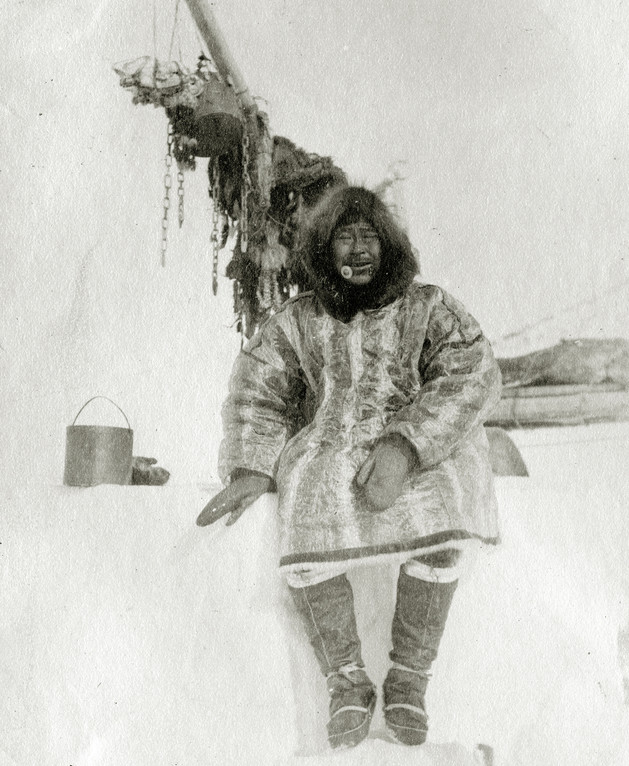
Inuit men in the western Arctic often wore labrets, also known as lip plugs or lip gauges. Inuit boys and men would pierce below their lips and place a large ivory labret inside the lip where it would rest against the lower teeth. Labrets were removed for long-distance travel in the cold to protect them from frostbite caused by cold conducted through the labret.
Four ivory lip plugs from the Western Inuit. Object #270/18
This form of body modification was designed to make the men look like a walrus, an important animal to the Western Inuit. This form of adornment represented the sense of spirit or “Inua” possessed by every living or natural thing. “Inua” facilitates the transformation of man into animal and animal into man, a common theme in Inuit belief. (Source: Peabody Exhibit Label, 2005, Past Perfect Database.)
A whaling captain wearing a labret. Wales, Alaska circa 1905. Courtesy of the Anchorage Museum, B96.9.05
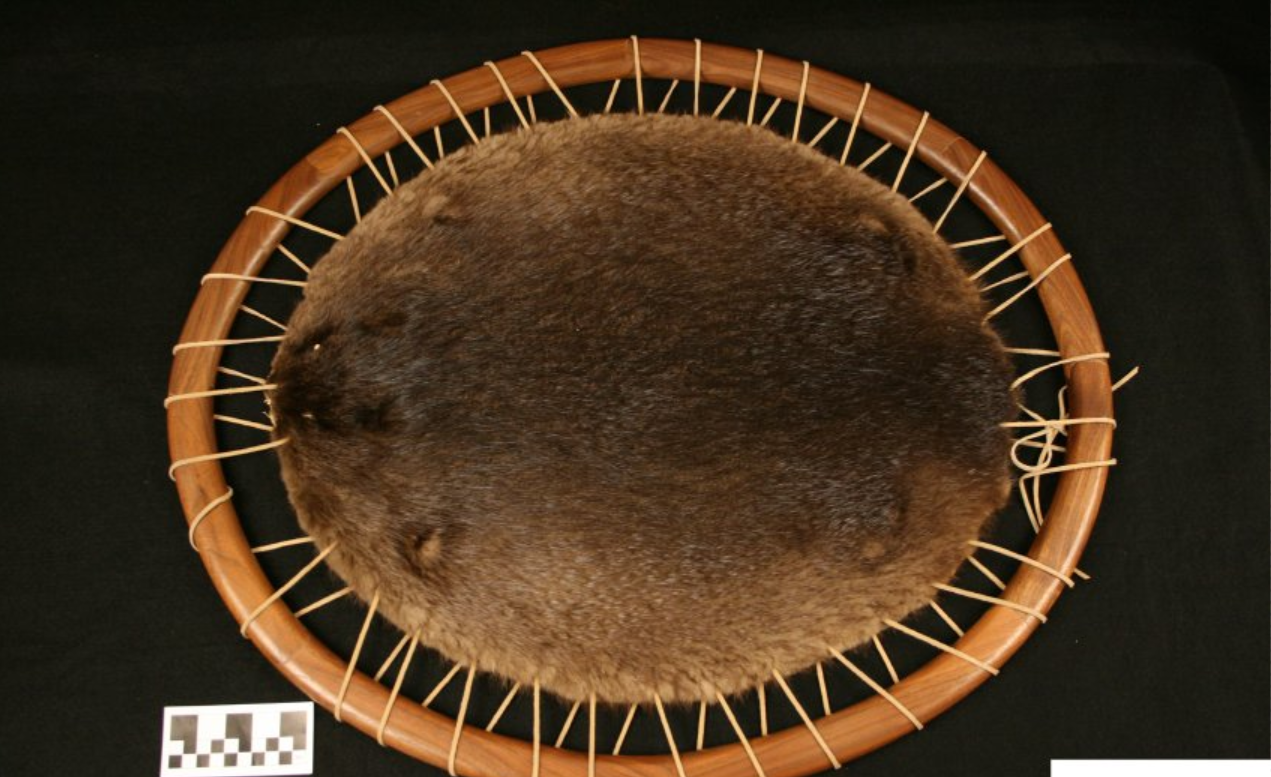
In the mid-1800s, beaver pelts were a unit trade, prized for their water repellant fur and warmth, and material longevity. After being cleaned and stretched (see image below), beaver skins were transformed into beaver pelts. Furs have played a large role in clothing across human history. Beaver pelts were popularly used in the production of outerwear such as coats, hats, garment and shoe lining, and ornamental adornment. Explore a brief history of the beaver trade and beaver pelts here.
Beaver pelt stretched on an oval frame with leather strips. Object #2012.8.40
Carvings of human figures served many purposes in traditional Inuit culture. They could possess curative powers when used by shamans. Sometimes they ‘stood in’ for someone missing an important social or religious event. Fathers also carved figurines for their daughters for play. Dolls for play were armless or had their arms close to their bodies so that their clothing could be easily changed. Both male and female figurines were made and dressed in clothing appropriate to their social group and gender.
Inuit girls would dress their dolls in clothes that they made. This was how many young girls learned to make water and wind proof clothes, a very important skill for survival in Arctic regions.
In some regions, such as the Bering Sea area, girls could not play with figurines inside the house or during winter. It was common belief that the return of geese in spring represented a period in which it was safe to play again and girls were allowed to play with their dolls. If a girl did not wait, she risked causing the geese to fly by without stopping and spring would pass directly into winter. (Source: Peabody Exhibit Label, 2005, Past Perfect Database.)
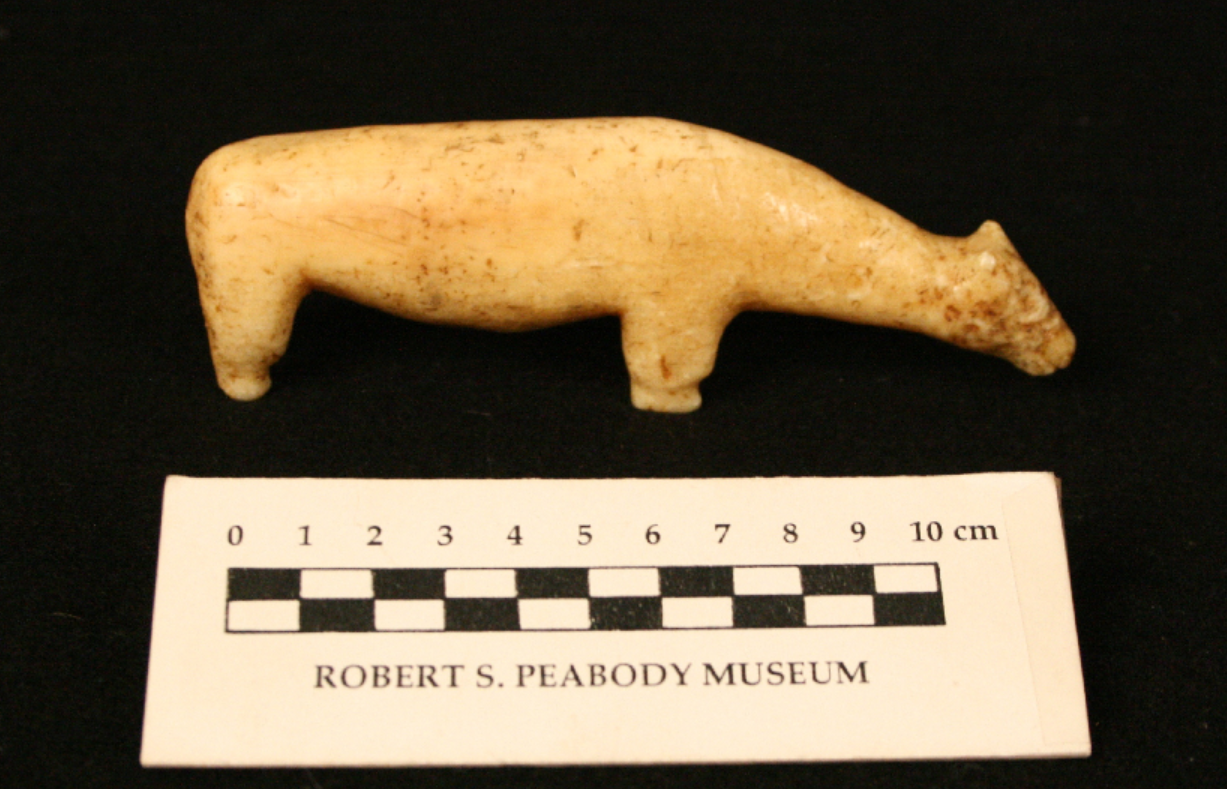
Animal effigies carved from ivory such as this polar bear may be linked to “hunting magic” or “sympathetic magic” in which effigies were used in rituals to increase the number of animals before a hunt or influence reality. Hunting is one of the oldest and most successful human adaptations, and is necessary for survival in the Arctic. The French priest and archaeologist, Abbe Henri Breuil, is an important figure in the history of cave art interpretation. Breuil believed many Paleolithic cave paintings were evidence of hunting magic. For more on Abbe Henri Breuil and hunting magic click here.
This particular polar bear effigy and style is suggested to be Thule, a culture that migrated throughout Alaska, Canada, and Greenland about 1000 years ago. (Source: Peabody Exhibit Label, 2005, Past Perfect Database.)
Polar bear effigy made from ivory: Northwest Alaska, date unknown. Object #98.27.2
To learn more about the history of these artifacts, check out these sources:
This winter I have been exploring and learning a new online platform – PowToon.
PowToon is a digital platform that is used to create fully customized videos for a variety of audiences. The videos can be short or long (max 20 min) and can include cartoon elements or real images and video.
My first video is targeted toward new faculty at the school who may not know how they can work with the Peabody. An engaging, fun video – in addition to our course catalogue – will hopefully bring new collaborations and faculty to the Peabody.
I am excited to continue learning this program and producing videos to highlight and augment our educational initiatives and digital programs such as Diggin’ In.
NAGPRA at 30: Reflecting on the Past, Looking to the Future
New England Museum Association Annual Meeting 2020
NAGPRA resources for session attendees:
NAGPRA Communities of Practice: https://liberalarts.du.edu/anthropology-museum/nagpra/community-practice Network of NAGPRA practitioners from museums, tribes, universities, and government agencies; bimonthly Zoom calls with presentations and networking opportunities; document and repatriation policy sharing.
National NAGPRA: https://www.nps.gov/subjects/nagpra/index.htm The National Park Service’s national NAGPRA website, with templates, databases, grant information, and contacts for the NPS professional NAGPRA staff.
Association on American Indian Affairs annual repatriation conference: https://www.indian-affairs.org/repatriation_conference.html The annual conference brings together repatriation practitioners and includes plenary and specialized sessions on all aspects of NAGPRA and repatriation.
Nekole Alligood, independent consultant, is a member of the Delaware Nation and has served as the NAGPRA Officer for the Nation. Alligood is a cultural anthropologist who has worked in museums and in Section 106. She has conducted NAGPRA repatriations in collaboration with the Delaware Tribe of Indians and the Stockbridge-Munsee Community and a non-NAGPRA reburial teaming with the National Forest Service in West Virginia. She currently is a scholar on the development of a traveling exhibit with Ball State University and Ohio History Connection focused on St. Claire’s Defeat (Battle of the Wabash). She also is working with Ohio History Connection on a reinterpretation of Schoenbrunn Village in Ohio. E-mail: workinglenape@gmail.com
Jaime Arsenault is the Tribal Historic Preservation Officer (THPO), Repatriation Representative, and Archives Manager for the White Earth Band of the Minnesota Chippewa Tribe. Ms. Arsenault has worked with Indigenous communities for over 20 years. Currently, she is a member of the Minnesota Historical Society Indian Advisory Committee and the Repatriation Working Group with the Association on American Indian Affairs (AAIA) and a member of the Smithsonian Institution’s National Museum of Natural History Repatriation Review Committee. She is a Community Intellectual Property Advisory Board Member for the Penobscot Nation and sits on both the Advisory Committee and the Collections Committee of the Peabody Institute of Archaeology. Ms. Arsenault also serves as a MuseDI Partner on decolonization practice for the Abbe Museum. E-mail: Jaime.Arsenault@whiteearth-nsn.gov
David Goldstein is an anthropologist with the National Park Service currently serving as the Tribal and Cultural Affairs Specialist in the Northeast Region. David works to bring the region’s tribal and community partners into the NPS stewardship programs through sharing capacity and ongoing consultation. The goal is to support self-determination and resource protection, acknowledging that tribal and community partnerships provide long term sustainability to stewardship. E-mail: david_goldstein@nps.gov
Katie Kirakosian is a trained archaeologist whose research focuses on the history of Native American archaeology. She has conducted archival research in repositories throughout New England and New York State on many NAGPRA sensitive sites, particularly shell middens, prompting recent research with co-author Irene Gates on the complex nature of archival records and digital repatriation. E-mail: kvkirako@anthro.umass.edu
Krystiana L. Krupa is NAGPRA Program Officer, University of Illinois at Urbana-Champaign. Her NAGPRA experience includes osteology and archival research relating to university and museum collections in addition to consultation. Krystiana’s current work focuses on tribal perspectives on the repatriation of biological samples extracted from ancestral remains, such as ancient DNA extracts. E-mail: klkrupa@illinois.edu
Melanie O’Brien is responsible for carrying out all duties assigned to the National NAGPRA Program by the Secretary of the Interior and serves as the Designated Federal Officer to the NAGPRA Review Committee. Throughout her career, Melanie has specialized in Federal-Indian law and policy, applying her master’s degree in public history from Loyola University Chicago to the work of the Federal government. E-mail: maobrien@nps.gov
Lorén M. Spears, Narragansett, Executive Director of Tomaquag Museum, holds a Master’s in Education and received a Doctor of Humane Letters, honoris causa, from the University of Rhode Island. She is an author, artist and shares her cultural knowledge with the public through museum programs. She has written curriculum, poetry, and narratives published in a variety of publications such as Dawnland Voices, An Anthology of Indigenous Writing of New England; Through Our Eyes: An Indigenous View of Mashapaug Pond; The Pursuit of Happiness: An Indigenous View and From Slaves to Soldiers: The 1st Rhode Island Regiment in the American Revolution. Recently, she co-edited a new edition of A Key into the Language of America by Roger Williams. She consults with K-12 districts, Higher Education, museums and historical societies on Native American Cultural Competency and DEI/J training. E-mail: lorenspears@tomaquagmuseum.org
Marla Taylor is the curator of collections at the Robert S. Peabody Institute of Archaeology at Phillips Academy in Andover, MA. She has worked in all facets of collections management from cataloging to conservation to repatriation. Marla currently splits her time between leading an effort to conduct a full inventory of the collection and facilitating access to the Peabody’s collection for tribal partners, researchers, and educators. E-mail: mtaylor@andover.edu
Jayne-Leigh Thomas is the Director of the Office of the Native American Graves Protection and Repatriation Act at Indiana University. Her work involves active consultation with over 100 federally recognized sovereign nations across the United States to return ancestral human remains and cultural items to their rightful communities. Her research interests are NAGPRA, repatriation, bioarchaeology, ethics, cremation studies, and mortuary studies. E-mail: thomajay@indiana.edu
Jackie Veninger-Robert is the NAGPRA Coordinator for the University of Connecticut. In addition to her NAGPRA and collection management responsibilities for the Office of State Archaeology, Jackie advises students and provides instruction on issues surrounding Native American cultural property law and advocates for opportunities to decolonize museum anthropology. Jackie has worked for tribal governments in southern New England in a NAGPRA and collections management capacity. She is a non-member advisee of Connecticut’s Native American Heritage Advisory Council (NAHAC). Her research interests include: archaeological ethics, heritage management and conflict archaeology. E-mail: jacqueline.veninger@uconn.edu
Ryan Wheeler is the director of the Robert S. Peabody Institute of Archaeology, a museum at Phillips Academy, Andover MA. At the Peabody he has advanced a strategic vision focused on collections, education, and repatriation. In 2017, Ryan co-founded the Journal of Archaeology & Education, the only academic journal devoted to the intersection of these two fields. Ryan lives with his family in Medford, MA. E-mail: rwheeler@andover.edu