Gedney House of Salem, MA

Contributed by Lindsay Randall

In July, I once again partnered with Dr. Bethany Jay of Salem State University to teach the graduate class for history teachers that focuses on using archaeology in the classroom to teach about marginalized individuals, who are often overlooked.

Since it is now our fifth year running this class, it is always exciting when we get to experience something new ourselves. This year we added a tour of the Gedney House in Salem to our listing of sites we were visiting. One of the students in the class, Tom, is a tour guide for the Gedney House and took us all around the historic house – we even got to go into the creepy basement!

The Gedney House is owned by Historic New England and was built in 1665, making it one of the oldest houses in Salem. Given the fire that swept through Salem in 1914, it is amazing that this structure still stands today.
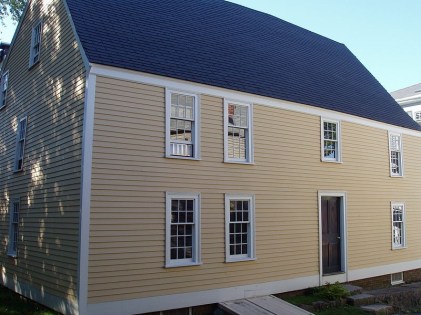
image 3.jpg
Gedney House (wikimedia commons via Daderot)

The house has gone through a lot of iterations throughout its history and they have left their marks on the building. Starting first as a single family home, for shipwright Eleazer Gedney, major renovations to the façade were added in the eighteenth and nineteenth centuries. Later it became a tenement in Salem’s Italian-American neighborhood.

What makes the house so interesting to history lovers (and archaeologists!) is that the house was originally set for total rehab in the 1960s and so the inside was completely gutted. That means that you can now see the original structure as well as the evidence for later renovations. It really sets the house apart from other first period houses located in New England. Dr. Abbott Lowell Cummings, a prominent architectural historian, once said that the “Gedney House in Salem, Massachusetts is the example par excellence which must be protected under a glass bell jar” due to the scholarly impact its raw architectural state offers to historic preservationists seeking to better understand the construction methods of these early houses so that they can more faithfully restore such structures.

Cummings was also the first scholar to suggest that dendrochronology (the study of tree rings for dating purposes) be used in New England to date the earliest colonial houses, using the Gedney House as one of the first structures on which to test this technique. After the former owner had stripped away much of the interior trim down to the frame, a beam that had been cut into at some point in the house’s history was exposed. The cut revealed an almost complete cross-section of the beam’s tree rings. Cummings used the rings to date the construction of the house to 1664-1665 based on a set of specific drought rings that coincided with the 1590s and 1615-1620.

If you happen to find yourself in Salem, MA during one of the days the house is open for limited tours (first Saturdays in April-October), I can’t recommend it enough. As you walk through the building, you can see the signs of each of the unique periods, as well as how they overlap with each other. So many people have called that house their home and their stories are literally carved into the frame of the house.

What a life the Gedney House has lived!!
Exciting Changes!

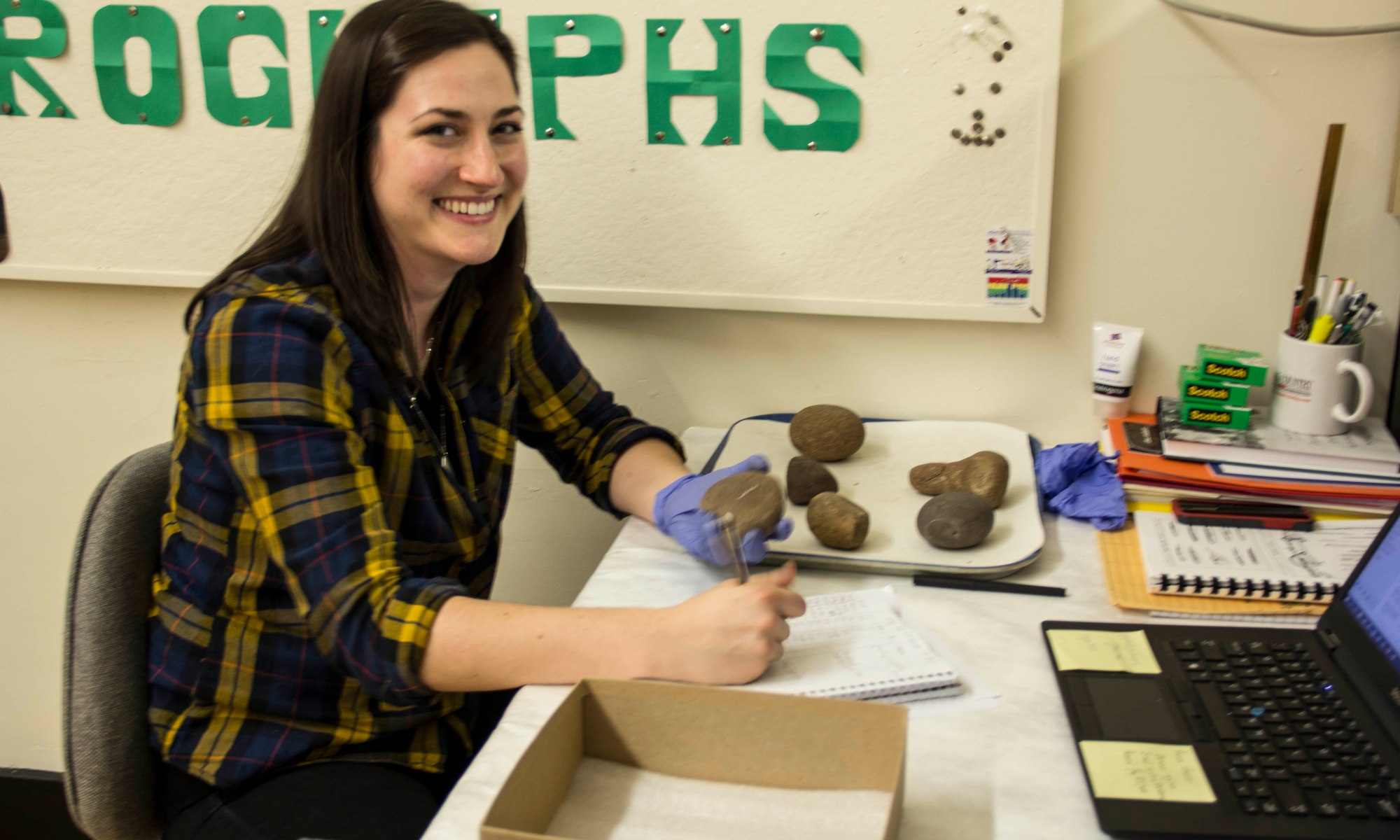
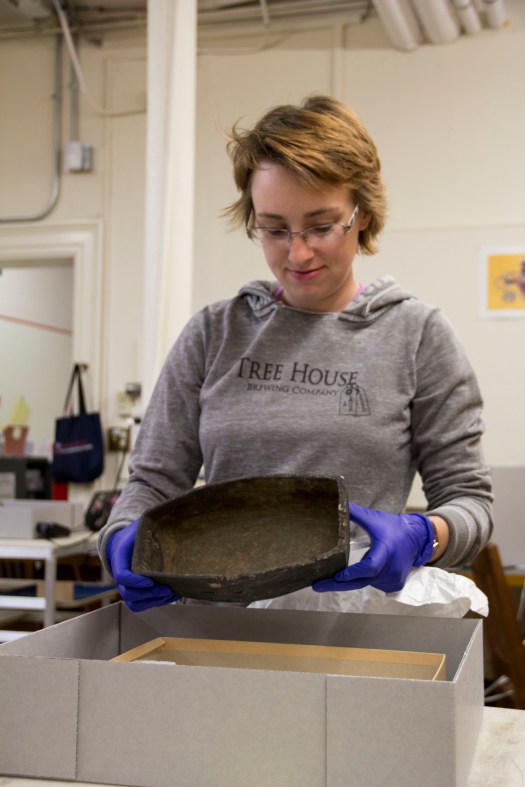
I have been working as the Inventory Specialist at the Peabody for the past year. It has been an incredibly rewarding experience and I have learned a great deal, not only about the collections at the Peabody, but about collections and artifacts from other institutions throughout the United States as well.

IMG_6487

It is with great pleasure that I will be taking on the position of Collections Assistant at the Robert S. Peabody Institute of Archaeology! With this new position comes a variety of new responsibilities that I am ready to undertake. While I will still be inventorying drawers as time allows, I will focus more on drawers that have been adopted through our Adopt A Drawer program. Through this program, donors can “adopt” a drawer housed at the Peabody! They receive updates on the progress of the inventory and rehousing of the artifacts in the drawer and pictures of what is inside. Upon completion, a write-up with information pertaining to the age, origin and various other details about the artifacts within the drawer is sent to the donor. Interested in participating? Contact Peabody director Ryan Wheeler (rwheeler@andover.edu).

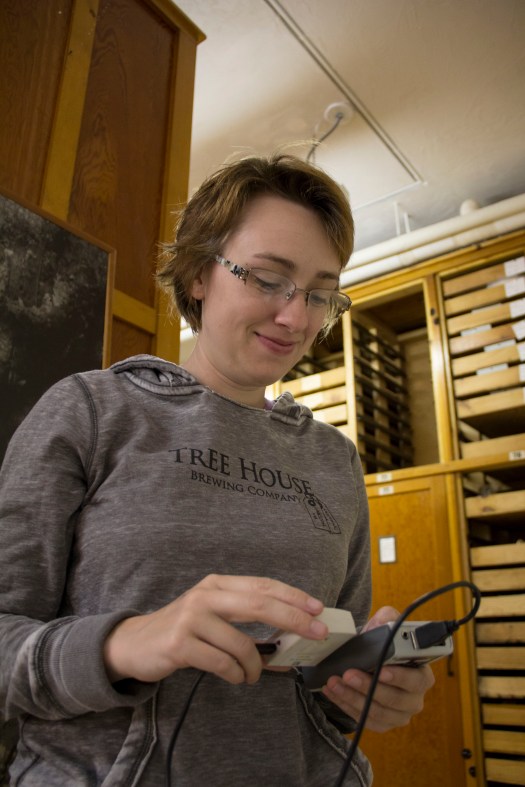
Another major part of the position will be monitoring the environment in the various collections spaces. Maintaining proper relative humidity and temperature is imperative to keeping a healthy collection. Fluctuations in these variables can be detrimental to the collection and cause damage to and have other undesirable effects on the artifacts. In addition to environmental monitoring, I will also be in control of the Integrated Pest Management program. Keeping on top of pest activity in any institution is the best way to avoid an infestation. This is especially important in museums where irreplaceable artifacts can be damaged by insect activity.

IMG_6483
Here I am, monitoring the environment.

A third big change will be working more closely with our volunteers and work duty students who spend time at the Peabody helping us with a few of the many tasks that need to be accomplished. Once a week groups of students from Phillips Academy assigned work duty at the Peabody will take time doing anything from inventorying drawers to digitally inputting information from catalog cards and ledgers. We also have a group of volunteers who join us once a week to inventory drawers, perform inspections of our ethnographic materials, or do other tasks as they present themselves. If this sounds like something interesting to you or anyone you know, feel free to contact us about volunteering at the Peabody!

I am very excited to be able to contribute to the Peabody in new ways!

Allow me to introduce myself…

Contributed by Annie Greco

Welcome to my inaugural blog post. I have been working at the Peabody Institute for three months, so it is high time I introduce myself. I am the new Inventory Specialist. It is my job to inventory and rehouse the collections in storage for the next year.

I am a graduate student at UMass Boston and am passionate about Indigenous studies, both in and outside of archaeology. I interned for National NAGPRA last fall where I learned the importance of employing ethical daily practices at museums, especially when looking through the lens of civil rights issues. I have also worked on various archaeological projects in New England, New Mexico, California, and Iceland.

I have learned a lot in my time here so far, the diversity of regional material culture across North America, the importance of preservation, the most effective rehousing practices…even how to throw an atlatl. (Although my success rate is nothing to brag about.)

While most of my work experience is with freshly excavated archaeological collections, I am excited to transition my focus to the preservation of older collections, including collections on which the foundations of Native American archaeology were built. At least once a week, I am blown away by the Peabody’s collections. Objects I have only had the pleasure of reading about appear in their drawers. Needless to say, I am happy to be here and happy to help with the rehousing inventory project.

Maine Indian Art Market

Contributed by Lindsay Randall

Taking a 5 hour drive might seem like a slog, but the destination was well worth it! On Friday May 18 I headed up to Bar Harbor to attend the inaugural Indian Art Market being put on by the Abbe Museum.

The Abbe Museum is an institution that focuses on using artifacts to tell the story and history of Maine’s indigenous people in a collaborative and inclusive manner. The Indian Art Market is just another way that they are using their institution to promote Wabanaki artisans, as well as other native artists.

On Saturday I got to enjoy the first day of the market with a fairly sizeable crowd of other interested visitors. All of the booths had exceptional stuff, but I was very interested in talking to a man named Hawk Henries (Nipmuc). Mr. Henries is a master flute carver and player. I am very interested in adding one of his pieces to our collection, particularly as we look to expand upon our offerings for the Music Department. It was a delight to talk with him and his wife, Sierra, about not only the flutes and his music, but how he is an active and engaged educator, who apparently even came to PA in 2003 and worked with students as well as toured the Peabody!

In addition to the opportunity to talk to Mr. Henries, I also had fascinating conversations with others such as Karen Ann Hoffman (Oneida Nation of Wisconsin), Geo Neptune (Passamaquoddy), and many others.  It was a fabulous trip and I would like to congratulate the Abbe Museum on a very successful venture and am very happy to see that plans for the 2nd annual Indian Art Market is underway!

To read more about the Indian Art Market, check out these articles form local news outlets:

More boxes of boxes

Today we unloaded another truck full of custom boxes from Hollinger Metal Edge.  This batch of 1,500 boxes is our final purchase with the Box Us In! Abbot grant that was generously funded by the Abbot Academy Fund in 2015, continuing Abbot’s tradition of boldness, innovation, and caring.

The ongoing project to obtain physical and intellectual control over our collections continues!

Born of Fire

Contributed by Barbara Callahan*

To the uninformed, the Peabody Institute of Archaeology is just a building on  the Phillips Academy campus that houses old artifacts and sherds of pottery from long ago archaeological expeditions. They would be very mistaken! The Peabody provides incredible academic enrichment opportunities to the student body across all disciplines.

In a unique approach to education, the Peabody collections are used to demonstrate the practical applications of history, language, mathematics, science and sociology.  This year celebrates the fifth year the Peabody has arranged for pottery artists from the Pueblo of Jemez to come to campus to work with students.

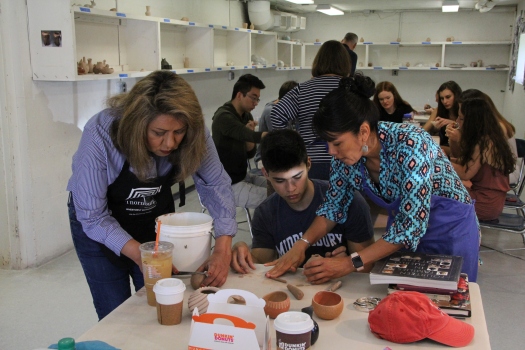
In collaboration with Thayer Zaeder’s ceramics classes the potters spent the week working with 48 students teaching the ancient techniques of transforming clay into pottery. I had the rare opportunity to not only observe these artists work with the students, but to actually work with them myself. Maxine, Dominique and Mia worked with students individually on both shape and decorative painting to create unique pieces of art.

Image of Pueblo potters Dominique and Mia Toya working with a high school student.
Dominique Toya (left) and Mia Toya (right) work with a student.

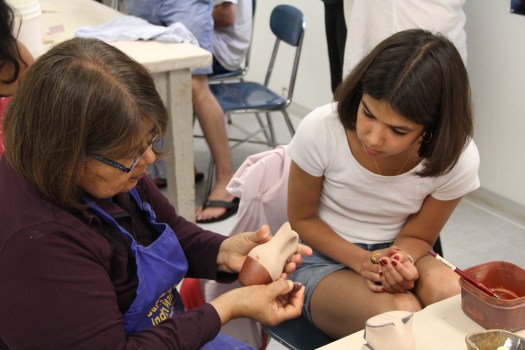
Glazing is not used in Pueblo pottery. Any glossy surfaces are achieved by polishing the area with smooth stones. The process is delicate and time consuming and if you mess up, as one student found out, the Potters would show you how to fix the problem – sand it all off and start again!

Image of Pueblo potter Maxine Toya showing a student how to polish a red slipped pot.
Maxine Toya demonstrates how to polish the red slip.

Dominique, Mia and their mother, Maxine Toya come from a multi-generational family tradition of Pueblo Potters. Each is known for their unique style, Dominique for her mellon designs, Mia for her signature butterfly designs and Maxine for her animals and figures. Their work is highly collectible and sought after. Nancy Youngblood, another prominent Pueblo potter, has joined them the last three years. These four ladies are the “Super Stars” in the Native American world of ceramic art.

When speaking with the Potters, one theme stood out. They love bringing the ancient methods to this generation to instill a knowledge of their culture and heritage. They each spoke of how polite the Andover students were as well as the appreciation shown to them by each student for the opportunity to learn this ancient art form.

Image of pottery firing.
Students look on as Dominique tends the fire.

The culmination of each of their visits is the “firing.” They still use the ancient method of firing the pottery outdoors, which usually draws a large crowd. A huge bonfire is built to bake all the pieces the classes have created. The end result brings pride and a sense of accomplishment to both students and teachers alike.

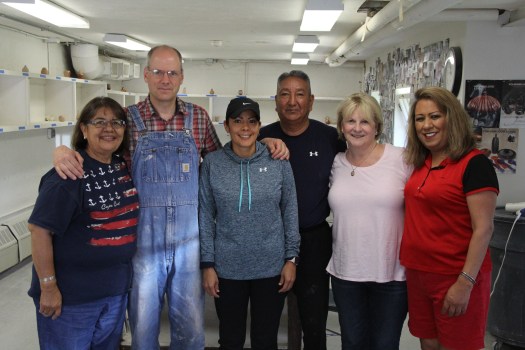
Image of Pueblo potters with ceramics instructor and blog author.
From left to right: Maxine Toya, Thayer Zaeder, Mia Toya, Ward Weppa, Barbara Callahan, and Dominique Toya.
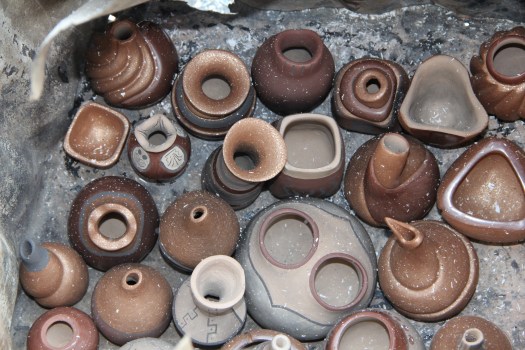
Image of soot covered vessels post firing.
Vessels as they emerge from the fire.

*Guest contributor Barbara Callahan is Secretary of the Peabody Advisory Committee. She and her husband Les Callahan (Phillips Academy Class of 1968) provided the generous support for the Pueblo Potters program in 2017 and 2018.

California Basketry Exploration

Contributed by Catherine Hunter

Native American basketry was the subject of a special research visit on June 4th. Ralph Shanks, Research Associate at University of California, Davis, and Lisa Woo Shanks are experts in identifying and analyzing Native American California basketry.  Together, they produced an outstanding 3-volume series on California basketry that has been indispensable in examining the Peabody collection.  The goal of their visit was the examination of over 100 Californian baskets for cultural identification.  The visit developed into a tutorial for staff as the discussions addressed ethnobotany, physical structure, and design elements found on the baskets.

Immersion in basketry required a specialized vocabulary for structures and materials such as twining, coiling, plaiting, overlay, double interlacing, foundation, willow, red bud, juncos and more.  The forms of baskets were confirmed as bowls, hats, seed beaters, burden baskets, winnowing trays, toys, and cooking vessels. Many Californian Indians cooked in water-tight water-filled baskets by adding heated stones; and examples of these were identified in the Peabody collection.

The visit was facilitated by Marla Taylor, Curator of Collections, and Catherine Hunter, Research Associate, who inventoried the collection of 300+ Native American baskets in 2015-16. Hunter returned to the Peabody recently to continue research for a paper “Indian Basketry in Yosemite Valley, 19th-20th Century: Gertrude ‘Cosie’ Hutchings Mills, Tourists and the National Park Serviceto be presented at the Textile Society of America Symposium in September 2018.  After Hunter consulted Shanks last month, he extended an East Coast vacation to include a visit to Andover.

Hunter selected this topic because of the Hutchings Mills Collection of baskets. Collector and donor Gertrude “Cosie” Hutchings Mills (1867-1956) was one of the first Anglo-American children born in Yosemite Valley to early settlers James Mason and Elvira Hutchings. She collected Native American baskets in the Yosemite Valley region before 1900, recording many acquisition sites and the names of three weavers. Such documentation is very rare; thus, the collection was of special interest to Ralph Shanks.

After marriage to William Elligood Mills in 1899, they lived in New England and their son attended Phillips Academy. In 1937 the collection of fifty-six baskets was donated by Mrs. Mills to the Peabody Institute.

Shanks was enthusiastic about the quality of the basketry, contributed significantly to our interpretation of the collection, and identified rare baskets that would enhance his own research. We were thrilled to host his visit!

Back to Class!

As part of my work at the Peabody, my supervisor suggested that I take an online class in Collections Management. Throughout school, I had never been offered classes that pertained to museum studies or collections management, so I thought that this was a great idea considering it is directly related to my current and hopefully future line of work. Therefore, over the past 6 weeks, I have been enrolled in an online class on Collections Management Policies for Cultural Institutions through museumclasses.org.

Over the period of the course, I learned a great deal about what it takes to create and implement a collections management policy at an institution such as the Peabody. For cultural institutions, these policies are very important to have because they set up guidelines for almost every aspect of the institution. These guidelines are good to have on file should any issues arise within the institution. For example, if an institution received a collection that does not fit within the scope of the collections, the museum staff could refer to their collections management policy for information on how to handle the situation. The policy also helps to establish consistency in practices regarding the proper management of collections associated with cultural institutions.

Throughout the course of the class, I have been tasked each week with writing various portions of a policy. My classmates and I would upload our segments to the online forum so that we could read and critique each other’s documents before turning them in for grading. The feedback was incredibly helpful and I feel it helped strengthen my policy. An additional part of the class was to participate in a chat room discussion for an hour once a week. These chats were always very interesting and everyone was very engaging. It was really interesting to see how different cultural institutions are run and how similar institutions can end up with very different policies tailored to their individual needs. I think that this class was an excellent decision, and one that will be very useful as I continue to pursue my career in collections management!

In other news, I have recently started cataloging drawers in the South Bay Storage area of the Peabody’s collections space! These bays primarily consist of sites from the American Southeast and Southwest, but also contain sites from Missouri, Kentucky, and even as far away as Labrador. I am very excited to continue working with artifacts that I don’t get to see as often as I would like!

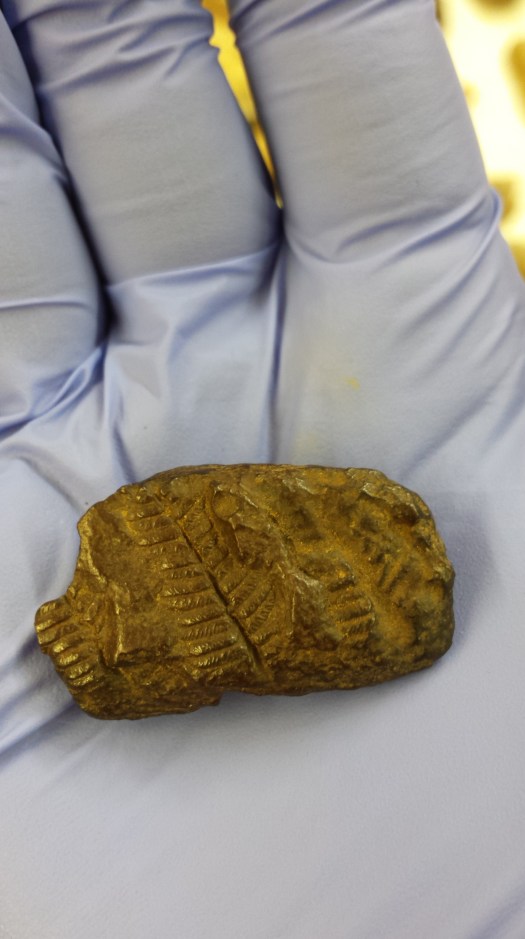
Fossil!
Here is a cool fossil I found in South Bay Storage. I’m not a plant expert, but it looks like a type of fern.

The Inventory Specialist position is supported by a generous grant from the Oak River Foundation of Peoria, Ill. to improve the intellectual and physical control of the institute’s collections. We hope this gift will inspire others to support our work to better catalog, document, and make accessible the Peabody’s world-class collections of objects, photographs, and archival materials. If you would like information on how you can help please contact Peabody director Ryan Wheeler at rwheeler@andover.edu or 978 749 4493.

New Acquisition

Contributed by Ryan Wheeler

We are delighted to share this recent acquisition, a contemporary painted vessel made by Jason Garcia. Garcia (Okuu Pin) is a talented ceramic artist from Santa Clara Pueblo in New Mexico known for his mix of traditional materials and methods with pop culture. This piece explores the Pueblo Revolt of 1680 through the media of traditionally built pottery and painting in the style of comic books or graphic novels.

Image of Jason Garcia's Pueblo Revolt 1680 ceramic vessel, with brightly painted, comic-book style figures of Po'Pay and Spanish soldiers.

Here Garcia illustrates a dynamic struggle between Tewa religious leader Po’Pay and Spanish soldiers. Po’Pay, from Ohkay Owingeh (also called San Juan Pueblo), is depicted in the style of a comic book superhero. He rose to prominence in 1675 after his imprisonment at the hands of the Spanish colonial government. After his release he planned the successful ouster of the Spanish from New Mexico, carefully orchestrating the insurgency across diverse linguistic, geographic, and cultural lines. The Spanish returned in 1692, but Po’Pay and the Pueblo Revolt of 1680 remain significant, though little-known in American history. We work with several Phillips Academy instructors in history and social science to introduce their students to the Pueblo Revolt, which some scholars have suggested provided a template for the American Revolution some one-hundred years later.


Welcome, Annie

Annie Greco just joined the Peabody team as our new Inventory Specialist.  She comes to us fresh from the University of Massachusetts Boston graduate program in archaeology and experience as a field archaeologist in New England.   Annie is already using her knowledge of New England tool typologies and excellent research skills to make a dent in the reboxing project!

Annie’s position is generously funded by Barbara and Les Callahan. Les is Phillips Academy Class of 1968 and Barbara is a member of the Peabody Advisory Committee; both have been active advocates and supporters of our mission.

We hope this gift will inspire others to support our work to better catalog, document, and make accessible the Peabody’s world-class collections of objects, photographs and archival materials. If you would like information on how you can help please contact Peabody director Ryan Wheeler at rwheeler@andover.edu or 978 749 4493.

Annie