Once again DNA analysis of sites is opening up our understanding of how societies operated historically. By testing bone samples from Room 33 in Pueblo Bonito of Chaco Canyon, scientists were able to shed more light on the inner workings of power, class, wealth and status of ancestral Puebloans, and the major role women played within these.
Mound 72 of the Cahokia culture complex, when originally excavated in 1967, was thought to be a shining example of a burial of elite male warriors. Fast forward almost 50 years and imagine archaeologist’s surprise when one third of the skeletons found were in fact female! These findings call into question the idea that Cahokia was a male warrior-led patriarchy.
The excavation of young Hohokam woman’s grave is an example of what the excavators and author call the “Bioarchaeology of care.” The young woman, who lived about 800 years ago had scoliosis, rickets, and tuberculosis. Through looking at this site, archaeologists are able learn more about the community in which the girl lived, and how they supported and cared for her, giving a decidedly human lens to a science that can sometimes become disconnected.
This blog represents the fifth entry in a blog series – Peabody 25 – that will delve into the history of the Peabody Museum through objects in our collection. A new post will be out with each newsletter, so keep your eyes peeled for the Peabody 25 tag!
The winter 2017 issue of the Andover magazine includes a great piece by Jane Dornbusch on our repatriation of a sacred birch bark scroll to the White Earth Nation in Minnesota. In a nutshell, Peabody curator Warren Moorehead received a number of items from the White Earth Anishinaabeg in 1909 during his investigation of fraud on the reservation. That collection—principally men’s ceremonial regalia and beaded bandolier bags—also included a pictographic bark scroll used in the ceremonies of the Midewiwin, or Grand Medicine Society. Jane’s story also mentions my visit to White Earth in March 2016. The following essay was written right after I returned from Minnesota and provides a few additional details about that visit.
White Earth Land Recovery Project Executive Director Bob Shimek talks to tribal members and college service learning students, March 2016.
At the end of March 2016 I flew into Fargo and drove east, headed for the White Earth Indian Reservation. As I drove I passed an occasional cluster of houses, farmland with lots of black, rich soil, as well as lakes, streams, and groves of trees dotting the horizon of a really big sky. I learned later from Bob Shimek, executive director of the White Earth Land Recovery Project, that I had driven across a variety of ecosystems, from oak savanna to pothole prairie.
That first evening in Minnesota I sat in the White Earth community center along with college students on a spring break service learning trip while Bob told us about the White Earth Anishinaabeg. We heard about the land and how this Indian reservation—established in 1867—was designed to succeed, starting with 829,440 acres of forest lands with timber and game, good farmland, lakes and streams with fish. Greedy timber companies and their henchmen defrauded tribal members of their lands and by 1934 less than 800 acres were held by the Anishinaabeg.
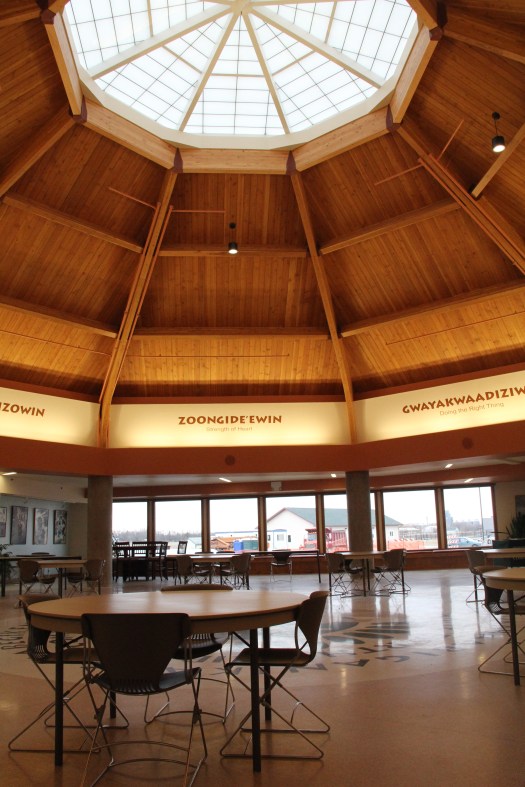
Drum hall at the White Earth tribal college, March 2016.
Since the 1930s the White Earth Anishinaabeg have done what Bob Shimek refers to as nation building. Efforts include a casino in Mahnomen, an annual indigenous farming conference, the Gizhiigin Art Place, a tribal college, the Niijii radio station, and more. Even repatriation, the recovery of sacred objects stored in museums for decades, is nation building. A lot of these nation building activities revolve around traditional food and foodways, like wild rice and maple sugar.
When the sap runs it is all hands on deck. Even the service learning students abandoned other projects and were recruited to haul sap to the boilers. Like New England, maple sugaring is a big deal in northern Minnesota. Among the Anishinaabeg maple sugar has a deep meaning—hauling and boiling sap recalls the origins of the Anishinaabeg. Ojibwe oral literature tells how in the beginning the maple trees were full of thick, sweet syrup that could be easily collected. Manabozho—the Ojibwe trickster and culture hero—decided the people had it too easy and made the syrup thin and watery. He gave the Anishinaabeg the technology to process the sap, but only during the end of winter. The rest of the year was to be spent fishing, hunting, and in other endeavors needed to earn a living.
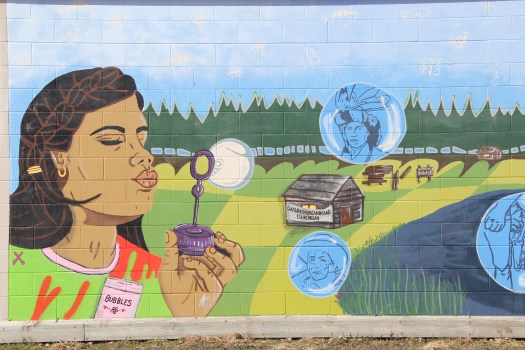
Mural at the Niiji radio station, White Earth Reservation, March 2016.
But afterwards, in the evening, there was time for more learning. My last night at White Earth I attended the Big Drum ceremony. This began with a potluck dinner, followed by a pipe ceremony, and then Keller Paap, one of the ceremony leaders, told the story of the Big Drum in Ojibwe. This was pretty remarkable, but things got even more interesting.
Keller and Anton Treuer, another ceremony leader, invited the college students to sit around the drum. Then they told the story of the Big Drum ceremony in English. But there was more. Paap is from Wisconsin and teaches at Waadookodading, an Ojibwe language immersion school, while Treuer is on the faculty at Bemidji State University. Together they shared the stories of religious suppression and how this didn’t change until 1978’s American Indian Religious Freedom Act, along with the importance of teaching and learning the Ojibwe language.
College service learning students talking with White Earth tribal member Diana King, March 2016.
So, there are lots of stories at White Earth. Some are written on birch bark scrolls, others are found in the pages of the Congressional inquiry into fraud and deceit, some drip in slightly sweet maple sap, while others still float on the night air in words of Ojibwe. For us, however, perhaps most remarkable is that we—Andover, Phillips Academy, the Peabody Museum—are a tiny part of the story too.
In January 2017 we met with representatives of the tribe again and agreed to the repatriation of several additional objects that, like the birch bark scroll, are examples of cultural patrimony under the Native American Graves Protection and Repatriation Act. Anton Treuer will be speaking at All School Meeting on Wednesday, April 5, 2017.
This blog represents the fourth entry in a blog series – Peabody 25 – that will delve into the history of the Peabody Museum through objects in our collection. A new post will be out with each newsletter, so keep your eyes peeled for the Peabody 25 tag!
Contributed by: Lindsay Randall
Peabody curator Warren K. Moorehead, beginning in 1915, excavated in the Castine area of Maine in search of sites related to the Red Paint People. Moorehead believed the Red Paint People to be an ancient culture that was distinct from the more recent Algonquian tribes that still live in Maine today. He recognized a number of unusual artifact types found in Red Paint cemeteries and the liberal use of red ochre in burials, hence the name Red Paint. Ideas about the origins and relationships of the Red Paint or Moorehead Burial Tradition (as it is now called) are changing and often still hotly contested by archaeologists and tribes today. The Abbe Museum in Bar Harbor, Maine presents a timeline of contemporary Wabanaki peoples in Maine, demonstrating continuity of modern American Indians back to the earliest occupation of the state.
Map showing the location of Castine, ME.
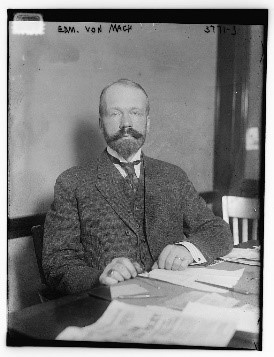
While Moorehead’s Castine investigation did not locate Red Paint site, numerous shell heaps were found. One of the most amazing sites to be excavated was located on the property of Professor Edmund Von Mach. Von Mach was an instructor in art and fine arts at Harvard, Wellesley and other schools in the Boston area and published books on painting and art history. He gained some notoriety during and after World War I for encouraging Americans to support the German cause and his book Official Diplomatic Documents Relating to the Outbreak of the War was withdrawn due to inaccuracies by the publisher.
Portrait of Edmund Von Mach
Von Mach’s politics aside, the shell heap was a very impressive monument, measuring approximately 660 feet long and having a depth between 3 and 5 feet. The vast majority of the shells present were quahog clams, quite common to the area. Given that a total of twenty four hundred artifacts were recovered, combined with the sheer expanse of the heap and its numerous layers, it is believed that the site was a permanent settlement used by tribes about 2,500 years ago.
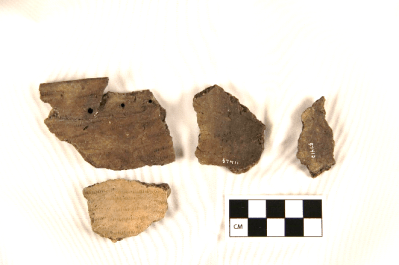
Throughout the summer, several hundred people visited the site to see what unique pieces of the past were being unearthed. Some of the most interesting artifacts discovered were fragments of pottery.
Four pottery pieces from the Von Mach Shell Heap collection at the Peabody Museum.
The pottery is unusual in New England as the soil conditions are very acidic and often deteriorate fragile artifacts. Ceramic specimens are more common in other parts of the country, like the American Southwest.
The only reason that the pottery was not dissolved by the acidic soils surrounding it is that the shells were deposited in the same area. Leaching of calcium carbonate from the shells neutralized the harmful acidic soil. Altering the soil matrix in this manner allows for almost unprecedented preservation of sensitive material.
The pottery helps us to learn about technology and artwork in the community. The introduction and development of ceramics into Maine around 2,700 years ago was very important. It is during this same period that the populations increased and became more sedentary in permanent villages.
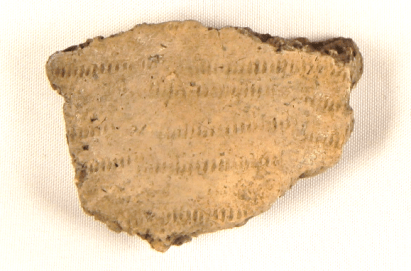
The majority of the pottery pieces in our collections are small and fragile, despite being preserved in the shell heaps. The ceramic pieces also are decorated with stamped and incised lines. This method of decoration not only reflects the aesthetics of the time, but may have helped reduce air bubbles prior to firing.
Close-up of one of the incised pottery fragments
Interestingly, archaeologists are now investigating the language that we use to describe archaeological sites. In her 2014 PhD dissertation at UMass Amherst Katie Kirakosian looks at the terms used by archaeologists like Warren Moorehead and his contemporaries to describe shell-bearing sites like Von Mach’s and how these terms have influenced our thinking about the sites and the people that made them. Kirakosian concludes that use of terms like “shell midden” to describe these sites (and, by extension, their Native constructors) denies their complexity and can result in a narrow and biased narrative.
The bulk of the Peabody’s collection is stored in the basement. It has been challenging over the years to control the temperature and humidity in the basement – an essential factor in maintaining an artifact collection. A small fluctuation of both temperature and humidity is normal and expected as seasons change. However, extreme variation lead to damage – bone can become fragile, ceramics can develop weak-points, and even stone tools can become brittle.
For the past four years, I have been tracking the environment throughout Peabody and noticed these strong fluctuations. By taking readings of the temperature and humidity in all our storage spaces once an hour (through the use of a datalogger), I determined that the influx of outdoor air through these poorly sealed windows is large contributing factor. There is only one way to fix this.
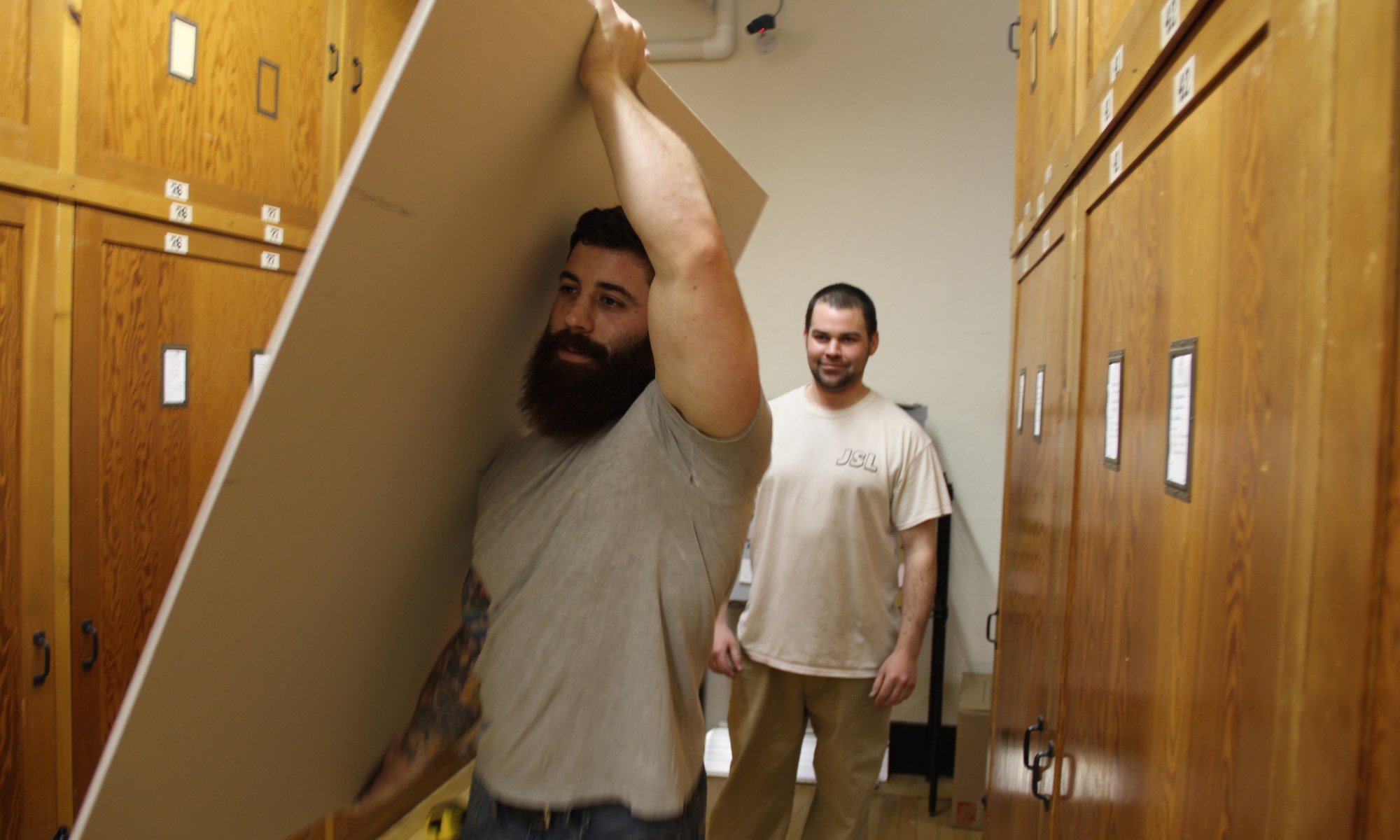
In collaboration with the Office of Physical Plant on campus, we are implementing a plan to mitigate some of this fluctuation. Contractors are working to seal the windows in the basement to stop outside air from sneaking into the storage.
This will stabilize the environment and lead to fewer changes in both temperature and humidity. The first step on the road to environmental control!
This week it seemed there were a lot of great links discussing new and exciting things happening within the world of archaeology. Here are just a few that we found:
This article talks about the role of diseases in shaping the genetic diversity of contemporary Native American communities. Historically these effects were documented by written accounts with little to no physical evidence since most European introduced diseases leave no evidence on bone. Recent breakthroughs in DNA markers, however, have been able to physically prove the evolutionary effects of these pandemics.
This article is a great example of how archaeologists are able to create and test hypothesis when attempting to solve puzzles encountered while excavating.
An interesting article that not only highlights the use of modern science in investigating historic traumas, but a great example of how important cultural context is both historically and in a contemporary lens.
Not only is this a super cool article talking about the first example of in situ beer making in China, but also a great example of how archaeologists are able to extrapolate larger and further reaching conclusions from a small snap shot of the past.
The central staircase of the Peabody includes a mural of American Indian life and history titled “Culture Areas of North America” by Stuart Travis (1868-1942). Travis was an accomplished and prolific American artist, illustrator, and designer who studied at the Académie Julian in Paris. His works—mostly drawings and watercolors—appeared frequently in magazines, books, and advertisements in the early twentieth century. Travis first came to Phillips Academy in 1928 to create the mural “History and Traditions of the School and Vicinity” in the Oliver Wendell Holmes Library. He continued to work at Phillips Academy, where he painted a total of three murals; he also designed the stone and wood gate that now leads to the Moncrieff Cochran Sanctuary.
Stuart Travis Mural at the Robert S. Peabody Museum of Archaeology. Photography by Gil Talbot.
The Peabody mural measures 13’11” by 10’2” and reflects ideas about anthropology and archaeology in the 1930s and 1940s. Major elements include the Maya Pyramid of the Magician at Uxmal on the left and a totem pole of the Northwest Coast on the right, with a map of cultures areas of North and Middle America occupying a central position, surmounted by six portraits across the top of the mural. Details and insets abound, illustrating artifacts, archaeological sites, ethnographic items, and scenes from Aztec and Maya codices. Illustrations of artifacts are drawn from the British Museum, the Museum of the American Indian (now the National Museum of the American Indian), the American Museum of Natural History, the Robert S. Peabody Museum of Archaeology, as well as several other prominent institutions.
Major Maya archaeological sites are labeled on the central map, but the majority of the map surface only depicts watersheds and topography, suggesting that Travis may have planned to add even more detail to the mural. The shadow of a thunderbird is painted over the central map, with a note explaining the widespread belief in supernatural birds in the Americas. Other details include an inset illustrating details of the Cahokia, Etowah, and Hopewell sites—likely a nod to long-time Peabody Director Warren K. Moorehead’s work. In all, there are over 30 American Indian artifacts illustrated (some in low relief), ranging from an example of Mi’kmaq writing on birch bark to a Tlingit “raven hat.” Many of these artifacts were probably drawn from contemporary books and articles on archaeology, while some may have been suggested by Museum staff. Detailed notes about the artifacts were likely included so the mural could be used as a teaching tool for visitors.
Travis dated the mural 1938, but continued with additions through 1942. The mural was restored in 1997 by Christy Cunningham-Adams through the generous support of the Abbott Academy Association.
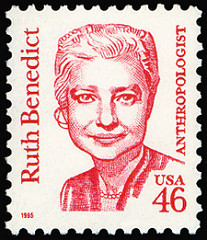
A quick Google search reveals that Ruth Benedict still looms large in the minds of contemporary anthropologists. Benedict (1887-1948) is known for many things—she was a favorite student of anthropology icon Franz Boas, she conducted multidisciplinary work across anthropology, psychology, and social science, and was close friend and confidant of Margaret Mead. Mead wrote a marvelous biography of her friend that gives her impressions alongside published and unpublished works by Benedict. Biographies continue to appear, including two dual bios of Mead and Benedict. Benedict wrote and talked about the paradigm shift in our field that she witnessed in the twentieth century as Boasian humanism gave way to scientific approaches. She famously argued that anthropology needed both.
1995 commemorative US postage stamp featuring Ruth Benedict.
Benedict has fared pretty well in the internet age. Blogger Jason Antrosio, writing at Living Anthropologically, pits Benedict against social geographer Jared Diamond, arguing that Benedict did what Diamond does, only better, more eloquently, with at least as much erudition, more personally, and at least seventy-five years before Diamond. Antrosio’s satiric comparison specifically looks at Diamond and Benedict’s take on what traditional societies have to teach the Western world. Likewise, Alex Golub, in his blog Savage Minds, argues that Benedict’s concise prose presages today’s best blog writing. Perhaps not surprisingly, some of Benedict’s more pithy insights appear on internet sites dedicated to quotation. One of these quotes has gotten a lot of attention recently—here it is:
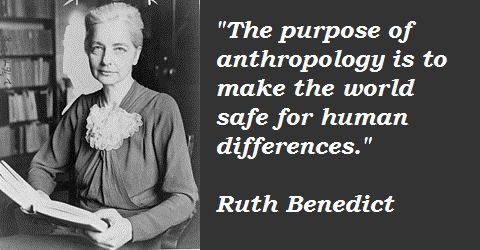
“The purpose of anthropology is to make the world safe for human differences”
Along with a presence on the quotation websites, this quote has made the rounds as an internet meme (framed against a nice photo of Benedict) and, perhaps most famously, was featured in remarks made by President Barack Obama during a press conference with Afghan President Ghani on March 24, 2015. The President referred to his own mother’s training as an anthropologist, as well as Ghani’s background. The remark, however, doesn’t specifically attribute the quote to Benedict. Simon Kuper, writing in The Financial Times, has dubbed Barack Obama the “anthropologist-in-chief” and a number of others have pointed out that President Obama’s interest in anthropology has tracked a growing interest in our discipline.
One version of the popular Ruth Benedict internet meme.
Specifically too, that quotation has resonated with a lot of people, myself included. I added it to my e-mail signature sometime over the summer—a place that I usually reserve for my contact info alone. I did notice, however, that while the quote appeared on a lot of websites, there was never any specific source cited. Archaeologist Meg Conkey told me recently that she too like the quote, but was unsure of its origins. She asked me if I knew and pointed out a Reddit post about the quote. The Reddit post argues that “Ruth Benedict never said it, not in any of her published writings. It seems to be merely myth. It is never specifically cited, nor does it make historical sense. In her own time, anthropology was a SCIENCE, not a political party.” The post includes a long list of internet memes, blog posts, and other websites that all attributed the quote to Benedict, but with no specific reference to back it up.
The quote aside for a moment, it is pretty clear that Benedict’s work had a strong political element. In many ways, as a cultural relativist, she sought to challenge American exceptionalism with her work. Benedict, along with anthropologist Gene Weltfish, prepared a pamphlet titled “The Races of Mankind” in 1943, intended as a guide for American troops operating overseas. This became an appendix to later editions of her 1940 book Race: Science and Politics, which makes both a humanistic and scientific case for the equality of all races.
A first edition copy of Ruth Benedict’s book The Chrysanthemum and the Sword.
During WWII Benedict prepared an “ethnography at a distance” study of Japanese culture for the U.S. Office of War Information, which appeared in 1946 as The Chrysanthemum and the Sword: Patterns of Japanese Culture. Along with her earlier work, Patterns of Culture, Chrysanthemum remains one of Benedict’s iconic projects. And it may provide a clue about that quote. This is what Benedict writes on page 14 of Chrysanthemum:
“The tough-minded are content that differences should exist. They respect differences. Their goal is a world made safe for differences, where the United States may be American to the hilt without threatening the peace of the world, and France may be France, and Japan may be Japan on the same conditions.”
Anthropologists certainly are a tough-minded lot, even if we get a bit loosey-goosey on our quotations. I suppose this is a consequence of progress, as brainyquotes.com replaces Bartlett’s.
A trip to the bookshelf provides another clue. On page 402 of their textbook Anthropology: The Human Challenge (15th edition) William Haviland and his co-authors include a nice profile of Ruth Benedict. There they say:
As Benedict herself once said, the main purpose of anthropology is “to make the world safe for human differences.”
So, she did say this, or at least something a lot like this. For the precise, we should likely reconsider using those quotes or their exact placement. It’s not surprising, however, that we still have a special place for Benedict in our discipline. Blogger Antrosio makes a nice point that Benedict, however, isn’t perfect, and that she suffers from the same flaws that afflict Jared Diamond:
“This history reveals the major theme missing from both Benedict and Diamond–an anthropology of interconnection. That as Eric Wolf described in Europe and the People Without History. Peoples once called primitive–now perhaps more politely termed tribal or traditional–were part of a co-production with Western colonialism.”
Johannes Fabian, in his 1983 book Time and the Other: How Anthropology Makes Its Object, makes much the same argument. Despite the shortcomings, Benedict has a lot to offer, from ideas about cultural relativism and race, to the direction that anthropology can take in the twenty-first century. As the contemporary scientific paradigm breaks free of its dialectic with humanism, can humanism assert itself in whatever comes next?
This blog represents the third entry in a blog new series –Peabody 25– that will delve into the history of the Peabody Museum through objects in our collection. A new post will be out with each newsletter, so keep your eyes peeled for the Peabody 25 tag!
Contributed by Marla Taylor
The unassuming and muddled looking object below is a piece of loosely formed breccia from Jacob’s Cavern in McDonald County, Missouri.
Breccia from Jacob’s Cavern
Breccia is a type of rock that is composed of broken fragments of other rocks that have been cemented together by a fine-grained matrix – this process can take thousands of years. While this piece is not yet solid rock, it is on the way. In this case, the matrix (or glue) is ash from thousands of fires that sustained life in the cavern for hundreds of years.
Acting on a tip from a local named E.H. Jacobs, Charles Peabody and Warren Moorehead traveled to Jacob’s Cavern in April of 1903 to examine the site. Upon arrival, they found a large rockshelter of limestone with hundreds of stalactites and stalagmites, and the floor was covered with a thick layer of fine ash up to 1.5 meters (nearly 5 feet) deep! This ash is most likely the direct result of untold numbers of small fires in the cavern to keep the occupants warm over the years of use.
Peabody and Moorehead excavated the thick layer of ashes in using a careful grid system and uncovered hundreds of artifacts. The stone tools were primarily projectile points and blades with relatively few large tools like axes. They also found a ‘considerable’ number of bone needles and awls. These small bone tools are essential in daily life to create, maintain, and repair clothing and other basic equipment. The sheer volume of ash and artifacts in the cavern indicates long-term occupation.
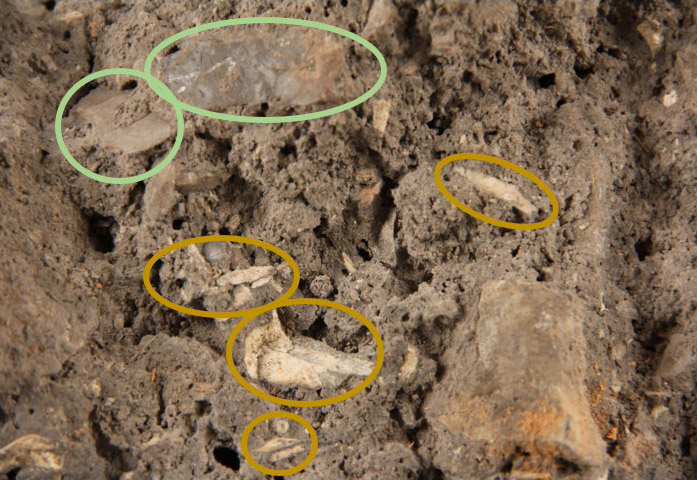
All evidence of human occupation – stone and bone tools, food debris – in the cavern was found in the layer of ashes and intermingled with breccia. And, most notably, many artifacts are visible within the breccia (see the photo below). This means that they were created, used, and discarded before the formation of the breccia and were left undisturbed for possibly thousands of years.
Detail of breccia with stone tools circled in green and bone fragments circled in yellow.
Peabody and Moorehead brought samples of the breccia and hundreds of collected artifacts back to the Peabody in 1903 while excavations continued by Mr. Jacobs for another couple years. Published in 1904, the report of their work became the first Bulletin published by the Department of Archaeology. The entirety of this report can be found here.
The work done by Peabody and Moorehead with Jacob’s Cavern became a foundation for later work at the Peabody. Explore and excavate a little-known site, bring the materials back to Andover for study, publish about that work, and provide invaluable new research and insight into the field of archaeology.
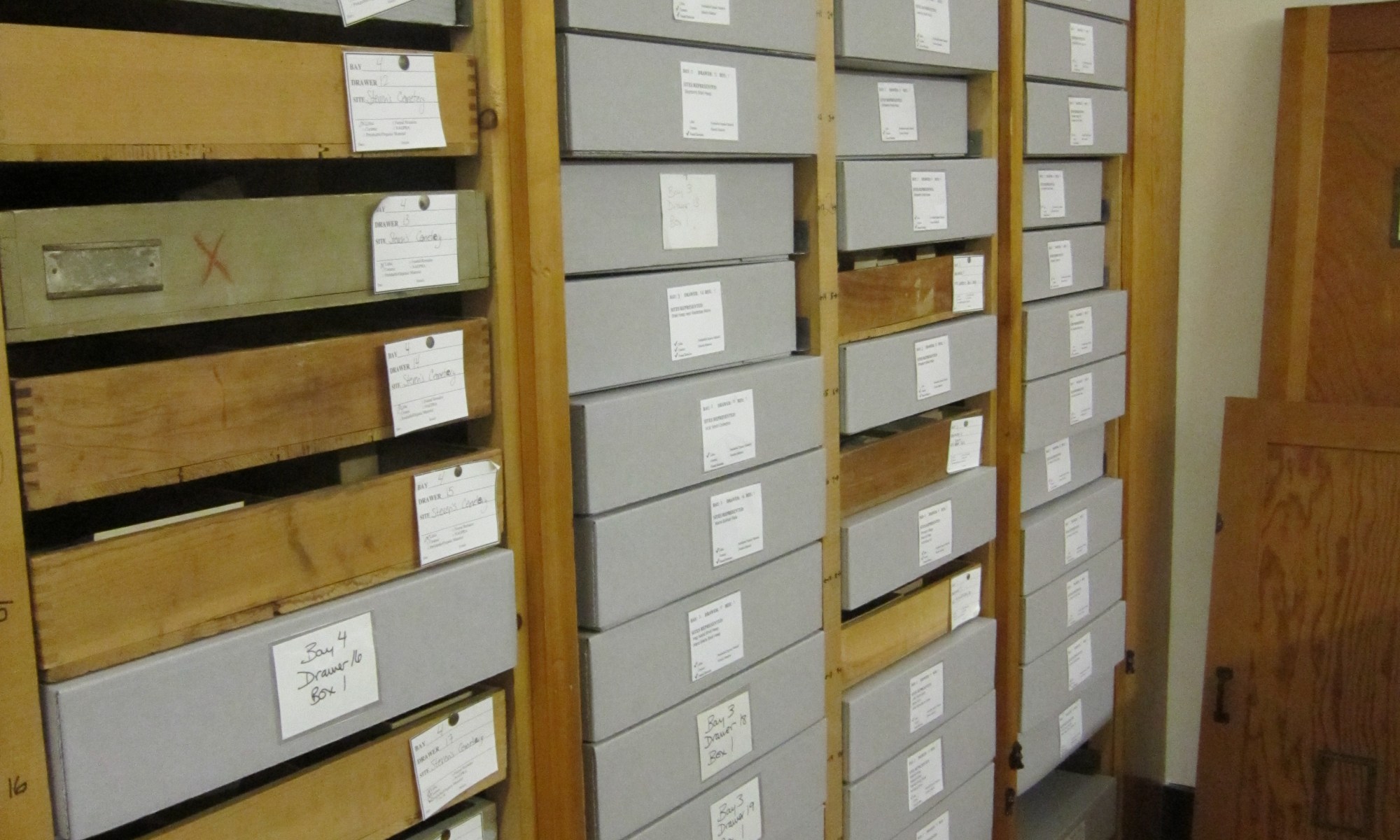
About six months in and the reboxing project is beginning to take off. With the help of students and volunteers, 52 drawers have been converted into 86 boxes. These first months have been spent ironing-out the kinks in the procedure and strategically identifying areas of the collection on which to focus.
The inventories produced from this project have already helped to identify areas of the collection for further attention and have made some objects available for education use.
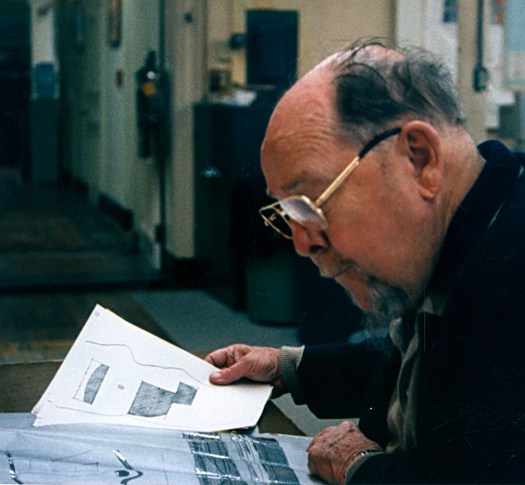
Archaeologist Richard S. MacNeish—known as Scotty—devoted his career to untangling two of the biggest questions of archaeology: when did people begin domesticating plants and how did that act impact and influence the development of civilization? During his tenure at Phillips Academy’s Robert S. Peabody Museum of Archaeology MacNeish led multidisciplinary expeditions to Mexico and Peru to search for the heartland of domesticated maize or corn. Before his death in 2001 MacNeish had searched for the origins of rice cultivation in China, studied early cultures of Belize, and planned to look at wheat domestication in Turkey. Evidence for domestication often could be found in dry caves, where ancient plant remains were preserved. Speaking of his research in China, MacNeish quipped, “I’ve crawled in and out of more caves than a Neanderthal caveman.”
Scotty MacNeish reviews excavation profiles.
Despite MacNeish’s indefatigable quest for the origins of the world’s most important crops, answers remained elusive. In Mexico’s Tehuacán Valley, near modern-day Puebla, MacNeish and his team reconstructed ancient environments, devised chronologies, and documented a sequence of corn domestication from tiny, primitive cobs to those that look much like the corn that was growing in the area during the Spanish conquest in the sixteenth century. MacNeish’s suggestion of an early date for corn domestication, however, was met with skepticism, as many archaeologists believed that these crops were developed after significant strides in social organization, urbanism, and the other hallmarks of civilization. A debate ensued, but much of MacNeish’s Tehuacán research was sidelined as other scientists found evidence for even earlier sites of corn domestication in the Mexican lowlands, pushing the dates back to at least 8,700 years ago.
MacNeish’s 1960s excavations at Coxcatlan Cave, Tehuacán Valley, Mexico.
MacNeish’s collections, preserved since the 1960s at Phillips Academy’s tiny Robert S. Peabody Museum of Archaeology, have continued to attract the interests of scientists. A November 21, 2016 article in the journal Current Biology reconstructs for the first time ever the complete genome of an early domesticated plant, based on a tiny, 5,310 year old cob from MacNeish’s Tehuacán project (Catalog number 90.184.36). The specimen was removed from an old exhibit case several years ago and loaned to the Smithsonian Institution’s Bruce Smith, a co-author of the new study. Statistical analyses of the DNA data indicate that the study specimen, dubbed Tehuacan162, is “a step that links modern maize with its wild ancestor.” Of particular interest were genetic markers for domestication—some of which were already exhibited in this early specimen—while others were not. This challenges previous models for corn domestication that focus on two major steps, countering that the history of domestication is more gradual and complex than currently believed. In conclusion, the study finds that Tehuacan162 is an ancient form of maize that is closely related to the ancestor of all modern maize, yet distinct from teosinte, a wild grass that is the closest living relative to maize.
MacNeish’s Tehuacán exhibit featured hand painted images like these of early plant domesticates.
Part of Scotty MacNeish’s 1970s era exhibit about his work in the Tehuacán Valley of Mexico–note the corn cobs and kernels.
The tiny corn specimen 90.184.36, also dubbed Tehuacán162, used in the recent study.
Corn cobs from Scotty MacNeish’s projects in Tamaulipas and Tehuacán Valley, Mexico.
Today the Robert S. Peabody Museum of Archaeology provides educational programming to the high school students of Phillips Academy, ranging from classes to work behind-the-scenes with our significant collections. Researchers also are encouraged to use the Museum’s holdings and often share their results with students.












 The Peabody