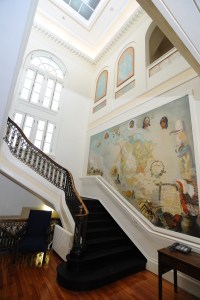
The central staircase of the Peabody includes a mural of American Indian life and history titled “Culture Areas of North America” by Stuart Travis (1868-1942). Travis was an accomplished and prolific American artist, illustrator, and designer who studied at the Académie Julian in Paris. His works—mostly drawings and watercolors—appeared frequently in magazines, books, and advertisements in the early twentieth century. Travis first came to Phillips Academy in 1928 to create the mural “History and Traditions of the School and Vicinity” in the Oliver Wendell Holmes Library. He continued to work at Phillips Academy, where he painted a total of three murals; he also designed the stone and wood gate that now leads to the Moncrieff Cochran Sanctuary.
Stuart Travis Mural at the Robert S. Peabody Museum of Archaeology. Photography by Gil Talbot.
The Peabody mural measures 13’11” by 10’2” and reflects ideas about anthropology and archaeology in the 1930s and 1940s. Major elements include the Maya Pyramid of the Magician at Uxmal on the left and a totem pole of the Northwest Coast on the right, with a map of cultures areas of North and Middle America occupying a central position, surmounted by six portraits across the top of the mural. Details and insets abound, illustrating artifacts, archaeological sites, ethnographic items, and scenes from Aztec and Maya codices. Illustrations of artifacts are drawn from the British Museum, the Museum of the American Indian (now the National Museum of the American Indian), the American Museum of Natural History, the Robert S. Peabody Museum of Archaeology, as well as several other prominent institutions.
Major Maya archaeological sites are labeled on the central map, but the majority of the map surface only depicts watersheds and topography, suggesting that Travis may have planned to add even more detail to the mural. The shadow of a thunderbird is painted over the central map, with a note explaining the widespread belief in supernatural birds in the Americas. Other details include an inset illustrating details of the Cahokia, Etowah, and Hopewell sites—likely a nod to long-time Peabody Director Warren K. Moorehead’s work. In all, there are over 30 American Indian artifacts illustrated (some in low relief), ranging from an example of Mi’kmaq writing on birch bark to a Tlingit “raven hat.” Many of these artifacts were probably drawn from contemporary books and articles on archaeology, while some may have been suggested by Museum staff. Detailed notes about the artifacts were likely included so the mural could be used as a teaching tool for visitors.
Travis dated the mural 1938, but continued with additions through 1942. The mural was restored in 1997 by Christy Cunningham-Adams through the generous support of the Abbott Academy Association.
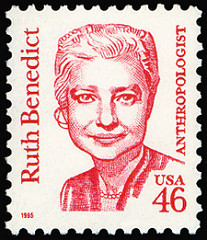
A quick Google search reveals that Ruth Benedict still looms large in the minds of contemporary anthropologists. Benedict (1887-1948) is known for many things—she was a favorite student of anthropology icon Franz Boas, she conducted multidisciplinary work across anthropology, psychology, and social science, and was close friend and confidant of Margaret Mead. Mead wrote a marvelous biography of her friend that gives her impressions alongside published and unpublished works by Benedict. Biographies continue to appear, including two dual bios of Mead and Benedict. Benedict wrote and talked about the paradigm shift in our field that she witnessed in the twentieth century as Boasian humanism gave way to scientific approaches. She famously argued that anthropology needed both.
1995 commemorative US postage stamp featuring Ruth Benedict.
Benedict has fared pretty well in the internet age. Blogger Jason Antrosio, writing at Living Anthropologically, pits Benedict against social geographer Jared Diamond, arguing that Benedict did what Diamond does, only better, more eloquently, with at least as much erudition, more personally, and at least seventy-five years before Diamond. Antrosio’s satiric comparison specifically looks at Diamond and Benedict’s take on what traditional societies have to teach the Western world. Likewise, Alex Golub, in his blog Savage Minds, argues that Benedict’s concise prose presages today’s best blog writing. Perhaps not surprisingly, some of Benedict’s more pithy insights appear on internet sites dedicated to quotation. One of these quotes has gotten a lot of attention recently—here it is:
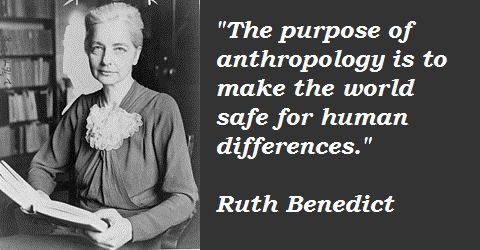
“The purpose of anthropology is to make the world safe for human differences”
Along with a presence on the quotation websites, this quote has made the rounds as an internet meme (framed against a nice photo of Benedict) and, perhaps most famously, was featured in remarks made by President Barack Obama during a press conference with Afghan President Ghani on March 24, 2015. The President referred to his own mother’s training as an anthropologist, as well as Ghani’s background. The remark, however, doesn’t specifically attribute the quote to Benedict. Simon Kuper, writing in The Financial Times, has dubbed Barack Obama the “anthropologist-in-chief” and a number of others have pointed out that President Obama’s interest in anthropology has tracked a growing interest in our discipline.
One version of the popular Ruth Benedict internet meme.
Specifically too, that quotation has resonated with a lot of people, myself included. I added it to my e-mail signature sometime over the summer—a place that I usually reserve for my contact info alone. I did notice, however, that while the quote appeared on a lot of websites, there was never any specific source cited. Archaeologist Meg Conkey told me recently that she too like the quote, but was unsure of its origins. She asked me if I knew and pointed out a Reddit post about the quote. The Reddit post argues that “Ruth Benedict never said it, not in any of her published writings. It seems to be merely myth. It is never specifically cited, nor does it make historical sense. In her own time, anthropology was a SCIENCE, not a political party.” The post includes a long list of internet memes, blog posts, and other websites that all attributed the quote to Benedict, but with no specific reference to back it up.
The quote aside for a moment, it is pretty clear that Benedict’s work had a strong political element. In many ways, as a cultural relativist, she sought to challenge American exceptionalism with her work. Benedict, along with anthropologist Gene Weltfish, prepared a pamphlet titled “The Races of Mankind” in 1943, intended as a guide for American troops operating overseas. This became an appendix to later editions of her 1940 book Race: Science and Politics, which makes both a humanistic and scientific case for the equality of all races.
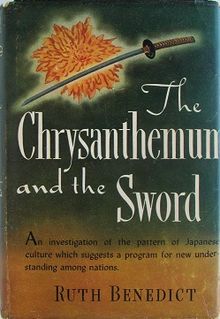
A first edition copy of Ruth Benedict’s book The Chrysanthemum and the Sword.
During WWII Benedict prepared an “ethnography at a distance” study of Japanese culture for the U.S. Office of War Information, which appeared in 1946 as The Chrysanthemum and the Sword: Patterns of Japanese Culture. Along with her earlier work, Patterns of Culture, Chrysanthemum remains one of Benedict’s iconic projects. And it may provide a clue about that quote. This is what Benedict writes on page 14 of Chrysanthemum:
“The tough-minded are content that differences should exist. They respect differences. Their goal is a world made safe for differences, where the United States may be American to the hilt without threatening the peace of the world, and France may be France, and Japan may be Japan on the same conditions.”
Anthropologists certainly are a tough-minded lot, even if we get a bit loosey-goosey on our quotations. I suppose this is a consequence of progress, as brainyquotes.com replaces Bartlett’s.
A trip to the bookshelf provides another clue. On page 402 of their textbook Anthropology: The Human Challenge (15th edition) William Haviland and his co-authors include a nice profile of Ruth Benedict. There they say:
As Benedict herself once said, the main purpose of anthropology is “to make the world safe for human differences.”
So, she did say this, or at least something a lot like this. For the precise, we should likely reconsider using those quotes or their exact placement. It’s not surprising, however, that we still have a special place for Benedict in our discipline. Blogger Antrosio makes a nice point that Benedict, however, isn’t perfect, and that she suffers from the same flaws that afflict Jared Diamond:
“This history reveals the major theme missing from both Benedict and Diamond–an anthropology of interconnection. That as Eric Wolf described in Europe and the People Without History. Peoples once called primitive–now perhaps more politely termed tribal or traditional–were part of a co-production with Western colonialism.”
Johannes Fabian, in his 1983 book Time and the Other: How Anthropology Makes Its Object, makes much the same argument. Despite the shortcomings, Benedict has a lot to offer, from ideas about cultural relativism and race, to the direction that anthropology can take in the twenty-first century. As the contemporary scientific paradigm breaks free of its dialectic with humanism, can humanism assert itself in whatever comes next?
This blog represents the third entry in a blog new series –Peabody 25– that will delve into the history of the Peabody Museum through objects in our collection. A new post will be out with each newsletter, so keep your eyes peeled for the Peabody 25 tag!
Contributed by Marla Taylor
The unassuming and muddled looking object below is a piece of loosely formed breccia from Jacob’s Cavern in McDonald County, Missouri.
Breccia from Jacob’s Cavern
Breccia is a type of rock that is composed of broken fragments of other rocks that have been cemented together by a fine-grained matrix – this process can take thousands of years. While this piece is not yet solid rock, it is on the way. In this case, the matrix (or glue) is ash from thousands of fires that sustained life in the cavern for hundreds of years.
Acting on a tip from a local named E.H. Jacobs, Charles Peabody and Warren Moorehead traveled to Jacob’s Cavern in April of 1903 to examine the site. Upon arrival, they found a large rockshelter of limestone with hundreds of stalactites and stalagmites, and the floor was covered with a thick layer of fine ash up to 1.5 meters (nearly 5 feet) deep! This ash is most likely the direct result of untold numbers of small fires in the cavern to keep the occupants warm over the years of use.
Peabody and Moorehead excavated the thick layer of ashes in using a careful grid system and uncovered hundreds of artifacts. The stone tools were primarily projectile points and blades with relatively few large tools like axes. They also found a ‘considerable’ number of bone needles and awls. These small bone tools are essential in daily life to create, maintain, and repair clothing and other basic equipment. The sheer volume of ash and artifacts in the cavern indicates long-term occupation.
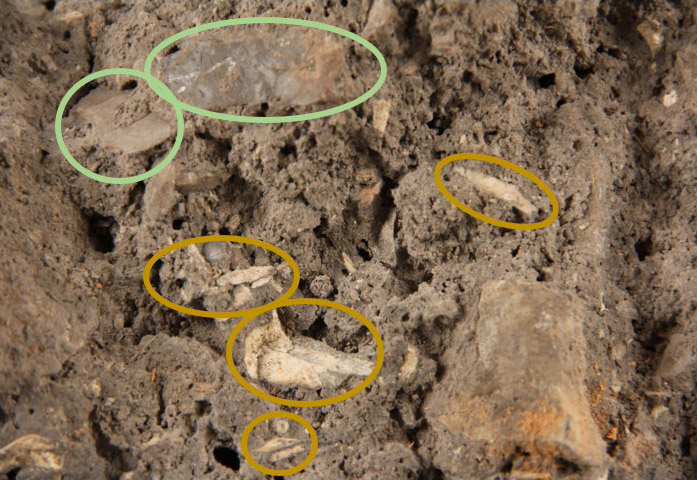
All evidence of human occupation – stone and bone tools, food debris – in the cavern was found in the layer of ashes and intermingled with breccia. And, most notably, many artifacts are visible within the breccia (see the photo below). This means that they were created, used, and discarded before the formation of the breccia and were left undisturbed for possibly thousands of years.
Detail of breccia with stone tools circled in green and bone fragments circled in yellow.
Peabody and Moorehead brought samples of the breccia and hundreds of collected artifacts back to the Peabody in 1903 while excavations continued by Mr. Jacobs for another couple years. Published in 1904, the report of their work became the first Bulletin published by the Department of Archaeology. The entirety of this report can be found here.
The work done by Peabody and Moorehead with Jacob’s Cavern became a foundation for later work at the Peabody. Explore and excavate a little-known site, bring the materials back to Andover for study, publish about that work, and provide invaluable new research and insight into the field of archaeology.
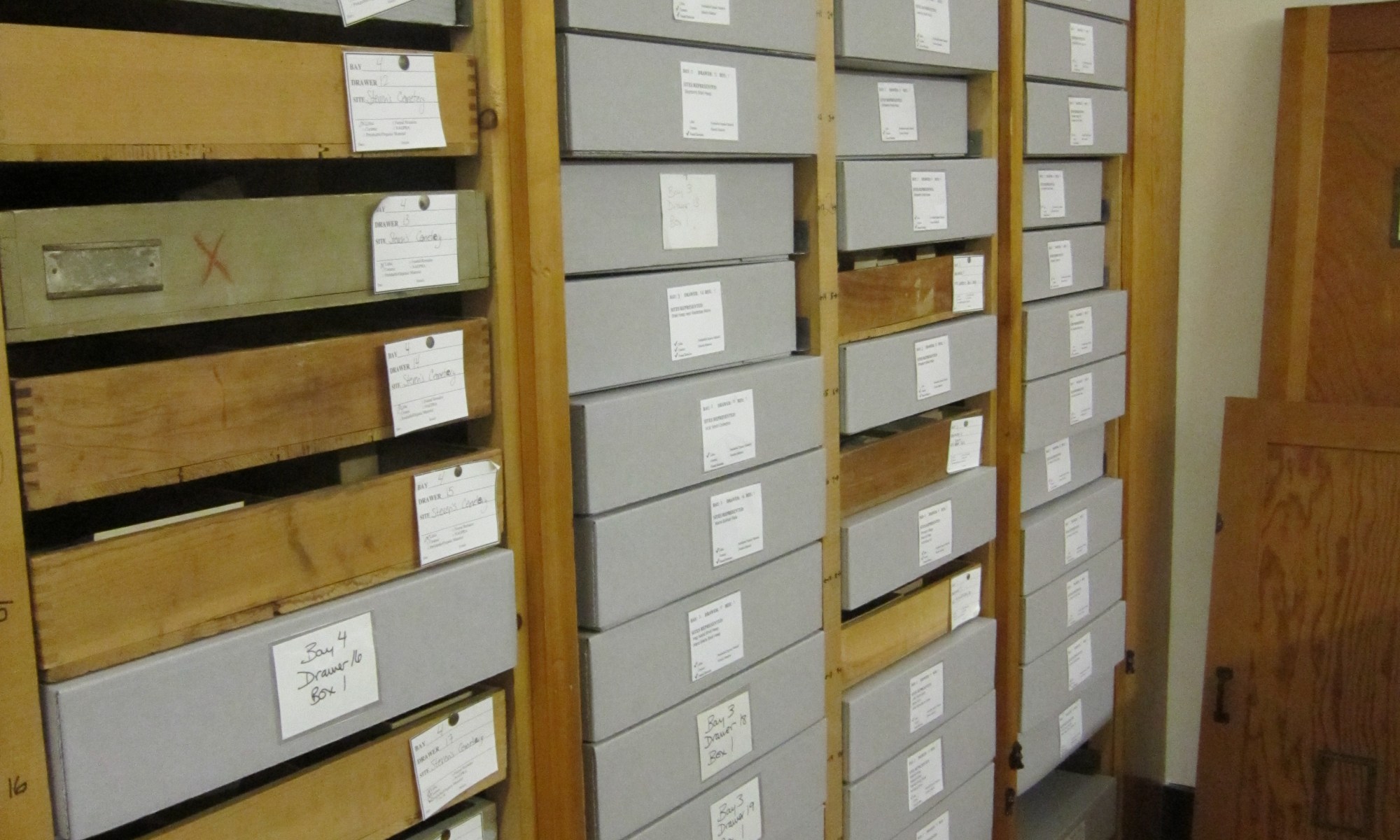
About six months in and the reboxing project is beginning to take off. With the help of students and volunteers, 52 drawers have been converted into 86 boxes. These first months have been spent ironing-out the kinks in the procedure and strategically identifying areas of the collection on which to focus.
The inventories produced from this project have already helped to identify areas of the collection for further attention and have made some objects available for education use.
Archaeologist Richard S. MacNeish—known as Scotty—devoted his career to untangling two of the biggest questions of archaeology: when did people begin domesticating plants and how did that act impact and influence the development of civilization? During his tenure at Phillips Academy’s Robert S. Peabody Museum of Archaeology MacNeish led multidisciplinary expeditions to Mexico and Peru to search for the heartland of domesticated maize or corn. Before his death in 2001 MacNeish had searched for the origins of rice cultivation in China, studied early cultures of Belize, and planned to look at wheat domestication in Turkey. Evidence for domestication often could be found in dry caves, where ancient plant remains were preserved. Speaking of his research in China, MacNeish quipped, “I’ve crawled in and out of more caves than a Neanderthal caveman.”
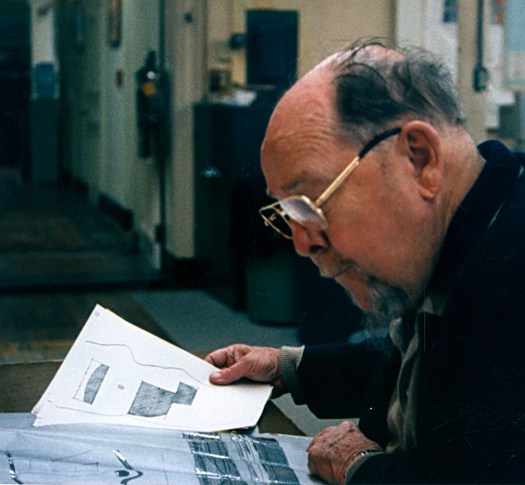
Scotty MacNeish reviews excavation profiles.
Despite MacNeish’s indefatigable quest for the origins of the world’s most important crops, answers remained elusive. In Mexico’s Tehuacán Valley, near modern-day Puebla, MacNeish and his team reconstructed ancient environments, devised chronologies, and documented a sequence of corn domestication from tiny, primitive cobs to those that look much like the corn that was growing in the area during the Spanish conquest in the sixteenth century. MacNeish’s suggestion of an early date for corn domestication, however, was met with skepticism, as many archaeologists believed that these crops were developed after significant strides in social organization, urbanism, and the other hallmarks of civilization. A debate ensued, but much of MacNeish’s Tehuacán research was sidelined as other scientists found evidence for even earlier sites of corn domestication in the Mexican lowlands, pushing the dates back to at least 8,700 years ago.
MacNeish’s 1960s excavations at Coxcatlan Cave, Tehuacán Valley, Mexico.
MacNeish’s collections, preserved since the 1960s at Phillips Academy’s tiny Robert S. Peabody Museum of Archaeology, have continued to attract the interests of scientists. A November 21, 2016 article in the journal Current Biology reconstructs for the first time ever the complete genome of an early domesticated plant, based on a tiny, 5,310 year old cob from MacNeish’s Tehuacán project (Catalog number 90.184.36). The specimen was removed from an old exhibit case several years ago and loaned to the Smithsonian Institution’s Bruce Smith, a co-author of the new study. Statistical analyses of the DNA data indicate that the study specimen, dubbed Tehuacan162, is “a step that links modern maize with its wild ancestor.” Of particular interest were genetic markers for domestication—some of which were already exhibited in this early specimen—while others were not. This challenges previous models for corn domestication that focus on two major steps, countering that the history of domestication is more gradual and complex than currently believed. In conclusion, the study finds that Tehuacan162 is an ancient form of maize that is closely related to the ancestor of all modern maize, yet distinct from teosinte, a wild grass that is the closest living relative to maize.
MacNeish’s Tehuacán exhibit featured hand painted images like these of early plant domesticates.
Part of Scotty MacNeish’s 1970s era exhibit about his work in the Tehuacán Valley of Mexico–note the corn cobs and kernels.
The tiny corn specimen 90.184.36, also dubbed Tehuacán162, used in the recent study.
Corn cobs from Scotty MacNeish’s projects in Tamaulipas and Tehuacán Valley, Mexico.
Today the Robert S. Peabody Museum of Archaeology provides educational programming to the high school students of Phillips Academy, ranging from classes to work behind-the-scenes with our significant collections. Researchers also are encouraged to use the Museum’s holdings and often share their results with students.
This blog represents the second entry in a blog new series – Peabody 25 – that will delve into the history of the Peabody Museum through objects in our collection. A new post will be out with each newsletter, so keep your eyes peeled for the Peabody 25 tag!
We don’t know much about the relationship between our institution’s founder Robert Singleton Peabody and his son Charles, the museum’s first director. In fact both men remain a bit of a mystery as they were intensely private and left little in the way of memoirs, notes, or archives. Robert’s rather substantial gift to the Academy, for example, was to remain anonymous until well after his death. For years we assumed that Charles, like Robert, had attended Phillips Academy. We found recently, however, that he stayed a bit closer to home and completed his high school education at the Germantown Academy—a venerable day school not far from the Peabody home in Philadelphia. In one of the few pieces of correspondence that we have between the two Peabodys, Charles exhorts his father to help him secure a position at the new Phillips Academy Department of Archaeology and asserts that he will not be the architect of his own undoing. Charles was on hand for the grand opening of the Archaeology Building in 1903, as he had been appointed the “honorary director.” One object in the Peabody’s collection provides a little window into what may have been a fraught and complicated relationship.
Object 19661 in Robert Peabody’s original collection is a small terracotta bird, perhaps a swan or goose. A handwritten note in pencil on lined paper tells us part of the story. Charles, during his tenure at the American School of Classical Studies at Athens, received the terracotta figurine from the school’s factotum Nikolaki. Charles muses in the note that Nikolaki had “hooked” it from one of the American excavations, perhaps at Argos or Eretria. Excavation reports can be found for both sites. For example, Charles Waldstein excavated at Argos from 1892 to 1895, with some focus on the Sanctuary of Hera. During the same time, Theodore Woolsey Heermance worked at the theatre of Eretria. Some quick poking around suggests that the little figurine, handmade of attic clay and covered with a white slip, is likely a votive offering. Similar offerings, representing an array of animals and birds, have been found at many Greek sites. Waldstein’s report on the Argos excavations mentions a number of terracotta figurines—some human and others animal. These offerings would have been placed in a temple for some set period and then discarded as ritual debris. Many similar examples can be found in auction catalogs and in the extensive collections exhibited at the Met.
The elder and younger Peabodys did have a lot in common, beyond their interest in discretion and privacy. Both were united in a passion for archaeology. Robert’s interests were more antiquarian—during his life he amassed some 38,000 archaeological specimens, principally from North America, while Charles was devoted to the French Paleolithic and dabbled in stratigraphic excavation, when horizontal and vertical control was a new concept. In many ways the two men represented archaeology’s past and future. Robert’s interests as a student had leaned toward the classical and he was named the valedictorian of his class. His correspondence with his curator Warren Moorehead and the administrators of Phillips Academy are filled with Latin and classical references. Charles received his PhD in philology—sort of a combination of classical languages, Biblical studies, and archaeology—from Harvard in 1893. After this he spent some time in Athens at the American School where he picked up the little votive bird. Robert appended his own note—in blue pencil—to Charles’s, indicating that he had received the bird from his son in 1897. Not long after this Charles was becoming established as an instructor in European archaeology at Harvard. With the creation of the Phillips Academy Department of Archaeology in 1901 Charles spent more time in Andover, helping to make decisions about the construction of the archaeology building and ultimately teaching classes as he could. The little votive bird was shipped from Philadelphia to Andover as part of Robert’s burgeoning collections, forming the core of the Museum that we know now. With Robert’s death in 1904, Charles pursued his passion for prehistoric European archaeology, participating in and leading a number of expeditions during his career before ultimately moving to France permanently in 1924.
We can only assume that both men, well versed in classical languages and archaeology, knew exactly what that little ceramic bird was—an offering from a votary to a god.
Thanks to Catherine Hunter, Peabody Museum research associate, our full basketry collection of 329 is inventoried and described. In September, Catherine turned over 7 binders of material including research into known artists, glossaries, information on weaving techniques, and a basic description of each basket. This massive project took Catherine nearly a year!
The next phase is to photograph each of these gorgeous baskets and improve their storage and accessibility. Last week, Marla Taylor, Samantha Hixson, and Catherine took a trip to the Peabody Museum of Archaeology and Ethnology at Harvard University to examine their basketry storage. The visit was full of inspiration and incredibly helpful as we continue to work on this project.
Keep your eyes peeled for the inclusion of these amazing baskets in our online collection database!
Catherine Hunter with some of the Peabody’s baskets
Catherine Hunter, Samantha Hixson, and Marla Taylor visit the Harvard Peabody basketry collection.
My name is Samantha Hixson and I am the new collections assistant here at the Peabody. I come to you from New Mexico where the weather is warm and has left me completely unprepared for New England winters (although Marla and Lindsay promise that they’ll get me through it).
I have previously worked at the Museum of Indian Arts and Culture in Santa Fe, New Mexico as well as the Smithsonian Institution’s National Museum of the American Indian in Washington, DC. It’s these places that got me excited to work within museums, focusing specifically on Native American collections. So you can imagine how excited I was when I was hired to work at the Peabody, it’s the perfect job for me! I’ve also had some other very interesting archaeological/ethnographic experiences, but those are for other posts.
I’ve started getting my feet wet in a couple projects already (with the promise of a lot more to come) and am most excited about the re-housing of the collection as well the Adopt A Drawer program. I think it’s great that these collections are getting new homes and more personal interactions, however brief.
If you’re in the neighborhood of the museum, come stop by; I’d love to meet you!
The new Peabody Collections Assistant, Samantha Hixson
Since October, I’ve been focusing on the largest collection at the Peabody, the Richard S. MacNeish papers. MacNeish donated about 220 linear feet of his papers and books to the museum in 2000, soon before he died. These papers span the length of his life and career, from childhood scrapbooks on the Maya to his MA and PhD theses, to field records and administrative files from his Tamaulipas, Ayacucho, Pendejo Cave and China projects, to research files on a variety of geographical regions and subjects, to records from his positions at Boston University, as head of the Andover Foundation for Archaeological Research (AFAR), and as director of the Peabody Museum itself. MacNeish, known as Scotty, was such a significant figure in American Archaeology in the 20th century that his papers are likely to have a high research value.
Scotty MacNeish, around 1980
An extensive amount of work was already carried out on this collection since it arrived at the museum. An item-level inventory was done, and about half of the boxes had their contents rehoused into acid-free folders (papers) and mylar sleeves (photographs). More recently, the museum decided to separate out the large number of books from the papers, many of which will be added to the Peabody library. Volumes that were annotated by MacNeish or bear a personalized dedication to him are being retained in the archives. After separating books from the archival materials the remaining papers now measure only 90 linear feet – a huge difference in terms of storage space.
Boxes of MacNeish papers
A typical box before sorting out the books
I’m now working on a few remaining steps: foldering loose items in boxes, determining date ranges for folders, updating the inventory to reflect those changes as well as the removal of the books, rearranging the materials into logical groupings, and rehousing contents into acid-free record cartons. Lastly, I’ll integrate within the guide to this collection the other Scotty MacNeish materials we have at the museum, his director’s records. MacNeish left about 20 linear feet of material at the museum at the end of his directorship in 1983. To preserve the provenance of these two groups of material, we decided to process them as separate collections – even though there is a lot of overlap between the two. I’m looking forward to having all of this material be easily accessible to researchers soon, and anticipate that this work will be completed and the collection guide available by mid to late January 2017.
The Temporary Archivist position is supported by a generous grant from the Oak River Foundation of Peoria, Ill. to improve the intellectual and physical control of the museum’s collections. We hope this gift will inspire others to support our work to better catalog, document, and make accessible the Peabody’s world-class collections of objects, photographs, and archival materials. If you would like information on how you can help please contact Peabody director Ryan Wheeler at rwheeler@andover.edu or 978 749 4493.
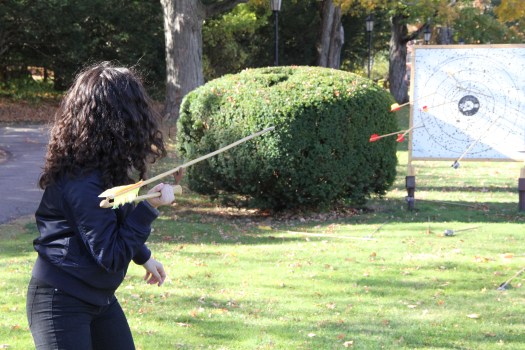
As the fall term wraps up this week it’s a great time to reflect on some of the big ideas that we have discussed in the multidisciplinary science course Human Origins, taught here at the Peabody. In many of our extended period labs we have replicated ancient technologies like chipped stone tools, fire making, the atlatl or spear thrower, and more. As we try launching a spear with a simple lever—the atlatl, or use a bow drill to produce heat, smoke, and (hopefully) fire, we wonder about whom first thought of and tried these things. In other words, who was the first innovator who discovered a technique to make fire or launch a dart? Innovation is a popular word today. In fact, it’s easy to find blogs, news stories, and more that suggest this word is a bit overused. Some writers have tracked the history of the term innovation and its divergence from invention, often indicating that innovation has economic and market implications.
Human Origins students experimented with fire making two ways–the bow drill and percussion. Notice a few wisps of smoke rising from the fire board.
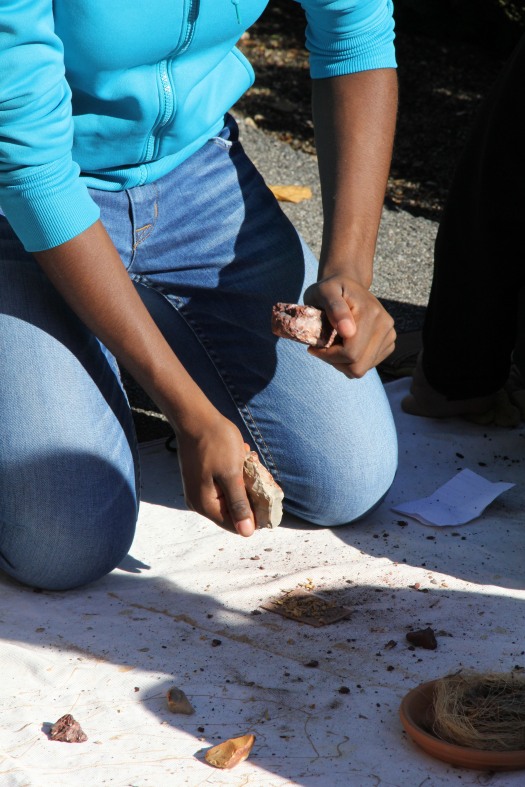
One piece that seems to be missing from many of these stories about innovation is that it doesn’t amount to much without a means for transmission. The ability to put the innovation into production, to teach and train others, to demonstrate and sell the new idea may, in fact, be even more important than the act of discovery or invention. Now some ideas—like fire—might sell themselves, but there are different methods and techniques. In Human Origins we experimented with two very different approaches: friction—using a bow drill and fire board, and percussion—essentially banging two rocks together. There are, however, lots of opportunities for innovation here, large and small. Which rocks will work best? Which wood makes the best fire board? How does one direct a spark or ember into a nest of kindling?
Making fire by percussion–banging two rocks together–isn’t so easy! This Human Origins student uses flint and iron ore. Lots of sparks and smoke, but no fire. The earliest evidence for control of fire comes from a Homo erectus site in Africa and dates to 1 million years ago.
Archaeologists—intent on the exploration of culture change through time—often claim that thinking about innovation and transmission of new ideas falls well within their province. But others have famously weighed in as well. Perhaps best known is evolutionary biologist Richard Dawkins notion of the “meme,” introduced in his 1976 book The Selfish Gene. Dawkins styles the meme—“an idea, behavior, or style that spreads from person to person within a culture,” in evolutionary terms, subject to natural selection, mutation, and the like. This idea has been popular, but has its detractors. One problem in the application of evolution to culture is that there is always an explanation, but sometimes at the benefit of understanding. Stephen J. Gould and Richard Lewontin tackle this in their 1979 article “The Spandrels of San Marco and the Panglossian Paradigm,” another staple of Human Origins. Here Gould and Lewontin argue that some features—both natural and cultural—are merely spandrels, or by-products of other evolutionary processes. The interpretation of these spandrels as adaptive will lead to erroneous conclusions.
The earliest atlatls or spear throwers date to around 20,000 years ago in France. The simple lever allowed a hunter to throw a dart with more power and precision. In many places the atlatl was replaced by the bow and arrow, but in some areas both coexist.
So, does archaeology offer another approach to understanding innovation and transmission of ideas in our distant past? Archaeologist Michael Brian Schiffer would answer affirmatively. Schiffer helped define behavioral archaeology, which is predicated on the idea that people in the past made decisions in ways that parallel present-day decision making. This model points out that people often make choices that are seemingly contrary to common sense, but take into account a variety of factors including tradition, peer pressure, social and political alliances, and the like. The atlatl or spear thrower is a good example. As far as we know, the earliest atlatls were made in France some 20,000 years ago. Within a few millennia we find highly decorated examples. It’s unclear if there are separate centers of innovation, but atlatls are known over much of the world, including the Americas and in Australia. In many places the atlatl is replaced by the bow and arrow, which offered several distinct advantages, but in some places both technologies coexist, suggesting that processes of innovation, transmission, adoption, and discontinuation may have varied considerably. Overall, however, our attempts to replicate ancient technology gave us new respect for the first innovators and some insight into the complexities around transmission of new ideas.