The art of collecting

“Briefly stated, the history of archaeology in the Northeast has been in no way different from the history of archaeology elsewhere: its birth was as relic collecting, for the pure and simple interest of the objects recovered. It was soon recognized that without supporting data such objects were little more than curios, and that even with supporting data as to provenience – all too frequently so vague as to be of little value—they still were closely akin to curiosities and the undertaking little more than antiquarianism.” (Douglas Byers, Peabody Annual Report, 1948)

Since beginning my project at the Peabody, I’ve been intrigued by how American Indian artifacts were collected in the first few decades of the 20th century. At the time, the practice ranged from small-scale hobby collecting to commercial-minded efforts to acquire and sell artifacts for profit, to museums collecting for “scientific study.” The Peabody archives offer a glimpse of how artifact collecting, mostly on a small scale, was conducted, documented and perceived. That distinctions were made between “collectors” and professional archaeologists seems clear, even in the early 1900s. And yet, as the quote from Byers above indicates, relic collecting is part of the story of archaeology in the United States. What role did it play in this story, and what common purposes and/or divides developed between the various actors interested in archaeology and artifacts?

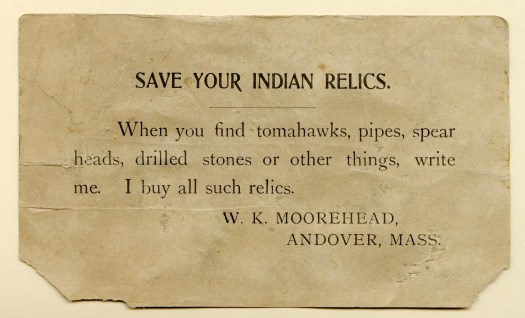
I first noted documentation of avocational artifact collecting in Warren K. Moorehead’s records (1890s-1930s). Moorehead, the Peabody’s first curator and subsequent director (1901-1938), was well known to amateur collectors; he wrote publications catered to them, such as Prehistoric Relics (1905), purchased artifacts from them, sold artifacts to them, and included images of collector artifacts in his two-volume The Stone Age of North America (1910) (which he then marketed back towards those same collectors). Collectors wrote him, seeking his expertise, as well as those seeking to sell larger collections. He was criticized by his professional peers for being overly focused on artifacts and not exercising rigorous archaeological science. Years later, in 1973, retired Peabody Curator Fred Johnson wrote in a letter to a graduate student: “Moorehead was very definitely not an archaeologist even in the frame of reference of his times. He has never published an important archaeological book or paper. He was a collector, a confirmed looter of archaeological sites and he had no other purpose in life than to secure by any means, regardless of any kind of ethics, specimens which were the ‘best,’ unique, unusual, etc.”

A small card bearing the following text: "Save your Indian relics. When you find tomahawks, pipes, spear heads, drilled stone or other things, write me. I buy all such relics. W.K. Moorehead, Andover, Mass."
Warren Moorehead’s “Save your Indian relics” card, circa 1900-1920

Despite those accusations, and the appearance he gave at times of being a salesman, Moorehead denounced those who destroyed sites to acquire artifacts, and had advocated for the preservation of archaeological sites in the past. In “Commercial vs. scientific collecting” (1905) he wrote: “.. [commercial collectors] have ransacked the graves, mounds and cliff houses, dragged forth the humble arts of simple aborigines long dead and sold them for a few paltry dollars. The destruction of archaeological testimony wrought by these vandals is something beyond compute” (114). In contrast, he describes the simple joys of avocational collecting: “For the local student who collects for his own pleasure, we should have nothing but commendation, for at some future date his cabinet may be preserved. His expenditures, his trips to favorite localities that he may personally roam over freshly ploughed fields, his hours spent in arranging his cabinet during winter evenings are all labors born of love” (114). He also notes that these small collections are “gradually drifting to the permanent museums,” rejoining collections obtained through professional excavations.

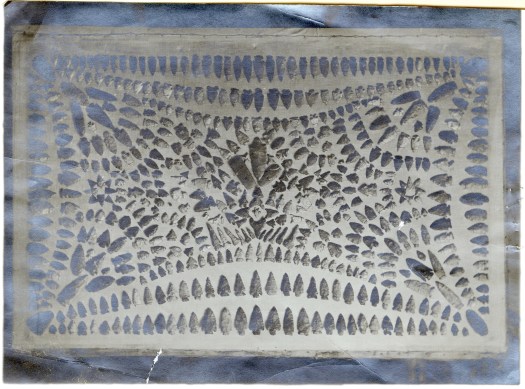
While looking through the photographs of artifacts sent to him, I was struck by the “arrangement of the cabinet,” how collectors artfully arranged their artifacts into patterns or staged them to be photographed. Current Peabody Director Ryan Wheeler told me the practice continues to this day. It’s almost as if the deliberate act of collecting is put on display through these creative arrangements: the hand of the collector in accumulating these collections is manifest.

Black and white photograph of of American Indian artifacts arranged into a pattern
Photograph sent to Warren Moorehead of American Indian artifacts from the collection of Inez A. Hall, Pennsylvania, circa 1900-1910

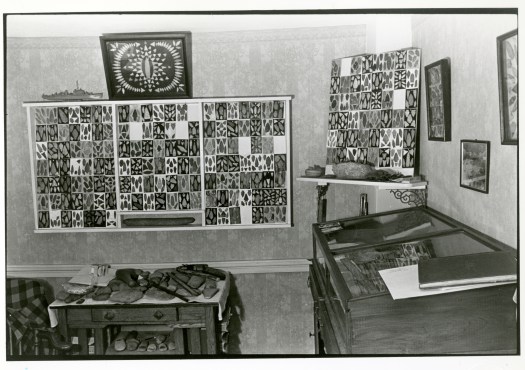
A fuller portrait of one such collector emerges in the Peabody archives. Massachusetts native Roy Athearn, born in 1895, began collecting artifacts as a boy in the early 1900s. He collected over 13,000 artifacts during the course of his lifetime, within a five mile radius of his home in Fall River. He took extensive notes on the circumstances of his finds, ensuring  his collection was well documented. He was a member of the Massachusetts Archaeological Society. Below is a photograph of his home, taken in conjunction with an analysis and assessment of his collection carried out by the Massachusetts Historical Commission in 1982.

This black and white photograph depicts several cabinets in the home of Massachusetts native Roy Athearn, whose 13,000 object collection was significant.
Artifact cabinets from Massachusetts collector Roy Athearn’s 13,000 object collection, circa 1982, photograph by T.C. Fitzgerald

To learn more about avocational and professional archaeology in the United States in the early 20th century, Ryan pointed me to a few books, one of which was Setting the Agenda for American Archaeology : The National Research Council Archaeological Conferences of 1929, 1932 and 1935 (2001). Within the NRC, the Committee on State Archaeological Surveys was founded in 1920 under the Division of Anthropology and Psychology. One problem the committee sought to address was “.. the fact that a nation’s fascination with the past was leading to a rapid destruction of archaeological sites and the commercialization of antiquities.” This had less to do with individual collectors than with state-level museums and historical societies, who carried out excavations with little training or expertise, and “had no guiding voices on how to explore the past without destroying the very record being examined” (x). The committee decided that one solution to this problem might be in reaching out to and educating non-professional archaeologists in standards-based archaeological method, through distribution of instructional literature and organization of seminars on the topic. To really appreciate these efforts, one must read the rest of the book, but a common purpose between disparate actors begins to take shape through the idea that avocational archaeologists could be enlisted in preserving contextual information of sites. How did this play out over the rest of the century? And what was the position of museums during this time, such as the Peabody? What divides continued to exist and what relationships evolved? These are all questions I’m curious to investigate further.

The Temporary Archivist position is supported by a generous grant from the Oak River Foundation of Peoria, Ill. to improve the intellectual and physical control of the museum’s collections. We hope this gift will inspire others to support our work to better catalog, document, and make accessible the Peabody’s world-class collections of objects, photographs, and archival materials. If you would like information on how you can help please contact Peabody director Ryan Wheeler at rwheeler@andover.edu or 978 749 4493.

Peabody director leads Human Origins course

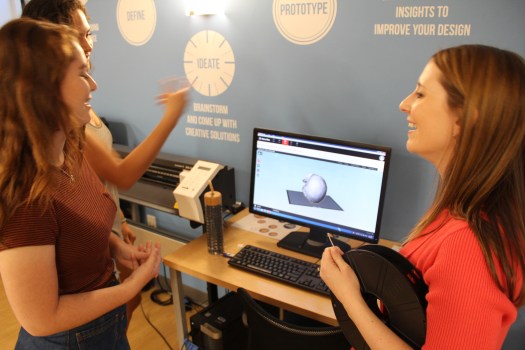
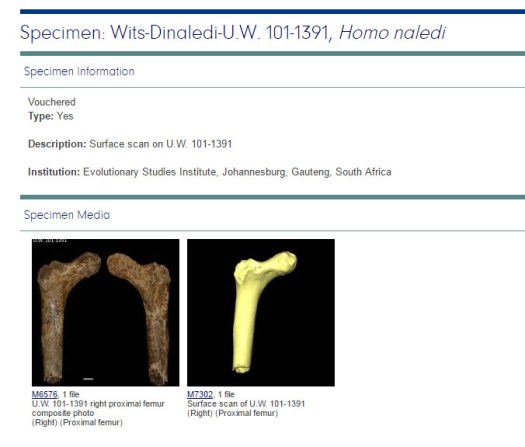
Students enrolled in Human Origins (SCIE 470) this fall will come face to face with our distant human ancestors as well as contemporary issues like race and scientific racism that are part and parcel of paleoanthropology’s legacy. Between reading and discussion on a variety of topics, ranging from the so-called “Hobbit” fossil—Homo floresiensis to the debate over multiregionalism, students will do some experimental archaeology, including flint knapping, fire making, and throwing a dart with an atlatl. We also will be visiting “The Nest”—the makerspace at the Oliver Wendell Holmes Library, where we will be 3D printing casts of the newest fossil discovery from South Africa—Homo naledi and comparing them to traditional plaster casts and resin models of other fossil hominins. Other hands-on projects will include looking for clues to human evolution in the bones of a modern human, bone flute making, and creating our own Mesolithic symbol system, akin to the painted pebbles found in Mas d’Azil cave in the French Pyrenees. Throughout the course students will explore some of the most recent discoveries and newest ideas about human evolution and the scientific discourse and debate that ensue. Students will be challenged to develop their critical thinking skills as we evaluate these new discoveries in light of broader discourse on race and the scientific method.

Image of students in Human Origins make bone flutes with bow drills while their instructor Jerry Hagler looks on.
Biology instructor Jerry Hagler looks on as students in Human Origins make bone flutes using bow drills, spring 2016.

Human Origins is an interdisciplinary science course developed collaboratively by biology instructor Jerry Hagler and personnel at the Peabody Museum and was first taught in 2007. Since then it has been offered most years as a senior elective. The pace of new discoveries—like Svante Pääbo’s work on the introgression of Neanderthal DNA into the modern human genome in 2011—means that the curriculum is constantly shifting, making for an exciting and lively class. Dr. Hagler is on sabbatical this year so Dr. Wheeler–Peabody Museum director–is leading the course.

2016-2017 Education Course Catalog

This summer we have worked on updating our course catalog that we share with the faculty at Andover. All of our programs incorporate the Peabody’s unique artifacts into classes that allow students to explore topics in art,  history, science, foreign languages, math, music, and many other subjects. While we offer many classes that support the goals and objectives of faculty through meaningful and engaging experiences for their students, we are also always have to collaborate to create new learning opportunities.

This year we are working with the History Department to create a week long activity for all History 100 students. It is an artifact rich class which will rely heavily on the expertise and assistance of our Curator of Collections, Marla Taylor.  The in-depth lesson will focus on the interaction and trade roots of the Moche, Maya, Puebloan, and Hopewell cultures. We cannot wait to get started!

To see what other lessons and activities we offer to the different departments at Phillips Academy, please browse our catalog

cover2

Peabody Study Hours

Contributed by Marla Taylor

As another school year begins, students on the lookout for a quiet place to study in the evening will have a new option.  The Peabody is now hosting study hours every Thursday evening from 5pm-9:15pm.

We will also be collaborating with the peer tutoring program on campus to provide a calm space for focused study and learning.

We hope to see you here!

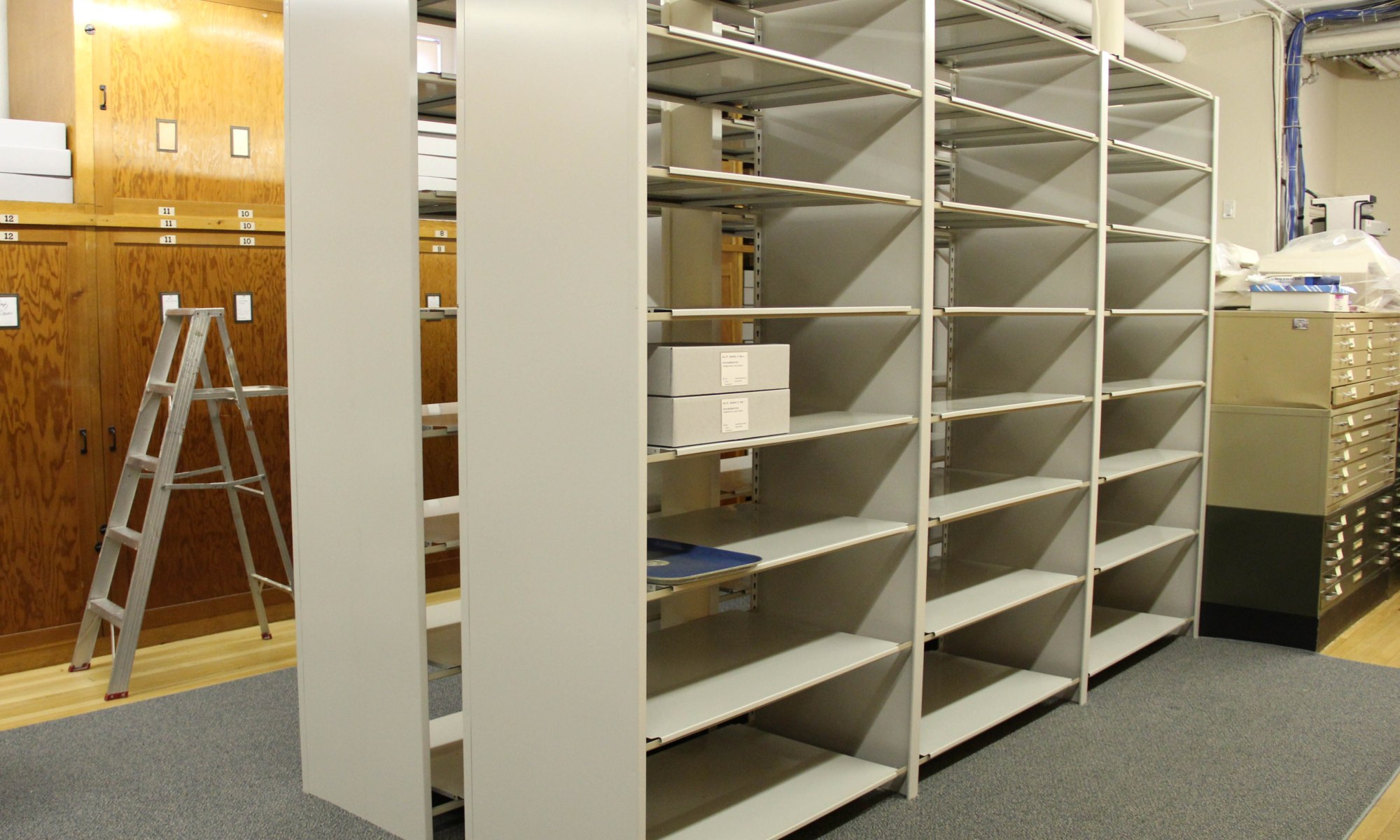
Shelving to the rescue!

Completed shelving

Contributed by Marla Taylor

As I began working this summer on the reboxing project, it immediately became apparent that the artifacts needed room to grow sooner rather than later.  Moving the objects from the wooden drawers into the boxes revealed just how heavy some of those drawers were – some too heavy to be supported by the new archival boxes.

What I needed was solid temporary shelving to support these materials.  Donnegan Systems, Inc. of Northboro, Massachusetts to the rescue!   Donnegan Systems has been consulting with us periodically to reimagine collections storage once all the artifacts have been boxed.  They saw our need and offered some spare shelving that was taking up space in their warehouse.  Delivered and installed in a single morning, these shelves will facilitate faster progress with the reboxing project.

Reorganizing the archives storage alcove

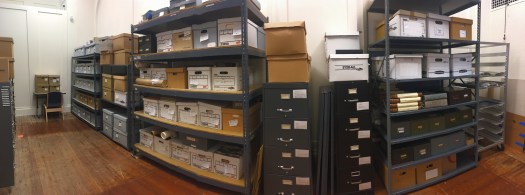
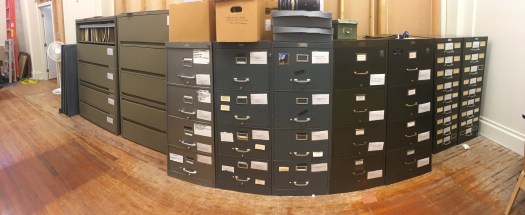
For the past two weeks, the museum staff (and one volunteer — thank you Quinn Rosefsky!) all pitched in to make the archives storage area neater and more manageable. This physical reorganization had been anticipated and discussed since I began my work here in May. At that time, many materials were still in filing cabinets, with boxes piled on top.

Though most of these cabinets and boxes were labeled, the exact nature of the materials and the period of the museum’s history to which they belonged were not necessarily obvious. Related materials could be spread out among different boxes and cabinets without that intellectual integrity being apparent. If a museum staff member was looking for a specific piece of information in the archives, say when a particular exhibit was on display at the museum, it could be challenging to find it!

As I reached the end of my collections survey, I began to understand which materials belonged together as collections. I boxed up several collections that were in filing cabinets, carefully labeling them as discrete groups of material: the Warren K. Moorehead records (1890s-1930s), the Douglas S. Byers and Frederick Johnson records (1920s-1960s), the Richard S. MacNeish records (1950s-1980s), the Tehuacan Archaeological-Botanical Project records (1959-1960s) and the Coxcatlan Project records (1960s-1970s). Other record groups such as the museum’s Education Department files were physically grouped together, and consolidated into fewer boxes. Empty filing cabinets were removed, new shelving was set up and boxes were arranged deliberately on the shelves.

Panorama of one side of the rearranged archives storages area.
West wall of the rearranged archives storage area.
Panorama of the east wall of the rearranged storage area.
East wall of the rearranged archives storage area.

Records that are still being consulted regularly by museum staff such as accession files and site files were left in filing cabinets. Other material, such as the Ayacucho Archaeological-Botanical Project records (1969-1980s), was left in filing cabinets because we don’t have enough shelf space to accommodate more boxes at this time. There are also a few stray boxes that don’t yet have a home. Further tinkering of the space and rehousing of material will likely occur throughout the year. For now, the focus of the archives project will turn to creating inventories for individual collections, so that the material within them is easily findable for museum staff and outside researchers.

The Temporary Archivist position is supported by a generous grant from the Oak River Foundation of Peoria, Ill. to improve the intellectual and physical control of the museum’s collections. We hope this gift will inspire others to support our work to better catalog, document, and make accessible the Peabody’s world-class collections of objects, photographs and archival materials. If you would like information on how you can help please contact Peabody director Ryan Wheeler at rwheeler@andover.edu or 978 749 4493.


Boxes and boxes of boxes

They’re here!

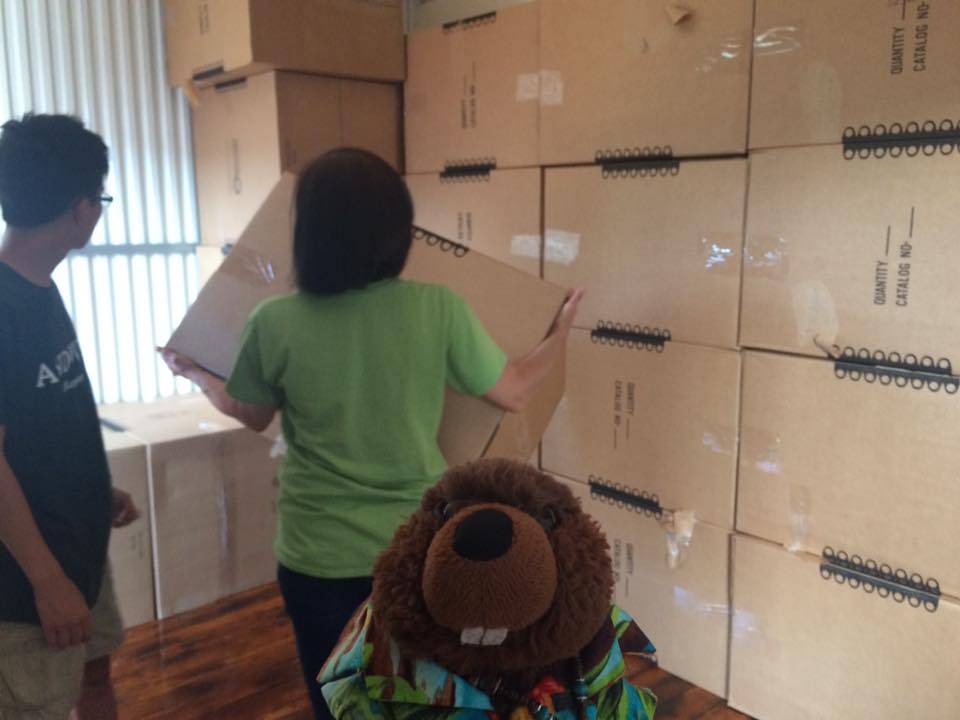
Fifteen-hundred custom archival boxes were delivered on Monday, July 25 to initiate the Peabody’s collections rehousing project.  Unloading the truck and storing the boxes was hard work, but was an important first step toward completely rehousing and inventorying our large collection. The boxes were assembled to our specifications by Hollinger Metal Edge and are archival quality.

These boxes are made possible by a grant from the Abbot Academy Association, continuing Abbot’s tradition of boldness, innovation, and caring. They will be used to replace the old wooden drawers that have supported our collection for decades, and will provide protection and a long-term home for our artifacts.

A special ‘thank you’ goes out to Will Shahbazian and C. Woodrow Randall for their helping hands (and paws).

Summer work duty students begin rehousing inventory

Work duty student inventorying a drawer

Embarking on a full inventory and rehousing of your museum collection is a daunting task.  Transferring approximately 1,700 drawers into 3,000 archival boxes will take years of work.  Fortunately for me, I have access to an invaluable resource – Phillips Academy students.

For a week in July, two Lowers (10th graders) came to the Peabody every day for four hours to fulfill their work duty commitment for the school year.  I gave them a crash course in artifact identification and object handling techniques before they got down to business.  As they worked through the meticulous process of inventorying everything in the collection, they made crucial observations that will improve my workflow.  Together, these two students recorded the contents of twenty-nine drawers!

Work duty student inventorying a drawer

Work duty students will continue to be an essential work force as we move through the collection.  I will share their progress and successes in the months and years to come.

Curator of Collections Marla Taylor and work duty students stand behind the empty boxes

Students Interogate the Peabody Dioramas

Contributed by Ryan Wheeler

Ann Wilkin asked if she could bring her two sections of Writing for Success students to the Peabody during summer session, July 2016. Ann said in her e-mail, “This week’s theme is ethics and responsibility, and I recall a particularly exciting experience another one of my classes had with you guys (possibly with you?) two years ago, as we discussed what it meant to put all kinds of artifacts of other cultures (particularly colonized cultures) in gallery spaces.”  She related too that her students had been reading Horace Miner’s “Body Ritual among the Nacirema,” as well as excerpts from Susan Sontag’s 2003 book Regarding the Pain of Others.

Image of the Peabody's Pawtucket village diorama circa 500 years ago.
“A Pawtucket Village on the Merrimack River, 500 Years Ago,” diorama built by Guernsey-Pitman Studios of Cambridge, Mass., 1939.

As I reflected on what we could do I thought it might be interesting to have the students conduct their own critical reading of one of the Peabody’s dioramas. The Peabody houses two dioramas of American Indian life.  The oldest, built in the 1930s by the Guernsey-Pitman Studios, illustrates life at the Shattuck Farm site in Andover, Mass. circa 500 years ago.  The scene is a bustling village, with a variety of daily activities depicted, from the construction of a birch bark canoe to firing pottery.  We understand that the scene was heavily influenced by curator Fred Johnson’s ethnographic work in Canada.

Amy Lonetree, in her 2012 book Decolonizing Museums: Representing Native America in National and Tribal Museums, explains that “many critics have argued that this form of representation (dioramas) reinforces commonly held belief that Native cultures were static and unchanging and that they have since disappeared….” Further, an issue with many museum exhibits about American Indians is that they lack contemporary Native voices.

I asked the students to spend some time looking at the diorama and to do some writing—specifically to answer a few questions which we would then discuss.  The students wrote about the following:

Who are depicted?

When is the diorama depicting?

Whose perspective is shown?

What is shown?  What isn’t?

What are we supposed to understand by looking at the diorama—in other words, what’s the message?

Image of students looking at the Pawtucket diorama
Ann Wilkin’s students examine the Pawtucket diorama.

The answers to these questions were quite interesting, and as our conversation about the diorama unfolded we gained a greater appreciation of some of the inherent biases built into the exhibit.  Several students pointed out that there were a disproportionate number of men depicted and we discussed demographics and talked about why so few women and children were shown. The question of perspective was interesting and we noticed that it depended on whether one was standing or kneeling.  We also kept returning to the question about when was depicted.  Most students wrote that it was 500 years ago (after all, that’s what it says on the diorama’s title), but we talked about what was happening 500 years ago and also about how there are many ways to answer that questions—the time of year, the day, the time of day, etc.  We talked about how many “whens” seemed to be collapsed into one single moment and that it was unlikely all of these things would have happened at the same time.  One student ultimately observed that the diorama might say more about the archaeologists and artists that constructed the model than the Native people being depicted.

The exercise produced some interesting dialogue and gave us an opportunity to talk about contemporary American Indians in Massachusetts and exercise our critical thinking skills when confronted with a museum exhibition.

The Ponca, Presidents, Politics, and Partial Answers

Contributed by Ryan Wheeler and Quinn Rosefsky (Phillips Academy Class of ’59)

There’s nothing like a good mystery and the Peabody Museum has plenty of them. A recent survey of the museum’s archives, including the extensive photographic collection, uncovered an intriguing photograph. The image itself was made with a panoramic camera and measures 22 inches in length by 10 inches in height; it’s tattered and torn and bears traces of the thumbtacks that once held it up. The subject is a large group of American Indians and Anglo-Americans in front of an official looking building. Faces can be seen peering out on the group from the building’s tall windows. In all, there are 16 American Indian men, 4 white men, 2 women, and 2 young boys.

Group photo of American Indians and Euro-Americans at the White House, January 1922
The Peabody Museum version of the Ponca photograph. No identifying information was included–the photo was found in the museum’s archives.

No caption or identifying information is included. Dress varies, with some of the American Indians in beaded regalia and feathered headdresses, while others are dressed in suits and ties with overcoats; on the right side of the photo some men wear feathered headdresses, while some on the left side wear their hair in long braids. The white members of the group are attired in suits with starched collars, ties and either bowler or fedora hats.  Only one of the member of the group was immediately recognizable to us—namely Warren Moorehead—the Peabody’s first curator and then director (he’s in the back, wearing a bowler hat and a dour expression). Moorehead’s activities extended beyond archaeology and included service on the Board of Indian Commissioners from 1908 through 1933. The commission was established as part of the federal government’s “peace policy” toward Native peoples and as a commissioner Moorehead had many opportunities to interact with tribal members and visit Indian Country. Peabody archivist Irene Gates used this information to run a series of Google searches and discovered a similar, though truncated, image preserved in the Library of Congress (http://www.loc.gov/pictures/item/hec2013002121/). Metadata with the Library of Congress photo identifies at least two of the party—General Hugh L. Scott (to the right of Moorehead)—and Chief Chas. McDonald (on Moorehead’s left, wearing the bear claw necklace). The White House is given as the location and 1921 to 1923 is offered as a date range; the photo was made by Harris & Ewing, a Washington D.C. photographic firm.

Truncated version of the Ponca photo at the Library of Congress
The Library of Congress truncated version of the Ponca photograph. The title is given as Gen. Hugh L. Scott & Chief Chas. McDonald with group in front of White House. LC-H27- A-4011 [P&P] Library of Congress Prints and Photographs Division Washington, D.C. 20540 USA

Who were Scott and McDonald? Hugh Lenox Scott (1853-1934) was a West Point graduate, later superintendent of West Point, and veteran of US conflicts from the Indian wars of the late 19th century through the beginning of World War I. In the army he worked closely with tribal allies and developed military signal systems based on American Indian sign language. Unlike many of his contemporaries, Scott had relied on diplomacy and level-headedness to de-escalate conflicts with American Indians. After his retirement as a major general and army chief of staff he served on the Board of Indian Commissioners from 1919 to 1929, during which time he remained friendly towards American Indians and influential on their behalf. He published a 1928 memoir called Some Memories of a Soldier, as well as several anthropological articles dealing with the Sun Dance and American Indian sign language.

General Hugh L. Scott and Chief Charles McDonald
Gen. Hugh L. Scott & Chief Chas. McDonald of Inca City, Okla. LC-H27- A-4010 [P&P] Library of Congress Prints and Photographs Division Washington, D.C. 20540 USA
Chief Chas McDonald is more of an enigma. Another Library of Congress photo (https://www.loc.gov/item/hec2013002120/) provides some clues. Here we find just two men–Hugh Scott and McDonald; the metadata indicates that the photo, also taken by Harris & Ewing, was made in Washington, DC on January 27, 1922. The photograph was published in The Washington Post on the same date—the caption reads “Gen. Hugh L. Scott, formerly chief of staff, U.S.A., and a famous old Indian fighter in his day, conversing by Indian sign language with Chief Charles McDonald, of the Ponca City tribe, Ponca City, Oklahoma. Photo made after the chief had called on the President.” At this point we can probably assume that the Peabody’s group photo and the similar, but truncated, Library of Congress image were made at the same time, specifically on or around January 27, 1922. Here things begin to come together. McDonald and his delegation could well be members of the Ponca tribe. The Ponca are a Siouan-speaking group, now with federally-recognized tribes in Nebraska and Oklahoma. The Ponca place their origins in the Ohio Valley, but were living in Nebraska when first contacted by Anglo-Americans. Federal efforts at relocation saw their removal, in part, to Oklahoma. And the Ponca were no strangers to sending delegations to Washington;  in 1877, 1909, and 1914 Ponca representatives visited the capital to lobby for their rights. One of the Ponca delegates in 1909 and 1914 was Louis McDonald, identified as the son of Buffalo Bull Chief (aka McDonald). A little genealogical research reveals that Charles McDonald (1873-1928) was also the son of Buffalo Chief McDonald (d. 1912). Charles appears occasionally in records; for example, in 1897 he and all adult Ponca in Oklahoma signed a grazing agreement that has been preserved in U.S. Congressional records. Louis McDonald (1880-1958), however, is better known; he helped found the Native American Church, a blend of traditional and Protestant beliefs known for its use of peyote in ceremonies. He also served as an informant for several ethnographic studies of the Ponca, including James Howard’s 1965 study for the Bureau of American Ethnography and Weston La Barre’s 1938 classic The Peyote Cult. Howard notes of Louis McDonald that he attended Carlisle Indian School and spent much of his adult life working on his tribe’s behalf in Washington. Comparison with a National Anthropological Archives portrait suggests that he’s also in the panoramic photo—standing behind the man with the cane.

Photo of Ponca delegation to Washington DC, April 1909
Ponca delegation to Washington DC, April 1909. Left to right, standing: Louis McDonald (son of Te-nu’-gaga-hi), Mon’-non’-ku-ge or Mike Roy; sitting: Mon-chu’-hin-xte, or Hairy Bear, Monshitin’-nu-ga (called Frank White Eagle). Negative 4239, National Anthropological Archives, Smithsonian Institution

Again, Irene examined other photographs in the Library of Congress digital archive and noticed that the man with the cane was in other photos that included American Indians. This man appears to be Charles H. Burke, who served as Commissioner of Indian Affairs from 1921 to 1929. Burke was often at odds with the members of the Board of Indian Commissioners and strongly advocated for the assimilation of American Indians and the end to traditional lifeways and religious practices, as well as dances—both sacred and secular. In fact, Burke’s presence may explain Moorehead’s sour expression in the photo. The other members of the group—Anglo and American Indian—remain unknown to us. We attempted to match them to other members of the Board of Indian Commissioners. From their annual report we learn that the Commissioners met in Washington for their annual meeting, January 25-26, 1922—just days before these photos were made. We even considered the possibility that one of the men was Warren Harding or Calvin Coolidge—not outlandish since the setting is the exterior of the West Wing. The photos, however, just don’t match. Comparisons with photos of other Poncas may help.

The purpose of the Ponca visit to Washington remains unknown to us, though from what we have pieced together it appears that Ponca Chief Charles McDonald met with President Warren Harding. A brief in The Washington Post from January 28, 1922—the same time period as our group photo—tells us that “a troupe of eleven Ponca Indians from Oklahoma” performed at the new auditorium of the City Club. Anthropologist Francis La Flesche of the Smithsonian Institution was on hand to explain the dances. Other newspaper stories from the same time confirm that these are the Ponca that had visited the White House; a note in the Friday, January 1927 edition of The Evening Star (page 10) tells us:

Eleven Indians from the plains of Oklahoma, garbed in their native costumes and equipped with all the weapons and tokens for their primitive war and sun dances, will furnish the feature number of the program to be presented at the City Club’s first stag night party in the new clubhouse tonight. The Indians, members of Ponca tribe, are in Washington to lay a petition before President Harding.

A similar note in the January 21, 1922 edition of The Washington Herald (page 5) confirms that dance was a big part of the Ponca’s delegation to Washington and that they and members of other Plains tribes participated in a “powwow” organized by the Archaeological Society of Washington:

The Archaeological Society of Washington has sent out cards for the 106th meeting of the society as guests of Victor J. Evans at the Victor Building. 724-726 Ninth Street Northwest, this evening, at 8:30 o’clock, when an Indian pow wow will be featured by native Indians from the Plains tribes, including champion dancers and singers from the Poncas, Otoes and other tribes interpreted by Francis La Flesche, a full-blooded Indian. Also the all-Indian film illustrating an historical event among the Kiowas and Comanches entitled “The Daughters of Dawn.” Guests are invited only by host or executive committee. In addition to a large collection of Indian curios which will be on display, there will be a number of Indians from the Poncas, Winnebagoes and other tribes, in their native dances and costumes. Indian men, women and children will take part in this entertainment. This affair, will he attended by a number of members of Congress.

The reference here to Victor J. Evans is interesting. Evans (1865-1931) was a successful patent attorney who also amassed a large collection of American Indian artifacts. His plan to construct a replica Maya temple near the National Zoo to house his collection never came to fruition, but he did represent several American Indian tribes in legal matters before the federal government. The other American Indians depicted in the photo may well be Otoe, Kiowa, and Comanche, since the newspaper accounts indicate that they were visiting at the same time. Also, it is interesting that the American Indian visitors participated in several dance performances—at least one newspaper account tells us that Commissioner Charles Burke was in attendance at one of these events—since Burke’s organization, the Indian Service, was working to stop Native dances. Specifically, Burke issued Circular No. 1655 in 1921, which made many dances “Indian offenses.” More genealogical research reveals that Charles McDonald had a son, Augustus or Gus. Gus McDonald’s (1898-1974) legacy is as one of the originators of the Fancy Dance style, which has its roots in the dances of the Hethuska Society. Attendees at modern powwows are familiar with the Fancy Dance, especially the brightly colored feather bustles.  The dance was developed in response to the government’s crackdown on traditional styles of dancing, and the Fancy Dance became popular in Wild West shows and at events open to the general public.  Gus McDonald certainly could be one of the young men in the photos of the Ponca delegation to Washington in 1922. An entry in Art and Archaeology magazine (January-June 1922 issue, pages 94-95) complete with a photograph, presents a more detailed account of the dances performed by the Ponca at the Archaeological Society powwow. Francis LaFlesche and Victor Evans are identified, but none of the Ponca are named. The same individuals seen in the Peabody photo, however, are pictured, including the two little boys—a total of 13 individuals altogether.

Image of Ponca dancers at the Archaeological Society of Washington's January 1922 powwow.
The Ponca dancers with Francis La Flesche and Victor Evans at the January 1922 powwow organized by the Archaeological Society of Washington. The image was published in the society’s magazine Art and Archaeology along with La Flesche’s interpretation of the dance.

A little more remains to be said though, specifically about the manner in which the photo preserved in the Library of Congress is both cropped—something presumably done by the photographers in the 1920s—and the way in which the picture is cataloged in the digital archive. Both effectively erase the American Indians depicted. The way the picture is cropped is most obvious. Here, the photographer “left out” 10 of the American Indians originally photographed—pretty much everyone to General Scott’s right. Why? Again, we can only speculate, however, the remaining image brackets the American Indians between two white men—General Scott and the unnamed man on the photo’s far right. Lucy Lippard, in the introduction to Partial Recall, tells us:

As we peruse old photographs from a century’s distance, we are all looking not only at but for something. That something varies among Euro-Americans and Native people. It is often necessary to pry up the surfaces of apparent pathos, as well as apparent pride, and to dig out from beneath something less accessible (page 19).

Lippard goes on to remind us that often what is most interesting is what is not in photographs of American Indians.  Similarly, Susan Sontag, in her 2003 book Regarding the Pain of Others, talks about how photographs have the power to objectify, to memorialize atrocities, but also to leave out the horrors—of genocide, of oppression, of loss—to create a narrative that might be more palatable.  With the group picture in mind, we can see some of this in play, especially in terms of the truncated version preserved in the Library of Congress.  Not only are people missing, left off the official version, but the decisions made in cataloging the photo in the digital archive effectively hide the entire image. The cataloger includes a title, presumably something that accompanied the original glass plate negative: “Gen. Hugh L. Scott & Chief Chas. McDonald with group in front of White House.” There is no mention that some of the group are American Indians or are wearing traditional American Indian regalia.  The lack of names associated with the image leaves us in an uncomfortable position of having to guess who is Native and who isn’t, or to simply sidestep this question, which is difficult in trying to give even the simplest description of the photo.

What we learn is that images like this have a lot to tell us and a lot to hide. They don’t give up their secrets willingly. Without more information it is hard to know what we are seeing—a photographic ritual where Natives pose with Euro-Americans, one that is repeated over and over again.  Are we witness to an act of resistance or submission?  We hope that sharing this more complete version of the photo helps add to the list of known individuals in the image, makes the existence of the photo better known to scholars and the Ponca themselves, and hopefully will lead to more information on the Ponca’s 1922 visit to Washington and their petition to the President. Is it possible that it was related to Commissioner of Indian Affairs Charles Burke’s crackdown on Native dance? As Lucy Lippard reminds us, however, it is best if Euro-Americans “surrender the right to represent everybody.”  With that in mind we will share this image with the Ponca.

Further reading:

Brown, Donald, and Lee Irwin 2001. Ponca. In Handbook of North American Indians: Plains, Vol. 13, part 1, edited by Raymond J. DeMallie, pp. 416-431. Smithsonian Institution, Washington, DC.

Howard, James H. 1965. The Ponca Tribe. Bulletin No. 195, Bureau of American Ethnology, Smithsonian Institution, Washington DC.

Lippard, Lucy (editor). 1993 Partial Recall: With Essays on Photographs of Native North Americans. New Press, New York.

Paul, R. Eli (editor). 2016 Sign Talker: Hugh Lenox Scott Remembers Indian Country. University of Oklahoma Press, Norman.

Scott, Hugh Lenox 1928. Some Memories of a Soldier. The Century Co., New York.

Sontag, Susan. 2003. Regarding the Pain of Others. Farrar, Straus and Giroux, New York.

Young, Gloria A., and Erik D. Gooding 2001. Celebrations and Giveaways. In Handbook of North American Indians: Plains, Vol. 13, part 2, edited by Raymond J. DeMallie, pp. 1011-1025. Smithsonian Institution, Washington, DC.