Welcome Samantha!

Contributed by Samantha Hixson

Hello everyone,

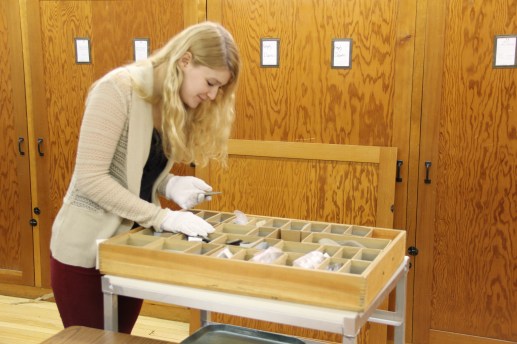
My name is Samantha Hixson and I am the new collections assistant here at the Peabody. I come to you from New Mexico where the weather is warm and has left me completely unprepared for New England winters (although Marla and Lindsay promise that they’ll get me through it).

I have previously worked at the Museum of Indian Arts and Culture in Santa Fe, New Mexico as well as the Smithsonian Institution’s National Museum of the American Indian in Washington, DC. It’s these places that got me excited to work within museums, focusing specifically on Native American collections. So you can imagine how excited I was when I was hired to work at the Peabody, it’s the perfect job for me! I’ve also had some other very interesting archaeological/ethnographic experiences, but those are for other posts.

I’ve started getting my feet wet in a couple projects already (with the promise of a lot more to come) and am most excited about the re-housing of the collection as well the Adopt A Drawer program. I think it’s great that these collections are getting new homes and more personal interactions, however brief.

If you’re in the neighborhood of the museum, come stop by; I’d love to meet you!

The new Peabody Collections Assistant, Samantha Hixson

No “Orphaned” Artifacts

This blog represents the first entry in a blog new series – Peabody 25 – that will delve into the history of the Peabody Museum through objects in our collection.  A new post will be out with each newsletter, so keep your eyes peeled for the Peabody 25 tag!

Contributed by Quinn Rosefsky  (Phillips Academy Class of ’59)

Robert Singleton Peabody (1837-1904) grew up in Muskingum County, Ohio—just outside of Zanesville—but attended an eastern boarding school—Phillips Academy—to graduate in 1857. After law school at Harvard he established a lucrative legal practice in Vermont before relocating to the Germantown area of Philadelphia. During much of his life, Robert nurtured an interest in archaeology and Native Americans and worked to amass a personal collection of artifacts. In 1866, Robert’s uncle, George Peabody (known as the father of modern philanthropy) gifted PA with funds to establish a “scientific department” to encourage scientific discourse be incorporated into the curriculum. At the turn of the 20th century, Robert sought to revitalize his uncle’s good intentions by re-establishing a program for the sciences, specifically archaeology.

The archives of the Peabody Museum contain the letters and documents that reveal the evolution of Robert’s intentions. The primary correspondence is between Robert Peabody and Warren K. Moorehead. Moorehead was the man responsible for building, cataloging, and maintaining Robert’s artifact collection and would ultimately become the first curator of the Department of Archaeology at Phillips Academy.

Peabody then wrote in a letter dated March 3, 1898, that he was impressed with Moorehead’s cataloguing of the substantial collection Peabody had amassed (nearly 50,000 artifacts), which were “of sufficient value, to be cared for.” Adding, “I have known too well the fate of those Orphaned collections placed at the Mercy of a cold world…” Although what Peabody then proposed was to establish a department of archaeology, he also wrote that the financial situation at the time was not good. He was likely referring to the Panic of 1893, during which 500 banks closed and 15,000 businesses failed. The ensuing financial depression lasted from 1893 to 1898. Peabody’s conclusion was: “…I will not deliberately, add another to the list of failures…I want to make assurance doubly sure, if I go into it at all.”

Nevertheless, Moorehead’s letter to Peabody on April 4, 1898, continued to press the issue. He had spoken to the wife of Dr. Wilson, a Curator of Anthropology at the Smithsonian Institute, and conveyed her response to Peabody: “…It is fortunate for Andover and the public at large that you conceived the idea of preserving archaeological relics.”

The archives have a gap in the sequence of letters, but it is clear that Robert S. Peabody had been having discussions with Dr. Cecil F. P.  Bancroft (1839-1901), Andover’s fifth headmaster. Bancroft agreed to help push the project forward with the school’s Board of Trustees. By November 11, 1900, planning was well-advanced.

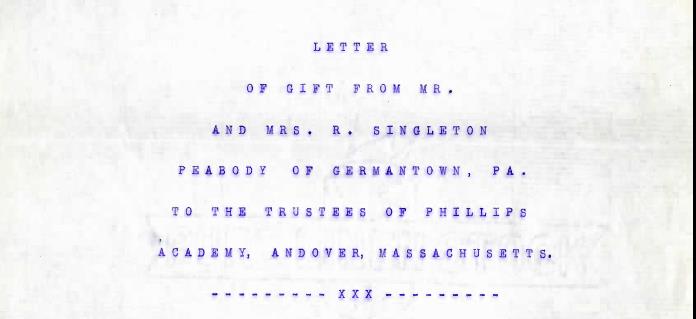
In a letter dated March 6, 1901 from Peabody to the Trustees of Phillips Academy, the amount and purpose of the donation were laid out. Specifically, Peabody wished his collection to have a home for preservation, the establishment of a Department of Archaeology which would be “self-supporting and independent.” Furthermore, this Department should be “disconnected from any other branch of Phillips Academy.” As for the museum itself, “…(it) should be, as far as consistent, tasteful and attractive on its exterior, with good proportions, not too high, and within, light and cheerful as possible, with some simple and tasteful decoration—as tinted walls, etc.” Peabody went on to propose that Moorehead be the first curator because “…Professor Moorehead knows every specimen in the collection, and its history.” Peabody also stipulated, “…that the building/museum be a pleasant place where students might find an agreeable relaxation during the broken events which occur in the lives of the most closely pressed.” In other words, the building would serve not only as a museum but as a social center.

It was no surprise that the amount of the gift to Andover, indicated in a letter dated March 8, 1901 from Peabody to Bancroft, was related to the amount given previously by his uncle in 1866. George Peabody had also dedicated the same amount—$150,000—to aid in founding the Peabody Museum of Archaeology and Ethnology at Harvard and the Yale Peabody Museum of Natural History. To differentiate himself from his uncle, Robert pointed out that his gift would also include a collection of artifacts. These artifacts amounted to one hundred thirty-two boxes containing nearly 50,000 items insured for $35,000 at the time of transportation by rail on July 10, 1901 from Philadelphia to Warren K. Moorehead in Andover. The actual endowment, anonymous by design, included $100,000 for the Peabody Foundation and $50,000 for the building. This amount would grow substantially at Peabody’s death, as he willed the residue and remainder of his estate to Phillips Academy in March, 1902. The total gift amounted to at least $500,000—approximately $12 to $13 million by today’s standards.

What did $50,000 buy in 1901? The future architect for Boston’s Museum of Fine Arts, Guy Lowell, was hired and he submitted plans for the projected museum at Phillips Academy. By the end of October, 1901, ground-breaking began on the site where formerly the First Classroom Building, the Farrar House, and then the Churchill House had been located. The building was completed in less than two years and was dedicated on March 28, 1903, the event was  memorialized in the mid-April 1903 edition of The Phillipian.“The building was tastefully decorated with potted palms and flowers…Mr. Frederick W. Putnam, L.L.D, professor of Ethnology and Archaeology at Harvard, said that students would learn to reason more for themselves, and would depend more upon their own powers than upon text books.”

Student Reflection – Alex Hagler ’16

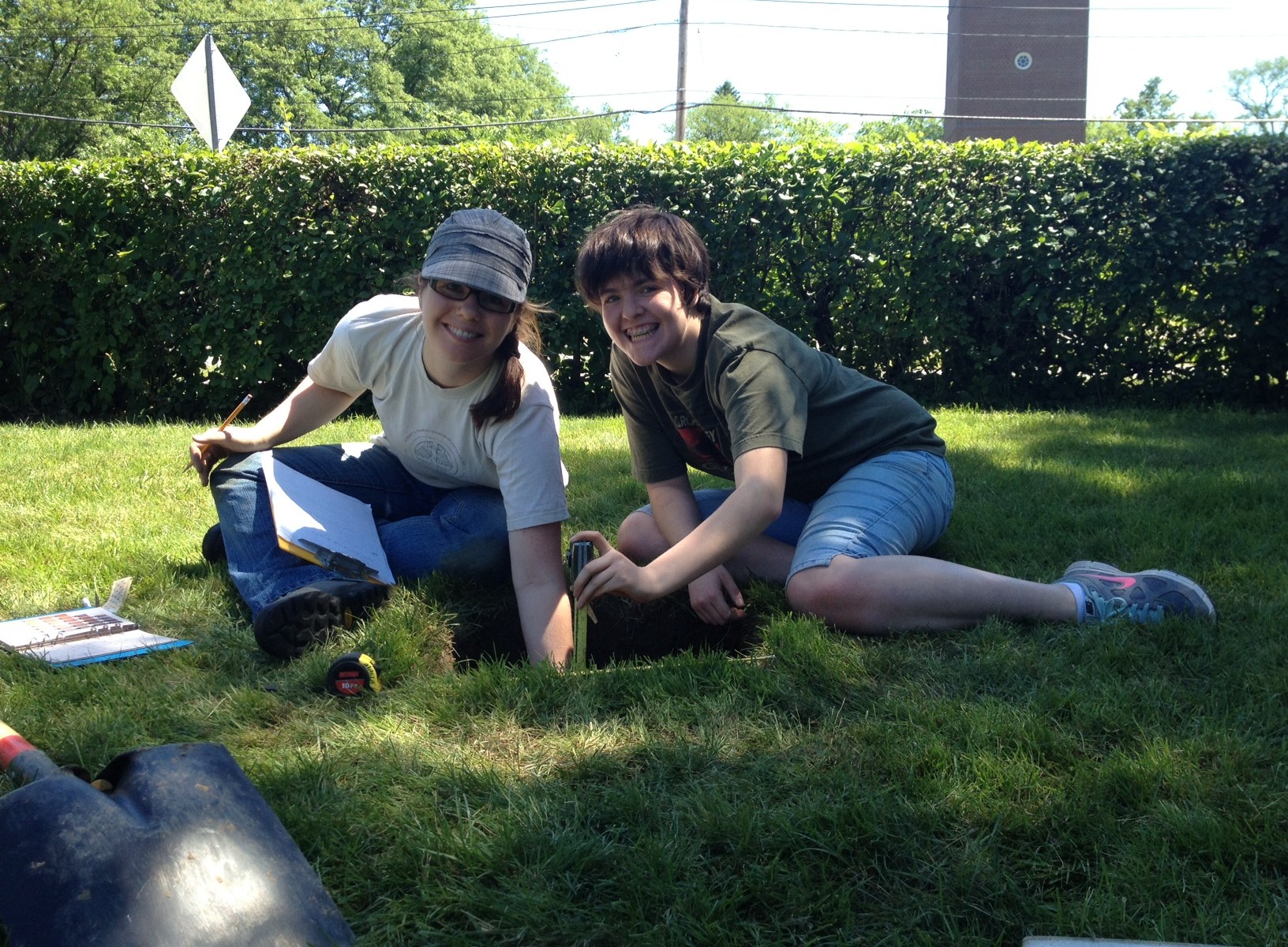
Alex and Marla excavated on campus

Contributed by Alex Hagler ’16

I began working at the Peabody in sixth grade, under the brilliant supervision of Lindsay Randall. I was introduced to the behind-the-scenes workings of a museum, cataloging artifacts, organizing photos, preparing materials for classes, all the jobs of a high school work duty student. It amazed me, and still does, that, despite my young age, I was treated just about the same as any other work duty student. I was given the trust of the people I worked with at the museum, and that trust has remained to this day. Because of that, I have had wonderful, momentous occasions at the Peabody. I represented the Peabody at the 2014 Alumni Reunion Weekend, and I presented the findings of my own independent research project to the Massachusetts Archaeological Society, to name only two. I have enjoyed the constant support of the people with whom I have worked all these years, and so the Peabody has become like a second home to me.

Now, as a graduating senior, I look back on my years at the Peabody. I find that I am mostly content, with only some minor regrets, namely that I have yet to see the floppy disk I was promised way back in sixth grade. But beyond that, I find that I am overwhelmed, reflecting on how I have changed over my years working here. At the beginning, I was nervous, hesitantly exploring the Peabody for the very first time, just starting to explore my new found interest in history. At the end, I am confident, not only in that I have made smart and responsible choices during my time here, but also in that I will continue to do so for the rest of my life. And I have the Peabody to thank for that.

Interested to read more student reflections?  Visit here and here for more perspectives.

Student Reflection – Alana Gudinas ’16

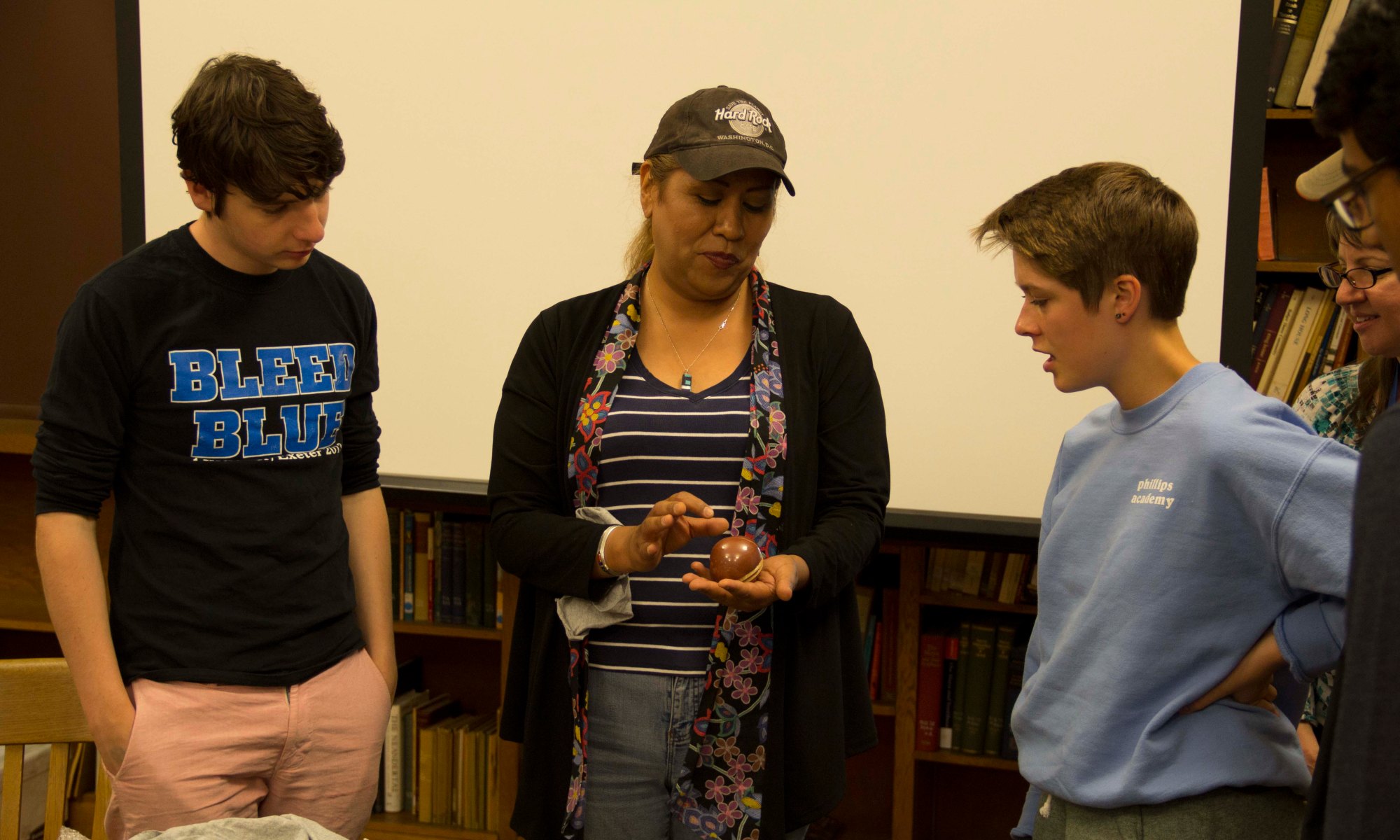
Alana and other work duty students learn about Pueblo pottery from Dominique Toya

Contributed by Alana Gudinas ’16

I started work duty at the Peabody in the beginning of my 10th grade year, mainly because it seemed like the most interesting job to do on campus. How many other high school students have the opportunity to help out at a renowned archaeological museum just a short walk’s away? That year I did a lot of of boring, but necessary, work cataloging objects and essentially entering data into computers. What made doing this so amazing, however, was the fact that I was handling objects that were often thousands of years old, all with their own history and archaeological context. I worked in the same room as Marla and Lindsay, both who shared with me a lot of information about what we were working with and why. This experience I had my sophomore year made me passionate about history and archaeology and want to dive in even deeper.

I did, in fact, become more involved in the Peabody these last two years, through listening to speakers that came to the Peabody for Massachusetts Archaeological Society meetings (and even giving a presentation myself at one of them), meeting the incredibly special artists (such as Dominique and Maxine Toya), teachers, and scholars who visit the museum, and taking a history class the fall term of this year that met in the museum classroom. Having such extensive access and exposure to the Peabody the past three years has instilled in me a love and appreciation for archaeology and all the people involved in the field. I feel that I have learned so much not only about the archaeological and historical background of various objects, but also about the nature of the two fields in general and how they are used in a museum setting. I am endlessly thankful for this experience.

Interested to read more student reflections?  Visit here and here for more perspectives.

Student Reflection – Jacob Boudreau ’16

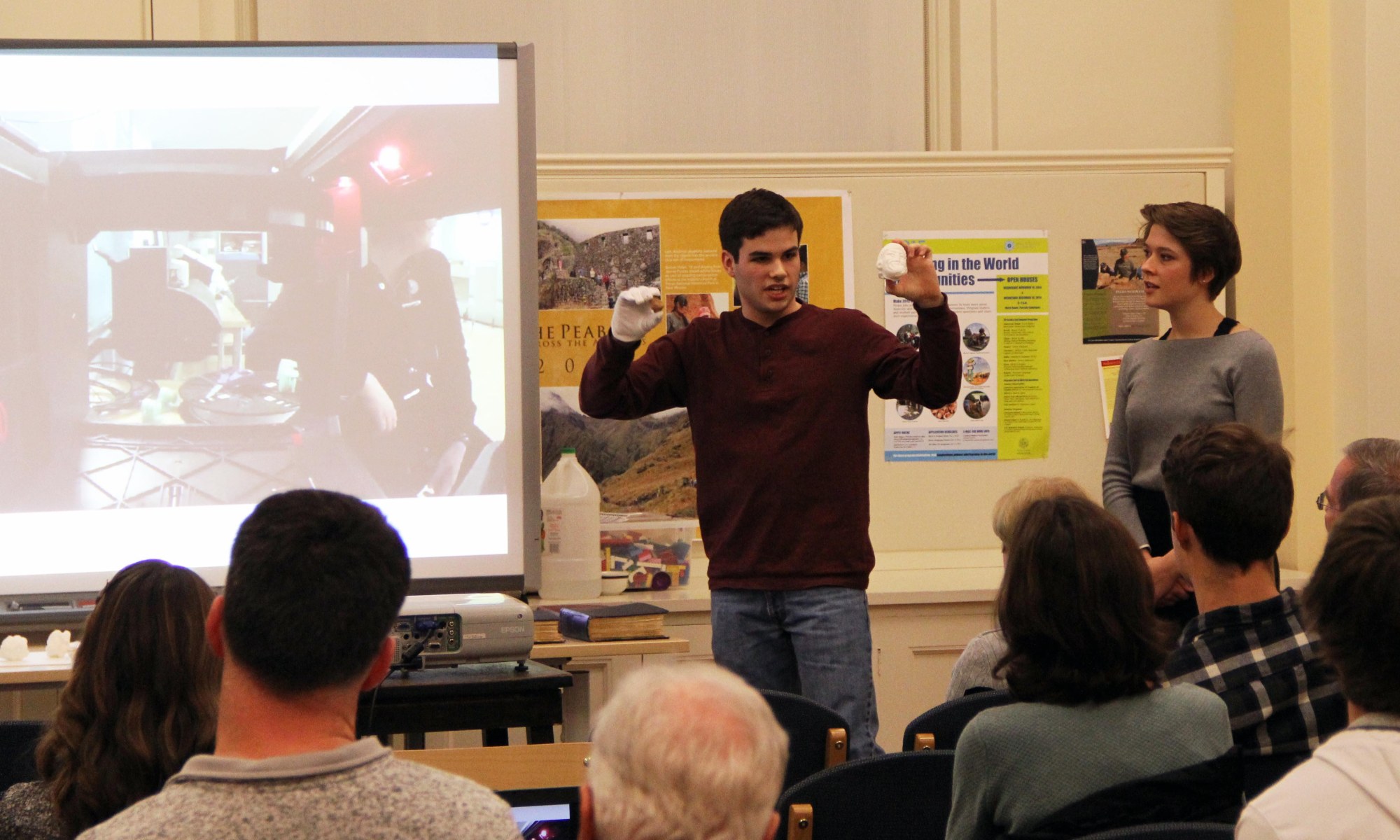
Image of student presenter

Contributed by Jacob Boudreau ’16

I didn’t know what to expect when I started work-duty at the Peabody. I don’t remember choosing to be in it. I didn’t know much at all about archaeology. By my third week of work-duty, I was convinced that archaeology (at the Peabody at least) was nothing but the glorified study of rocks. I was disappointed that I would be stuck inside categorizing rocks for 45 minutes a week, instead of doing one of the quick and easy 5-minute-per-week work-duties.

Those first few weeks, however, are not summary of my time at the Peabody. My time at the Peabody has taught me a lot about archaeology—what it is, what the various aspects of it are, what goes on behind the scenes—and it has imbued me with a deeper appreciation for the discipline. I have learned how artifacts are excavated; how they are stored, cataloged, and inventoried; how one handles delicate artifacts, creates displays for them, records when they are taken out for a class or put back into storage. All of these things I learned during work duty through experience – it was all hands-on. The other work-duty students and I weren’t simply there ticking off check-boxes on a clipboard while the museum staff did the “real work.” We all got the chance to engage directly with the artifacts in the various ways I listed above.

The best part of work-duty at the Peabody is all of the people I get to work with. Each term I work with a new team of students, which is a lot of fun. I really enjoy working with Marla as she always makes the tasks interesting and engaging and talks to us more like adults or friends than high school students.

The highlight of my time at the Peabody was the term that my work-duty group 3D scanned and printed selected artifacts, and then presented our results and research on the topic at a MAS meeting. I’m a math and science guy, and I was thrilled when Marla announced the plans for the term to us. We cooperated with Ms. Wessner from the makerspace and her work-duty students to learn how to scan and print the artifacts we had chosen. We each then presented on a specific part of the project: one student on how we selected the artifacts to print, me on how we scanned and printed them, and two students on the implications of the 3D replication of artifacts. (We also got to eat a lot of food at the meeting.) It just goes to show how interdisciplinary work at the Peabody can be.

Interested to read more student reflections?  Visit here and here for more perspectives.

Neponset Paleoindian Preform

Contributed by Quinn Rosefsky

While most of us have seen “arrowheads,” making sense of the complex world of Paleoindian lithic points is a challenge. The process of manufacture, flint knapping: the shaping of flint, chert, obsidian or other conchoidal fracturing stone through the process of lithic reduction (using a hand-tool pressure-flaking process) demonstrates a highly-advanced knowledge of how flint fractures when struck in specific locations on its surface. That the process has been in use for over 10,000 years commands respect for the fine hand coordination, skill, and thought-processes of individuals using this tool-making method. The example we are examining, a Neponset preform, is representative of the post-Clovis Folsom era.

Paleoindian biface from Neponset site, Massachusetts

About 12,000 years ago on the sandy shoreline of a partially drained glacial lake near what is now Canton, Massachusetts, a flint knapper, a Paleoindian using flint from Mt. Jasper over two hundred miles away in New Hampshire, stopped work on our preform. We can presume that something had gone wrong, resulting in the flint fracturing before it could be transformed into a tool, a projectile point, specifically a spear point. Call it quality control.

New England had three distinct point styles, each named after sites where they were found: Bull Brook, Neponset, and Nicholas. Materials came from three major sources: Munsungan, Maine (chert); Mt. Jasper, New Hampshire (rhyolite); and Hathaway, Vermont (chert). The Neponset site was found at the time of construction of a segment of I-95 not far from Canton. The work done by Stanley Buzarewicz, first in the early 1970s, and then in conjunction with Fred Carty in the late 1970s and early 1980s, yielded a variety of artifacts. In a 100 square meter area the archaeologists found ten fluted points and fragments; two miniature points and drills; thirty channel flakes and fragments; ten bifaces including preforms and fragments; eight leaf-shaped bifaces; and three biface edge fragments.

The findings were thoroughly categorized, including channel flakes because these provided direct evidence that a fluted channel had been created. Fluting refers to distinctive channels knapped into both the obverse and reverse of the point. The ones found at Neponset are distinguished from fluted points found at Bull Brook and Nicholas by stylistic elements. Neponset flutes run more than half the length of the point; have an average length of 6 cm; and are slightly tapered towards the base with flared ears.

The preform point, excavated on May 26, 1979, was described in Fred Carty and Arthur Spiess’s article The Neponset Paleoindian Site in Massachusetts published in Archaeology of Eastern North America, Vol 20 (Fall 1992, pp. 19-37). Made from Neponset rhyolite, it is a dark gray, glassy, nearly opaque material.  In these two pieces—now glued together making it whole again—this specimen was the largest preform found at the Neponset site, weighting 30.31 grams.  It measures 106.2 mm long, 36.6 mm wide at the widest point, and has a 6.2 mm deep basal indentation. The specimen was a final stage preform, meaning it had not yet reached the point where its maker would add the flute and finish its base. For whatever reason the point never reached its final form, we are witnesses to that moment in time, over 10,000 years ago, when a living person made the conscious decision not to complete a task.

Biface Cache Research

Contributed by Bonnie Sousa

Abigail Gamble, a student at the University of Massachusetts, Amherst, visited the Peabody to examine stone tools for her senior thesis.  She looked at several stone blades from an archaeological site in Andover for her comparative study of blades in the Northeast.   The museum acquired the artifacts from collector Arthur Hofmann in the early 1940s.

Gamble,Abigail_March2016

A Westerwald Chamber Pot

Contributed by Quinn Rosefsky (Phillips Academy Class of 1959)

As a Peabody Museum volunteer for the past 6 ½ years, I have had the rare opportunity to help staff members with a variety of unique and exciting tasks. Today, I was introduced to a bit of our Colonial history. The object in question is a rather attractive example of its kind, a chamber pot that survived intact from early Colonial days, preserved in a drawer in the Peabody’s basement storage. See the full catalog record online at http://bit.ly/1XVnQd3. Aside from the intrigue of its nearly pristine condition, there is the question of date of manufacture. The Boston City Archaeologist, Joe Bagley, points out that the chamber pot may be from a 1630s well on Boston’s Congress Street. Several avenues of inquiry are open, including details of the well’s exploration and if the well was ultimately used as a privy and refuse dump, a common trajectory for such a feature. But in order to take a stand on the dating issue we need to have an appreciation of the phases of use and manufacture of such pots.


The earliest chamber pots date from at least the sixth century B.C. in Greece. In the past four to five hundred years chamber pots were found in nearly every household, usually stored under beds but sometimes in dining rooms. English and Colonial lead-glazed earthenware chamber pots came in a variety of colors: brown, green, red, orange, tortoiseshell, gray, and black. There were also stoneware pots, and some of the more striking ones are known as Westerwald or Rhenish Gray (1575-1725), followed by Debased Westerwald (1725-1775), and then American Westerwald (1730s). In the eighteenth century, these pots were mass-produced.

Not to be ignored were chamber pots made of metal, the earliest example being from 1545. It was possible to assess a person’s wealth by whether or not they had silver or pewter chamber pots. But the English Civil War of the 1640s temporarily spoiled this method because the Royalists conscripted silver and pewter to make silver coinage to fund their war efforts, a practical, if unhygienic way to pay off debt using dirty money without resorting to taxes.

A chamber pot might have a tame inscription, “Break Me Not I Pray in Your Hast for I to Non will Give Destast.” Some showed less decorum, “Oh Dear Me What Do I See.”

The chamber pot at the Peabody is gray, salt-glazed stoneware with cobalt blue cordons beneath the rim and above the base. In remarkable condition, the pot measures 6 ¾” wide at the opening and 6” high. There are no pithy inscriptions, but two cobalt blue bellicose lions, each one crowned, and three stamped rosettes, each filled with four spades and a central diamond, are eye-catching. These lions and rosettes have been “sprigged on,” meaning attached with separately molded designs. The rim tapers upward to a narrow “seat.” For dating purposes, it appears that mid-eighteenth century pots had wider rims. Extending out from the rim is a ribbed handle attached in a manner so that the pot won’t tip. There are no “makers” marks or dates. But comparing the chamber pot under examination with a very similar Westerwald example dated 1632 found in Ivor Noël Hume’s 2001 book, If These Pots Could Talk: Collecting 2,000 Years of British Household Pottery, we see many similarities, including the tapering of the opening, rosettes, and the sprig-applied crowned lions. A valid case can be made for a 1630s date given the similarities with Noël Hume’s text and its preservation in the Congress Street well. But there are other dating possibilities that need to be considered.

With the accession to the throne of England of William and Mary, whose reign spanned the years 1689 to 1702, they brought with them a passion for what was called the Rhenish or Westerwald chamber pot, originating in the Rhineland district of Germany. The style and patterns were very close to what we have at the Peabody, examples of what were called “grès-de-flandres.” By 1710, large supplies of these gray stoneware chamber pots with their sprig-mounted lions and rosettes were being shipped to England. Over the next fifty years, this style of chamber pot was found in most British and Colonial homes. Eventually variations were produced on both sides of the Atlantic, satisfying a combination of hygienic, commercial, and political needs. Later versions of Colonial chamber pots had variations in the rosettes, including a profile relief of George III sprigged onto the side. What better way to pay daily homage to the monarch?

So which date do we choose? In order to settle the debate, I would be happy to fly to Amsterdam with the Peabody’s Westerwald chamber pot tucked under my arm (in bubble wrap) to compare it with the one from Noël Hume’s book. As there is no inflammatory profile of George III, I doubt I would have any difficulties in case the plane had to make an emergency landing at Heathrow Airport. But budget constraints are likely to apply to such a trip and less costly research methods would pertain, such as having a debate amongst archaeological scholars. Whatever the outcome, we have the satisfaction of knowing that this chamber pot, however humble and utilitarian, played a role in the origins of Congress Street prior to its transformation into a thriving financial district.


3D Scanning Artifacts: How Does it Work?

Image of 3D scan in the 3D printing software

Contributed by Claudia Wessner, Makerspace Coordinator and Library Experience Designer

Huge progress has been made in the collaborative project between The Nest, the makerspace at Phillips Academy, and the Peabody Museum! From the first day we received the Next Engine 3D Scanner, we had hopes of testing out this new technology in a fun and interesting way. After talking to Marla Taylor, we both thought it was a no brainer to form a collaboration between the museum, the makerspace and a group of work duty students (Alana Gudinas ’16, Jacob Boudreau ’16, Mia LaRocca ’16, and Sarah Schmaier ’16) to further explore the scanning possibilities.

In a previous post, Marla discussed the parameters in which the artifacts were selected. Once we brought the artifacts over to the Nest, we were able to make custom stands for two of the three artifacts so that they would be stable on the scanner. Then we got to work!

So, how does it work?

Before the scanning starts, we set up preferences such as resolution, color mode, and the number of incremental scans, as well as positioning the object in the camera’s field of view. The higher the desired resolution, the longer the scanning process will take.  Most of the objects we scanned took around one hour.

Collage of photos showing the lasers during the scanning process
Lasers scan the artifact

The scanner begins by taking a 2D image of the object then shoots out an array of red laser beams to capture the depth and texture of the object. Next, it completes a series of slow incremental rotations, based on the level of resolution selected, and performs the same 2D/3D rendering for each increment.  The Next Engine software slowly builds the 3D model before your eyes as it layers the data captured by the scanner.

Image of 3D scan of artifact
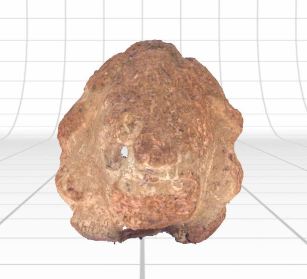
Fully rendered 3D model from the scan

After the scanning is complete, the 3-dimensional model of the artifact appears in the Next Engine software. Depending on how the artifact is scanned, there may be some holes in the model. This would be where the lasers may not have been able to reach, such as the top or the bottom of the artifact. There are ways to avoid holes by completing several scans of the same object (top, bottom, full 360) and then fusing them together. This is something I am looking forward to experimenting with in the future, but for our initial exploration we did a single scan.

In order to fill the holes in our model, I “polished” it using the Next Engine software. The program will automatically find and select holes in the model. Then you can use a paintbrush tool to select the areas in which you’d like to fill.  This can also take some time and experimentation, especially with very high resolution scans where image rendering can use a lot of computing power.

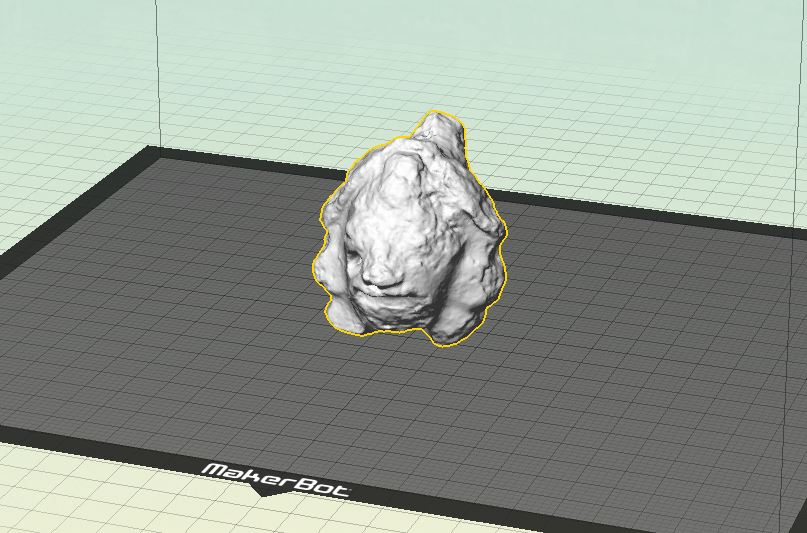
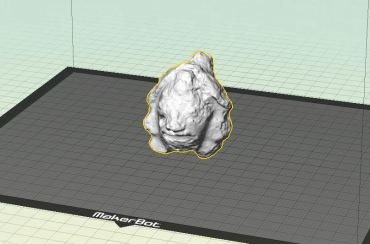
Once the editing of the model is complete, it is ready to prepare for printing by saving it as a .stl file and opening it in the Makerbot Desktop software. In the software you can scale, rotate, and place your object in the desired location on the build plate. You can also preview how long the print will take.  This artifact, which was approximately four inches tall, took about 5 hours to print.

Image of 3D scan in the 3D printing software
The 3D scan is ready to print

The Makerbot 3D printer uses a material called PLA that is stored in a spool in the back of the machine. The PLA is heated in an extruder and lays down very thin layers of material to build the object from the bottom up. Think of it like a glorified glue gun! The makerbot will automatically add “support material” that will support the object as it is printing so that everything stays intact. Once it is finished printing, any support material easily breaks off from the print.

Image of the 3D printed artifact
The 3D printed artifact!

We are so excited about the results of our project! We are looking forward to scanning more artifacts in the Peabody collection and refining our skills with this new technology! Stay tuned!

A Day in the Life at the Peabody Museum

Contributed by Bonnie Sousa, Registrar/Senior Collections Manager

When I mention to people outside of the museum world that I am in collections management and registration, some think I work for a collections agency. In fact, museuSousa,Bonniem collections management and registration involves physical and intellectual control of artifact collections and includes such activities as cataloging, inventorying, and storing artifacts; accessioning (the formal process of taking items into the collections); managing loans; answering research and reproduction queries; and working on the museum’s Native American Graves Protection and Repatriation Act (NAGPRA) inventory, to name a few.

And at a small museum like the Peabody, the list of responsibilities grows to include additional activities. Not typically mentioned in job descriptions, but still important in the goal of reaching professional standards, are such unglamorous tasks as emptying dehumidifiers in artifact storage spaces, handling early morning calls from the alarm company regarding power outages at the building, and removing food trash at the end of the day so that insects and other pests are not attracted to the artifacts. To give you a better idea of what’s involved in collections management and registration at the Peabody, here is a list of a few behind the scenes tasks I performed on a typical day recently:

Morning:
Answered e-mail queries—Some of the queries we receive are from textbook publishers asking for CornCobs_MacNeish_Tehuacanpermission to use images from the Peabody’s collections. To date, our most received request is for this image of the evolution of corn from the excavations of Richard “Scotty” MacNeish in the Tehuacán Valley of Mexico. Many college-level, introduction to archaeology textbooks feature this image.

Renewed our loan to the Visitor Center at the Pueblo of Jemez—The Peabody has several ongoing loans to other museums, Native American tribes, a national park, and a public high school. On loan to the Visitor Center at the Pueblo of Jemez are artifacts from their ancestral site, Pecos Pueblo.

Put away artifacts for a Phillips Academy history class on westward expansion – Artifacts from the Peabody are regularly used in classes taught at the Peabody. Our PastPerfect collections management database allows us to create lists that work perfectly for pulling artifacts to ensure that we can locate them and put them back in the right spot.

Afternoon:
Entered catalog records into the Peabody’s database for artifacts from the Mansion Inn, a site in Wayland, Mass. — We recently learned that items from this site must be listed on the museumCatalog Cards’s NAGPRA inventory. Assembling an inventory begins with compiling existing documentation and records and ensuring that all artifacts are entered into the museum’s database. Our next steps will be to contact tribal officials to let them know we hold these collections, and National NAGPRA, a Cultural Resources program of the National Park Service, to update the museum’s inventories. After consulting with tribal officials and submitting drafts to National NAGPRA, a Notice of Inventory Completion will be published in the Federal Register.

Updated storage locations for textile artifacts—I have two volunteers who have been trained to inspect and vacuum textile collections for pest damage as part of a comprehensive pest management program. When textile artifacts have been inspected and vacuumed after undergoing low temperature treatment to eliminate any potential pests, their storage locations must be updated to ensure we can find them in the future.

Backed up our PastPerfect collections management database before heading home—Regular backups of data are important so that recent information added about the artifacts is not lost.

As you can see, one of the most rewarding benefits of working in museum collections is the wide variety of work that needs to be done, and I’ve really only touched the surface here. There is never a dull moment, and the nature of the work keeps me on my toes. I wouldn’t have it any other way.