Human Origins, winter edition

Contributed by Ryan Wheeler

Bigfoot, ancient aliens, Homo naledi, Australopithecines, stone tools, painted pebbles, scientific racism, repatriation. How are these topics connected? Students in the senior science elective Human Origins find out. A lot of it has to do with the history of anthropology–the scientists that studied fossil humans also studied race. The two fields continue to influence one another, not always in the most positive ways. The course is divided into modules that explore science and pseudoscience, human biological evolution and the development of technology and imagery, and the concept of race and scientific racism.

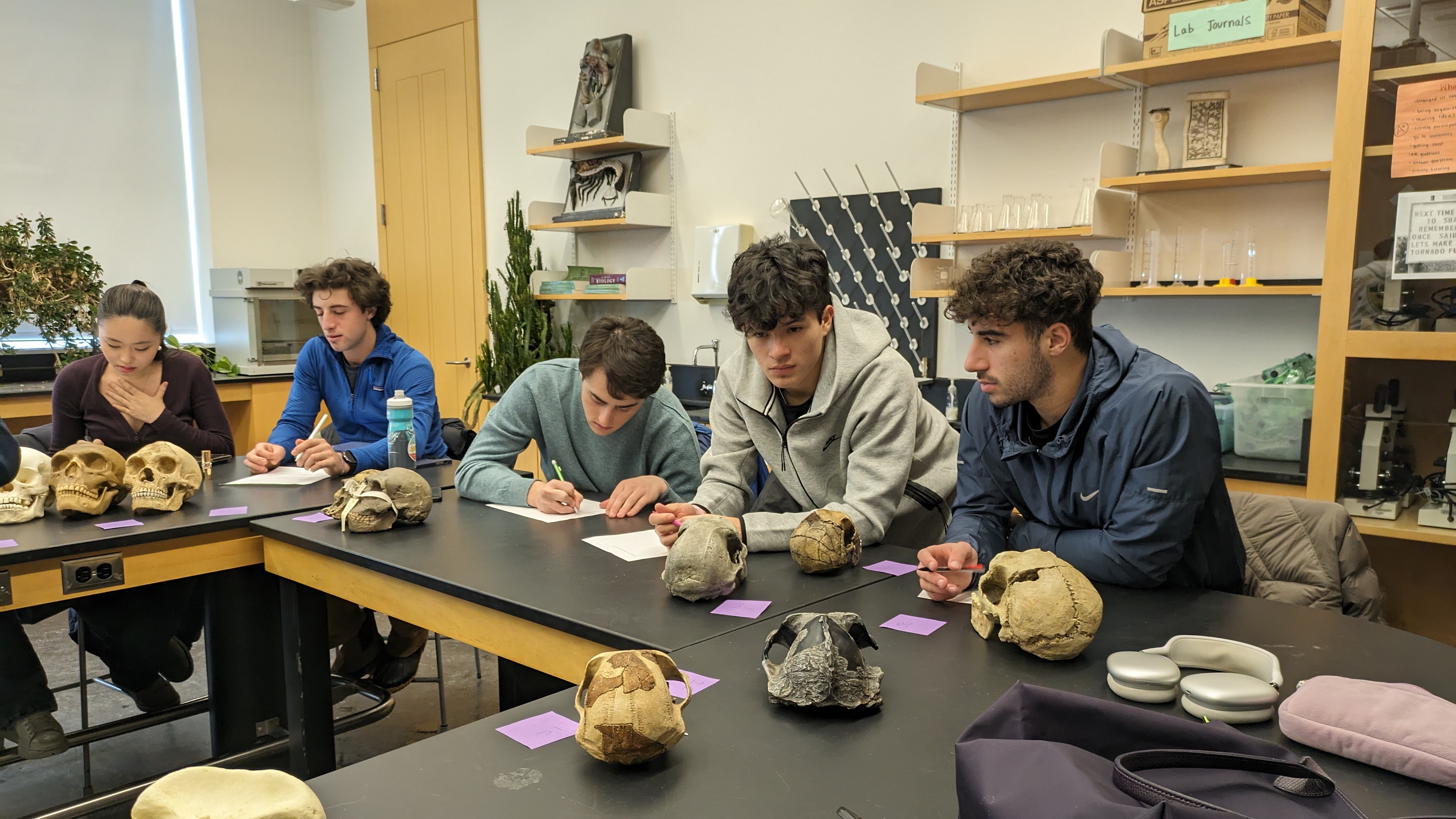
Human Origins students explore some of the Peabody Institute’s fossil human crania casts and models.

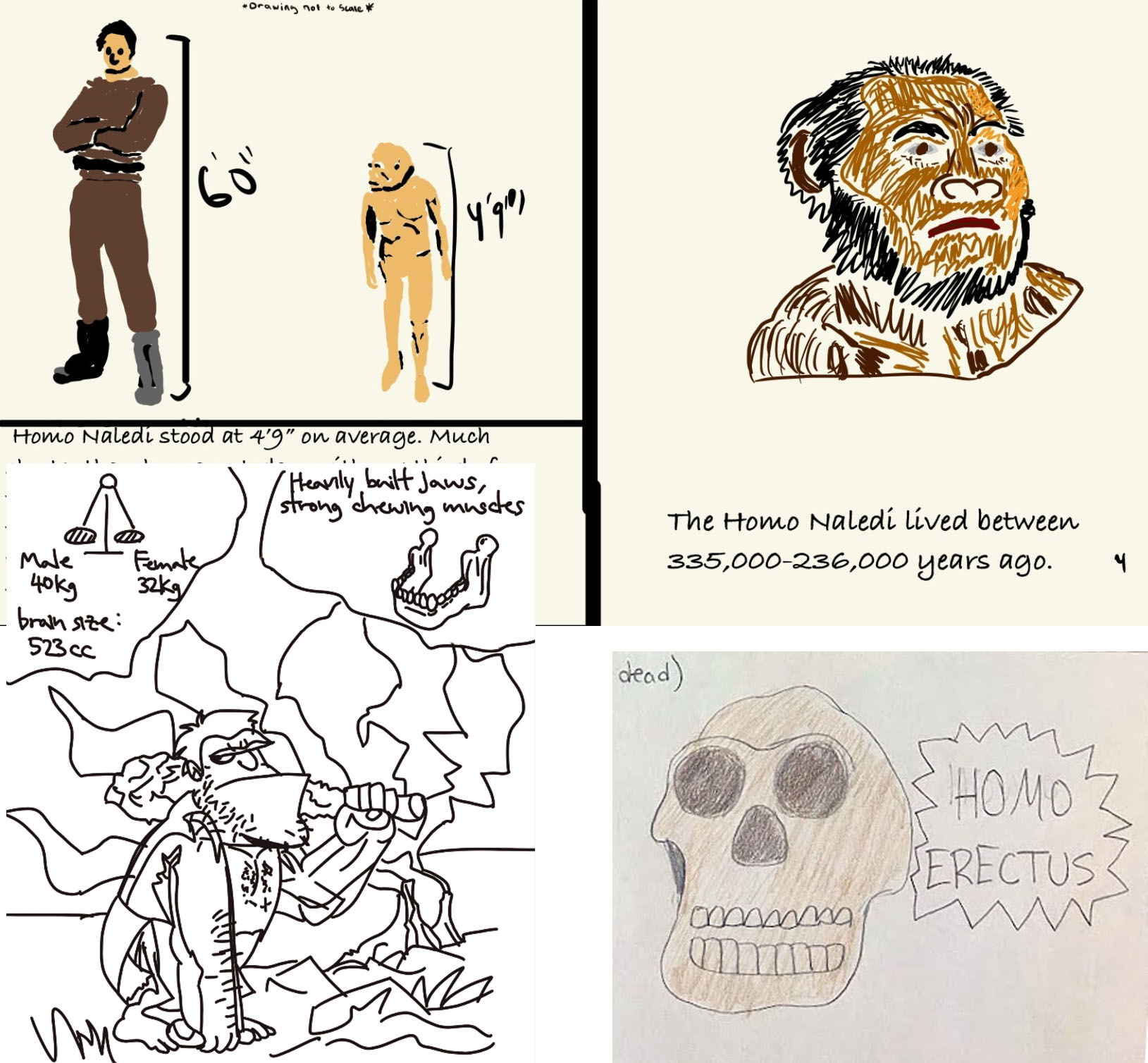
Some of my favorite assignments are team projects that involve producing a trailer for a new tv series on pseudoscience, a new comic pages project that focused on specific fossil humans, and Human Origins in the News, where student teams lead class. We just finished midterm, and I was wowed by the new comic pages assignment. I’ve wanted to develop a comics assignment and I’m really pleased with the results–student teams researched particular fossils and then developed a few comic pages in response to a series of prompts. Students are now making their own chipped stone tools and starting to plan their podcasts for the end of the term.

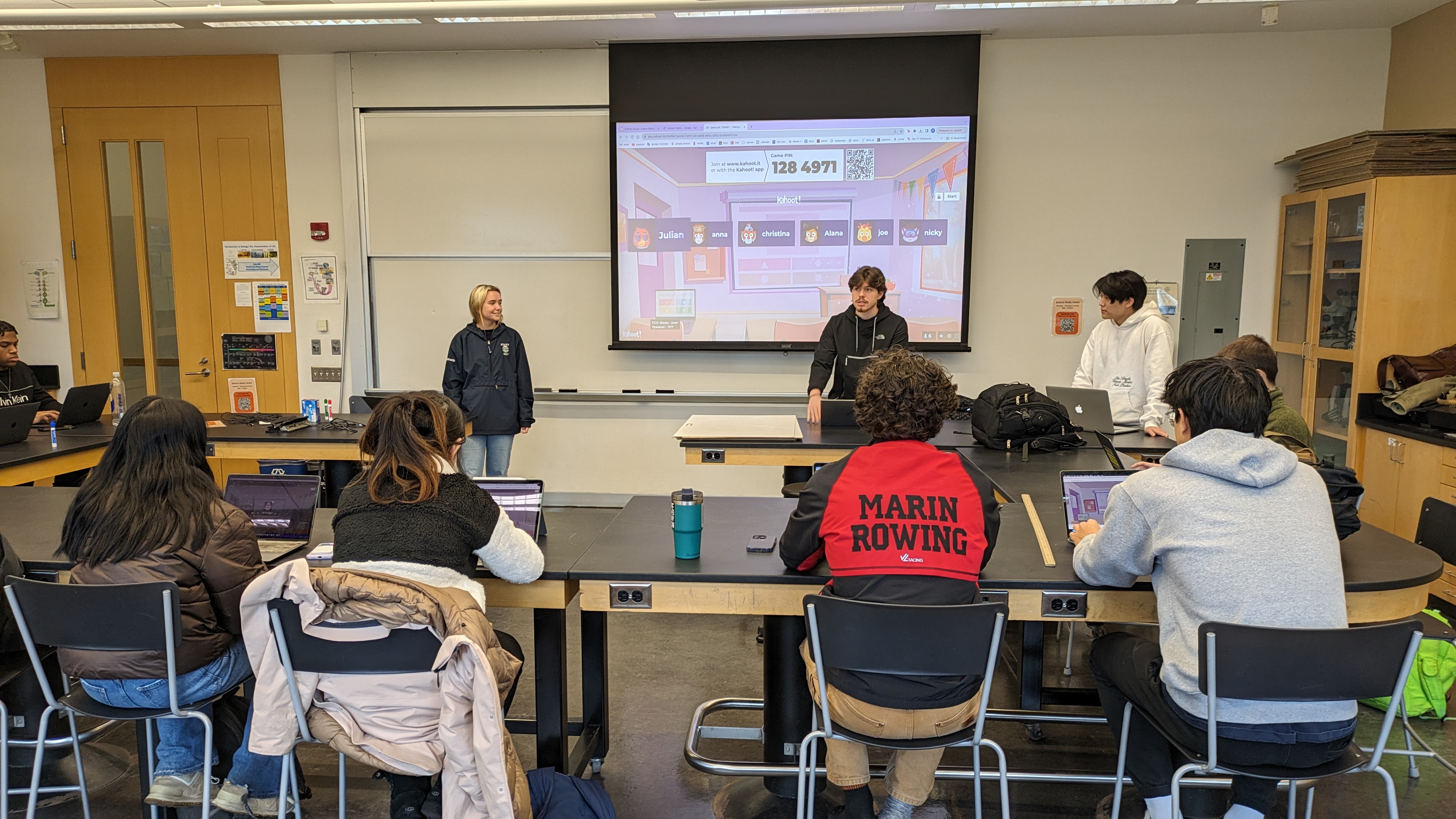
Human Origins students lead class during our “short period” on most Mondays with Human Origins in the News.

A couple of big changes this term include teaching during winter term–usually we’ve offered Human Origins in the fall–and we’ve been meeting the class in the Gelb science building, as Phase 1 of the Peabody Institute renovation wraps up. I’m really grateful to my colleagues in the science division for sharing the Gelb classroom with me. It will be nice to return to the Peabody Institute in the near future. We’ll at least be close-by next week when we explore the atlatl and throw spears on the Chandler-Wormley Vista!

A sample from the comic pages created by Human Origins students this term.

PA Students Visit Harvard’s 25th Annual Powwow

Contributed by Emma Lavoie

Last month, the Peabody Institute sponsored a day trip to Harvard University for Phillips Academy students. The 25th Annual Powwow was hosted by the Harvard University Native American Program (HUNAP). After a three-year hiatus due to the Covid-19 pandemic, the HUNAP program was able to welcome the return of their Powwow.

Flyer for HUNAP’s 25th Annual Powwow

This year’s theme for the HUNAP Powwow was Protect Indigenous Futures! The event was held on Orange Shirt Day, a national day of remembrance and reconciliation for victims of residential schools, which sought to separate Native children from their families and forcibly assimilate them. The Powwow honored survivors and victims of residential schools throughout Canada and the United States.

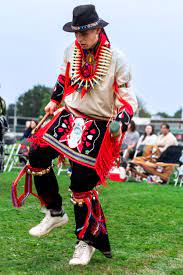
The Powwow ceremony is an Indigenous gathering with traditional dances and music held by Tribal nations from the New England area. The event welcomed hundreds of attendees from Harvard, neighboring Native communities, and the Greater Boston area.

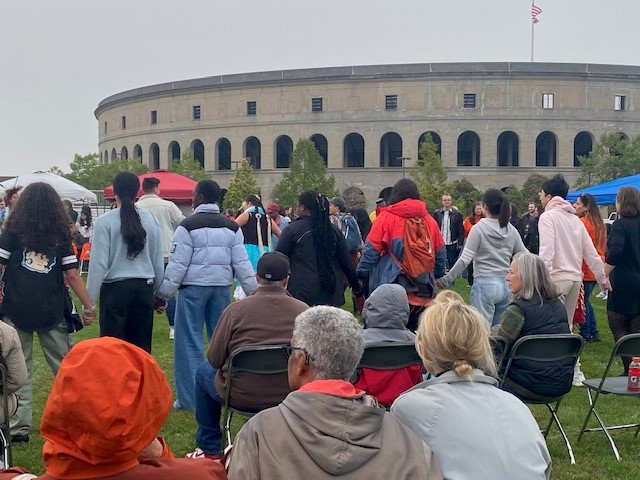
Photos from the HUNAP Powwow
Photos by Catherine Dondero and Courtesy of Harvard University

Students took part in community dances, which welcomed all event attendees into the arena to dance together. Many PA students took part in these community dances and got to experience the ceremony traditions first-hand.

PA students participating in community dances

This event was a wonderful opportunity for students to experience Indigenous cultural traditions and ceremonies. Students also had the opportunity to connect with Indigenous students, community members, HUNAP students, and Tribal nations from the Greater Boston area, New England, and those visiting from other parts of the United States and Canada.

Want to hear more about this event from the students’ perspective? Check out this article from Phillips Academy’s student paper, The Phillipian.

For more details about the HUNAP 25th Annual Powwow, explore this article from The Harvard Gazette and video coverage of the event by Harvard University.

Behind the Abbot Photographs… and a song book!

Contributed by Emma Lavoie

Since the Peabody staff moved to the School Room in Abbot Hall, I’ve been fascinated by the history of Abbot Academy and what remains of the school’s campus. As we work in the very heart of the Abbot Academy campus, I can’t help but notice the many features and tangible details left since the merger of Abbot and Phillips in 1973.

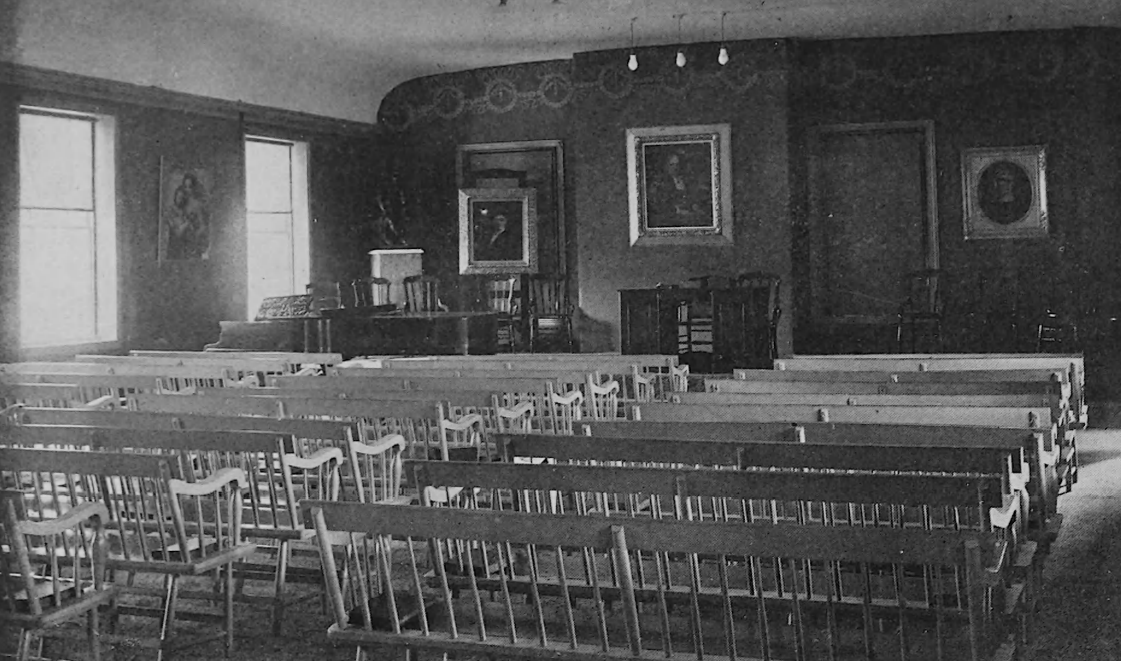
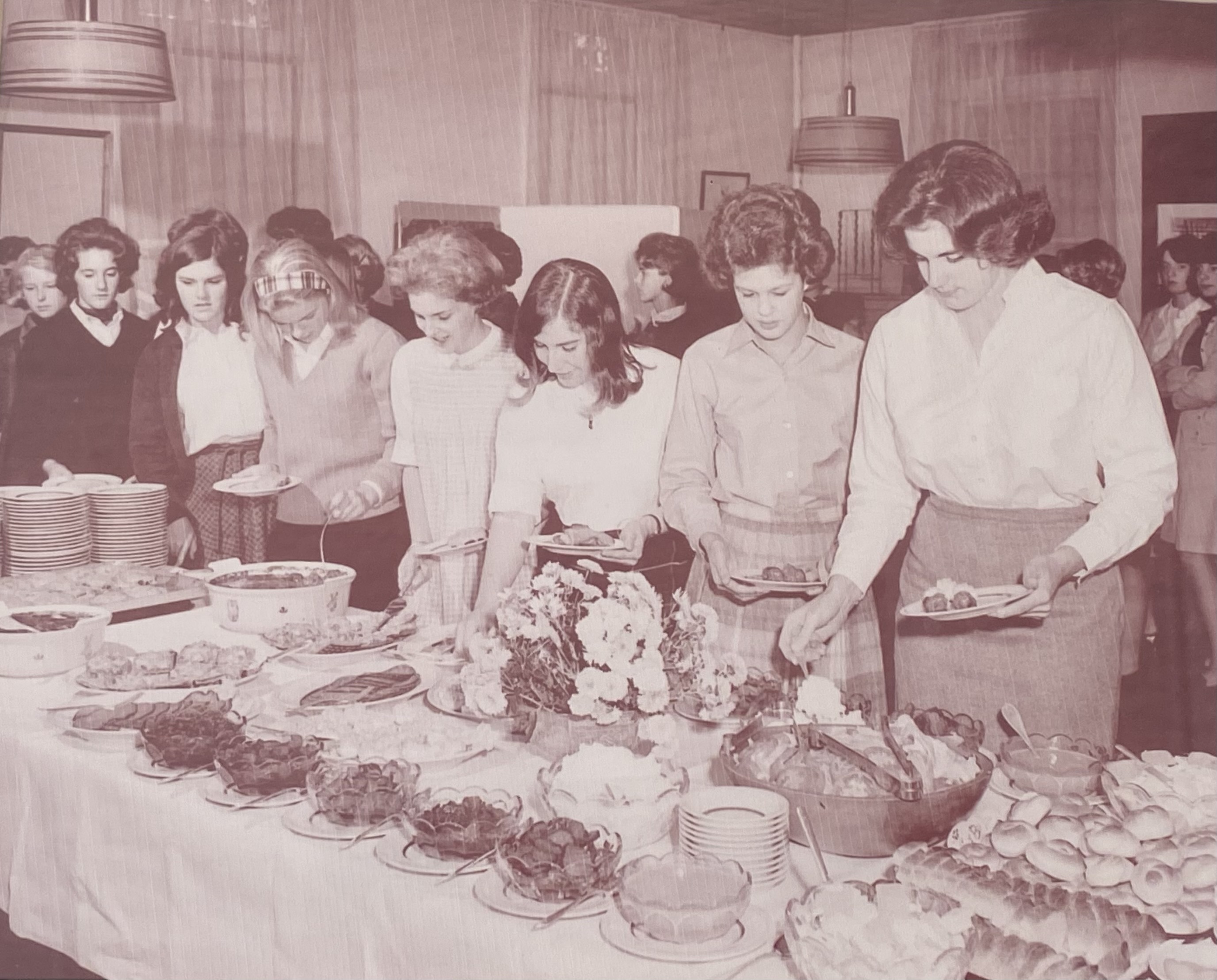
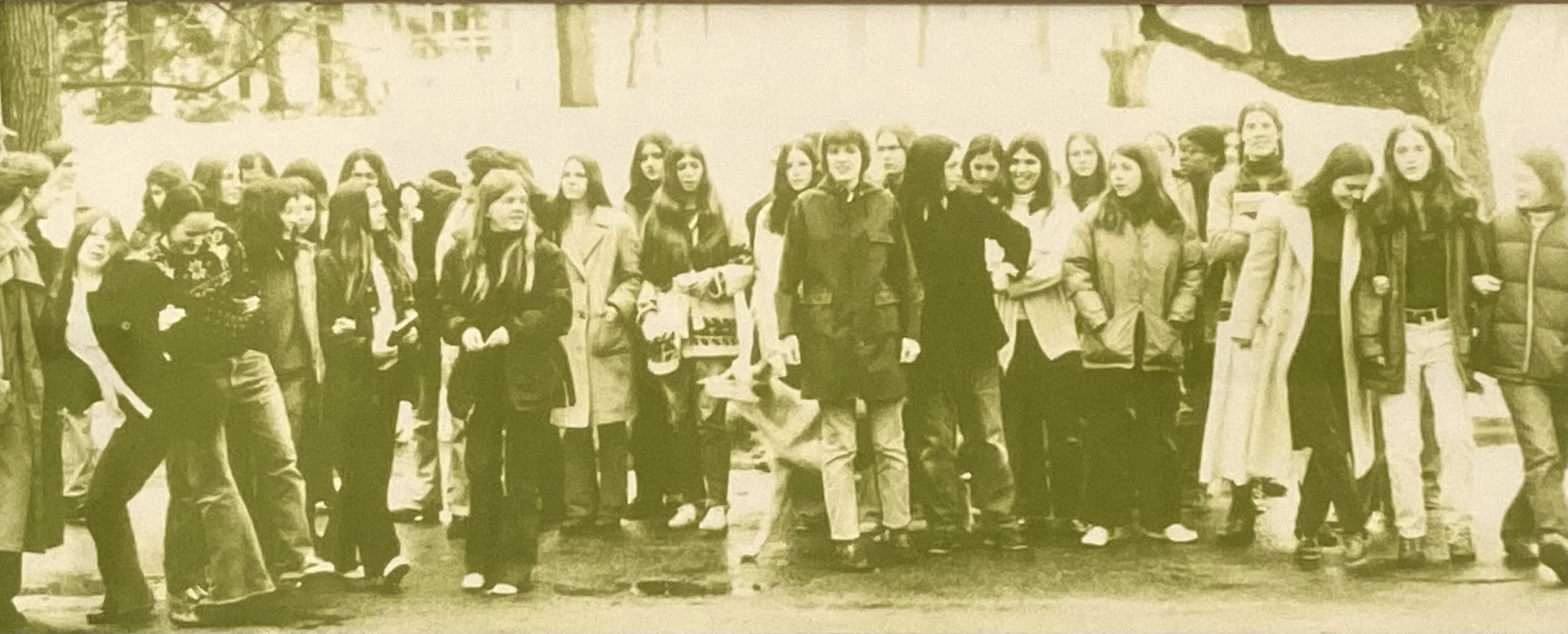
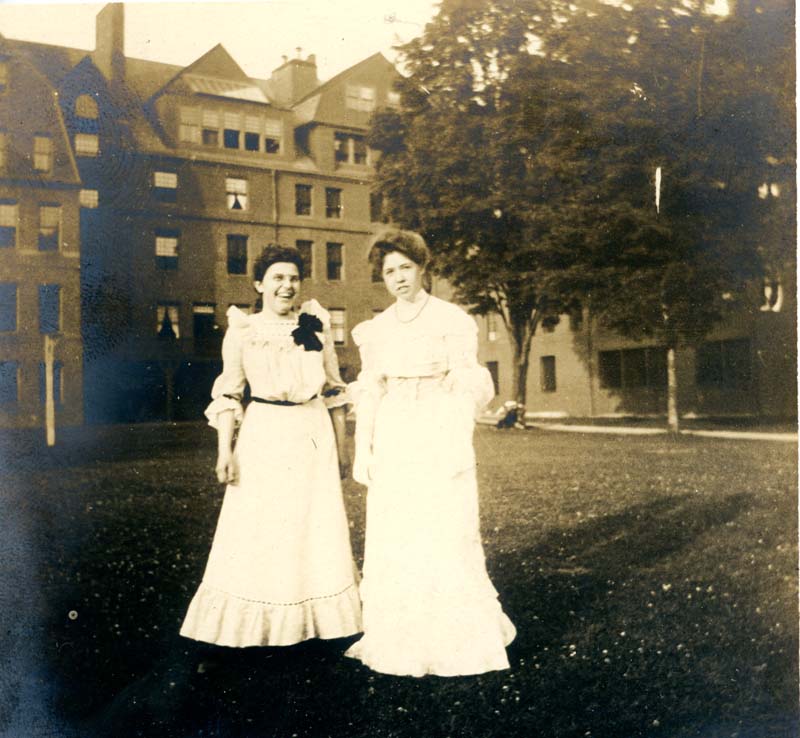
The very School Room in which our staff currently resides was once an assembly room for all the Abbot Academy students to gather, known as the “Hall” and later as the “Chapel.” Within this same building are many rooms with remnants of old chalk boards as well as photographs of Abbot students from throughout the school’s history. These photographs inspired this next entry of the Behind the Photograph blog series and although many do not have specific provenance or further information provided, they represent what life and education was like at Abbot Academy during a rapidly changing America.

The “Hall” at Abbot Hall, now known as the School Room, circa 1906.
Students gather in the “Chapel” at Abbot Hall, now known as the School Room, circa 1945.

Abbot Academy was one of the first educational institutions in New England for girls and women. Founded through the financial support of Sarah Abbot, the Academy opened in May 6, 1829 with seventy students and continued as an independent preparatory school for female boarding and day students until the merger of the two schools in 1973. Today the campus continues to be used by the combined school where many of its buildings and stories remain.

Sarah Abbot, Founder of Abbot Academy

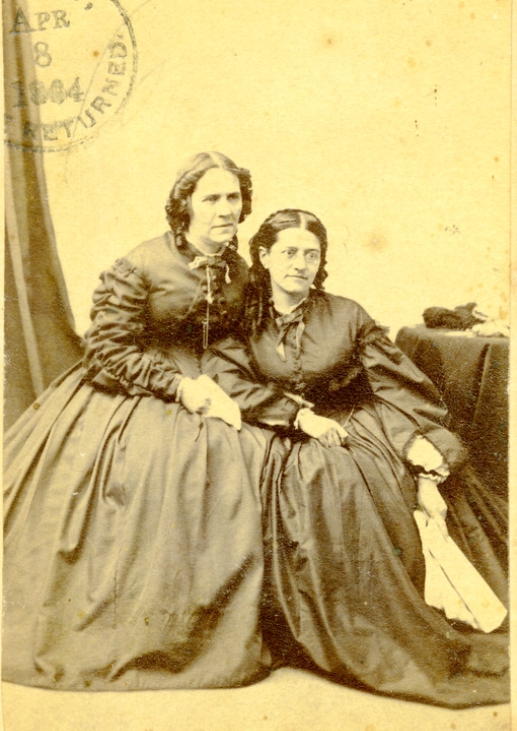
Although many were hesitant at its reception and Victorian society questioned the need to educate women, Abbot Academy quickly became an example of women’s accomplishment. Some believed its curriculum even surpassed the all-male Phillips Academy up the hill. One particular era of note was Abbot’s “golden age” under the McKeen sisters, headmistresses Philena and Phebe (Abbot Academy, 1859-1892).

The McKeen sisters, headmistresses Philena and Phebe McKeen. Image courtesy of the Phillips Academy Andover Archives

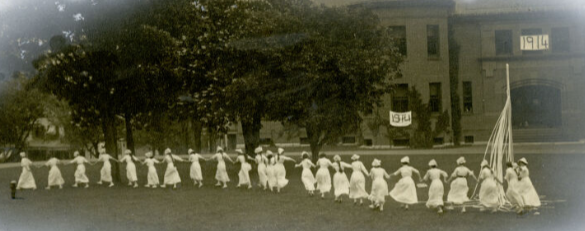
The sisters brought about many changes at Abbot including the expansion of buildings, strict schedules for students, world language classes, student involvement in the surrounding community, lecture opportunities, emphasis on art education, and so much more. The Abbot Circle was created with the construction of Draper Hall in 1890. Abbot Hall was also moved to frame the new grass plot. Activities such as commencement and winding the Maypole were staged on the lawn and became traditions for years to come.

The Abbot Circle, framed by Abbot Hall (left), Draper Hall (center), and the old Davis Hall (right), (1890-1892)
Abbot Academy Class of 1914 with Maypole on Abbot Circle

Draper Hall contained the parlors, library and reading room, music rooms, studio and infirmary, dining room, and student dormitories. Abbot Hall was later altered to make space for laboratories, an art studio, and an exhibition gallery.

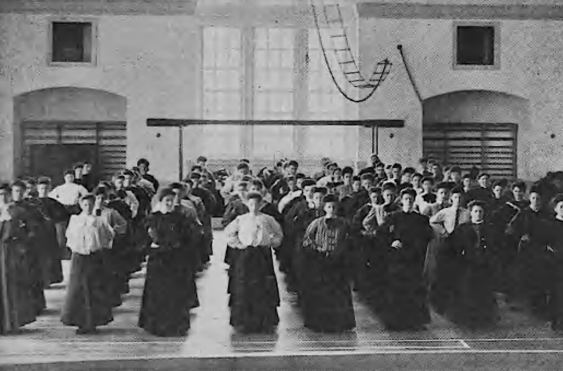
Many of the McKeen traditions continued, even after the sisters departed Abbot in 1892. In the early 1900s, McKeen Hall was built on the original site of Davis Hall. This new building was dedicated to the memory of the McKeen sisters and used as a study hall, classrooms, and gymnasium that doubled as an assembly room named Davis Hall.

Davis Hall (located in McKeen Hall) doubled as both a gymnasium and assembly space for students. At one point there was even an organ in the upper loft of the space! (1912-1925)
Students playing field hockey on the Abbot grounds. As a previous field hockey player myself, I just love this photo! “The twenty-three acres of grounds allow plenty of room for these sports close at hand.”

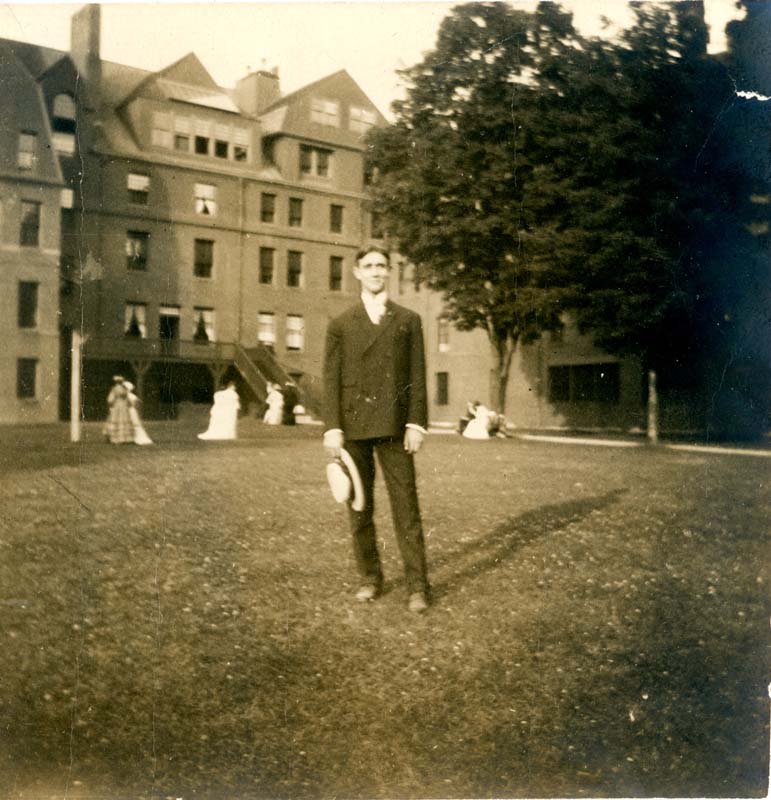
As Abbot faced new challenges such as the Great Depression and two World Wars, the school isolated itself, however, this only kept out new waves of change as women’s colleges and public schooling became a permanent fixture in American society. Students described these years as isolating, strict, and confining. Students had a rigid dress code, curfews, and could not speak to boys (especially those from Phillips Academy).

A Phillips Academy boy and Abbot Academy girls standing in the same place, but never together.

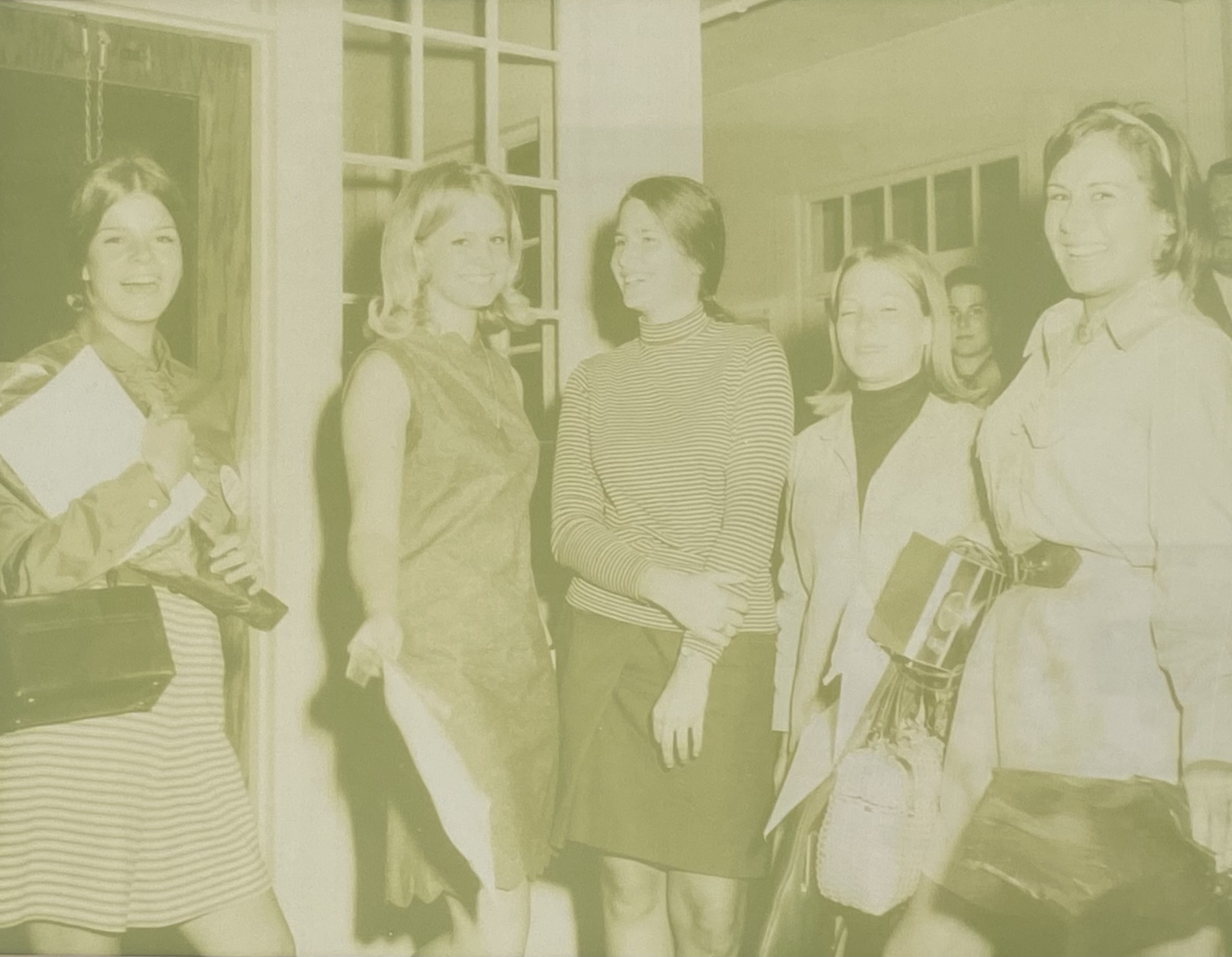
After World War II, the Academy experienced a jump in enrollment and opened its doors more widely to minority groups of women. As a result, the academic excellence of the Abbot school improved and applications to the school increased in the 1950s and 1960s. The strict rules of the past were gone by the 1960s, giving female students more independence and featuring more chaperoned dances and interactions with the Phillips Academy boys.

By the late 1960s, many colleges and universities were becoming coeducational institutions. As a result, along with other factors such as shared history and common activities, Abbot Academy and Phillips Academy merged on June 28, 1973. Many Abbot traditions were included in the combined school, such as Parents Weekend. The Phillips Academy headmaster at the time, John Kemper, believed the merger was “practical, ethical, and educationally sound.” The Peabody had already opened Richard “Scotty” MacNeish’s archaeology course to Abbot women as preparations for the merger were being made. This year, we celebrate 50 years of the Abbot Academy and Phillips Academy merger!

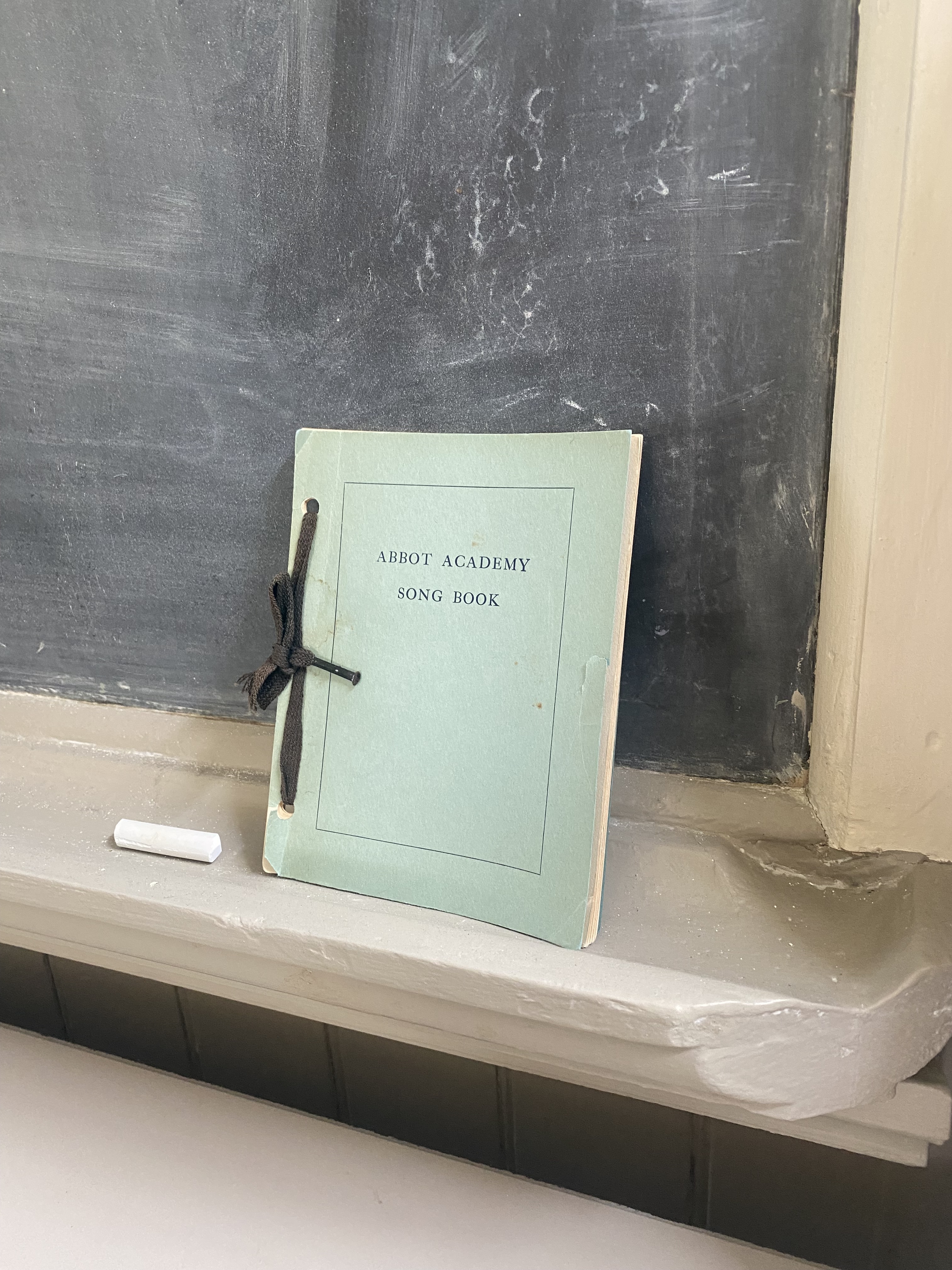
In additon to all the wonderful and candid photographs that decorate the walls in Abbot Hall, my favorite find was an Abbot Academy Song Book. This book is filled with a variety of school songs, marches, sport songs, serenades and salutes, rounds, parting hymn, and Bradford songs remembered by past Abbot Academy alumni. What really brought this find full circle for me was listening to past Abbot Academy alumni sing these songs during our 2023 reunion weekend.

There’s something special about the Abbot Academy campus and I’ve truly enjoyed calling this place home for the last several months. There is so much history here and I hope I provided a small glimpse of this history by sharing the photographs that adorn Abbot Hall.

For more photographs related to Abbot Academy and student life check out the Abbot Collections online archive here!

Additional Reading on the History of Abbot Academy

Academy Hill: The Andover Campus, 1778 to the Present. New York: Princeton Architectural Press, 2000.

Dominique, Robert A. Phillips Academy Andover, Massachusetts: An Illustrated History of the Property (including Abbot Academy). Wilmington, MA: Hampshire Press, 1990.

Lloyd, Susan McIntosh. A Singular School: Abbot Academy, 1828-1973. Hanover, NH: University Press of New England, 1979.

McKeen, Phebe Fuller. Annals of Fifty Years: A History of Abbot Academy, Andover, Mass., 1829-1879. Andover, MA: W.F. Draper, 1880.

McKeen, Philena. Sequal to Annals of Fifty Years: A History of Abbot Academy, Andover, Mass., 1828-1892. Andover, MA: W.F. Draper, 1897.

Roberts, Paige. “Abbot Hall, 1828-1829, at Phillips Academy.” Clio: Your Guide to History. December 5, 2019. Accessed June 22, 2023. https://theclio.com/entry/88419

Here’s the Dirt on Andover Summer’s Dig This! 2023

Contributed by Mikala Hardie

This summer, 23 young archaeologists set out to investigate one of the first buildings constructed by Samuel Phillips Jr. after he founded Phillips Academy. During the first week of the Andover Summer program, the students of the Lower School’s Dig This course were introduced to the story of the Mansion House and the mysterious fire that destroyed it in 1887. According to primary accounts, the fire seemed to have started in two different places in the house. This account was made even more suspicious by sources that said the caretakers, Mr. and Mrs. Carter, had their bags packed the day of the fire and walked away with insurance money. With this interesting piece of information, the students were excited to uncover more clues about the Mansion House and the people who inhabited it. The students worked in groups of 3 to 4 at six excavation units. These units were spread across the site in areas that, using past excavation results and Ground Penetrating Radar maps, had a good chance of finding evidence of the Mansion House.

Figure 1. Commemorative Plaque of the Mansion House

The first day of excavations was met with enthusiasm, apprehension, and later exhaustion as the students realized how much work goes into opening a unit. Nonetheless, we persevered and by the end of the first week of excavations many groups had already finished Level 1. Some had even found glass and metal artifacts which, of course, created healthy competition between groups and motivated the students as they continued in the second week of excavations.

Figure 2. Two students working in Excavation Unit 1

During the second week, things got interesting. The students working in Excavation Unit 5 came across an 1802 “Draped Bust” Liberty penny which caused a ripple of excitement for both the students and the instructors. This coin gave an important terminus post quem (TPQ) for the level and showed the students how old the artifacts we were finding really were.

Additionally, in Excavation Unit 2 Level 2, a brick feature began to reveal itself in the northeast corner. This unit was placed near a 2018 excavation unit that uncovered part of a chimney, so it is likely these features were related and Unit 2 uncovered another part of the chimney which helps in understanding how large the chimneys would have been and the layout of the Mansion House. The images below show the brick feature when it began to be discovered in Level 2 and the brick feature in Level 3 before backfilling.

The third and final week of excavations supported the archaeological adage that you always find the most interesting stuff right before you’re going to leave a project. This week, two new features were discovered. One was in Excavation Unit 6, which was intended to find one of the foundational walls of the structure. This feature also included a brick, though it is unclear if it relates to another chimney of the house. There was also a large stone and some smaller stones found near it, though, likely not enough to constitute a foundational wall of the building.

Figure 5. Students working in Excavation Unit 6

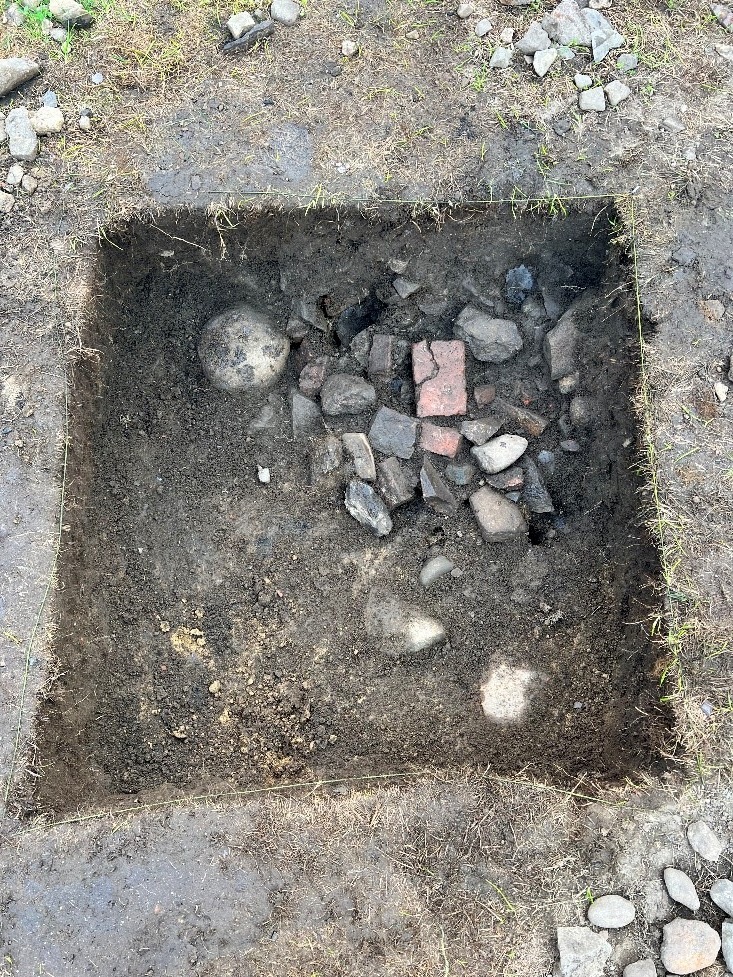
That being said, one of the biggest finds of the project included a huge rectangular stone with other large stones overlapping it. This feature was found in Excavation Unit 1 which was placed north of Excavation Unit 2 in the hopes of uncovering part of the foundation of the house. Given the size of the stone and the overlapping rock around it, it is pretty likely that this feature relates to the foundation or a wall of the Mansion House. On the last day of excavations this unit surprised us further by containing a large amount of metal artifacts in the southwest corner of the unit. A fork, a hinge, a handle, and a plethora of other artifacts were uncovered in the last level of this unit. We probably could have found more in the next level if we didn’t have to backfill the next day. This unit is definitely one to revisit in future years!

Figure 6. Stone feature in Excavation Unit 1 Level 3.

While neither unit contained a feature, Excavation Unit 3 and Excavation Unit 4 contained a lot of charcoal and mortar. Excavation Unit 3 specifically had extremely dark, somewhat ashy soil which was likely due to the fire. Ideally future Dig This! classes will uncover more of this ashy, dark soil and the data can be compiled to give a better understanding of how the fire destroyed the mansion house.

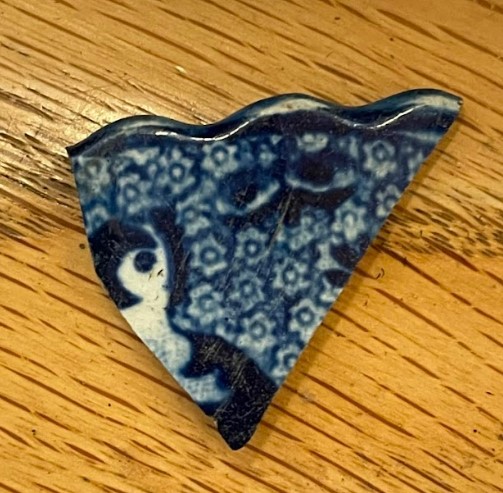
During the last week of the course, the students were busy washing their artifacts and picking a few to display at their end of the year exhibition. These artifacts included a locking mechanism, large nails, blue transfer print ceramics, a marble, a hinge, and a fork! All of the artifacts found during this summer’s course were transferred to the Peabody Institute to be cataloged and analyzed with the rest of the Mansion House artifacts.

Overall, the students had a great summer excavating the Mansion House and learning how to be archaeologists by following proper archaeological methods and recording techniques. I look forward to seeing what next summer’s Dig This class will find!

Peabody Volunteer Spotlight: Meet Mike

Contributed by Mike Agostino

Hello, my name is Mike Agostino and I am a volunteer here at the Peabody Institute of Archeology. I am a recently retired scientist from the field of bioinformatics. My work in this field, for over 30 years, concerned the analysis of gene and protein sequences. I love the field so much that I am presently an instructor on the subject for the Harvard Extension School. I am also writing the second edition of a textbook I published on this topic more than 12 years ago.

Peabody volunteer, Mike, analyzes various projectile points in the Peabody collection.

As a resident of Andover, I frequently went past the Peabody and often wondered what treasures it held. When a good friend, Richard Davis, said he volunteered here and told me about the work, I immediately wanted to join him. To say this is a dream come true is not an exaggeration. I have always been interested in archaeology and spent many years looking down on the ground for the artifacts people said were all around us. But I never found any! To work with and learn about dozens, if not hundreds of specimens each day is amazing. As I hold these objects in my hands, I try to imagine their history: was it careful fabrication by an adult expert, or was it made during a learning period of a youngster? Was it used to bring home a meal, build a boat or dwelling, or for the creation of clothes? Did it come from local stone, or did it travel many miles to be found at a new locale? My imagination is further enhanced or tempered by the kind and knowledgeable staff of the Peabody who are training and patiently helping me identify what is in my hand. I have only been at the Peabody for less than two years and there is so much to learn!

After years as a scientist, I feel right at home with my principal responsibilities: the careful handling, description, cataloging, and storage of the specimens. Attention to detail is absolutely required and very satisfying. We record their identities, or best guesses because many are just fragments. The intact specimens are something to behold. Some arrowheads or axes are impossibly beautiful, and the precision of shaping and symmetry with such a hard material is just astounding. The skills of the people, past and present, are just amazing.

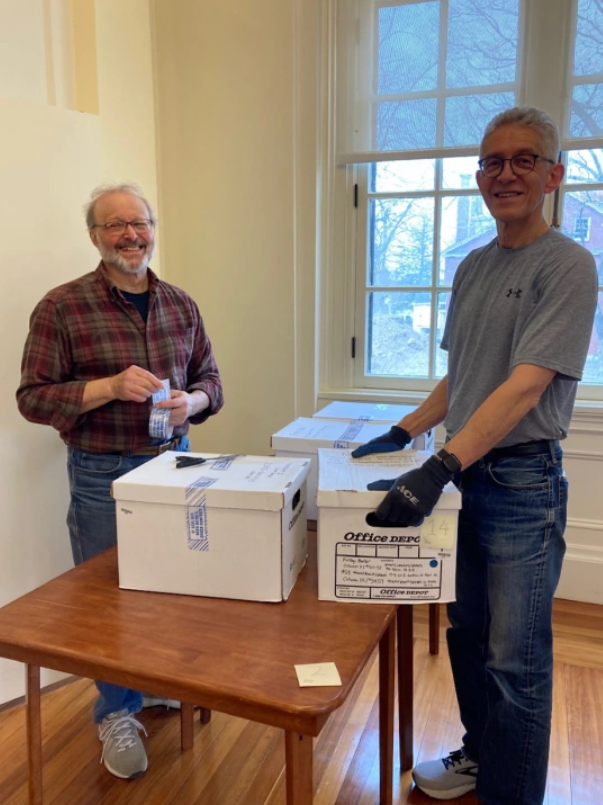
Peabody volunteers, Richard (left) and Mike (right), moving boxes for the Peabody’s building project.

I have also helped with activities associated with the huge renovation project of the building (for pictures and updates, see the blog postings by Marla Taylor). I am impressed with how everyone has remained calm considering hundreds of boxes, and specimens too large for boxes, had to be carefully moved up one or two floors from the basement to temporary locations elsewhere in the building. With the absence of an elevator, I helped move many boxes up the stairs out of harm’s way. My smart watch said I went up 80 flights of stairs one day! And I am only there one day a week, so the staff had a monumental challenge. We are now waiting for the renovations to be completed and then we will return the specimens to a much-improved setting. Even with the new elevator, reshelving hundreds of boxes won’t be easy, but I am looking forward to the project and the “new” institute.

Reunion Weekend

Contributed by Marla Taylor

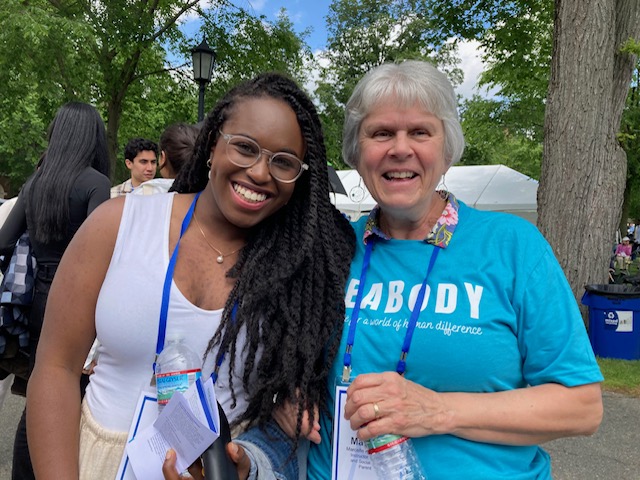
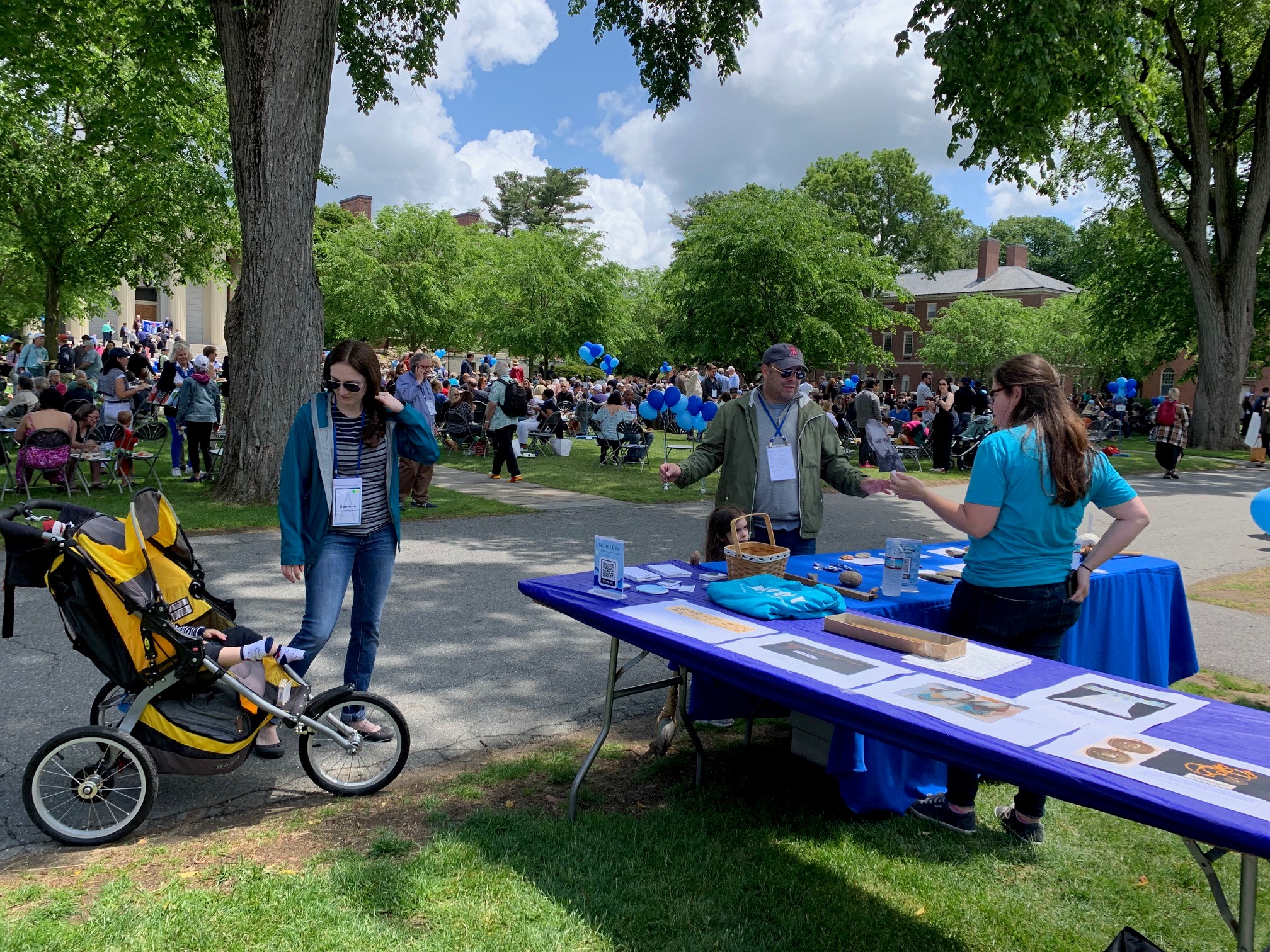
The second weekend of June is always Phillips Academy Reunion Weekend and one of the most fun days to be on campus.  PA alums with graduation years ending in 3s and 8s came back to campus to celebrate everything from their 5th to 70th (!) reunions.

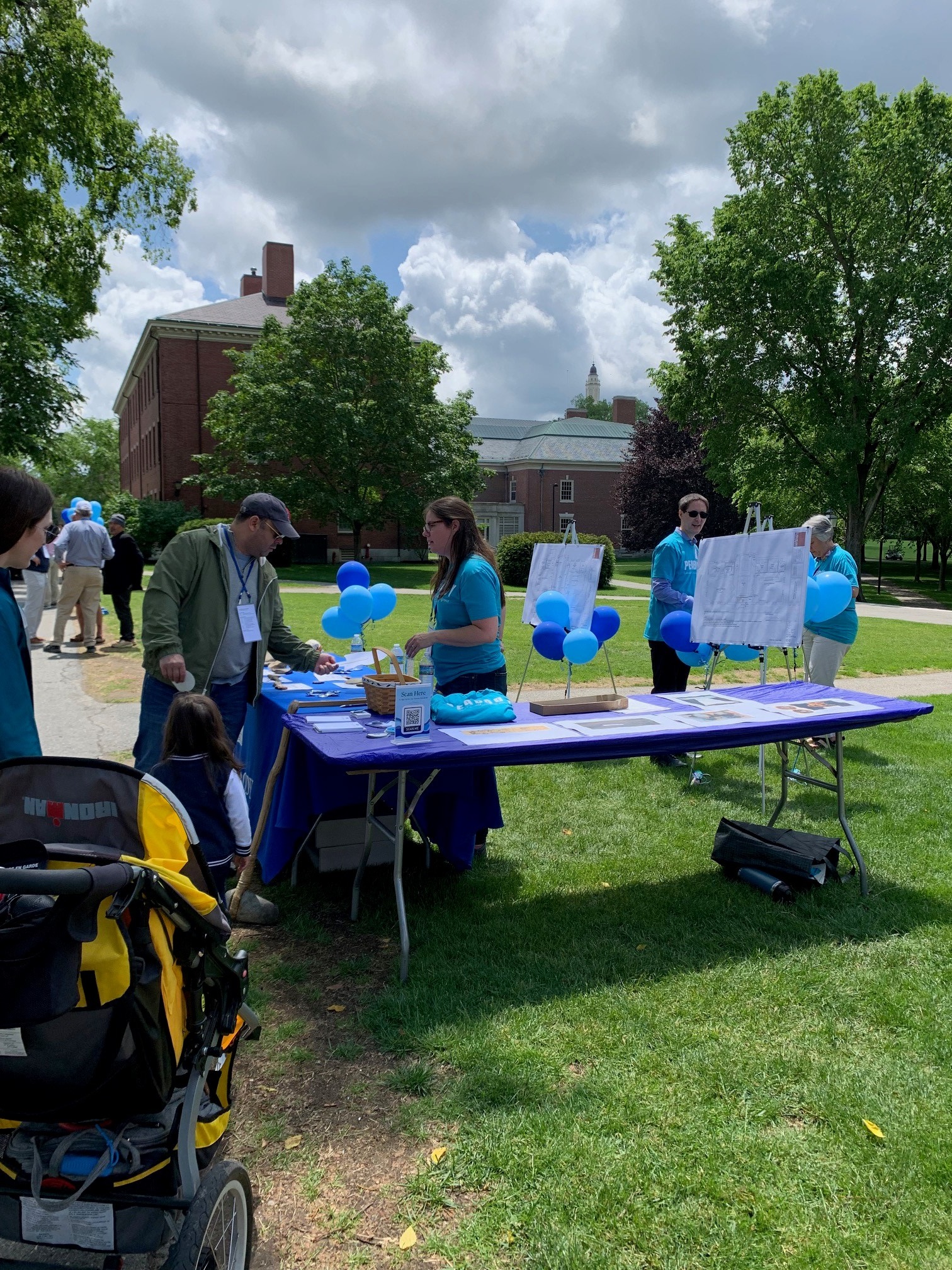
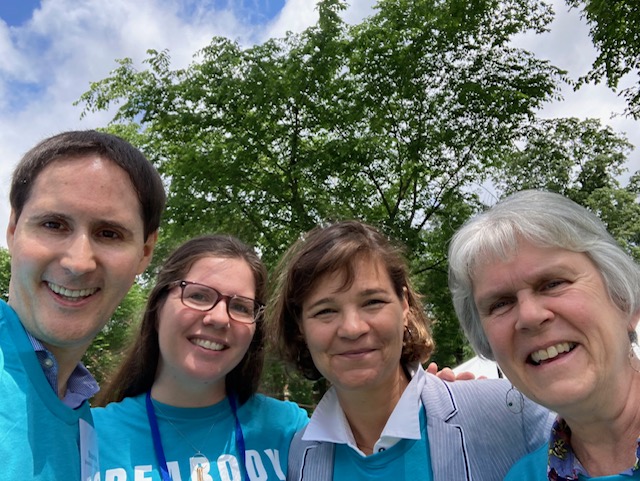
This year, because the Peabody building is under construction we set up a table by the Richard T. Greener Quadrangle during the lunch hour on the Saturday.  The table was staffed by myself and several members of the Peabody Advisory Committee – Jenny Elkus ’92, Brandon Stroman ’97, and Marcelle Doheny P’18 and PA faculty member.  We had a fabulous time engaging with alumni from across the country and the decades. 

One of the reasons that I enjoy working Reunion weekend is because I am often meeting alumni who had never engaged with the Peabody during their time at PA.  It is a wonderful opportunity to introduce them to what we do and how we engage with students now.  So many people react positively to our work and lament that they did not have the opportunity to engage when they were students.  But that has definitely changed!

2023 Summer Reading List: Our Peabody Picks

Contributed by Emma Lavoie

As the school year comes to a close and we take time to slow down (thank you vacation time), what better time this season then to grab a book and settle down on a porch swing. It’s time to grab your library card, load up your Kindle, or get yourself to your local bookstore. Our staff and friends of the Peabody have done it again… Back by popular demand! The Peabody shares their favorite finds for this summer’s reading list. We even threw in a podcast as a bonus for any listeners! We hope you have a wonderful summer dear readers and enjoy exploring these “Peabody Picks.”

Happy reading!

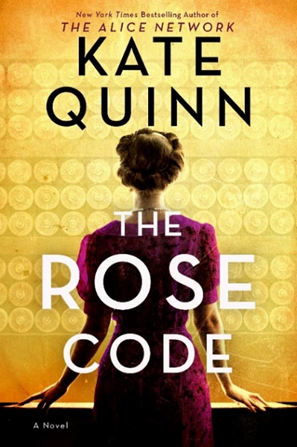
The Rose Code by Kate Quinn – Recommended by Emma Lavoie, Administrative Assistant

If you read one historical fiction book this year, THIS SHOULD BE IT! As England prepares for World War II, three women from very different walks of life answer the call to mysterious county estate Bletchley Park, where the best minds in Britain train to break German military codes. Osla translates decoded enemy secrets, Mab works the legendary code-breaking machines, and Beth is one of the Park’s few female cryptanalysts. Eventually war, loss, and the impossible pressure of secrecy will tear the three apart. Flash forward seven years later, these friends-turned-enemies are reunited by a mysterious encrypted letter – the key to which lies buried in the long-ago betrayal that destroyed their friendship and left one of them confined to an asylum. A mysterious traitor has emerged from the shadows of their Bletchley Park past, and now Osla, Mab, and Beth must resurrect their old alliance and crack one last code together against the backdrop of the royal wedding of Elizabeth and Philip.

“The reigning queen of historical fiction.”Fiona Davis, New York Times bestselling author of The Lions of Fifth Avenue

Killers of the Flower Moon by David Grann – Recommended by Michael Agostino, Peabody Volunteer

Set in the 1920s, this book features people of the Osage Nation who were relocated to barren lands in Oklahoma which were later discovered to be rich in oil. Per capita, members of the Osage nation quickly became the richest people in the world and targets for murder. This book carefully describes efforts by lawmen to solve these crimes and bring the murderers to justice. The lawmen were led by J. Edgar Hoover and his organization soon became the FBI – in what became one of the organization’s first major homicide investigations. Together with the Osage and Texas Ranger, Tom White, they began to expose one of the most sinister conspiracies in American History. A true-life murder mystery about one of the most monstrous crimes in American history, Killers of the Flower Moon, is highly acclaimed, receiving numerous awards, and was recently made into a movie starring Leonardo DiCaprio and Robert Deniro.

 “A masterful work of literary journalism crafted with the urgency of a mystery…. Contained within Grann’s mesmerizing storytelling lies something more than a brisk, satisfying read. Killers of the Flower Moon offers up the Osage killings as emblematic of America’s relationship with its indigenous peoples and the ‘culture of killing’ that has forever marred that tie.” The Boston Globe

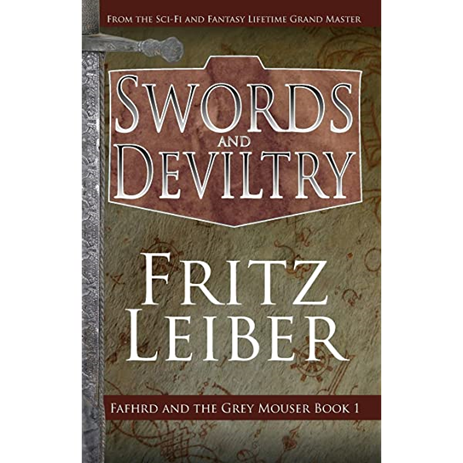
Swords and Deviltry (Fafhrd & the Gray Mouser #1) by Fritz Leiber – Recommended by Ryan Wheeler, Peabody Director

First in the influential fan-favorite series, Swords and Deviltry collects four fantastical adventure stories from Fritz Leiber, the author who coined the phrase “sword and sorcery” and helped birth an entire genre. This collection of short stories and novellas follows the adventures of barbarian Fafhrd and conjurer turned sword fighter Gray Mouser written by Leiber in the 1950s and 60s and collected in 1970. If you like Robert E. Howard and Conan the Barbarian, you will love this! And if you do, there are a total of seven of these collected volumes chronicling the exploits of Fafhrd and the Gray Mouser, in this and other dimensions.

“A Grand Master of Science Fiction and Fantasy.”Science Fiction Writers of America

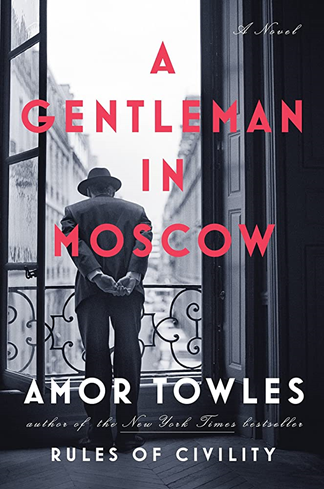
A Gentlemen in Moscow by Amor Towles – Recommended by Richard Davis, Peabody Volunteer

In 1922, Count Alexander Rostov is deemed an unrepentant aristocrat by a Bolshevik tribunal, and is sentenced to house arrest in the Metropol, a grand hotel across the street from the Kremlin. Rostov, an indomitable man of erudition and wit, has never worked a day in his life, and must now live in an attic room while some of the most tumultuous decades in Russian history are unfolding outside the hotel’s doors. Unexpectedly, his reduced circumstances provide him entry into a much larger world of emotional discovery. Brimming with humor, a glittering cast of characters, and one beautifully rendered scene after another, this singular novel casts a spell as it relates the count’s endeavor to gain a deeper understanding of what it means to be a man of purpose.

“How delightful that in an era as crude as ours this finely composed novel stretched out with old-World elegance.”The Washington Post

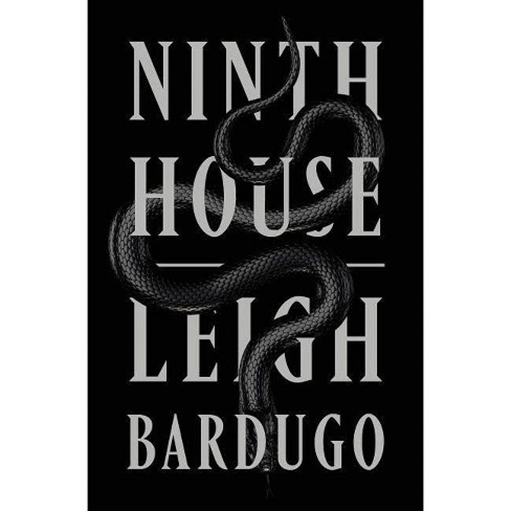
Ninth House by Leigh Bardugo – Recommended by Marla Taylor, Curator of Collections

Galaxy “Alex” Stern is the most unlikely member of Yale’s freshman class. Alex dropped out of school early and into a world of dead-end jobs and much, much worse. In fact, by age twenty, she is the sole survivor of a horrific, unsolved multiple homicide. Some might say she’s thrown her life away, but Alex is offered a second chance: to attend one of the world’s most prestigious universities on a full ride. What’s the catch, and why her? Still searching for answers, Alex arrives in New Haven tasked by her mysterious benefactors with monitoring the activities of Yale’s secret societies. Their eight windowless “tombs” are the well-known haunts of the rich and powerful, from high-ranking politicos to Wall Street’s biggest players. But their occult activities are more sinister and more extraordinary than any paranoid imagination might conceive. They tamper with forbidden magic. They raise the dead. And, sometimes, they prey on the living.

“The best fantasy novel I’ve read in years, because it’s about real people. Bardugo’s imaginative reach is brilliant, and this story – full of shocks and twists – is impossible to put down.”Stephen King

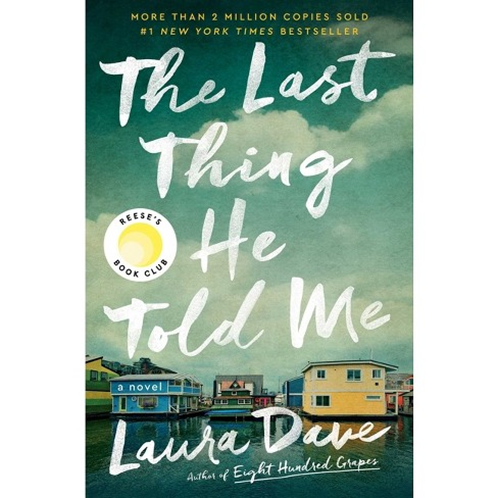
The Last Thing He Told Me by Laura Dave – Recommended by Beth Parsons, Office of Academy Resources, Director for Museums and Educational Outreach

Before Owen Michaels disappears, he manages to smuggle a note to his beloved wife of one year: Protect her. Despite her confusion and fear, Hannah Hall knows exactly to whom the note refers: Owen’s sixteen-year-old daughter, Bailey. Bailey, who lost her mother tragically as a child. Bailey, who wants absolutely nothing to do with her new stepmother. As Hannah’s increasingly desperate calls to Owen go unanswered; as the FBI arrests Owen’s boss; as a US Marshal and FBI agents arrive at her Sausalito home unannounced, Hannah quickly realizes her husband isn’t who he said he was. And that Bailey just may hold the key to figuring out Owen’s true identity—and why he really disappeared. Hannah and Bailey set out to discover the truth, together. But as they start putting together the pieces of Owen’s past, they soon realize they are also building a new future. One neither Hannah nor Bailey could have anticipated.

“In this novel, now an Apple TV+ series, Laura Dave has given readers what they crave most – a thoroughly engrossing yet comforting distraction.”BookPage

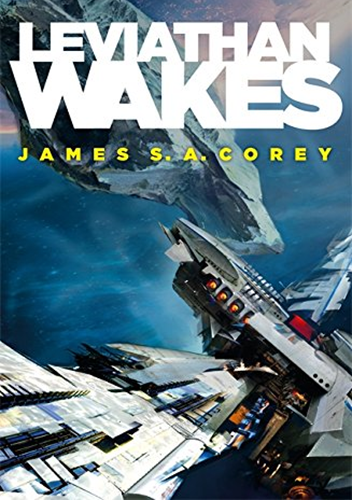
Leviathan Wakes by James A. Corey – Recommended by Nick Andrusin, Temporary Educator and Collections Assistant

Humanity has colonized the solar system—Mars, the Moon, the Asteroid Belt and beyond—but the stars are still out of our reach. Jim Holden is XO of an ice miner making runs from the rings of Saturn to the mining stations of the Belt. When he and his crew stumble upon a derelict ship, the Scopuli, they find themselves in possession of a secret they never wanted. A secret that someone is willing to kill for—and kill on a scale unfathomable to Jim and his crew. War is brewing in the system unless he can find out who left the ship and why. Detective Miller is looking for a girl. One girl in a system of billions, but her parents have money and money talks. When the trail leads him to the Scopuli and rebel sympathizer Holden, he realizes that this girl may be the key to everything. Holden and Miller must thread the needle between the Earth government, the Outer Planet revolutionaries, and secretive corporations—and the odds are against them. But out in the Belt, the rules are different, and one small ship can change the fate of the universe. Also now a Prime Original TV Series called The Expanse.

“This is the future the way it was supposed to be.”The Wall Street Journal

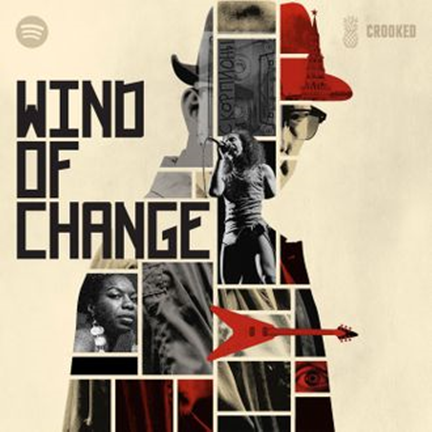
Wind of Change Podcast by Pineapple Street Studios and Crooked Media – Recommended by John Bergman-McCool, Collections Assistant

It’s 1990. The Berlin Wall has just come down. The Soviet Union is on the verge of collapse. A heavy metal band from West Germany, the Scorpions, releases a power ballad, “Wind of Change.” The song becomes the soundtrack to the peaceful revolution sweeping Europe – and one of the biggest rock singles ever. According to some fans, it’s the song that ended the Cold War. Decades later, New Yorker writer (and podcast host) Patrick Radden Keefe hears a rumor from a source: the Scorpions didn’t actually write “Wind of Change.” The CIA did. This is Patrick’s journey to find the truth. Among former operatives and leather-clad rockers, from Moscow to Kyiv to a GI Joe convention in Ohio, It’s a story about spies doing the unthinkable, about propaganda hidden in pop music, and a maze of government secrets.

“Wind of Change is a beautifully constructed listen, never less than entertaining.”The Guardian
Save the Date! PA Giving Day Begins March 30, 2022!

Contributed by Emma Lavoie

Mark your calendars! PA Giving Day begins Wednesday, March 30, 2022! This year, the PA Giving Day event will run from Wednesday, March 30, 9 a.m. to Thursday, March 31, 12 p.m. EDT.

For those inspired to give early, please complete the PA Giving Day form here! Please be sure to select the Robert S. Peabody Institute under the “designation” section. Any gift made in advance of the event will count toward PA Giving Day totals.

Last year the Peabody Institute garnered 70 gifts! This year we hope to have more challenges and even more support! Keep a look out for exciting posts and takeovers across our social media channels leading up to PA Giving Day!

PA student preparing to throw an atlatl on the Vista

Reconnecting with old friends

Contributed by Marla Taylor

In late January, the Peabody Institute hosted a special school group visit of students at Cape Cod Academy. Why is this school group more special than any other? Well, it actually had a lot more to do with the teacher – Alex Hagler.

Alex has been a part of the Peabody’s extended family for nearly 13 years. They started as a volunteer in 2009 and have worked at the Peabody in several capacities: work duty student, volunteer, and temporary employee. Alex has been kind enough to contribute to the blog in the past and you can read their thoughts in a student reflection and retrospective submission from several years ago.

Now, Alex is a Latin teacher at Cape Cod Academy and introduces archaeology to their students as part of the curriculum. One of the best places for that, of course, is here at the Peabody Institute. Alex, and a co-teacher, brought six students to explore our TARPS mock excavation exercise and take a tour of the collections spaces. The students asked fabulous questions and learned important lessons about archaeology and Native American culture. 

Welcoming Alex back as a teacher with their own students was a powerful “full circle” moment for us here. It is so rewarding to have an ongoing relationship with the students and alumni who connected with the Peabody while here at Phillips Academy. 

If you are one of those students who enjoyed your time at the Peabody – reach out! We would love to connect with you again.

Cutshamache and Cochichawick

Contributed by Ryan Wheeler

What is now called Andover, North Andover, and parts of Lawrence, Massachusetts were once Cochichawick. This is the Indigenous name for the place where many of us work and live. The name persists in Lake Cochichewick in North Andover, Essex County’s largest lake. Indigenous leader Cutshamache transferred the land to English colonists, not through a deed, but rather in an agreement ultimately attested before the General Court of the Massachusetts Bay Colony:

At a General Court, at Boston 6th of the 3rd m, 1646 (in the Gregorian calendar, May 16, 1646)

Cutshamache, sagamore of the Massachusets, came into the Court, and acknowledged that for the sum of 6 pounds & a coat, which he had already received, he had sold to Mr. John Woodbridge, in behalf of the inhabitants of Cochichawick, now called Andover, all his right, interest, and privilege in the land six miles southward from the town, two miles eastward to Rowley bounds, be the same more or less, northward to Merrimack River, provided that the Indian called Roger & his company may have liberty to take alewifes in Cochichawick River, for their own eating; but if they either spoil or steal any corn or other fruit, to any considerable value, of the inhabitants there, this liberty of taking fish shall forever cease; and the said Roger is still to enjoy four acres of ground where now he plants. This purchase the Court allows of, and have granted the said land to belong to the said plantation forever, to be ordered and disposed of by them, reserving liberty to the Court to lay two miles square of their southerly bounds to any town or village that hereafter may be erected thereabouts, if so they see cause.

Cutshamache acknowledged this before the magistrates, and so the Court approved thereof, and of the rest in this bill to be recorded, so as it prejudice no former grant.

Enamel pin created in 1895 by John E. Whiting to commemorate Andover’s 250th anniversary, the origin of the town seal featuring Cutshamache. Collection of the Robert S. Peabody Institute of Archaeology.

The story and its protagonist feature prominently in Andover’s 1895 town seal, where we see Cutshamache holding the coat, part of his payment for the land. Cutshamache appears frequently in the seventeenth century records of the English colony in Massachusetts, ranging from his involvement in the Pequot War to skepticism about missionary John Eliot’s preaching (see Drake 1856). Frank Speck (1928:141), in his discussion of the Punkapog Band of Massachusett, mentions that “the name and pronunciation of Kitchamakin or Cutshamekin are still remembered.” For us, his involvement in selling a large portion of Andover, North Andover, and Lawrence to John Woodbridge sometime in the early 1640s is of greatest interest. Local histories, in books, articles, and now online, frequently repeat the story, and tweak it to fit whatever narrative is being told. In some cases, the currency is converted into modern dollars (a pretty complicated exercise), and in other variants, Cutshamache is described as a Pennacook leader (see the Wikipedia entry for the Town of Andover). The latter makes sense, since the Pennacook, helmed by their leader Passaconaway, are associated with the area around Andover. However, Cutshamache does not appear to have been Pennacook, but was rather a Massachusett leader who lived in what is now Dorchester. The General Court statement clearly identifies him as such. But, this is puzzling, since Dorchester is pretty far from Andover. So what’s going on?

Many authors suggest a family connection between Passaconaway and Cutshamache, possibly based on Sidney Perley’s assertion (1912:35), though I have found no primary sources to support this and this suggested link may just be a way to help explain Cutshamache’s involvement in the sale of the Andover lands. Passaconaway does seem to have created alliances through marriage that crosscut ethnicity and relied more on cultural similarities, creating a heterogeneous coalition distinct from the more homogenous Massachusett (see Cook 1976:29; Stewart-Smith 1998:24-25). What’s more intriguing is the sale of Haverhill in 1642 by Native leaders Passaquo and Saggahew required the consent of Passaconaway (in fact, his consent is mentioned twice in the text of the deed). See the original document and transcript on the Essex National Heritage Area website. The General Court acknowledgment of the Andover, North Andover, and Lawrence sale does not mention Passaconaway, suggesting several possibilities. Perhaps Cutshamache’s less formal court appearance resulted in an omission. But, the court statement includes considerable detail, including the preservation of land and fishing rights for Roger and his company, Indigenous residents of the area.

Tile mosaic version of Andover’s town seal in the foyer of the Town Hall by Perley Gilbert and Elias Galassi. Photograph by Ryan Wheeler, February 3, 2020.

Archaeologist Eric Johnson (1999:155), in his book chapter on Native political geography, provides a different way of thinking about Indigenous groups in the area during the seventeenth century that helps inform Cutshamache’s sale of Cochichawick. Johnson says, “What does a map of bounded tribes imply about political organization? It implies stasis and homogeneity, both within and among political units.” He attributes this to the desire of colonial European observers to describe unfamiliar people and places in a familiar way—through the lens of political organization in seventeenth century Europe. This plagues our understanding today—we want carefully delineated maps that show the boundaries of Indigenous lands, matching those of city, county, and state political entities. Johnson (1999:158) argues for a different model to understand the geography of the area that takes into account the dynamic and heterogeneous polities. Further, he suggests that groups in the region consisted of autonomous communities that regularly underwent expansion, contraction, and internal upheaval, depending on a variety of socio-political strategies at play among leaders and group members. Alliances, often transitory, could result in confederacies of autonomous groups, as well as splintering and new alliances. Confederations were based on real and fictive kinship relationships between principal leaders and those of local communities; autonomy of local communities varied greatly depending on the leadership qualities of the principal leader, overall group size, geographic distances between communities, and genealogical connections (Johnson 1999:161). Within this context, Kathleen Bragdon (2009:206-209), in her second book on the Native people of the Northeast, points to connections between Indigenous communities across the region, stating, “linkages between the Pennacooks and Pawtuckets of the Merrimac drainage of what is now northeastern Massachusetts and southern New Hampshire, show connections ranging as far south and east as Natick and Charlestown. Other historical evidence shows marriage ties between Pennacooks and Pawtuckets with Niantics and Wamesits as well.”

Intertribal relations just at the time of European conquest illustrate the linkages that likely characterize the area. After the devastating epidemic of 1619, Indigenous allies of the French raided the lower Merrimack. Passaconaway was the Pennacook sachem at the time. His Pawtucket counterpart, Nanepashemet, was killed around present-day Medford or Malden and his widow assumed the role of sachem. Two of her sons married Passaconaway’s daughters, cementing the Pennacook-Pawtucket alliance. According to historian David Stewart-Smith (1998:24-25), Passaconaway (also called Papisseconnewa) was acknowledged as the leader of Pawtucket, Agawam, and Piscataqua, though each group retained local leaders as well. He explains that it is helpful to think of the larger tribal designations as “aggregations of allied family territories,” including Pennacook, Pawtucket, Massachusett, Nipmuc, and others (Stewart-Smith 1998:28). The divisions were not hard lines, but rather fluctuated with marriages and other connections.

View of Lake Cochichewick from the Brooks School, North Andover Massachusetts, January 15, 2012. John Phelan, CC BY 3.0 https://creativecommons.org/licenses/by/3.0, via Wikimedia Commons

Historian Peter Leavenworth (1999:277) explains the ways in which Pennacook-Pawtucket lands moved into English ownership in the seventeenth century, principally through legal means, but also via violent incursions. He also documents important instances where Indigenous people resisted land loss. Leavenworth describes a violent attack against the Pennacook during King Philip’s War (1675-78), but helps us understand that the extensive transfers of land, through deeds or appearances in the General Court like Cutshamache’s, occurred during the 1640s, following the smallpox epidemic of 1633-34 and decisions by Passaconaway, including the belief that Indigenous people could share land with the English. According to Leavenworth (1999:281), there were serious misunderstandings in terms of what was happening, especially as these more informal land “sales” occurred: English colonists believed they were buying large tracts of land, while the Indigenous “sellers” believed they retained their usufruct rights. This is reflected in Cutshamache’s sale of Cochichawick, which references Roger and his group’s continuing rights to at least some small part of the landscape and fishing rights (check out this interactive map site that shows Rogers Brook in Andover, namesake of the seventeenth century Indigenous inhabitant). Leavenworth also documents an interesting shift in acceptable payment—at first the English were buying land for clothing, tools, ornaments and other trade goods, but apparently by 1650, the Indigenous people of the area would only accept currency. Cutshamache’s sale involves both—6 pounds in money, and a coat (interestingly, an earlier order by the General Court in 1642 directed that a coat be given to Cutshamache, perhaps the coat referenced in the 1646 appearance?).

So, there’s a lot to unpack in Cutshamache’s sale of Cochichawick. Most notable are the traditional cultural patterns that involved seasonal movements, settlement, and marriage that linked widely dispersed groups versus our modern desire to have Indigenous people fit into neat territories that align with historical and modern municipal, county, state, and national boundaries. It’s also impossible to think about this outside the devastating disruptions wrought by European incursions and the attendant diseases and demographic shifts (Strobel 2020:71-75). For example, Daniel Gookin, one of the English colonists, recorded 3,000 Pawtucket men in the earliest days of European conquest, but by 1674, the tribe had been reduced to “not above 250 men.” Within this milieu—traditional Indigenous practices, the disease and disruptions brought by the English, and attempts to adapt—land moved from Native to European hands.

For an Indigenous perspective, check out the detailed histories, timelines, and more on the Massachusett Tribe at Ponkapoag’s website. Here you can learn about the modern day Massachusett, their history, as well as ongoing initiatives, like work on the newly created Massachusetts state seal commission. If you would like to learn more about the Abenaki tribes in nearby New Hampshire and Vermont, start with the website of the Cowasuck Band of the Pennacook-Abenaki. There you can learn about history and contemporary initiatives of the Abenaki, who have close ties to the Native inhabitants of the Andover area.

References Cited and Further Reading

Bragdon, Kathleen J.

2009 Native People of Southern New England 1650 – 1775. University of Oklahoma Press, Norman.

Cook, Sherburne F.

1976 The Indian Population of New England in the Seventeenth Century. University of California Publications in Anthropology Vol. 12. University of California Press, Berkeley.

Drake, Samuel G.

1856 Biography and History of the Indians of North America, from its first discovery. Sanborn, Carter, and Bazin, Boston.

Johnson, Eric S.

1999 Community and Confederation: A Political Geography of Contact Period Southern New England. In The Archaeological Northeast, edited by Mary Ann Levine, Kenneth E. Sassaman, and Michael S. Nassaney, pp. 155-168. Bergin & Garvey, Westport, CT.

Leavenworth, Peter S.

1999 “The Best Title That Indians Can Claime:” Native Agency and Consent in the Transferal of Penacook-Pawtucket Land in the Seventeenth Century. The New England Quarterly 72(2):275-300.

Perley, Sidney

1912 Indian Land Titles, Essex County, Massachusetts. Riverside Press, Cambridge (for Essex Book and Print Club).

Speck, Frank G.

1928 Territorial Subdivisions of the Wampanoag, Massachusett, and Nauset Indians. Indian Notes and Monographs No. 44. Museum of the American Indian, Heye Foundation, New York.

Stewart-Smith, David

1998 The Pennacook Indians and the New England Frontier, circa 1604 – 1733. PhD dissertation, Union Institute, Cincinnati OH.

Strobel, Christoph

2020 Native Americans of New England. Praeger, Santa Barbara CA.