Peabody Safe Following Gas Emergency

Contributed by Ryan Wheeler

On Thursday September 13 just after 5pm we received text, email, and phone alerts to evacuate all campus buildings. Phillips Academy responded quickly to evacuation orders, due to gas fires and explosions in Lawrence, Andover, and North Andover. Reports from town officials at the time stated that in Andover a total of 35 fires were reported with 18 fires burning at the same time. Significant damage was being reported from surrounding communities as well, and sirens and emergency vehicle were regular sights on Main Street. Subsequent reports indicate that older gas lines had been over pressurized, resulting in gas accumulation, fires, and explosions. Officials and first responders described the scene as a “war zone” and “Armageddon.”

Image of utility signs and trucks next to building.
Utility workers purge gas lines on Phillips Street, next to the Peabody. September 26, 2018.

Quiet study night at the Peabody had just begun when we received the evacuation order and several students were already in the building. They evacuated and joined their peers on the Great Lawn. All students were well cared for by their house counselors, faculty, and administrators and ultimately were able to get back into their dorms around 11:00pm. Classes were cancelled on Friday at Phillips Academy and in the other affected towns.

I remained at the Peabody until just after 7:00pm to ensure that there was no immediate danger to our collections. Rachel Manning arrived and kept an eye on things for another hour. Curator of Collections Marla Taylor was in touch with both of us. By this time utility workers had depressurized the gas lines in our vicinity and all electricity had been shut down to the towns.

Image of venting pipes at gas vault next to Peabody.
Utility workers purge old gas from the lines just outside the Peabody. September 26, 2018.

Following in the wake of the recent conflagration and near total loss of the Brazilian national museum, we were extremely concerned about possible threats to the Peabody building and collections. The Brazilian fire illustrates just how susceptible cultural collections are to loss. In that case officials estimate that nearly 20 million objects were destroyed, including recordings of now-extinct Native languages, paintings and decorative arts, and other significant archaeological and ethnographic collections.
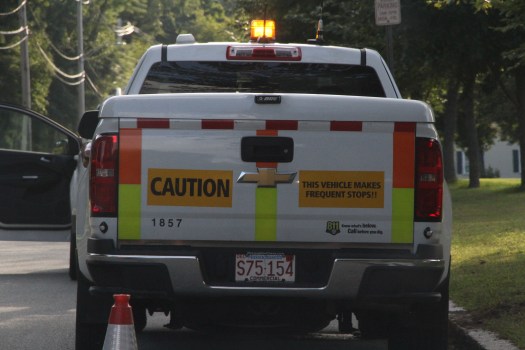
Image of utility truck parked next to Peabody building.
Utility workers monitored the gas vault behind the Peabody in the days following the emergency.

Happily the Peabody has never had gas service, so we were relatively safe, though gas can travel through the soil and invade basements. Gas lines do exist in the area and provide service to many of the homes and apartments on campus and in the vicinity. There is an access point to one line–a vault–just outside our building and I watched the utility worker depressurize this and shut it off. This site has continued to attract the attention of utility workers over the subsequent days. On Wednesday September 26 workers purged old gas from these lines in anticipation of line replacement.

This was a pretty scary emergency, especially considering the scale and scope. It’s absolutely heartbreaking to see the loss of homes in our Merrimack Valley community, as well as learning about the injuries to dozens of people and at least two deaths. Many homes and businesses in the area remain without heat and considerable numbers are out of work.

Different but the Same

Contributed by Alex Hagler ’16

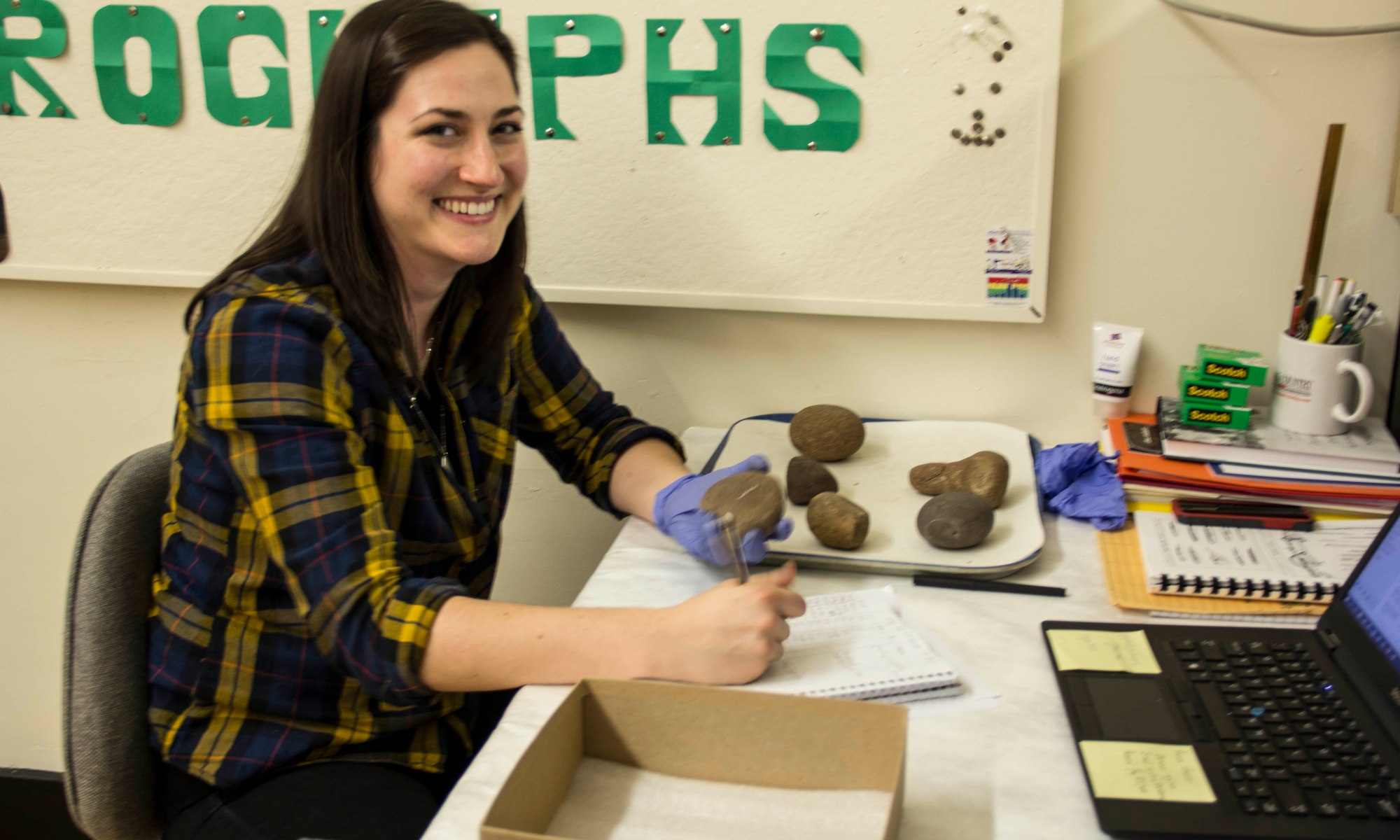
Before I officially became a staff member here at the Peabody, I was a volunteer and work duty student. I started volunteering at the Peabody about nine years ago, and when I came to Phillips Academy as a student I immediately signed on to do work duty. As a volunteer and work duty student, I worked to catalogue and inventory returned artifact loans, set out class activities, digitize records, and photograph artifacts. Since going to college out of state about two years ago, I have not been back at the Peabody, other than for brief visits. Reflecting on my time working here, it is fascinating, and somewhat nostalgic, to look back at what the Peabody was like when I started all those years ago and how it has changed so much since then!

When I started volunteering here, the Peabody was still officially a museum and still had standing exhibit space on the first floor. Some of those exhibit cases displayed artifacts, others dioramas or archaeology-related activities done by some Phillips Academy classes. Down in the collections, we used white cotton gloves to handle artifacts, rather than the purple nitrile gloves we use now. The reboxing project had not begun, so much of the work I did was cataloguing and inventorying in preparation for when that project might get funding. While I was doing work-duty, I sat in on some meetings about how to make the Peabody more accessible to Phillips Academy students, both in terms of the collections and the building space as a whole. Since then, the Peabody has initiated student study hours, during which the building is open to students as a study space, and renovated the first floor to make it more class-friendly!

It has been just over two years since I graduated from Phillips Academy, and I am so happy to be back working here! I study archaeology in college, and so working here, albeit temporarily, is an opportunity not only to continue learning how to preserve archaeological collections, but also to put into practice what I have learned at school, namely how to make archaeology more accessible for everyone.

Alex
Inventorying the never-ending drawers


Collections Summer Summary

Contributed by Marla Taylor

Another summer is nearly gone and the school year is about to begin.  Sometimes, I get asked “what do you do when the students aren’t here?” Well… everything!

In the past couple of months, the collections department has inventoried and rehoused over 100 artifact drawers! This included an ambitious project (and maybe a little bit crazy) to reorganize the ceramics from the Scotty MacNeish collection. MacNeish stored the ceramics by typology – useful for analysis, but really unhelpful for collections management.  Objects with the same catalog number were spread out over 8 to 12 different drawers and were not easy to locate for researcher or class use. It took over a week to empty, consolidate, and inventory 55 drawers. But now everything is easy to access!

I have also been teaching Annie Greco, inventory specialist, and Rachel Manning, our new collections assistant, the basics of pest management and mitigation. We inspected artifacts for insect activity and damage and then learned how to properly clean objects that have been affected. Fortunately, nothing serious was found and it was a valuable exercise for all of us.

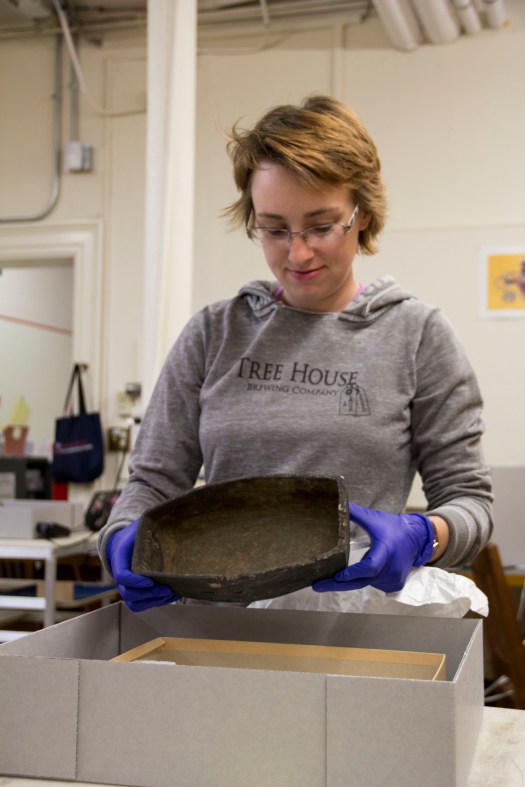
Annie and Rachel pest
Annie and Rachel examine an artifact for pest activity.

Also, outside research does not follow the school year patterns. I have been working with several professors to facilitate access to Peabody collections for a variety of projects.

Summer at the Peabody is a different pace than the school year, but not any slower!

Exciting Changes!

I have been working as the Inventory Specialist at the Peabody for the past year. It has been an incredibly rewarding experience and I have learned a great deal, not only about the collections at the Peabody, but about collections and artifacts from other institutions throughout the United States as well.

IMG_6487

It is with great pleasure that I will be taking on the position of Collections Assistant at the Robert S. Peabody Institute of Archaeology! With this new position comes a variety of new responsibilities that I am ready to undertake. While I will still be inventorying drawers as time allows, I will focus more on drawers that have been adopted through our Adopt A Drawer program. Through this program, donors can “adopt” a drawer housed at the Peabody! They receive updates on the progress of the inventory and rehousing of the artifacts in the drawer and pictures of what is inside. Upon completion, a write-up with information pertaining to the age, origin and various other details about the artifacts within the drawer is sent to the donor. Interested in participating? Contact Peabody director Ryan Wheeler (rwheeler@andover.edu).

Another major part of the position will be monitoring the environment in the various collections spaces. Maintaining proper relative humidity and temperature is imperative to keeping a healthy collection. Fluctuations in these variables can be detrimental to the collection and cause damage to and have other undesirable effects on the artifacts. In addition to environmental monitoring, I will also be in control of the Integrated Pest Management program. Keeping on top of pest activity in any institution is the best way to avoid an infestation. This is especially important in museums where irreplaceable artifacts can be damaged by insect activity.

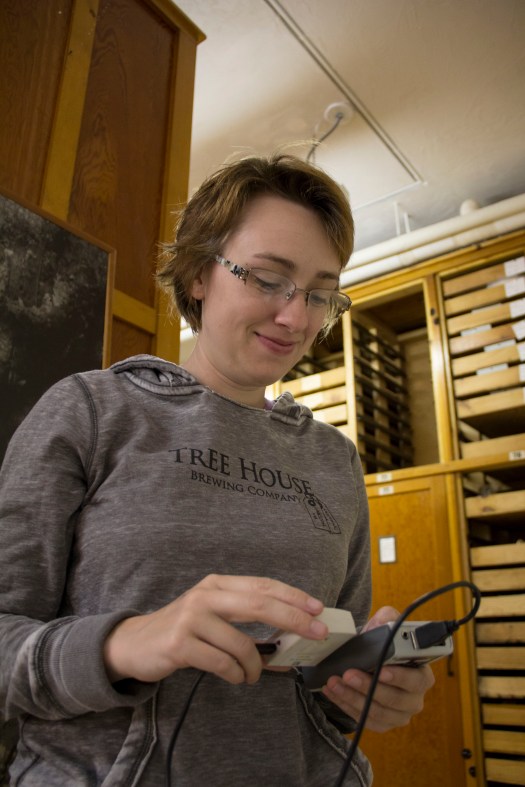
IMG_6483
Here I am, monitoring the environment.

A third big change will be working more closely with our volunteers and work duty students who spend time at the Peabody helping us with a few of the many tasks that need to be accomplished. Once a week groups of students from Phillips Academy assigned work duty at the Peabody will take time doing anything from inventorying drawers to digitally inputting information from catalog cards and ledgers. We also have a group of volunteers who join us once a week to inventory drawers, perform inspections of our ethnographic materials, or do other tasks as they present themselves. If this sounds like something interesting to you or anyone you know, feel free to contact us about volunteering at the Peabody!

I am very excited to be able to contribute to the Peabody in new ways!

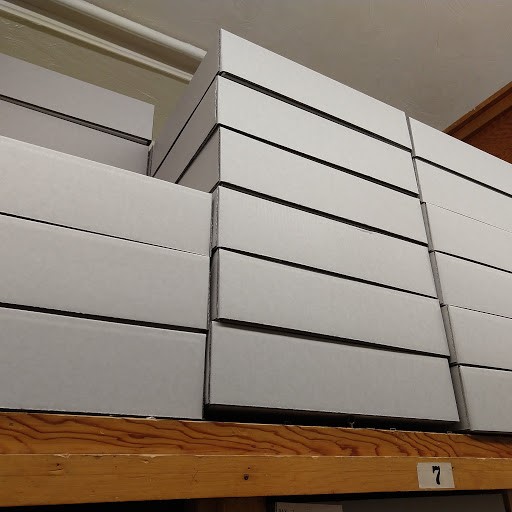
More boxes of boxes

Today we unloaded another truck full of custom boxes from Hollinger Metal Edge.  This batch of 1,500 boxes is our final purchase with the Box Us In! Abbot grant that was generously funded by the Abbot Academy Fund in 2015, continuing Abbot’s tradition of boldness, innovation, and caring.

The ongoing project to obtain physical and intellectual control over our collections continues!

California Basketry Exploration

Contributed by Catherine Hunter

Native American basketry was the subject of a special research visit on June 4th. Ralph Shanks, Research Associate at University of California, Davis, and Lisa Woo Shanks are experts in identifying and analyzing Native American California basketry.  Together, they produced an outstanding 3-volume series on California basketry that has been indispensable in examining the Peabody collection.  The goal of their visit was the examination of over 100 Californian baskets for cultural identification.  The visit developed into a tutorial for staff as the discussions addressed ethnobotany, physical structure, and design elements found on the baskets.

Immersion in basketry required a specialized vocabulary for structures and materials such as twining, coiling, plaiting, overlay, double interlacing, foundation, willow, red bud, juncos and more.  The forms of baskets were confirmed as bowls, hats, seed beaters, burden baskets, winnowing trays, toys, and cooking vessels. Many Californian Indians cooked in water-tight water-filled baskets by adding heated stones; and examples of these were identified in the Peabody collection.

The visit was facilitated by Marla Taylor, Curator of Collections, and Catherine Hunter, Research Associate, who inventoried the collection of 300+ Native American baskets in 2015-16. Hunter returned to the Peabody recently to continue research for a paper “Indian Basketry in Yosemite Valley, 19th-20th Century: Gertrude ‘Cosie’ Hutchings Mills, Tourists and the National Park Serviceto be presented at the Textile Society of America Symposium in September 2018.  After Hunter consulted Shanks last month, he extended an East Coast vacation to include a visit to Andover.

Hunter selected this topic because of the Hutchings Mills Collection of baskets. Collector and donor Gertrude “Cosie” Hutchings Mills (1867-1956) was one of the first Anglo-American children born in Yosemite Valley to early settlers James Mason and Elvira Hutchings. She collected Native American baskets in the Yosemite Valley region before 1900, recording many acquisition sites and the names of three weavers. Such documentation is very rare; thus, the collection was of special interest to Ralph Shanks.

After marriage to William Elligood Mills in 1899, they lived in New England and their son attended Phillips Academy. In 1937 the collection of fifty-six baskets was donated by Mrs. Mills to the Peabody Institute.

Shanks was enthusiastic about the quality of the basketry, contributed significantly to our interpretation of the collection, and identified rare baskets that would enhance his own research. We were thrilled to host his visit!

Back to Class!

As part of my work at the Peabody, my supervisor suggested that I take an online class in Collections Management. Throughout school, I had never been offered classes that pertained to museum studies or collections management, so I thought that this was a great idea considering it is directly related to my current and hopefully future line of work. Therefore, over the past 6 weeks, I have been enrolled in an online class on Collections Management Policies for Cultural Institutions through museumclasses.org.

Over the period of the course, I learned a great deal about what it takes to create and implement a collections management policy at an institution such as the Peabody. For cultural institutions, these policies are very important to have because they set up guidelines for almost every aspect of the institution. These guidelines are good to have on file should any issues arise within the institution. For example, if an institution received a collection that does not fit within the scope of the collections, the museum staff could refer to their collections management policy for information on how to handle the situation. The policy also helps to establish consistency in practices regarding the proper management of collections associated with cultural institutions.

Throughout the course of the class, I have been tasked each week with writing various portions of a policy. My classmates and I would upload our segments to the online forum so that we could read and critique each other’s documents before turning them in for grading. The feedback was incredibly helpful and I feel it helped strengthen my policy. An additional part of the class was to participate in a chat room discussion for an hour once a week. These chats were always very interesting and everyone was very engaging. It was really interesting to see how different cultural institutions are run and how similar institutions can end up with very different policies tailored to their individual needs. I think that this class was an excellent decision, and one that will be very useful as I continue to pursue my career in collections management!

In other news, I have recently started cataloging drawers in the South Bay Storage area of the Peabody’s collections space! These bays primarily consist of sites from the American Southeast and Southwest, but also contain sites from Missouri, Kentucky, and even as far away as Labrador. I am very excited to continue working with artifacts that I don’t get to see as often as I would like!

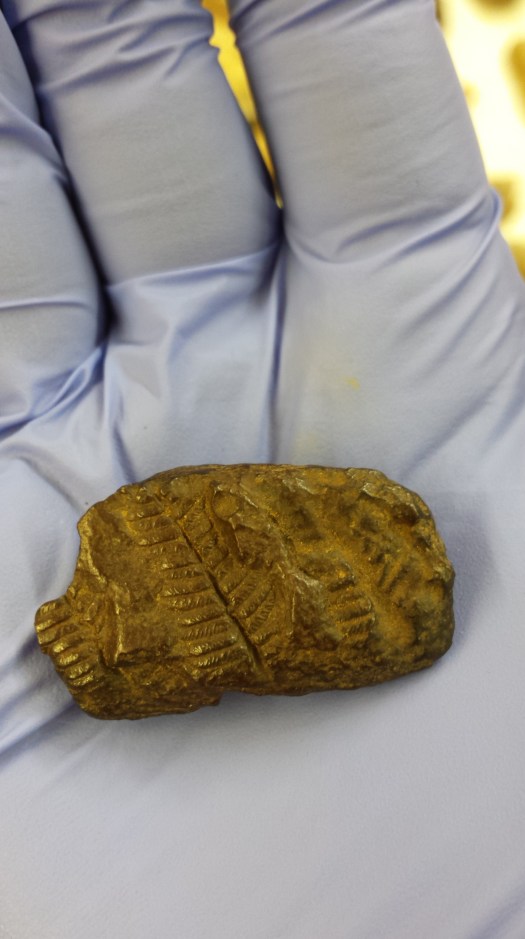
Fossil!
Here is a cool fossil I found in South Bay Storage. I’m not a plant expert, but it looks like a type of fern.

The Inventory Specialist position is supported by a generous grant from the Oak River Foundation of Peoria, Ill. to improve the intellectual and physical control of the institute’s collections. We hope this gift will inspire others to support our work to better catalog, document, and make accessible the Peabody’s world-class collections of objects, photographs, and archival materials. If you would like information on how you can help please contact Peabody director Ryan Wheeler at rwheeler@andover.edu or 978 749 4493.

New Acquisition

Contributed by Ryan Wheeler

We are delighted to share this recent acquisition, a contemporary painted vessel made by Jason Garcia. Garcia (Okuu Pin) is a talented ceramic artist from Santa Clara Pueblo in New Mexico known for his mix of traditional materials and methods with pop culture. This piece explores the Pueblo Revolt of 1680 through the media of traditionally built pottery and painting in the style of comic books or graphic novels.

Image of Jason Garcia's Pueblo Revolt 1680 ceramic vessel, with brightly painted, comic-book style figures of Po'Pay and Spanish soldiers.

Here Garcia illustrates a dynamic struggle between Tewa religious leader Po’Pay and Spanish soldiers. Po’Pay, from Ohkay Owingeh (also called San Juan Pueblo), is depicted in the style of a comic book superhero. He rose to prominence in 1675 after his imprisonment at the hands of the Spanish colonial government. After his release he planned the successful ouster of the Spanish from New Mexico, carefully orchestrating the insurgency across diverse linguistic, geographic, and cultural lines. The Spanish returned in 1692, but Po’Pay and the Pueblo Revolt of 1680 remain significant, though little-known in American history. We work with several Phillips Academy instructors in history and social science to introduce their students to the Pueblo Revolt, which some scholars have suggested provided a template for the American Revolution some one-hundred years later.


Welcome, Annie

Annie Greco just joined the Peabody team as our new Inventory Specialist.  She comes to us fresh from the University of Massachusetts Boston graduate program in archaeology and experience as a field archaeologist in New England.   Annie is already using her knowledge of New England tool typologies and excellent research skills to make a dent in the reboxing project!

Annie’s position is generously funded by Barbara and Les Callahan. Les is Phillips Academy Class of 1968 and Barbara is a member of the Peabody Advisory Committee; both have been active advocates and supporters of our mission.

We hope this gift will inspire others to support our work to better catalog, document, and make accessible the Peabody’s world-class collections of objects, photographs and archival materials. If you would like information on how you can help please contact Peabody director Ryan Wheeler at rwheeler@andover.edu or 978 749 4493.

Annie

Collections Reboxing project –Update

Contributed by Marla Taylor

When I last shared an update in December of 2016, we had boxed only 52 drawers in our quest to gain full physical control of our collection.  With the diligent work of students, volunteers, and inventory specialist Rachel Manning, we have now inventoried and boxed over 400 drawers!  More than 75,000 individual artifacts have been counted and documented – including projectile points, bone awls, ceramic sherds, and delicately crafted beads.

At the end of the month, our team will grow again with another Temporary Inventory Specialist – Annie Greco.  Annie’s position is generously funded by Barbara and Les Callahan. Les is Phillips Academy Class of 1968 and Barbara is a member of the Peabody Advisory Committee; both have been active advocates and supporters of our mission. I hope that our next update includes even better news!

Our deepest appreciation goes to the Oak River Foundation for their continued generosity and support of the Peabody’s goal to improve the intellectual and physical control of the museum’s collections.

We hope this gift will inspire others to support our work to better catalog, document, and make accessible the Peabody’s world-class collections of objects, photographs and archival materials. If you would like information on how you can help please contact Peabody director Ryan Wheeler at rwheeler@andover.edu or 978 749 4493.