I was so pleased to learn this summer that the Oak River Foundation had decided to fund another year of the archives project at the Peabody! This continuation of the project will allow me to focus on the photographic and map collections, excavation records from the Tehuacán Archaeological-Botanical Project and the Ayacucho Archaeological-Botanical Project, among others. I also hope to begin developing sustainable digitization workflows for some of the archival material, help with reference requests, and continue an oral history project about Scotty MacNeish. I am very happy to be back at the Peabody, continuing this work.
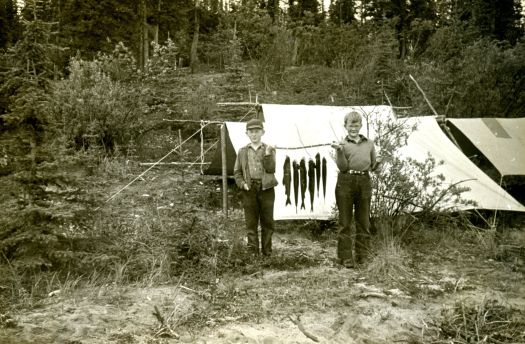
A photograph from the archives that caught my eye: Karl and David Raup (sons of Hugh Raup) with fish caught in stream. Big Arm, Kluane Lake. 8/21/44. Andover-Harvard Yukon Expedition.
Since starting back up here in early September, I have mostly been working on organizing and inventorying internal museum records like loan, exhibition, and NAGPRA records. These records might not have huge interest for outside researchers (and, as is common for institutions, are typically restricted for 25 years after creation for privacy concerns), but are important for staff members in the course of day-to-day collections management and ongoing repatriation efforts. Now that I am more familiar with the museum’s institutional history, I am finding that I can categorize material more quickly – I don’t have to repeat the learning curve of my first year.
On a personal note, I spent most of the summer between Boston (where I live) and western Massachusetts, where my sister and I own what used to be our grandparents’ house. My French, North African-born grandmother met my American grandfather (from a Scottish family who emigrated to the Boston area in the 1920s) during World War II while he was stationed in Algeria. The house is full of photographs, letters, books, and interesting objects documenting their lives – essentially, my family’s archives. I also spent two weeks working at the Phillips Academy Archives and Special Collections, helping Director of Archives and Special Collections Paige Roberts prepare for an upcoming move of the collections associated with the Oliver Wendell Holmes Library renovation. So, I didn’t stray too far from the work I do here, even while I was away.
The Temporary Archivist position is supported by a generous grant from the Oak River Foundation of Peoria, Ill. to improve the intellectual and physical control of the museum’s collections. We hope this gift will inspire others to support our work to better catalog, document, and make accessible the Peabody’s world-class collections of objects, photographs, and archival materials. If you would like information on how you can help please contact Peabody director Ryan Wheeler at rwheeler@andover.edu or 978 749 4493.
Exhibits and exhibitions are not the focus of the Peabody. However, once in a while a unique opportunity presents itself.
Visual artist Angela Lorenz (’83, P’14) reached out in early 2017 to suggest a collaboration with the Peabody. Angela’s newest art book, r.ed monde in r.ed engender.ed, explores the world around us through pointy-shapes and r.ed.
After spending decades in a drawer in the artist’s studio, r.ed steps out on a journey of self-identity. r.ed identifies with pointy-shaped objects and images from around the world – many of which are similar to pieces in the Peabody’s collection.
Angela Lorenz’s newest art book
r.ed holding a sherd that will be part of the upcoming exhibit
Angela and I surveyed collection and collaborated to create r.ed in residence: r.ed monde visits the Peabody. This short exhibition will have an opening reception on Saturday, October 21st from 1-4pm. Angela will discuss r.ed and her work from 1-2pm and be available to talk with visitors. Refreshments will be served and we will have hands-on activities for all ages.
Come by to explore a new way to examine archaeological artifacts through the lens of contemporary art!
On Monday July 17 the Peabody staff joined volunteers at the Robbins Museum of Archaeology in Middleboro, MA to help with an ongoing collections inventory project. The Robbins Museum is an all-volunteer organization that is currently working on their NAGPRA obligations and repatriation. In addition to Ryan, Marla, Samantha, and Lindsay, others who came out to help were professional archaeologists with ties to the Robbins Museum along with Jim Peters, Massachusetts Commissioner of Indian Affairs and Mashpee Wampanoag tribal member who is also part of the Wampanoag Repatriation Confederacy.
The Robbins and Peabody museums are working together on the repatriation of related collections from the Mansion Inn site, split between the two institutions. The site, located in Wayland MA, was excavated by J. Alfred Mansfield and Leslie Longworth, members of the Massachusetts Archaeological Society (the parent institution of the Robbins Museum) in 1959; Doug Byers and Fred Johnson of the Peabody also became involved with the site at that time. For that reason, both institutions have collections and have decided to work together as the process moves forward.
Throughout the day everyone worked diligently in an effort to create a streamlined checklist that will assist with the transfer of custody of the human remains and associated funerary objects. It was a very eventful and fun day and we look forward to working with the Robbins Museum again on the process!
In 2016, the Peabody Museum received a generous grant of $100,000 from the Oak River Foundation of Peoria, Ill., to support work pertaining to the intellectual and physical control of the museum’s collections.
The grant was spread across two years and initially supported the work of an archivist to whip the Peabody’s 100+ years of archives into shape. With that funding, Irene Gates was able to share archival collection records online and process over 140 linear feet of material. She also created three finding aids to the material belonging to prominent directors of the Peabody’s past.
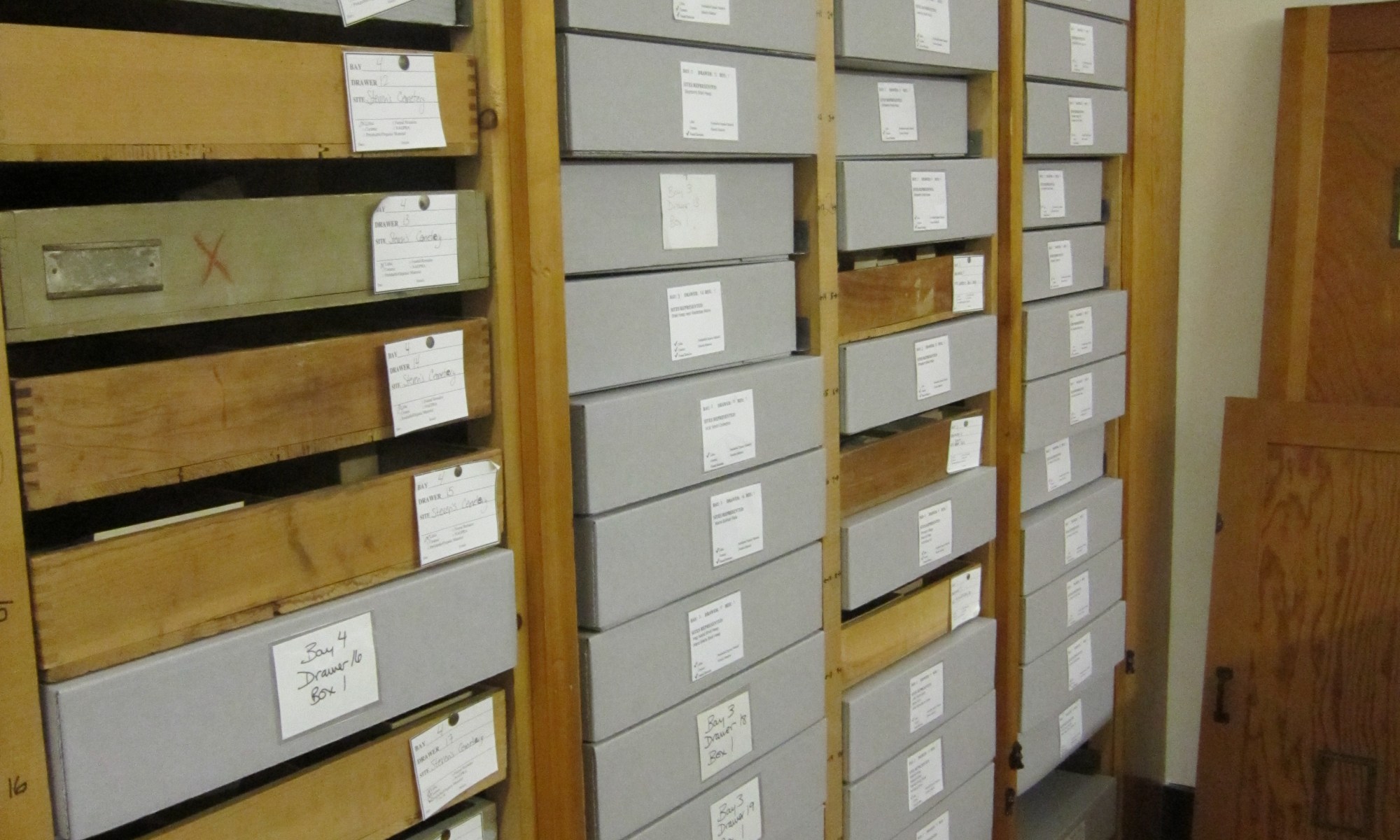
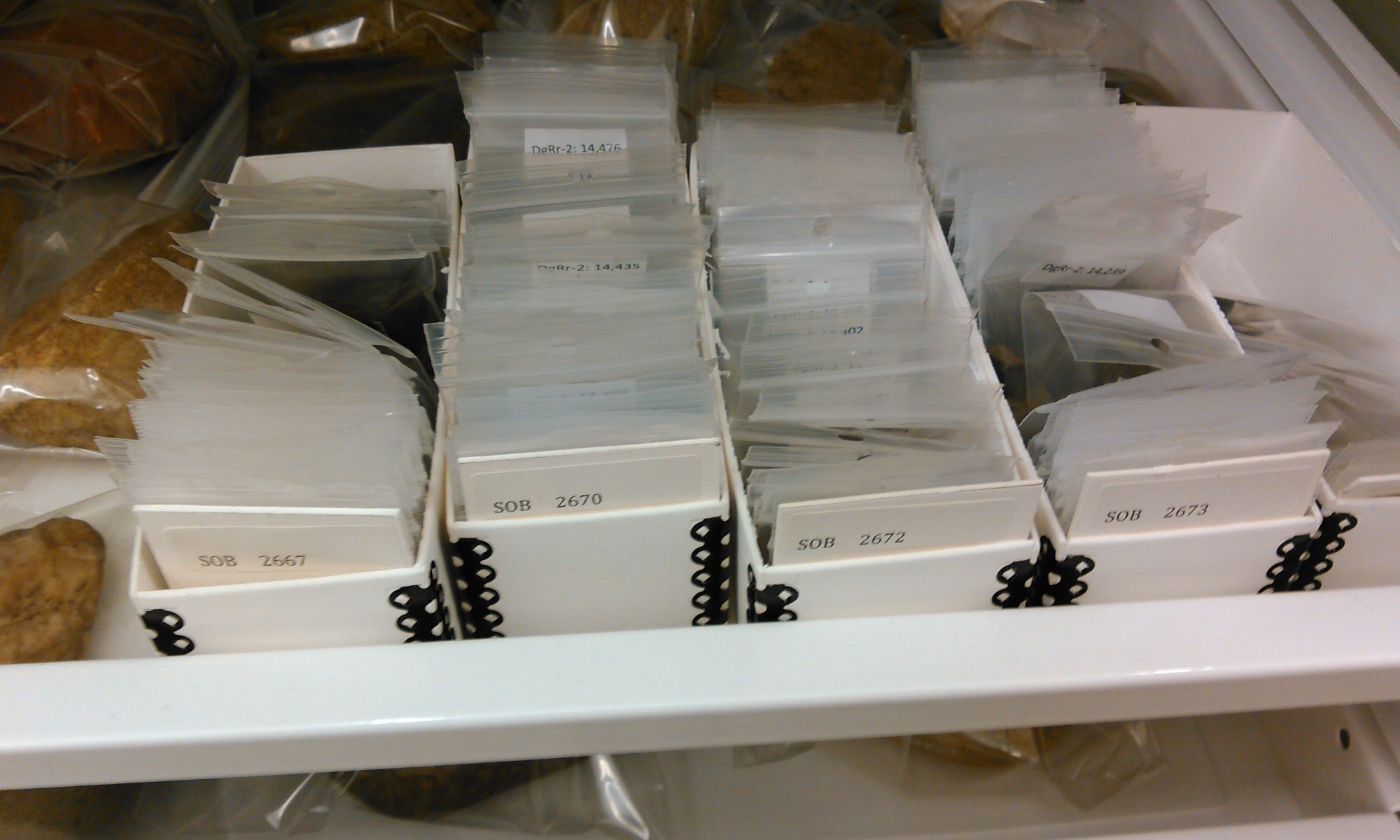
The second year of funding is designated to supporting the work of a temporary inventory specialist – Rachel Manning. Rachel will be spending her time inventorying drawers of artifacts and rehousing them into archival boxes as part of our larger collections storage project. While she only began her work in early August, Rachael has already been making steady progress.
Rachel inventories a drawer from Massachusetts.
And we are pleased to announce that the Oak River Foundation has stepped up again and provided additional funding for Irene to return and spend another year in the Peabody archives! This second year will facilitate processing the remaining 150 linear feet of material as well as addressing the photographic and map collections.
Our deepest appreciation goes to the Oak River Foundation for their continued generosity and support of the Peabody’s goal to improve the intellectual and physical control of the museum’s collections.
We hope this gift will inspire others to support our work to better catalog, document, and make accessible the Peabody’s world-class collections of objects, photographs and archival materials. If you would like information on how you can help please contact Peabody director Ryan Wheeler at rwheeler@andover.edu or 978 749 4493.
The collections team remains busy at the Peabody during the summer time, following an already packed school year. Instead of working with PA students, we spend much of our time working to catalog the collections and hosting outside researchers.
The summer has started off strong with one of the Linda S. Cordell Memorial Research Award recipients , John Andrew Campbell. John is documenting artifacts from the period of first contact between Native Americans and European settlers along the maritime region of eastern Canada and northern New England. ”What does that mean?,“ you may ask.
Basically, John is identifying copper, glass beads, and glazed ceramic artifacts that were found intermingled with traditional native tools and artifacts. The first appearance of these ”foreign” materials indicates that contact between the cultures had been made. Their use and modification by tribes is the direct result of trade with the European settlers and can be revealing of those early interactions.
The Peabody is John’s first stop for collections research as he begins to build data for his dissertation work at Memorial University in Newfoundland. He will be visiting for most of June and documenting hundreds of items.
The rest of the summer is chock full of research appointments and we are happy to share our collections to contribute to the field of archaeology!
Drawers pulled for research
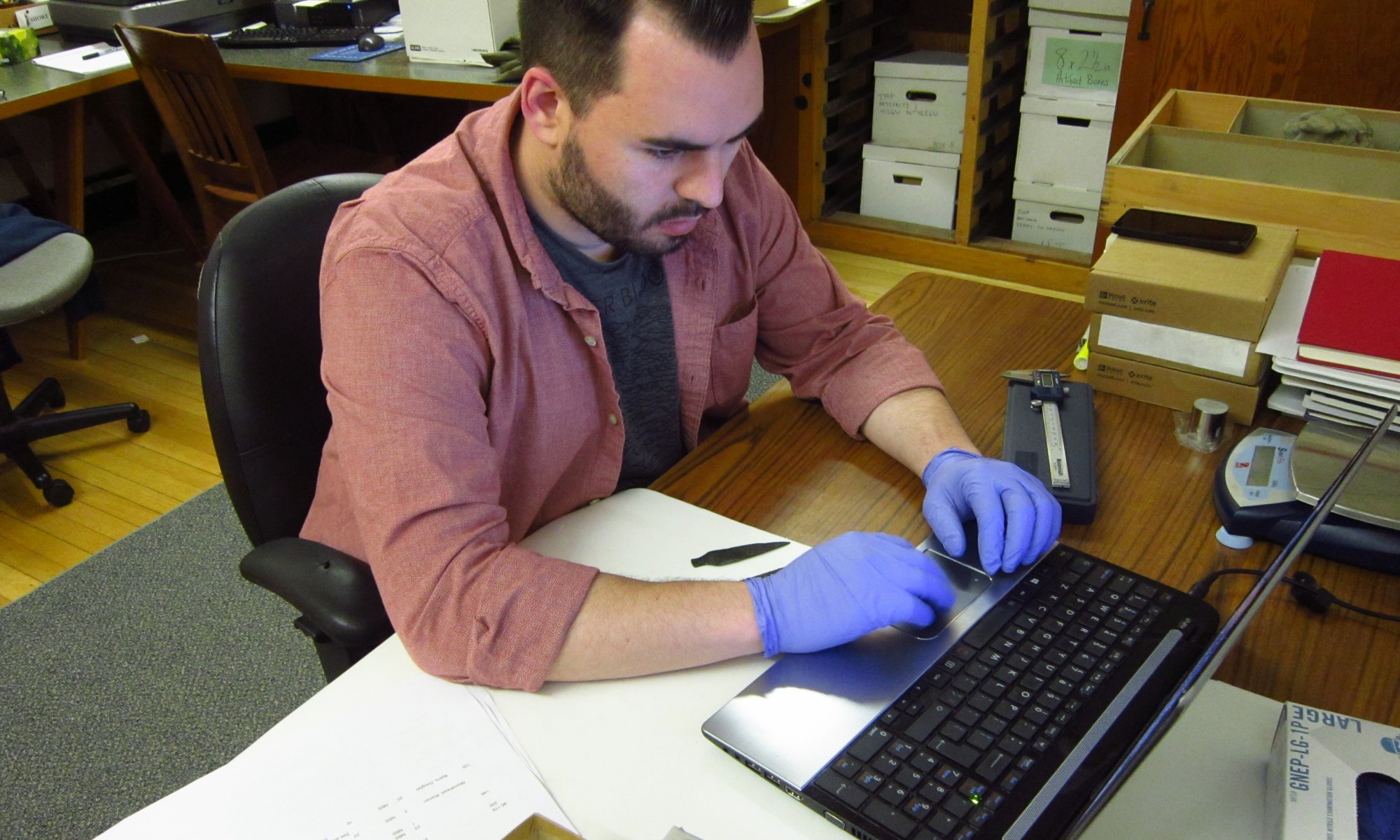
Researcher John Andrew Campbell recording details about objects in the Peabody collection
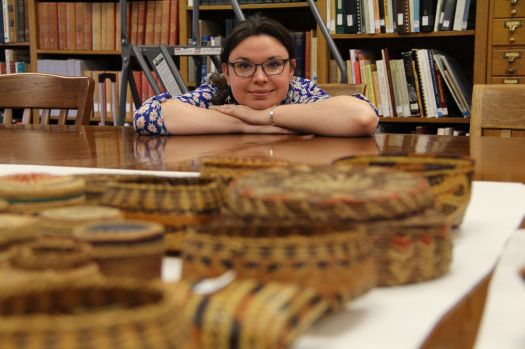
Though the Peabody is small by museum standards we are mighty, especially when it comes to our baskets. With close to 400 baskets, the Peabody collection covers all major geographical regions and tribal communities of North America, and spans over 200 years. Baskets from notable artists like Molly Neptune Parker (Maine) and Clara Darden (Louisiana) help to support and curate these artists’ work, and are examples of continued and evolving traditions within Native communities.
Molly Neptune Parker
Clara Darden
One of my first large projects at the Peabody was to completely catalog, inventory, and rehouse this great collection. The purpose of this was twofold:
First, it was important to consolidate our records regarding these baskets. Museums are full of information, and it’s usually in five different places! By gathering what we know, and putting it all in one place, we not only gain better control over this knowledge, but we make it more accessible to museum staff, researchers, and students. The convenience of this newfound accessibility encourages more use in the classroom and more research by professionals, giving these baskets the attention they deserve.
Secondly, by revamping the basket organization and rehousing, we are better able to care for these objects and their specific needs. Although baskets aren’t usually as fragile as most people fear, they still require some TLC. By creating storage mounts that are custom designed to each basket, we are able to provide more support to the object, especially when it is being moved and shifted around during handling. Within our ethnographic storage, space is at a premium, so another byproduct of the rehousing was the space it opened up. We were able to clear seven shelves!
Basket Elf in natural habitat
Happy baskets, happy collection staff.
To see previous work done with the baskets by Catherine Hunter, check out these previous blogs!
Next Thursday marks the final day at the Peabody for Temporary Archivist, Irene Gates. Irene was hired for a year to tackle the organizational challenge that was the Peabody archives and she has succeeded beyond our expectations.
Irene carried out a full collections survey and created 65 collection level catalog records – 33 of which are now available via our collection online. She wrapped her arms around the archives of previous director (and the man who saved everything) Richard ‘Scotty’ MacNeish and processed 92 linear feet of material. You can see the incredible finding aid for MacNeish’s material here.
In total, Irene has processed 140 linear feet of material, developed 3 finding aids, and written policies and procedures. Her work has directly benefited the accessibility of collections, the efficiency of current museum functions, and our transparency as an institution.
Irene’s quiet and steady presence will be missed around the Peabody and we have been incredibly fortunate to call her colleague and friend over the past year. Wishing her the best of luck in her next adventure!
Irene Gates
The Temporary Archivist position is supported by a generous grant from the Oak River Foundation of Peoria, Ill. to improve the intellectual and physical control of the museum’s collections. We hope this gift will inspire others to support our work to better catalog, document, and make accessible the Peabody’s world-class collections of objects, photographs, and archival materials. If you would like information on how you can help please contact Peabody director Ryan Wheeler at rwheeler@andover.edu or 978 749 4493.
Did you know that the Peabody curates ancient poop?
Coprolites are the fossilized remnants of excrement – animal or human. While it may sound gross, curating these materials is invaluable for the archaeological community. You may be asking yourself ‘what could you possibly learn from poop?!’ and while I understand your incredulity, allow me to share the incredibly fascinating information that you can learn.
A coprolite from an unknown site in Arizona.
Coprolites are the snapshot of one day of one individual’s life thousands of years ago. They can reveal what that person ate – whether or not that food was cooked first, was that food local to the area or the product of trade, what time of year that food would be available. Is there evidence of disease or illness? Did different individuals from the same site have radically different diets? If so, what does that say about social status? Coprolites are also viable sources of ancient DNA!
The Peabody curates only a couple dozen coprolites in the collection. And we are always thrilled when researchers come to get the scoop on the poop!
Most of the Peabody staff recently traveled to Vancouver, British Columbia to take part in the 82nd annual meeting of the Society for American Archaeology (SAA). While at the conference, we each had our own role. In addition to helping to staff the Peabody table in the exhibitor hall, collections assistant Samantha Hixson and I had the privilege of a collections tour at the Museum of Anthropology (MOA) and the Laboratory of Archaeology (LOA) at the University of British Columbia.
The MOA is a unique institution that houses ethnographic objects from around the world, with an emphasis on material from the Pacific Northwest. The vast majority of these pieces are on display in open storage. That means the galleries are essentially storage spaces with thousands of objects presented to the visitor with little interpretative text.
Basketry display at the MOA
Totem poles at the MOA
Display of a fish mask at the MOA
Collections storage at the MOA is impressive and elaborate. Each object has its own individually crafted mount and locations are tracked with barcodes. The Laboratory of Archaeology on the other hand has very little to no exhibition space. They carefully photograph every object for inclusion in their online catalog and individually bag and label each artifact. Their storage is no less impressive as artifacts are arrayed on compacting storage shelves with room for growth. This is the type of collections storage that I aspire to – but we have a long way to go!
Example of individual object storage at the MOA
Example of individual object storage at the LOA
Collections storage at the MOA
Touring the storage spaces at these institutions was incredibly helpful as Samantha and I brainstorm to reimagine collections storage at the Peabody. We are very grateful for the time spent and information shared with us – well worth the trip!
This blog represents the sixth entry in a blog series – Peabody 25 – that will delve into the history of the Peabody Museum through objects in our collection. A new post will be out with each newsletter, so keep your eyes peeled for the Peabody 25 tag!
Overview of Chaco Canyon, New Mexico
At the Robert S. Peabody Museum, it seems as though there is almost no limit to the range of phenomena one can explore. When the topic Chaco Canyon was suggested, I thought looking at trade routes would be interesting. It quickly became clear that what I was about to enter was the world of a great culture which I thought had mysteriously “disappeared” about 800 years ago. What I quickly learned was that these people, the “Ancestral Puebloans,” had not disappeared. Research has shown that the Puebloans had adapted to climate change in the area by dispersing. “Today, twenty Puebloan groups in New Mexico, as well as the Hopi in Arizona, claim Chaco as their ancestral homeland and are tied to this place through oral traditions and clan lineages. A number of Navajo clans are also affiliated with Chacoan sites through their traditional stories.” (National Park Service: https://www.nps.gov/chcu/faqs.htm)
Chaco Canyon, located on a section of the Colorado Plateau in northwest New Mexico, was home to the Chacoan culture which flourished from AD 1000 to 1150. A UNESCO World Heritage Site, the people who lived there were very sophisticated. They used astronomical alignments, geometry, and impressive building techniques, allowing for multi-storied masonry houses. They had a complex road system stretching hundreds of miles, linking Chaco to other communities. One of their buildings, four or five stories high, Pueblo Bonito, contained about 650 rooms.
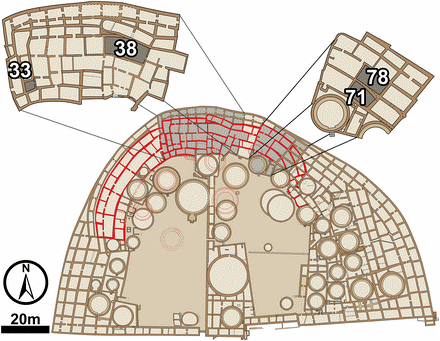
Plan view of Pueblo Bonito with the earliest construction highlighted in red. The locations of the elite burial crypt, room 33, and the three rooms with dated macaw samples are highlighted. From Adam Watson and colleagues’ article on Chaco macaws in Proceedings of the National Academy of Sciences Vol. 112(27): http://www.pnas.org/content/112/27/8238)
The Chacoans traded with people in the Mongollon and Hohokam regions to the south and with people from Mexico and Central America. Long-distance travel by Ancestral Puebloan people was common and among the goods they acquired were turquoise, seashells, copper and chocolate, none of which were found locally. They also traded for scarlet macaws, a bird with a natural habitat 1000 miles to the south.
Scarlet macaw
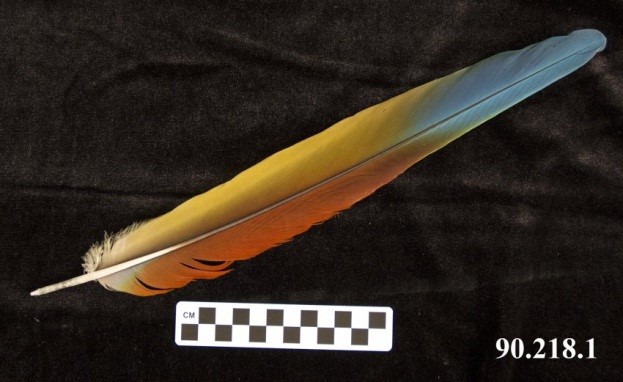
Macaw feather from the Peabody collection
The Robert S. Peabody Museum has several “modern” macaw tail feathers in its collection, one of which is shown below. Preserved feathers from 1000 years ago would be quite rare.
Scarlet macaws measure about thirty-two inches long, of which more than half is a pointed tail. They can live up to seventy-five years and eat mostly fruits, nuts and seeds. We know macaws, essentially large parrots, as intelligent birds that are quick to echo our deepest secrets using speech, a magical quality, especially because macaws have no vocal cords. That parrots are rated among the top five in the animal world for intelligence and cognition should come as no surprise. It is likely that the people of Chaco Canyon would have been awed by such an animal.
Scarlet macaws are native to the gulf coast of Mexico, Central America, and South America. The question to ask is for what purpose macaws were brought back to Pueblo Bonito?
Thirty four macaws were recovered from Pueblo Bonito and other sites in Chaco Canyon. Room 33 (see illustration above) was used as a burial crypt for 200-250 years. Macaws were found in rooms 38, 71, and 78. Archaeologist Adam Watson and his colleagues postulated that scarlet macaws were a powerful cosmological symbol and that their presence from the early tenth century reinforced and stimulated a rising social inequality. Those who possessed the birds had access to key cosmological beings and forces as well as links with far distant cultural groups. There is little doubt that the ability of the birds to speak played into this perception.
What is currently exciting is how recent radiocarbon dating of scarlet macaw skeletons from Chaco Canyon has given further insight into the question of their presence. What has been shown is that, based on acquisition and control of valued items such as chocolate and macaws, an elite class at the top of a social and political hierarchy dominated Chacoan life. (Watson et al. 2015)
What the elites achieved and their importance is amply demonstrated in their “great houses” and the acquisition of “exotic” goods from distant regions (ibid.) Included in these exotic goods were macaws. Feathers from macaws were found on prayer sticks, costumes, and masks. According to Watson and his colleagues,“…the flight of or just the appearance of certain birds or the use of their feathers is believed to motivate the fall of rain or snow, as well as the seasons, the sunshine, and the heat.”
Originally, it was believed that trade in items such as macaws at Chaco dated from around AD 1040. With radiocarbon dating done in 2010 on skeletal remains of the macaws from Pueblo Bonito, the dates of the florescence have been moved back to AD 775-875.
Whether or not the macaws were brought back to Pueblo Bonito in single journeys or in successive stages has been debated extensively. Some have raised the possibility that macaws were also bred locally in Chaco Canyon itself, although the arid region is not a natural habitat for such birds. The discovery of breeding pens, perches, bones, and eggshell fragments has led to speculation about on site breeding, but evidence suggests such macaws did not reach maturity.
“There are no indications that the people of Pueblo Bonito bred scarlet macaws. Only one of the sample birds was of breeding age and none were exceptionally young. There is also no mention of eggshells in any of the excavation notes, although one room where many of the bird remains were found was probably an aviary.” (“Scarlet macaws point to early complexity at Chaco Canyon.” A’ndrea Elyse Messer, 2015: http://news.psu.edu/story/361255/2015/06/22/research/scarlet-macaws-point-early-complexity-chaco-canyon).
One of many phenomena to explore at the Peabody, the scarlet macaw feathers represent a tangible example of extensive trade routes present in the New World prior to European contact.













 The Peabody