On Thursday, February 21 we will be hosting our Family Fun with Archaeology event. This free event will have activities such as building Lego models of ancient ruins, playing Native American musical instruments, making a clay pot, and more.
Since we have run the program a few times, I have been thinking of ways that we might add new activities for kids and adults to do together.
One of the new interactive activities for families is creating a fishing net. Fishing has played a vital role in New England’s history, from the First People to today. Ancient nets were made of various plant fibers and used in a variety of ways to catch fish in rivers.
While talking with Ellen Berkland, archaeologist for the Department of Recreation and Conservation, about an archaeology event at Maudsley State Park in Newburyport, MA that she hosted in October, she mentioned that she had included net making. I was instantly intrigued!
After talking with Ellen and googling “net making,” as well as watching a few YouTube videos, I settled on using the simple overhand knot to make the net. I also decided to use different color strings to help make it easier for people to see what strings they are working with.
Overhand knot
Here is my attempt at making a net – I think it looks pretty good for a first time!
If you want to try your hand at this or other crafts, come to the Peabody next month!
During spring break, March 2019, eighteen Phillips Academy students will accompany Peabody director Ryan Wheeler, instructor in Chinese Congmin Zhao, and Anne Martin-Montgomery, Chinese for Families, on the inaugural Adventures in Ancient China trip. Adventures in Ancient China is one of the newest Learning in the World Programs, offered cooperatively by the Tang Institute and the Robert S. Peabody Institute of Archaeology.
Recruiting for the trip commenced in fall 2018, with a deadline for applications on December 1, 2018. Wheeler, Zhao, and Carmen Muñoz-Fernández, Director of Learning in the World, hustled to make decisions and invite students to participate before winter break began. We were impressed by the diversity of the group, with a good mix of male and female students, as well as good representation of each grade, including some intrepid juniors! Students and families were asked to complete the first round of paperwork necessary for the trip, and to check that passports were current.
Flyer from the Chinese Consulate in New York detailing visa photo requirements.
Once all the initial paperwork was in at the outset of January, we began the process of booking flights and lodging, all necessary for the fairly complex visa applications that would be required of most of our travelers. Along the way we learned a lot about Adobe Acrobat forms and benefited from tips provided by one parent! At this point we have our hotels booked for our stay in Beijing, as well as our airline tickets secured, thanks to assistance from China Highlights and Jody’s Travel. As families complete visa application forms, we’ve asked our student travelers to secure their visa photos. Happily, there are several apps that can help generate the photos in their required format and size (33 mm by 48 mm).
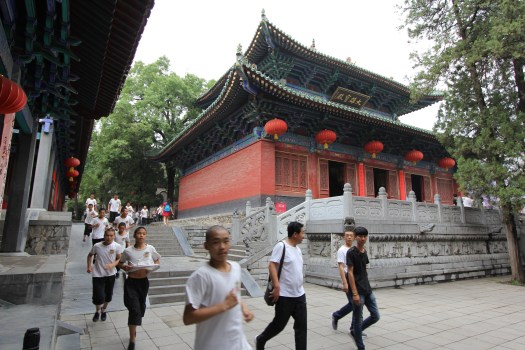
Gong Fu students from a nearby school training at the Shaolin Monastery.
Setting aside the paperwork, bookings, and visa applications for a moment, however, we can reflect on some of the cultural and archaeological wonders that await us in a China. Some of our student travelers have mentioned that they are particularly excited about visiting the Shaolin Monastery, a day trip during our stay in Luoyang. The Shaolin Monastery is the center of Chan Buddhism and is believed to have been founded in the fifth century CE—some 1,500 years ago! Chan Buddhism is believed to be the predecessor of Japanese Zen Buddhism and shares many similarities; Chan Buddhism was also heavily influenced by Taoism, and this is evident in some of the martial arts practiced by the Shaolin monks and at the many Gong Fu (Kung Fu) schools in the area. We will get a chance to visit one of those schools and take a short course in Gong Fu!
A pipa toting Buddhist immortal gets a touch up at the Shaolin Zhongyue Temple. June 21, 2017. The pipa is a four-stringed musical instrument, similar to a lute.
Soon it will be time to hand in the completed visa applications, which will then go to a visa service company and the Chinese consulate in New York. We’re also planning for our first gathering with the students—an opportunity to meet fellow travelers, review the itinerary, ask questions about the packing list, and get ready for our trip!
Before I officially became a staff member here at the Peabody, I was a volunteer and work duty student. I started volunteering at the Peabody about nine years ago, and when I came to Phillips Academy as a student I immediately signed on to do work duty. As a volunteer and work duty student, I worked to catalogue and inventory returned artifact loans, set out class activities, digitize records, and photograph artifacts. Since going to college out of state about two years ago, I have not been back at the Peabody, other than for brief visits. Reflecting on my time working here, it is fascinating, and somewhat nostalgic, to look back at what the Peabody was like when I started all those years ago and how it has changed so much since then!
When I started volunteering here, the Peabody was still officially a museum and still had standing exhibit space on the first floor. Some of those exhibit cases displayed artifacts, others dioramas or archaeology-related activities done by some Phillips Academy classes. Down in the collections, we used white cotton gloves to handle artifacts, rather than the purple nitrile gloves we use now. The reboxing project had not begun, so much of the work I did was cataloguing and inventorying in preparation for when that project might get funding. While I was doing work-duty, I sat in on some meetings about how to make the Peabody more accessible to Phillips Academy students, both in terms of the collections and the building space as a whole. Since then, the Peabody has initiated student study hours, during which the building is open to students as a study space, and renovated the first floor to make it more class-friendly!
It has been just over two years since I graduated from Phillips Academy, and I am so happy to be back working here! I study archaeology in college, and so working here, albeit temporarily, is an opportunity not only to continue learning how to preserve archaeological collections, but also to put into practice what I have learned at school, namely how to make archaeology more accessible for everyone.
In July, I once again partnered with Dr. Bethany Jay of Salem State University to teach the graduate class for history teachers that focuses on using archaeology in the classroom to teach about marginalized individuals, who are often overlooked.
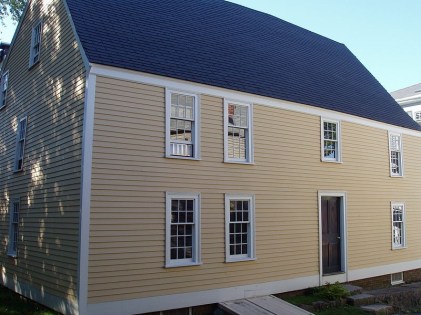
Since it is now our fifth year running this class, it is always exciting when we get to experience something new ourselves. This year we added a tour of the Gedney House in Salem to our listing of sites we were visiting. One of the students in the class, Tom, is a tour guide for the Gedney House and took us all around the historic house – we even got to go into the creepy basement!
The house has gone through a lot of iterations throughout its history and they have left their marks on the building. Starting first as a single family home, for shipwright Eleazer Gedney, major renovations to the façade were added in the eighteenth and nineteenth centuries. Later it became a tenement in Salem’s Italian-American neighborhood.
What makes the house so interesting to history lovers (and archaeologists!) is that the house was originally set for total rehab in the 1960s and so the inside was completely gutted. That means that you can now see the original structure as well as the evidence for later renovations. It really sets the house apart from other first period houses located in New England. Dr. Abbott Lowell Cummings, a prominent architectural historian, once said that the “Gedney House in Salem, Massachusetts is the example par excellence which must be protected under a glass bell jar” due to the scholarly impact its raw architectural state offers to historic preservationists seeking to better understand the construction methods of these early houses so that they can more faithfully restore such structures.
Cummings was also the first scholar to suggest that dendrochronology (the study of tree rings for dating purposes) be used in New England to date the earliest colonial houses, using the Gedney House as one of the first structures on which to test this technique. After the former owner had stripped away much of the interior trim down to the frame, a beam that had been cut into at some point in the house’s history was exposed. The cut revealed an almost complete cross-section of the beam’s tree rings. Cummings used the rings to date the construction of the house to 1664-1665 based on a set of specific drought rings that coincided with the 1590s and 1615-1620.
If you happen to find yourself in Salem, MA during one of the days the house is open for limited tours (first Saturdays in April-October), I can’t recommend it enough. As you walk through the building, you can see the signs of each of the unique periods, as well as how they overlap with each other. So many people have called that house their home and their stories are literally carved into the frame of the house.
We are delighted to share this recent acquisition, a contemporary painted vessel made by Jason Garcia. Garcia (Okuu Pin) is a talented ceramic artist from Santa Clara Pueblo in New Mexico known for his mix of traditional materials and methods with pop culture. This piece explores the Pueblo Revolt of 1680 through the media of traditionally built pottery and painting in the style of comic books or graphic novels.
Here Garcia illustrates a dynamic struggle between Tewa religious leader Po’Pay and Spanish soldiers. Po’Pay, from Ohkay Owingeh (also called San Juan Pueblo), is depicted in the style of a comic book superhero. He rose to prominence in 1675 after his imprisonment at the hands of the Spanish colonial government. After his release he planned the successful ouster of the Spanish from New Mexico, carefully orchestrating the insurgency across diverse linguistic, geographic, and cultural lines. The Spanish returned in 1692, but Po’Pay and the Pueblo Revolt of 1680 remain significant, though little-known in American history. We work with several Phillips Academy instructors in history and social science to introduce their students to the Pueblo Revolt, which some scholars have suggested provided a template for the American Revolution some one-hundred years later.
Kevin Porter, the Vice Chairman and Overseer Coordinator for the Andover Conservation Commission, invited me to be the Keynote Speaker for their annual meeting on April 19. Mr. Porter was looking for someone who could speak to their group about the Native history of the area, and my name had been given to him by Stephanie Aude, a former OWHL librarian who now works at Andover’s Memorial Hall Library.
The reason for his interest in a speaker on Native Americans is that they have begun working on making Retelle Reservation in Andover more accessible to the public, and that includes creating informational panels about the landscape.
Map showing the location of Retelle Reservation
While the volunteers who are managing Retelle Reservation have created panels to highlight the different environments and animals one might encounter while enjoying the area, they want to include one about the Native people who use to live there.
Image of the Peabody’s diorama of the Shattuck Farm site.
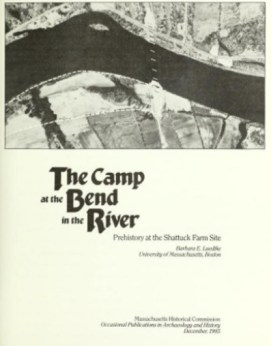
The Overseers and other volunteers recognized the importance of this history and sharing it with visitors because Retelle Reservation is on the western edge of the Shattuck Farm site. This site is very important to understanding the Native history of the Merrimack Valley and was excavated by Warren Moorehead, Alfred Kidder, and others who worked at the Peabody, in addition to Barbara Luedtke’s investigation of the site in the 1980s.
Since the presentation, Willow Cheeley of the Merrimack River Watershed Council (MRWC) has reached out regarding their property, Pine Island. Pine Island is situated near Retelle Reservation, in the middle of the Merrimack River, and has the potential to be archaeologically important because there was a small camp site located on it. It is believed that the camp was used to monitor those who traveled on the river and to keep them away from the larger village that was on the mainland.
As the MRWC begins to think about ways to preserve and tell the history of Pine Island and the surrounding area, they are also investigating the collaboration possibilities between MRWC, the Town of Andover, and Phillips Academy. Their interest in partnering with PA stems from the records and expertise the staff at the Peabody have and from their previous work with faculty member Mark Cutler.
This timing could not be more perfect since Mark will be taking a sabbatical for the 2018-2019 academic year to work on creating a bilingual experiential curriculum on the cultural history of the Merrimack Valley. This work will be an extension of his class Confluence: Environment, Culture, and Community. Mark also hopes that the materials he creates will be utilized by area schools and institutions, and possibly even adapted as an interdisciplinary class at PA in the future.
And having heard that I was giving the Keynote Lecture, Mark attended the talk, and has already roped me into helping him with the development of the Native history part of his curriculum. This will certainly be an interesting partnership and an amazing way for the Peabody to contribute to both the PA and Andover (and more!) communities. We look forward to keeping you updated as these projects progress!
I was recently invited, along with my frequent collaborator (also known as my partner-in-crime), Dr. Bethany Jay, to present at University of Southern Maine’s inaugural symposium, Race, Power, and Difference: A symposium for Maine Educators.
Conference program and other documents from the symposium.
The symposium featured Dr. Tiffany Mitchell who kept the audience laughing throughout her keynote address that focused on how educators could go beyond one-dimensional narratives about people of color in the classroom, using her own experiences to emphasize points.
Bethany and I were there to present our work on how to incorporate practical strategies and hands-on learning regarding slavery. Our work with the Southern Poverty Law Center’s Teach Hard History program and lessons that we each use with our own students served as the basis for our discussion with the participants.
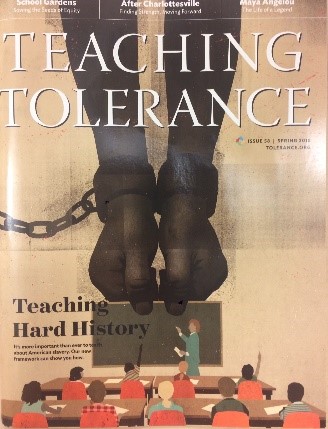
The Teaching Tolerance magazine focusing on teaching American Slavery.
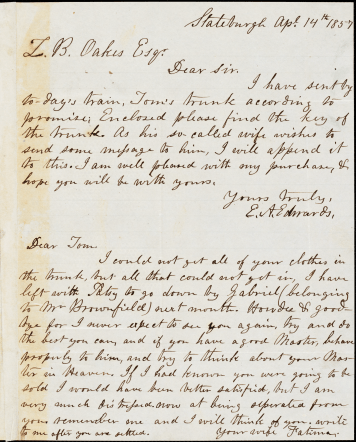
One of the documents from the ZB Oakes collections that Bethany used for her documentary analysis activity.
***Interestingly, ZB Oakes was a slave auctioneer who lived in Charleston, SC in the 1800s. His papers are part of the collections at the Boston Public Library because they were seized during the Civil War by a Massachusetts regiment comprised of free blacks and brought back to Frederick Douglass – as almost a trophy about what he helped accomplish!
Our session was one of the most attended of the day, with some participants having to stand and a continual stream of adding more chairs to the already cramped room. It clearly demonstrated that educators KNOW that this is an important topic and yet struggle for finding appropriate resources. Throughout the presentation and activities the participants were continually engaged and asking great questions – of us and other attendees – about strategies that they might use or modify to fit their unique student populations.
Bethany setting the stage about what the session will cover and how the activities will run.
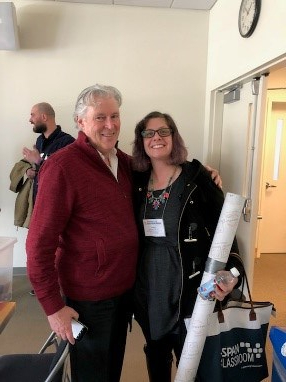
And to make things even MORE exciting – one of the fellow presenters was Dr. Nate Hamilton! Nate frequently collaborates with Bethany and me and has been a part of the Peabody extended family for years. It was nice to see him in his “natural habitat” of Maine for once!
Nate and I enjoyed running into each other after our session.
In the last two weeks, we have had three major Nor’easters here in New England. Fortunately, it has been while students are on break and has not slowed down the creation of new lessons for spring term.
“A man never lies in his garbage heap” – Franz Boas.
Last term I was approached by Emma Frey, faculty in history, to create a single period activity that would introduce her 9th graders to the concept of reading objects as text and use them to tell a story. As Emma and I talked and brainstormed, we decided on an existing lesson that I had created years ago for our Archaeology Explorers and how we could flesh it out so that it better met Emma’s class goals and objectives. The activity is a garbology lesson called Trash Talks!
Two bags of clean trash that students will analyze.
In the activity students are divided into three groups and are given a bag of clean trash. While working together to sort and identify the trash, each group also compiles a biography of the person(s) who created the trash. They will be asked to make observations and inferences about the trash and what it might reflect about a person, such as their gender, age, activities, etc.
An example of how students might mark down artifacts in their trash bags to better understand what they show about the life of someone.
While the trash is “modern” the principles that students use to analyze the trash are the same as the ones that archaeologists use to study cultures of the past.
I am very excited to run this lesson with students and to see how they interpret the trash!
The past five years have been a busy time for museums- most notably in the image department. Following a number of high profile controversies, a lot of people–audiences, and museum professionals alike–asked what role museums play in our society? Here are a couple of recent articles dealing with this subject head on.
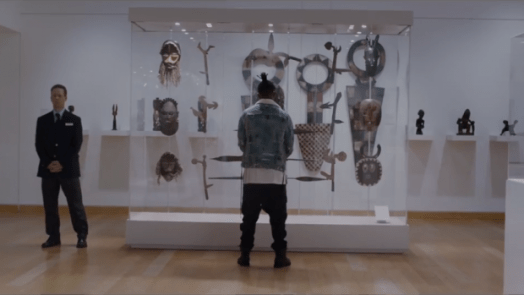
Killmonger in the Museum (Photo courtesy of article)
Last month saw the release of Marvel’s newest blockbuster, Black Panther. Besides being a fantastic movie, this film offers a unique chance to open dialogues on a large scale about many topics- least of which are museums as mechanisms of colonialism. This article discusses how and why museum professionals especially should look at their roles in this and the effects they have on the audiences we try to reach. The piece ends by laying out suggestions for how museums can move forward incorporating and working towards more diverse and open dialogues between communities.
Gover and Bunch at Symposium (Photo courtesy of Smithsonian Magazine)
This article opens with the quote, “history matters because it has contemporary consequences,” and it just gets better from there. Directors Kevin Gover (National Museum of the American Indian) and Lonnie Bunch (National Museum of African American History and Culture) participated in a day long symposium titled, “Mascots, Myths, Monuments and Memory,” in which they talked about confronting the historic and continued racist ideologies that are entrenched in contemporary American society and the role of museums. They specifically discuss the example of the concurrent rise of confederate statues and racist mascots.
Chronicling a series of high profile controversies, this article looks at the combination of factors that have led to these, as well as the changes they are bringing to museums and their operation. It also discusses why museums have become ground zero for explosive cultural encounters stating, “We’re in a time when these issues are real, these controversies are part of public space and public discourse, and museums are going to become the places where these issues get played out.”
Students using NK360 (photo courtesy of Smithsonian Insider)
This article showcases the role museums have within their respective walls and how they are branching out to have far reaching impacts in classrooms all over the nation. Similar to classes taught at the Peabody by Curator of Education, Lindsay Randall, this article follows the creation and implementation of National Museum of the American Indian’s newest initiative, Native Knowledge 360. NK360 is a “long-term initiative to integrate the Native American experience into social studies, language arts and other curriculum in kindergarten through 12th-grade classrooms across the country.” This program works with the inclusion and cooperation of Native communities and educators as well as provides educational materials for teachers.
The collections staff at the Peabody keep telling me that I can’t have a cat. Which I guess was fair, until I found out that all this time they have been hiding a jaguar in our basement!
A few weeks ago I was approached by Elizabeth Aureden, instructor in music, to design an interactive class for her Music 410 course, The Musical Brain. While looking through our collections for musical instruments, I learned from collections assistant Samantha Hixson that she had just found and catalogued some effigy rattles.
The objects were made of clay and painted a variety of colors, and some still rattled.
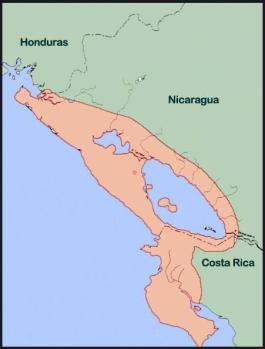
This new find seemed very promising and so I wanted to learn more about them. Research indicated that these objects were from the Nicoya Peninsula of Costa Rica and most likely date from AD 1000 – 1350.
Map showing the Nicoya cultural region. By Rodtico21 (Own work)[CC BY-SA 3.0 https://creativecommons.org/licenses/by-sa/3.0The parts we have are clearly broken and part of a much larger artifact. These are the remnants of the tripod legs of a rattle effigy vessel. Each of the three legs would have contained three clay balls and had openings on the side for the sound. When shaken a rhythmic sound can be heard.
Image of a complete vessel. Notice the holes in the side of the legs. By Daderot (Own work) [CC0], via Wikimedia CommonsThat’s pretty neat! But the story became even cooler as I found more information about this style of pottery.
The bowls were used to add a percussive sound to a ceremony. And the sound it made was not an accidental rattling sound, but rather a deliberate and meaningful one. When the bowl is shaken or moved about, and the clay balls rattle together, they create a deep, rumble. This sound is mimicking the low growl of an actual jaguar!!!!! Researchers have even noted that when the bowl is tilted and moving forward – like a jaguar lunging at prey – the sound is more prominent.
If your interest is now piqued about other objects from the Nicoya Peninsula, check out Dr. Rebecca Stone’s book, The Jaguar Within.
So next time you are at the Peabody be on the lookout, because you never know what other predatory animals might be lurking!!!
Scary lion from the 1995 movie Jumanji. Sometimes the Peabody seems like it’s playing its own version of the game Jumanji, with all the random artifacts that mysteriously present themselves to staff members.