Birch bark, maple sap, and a visit to the White Earth Reservation

Contributed by Ryan Wheeler

This blog represents the fifth entry in a blog series – Peabody 25 – that will delve into the history of the Peabody Museum through objects in our collection. A new post will be out with each newsletter, so keep your eyes peeled for the Peabody 25 tag!

The winter 2017 issue of the Andover magazine includes a great piece by Jane Dornbusch on our repatriation of a sacred birch bark scroll to the White Earth Nation in Minnesota. In a nutshell, Peabody curator Warren Moorehead received a number of items from the White Earth Anishinaabeg in 1909 during his investigation of fraud on the reservation. That collection—principally men’s ceremonial regalia and beaded bandolier bags—also included a pictographic bark scroll used in the ceremonies of the Midewiwin, or Grand Medicine Society. Jane’s story also mentions my visit to White Earth in March 2016. The following essay was written right after I returned from Minnesota and provides a few additional details about that visit.

Image of White Earth Land Recovery Project Executive Director Bob Shimek talking to tribal members and college service learning students, March 2016.
White Earth Land Recovery Project Executive Director Bob Shimek talks to tribal members and college service learning students, March 2016.

At the end of March 2016 I flew into Fargo and drove east, headed for the White Earth Indian Reservation. As I drove I passed an occasional cluster of houses, farmland with lots of black, rich soil, as well as lakes, streams, and groves of trees dotting the horizon of a really big sky. I learned later from Bob Shimek, executive director of the White Earth Land Recovery Project, that I had driven across a variety of ecosystems, from oak savanna to pothole prairie.

That first evening in Minnesota I sat in the White Earth community center along with college students on a spring break service learning trip while Bob told us about the White Earth Anishinaabeg. We heard about the land and how this Indian reservation—established in 1867—was designed to succeed, starting with 829,440 acres of forest lands with timber and game, good farmland, lakes and streams with fish. Greedy timber companies and their henchmen defrauded tribal members of their lands and by 1934 less than 800 acres were held by the Anishinaabeg.

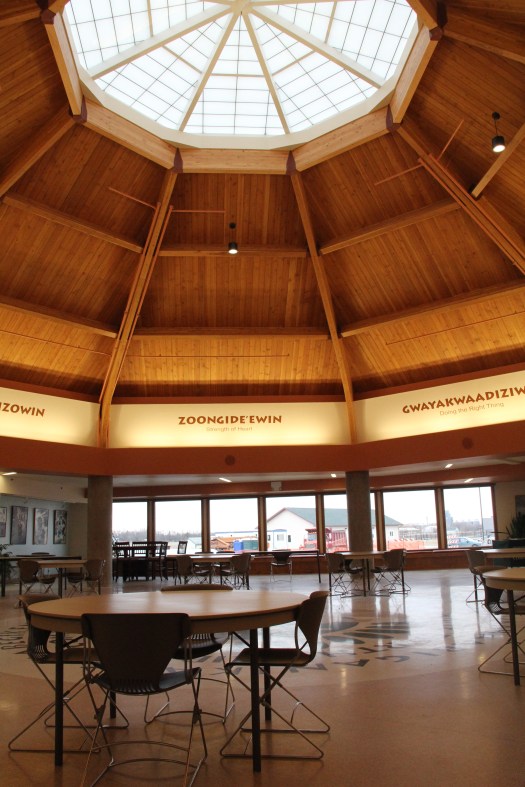
Image of the drum hall at the White Earth tribal college, taken March 2016.
Drum hall at the White Earth tribal college, March 2016.

Since the 1930s the White Earth Anishinaabeg have done what Bob Shimek refers to as nation building. Efforts include a casino in Mahnomen, an annual indigenous farming conference, the Gizhiigin Art Place, a tribal college, the Niijii radio station, and more. Even repatriation, the recovery of sacred objects stored in museums for decades, is nation building. A lot of these nation building activities revolve around traditional food and foodways, like wild rice and maple sugar.

When the sap runs it is all hands on deck. Even the service learning students abandoned other projects and were recruited to haul sap to the boilers. Like New England, maple sugaring is a big deal in northern Minnesota. Among the Anishinaabeg maple sugar has a deep meaning—hauling and boiling sap recalls the origins of the Anishinaabeg. Ojibwe oral literature tells how in the beginning the maple trees were full of thick, sweet syrup that could be easily collected. Manabozho—the Ojibwe trickster and culture hero—decided the people had it too easy and made the syrup thin and watery. He gave the Anishinaabeg the technology to process the sap, but only during the end of winter. The rest of the year was to be spent fishing, hunting, and in other endeavors needed to earn a living.

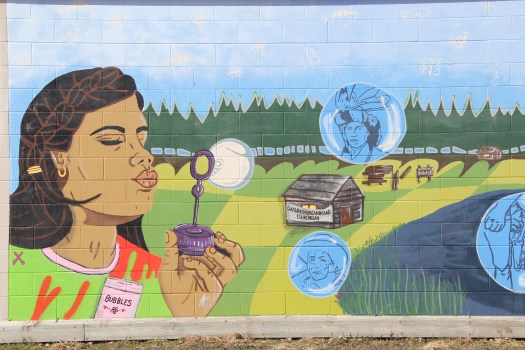
Image of mural on the Niiji radio building, White Earth Reservation, taken March 2016.
Mural at the Niiji radio station, White Earth Reservation, March 2016.

But afterwards, in the evening, there was time for more learning. My last night at White Earth I attended the Big Drum ceremony. This began with a potluck dinner, followed by a pipe ceremony, and then Keller Paap, one of the ceremony leaders, told the story of the Big Drum in Ojibwe. This was pretty remarkable, but things got even more interesting.

Keller and Anton Treuer, another ceremony leader, invited the college students to sit around the drum. Then they told the story of the Big Drum ceremony in English. But there was more. Paap is from Wisconsin and teaches at Waadookodading, an Ojibwe language immersion school, while Treuer is on the faculty at Bemidji State University. Together they shared the stories of religious suppression and how this didn’t change until 1978’s American Indian Religious Freedom Act, along with the importance of teaching and learning the Ojibwe language.

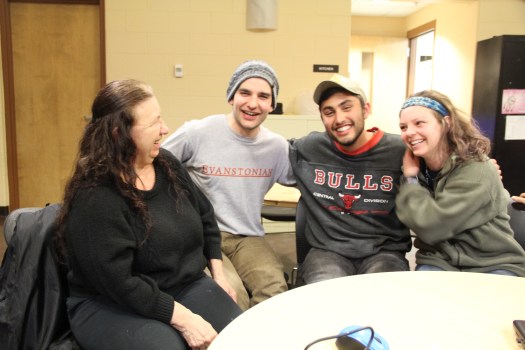
Image of three college students talking with tribal member Diana King, taken March 2016.
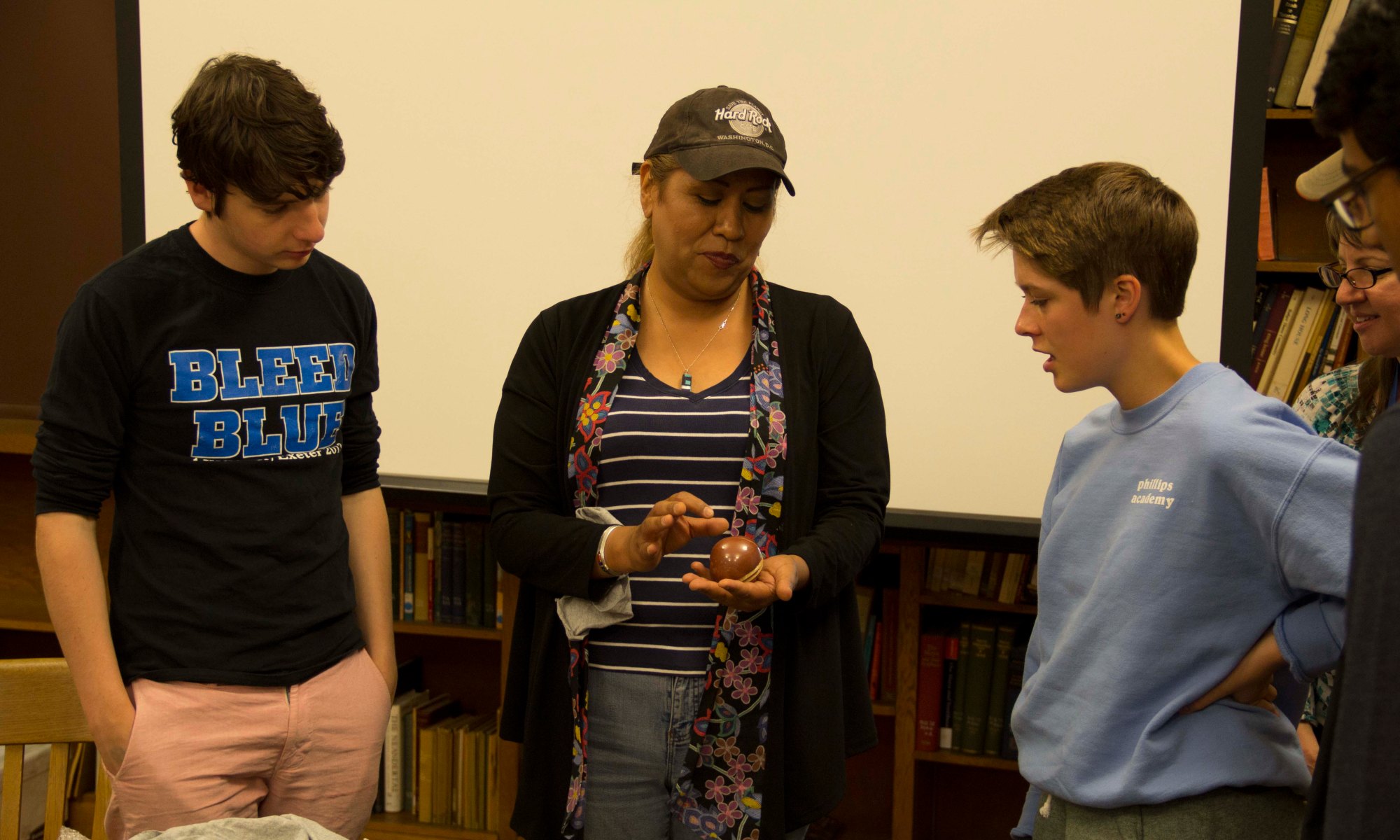
College service learning students talking with White Earth tribal member Diana King, March 2016.

So, there are lots of stories at White Earth. Some are written on birch bark scrolls, others are found in the pages of the Congressional inquiry into fraud and deceit, some drip in slightly sweet maple sap, while others still float on the night air in words of Ojibwe. For us, however, perhaps most remarkable is that we—Andover, Phillips Academy, the Peabody Museum—are a tiny part of the story too.

In January 2017 we met with representatives of the tribe again and agreed to the repatriation of several additional objects that, like the birch bark scroll, are examples of cultural patrimony under the Native American Graves Protection and Repatriation Act. Anton Treuer will be speaking at All School Meeting on Wednesday, April 5, 2017.

Human Origins–innovation & transmission

Contributed by Ryan Wheeler

As the fall term wraps up this week it’s a great time to reflect on some of the big ideas that we have discussed in the multidisciplinary science course Human Origins, taught here at the Peabody. In many of our extended period labs we have replicated ancient technologies like chipped stone tools, fire making, the atlatl or spear thrower, and more. As we try launching a spear with a simple lever—the atlatl, or use a bow drill to produce heat, smoke, and (hopefully) fire, we wonder about whom first thought of and tried these things. In other words, who was the first innovator who discovered a technique to make fire or launch a dart? Innovation is a popular word today. In fact, it’s easy to find blogs, news stories, and more that suggest this word is a bit overused. Some writers have tracked the history of the term innovation and its divergence from invention, often indicating that innovation has economic and market implications.

Student in Human Origins course tries to make fire with a bow drill.
Human Origins students experimented with fire making two ways–the bow drill and percussion. Notice a few wisps of smoke rising from the fire board.

One piece that seems to be missing from many of these stories about innovation is that it doesn’t amount to much without a means for transmission. The ability to put the innovation into production, to teach and train others, to demonstrate and sell the new idea may, in fact, be even more important than the act of discovery or invention. Now some ideas—like fire—might sell themselves, but there are different methods and techniques. In Human Origins we experimented with two very different approaches: friction—using a bow drill and fire board, and percussion—essentially banging two rocks together. There are, however, lots of opportunities for innovation here, large and small. Which rocks will work best? Which wood makes the best fire board? How does one direct a spark or ember into a nest of kindling?

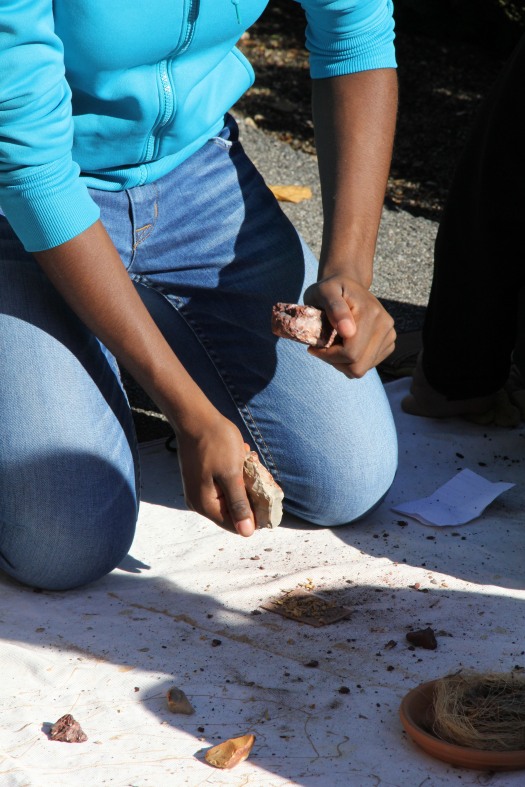
Student in Human Origins course experiments with the percussion method of fire making by banging two rocks together.
Making fire by percussion–banging two rocks together–isn’t so easy! This Human Origins student uses flint and iron ore. Lots of sparks and smoke, but no fire. The earliest evidence for control of fire comes from a Homo erectus site in Africa and dates to 1 million years ago.

Archaeologists—intent on the exploration of culture change through time—often claim that thinking about innovation and transmission of new ideas falls well within their province. But others have famously weighed in as well. Perhaps best known is evolutionary biologist Richard Dawkins notion of the “meme,” introduced in his 1976 book The Selfish Gene. Dawkins styles the meme—“an idea, behavior, or style that spreads from person to person within a culture,” in evolutionary terms, subject to natural selection, mutation, and the like. This idea has been popular, but has its detractors. One problem in the application of evolution to culture is that there is always an explanation, but sometimes at the benefit of understanding. Stephen J. Gould and Richard Lewontin tackle this in their 1979 article “The Spandrels of San Marco and the Panglossian Paradigm,” another staple of Human Origins. Here Gould and Lewontin argue that some features—both natural and cultural—are merely spandrels, or by-products of other evolutionary processes. The interpretation of these spandrels as adaptive will lead to erroneous conclusions.

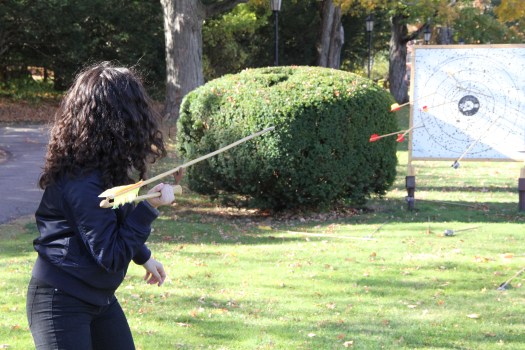
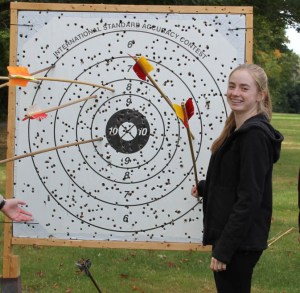
Student in Human Origins course throws a spear using an atlatl or spear thrower. The target in the distance has already been hit with other darts.
The earliest atlatls or spear throwers date to around 20,000 years ago in France. The simple lever allowed a hunter to throw a dart with more power and precision. In many places the atlatl was replaced by the bow and arrow, but in some areas both coexist.

So, does archaeology offer another approach to understanding innovation and transmission of ideas in our distant past? Archaeologist Michael Brian Schiffer would answer affirmatively. Schiffer helped define behavioral archaeology, which is predicated on the idea that people in the past made decisions in ways that parallel present-day decision making. This model points out that people often make choices that are seemingly contrary to common sense, but take into account a variety of factors including tradition, peer pressure, social and political alliances, and the like. The atlatl or spear thrower is a good example. As far as we know, the earliest atlatls were made in France some 20,000 years ago. Within a few millennia we find highly decorated examples. It’s unclear if there are separate centers of innovation, but atlatls are known over much of the world, including the Americas and in Australia. In many places the atlatl is replaced by the bow and arrow, which offered several distinct advantages, but in some places both technologies coexist, suggesting that processes of innovation, transmission, adoption, and discontinuation may have varied considerably. Overall, however, our attempts to replicate ancient technology gave us new respect for the first innovators and some insight into the complexities around transmission of new ideas.

Peabody Study Hours

Contributed by Marla Taylor

As another school year begins, students on the lookout for a quiet place to study in the evening will have a new option.  The Peabody is now hosting study hours every Thursday evening from 5pm-9:15pm.

We will also be collaborating with the peer tutoring program on campus to provide a calm space for focused study and learning.

We hope to see you here!

Summer work duty students begin rehousing inventory

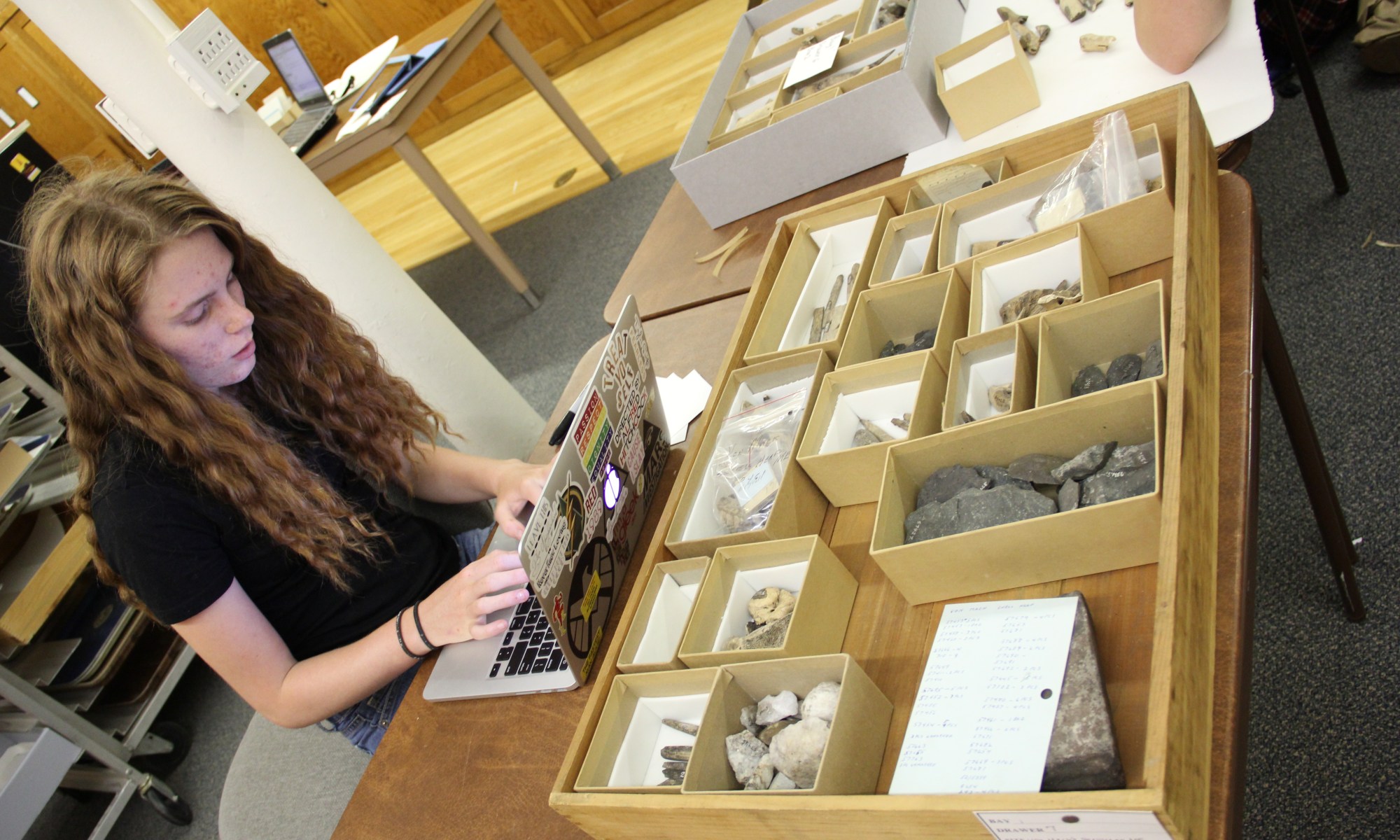
Work duty student inventorying a drawer

Embarking on a full inventory and rehousing of your museum collection is a daunting task.  Transferring approximately 1,700 drawers into 3,000 archival boxes will take years of work.  Fortunately for me, I have access to an invaluable resource – Phillips Academy students.

For a week in July, two Lowers (10th graders) came to the Peabody every day for four hours to fulfill their work duty commitment for the school year.  I gave them a crash course in artifact identification and object handling techniques before they got down to business.  As they worked through the meticulous process of inventorying everything in the collection, they made crucial observations that will improve my workflow.  Together, these two students recorded the contents of twenty-nine drawers!

Work duty student inventorying a drawer

Work duty students will continue to be an essential work force as we move through the collection.  I will share their progress and successes in the months and years to come.

Curator of Collections Marla Taylor and work duty students stand behind the empty boxes

Peabody Advisory Committee Welcomes New Members

Photo of Ben BurkeBenjamin Burke ’11

Ben is business development analyst and developer at Dispel, a New York based technology start-up specializing in online security. He is a graduate of Yale University. Ben aided with collections organization during his Phillips Academy work duty service at the Peabody. Ben says of his experiences, “the Peabody Museum was a source of endless adventure during my time at Andover. I am happy to have spent countless hours there through work duty, various classes, and through one of the Peabody’s sponsored trips (BALAM-Bilingual Archaeological Learning Adventure in Mesoamerica). I am pleased to have the opportunity to make sure the Peabody remains a welcoming place for students and to help grow that mission of inclusion, education, and exploration.”

Jenny Elkus ’92Photo of Jenny Elkus

Jenny Elkus is an architect at Elkus Manfredi Architects in Boston. She is a graduate of Harvard University and Harvard’s Graduate School of Design. Jenny has fond memories of using the Peabody’s library as a senior at Phillips Academy in the early 1990s—she notes that it was much quieter at the Peabody then!


Photo of Agnes Hsu-TangAgnes Hsu-Tang

Agnes Hsu-Tang received her PhD in Chinese art and archaeology from the University of Pennsylvania in 2004. Agnes is an accomplished scholar, cultural heritage policy advisor, and is well-known as the host of several award-winning TV documentaries, including the History Channel’s Mankind: The Story of All of Us. Dr. Hsu-Tang serves on a number of boards, including the University of Pennsylvania Museum of Archaeology & Anthropology and the Institute for the Study of the Ancient World at NYU. Along with her scholarly achievements, Dr. Hsu-Tang is an accomplished musician and serves as a managing director of the Metropolitan Opera. She is adjunct associate research scholar in the Department of East Asian Languages and Cultures at Columbia University.

Margot Steiner ’17Photo of Margot Steiner with museum textiles

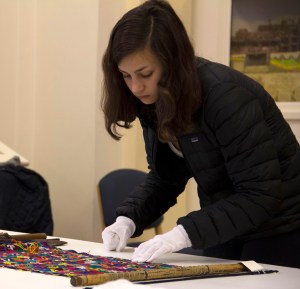
Margot is a three year upper from New York City. She especially likes working with textiles and rearranging artifacts during her volunteer time at the Peabody. Although she only started working at the Peabody this year Margot had always enjoyed coming as a lower and junior. Her weaving class last year really pushed her to start volunteering after seeing the Peruvian burial shawl. Outside of the Peabody Margot can be found in Silent Study tackling her work in order to get her much needed 8 hours of sleep!

katherine-hallKatherine Hall ’17

Katherine is a three year upper from Andover, Mass. She began working at the Peabody Museum in the fall of 2014, and she has enjoyed working on various research, cataloging, and creative projects during her time here. Outside of her life at the Peabody, Katherine is active in local theater, enjoys rock climbing, and tutors other students in math. She is excited to be a part of the advisory committee!

The Language of Weaving

Contributed by Catherine K. Hunter

Warps, warp-face, wefts, weft-face, ikat or jaspe, brocade, coiling, twining, plaiting—these technical terms come from the language of weaving. For students in Therese Zemlin’s art class, an exploration of weaving was motivation for a tour of collections at the Peabody Museum in April and May 2016 with research associate Catherine Hunter. The themes were textiles of Guatemala and Peru, and Native American baskets.

Weaving involves the interlacing of two elements: warp and weft. The loom supports vertical elements or yarns (warps) under tension. Then, weaving is the process of interlacing horizontal elements (wefts) side-to-side perpendicular to the warps. The weaver manipulates the colors and density of the warp or weft, making the potential for new designs endless.

Forty items were selected from the museum’s collection of 400+ 20th century Guatemalan textiles and back-strap looms, and ancient Peruvian textiles. The majority were blouses called huipiles, assembled from several parallel lengths of cloth. Among the Maya distinctive traditional designs have been associated with specific villages. Communities consistently favor bright colors with beautiful sophisticated geometric and zoomorphic designs.

IMG_9335 (1)
Students examines a vibrant Guatemalan textile on backstrap loom.

From an inventory of 350 19th-20th century Native American baskets, 20 were chosen to represent the cultural preferences of five geographic regions. This tradition is acknowledged as the finest expression of its type, setting the standard for anyone who studies baskets as art. The basic techniques are coiling, twining and plaiting.

IMG_4502
Catherine Hunter sharing the vast array of baskets in the Peabody’s collections.

There is remarkable ingenuity in the variety of plants and trees discovered for basketry materials, including ash splints, river cane, pine needles, roots, grasses, and red cedar. Harvesting and processing of materials was a time-consuming community activity with an appreciation of seasonal and sustainable practices.

There is amazing vitality in the forms of baskets including bowls, jars, rectangles, cones, trays, and plaques. Fascinating objects in themselves, it is all the more interesting to know their uses include food gathering, cooking (in water tight baskets), water bottles, seed bottles, pictorial trays illustrating mythology, feather-covered gift baskets, hats, and forms targeting the interest of tourists.

Both traditions—Guatemalan weaving and Native American basketry— continue today as a source of cultural pride for communities and as professions for artists.

AUTHOR BIO

Catherine K. Hunter is an independent museum consultant whose career began in the Department of Textiles at the Museum of Fine Arts in Boston. She began an inventory of the Peabody Museum’s basket collection in November 2015 and will complete the project in summer 2016.

Student Reflection – Alex Hagler ’16

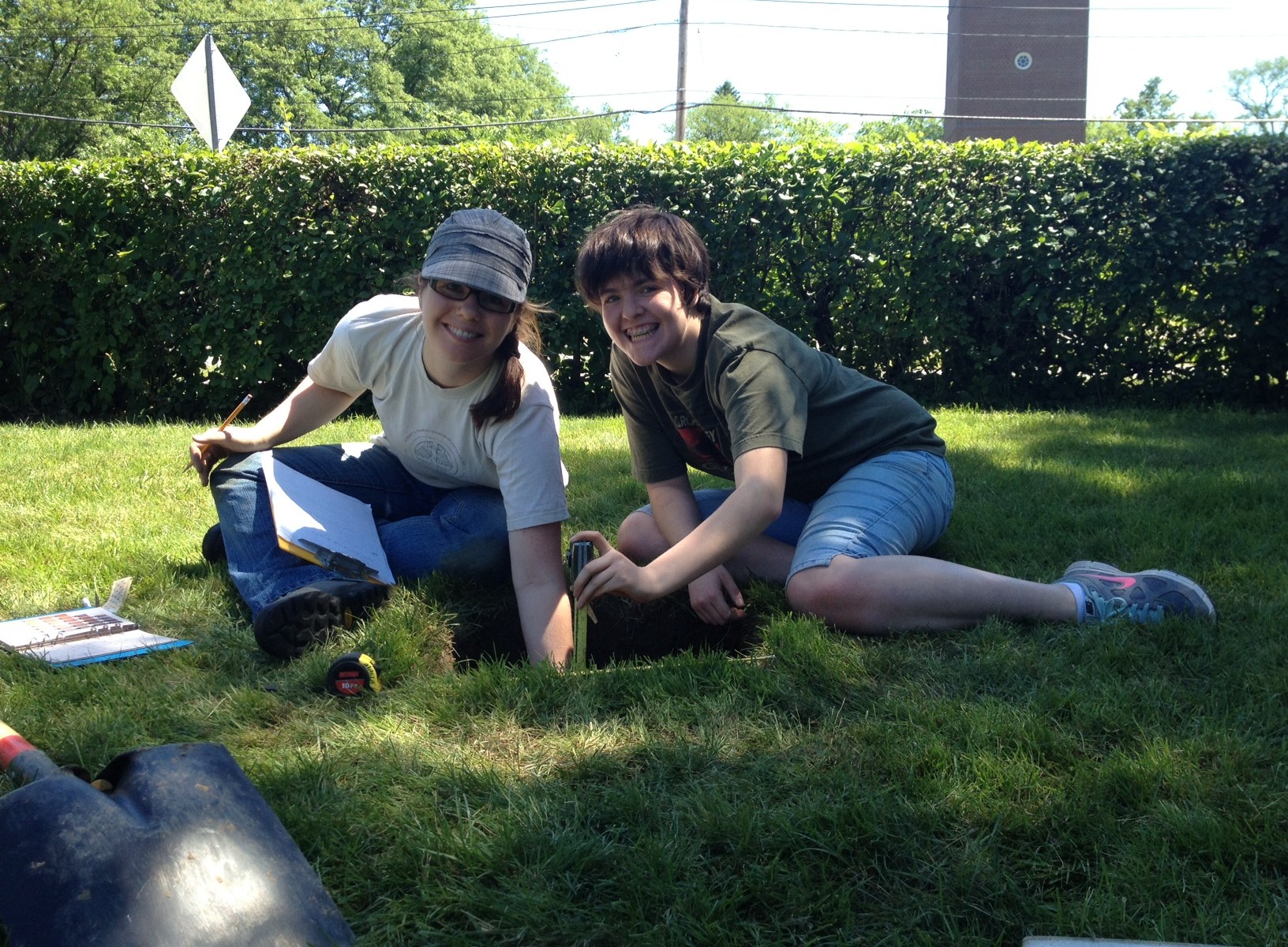
Alex and Marla excavated on campus

Contributed by Alex Hagler ’16

I began working at the Peabody in sixth grade, under the brilliant supervision of Lindsay Randall. I was introduced to the behind-the-scenes workings of a museum, cataloging artifacts, organizing photos, preparing materials for classes, all the jobs of a high school work duty student. It amazed me, and still does, that, despite my young age, I was treated just about the same as any other work duty student. I was given the trust of the people I worked with at the museum, and that trust has remained to this day. Because of that, I have had wonderful, momentous occasions at the Peabody. I represented the Peabody at the 2014 Alumni Reunion Weekend, and I presented the findings of my own independent research project to the Massachusetts Archaeological Society, to name only two. I have enjoyed the constant support of the people with whom I have worked all these years, and so the Peabody has become like a second home to me.

Now, as a graduating senior, I look back on my years at the Peabody. I find that I am mostly content, with only some minor regrets, namely that I have yet to see the floppy disk I was promised way back in sixth grade. But beyond that, I find that I am overwhelmed, reflecting on how I have changed over my years working here. At the beginning, I was nervous, hesitantly exploring the Peabody for the very first time, just starting to explore my new found interest in history. At the end, I am confident, not only in that I have made smart and responsible choices during my time here, but also in that I will continue to do so for the rest of my life. And I have the Peabody to thank for that.

Interested to read more student reflections?  Visit here and here for more perspectives.

Student Reflection – Alana Gudinas ’16

Alana and other work duty students learn about Pueblo pottery from Dominique Toya

Contributed by Alana Gudinas ’16

I started work duty at the Peabody in the beginning of my 10th grade year, mainly because it seemed like the most interesting job to do on campus. How many other high school students have the opportunity to help out at a renowned archaeological museum just a short walk’s away? That year I did a lot of of boring, but necessary, work cataloging objects and essentially entering data into computers. What made doing this so amazing, however, was the fact that I was handling objects that were often thousands of years old, all with their own history and archaeological context. I worked in the same room as Marla and Lindsay, both who shared with me a lot of information about what we were working with and why. This experience I had my sophomore year made me passionate about history and archaeology and want to dive in even deeper.

I did, in fact, become more involved in the Peabody these last two years, through listening to speakers that came to the Peabody for Massachusetts Archaeological Society meetings (and even giving a presentation myself at one of them), meeting the incredibly special artists (such as Dominique and Maxine Toya), teachers, and scholars who visit the museum, and taking a history class the fall term of this year that met in the museum classroom. Having such extensive access and exposure to the Peabody the past three years has instilled in me a love and appreciation for archaeology and all the people involved in the field. I feel that I have learned so much not only about the archaeological and historical background of various objects, but also about the nature of the two fields in general and how they are used in a museum setting. I am endlessly thankful for this experience.

Interested to read more student reflections?  Visit here and here for more perspectives.

Student Reflection – Jacob Boudreau ’16

Image of student presenter

Contributed by Jacob Boudreau ’16

I didn’t know what to expect when I started work-duty at the Peabody. I don’t remember choosing to be in it. I didn’t know much at all about archaeology. By my third week of work-duty, I was convinced that archaeology (at the Peabody at least) was nothing but the glorified study of rocks. I was disappointed that I would be stuck inside categorizing rocks for 45 minutes a week, instead of doing one of the quick and easy 5-minute-per-week work-duties.

Those first few weeks, however, are not summary of my time at the Peabody. My time at the Peabody has taught me a lot about archaeology—what it is, what the various aspects of it are, what goes on behind the scenes—and it has imbued me with a deeper appreciation for the discipline. I have learned how artifacts are excavated; how they are stored, cataloged, and inventoried; how one handles delicate artifacts, creates displays for them, records when they are taken out for a class or put back into storage. All of these things I learned during work duty through experience – it was all hands-on. The other work-duty students and I weren’t simply there ticking off check-boxes on a clipboard while the museum staff did the “real work.” We all got the chance to engage directly with the artifacts in the various ways I listed above.

The best part of work-duty at the Peabody is all of the people I get to work with. Each term I work with a new team of students, which is a lot of fun. I really enjoy working with Marla as she always makes the tasks interesting and engaging and talks to us more like adults or friends than high school students.

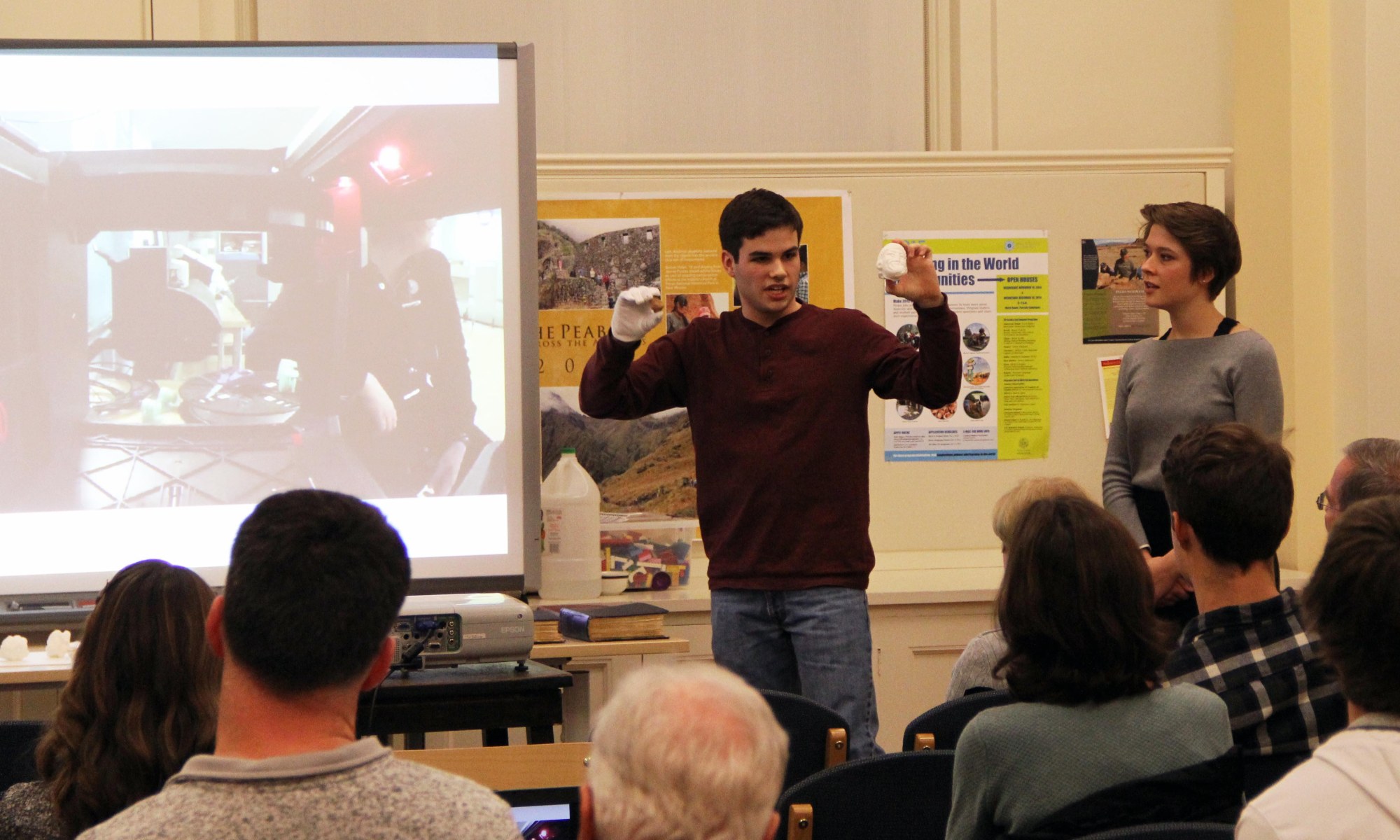
The highlight of my time at the Peabody was the term that my work-duty group 3D scanned and printed selected artifacts, and then presented our results and research on the topic at a MAS meeting. I’m a math and science guy, and I was thrilled when Marla announced the plans for the term to us. We cooperated with Ms. Wessner from the makerspace and her work-duty students to learn how to scan and print the artifacts we had chosen. We each then presented on a specific part of the project: one student on how we selected the artifacts to print, me on how we scanned and printed them, and two students on the implications of the 3D replication of artifacts. (We also got to eat a lot of food at the meeting.) It just goes to show how interdisciplinary work at the Peabody can be.

Interested to read more student reflections?  Visit here and here for more perspectives.

Adopt A Drawer: What is it like to catalog a drawer?

The drawer before cataloging

Contributed by Marla Taylor

In fall 2013 the Peabody launched Adopt A Drawer, which connects supporters with our collections. Each gift of $1,000 supports the complete cataloging of one artifact storage drawer. Participants receive an Adopt A Drawer t-shirt, updates on cataloging,  and their support is acknowledged with a name plaque and in our online catalog, PastPerfect.

Cataloging the adopted drawers is a time-consuming but rewarding task. Each drawer is selected with care to identify areas of the collection that need a little extra TLC. Often times, I don’t even know what I am going to find in the drawer!

The drawer that I am currently working on has taken quite some time. There are over 130 artifacts – mostly stone tools – from at least 13 different sites across France. Many of them are from cave sites of the Magdalenian era (10,000 – 17,000 years ago), but some of these blades, scrapers, and cores date as far back as 70,000 years old. Some of these tools could have been crafted by the hands of Neanderthals.

The drawer before cataloging

When I first began work on the drawer, the tools were piled on top of one another in several smaller boxes. This poor storage can easily lead to damage along the delicately crafted edges of these tools. It was in need of a major upgrade!

With the help of work duty students – I couldn’t do this without them! – each artifact was photographed, measured, and rehoused. I have researched each artifact in our original accession ledgers for location and collection information. These records have then been combined with notes provided by Kathleen Sterling and Sebastien Lacombe of Binghampton University and experts in the lithic technology of France’s Upper Paleolithic who visited the collection in May 2015. I am integrating all of this information into their catalog records and the adoption process is nearly complete.

I will soon share details of the contents of this drawer with its donor and you can access it too by exploring our collection online.

For additional information how to adopt a drawer watch our short video or visit our website.