The Language of Weaving

Contributed by Catherine K. Hunter

Warps, warp-face, wefts, weft-face, ikat or jaspe, brocade, coiling, twining, plaiting—these technical terms come from the language of weaving. For students in Therese Zemlin’s art class, an exploration of weaving was motivation for a tour of collections at the Peabody Museum in April and May 2016 with research associate Catherine Hunter. The themes were textiles of Guatemala and Peru, and Native American baskets.

Weaving involves the interlacing of two elements: warp and weft. The loom supports vertical elements or yarns (warps) under tension. Then, weaving is the process of interlacing horizontal elements (wefts) side-to-side perpendicular to the warps. The weaver manipulates the colors and density of the warp or weft, making the potential for new designs endless.

Forty items were selected from the museum’s collection of 400+ 20th century Guatemalan textiles and back-strap looms, and ancient Peruvian textiles. The majority were blouses called huipiles, assembled from several parallel lengths of cloth. Among the Maya distinctive traditional designs have been associated with specific villages. Communities consistently favor bright colors with beautiful sophisticated geometric and zoomorphic designs.

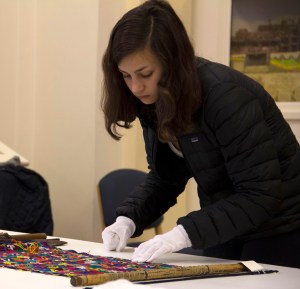
IMG_9335 (1)
Students examines a vibrant Guatemalan textile on backstrap loom.

From an inventory of 350 19th-20th century Native American baskets, 20 were chosen to represent the cultural preferences of five geographic regions. This tradition is acknowledged as the finest expression of its type, setting the standard for anyone who studies baskets as art. The basic techniques are coiling, twining and plaiting.

IMG_4502
Catherine Hunter sharing the vast array of baskets in the Peabody’s collections.

There is remarkable ingenuity in the variety of plants and trees discovered for basketry materials, including ash splints, river cane, pine needles, roots, grasses, and red cedar. Harvesting and processing of materials was a time-consuming community activity with an appreciation of seasonal and sustainable practices.

There is amazing vitality in the forms of baskets including bowls, jars, rectangles, cones, trays, and plaques. Fascinating objects in themselves, it is all the more interesting to know their uses include food gathering, cooking (in water tight baskets), water bottles, seed bottles, pictorial trays illustrating mythology, feather-covered gift baskets, hats, and forms targeting the interest of tourists.

Both traditions—Guatemalan weaving and Native American basketry— continue today as a source of cultural pride for communities and as professions for artists.

AUTHOR BIO

Catherine K. Hunter is an independent museum consultant whose career began in the Department of Textiles at the Museum of Fine Arts in Boston. She began an inventory of the Peabody Museum’s basket collection in November 2015 and will complete the project in summer 2016.

Student Reflection – Alex Hagler ’16

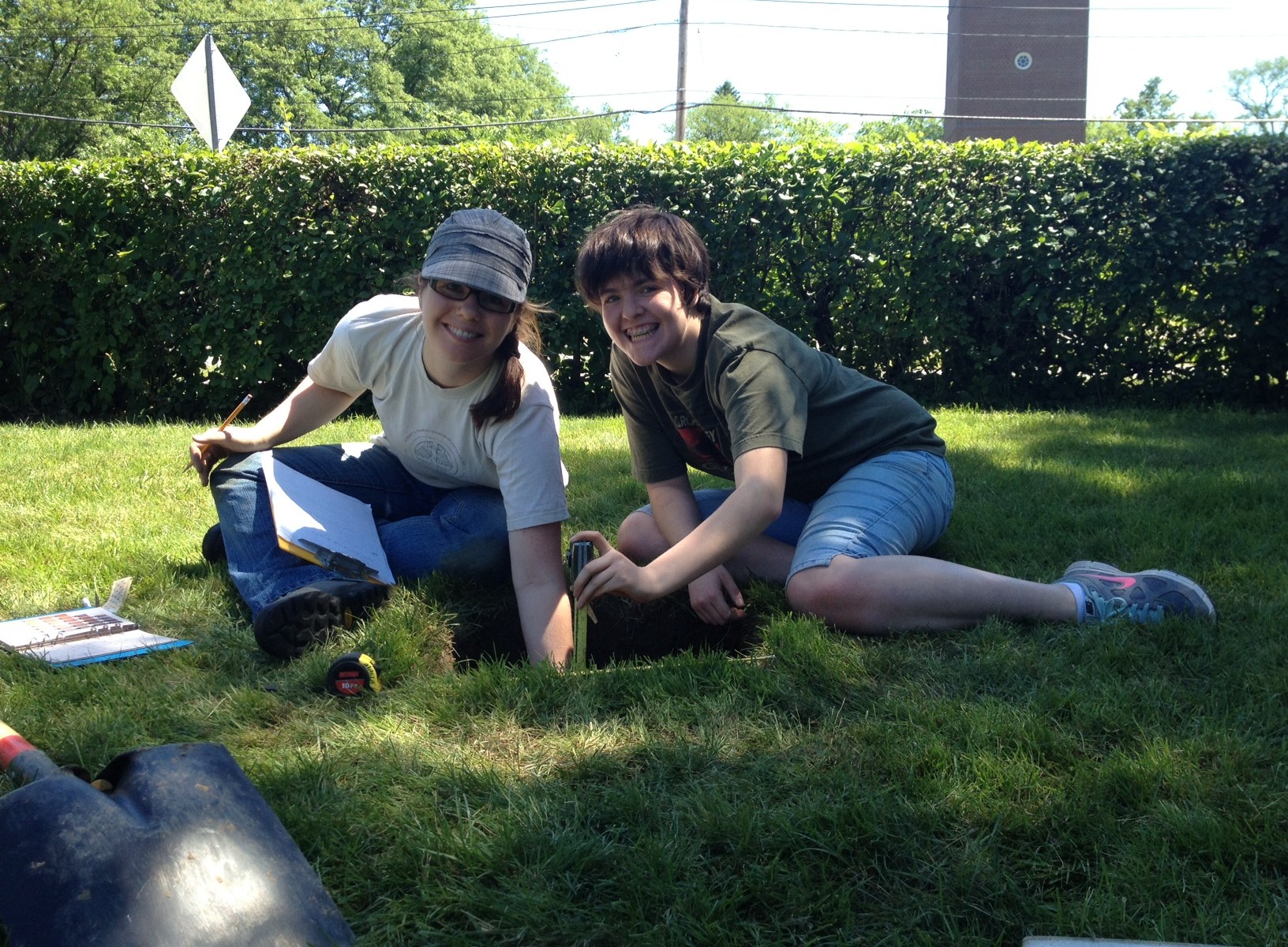
Alex and Marla excavated on campus

Contributed by Alex Hagler ’16

I began working at the Peabody in sixth grade, under the brilliant supervision of Lindsay Randall. I was introduced to the behind-the-scenes workings of a museum, cataloging artifacts, organizing photos, preparing materials for classes, all the jobs of a high school work duty student. It amazed me, and still does, that, despite my young age, I was treated just about the same as any other work duty student. I was given the trust of the people I worked with at the museum, and that trust has remained to this day. Because of that, I have had wonderful, momentous occasions at the Peabody. I represented the Peabody at the 2014 Alumni Reunion Weekend, and I presented the findings of my own independent research project to the Massachusetts Archaeological Society, to name only two. I have enjoyed the constant support of the people with whom I have worked all these years, and so the Peabody has become like a second home to me.

Now, as a graduating senior, I look back on my years at the Peabody. I find that I am mostly content, with only some minor regrets, namely that I have yet to see the floppy disk I was promised way back in sixth grade. But beyond that, I find that I am overwhelmed, reflecting on how I have changed over my years working here. At the beginning, I was nervous, hesitantly exploring the Peabody for the very first time, just starting to explore my new found interest in history. At the end, I am confident, not only in that I have made smart and responsible choices during my time here, but also in that I will continue to do so for the rest of my life. And I have the Peabody to thank for that.

Interested to read more student reflections?  Visit here and here for more perspectives.

Student Reflection – Alana Gudinas ’16

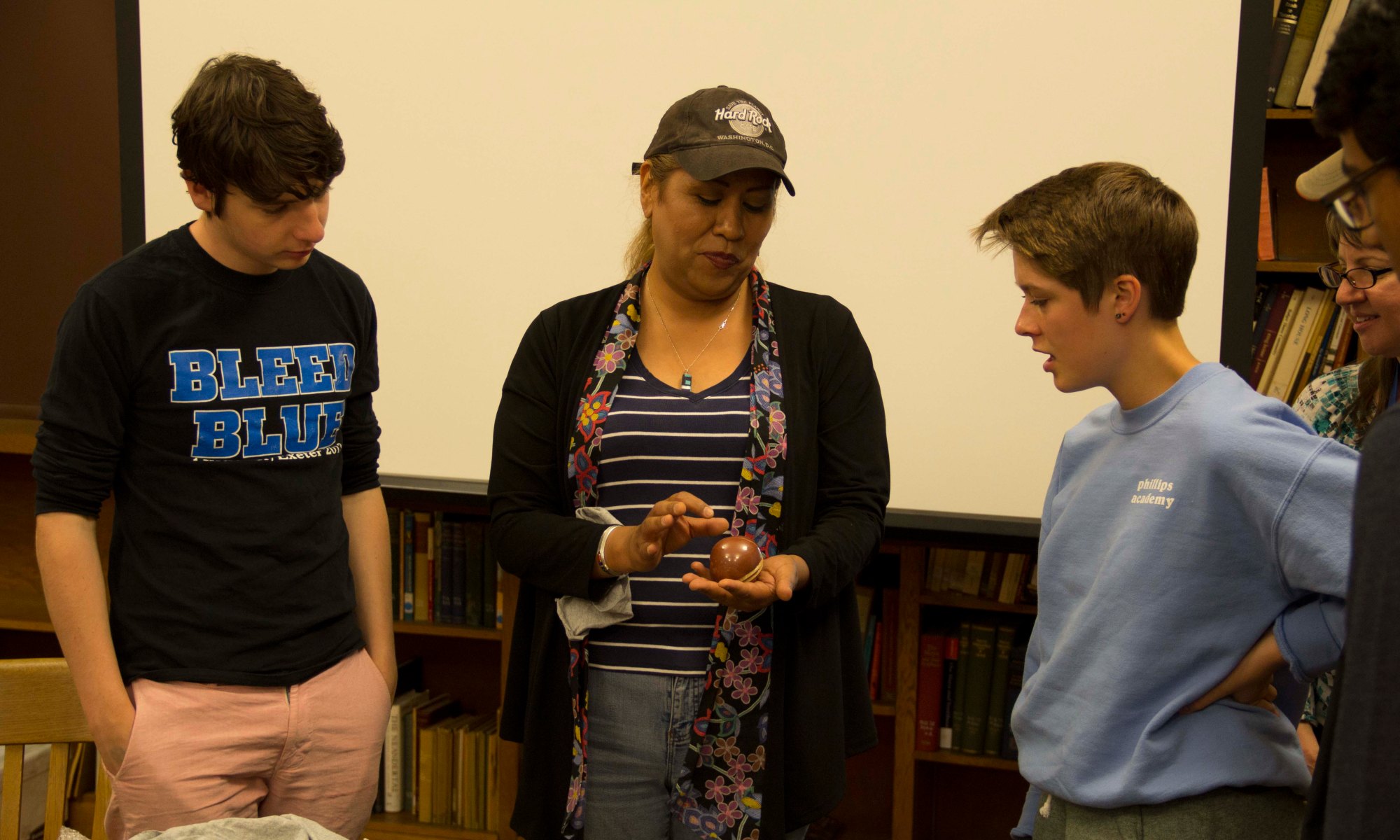
Alana and other work duty students learn about Pueblo pottery from Dominique Toya

Contributed by Alana Gudinas ’16

I started work duty at the Peabody in the beginning of my 10th grade year, mainly because it seemed like the most interesting job to do on campus. How many other high school students have the opportunity to help out at a renowned archaeological museum just a short walk’s away? That year I did a lot of of boring, but necessary, work cataloging objects and essentially entering data into computers. What made doing this so amazing, however, was the fact that I was handling objects that were often thousands of years old, all with their own history and archaeological context. I worked in the same room as Marla and Lindsay, both who shared with me a lot of information about what we were working with and why. This experience I had my sophomore year made me passionate about history and archaeology and want to dive in even deeper.

I did, in fact, become more involved in the Peabody these last two years, through listening to speakers that came to the Peabody for Massachusetts Archaeological Society meetings (and even giving a presentation myself at one of them), meeting the incredibly special artists (such as Dominique and Maxine Toya), teachers, and scholars who visit the museum, and taking a history class the fall term of this year that met in the museum classroom. Having such extensive access and exposure to the Peabody the past three years has instilled in me a love and appreciation for archaeology and all the people involved in the field. I feel that I have learned so much not only about the archaeological and historical background of various objects, but also about the nature of the two fields in general and how they are used in a museum setting. I am endlessly thankful for this experience.

Interested to read more student reflections?  Visit here and here for more perspectives.

Student Reflection – Jacob Boudreau ’16

Image of student presenter

Contributed by Jacob Boudreau ’16

I didn’t know what to expect when I started work-duty at the Peabody. I don’t remember choosing to be in it. I didn’t know much at all about archaeology. By my third week of work-duty, I was convinced that archaeology (at the Peabody at least) was nothing but the glorified study of rocks. I was disappointed that I would be stuck inside categorizing rocks for 45 minutes a week, instead of doing one of the quick and easy 5-minute-per-week work-duties.

Those first few weeks, however, are not summary of my time at the Peabody. My time at the Peabody has taught me a lot about archaeology—what it is, what the various aspects of it are, what goes on behind the scenes—and it has imbued me with a deeper appreciation for the discipline. I have learned how artifacts are excavated; how they are stored, cataloged, and inventoried; how one handles delicate artifacts, creates displays for them, records when they are taken out for a class or put back into storage. All of these things I learned during work duty through experience – it was all hands-on. The other work-duty students and I weren’t simply there ticking off check-boxes on a clipboard while the museum staff did the “real work.” We all got the chance to engage directly with the artifacts in the various ways I listed above.

The best part of work-duty at the Peabody is all of the people I get to work with. Each term I work with a new team of students, which is a lot of fun. I really enjoy working with Marla as she always makes the tasks interesting and engaging and talks to us more like adults or friends than high school students.

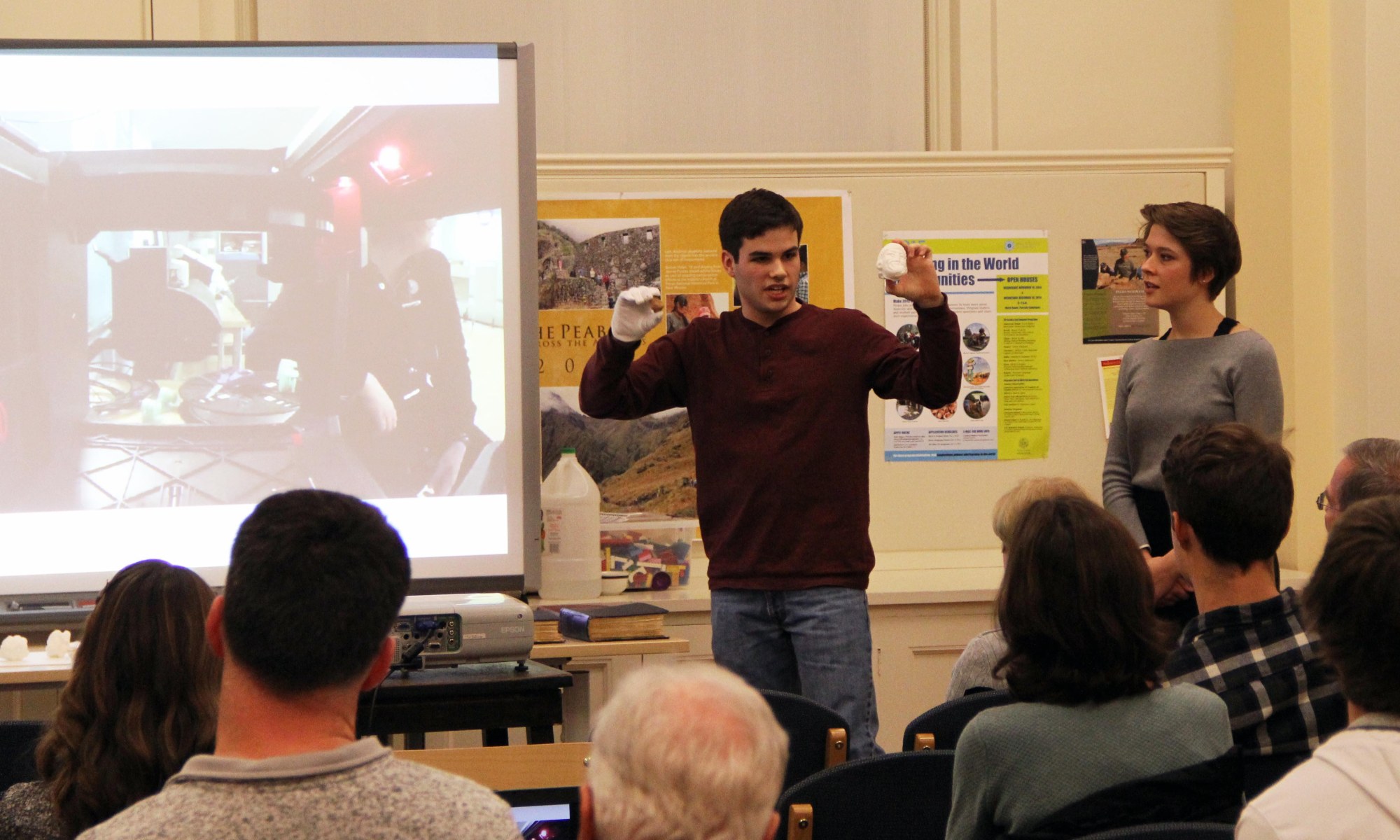
The highlight of my time at the Peabody was the term that my work-duty group 3D scanned and printed selected artifacts, and then presented our results and research on the topic at a MAS meeting. I’m a math and science guy, and I was thrilled when Marla announced the plans for the term to us. We cooperated with Ms. Wessner from the makerspace and her work-duty students to learn how to scan and print the artifacts we had chosen. We each then presented on a specific part of the project: one student on how we selected the artifacts to print, me on how we scanned and printed them, and two students on the implications of the 3D replication of artifacts. (We also got to eat a lot of food at the meeting.) It just goes to show how interdisciplinary work at the Peabody can be.

Interested to read more student reflections?  Visit here and here for more perspectives.

Adopt A Drawer: What is it like to catalog a drawer?

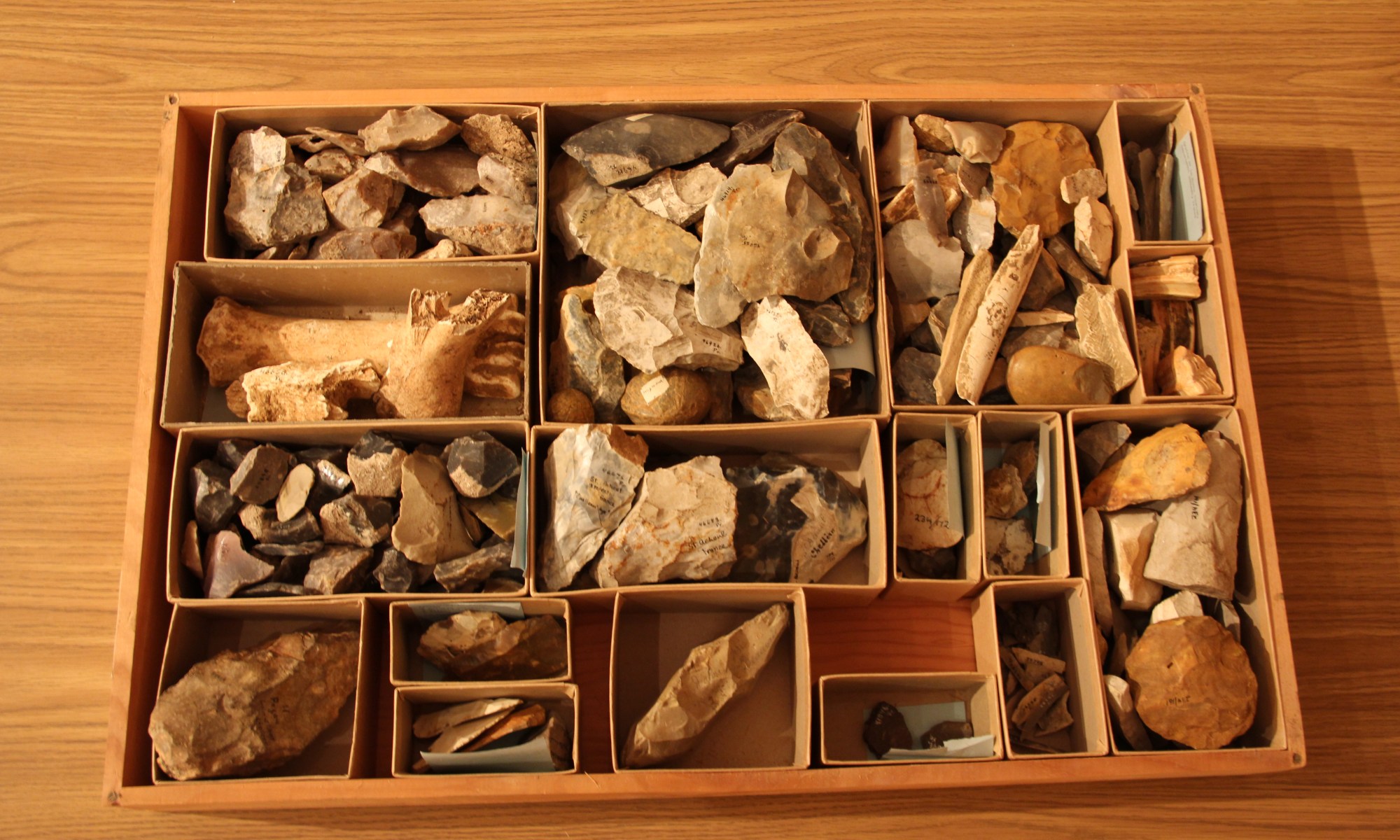
The drawer before cataloging

Contributed by Marla Taylor

In fall 2013 the Peabody launched Adopt A Drawer, which connects supporters with our collections. Each gift of $1,000 supports the complete cataloging of one artifact storage drawer. Participants receive an Adopt A Drawer t-shirt, updates on cataloging,  and their support is acknowledged with a name plaque and in our online catalog, PastPerfect.

Cataloging the adopted drawers is a time-consuming but rewarding task. Each drawer is selected with care to identify areas of the collection that need a little extra TLC. Often times, I don’t even know what I am going to find in the drawer!

The drawer that I am currently working on has taken quite some time. There are over 130 artifacts – mostly stone tools – from at least 13 different sites across France. Many of them are from cave sites of the Magdalenian era (10,000 – 17,000 years ago), but some of these blades, scrapers, and cores date as far back as 70,000 years old. Some of these tools could have been crafted by the hands of Neanderthals.

The drawer before cataloging

When I first began work on the drawer, the tools were piled on top of one another in several smaller boxes. This poor storage can easily lead to damage along the delicately crafted edges of these tools. It was in need of a major upgrade!
With the help of work duty students – I couldn’t do this without them! – each artifact was photographed, measured, and rehoused. I have researched each artifact in our original accession ledgers for location and collection information. These records have then been combined with notes provided by Kathleen Sterling and Sebastien Lacombe of Binghampton University and experts in the lithic technology of France’s Upper Paleolithic who visited the collection in May 2015. I am integrating all of this information into their catalog records and the adoption process is nearly complete.
I will soon share details of the contents of this drawer with its donor and you can access it too by exploring our collection online.

For additional information how to adopt a drawer watch our short video or visit our website.

Changing Spaces

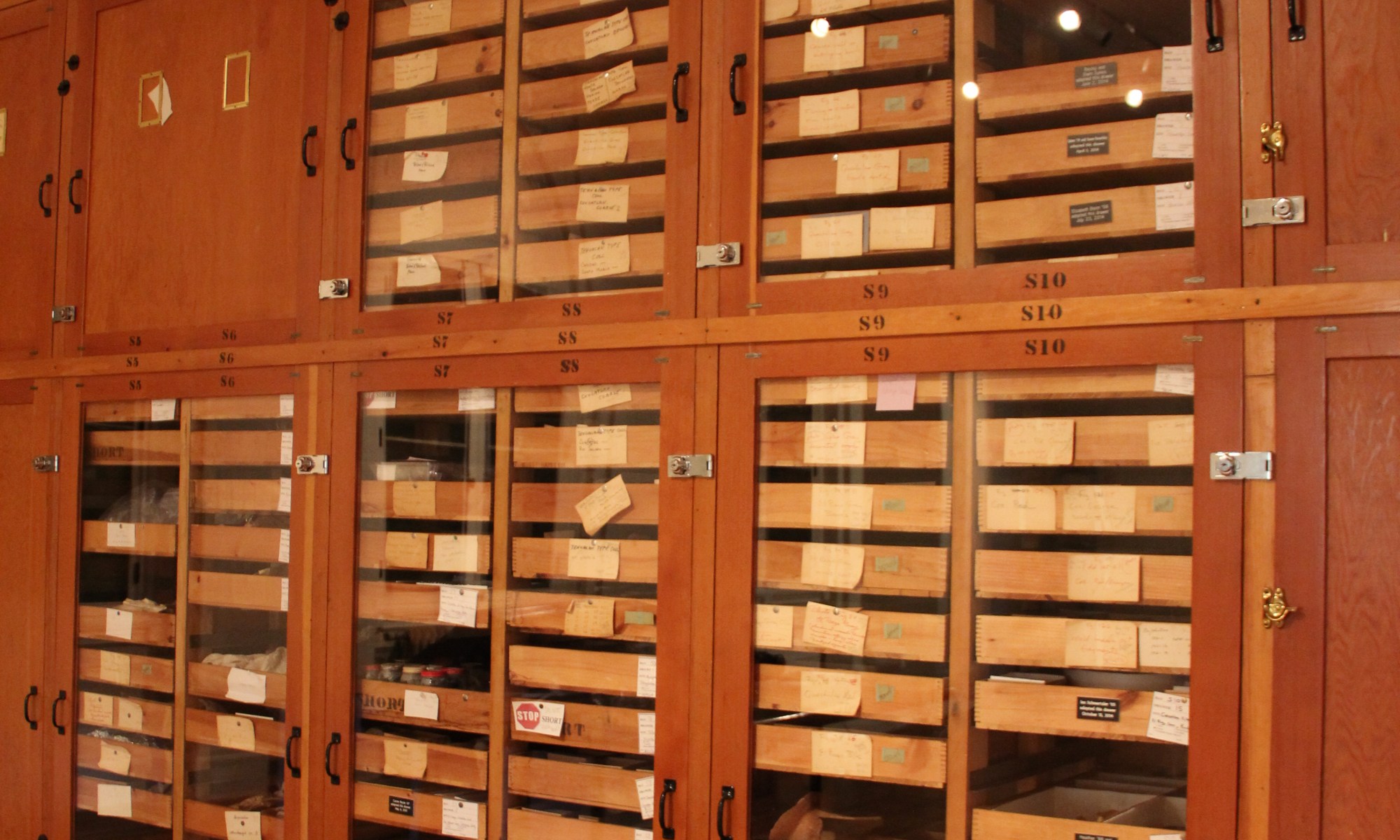
Collections with new plexi-glass doors

Contributed by Marla Taylor

Updating spaces at the Peabody is like playing with a giant sliding puzzle. In order to rearrange one room, you have to make space in another for everything that will be displaced. We wrestled with this puzzle as we recently updated two major spaces at the museum – our basement work room and our main exhibit gallery.

The basement work room is the center of most of the collections work at the Peabody. It is where work duty students, volunteers, and collections staff spends most of their time. And, until recently, it was home to several staff work spaces too. But it was time to refresh the space and make room to spread out the collection as we transfer artifacts from the old wooden drawer to new archival boxes.


Updating the gallery space was no small task! First, all the old exhibit was dismantled and objects were returned to storage. Then the exhibit cases were removed. And finally, the false walls that confined the space were demolished. Patching and painting is now underway. Future projects will see updated lighting and restoration of the windows.


Conversations are on-going about how to utilize this newly empty gallery space. The added space has already benefited our community family days and will hopefully provide space for student curated exhibits and larger student and alumni events.

If you haven’t been over to the Peabody for a while, now is the time!

Masks at the Peabody

Contributed by Lindsay Randall

Masks are one of the most visual elements of a culture, often used to transform the wearer during rituals, ceremonies, or other events. The use of masks dates back thousands of years, at least to the Neolithic period some 9,000 years ago or much earlier. Many of our masks are believed to be from Mexico. Two years ago work duty students began researching some of the masks in our collection.  While not complete, their work has been invaluable for the classes we teach. Recently the Peabody pulled all the masks from our collection to share with students in Therese Zemlin’s art classes.

One class has an assignment to make a 3 dimensional clay gargoyle. By studying the Peabody’s masks students investigate how artist’s created expressions, developed the proportions of facial features, and how human and animal features were melded together. The other class is learning to perceive minute details that are otherwise missed when we assume we understand what we see.

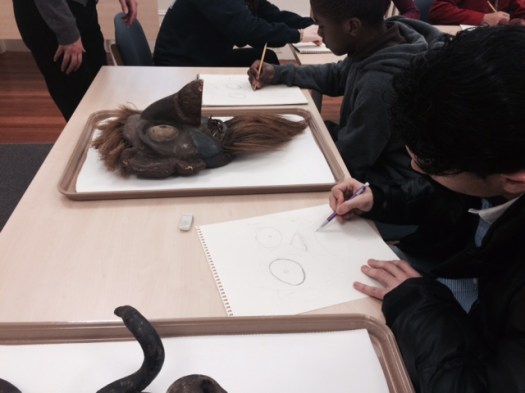
After looking at the masks and talking with me, the students are given time to begin sketching a mask of their choosing. This helps them to focus their attention even more and to gain a more intimate appreciation of the object in front of them, which will in turn aid them with their art projects.

FullSizeRender
A student sketches a mask of unidentified origin

To see some of the masks that the Peabody has visit our online catalog: http://peabody.pastperfect-online.com/40391cgi/mweb.exe?request=record;id=5114D1BC-AAD1-4BF5-A8B7-271626649170;type=101

Sharing what you learn – Student presentations

Image of student presenter

Contributed by Marla Taylor

On the third Tuesday of every month, the Massachusetts Archaeological Society – Gene Winter Chapter invites a guest speaker to their meeting at the Peabody Museum.  For the past six years, Phillips Academy students have been invited to speak about their experiences with archaeology at one of these meetings.

On February 16th, seven students, in three groups, shared their research and work on a variety of topics.

Youth for Restoration: Preserving Local History

Viraj Kumar’s ’17 interest in local history led him to create a non-profit organization that works to preserve and restore local history in Poughquag, New York. He discussed his experiences working with the community on a 19th century grist mill.

Printing History: 3D Rendering of Artifacts

Four students, Alana Gudinas ’16, Jacob Boudreau ’16, Mia LaRocca ’16, and Sarah Schmaier ‘16, were challenged to scan three artifacts from the Peabody Museum’s collection and print them as 3D models.  They discussed the process and highlight some of the implications of this technology for museums and other institutions.

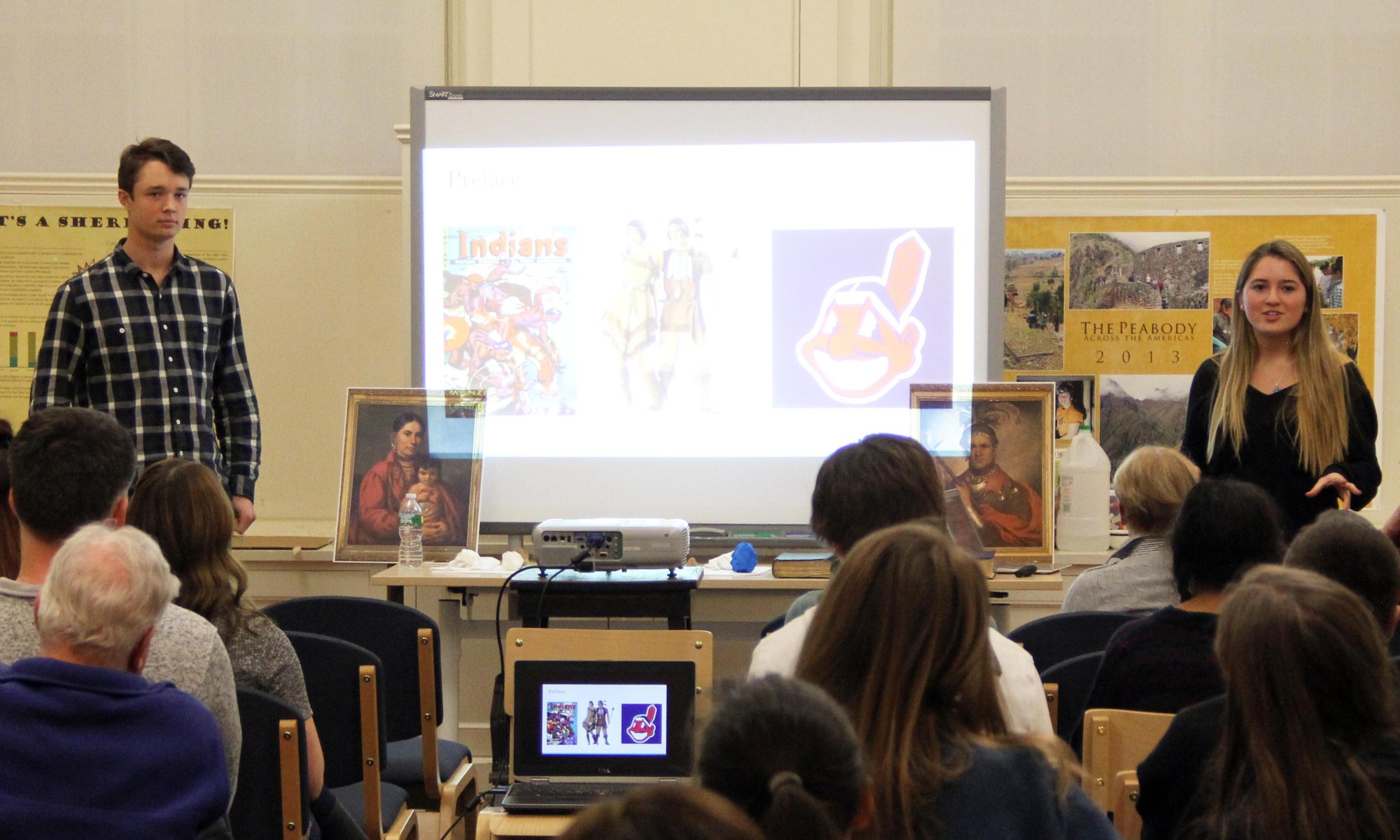
More than Meets the Eye:  19th Century Portrayals of Native Americans

In the 1830s, the first director of the Bureau of Indian Affairs launched an ambitious effort to collect over one hundred portraits of Native Americans.  Veronica Nutting ’16 and Alex Armour’16 investigated three of these paintings at the Peabody–how and when they got here, why they’re important, and how they compare to contemporary depictions of Native Americans.

Speaking to an audience of nearly 50 chapter members, professional archaeologists, and members of the PA community, all the presentations were very well received.  Congratulations to all the students for their hard work!

Check out this article from the Phillipian to learn even more.

Where the Past Meets the Future–The Peabody’s 2015-2020 Strategic Plan

We are happy to share the Peabody Museum’s draft strategic plan for 2015-2020, which charts the course for significant projects ranging from improvements to the historic museum building to enhanced physical and intellectual control over archive, photographic, and object holdings.

The plan emphasizes elements of Phillips Academy’s 2014 strategic plan, especially around the pillars of Creativity and Innovation and Equity and Inclusion. Many of the most requested class units at the Peabody explicitly deal with issues of race, ethnicity, and gender, often in the context of Native American history. The new plan underscores the importance of anthropological perspectives in teaching in these areas and encourages continued good partnerships with Native American communities. The pedagogy of collaborative learning is central to the Peabody’s strategic plan, which stresses hands on learning, project- and problem-based learning, experiential learning, and informed discussion in all of the Museum’s student focused programs. Plans to significantly improve collections storage will increase accessibility and ensure that collections are available for use well into the future. Centralized storage of collections within the Peabody building will set the stage for expanded classroom space in the future and allow us to better care for our significant collections.

To read the plan please visit our website  http://www.andover.edu/Museums/MuseumOfArchaeology/Documents/PeabodyPlan2015_2020.pdf

Feedback is welcome! Please contact museum director Ryan Wheeler to share and discuss your ideas. E-mail: rwheeler@andover.edu or Phone: 978.749.4493

Blubber: It’s what’s for dinner

Contributed by Lindsay Randall

The end of Winter Term has arrived and with it the bitter New England cold, which is fitting given our most popular lesson during this time is our Inuit focused activity, Blubber: It’s What’s for Dinner.

The lesson is part of the History 100 theme related to nomadic people. In the fall 9th graders learn about the Bedouins who travel throughout a desert landscape. During winter term students continue that theme by learning about the Mongols, a nomadic group who live in the Asiatic steppe. Classes examine the Peabody’s arctic collections as a way to support their learning about nomadic societies, giving them a chance to apply concept they have learned in class and applying them to another nomadic culture.

The three extreme environments; desert, temperate grasslands, and the frozen north help to highlight the similarities of the three groups. This allows students to pick out important key aspects that are central to any nomadic group, no matter the landscape they inhabit.

Students move between four stations that are set up around the Peabody and work in groups to determine answers to the following questions:

  • What is each object? How was it used?
  • What is the object made from?
  • Why are the objects grouped together?

As class begins we review what it means to be nomadic and how that might be reflected in material culture. An initial activity emphasizes that everything a nomadic person carries has a purpose and the heavier an item, the more important it might be.

This is illustrated by the object depicted below. Students quickly determine that it is made from stone, which automatically demonstrates its importance.  The shape suggests that it was made to hold something, similar to a bowl. They know that whatever it held had to be extremely important. Some students notice that each bowl has some black markings around the rim. It is usually this revelation that helps students to work towards the correct assumption – the bowl held fire, which in the arctic is central to survival.

This stone blubber lamp was collected by William Duncan Strong in Hopedale, Labrador Canada. You can see charring along the edge as well as a hole in the center to hold the wick.

This is one of my favorite lessons to do because it gets students to look at objects as cultural markers and to understand how they can be “read” for information about the people who made and used them.

The class is also a source of enjoyment because of how deeply engaged students get, particularly when I give them frustrating answers. “Yes but no” or “no, but close” are two of the phrases I often tell students when they share with me their hypotheses about the objects.

To many students these answers are a challenge. However, the most enjoyable moment is when the entire group rushes across the room to conspiratorially whisper their new answers to me  – least their classmates hear – and jump around in joy to find out they are, in fact, correct.

Best. Part. Of. Teaching. EVER.

Lindsay Randall revealing to the entire class the names and uses of objects at one of the stations.