More Than a Number: Cataloguing the Peabody Collection

Contributed by Emma Cook

My name is Emma Cook, I am the Administrative Assistant at the Robert S. Peabody Institute of Archaeology. I have a background in archaeology, history, and museum studies with undergraduate and graduate degrees from the University of Georgia and Tufts University. Aside from my administration duties, I work with the Peabody’s collections. Recently I’ve been involved in the Inventory and Rehousing Project and I am working with collections on the first floor South Alcove, located in one of our gallery/classroom spaces.

The Robert S. Peabody Institute of Archaeology collection comprises nearly 600,000 artifacts, photographs, and archives. Some of these materials are displayed and used for teaching, while many reside in our collection storage. What is unique about much of our collection space is its original storage. The bays and drawers in which many of these artifacts inhabit are almost as old as the Peabody itself, the bays being first built in the early 1920s. However, below the surface of these pine wood bays and drawers are a collection of uncatalogued objects that have hardly come to light (literally), with some still stored in the tin foil and paper bags they were placed in upon archaeological excavation many years ago.

The antiquated charm of these wooden bays is not enough to meet the need of accessible storage for our collections and the goal is to replace them with new custom-built shelves. In preparation of this storage renovation, objects need to be identified, catalogued, and rehoused. This work is completed through our Inventory and Rehousing Project.

Blog_1
First Floor, South Alcove – where my cataloguing work began

I began my work simply inventorying the objects in each drawer of each bay in the alcove. Some of these objects were already identified, numbered, and recorded in Past Perfect – a museum software that is the standard for cataloguing museum collections. Through this software, the Peabody collection is documented and made accessible online. My job was to make sure these objects were accounted for and in the right place, as well as properly rehoused and organized within the drawers. Sounds pretty easy right? Well, eventually things changed as I came across several drawers and bays containing objects with old numbers or no numbers at all. This is where my cataloguing efforts began.

Cataloguing is the process of recording details about an object into a collection catalog or database that documents the information of each object as well as its location in storage. Through this process each object receives a unique number. This number is physically attached to the object and appears in records related to the object in Past Perfect. In museums and archives, objects or materials in a collection are normally catalogued in what is called a collection catalog. In the past, this was traditionally done using a card index, but in the present-day it is normally implemented using a computerized database – for the Peabody this is Past Perfect. Some of the objects I came across with “old numbers” were either connected to the Peabody’s past card index cataloguing system or the Peabody’s original numbering system (i.e. 1,2,3,…. 78,049).

Blog_4
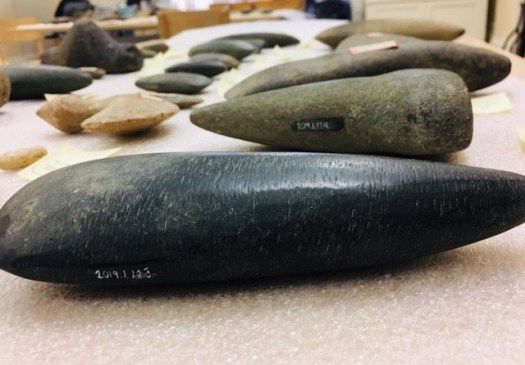
Lithic objects with affixed labels and old numbers

Each object was given a new number associated with the Peabody’s present catalog numbering sequence (i.e. 2019.1.123). This numbering sequence is a three-part number, making it both simple and expandable. The first part of the sequence is the year in which the object was accessioned or catalogued (i.e. 2019). The second part of the sequence is given to objects in chronological order based on when they were first accessioned (i.e. 2019.1). The third part of the sequence gives a single object a number in chronological order (i.e. 2019.1.1). Objects that had an affixed label had the new number written on the label. Objects without labels had their numbers painted on with ink. A solution called B72 is applied to the object before the ink in order to protect the original surface of each object. This solution is not harmful to the object and can be easily removed if a mistake is made or the object needs a different number.
Blog_5
Lithic objects with new numbers painted on their surface using ink and the B72 solution

The cataloguing process is not an easy one, nor is inventorying and rehousing a collection. The process may be slow and tedious, but it does have its rewards. By using a great deal of care, time, and effort, rehoused and identified objects can be used for teaching and research. Not only can collection staff have full access to the collection, they can provide a safe and accessible place for these materials in storage. The cataloguing process may seem like a trivial task, but it just goes to show – it’s more than a number.

For more information and reading on the Inventory and Rehousing Project, see the following blogs below:

Transcribing the Collection – January 2019

A New Face in the Basement – January 2019

Ceramic Inventory Complete – December 2018

Collections Reboxing Project Update – April 2018

A Day in the Life of Boxing Boxes – November 2017

Shelving to the Rescue – September 2016

Boxes and Boxes and Boxes – August 2016

Summer Work Duty Students Begin Rehousing Inventory – August 2016
Peabody at the Smithsonian

Contributed by Marla Taylor

Did you know that you can find artifacts from the Peabody in Washington, D.C.?  Well, you can!

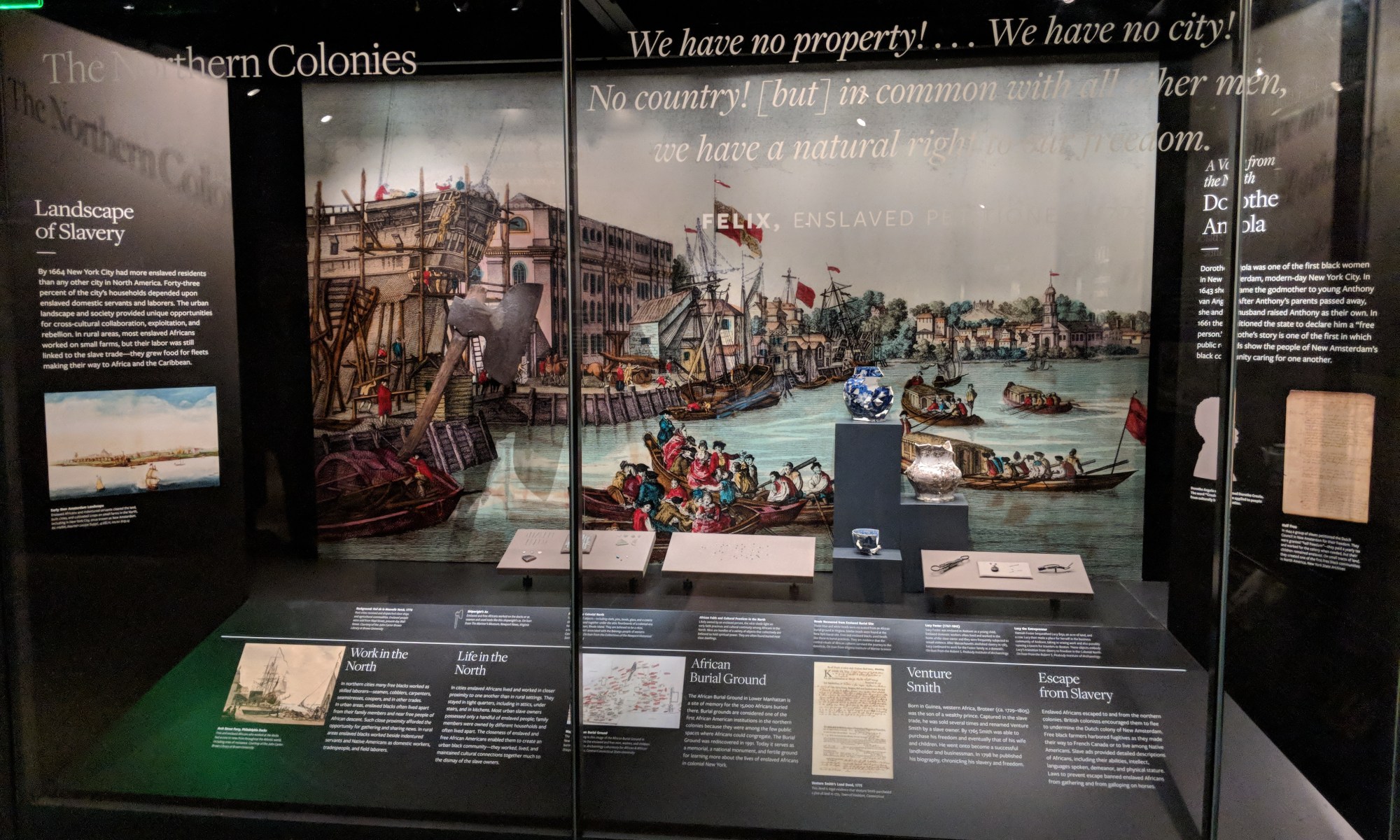
In 2018, the National Museum of African American History and Culture (NMAAHC) contacted the Peabody to request the loan of objects associated with Lucy Foster, a free Black woman, who lived in the Ballardvale section of Andover, for their Slavery and Freedom exhibition. Here is how the NMAAHC describes the exhibition:

The Slavery and Freedom inaugural exhibition is at the physical heart of the Smithsonian’s National Museum of African American History and Culture. The exhibition invites visitors to explore the complex and intertwined histories of slavery and freedom through the personal stories of those who experienced it. Chronicling the early 15th century through 1876, the exhibition explores the cultural, economic, and political legacies of the making of modern slavery and the foundation of American freedoms. Visitors will encounter both free and enslaved African Americans’ contributions to the making of America in body, mind, and spirit. They will glimpse a vision of freedom—an American freedom—pushed to its fullest and most transformational limits through the everyday actions of men and women. Most importantly, they will walk away with an understanding of how the story of slavery and freedom is a shared American history with deep roots linking all people together and that still impacts American society today.

The discovery of Lucy Foster’s homestead was an accident in 1945 as archaeologists Adelaide and Ripley Bullen were looking for evidence of an ancient Native American settlement. Lucy’s early nineteenth century homestead was instead one of the first African American archaeological sites excavated in the United States. To learn more about the excavation and the artifacts recovered, check out these sources:

Adelaide and Ripley Bullen’s 1945 article on the Lucy Foster site

Vernon Baker’s 1978 “blue book” on Lucy Foster’s ceramics

Vernon Baker’s 1972 book chapter on Lucy Foster

Anthony Martin’s 2018 article Homeplace Is also Workplace: Another Look at Lucy Foster in Andover, Massachusetts

You can also find many of Lucy’s belongings in our online collection.

The Lucy Foster site objects are displayed in Slavery and Freedom in “The Northern Colonies: Expanding Merchant Capital” section of the museum. These objects allow the NMAAHC to tell the story of women and their work in the north and bring to light the personal voice and story of Lucy Foster. Foster was born in Boston in 1767 and was sold into the household of Job and Hannah Foster at age four, in 1771. She worked as a domestic in their household until Job’s death in 1789, when she moved with Hannah to her new husband Philemon Chandler’s household. After Chandler’s death, they moved back to the Foster household until Hannah’s death in 1815. Lucy then established her own household on land willed to her by Hannah. Lucy died of pneumonia on November 1, 1845. Occasional mentions of Lucy in historical documents, coupled with the archaeological remains, has allowed a glimpse into her life.

The NMAAHC requested these objects because Lucy’s story is unique. She is one of two People of Color from this area with documentary and archaeological records to tell her story. Lucy was part of both free and enslaved communities in Andover, and these objects show how she continually used her sewing and cooking skills to carve a place for herself in the Andover community. These objects embody the presence of women and their work as fundamental to the northern states and are a rare example of objects from the early nineteenth century concretely connected to an enslaved person.

If you are in the D.C. area, be sure to stop by and say “hello” to Lucy!

Transcribing the Collection

Contributed by Marla Taylor

The Peabody Institute has been working for some time now to establish full physical and intellectual control over our collection. You can read about our progress here, here, here, and here.

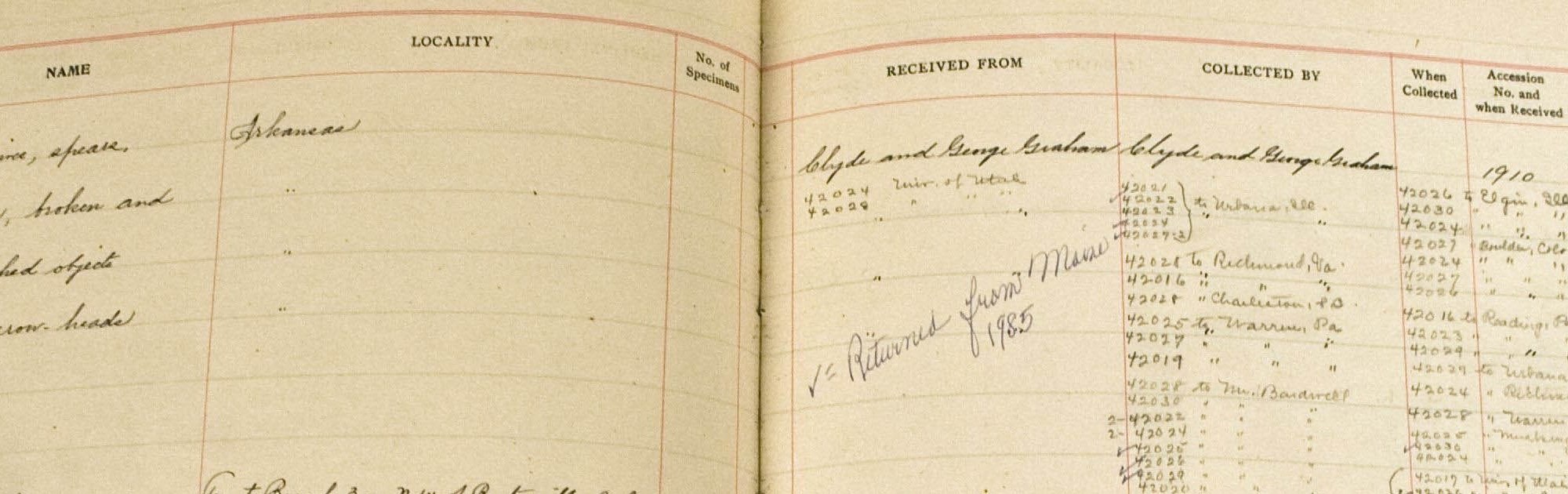
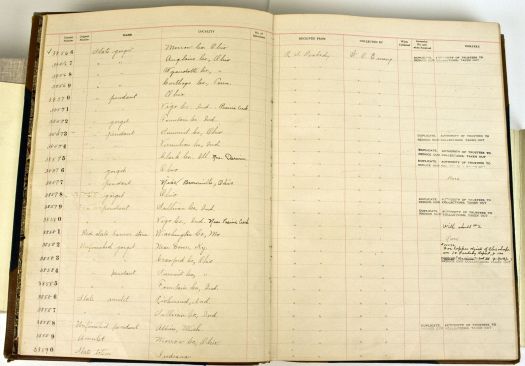
But, physically inventorying the collection is only half the project. The Peabody also needs to document and account for all the artifacts that came into, and left, the collection over the years. Currently, about 56,000 catalog records are present in our database, PastPerfect, versus the nearly 120,000 unique catalog numbers that have been assigned over the years. Original cataloging records at the Institute are largely on paper in two formats – ledger books that document the first phase of collections and individual catalog cards that were in use through the 1980s. Often, a single line of handwritten text or a 3×5 index card contains all the documented information for a specific artifact. That data is invaluable for making objects relevant and accessible to researchers, faculty, students, and in our ongoing repatriation work with Native American tribes.

example accession ledger page
A page from one of the accession ledgers

Recently, I presented this problem to the Board of the Abbot Academy Fund as part of their biannual grant cycle. Focusing on the need to transcribe the hand-written ledger books – 78,094 individual line entries in 14 ledger books. I am thrilled to report that the Abbot Academy Fund has chosen to support our Transcribing the Collection initiative!

The grant funds a temporary project transcriptionist who will type each line of the original accession ledgers from early twentieth century cursive into an Excel document. The project will be complete in the fall of 2019.

Once all this information is recorded, the Peabody will collaborate with PastPerfect to migrate the data into our database. The ultimate goal is to make the collection more accessible to staff, researchers, students and tribes.

I will keep you updated!

The Transcribing the Collection project is made possible by a grant from the Abbot Academy Fund, continuing Abbot’s tradition of boldness, innovation, and caring.

A New Face in the Basement

Contributed by John Bergman-McCool

Hi there! My name is John and I am the new Inventory Specialist at the Robert S. Peabody Institute. As Inventory Specialist my primary task is to work on the ongoing inventory and rehousing project. The project’s goals are to fully understand the collections that are held at the Institute and move them from their old wooden drawers into archival boxes. Armed with the more precise knowledge of what is in the Peabody, the institute can ensure their continued care and share them with students and the public for years to come.

This position is a dream job for me. It brings together my interest in archaeology, museums and collections care, and who doesn’t love spending time underground!

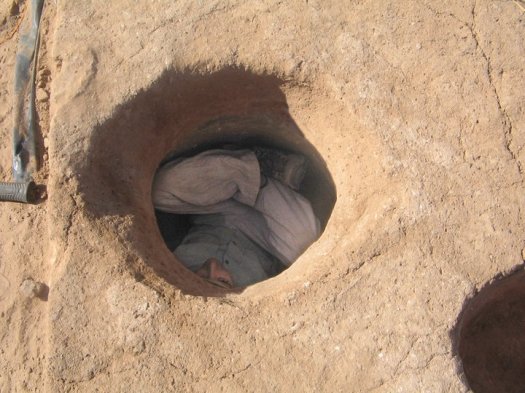
John inside a pit during excavations
Yep, this is me in a bell pit during an excavation in Arizona!

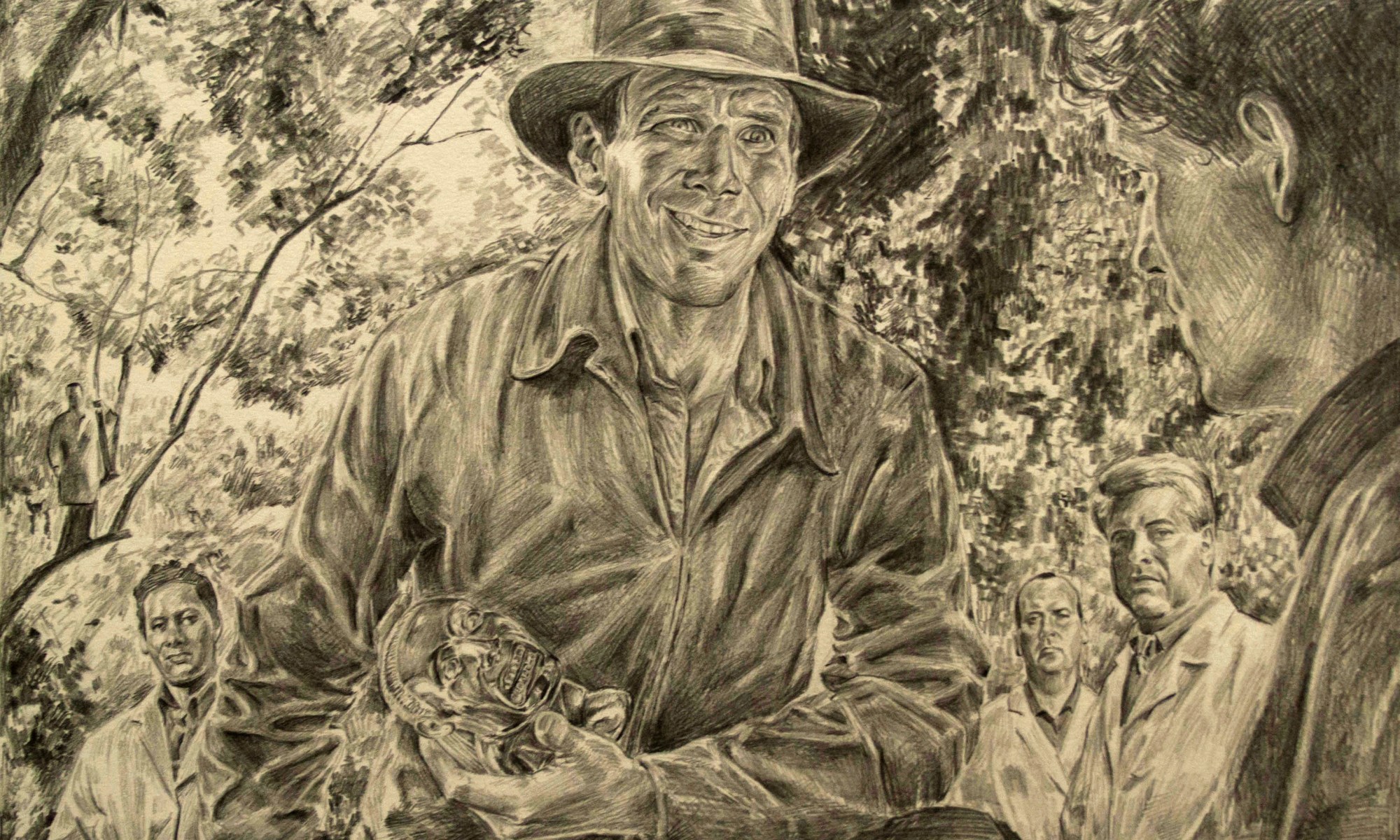
Before moving to Massachusetts in 2013, I worked for almost a decade as an archaeologist in the Pacific Northwest and Arizona. After relocating to New England I enrolled in the MFA program at Tufts and the School of the Museum of Fine Arts. During my time as a graduate student I found that I kept coming back to archaeology and the history of museum collections as a subject for my artwork.

_mg_9080 copy
Artwork from my thesis project

While I was in graduate school I also pursued a certificate in Museum Studies. I gravitated towards collections care and since graduating I’ve worked in collections at the Fitchburg Art Museum and Historic New England. ­

In a round-about way I’ve come back to archaeology, though it’s been following me for the past 5 years. During my time here I’ve been inventorying objects from Missouri. There have been some surprising finds, which has been great. You never know what you’re going to find here at the Peabody.

Ceramic Inventory Complete!

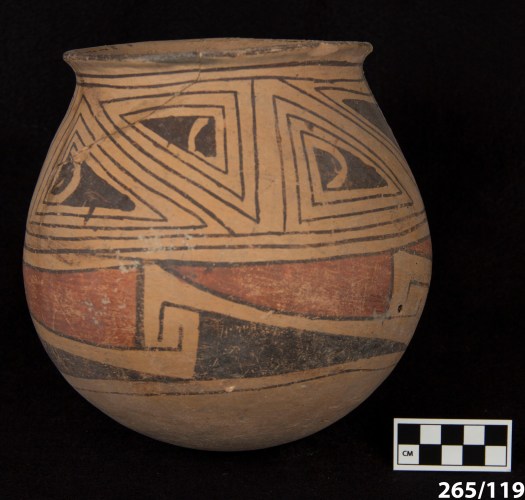
For the past year and a half, I have spent the majority of my time inventorying drawers as part of the Peabody’s Inventory and Reboxing Project. As exciting as that project has been, every once in a while I have needed to take a break from it to recharge my brain. In order to recharge while simultaneously staying productive, I was tasked with photographing and inventorying the ceramic vessel collection that is housed on the second floor of the Peabody. In order to complete this project, I printed out inventory sheets for the ceramic cabinets in Second Floor Storage and went shelf by shelf making sure each vessel was there and photographing it. This was great because I enjoy photography and try to do it often in my spare time. Once the vessels were photographed, I edited them in Photoshop and then uploaded the finished photos to each object’s catalog record in our museum software, PastPerfect. Editing the photos was very enjoyable for me because I was able to expand my Photoshop skills, which were pretty limited before taking on this project.

265_119
One of the ceramics that was inventoried and photographed

The original goal was to take one day a week to do these tasks. However, as the inventory project got rolling and certain collections needed to be cataloged faster than others, the ceramic inventory ended up getting slightly pushed aside in order to accommodate more pressing tasks at the Peabody. The main point of this blog post is this: the ceramic inventory has officially been completed!! Each vessel is logged into PastPerfect and has a photograph attached to it. The other exciting bit of information is that all of these vessels (except for NAGPRA sensitive ones) are available to view in our online catalog which can be found HERE. Take a look at the link to see what I have been working on, and feel free to peruse the online collections even further to see what else is housed at the Robert S. Peabody Institute of Archaeology!

Weaving through the collection

Have you explored the Peabody collection online lately?  If not, you should!

Nearly 375 baskets in our collection have recently been added to the online catalog.  Explore baskets from many regions of the country – southwest, California, northwest, and New England.  The baskets are cataloged by shape – Jar/bottle form, Tray form, Bowl form, Burden/gathering basket, Cap/hat, and Container.

We are proud to house baskets made by Molly Neptune Parker, Jeremy Frey, and Clara Darden.  Our collection also contains several rare baskets like these Salinin and Yuki examples from Central California.

Check it out and weave your way through the collection!

Peabody Signs on AAIA Statement on Indigenous Art

Contributed by Ryan Wheeler

The Robert S. Peabody Institute of Archaeology was one of seventeen tribes and other organizations supporting the Association on American Indian Affairs December 6, 2018 statement urging collectors and investors to buy contemporary American Indian art instead of antiquities.

The AAIA statement asks that collectors “interested in American Indian art should … support contemporary American Indian artists and their creations made for the art market” rather than buy American Indian “artifacts” and “antiquities.”

The statement explains the sad truth known to most archaeologists and museum workers, namely that “there is a long history of looting and stealing American Indian burials and important American Indian cultural and sacred patrimony. These items often end up in private collections and ultimately auction houses and institutions all over the world.”

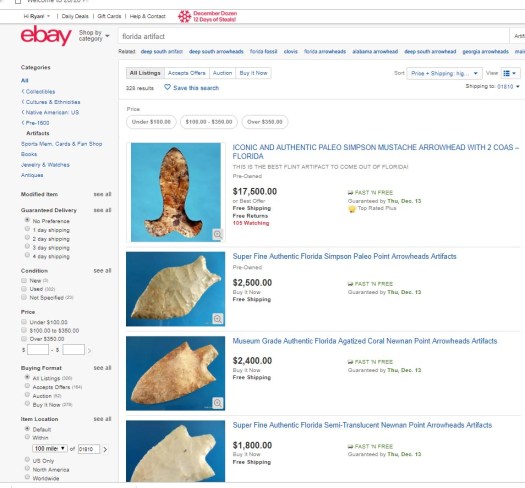
Image of artifacts for sale on the web.
A small sample of the many American Indian artifacts for sale on a popular internet auction site.

The advent of internet auctions in the mid-1990s made it easy for collectors to connect with sellers, ultimately fueling the demand for American Indian artifacts and antiquities and driving up prices. Internationally the trade in antiquities has been closely linked to funding terrorism, while domestically it is related to the illicit drug trade. A November 3, 2017 blog post by Jason Daley on Smithsonian.com concludes that most international antiquities being sold online are fake or illegal. The same is likely true of artifacts from the United States.

Image of posters about site looting, Operation Timucua press conference.
Exhibit during Operation Timucua news conference. Photo by Tim Donovan, Florida Fish and Wildlife Conservation Commission, February 12, 2013. Used in compliance with Creative Commons license https://creativecommons.org/licenses/by-nd/2.0/

One example is found in Operation Timucua, a multi-year undercover sting conducted by law enforcement agencies in Florida, which culminated in a number of arrests in 2014. Florida Fish and Wildlife Conservation Commission officers spent two years infiltrating what they came to know as a crime ring intent on removing ancient American Indian artifacts from public lands and then selling them on the internet, netting nearly $2 million. Thirteen individuals from Florida and Georgia were arrested, considered the main dealers and looters involved in the illicit organization. Massive numbers of antiquities were seized as well, many torn from sacred mounds and riverbeds where they had been placed and remained for thousands of years.

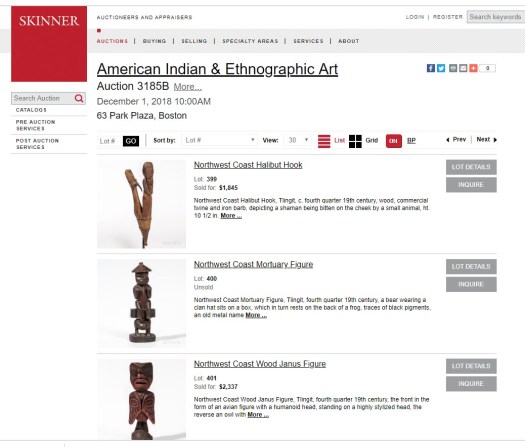
Image of some items sold in the Skinner December 1 2018 auction.
Screen shot of some of the items that were sold in the December 1, 2018 Skinner auction.

Closer to home, public outcry recently halted the auction of seven objects that originated with Tlingit, Bella Coola, and Nitinat peoples in the Pacific Northwest. The Medford Public Library, in a suburb of Boston, had received the objects in 1880. The objects were being offered in a December 1, 2018 auction run by Skinner in Boston, with sales of $117,000 anticipated and earmarked to fund construction of a new library. Shannon Keller O’Loughlin, executive director of the Association on American Indian Affairs asserted that the library needed to comply with the Native American Graves Protection and Repatriation Act (NAGPRA), a federal law that requires museums and other publically funded institutions and agencies to consult with tribes regarding sacred objects and objects of cultural patrimony. Medford Mayor Stephanie M. Burke investigated the auction with input from the town’s attorneys and ultimately agreed that the items should be pulled from the auction.

The AAIA statement concludes by stating that:

Buyers and collectors interested in Tribal antiquities and artifacts should do their own careful due diligence and consideration as to whether Ancestors and burial belongings, and cultural and sacred patrimony are a proper investment. Perceptions on collecting items of Tribal Cultural Heritage are changing quickly, along with laws that seek to protect them. Finally, and as stated above, buyers and collectors should focus their investment on contemporary American Indian artists whose stories and creations are accessible and created to share.

The William Duncan Strong Collection

This blog represents the twelfth entry in a blog series – Peabody 25 – that will delve into the history of the Peabody Institute through objects in our collection.  A new post will be out with each newsletter, so keep your eyes peeled for the Peabody 25 tag!

The Peabody Institute holds many collections from across North America. In the early 20th century, institutions often traded objects with one another in order to expand holdings and develop more diverse collections. One of the collections the Peabody received in trade is the William Duncan Strong collection, which consists of objects from Labrador. Strong was a prolific archaeologist and anthropologist who was known for his direct historical approach to studying Indigenous cultures of North and South America.

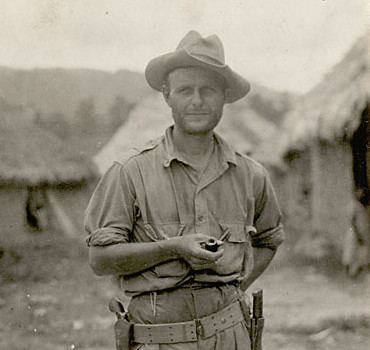
William Duncan Strong was born in Portland, Oregon in 1899. He attended the University of California at Berkeley where he initially studied zoology before switching his focus to Anthropology. While at Berkeley, he studied under Alfred L. Kroeber, a well-known American anthropologist who Strong considered a mentor and friend. Strong received his Ph. D. in 1926. His dissertation, titled “An Analysis of Southwestern Society,” was subsequently published in American Anthropologist, the flagship journal of the American Anthropological Association. Throughout his career, Strong conducted ethnographic and archaeological studies throughout southern California, Nebraska, the Pacific Northwest, the Great Plains, Peru, and Labrador.

william-duncan-strong-6f5667e9-c454-4b90-82e6-bc08deefff3-resize-750
William Duncan Strong. Photo Source: Alchetron.com/william-duncan-strong

The Labrador collection is one of the largest collections housed at the Peabody. It was given to the Peabody by the Field Museum in Chicago in exchange for materials from Pecos Pueblo. The Labrador collection contains many interesting artifacts from the Arctic region. Strong assembled the collection as part of a 1927-28 expedition to the Arctic led by Commander Donald B. MacMillan. MacMillan was known for his arctic cruises, which often included a variety of scientists and observers. Most of Strong’s time was spent in ethnographic research with the Montagnais-Naskapi, but he also found time to excavate several Inuit villages—this is where the Peabody collection originated.

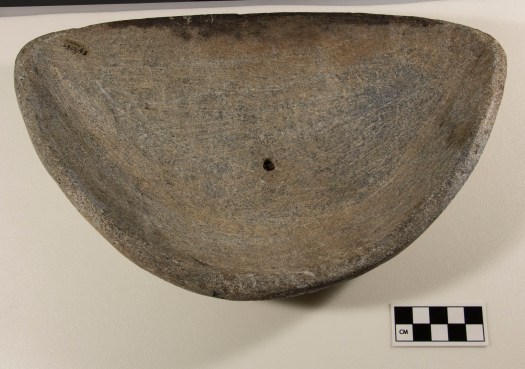
One of the artifacts that I found the most intriguing was what looked like a boat carved out of stone. I asked about what this object was since I had never come across anything like it.  I thought perhaps it was some kind of kettle but I was informed that it was actually a lamp called a Kudlik.

Lamp
One of the Kudliks present in our collection.

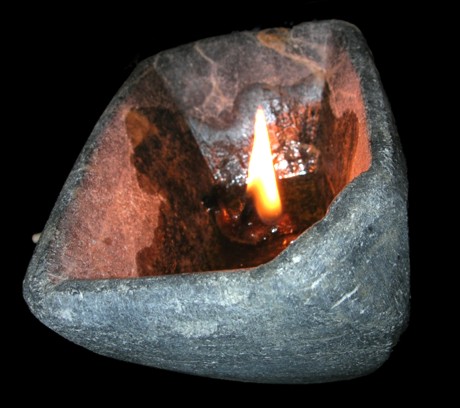
These lamps were typically used by people in the Arctic to light and heat their dwellings, to melt snow, and to cook. They were usually made out of soapstone, which was carved into a dish-like object with a shallow perforation in the center. This is where the wick, which was fashioned from cottongrass or moss, would be placed. The surrounding dish was then most commonly filled with seal blubber, although whale blubber was also used in whaling communities. The wick would soak in blubber, which would then allow it to remain lit and provide people with light.

paleoeskimo lamp burning
A picture of a Kudlik in use. Photo Credit: elfshotgallery.blogspot.com

It is always very interesting to see how people in the past used various objects from their environment to create tools that we still use to this day!

Party’s not over – volunteering at the Peabody

Contributed by Quinn Rosefsky ’59

No one invited us to the party but we’ve stayed for over nine years. And the desserts keep getting better. Not that what we do would come under the category of party. What should be obvious to readers of this blog is that I am talking about what it is like to volunteer at the Peabody Institute. First of all, who can volunteer? Being a graduate of Phillips Academy helps in passing the rigorous entrance examination but there are exceptions, such as my wife, Susan, whose qualifications, while many, started with marriage. This automatically reduces the interview process (but does not eliminate the background check.) And what do volunteers do?

Some of you might get the wrong impression that all we do is what the staff shy away from. Far from it. There have been plenty of occasions where it was all we could do to pry staff apart from a project to allow us to either dig into the unknown (such as categorizing about one hundred yards of unclassified photos) or finish it off (such as one hundred yards of labels.)

Of course, I am exaggerating. (No point in frightening you.) I have handled (and often read) documents from the nineteenth and twentieth centuries; paleolithic artifacts from 10,000 B.C.E; ledgers with tens of thousands of entries. I can picture specific bifaces, sherds and feathers.

What my wife, Susan, and I have been doing has varied considerably over the years as staff have come and gone, priorities have shifted, and time frames have expanded. I like to think that volunteering has allowed the Peabody to think in terms of decades, not centuries. This might come as a surprise until you consider that the Peabody is home to somewhere in the vicinity of 600,000 artifacts.

For quite a number of the past nine years, Susan and Leah (another spectacular volunteer) have been inspecting, vacuuming and protecting textiles from Guatemala. Although the end of the project has been in their sights for the past year, Einstein’s theory of special relativity keeps getting in the way (time slowing, distances shortening…easy stuff.) Eager to try my own hand at a multitude of projects, my time has been slowed as well. Despite Einstein’s slowing of time as we operate at the speed of light, sadly, all of us working as an extended family inside the Peabody’s walls have grown somewhat older (but not by much and not at the same rate.)

Most recently, I had the task of filling out labels to put on a few of the 1,500 drawers containing a variety of artifacts. It was a matter of necessity, not just my dexterity and eye coordination. When I completed that task, it was my honor to look for the “absence” of items. It all started with the discovery that an item had been “mislabeled.” That’s akin to looking through a haystack and saying you didn’t find the needle. And winning means you did not find the needle.

Sometimes I write blogs. I’ll stop here because my limit is 500 words. (Only staff can do more!)

Yoda_Quinn
Quinn after volunteering for 9 years

Ayacucho animals migrate to the Peabody

Contributed by Marla Taylor

Artifact collections are not meant to stagnate – museum collections are meant to be researched, examined, and shared.  In a perfect world, all loans are returned promptly and paper-work is meticulous. But, let’s be real, in an institution with 100+ years of history, this is not often the case. Fortunately, some past researchers remember you when it is time to relocate collections.

Circa 1972, Scotty MacNeish sent faunal material from the Ayacucho Valley of Peru to Dr. Kent Flannery of the University of Michigan for analysis. Dr. Flannery is a prominent zooarchaeologist who specializes in investigating the origins of agriculture in Mesoamerica and the Near East.  Many know Flannery from his 1976 book The Early Mesoamerican Village and his 1982 article The Golden Marshalltown: A Parable for the Archeology of the 1980s. Dr. Flannery completed the Ayacucho faunal analysis and sent data and a written chapter (for Volume I of the Prehistory of the Ayacucho Basin) back to MacNeish. But the artifacts were not returned until July, 2018.

Dr. Flannery, and the Museum of Anthropological Archaeology at the University of Michigan, shipped us 493 bags and 11 small boxes of faunal material.  A loan from 45 years ago, of course, did not have much paperwork, though we did locate the original Peruvian export permits and customs documents. But, all bags and boxes are now inventoried and part of the Peabody collection. The material is from Jaywamachay Cave, Ruyru Rumi Cave, and Chumpas Cave in the Ayacucho Valley.

Why does this matter? These collections can now be made available to a new generation of researchers and are reunited with other materials from MacNeish’s Ayacucho work.

If you want to learn more about the Ayacucho Valley and MacNeish’s work, check out the First Annual Report and Second Annual Report on the Ayacucho Archaeological Botanic Project. Some of the published volumes are available for free via the HathiTrust Digital Library.