Curious about the scholarly depth of the Peabody collections? Looking for material from a particular site for your research? Interested in simply browsing through the artifacts?
The site’s new and improved format is more user-friendly and provides easier access to our object records. Enter a key word to search, browse a full list of sites, and click through random images of artifacts.
In addition to a streamlined interface, the updated website also includes information about the archival collections housed at the Peabody. Temporary Archivist Irene Gates’s recent blog post highlights the completion of the first step in processing our archives. Or, explore the archival collections here.
While we do not yet have our full collection online, we add new records regularly – so come back often. I hope that you enjoy exploring the Peabody’s collections as much as I do!
The Peabody Collection Online is made possible in part by a grant from the Abbot Academy Association, continuing Abbot’s tradition of boldness, innovation, and caring.
Collection records for the Peabody’s archival collections are now online, via the museum collections management database’s online portal: take a look.
I am also very happy to announce that the processing work on the MacNeish archives is complete and that this material is now open for research. These archives have been processed as two collections, the Richard S. MacNeish papers and the Richard S. MacNeish records. The papers were donated by MacNeish in 2000, shortly before his death, while the records resulted from his directorship of the Peabody, 1968-1983, and had not left the museum since then. A finding aid with a folder-level inventory can be accessed via the link at the bottom of each collection record. There is parallel content in the two collections, so researchers are advised to consult both.
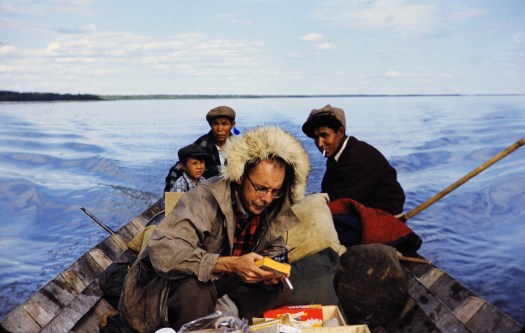
Here is one of my favorite photographs of MacNeish, from his papers – I think it exemplifies what an adventurer he was.
Richard MacNeish in canoe in the MacKenzie River, Canada, during his survey work there in the 1950s
The Temporary Archivist position is supported by a generous grant from the Oak River Foundation of Peoria, Ill. to improve the intellectual and physical control of the museum’s collections. We hope this gift will inspire others to support our work to better catalog, document, and make accessible the Peabody’s world-class collections of objects, photographs, and archival materials. If you would like information on how you can help please contact Peabody director Ryan Wheeler at rwheeler@andover.edu or 978 749 4493.
Last week, the Peabody had the pleasure of hosting Dr. Paulette Steeves as she examined portions of the MacNeish collection. Dr. Steeves is currently a Lecturer of Indigenous archaeology and anthropology and the Interim Director of the certificate program in Native American Studies at UMass Amherst. Her research focuses on the peopling of the Western hemisphere, but not through the traditional Bering Strait theory.
Dr. Steeves uses indigenous theory and methodology to explore sites in the Americas that date back as far as 60,000 years ago. This is actually a big deal and an anti-establishment approach to the subject. Dr. Steeves is looking into the materials collected by Scotty MacNeish during his work in the 1960s in Peru and Mexico for additional evidence. MacNeish was also a proponent of the idea of early colonization and much of his collection has remained unanalyzed for decades.
Dr. Steeves was thrilled to see the collection and to meet MacNeish himself on her visit. We look forward to hosting her again for many research visits to come!
This blog represents the fourth entry in a blog series – Peabody 25 – that will delve into the history of the Peabody Museum through objects in our collection. A new post will be out with each newsletter, so keep your eyes peeled for the Peabody 25 tag!
Contributed by: Lindsay Randall
Peabody curator Warren K. Moorehead, beginning in 1915, excavated in the Castine area of Maine in search of sites related to the Red Paint People. Moorehead believed the Red Paint People to be an ancient culture that was distinct from the more recent Algonquian tribes that still live in Maine today. He recognized a number of unusual artifact types found in Red Paint cemeteries and the liberal use of red ochre in burials, hence the name Red Paint. Ideas about the origins and relationships of the Red Paint or Moorehead Burial Tradition (as it is now called) are changing and often still hotly contested by archaeologists and tribes today. The Abbe Museum in Bar Harbor, Maine presents a timeline of contemporary Wabanaki peoples in Maine, demonstrating continuity of modern American Indians back to the earliest occupation of the state.
Map showing the location of Castine, ME.
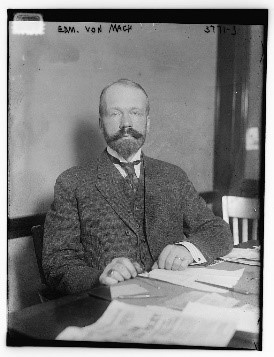
While Moorehead’s Castine investigation did not locate Red Paint site, numerous shell heaps were found. One of the most amazing sites to be excavated was located on the property of Professor Edmund Von Mach. Von Mach was an instructor in art and fine arts at Harvard, Wellesley and other schools in the Boston area and published books on painting and art history. He gained some notoriety during and after World War I for encouraging Americans to support the German cause and his book Official Diplomatic Documents Relating to the Outbreak of the War was withdrawn due to inaccuracies by the publisher.
Portrait of Edmund Von Mach
Von Mach’s politics aside, the shell heap was a very impressive monument, measuring approximately 660 feet long and having a depth between 3 and 5 feet. The vast majority of the shells present were quahog clams, quite common to the area. Given that a total of twenty four hundred artifacts were recovered, combined with the sheer expanse of the heap and its numerous layers, it is believed that the site was a permanent settlement used by tribes about 2,500 years ago.
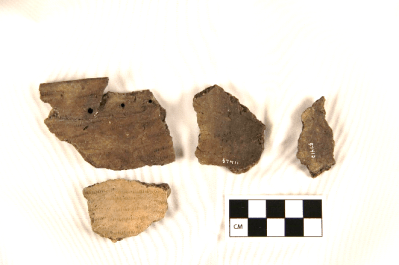
Throughout the summer, several hundred people visited the site to see what unique pieces of the past were being unearthed. Some of the most interesting artifacts discovered were fragments of pottery.
Four pottery pieces from the Von Mach Shell Heap collection at the Peabody Museum.
The pottery is unusual in New England as the soil conditions are very acidic and often deteriorate fragile artifacts. Ceramic specimens are more common in other parts of the country, like the American Southwest.
The only reason that the pottery was not dissolved by the acidic soils surrounding it is that the shells were deposited in the same area. Leaching of calcium carbonate from the shells neutralized the harmful acidic soil. Altering the soil matrix in this manner allows for almost unprecedented preservation of sensitive material.
The pottery helps us to learn about technology and artwork in the community. The introduction and development of ceramics into Maine around 2,700 years ago was very important. It is during this same period that the populations increased and became more sedentary in permanent villages.
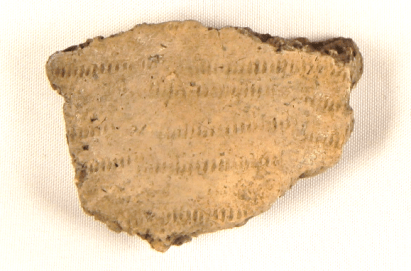
The majority of the pottery pieces in our collections are small and fragile, despite being preserved in the shell heaps. The ceramic pieces also are decorated with stamped and incised lines. This method of decoration not only reflects the aesthetics of the time, but may have helped reduce air bubbles prior to firing.
Close-up of one of the incised pottery fragments
Interestingly, archaeologists are now investigating the language that we use to describe archaeological sites. In her 2014 PhD dissertation at UMass Amherst Katie Kirakosian looks at the terms used by archaeologists like Warren Moorehead and his contemporaries to describe shell-bearing sites like Von Mach’s and how these terms have influenced our thinking about the sites and the people that made them. Kirakosian concludes that use of terms like “shell midden” to describe these sites (and, by extension, their Native constructors) denies their complexity and can result in a narrow and biased narrative.
The bulk of the Peabody’s collection is stored in the basement. It has been challenging over the years to control the temperature and humidity in the basement – an essential factor in maintaining an artifact collection. A small fluctuation of both temperature and humidity is normal and expected as seasons change. However, extreme variation lead to damage – bone can become fragile, ceramics can develop weak-points, and even stone tools can become brittle.
For the past four years, I have been tracking the environment throughout Peabody and noticed these strong fluctuations. By taking readings of the temperature and humidity in all our storage spaces once an hour (through the use of a datalogger), I determined that the influx of outdoor air through these poorly sealed windows is large contributing factor. There is only one way to fix this.
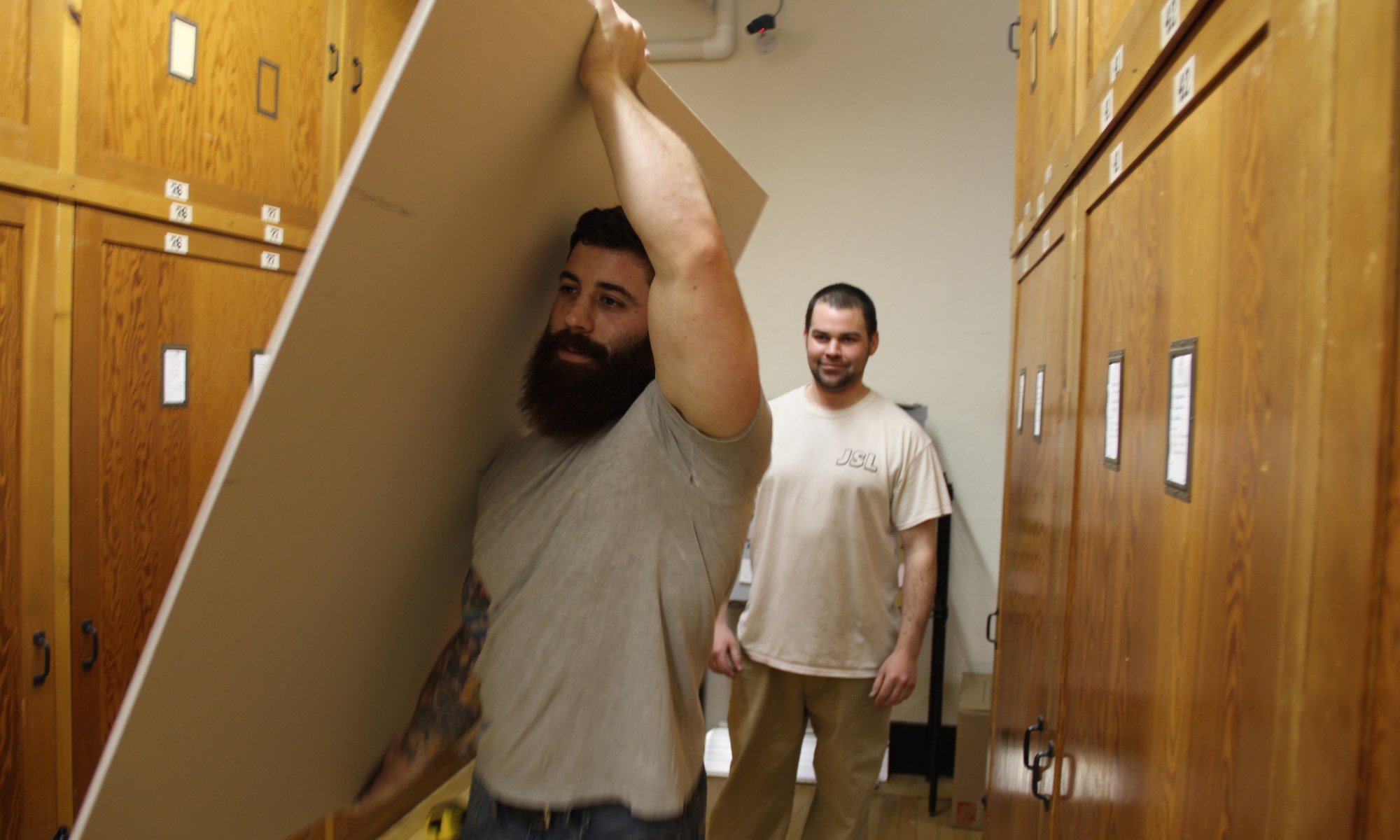
In collaboration with the Office of Physical Plant on campus, we are implementing a plan to mitigate some of this fluctuation. Contractors are working to seal the windows in the basement to stop outside air from sneaking into the storage.
This will stabilize the environment and lead to fewer changes in both temperature and humidity. The first step on the road to environmental control!
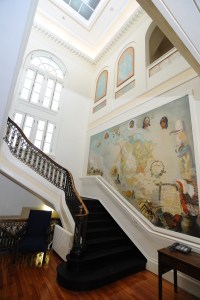
The central staircase of the Peabody includes a mural of American Indian life and history titled “Culture Areas of North America” by Stuart Travis (1868-1942). Travis was an accomplished and prolific American artist, illustrator, and designer who studied at the Académie Julian in Paris. His works—mostly drawings and watercolors—appeared frequently in magazines, books, and advertisements in the early twentieth century. Travis first came to Phillips Academy in 1928 to create the mural “History and Traditions of the School and Vicinity” in the Oliver Wendell Holmes Library. He continued to work at Phillips Academy, where he painted a total of three murals; he also designed the stone and wood gate that now leads to the Moncrieff Cochran Sanctuary.
Stuart Travis Mural at the Robert S. Peabody Museum of Archaeology. Photography by Gil Talbot.
The Peabody mural measures 13’11” by 10’2” and reflects ideas about anthropology and archaeology in the 1930s and 1940s. Major elements include the Maya Pyramid of the Magician at Uxmal on the left and a totem pole of the Northwest Coast on the right, with a map of cultures areas of North and Middle America occupying a central position, surmounted by six portraits across the top of the mural. Details and insets abound, illustrating artifacts, archaeological sites, ethnographic items, and scenes from Aztec and Maya codices. Illustrations of artifacts are drawn from the British Museum, the Museum of the American Indian (now the National Museum of the American Indian), the American Museum of Natural History, the Robert S. Peabody Museum of Archaeology, as well as several other prominent institutions.
Major Maya archaeological sites are labeled on the central map, but the majority of the map surface only depicts watersheds and topography, suggesting that Travis may have planned to add even more detail to the mural. The shadow of a thunderbird is painted over the central map, with a note explaining the widespread belief in supernatural birds in the Americas. Other details include an inset illustrating details of the Cahokia, Etowah, and Hopewell sites—likely a nod to long-time Peabody Director Warren K. Moorehead’s work. In all, there are over 30 American Indian artifacts illustrated (some in low relief), ranging from an example of Mi’kmaq writing on birch bark to a Tlingit “raven hat.” Many of these artifacts were probably drawn from contemporary books and articles on archaeology, while some may have been suggested by Museum staff. Detailed notes about the artifacts were likely included so the mural could be used as a teaching tool for visitors.
Travis dated the mural 1938, but continued with additions through 1942. The mural was restored in 1997 by Christy Cunningham-Adams through the generous support of the Abbott Academy Association.
This blog represents the third entry in a blog new series –Peabody 25– that will delve into the history of the Peabody Museum through objects in our collection. A new post will be out with each newsletter, so keep your eyes peeled for the Peabody 25 tag!
Contributed by Marla Taylor
The unassuming and muddled looking object below is a piece of loosely formed breccia from Jacob’s Cavern in McDonald County, Missouri.
Breccia from Jacob’s Cavern
Breccia is a type of rock that is composed of broken fragments of other rocks that have been cemented together by a fine-grained matrix – this process can take thousands of years. While this piece is not yet solid rock, it is on the way. In this case, the matrix (or glue) is ash from thousands of fires that sustained life in the cavern for hundreds of years.
Acting on a tip from a local named E.H. Jacobs, Charles Peabody and Warren Moorehead traveled to Jacob’s Cavern in April of 1903 to examine the site. Upon arrival, they found a large rockshelter of limestone with hundreds of stalactites and stalagmites, and the floor was covered with a thick layer of fine ash up to 1.5 meters (nearly 5 feet) deep! This ash is most likely the direct result of untold numbers of small fires in the cavern to keep the occupants warm over the years of use.
Peabody and Moorehead excavated the thick layer of ashes in using a careful grid system and uncovered hundreds of artifacts. The stone tools were primarily projectile points and blades with relatively few large tools like axes. They also found a ‘considerable’ number of bone needles and awls. These small bone tools are essential in daily life to create, maintain, and repair clothing and other basic equipment. The sheer volume of ash and artifacts in the cavern indicates long-term occupation.
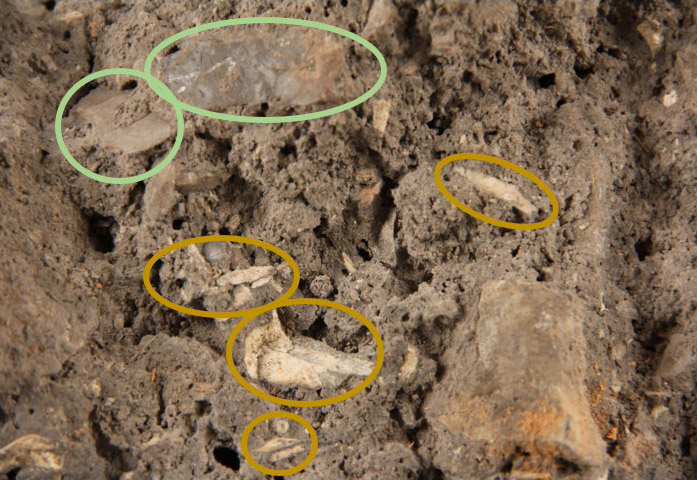
All evidence of human occupation – stone and bone tools, food debris – in the cavern was found in the layer of ashes and intermingled with breccia. And, most notably, many artifacts are visible within the breccia (see the photo below). This means that they were created, used, and discarded before the formation of the breccia and were left undisturbed for possibly thousands of years.
Detail of breccia with stone tools circled in green and bone fragments circled in yellow.
Peabody and Moorehead brought samples of the breccia and hundreds of collected artifacts back to the Peabody in 1903 while excavations continued by Mr. Jacobs for another couple years. Published in 1904, the report of their work became the first Bulletin published by the Department of Archaeology. The entirety of this report can be found here.
The work done by Peabody and Moorehead with Jacob’s Cavern became a foundation for later work at the Peabody. Explore and excavate a little-known site, bring the materials back to Andover for study, publish about that work, and provide invaluable new research and insight into the field of archaeology.
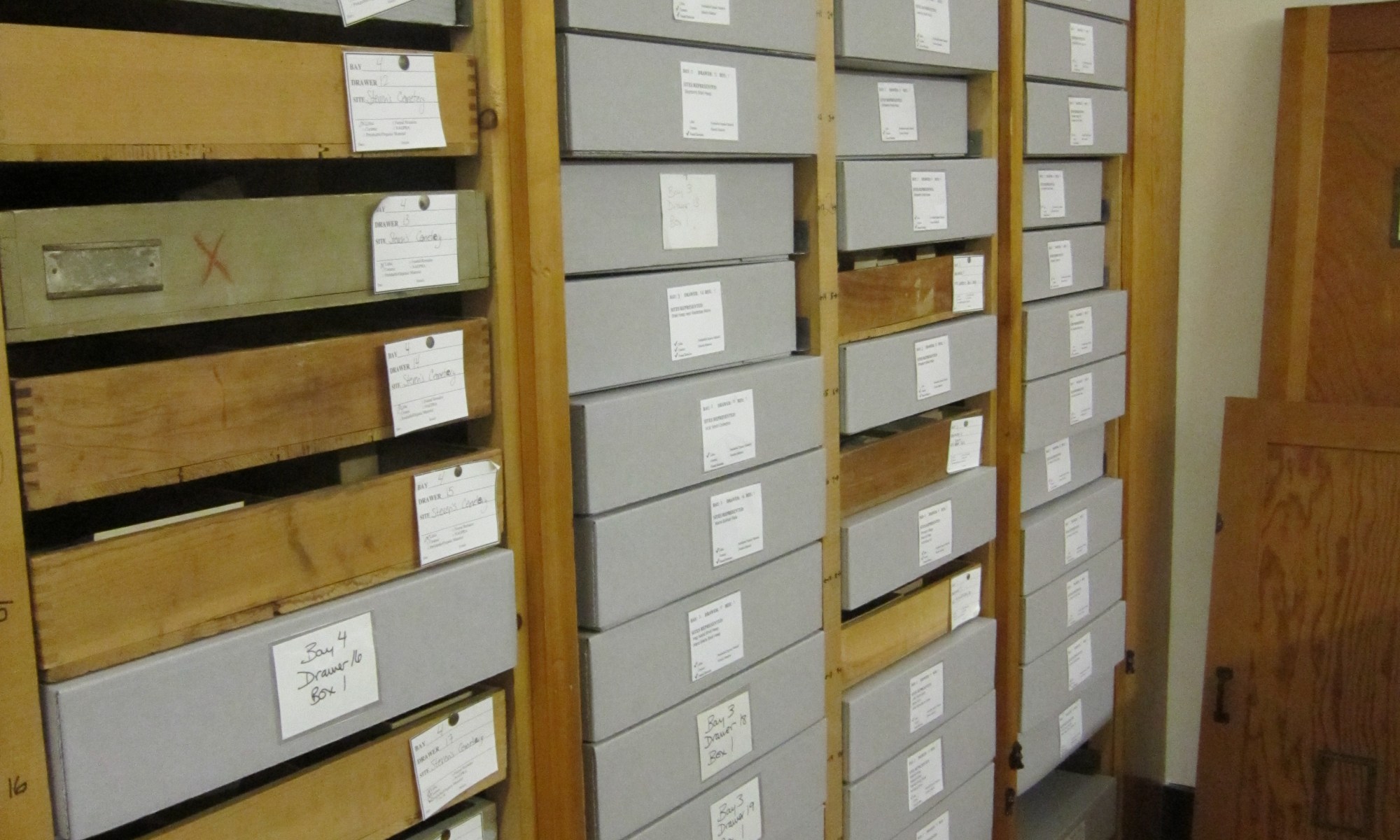
About six months in and the reboxing project is beginning to take off. With the help of students and volunteers, 52 drawers have been converted into 86 boxes. These first months have been spent ironing-out the kinks in the procedure and strategically identifying areas of the collection on which to focus.
The inventories produced from this project have already helped to identify areas of the collection for further attention and have made some objects available for education use.
Archaeologist Richard S. MacNeish—known as Scotty—devoted his career to untangling two of the biggest questions of archaeology: when did people begin domesticating plants and how did that act impact and influence the development of civilization? During his tenure at Phillips Academy’s Robert S. Peabody Museum of Archaeology MacNeish led multidisciplinary expeditions to Mexico and Peru to search for the heartland of domesticated maize or corn. Before his death in 2001 MacNeish had searched for the origins of rice cultivation in China, studied early cultures of Belize, and planned to look at wheat domestication in Turkey. Evidence for domestication often could be found in dry caves, where ancient plant remains were preserved. Speaking of his research in China, MacNeish quipped, “I’ve crawled in and out of more caves than a Neanderthal caveman.”
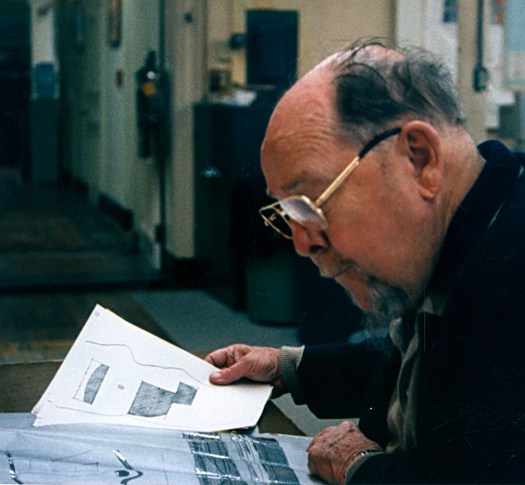
Scotty MacNeish reviews excavation profiles.
Despite MacNeish’s indefatigable quest for the origins of the world’s most important crops, answers remained elusive. In Mexico’s Tehuacán Valley, near modern-day Puebla, MacNeish and his team reconstructed ancient environments, devised chronologies, and documented a sequence of corn domestication from tiny, primitive cobs to those that look much like the corn that was growing in the area during the Spanish conquest in the sixteenth century. MacNeish’s suggestion of an early date for corn domestication, however, was met with skepticism, as many archaeologists believed that these crops were developed after significant strides in social organization, urbanism, and the other hallmarks of civilization. A debate ensued, but much of MacNeish’s Tehuacán research was sidelined as other scientists found evidence for even earlier sites of corn domestication in the Mexican lowlands, pushing the dates back to at least 8,700 years ago.
MacNeish’s 1960s excavations at Coxcatlan Cave, Tehuacán Valley, Mexico.
MacNeish’s collections, preserved since the 1960s at Phillips Academy’s tiny Robert S. Peabody Museum of Archaeology, have continued to attract the interests of scientists. A November 21, 2016 article in the journal Current Biology reconstructs for the first time ever the complete genome of an early domesticated plant, based on a tiny, 5,310 year old cob from MacNeish’s Tehuacán project (Catalog number 90.184.36). The specimen was removed from an old exhibit case several years ago and loaned to the Smithsonian Institution’s Bruce Smith, a co-author of the new study. Statistical analyses of the DNA data indicate that the study specimen, dubbed Tehuacan162, is “a step that links modern maize with its wild ancestor.” Of particular interest were genetic markers for domestication—some of which were already exhibited in this early specimen—while others were not. This challenges previous models for corn domestication that focus on two major steps, countering that the history of domestication is more gradual and complex than currently believed. In conclusion, the study finds that Tehuacan162 is an ancient form of maize that is closely related to the ancestor of all modern maize, yet distinct from teosinte, a wild grass that is the closest living relative to maize.
MacNeish’s Tehuacán exhibit featured hand painted images like these of early plant domesticates.
Part of Scotty MacNeish’s 1970s era exhibit about his work in the Tehuacán Valley of Mexico–note the corn cobs and kernels.
The tiny corn specimen 90.184.36, also dubbed Tehuacán162, used in the recent study.
Corn cobs from Scotty MacNeish’s projects in Tamaulipas and Tehuacán Valley, Mexico.
Today the Robert S. Peabody Museum of Archaeology provides educational programming to the high school students of Phillips Academy, ranging from classes to work behind-the-scenes with our significant collections. Researchers also are encouraged to use the Museum’s holdings and often share their results with students.
This blog represents the second entry in a blog new series – Peabody 25 – that will delve into the history of the Peabody Museum through objects in our collection. A new post will be out with each newsletter, so keep your eyes peeled for the Peabody 25 tag!
We don’t know much about the relationship between our institution’s founder Robert Singleton Peabody and his son Charles, the museum’s first director. In fact both men remain a bit of a mystery as they were intensely private and left little in the way of memoirs, notes, or archives. Robert’s rather substantial gift to the Academy, for example, was to remain anonymous until well after his death. For years we assumed that Charles, like Robert, had attended Phillips Academy. We found recently, however, that he stayed a bit closer to home and completed his high school education at the Germantown Academy—a venerable day school not far from the Peabody home in Philadelphia. In one of the few pieces of correspondence that we have between the two Peabodys, Charles exhorts his father to help him secure a position at the new Phillips Academy Department of Archaeology and asserts that he will not be the architect of his own undoing. Charles was on hand for the grand opening of the Archaeology Building in 1903, as he had been appointed the “honorary director.” One object in the Peabody’s collection provides a little window into what may have been a fraught and complicated relationship.
Object 19661 in Robert Peabody’s original collection is a small terracotta bird, perhaps a swan or goose. A handwritten note in pencil on lined paper tells us part of the story. Charles, during his tenure at the American School of Classical Studies at Athens, received the terracotta figurine from the school’s factotum Nikolaki. Charles muses in the note that Nikolaki had “hooked” it from one of the American excavations, perhaps at Argos or Eretria. Excavation reports can be found for both sites. For example, Charles Waldstein excavated at Argos from 1892 to 1895, with some focus on the Sanctuary of Hera. During the same time, Theodore Woolsey Heermance worked at the theatre of Eretria. Some quick poking around suggests that the little figurine, handmade of attic clay and covered with a white slip, is likely a votive offering. Similar offerings, representing an array of animals and birds, have been found at many Greek sites. Waldstein’s report on the Argos excavations mentions a number of terracotta figurines—some human and others animal. These offerings would have been placed in a temple for some set period and then discarded as ritual debris. Many similar examples can be found in auction catalogs and in the extensive collections exhibited at the Met.
The elder and younger Peabodys did have a lot in common, beyond their interest in discretion and privacy. Both were united in a passion for archaeology. Robert’s interests were more antiquarian—during his life he amassed some 38,000 archaeological specimens, principally from North America, while Charles was devoted to the French Paleolithic and dabbled in stratigraphic excavation, when horizontal and vertical control was a new concept. In many ways the two men represented archaeology’s past and future. Robert’s interests as a student had leaned toward the classical and he was named the valedictorian of his class. His correspondence with his curator Warren Moorehead and the administrators of Phillips Academy are filled with Latin and classical references. Charles received his PhD in philology—sort of a combination of classical languages, Biblical studies, and archaeology—from Harvard in 1893. After this he spent some time in Athens at the American School where he picked up the little votive bird. Robert appended his own note—in blue pencil—to Charles’s, indicating that he had received the bird from his son in 1897. Not long after this Charles was becoming established as an instructor in European archaeology at Harvard. With the creation of the Phillips Academy Department of Archaeology in 1901 Charles spent more time in Andover, helping to make decisions about the construction of the archaeology building and ultimately teaching classes as he could. The little votive bird was shipped from Philadelphia to Andover as part of Robert’s burgeoning collections, forming the core of the Museum that we know now. With Robert’s death in 1904, Charles pursued his passion for prehistoric European archaeology, participating in and leading a number of expeditions during his career before ultimately moving to France permanently in 1924.
We can only assume that both men, well versed in classical languages and archaeology, knew exactly what that little ceramic bird was—an offering from a votary to a god.










 The Peabody