Behind the Photograph: Traveler in Tweed

Contributed by Emma Lavoie

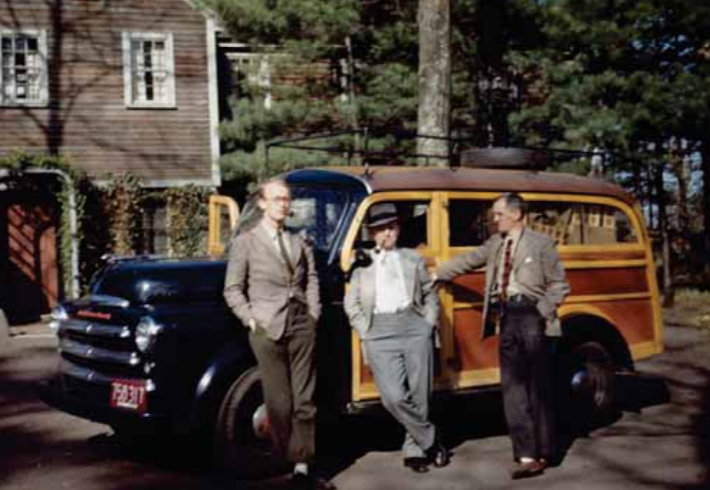
Pipe in mouth and axe in hand, a man in a tweed suit stands in front of a 1940s Dodge “Woody” station wagon brimming with suitcases and archaeological gear. The crates on the ground by his feet are labeled, “F. JOHNSON, PEABODY FNDN, ANDOVER, MASS.” Who is this man and where could he be traveling to?

The year is 1948 and this traveler in tweed is Frederick Johnson, curator of the Peabody (known as the Robert S. Peabody Foundation for Archaeology at the time) from 1936-1968.
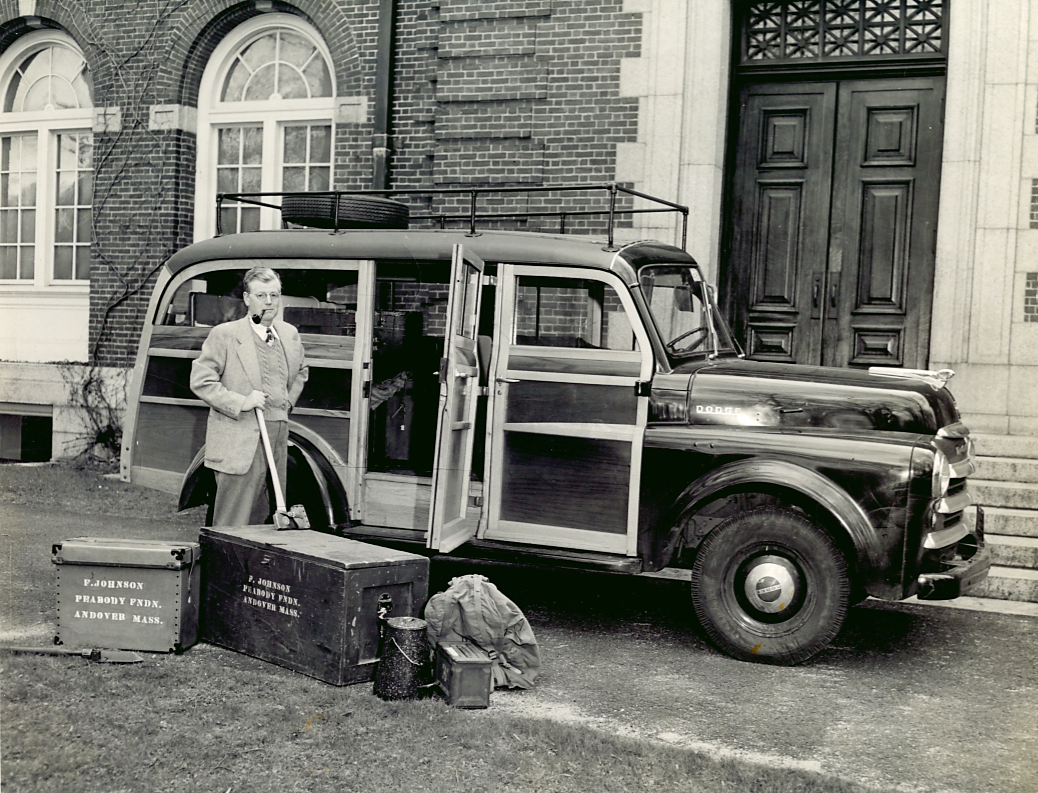
Fred Johnson with expedition gear in front of the Peabody, 1948.

Frederick Johnson (1904-1994) joined the Robert S. Peabody Foundation for Archaeology as Curator in 1936. He held this position until 1968, serving one year as Director before retiring in 1969. During his time at the Peabody, Johnson initiated an archaeological excavation program for students at Phillips Academy. He also organized the Committee for the Recovery of Archaeological Remains (1945-1968) and chaired the American Anthropological Association’s Committee on Radioactive Carbon 14 (1948-1968.)

Johnson is recognized for contributing to the development of an interdisciplinary approach to archaeology, using scientists from various fields to study archaeological problems together. The Boylston Street Fish Weir project (1939) in Boston, MA as well as the Andover-Harvard Yukon Expedition (1944 and 1948) were two examples of this method.

The image of Fred Johnson above was taken before his trip to the Yukon Territory for the last year of the Andover-Harvard Yukon Expedition. This five-month field project combined archaeological and geobotanical research in the unknown northwestern interior of North America and was carried out jointly by the Peabody and Harvard University (funded by additional sources, including the Wenner-Gren Foundation.)

The journey began from North Dakota to Burwash Landing, Yukon with research in parts of the Shakwak and Dezadeash Valleys in southwestern Yukon. The project leaders were Fred Johnson and Professor Hugh Raup, botanist and Director of the Harvard Forest in Harvard, MA. Two Harvard graduate students served as assistants in the botanical and archaeological research, Bill Drury and Dr. Elmer Harp, Jr.

Harp was a recent Harvard graduate and Curator of Anthropology for the Dartmouth College Museum in Hanover, NH. He documented the trip through field notes and his own photographs. Below is one of Harp’s photographs taken at the beginning of their trip. Do you notice anything similar between these two images? That is the same station wagon in each photograph and yes, that is Fred Johnson with his pipe again! Harp and Drury were tasked with driving the expedition’s station wagon from Boston to Whitehorse, Yukon Territory – standard labor assigned to graduate students in the field.
Bill Drury, Fred Johnson, and Elmer Harp at the start of the Andover-Harvard Yukon Expedition, May 4, 1948. Photograph by Dr. Elmer Harp, Jr., Professor of Anthropology Emeritus, Dartmouth College, Hanover, NH.

According to Harp’s recordings from the expedition, Johnson and Raup conducted several projects in the early years of the Yukon project (1943-1944) exploring for evidence of the first appearance of humans in the New World. The 1948 project was to search for archaeological sites along the eastern borders of the Rocky Mountains via the Alcan Highway. This was the first time the highway was opened to civilian traffic since the beginning of WWII. The Andover-Harvard expeditions went on to represent the first systematic explorations of Yukon’s prehistoric past.

Further Readings and Resources

For more information on the Yukon project, see its publication: Investigations in Southwest Yukon, by Fred Johnson, Hugh Raup, and Richard MacNeish, 1964

Explore Elmer Harp, Jr.’s field notes on the Andover-Harvard Yukon Expedition: North to the Yukon Territory via the Alcan Highway in 1948: Field Notes of The Andover-Harvard Expedition.

For more information on the Andover-Harvard Yukon Expedition photographs by Fred Johnson check out our blog: Cataloging photographs in our database, and the Andover-Harvard Yukon Expedition photographs

JAE Publishes Special Issue on Doing and Teaching Archaeology Online

Contributed by Ryan Wheeler

May 2021 saw the publication of special issue “Perspectives on Teaching, Learning, and Doing Archaeology and Anthropology Online” in the Journal of Archaeology and Education. Nine timely articles address the big picture and specific case studies in teaching archaeology and anthropology online—something that many of us have gained new experience in during the pandemic. And, while most institutions are looking to a return to in-person teaching, these articles, organized by David Pacifico and Rebecca Robertson, and based on the 2018 American Anthropological Association roundtable session “Teaching and Learning Anthropology Online,” make the case that teaching archaeology and anthropology online is not only possible, but can be done well and comes with some benefits. For example, Russ Bernard makes the case in his article that “online education is the only way to scale up training in statistics and research methods for both graduate students and undergraduate students of anthropology,” helping to forge more and better connections between our academic departments and employment. Michael Wesch, in his contribution, describes anth101.com, an online course that “is organized around 10 big lessons that attempt to help students embody the ‘ethos’ of anthropology, including … the ability to ask big questions, try new things, see patterns, see the big picture, see the little things that matter, and overcome fear, hate, and ignorance to empathize with others and understand cultural differences.” Check out this great special issue and all it has to offer at JAE today! And, many thanks to JAE editor Jeanne Moe and JAE guest editor Katie Kirakosian for their work on the special issue, and to the authors for sharing their work in JAE!

The Journal of Archaeology and Education is a peer-reviewed, open-access journal dedicated to disseminating research and sharing practices in archaeological education at all levels. We welcome submissions dealing with education in its widest sense, both in and out of the classroom—from early childhood through the graduate level—including public outreach from museums and other institutions, as well as professional development for the anthropologist and archaeologist. The journal’s founders recognize the significant role that archaeology can play in education at all levels and intend for The Journal of Archaeology and Education to provide a home for the growing community of practitioners and scholars interested in sharing their first-hand experiences and research.

JAE was founded at the Robert S. Peabody Institute of Archaeology, where archaeology is used to support high school curricula at Phillips Academy, and is hosted at the University of Maine’s Digital Commons website.

dIPPIN’ iN: Quick Conversations with Archaeologists

Contributed by Lindsay Randall

Given how wildly successful our Diggin’ In: Digital Lecture series has been, we wanted to expand how our audiences can interact with archaeologists from around the country. 

Our new project – dIPPIN’ IN: Quick Conversations with Archaeologists – highlights the variety of jobs and experiences archaeologists can have by asking each person the same five questions:

  • Describe what kind of archaeology you focus on.
  • How did you get into archaeology?
  • Why should we care about archaeology and history?
  • What is the most exciting thing you ever found?
  • Anything else people should know about archaeology?

It is fascinating to learn about each archaeologist’s career path and what initially hooked them. And, while some answers have been remarkedly similar many are wildly different!

If you want a glimpse into the exciting field of archaeology through the personal lens of an archaeologist, this series is for you.

As we continue to add to the series, you can find the videos here.

And, if you are an archaeologist who wants to participate or if there is someone you want us to interview – let us know!

Diggin’ In: Season 2

Contributed by Lindsay Randall

We are tremendously excited to announce the continuation of Diggin’ In: Digital Conversations with Archaeologist. Co-hosted by the Peabody Institute and the Massachusetts Archaeological Society the lecture series brings leading experts and their work directly to our viewers. All lectures are free and open to the public.

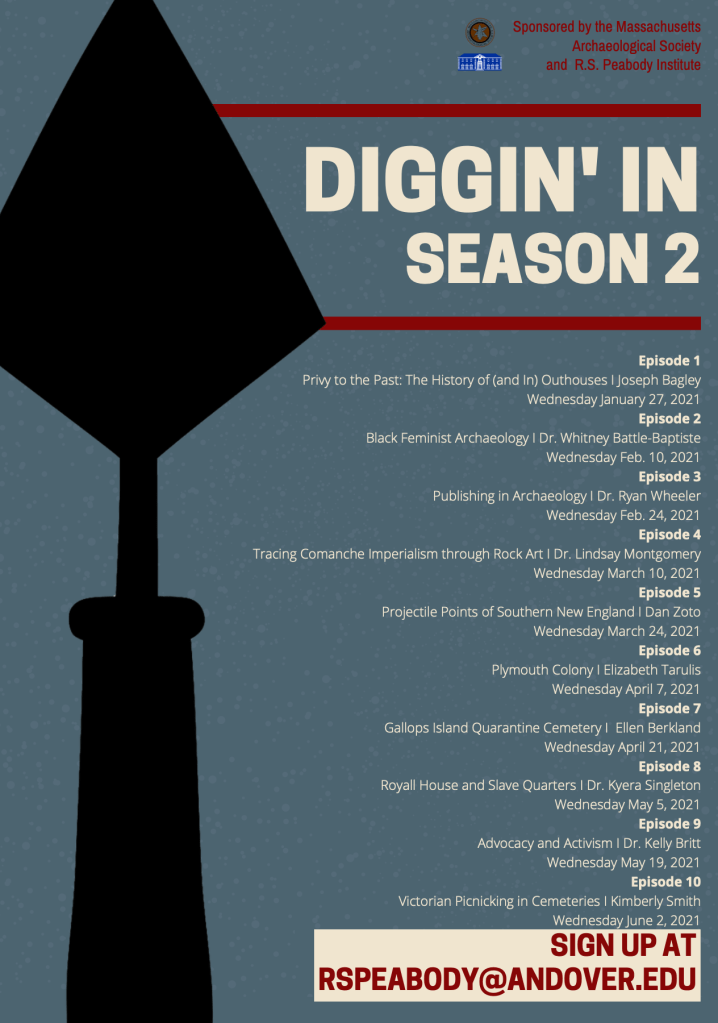
Building on the success of the inaugural season of Diggin’ In, which reached over 1000 individuals, Season 2 promises to continue to be especially robust. Outstanding scholars such as Dr. Whitney Battle-Baptist, Dr. Lindsay Montgomery, and Kimberly Smith will cover fascinating topics ranging from Black feminist archaeology, to Comanche rock art, to the artifact patterning of the Victorian practice of picnicking in cemeteries.

Join us on Wednesday January 27, 2021 for the launch of the new season with Joe Bagley, Boston City Archaeologist for his talk Privy to the Past: The History of (and in) Privies. All lectures begin at 1:30 pm. 

If you want to attend one or all of these lectures, please sign up at rspeabody@andover.edu to get on the ZOOM invitation list.

Each episode will be recorded and uploaded to YouTube afterwards.

The Making of the Peabody Annual Report

Contributed by Emma Lavoie

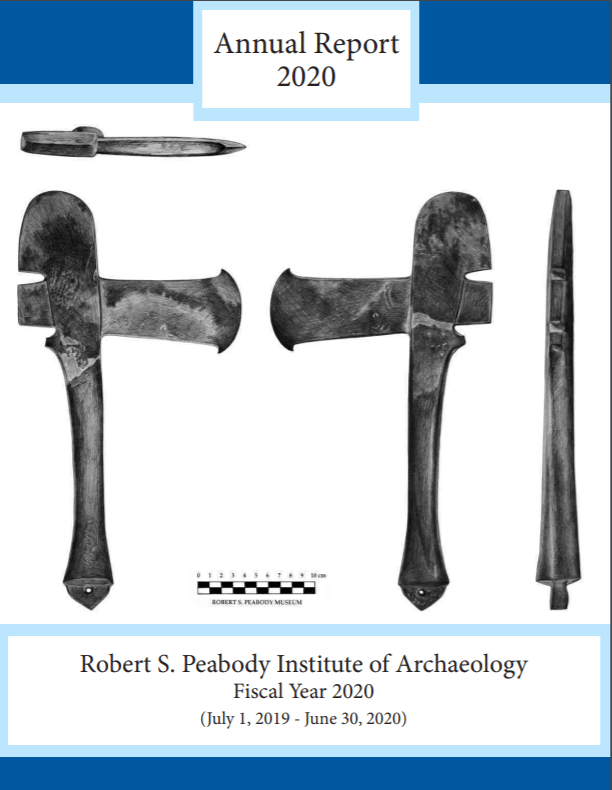
To many institutions, the annual report is one of the most important pieces of information. A single document, yet a powerful tool in communicating an institution’s performance during each fiscal year. Each fall the Peabody presents their annual report to the public, highlighting their achievements, overall performance of the past year, as well as their goals and objectives for the coming year. Not only does the annual report provide a snap shot of what a year at the Peabody looks like, it provides transparency of the institution to the public and its local community.

The making of the Peabody annual report includes several staff members who collaborate in the documentation, writing, and gathering of the material across several departments within the Peabody. These include: Administration (Ryan, Director), Education and Outreach (Lindsay, Curator of Education and Outreach and Ryan, Director), Collections (Marla, Curator of Collections), and Peabody Donors and Support (Beth, PA Director for Museums and Educational Outreach). Once the information is gathered and content is written, I take over to design the overall layout of the annual report.

A page from the 2020 Peabody Annual Report

Using the Adobe InDesign software, I create each page spread using the information that staff give me. When designing, it is important to always keep in mind the overall flow of information and that the format/design features are cohesive throughout the document. Something new I incorporated into the report this year were black and white photographs from the Peabody archives. I used these photographs as transitions between specific sections of the report to provide a natural break, while still maintaining the overall flow of the report. I also had a little fun creating a new page dedicated to our collections remote work during Covid-19.

Photograph from the Peabody archives used in the 2020 Peabody Annual Report

I really enjoy designing the annual report and watching all the work Peabody staff put into the year unfold with the design of each page. Not only does it provide an opportunity for each department to feature their success and performance, its where all the Peabody’s work finally comes together.

You can view the 2020 Peabody Annual Report here. Enjoy!

SAA Announces New Peabody Award

Contributed by Ryan Wheeler

In August, the Society for American Archaeology (SAA) announced its newest education award, the Robert S. Peabody Institute of Archaeology Award for Archaeology and Education.

SAA_logo

The Robert S. Peabody Institute of Archaeology Award for Archaeology and Education recognizes the excellence of individuals or institutions in using archaeological methods, theory, and/or data to enliven, enrich, and enhance other disciplines, and to foster the community of archaeology education practitioners. The Peabody Award will spotlight these contributions and promote teaching ideas, exercises, activities, and methods across the educational spectrum, from K-12 through higher education and public education.

Peabody Advisory Committee member and recent chair Dan Sandweiss ’75 proposed the award to the PAC and SAA. Both organizations agreed that it was a great opportunity to honor those involved in archaeology and education, joining the Journal of Archaeology & Education as another important tool for creating community among those engaged in these endeavors.

One important criterion is that nomination documentation must include materials—like activities or lesson plans—that can be shared with the broader community via SAA’s website.

The award description indicates that anyone may submit a nomination and that nominees do not have to be members of the SAA. Both individuals and programs are eligible. The award committee offered this list as examples of activities that might distinguish a nominee, including archaeology service learning programs, popular archaeology writing, adult or youth training programs, lessons or lesson plans for K-12 educators, archaeological outreach programming, oral history projects, lifelong learning classes or programs, archaeology camp experiences, and collaborative work with other educators or institutions around archaeological pedagogy.

The deadline for submitting a nomination is December 1, 2020 and submission information and guidelines are on the SAA website for the Robert S. Peabody Institute of Archaeology Award in Archaeology and Education. Peabody director Ryan Wheeler is serving as the SAA’s Teaching Awards committee chair and can be contacted with questions about the Peabody Award.

Diggin’ In: Digital Speaker Series

Contributed by Lindsay Randall

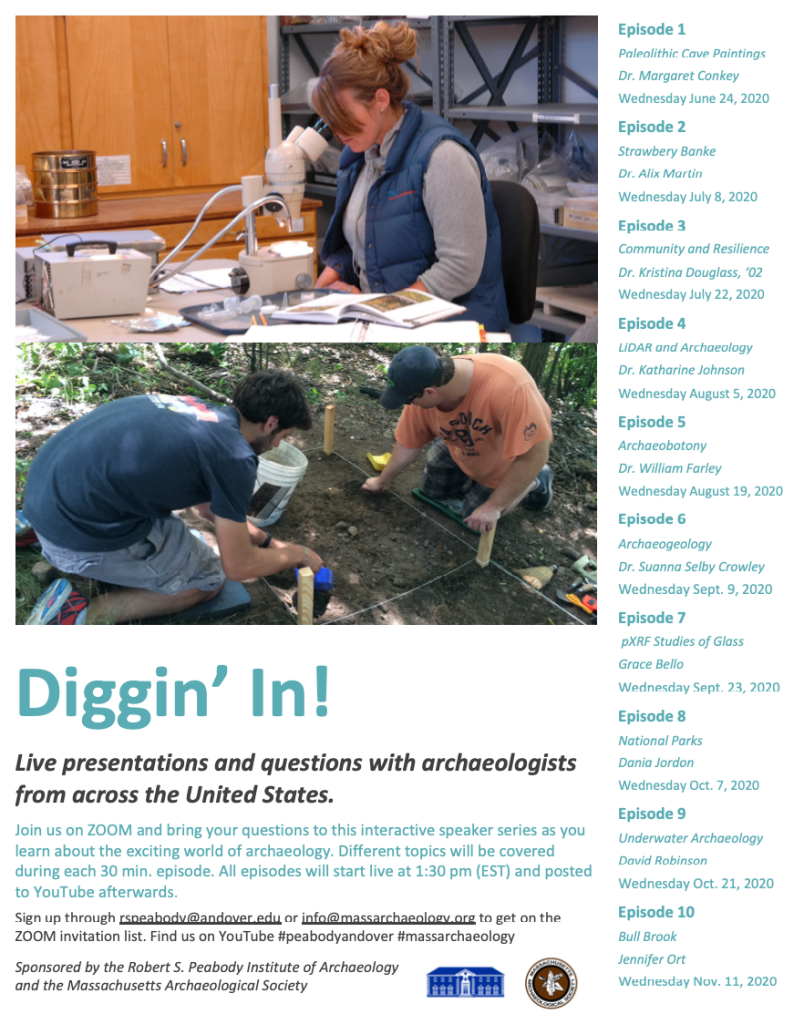
Part of the missions of both R.S. Peabody Institute and the Massachusetts Archaeological Society is to engage and connect with all who are interested in archaeology. Since we are unable to do this in person, both institutions are excited to announce our joint digital speaker series: Diggin’ In.

This series show cases live presentations with archaeologists from across the United States who will take questions directly from you!

Different topics will be covered during each 30 min episodes, which start live at 1:30 pm (EST) every other Wednesday and then will be posted to YouTube afterwards.

Sign up through the following emails to get on the ZOOM invitation list:

 rspeabody@andover.edu or info@massarchaeology.org 

While we are excited to welcome all our speakers digitally to our campus and community, we are particularly pleased to have Dr. Meg Conkey and Dr. Kristina Douglass join us.

In addition to her work at University of California, Berkeley and in France, Dr. Conkey is also a current member of the R.S. Peabody’s advisory board.

And while Phillips Academy might be unfamiliar to some of our speakers, that is certainly not the case for Dr. Kristina Douglass who graduated from PA in 2002. It will be fun to welcome her “home” even if it is remotely.

Our complete slate of speakers are as follows

Episode 1

Paleolithic Cave Paintings

Dr. Margaret Conkey

Wednesday June 24, 2020

Episode 2

Strawbery Banke Museum

Dr. Alix Martin

Wednesday July 8, 2020

Episode 3

Community and Resilience 

Dr. Kristina Douglass, ‘02

Wednesday July 22, 2020

Episode 4

LiDAR and Archaeology

Dr. Katharine Johnson

Wednesday August 5, 2020

Episode 5

Archaeobotony

Dr. William Farley

Wednesday August 19, 2020

Episode 6

Archaeogeology

Dr. Suanna Selby Crowley 

Wednesday Sept. 9, 2020

Episode 7

 pXRF Studies of Glass

Grace Bello

Wednesday Sept. 23, 2020

Episode 8

National Parks

Dania Jordon

Wednesday Oct. 7, 2020

Episode 9

Underwater Archaeology

David Robinson

Wednesday Oct. 21, 2020

Episode 10

Bull Brook 

Jennifer Ort

Wednesday Nov. 11, 2020

Digital Resource Spotlight: FPAN

Contributed by Lindsay Randall

The Digital Resource Spotlight series will highlight a variety of heritage-based organizations that offer unique activities that educators and parents may want to explore. We hope that you find our compilations helpful as you navigate this new educational landscape.

unnamed

The Florida Public Archaeology Network (FPAN) is a premier educational resource for educators looking to incorporate easy, hands-on activities. Many of their lessons can easily be restructured to fit the current online learning model that many private and public schools are adapting to. They are also clear and straightforward, which makes them a perfect tool for the numerous parents who are finding themselves suddenly acting as their children’s teacher.

Their 130 page guide Beyond Artifacts is a trove of useful lesson plans that could readily be duplicated in a students home, with online guidance from the teacher. Want to study archaeology during lunch? They have a Peanut butter and Jelly Excavation lunch, which can even be followed up by a cookie excavation. YUM!!!!

In addition to the broad archaeology lessons they also offer more topical ones focused on prehistoric, historic, and underwater archaeology.

One of my favorite lessons that they ha is one called Stone Silent. It allows student to collect demographic data from a local cemetery. This is a perfect lesson as it will help everyone to get outside (which we all desperately need) while still practicing social distancing since there are probably not many people wandering cemeteries for fun right now.

FPAN has many other resources to offer, so be sure to check out all of them here.


COVID-19 and Social Distancing: What Museums Are Doing to Bring Their Collections to Audiences Stuck at Home

Contributed by Emma Lavoie

The Centers for Disease Control and Prevention (CDC) issued guidelines to limit the spread of COVID-19, also known as the coronavirus. One recommendation included in these guidelines was for “social distancing” – a term referring to the conscious effort to reduce close contact between people and hopefully hinder the community transmission of the virus.

While schools, companies, and various workplaces determine the best possible options to both adhere to these guidelines as well as provide the appropriate support to their staff, students, and customers – many have chosen to close their doors. Some institutions and companies have shut down indefinitely, while various schools and universities have moved to remote teaching, where students complete their classes online and stay at home. Universities and colleges all over the country have moved courses to online platforms. Undergrads are being told to move out of their dorms and off campus for the remainder of the semester.

Phillips Academy (PA), a New England boarding school and the Peabody’s parent institution has instituted similar measures, following the directives issued by Massachusetts Governor Charlie Baker.

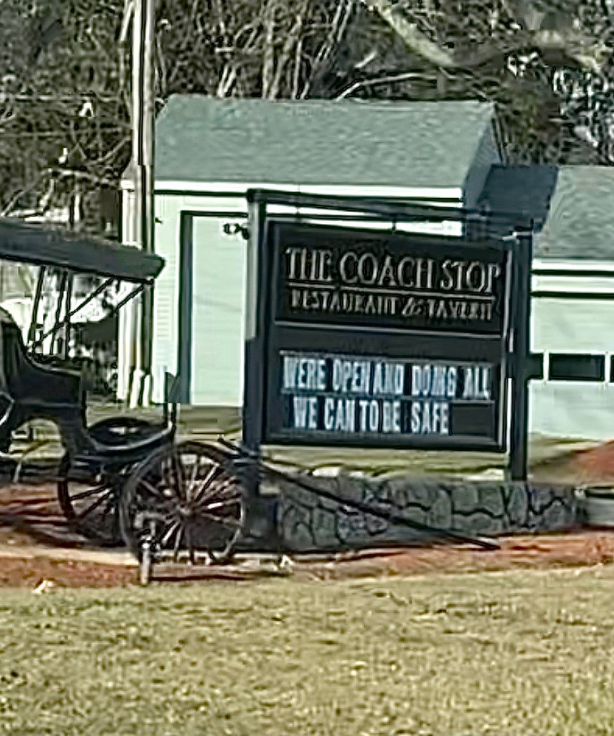
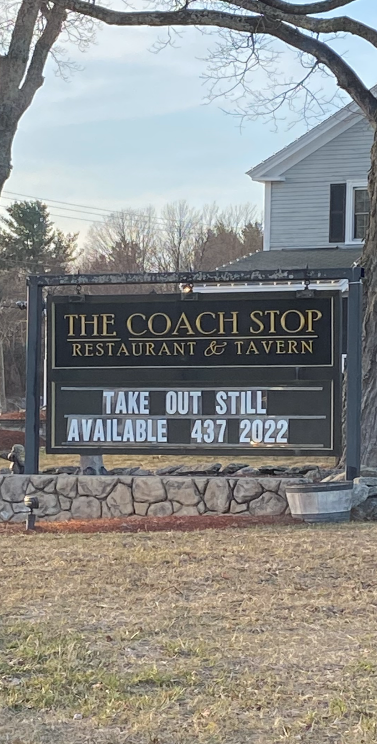
A local restaurant closes their doors in light of “on-site eating” bans over COVID-19

Now many would say they like working from home and actually get more done, but it is not the case for everyone. The Peabody staff are doing what they can to continue their museum work from home. For the Peabody collections team, it is very difficult to continue much of the work they do every day at the institution, as much of the collections and material cannot leave the building. While inventory, rehousing, and cataloguing of the collection is put on hold, our staff is editing object photographs, digitizing documents, transcribing collection ledgers, writing blogs (like this one), and more.

My dog, Rourke, is very happy to have me working from home!

Outside of my remote-work, I am wondering like many others who are stuck at home – what else can I do with the rest of my week? By being at home, we miss out on the daily interactions with our coworkers, colleagues, and classmates. Our experiences with each other fuel our creativity and critical thinking, and are important for much needed collaborative efforts. Through “social distancing” we are recommended to not take part in every day, public activities such as eating out, going to the store, or visiting a museum or historical site with our friends and family.

But don’t let social distancing doom your week and weekend! Museums have found a way to bring some of their collections to their visitors. So worry no more! You can view that Van Gough from the couch!

I was happy to enjoy a little culture and education in my off-time while at home. According to Fast Company, Google Arts & Culture has teamed up with over 500 museums and galleries around the world to bring virtual tours and online exhibits to a global audience.

Some of the museums highlighted by Google Arts & Culture include the British Museum in London, the National Gallery of Art in Washington, D.C., the Musée d’Orsay in Paris, France, the National Museum of Anthropology in Mexico City, Mexico, and various historical parks and sites.

Design of the Musée d’Orsay in 1979
Image courtesy of A.C.T. Architecture and the Musée d’Orsay

The first museum I “visited” was the Musée d’Orsay in Paris, France. As a student, I had visited this museum on a class trip many years ago and I was interested in the exhibits they provided online. This exhibit was a detailed history on the building of the museum titled, From Station to the Renovated Musée d’Orsay. This endeavor was a groundbreaking project for Paris as it was the first time an industrial building had been restored to accommodate a major museum. The virtual exhibit showcases the early building plans and images of the Orsay train station and hotel from the 1900s as well as images of the museum and its galleries after the renovation project in the early 2000s. Explore this virtual exhibit here!

I visited a second virtual exhibition, this time, at the National Gallery of Art in Washington, D.C. The exhibition is called, Fashioning a Nation. This exhibit features drawings from the Index of American Design, a collection of more than 18,000 watercolor pictures of American decorative art objects. This exhibition explores the American fashions from 1740 to 1895, giving insight into the character and quality of American life from the colonial period to the Industrial Revolution. Click here to explore this exhibit!

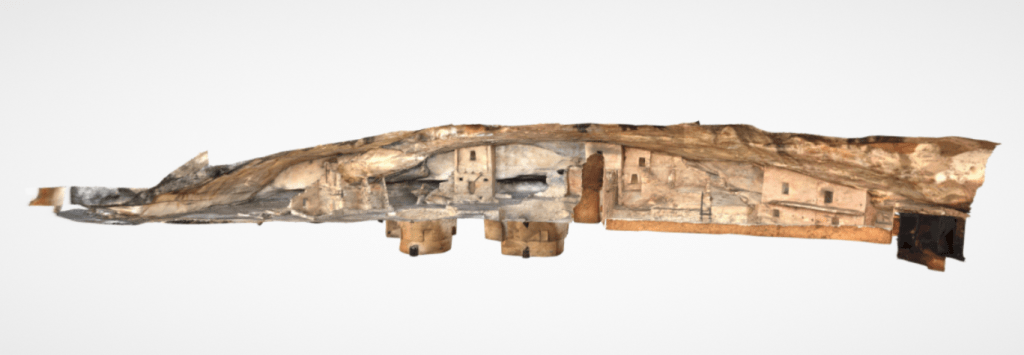
3D model of the Balcony House at Mesa Verde National Park
Image courtesy of CyArk and Open Heritage – Google Arts & Culture

If museums aren’t your thing, explore a historic site! Open Heritage – Google Arts & Culture offers iconic locations in 3D, using 3D modeling techniques for you to explore. You can learn about the tools of digital preservation and how people all over the world are preserving our shared history. One site I visited was the Mesa Verde National Park. This site is home to Native American cliff dwellings in southern Colorado that span over 700 years of Native American history (600-1300 CE). An expedition was led by CyArk in February 2017. CyArk is a nonprofit organization that specializes in the digital documentation and preservation of historic sites. The organization documented the Balcony House at Mesa Verde using Light Detection and Ranging (LIDAR) and terrestrial photogrammetry. Combining these two technologies is what creates the 3D model of a site. To explore the 3D model of the Balcony House at Mesa Verde, click here!

Unfortunately, not all popular museums and galleries are included on Google Arts & Culture’s collection website, but some museums are offering virtual tours and online visits on their own websites, such as the Louvre in Paris, France. To see more of Google Arts & Culture’s collection of virtual museums and exhibits, visit their collection website. Explore and enjoy your visit!

The Peabody at the SHAs

Contributed by Lindsay Randall

We have had a very busy couple of days this month as the Society for Historical Archaeology held their annual international conference in Boston – and of course the Peabody was in the thick of things!

The Peabody hosted a table at the SHAs Public Archaeology event at the Boston Public Library. Throughout the event there was a steady stream of conference attendees as well as families with children interacting with the fifteen different activity stations.

In addition to the Peabody, the Museum of Science, Massachusetts Archaeological Society, Salem National Historical Park, Indigenous Resource Collaborative, Plimoth Plantation, Archaeological Institute of America, Epoch Preservation, Friends of the Office of State Archaeology, Massachusetts 54th Regiment, Hurstwic, Gray & Pape, Donahue Consulting, Cape Cod Museum of Natural History, and Northeast Museum Services Center presented amazing and engaging hands on activities.

However, I do have to give a particular shout out to Mike Adams from the Museum of Science (and former Peabody intern) for his unique activity that had visitors make their own fishweir before testing it in water with robotic fish. It was super cool – and I really want to steal his idea!

charlie fish
Robotic fish zipping through a fishweir 

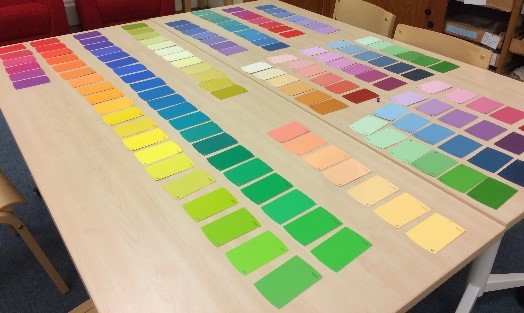
For our activity, the Peabody brought a Munsell themed game that asked visitors to put different color hues in order. There was even sets that changed from one color to another if someone was feeling very confident in their color gradient identifying skills. And while archaeologists typically only focus on brownish-yellow (or yellow-brownish?) colors, I figured that we’d expand our color palate for the game to include more visually appealing ones.

munsellphoto
Different sets of colors used in the Munsell sorting game.

In addition to the sorting activity, we had a Munsell bookmark making table. Children and adults got to use stamps and hole punchers of different designs to decorate their paint chip bookmarks. This was a big hit with visitors of all ages.

bookmark
Making a paint chip bookmark

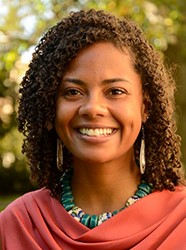
I also had the opportunity to meet Dr. Kristina Douglass ’02 who is an archaeologist at Penn State. Her research focuses on human-environment interactions on Madagascar, which I am excited to learn more about. I plan to read this article about radiocarbon dates and the human settlement on Madagascar by Dr. Douglass soon. Our meet up was lovely – but way to short! I look forward to getting to know her better in the future – maybe SHA 2022 in Philadelphia?

Douglass
Dr. Kristina Douglass ’02

In the book room, I had the opportunity to talk with the wonderful people representing Berghahn Books about their work and mine. The generously gave me a copy of their newest book Experiencing Archaeology, which is designed for high school level classes. I cannot wait to dive into the book to explore how the Peabody might utilize their activities!

Book

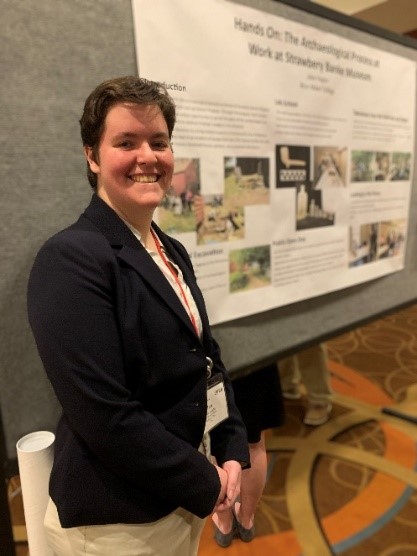
However, one of the most rewarding moments of the conference was when I got to see Alex Hagler ’16 present their poster, which focused on their work at Strawbery Banke Museum during summer 2018. To learn more about the work Alex conducted at the museum, check out their blog post.

Alex is a senior at Bryn Mawr College and is studying Classical Archaeology. I must say that I am very proud of their achievements and often can be found taking any opportunity to embarrass them by talking about them to anyone and everyone. But that happens when one has known someone since they were in the 6th grade.

Alex
Alex Hagler ’16 presenting at the SHA poster session