Native History of Andover’s Open Spaces

Contributed by Lindsay Randall

Kevin Porter, the Vice Chairman and Overseer Coordinator for the Andover Conservation Commission, invited me to be the Keynote Speaker for their annual meeting on April 19.  Mr. Porter was looking for someone who could speak to their group about the Native history of the area, and my name had been given to him by Stephanie Aude, a former OWHL librarian who now works at Andover’s Memorial Hall Library.

The reason for his interest in a speaker on Native Americans is that they have begun working on making Retelle Reservation in Andover more accessible to the public, and that includes creating informational panels about the landscape.

map of reservation
Map showing the location of Retelle Reservation

While the volunteers who are managing Retelle Reservation have created panels to highlight the different environments and animals one might encounter while enjoying the area, they want to include one about the Native people who use to live there.

diorama
Image of the Peabody’s diorama of the Shattuck Farm site.

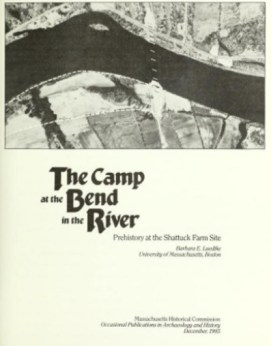
The Overseers and other volunteers recognized the importance of this history and sharing it with visitors because Retelle Reservation is on the western edge of the Shattuck Farm site. This site is very important to understanding the Native history of the Merrimack Valley and was excavated by Warren Moorehead, Alfred Kidder, and others who worked at the Peabody, in addition to Barbara Luedtke’s investigation of the site in the 1980s.
camp
The Camp at the Bend in the River

Since the presentation, Willow Cheeley of the Merrimack River Watershed Council (MRWC) has reached out regarding their property, Pine Island. Pine Island is situated near Retelle Reservation, in the middle of the Merrimack River, and has the potential to be archaeologically important because there was a small camp site located on it. It is believed that the camp was used to monitor those who traveled on the river and to keep them away from the larger village that was on the mainland.

As the MRWC begins to think about ways to preserve and tell the history of Pine Island and the surrounding area, they are also investigating the collaboration possibilities between MRWC, the Town of Andover, and Phillips Academy. Their interest in partnering with PA stems from the records and expertise the staff at the Peabody have and from their previous work with faculty member Mark Cutler.

This timing could not be more perfect since Mark will be taking a sabbatical for the 2018-2019 academic year to work on creating a bilingual experiential curriculum on the cultural history of the Merrimack Valley. This work will be an extension of his class Confluence: Environment, Culture, and Community. Mark also hopes that the materials he creates will be utilized by area schools and institutions, and possibly even adapted as an interdisciplinary class at PA in the future.

And having heard that I was giving the Keynote Lecture, Mark attended the talk, and has already roped me into helping him with the development of the Native history part of his curriculum. This will certainly be an interesting partnership and an amazing way for the Peabody to contribute to both the PA and Andover (and more!) communities. We look forward to keeping you updated as these projects progress!

Race, Power, and Difference

Contributed by Lindsay Randall

I was recently invited, along with my frequent collaborator (also known as my partner-in-crime), Dr. Bethany Jay, to present at University of Southern Maine’s inaugural symposium, Race, Power, and Difference: A symposium for Maine Educators.

program
Conference program and other documents from the symposium.

The symposium featured Dr. Tiffany Mitchell who kept the audience laughing throughout her keynote address that focused on how educators could go beyond one-dimensional narratives about people of color in the classroom, using her own experiences to emphasize points.

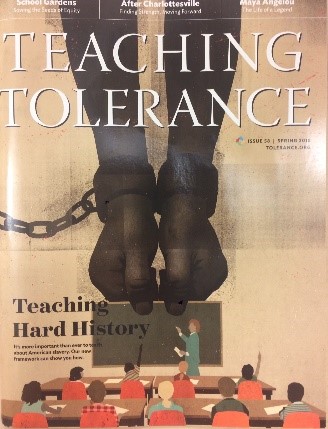
Bethany and I were there to present our work on how to incorporate practical strategies and hands-on learning regarding slavery. Our work with the Southern Poverty Law Center’s Teach Hard History program and lessons that we each use with our own students served as the basis for our discussion with the participants.

toler
The Teaching Tolerance magazine focusing on teaching American Slavery.

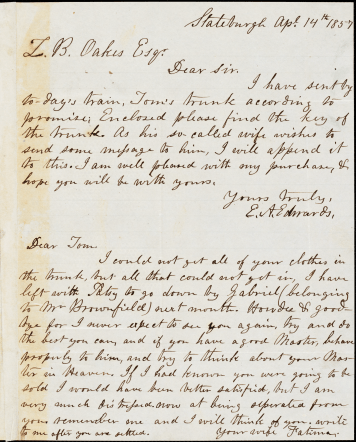
I shared our Little Spots Allow’d Them lesson, while Bethany walked everyone through a set of documents from the ZB Oakes collection.

zb.png
One of the documents from the ZB Oakes collections that Bethany used for her documentary analysis activity.

***Interestingly, ZB Oakes was a slave auctioneer who lived in Charleston, SC in the 1800s. His papers are part of the collections at the Boston Public Library because they were seized during the Civil War by a Massachusetts regiment comprised of free blacks and brought back to Frederick Douglass – as almost a trophy about what he helped accomplish!

Our session was one of the most attended of the day, with some participants having to stand and a continual stream of adding more chairs to the already cramped room. It clearly demonstrated that educators KNOW that this is an important topic and yet struggle for finding appropriate resources. Throughout the presentation and activities the participants were continually engaged and asking great questions – of us and other attendees – about strategies that they might use or modify to fit their unique student populations.

bethany
Bethany setting the stage about what the session will cover and how the activities will run.

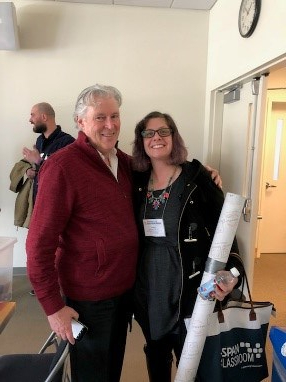
And to make things even MORE exciting – one of the fellow presenters was Dr. Nate Hamilton! Nate frequently collaborates with Bethany and me and has been a part of the Peabody extended family for years. It was nice to see him in his “natural habitat” of Maine for once!

nate.jpg
Nate and I enjoyed running into each other after our session.

Peabody lessons are the dumps, litter ally.

Contributed by Lindsay Randall

In the last two weeks, we have had three major Nor’easters here in New England. Fortunately, it has been while students are on break and has not slowed down the creation of new lessons for spring term.

“A man never lies in his garbage heap” – Franz Boas.

Last term I was approached by Emma Frey, faculty in history, to create a single period activity that would introduce her 9th graders to the concept of reading objects as text and use them to tell a story. As Emma and I talked and brainstormed, we decided on an existing lesson that I had created years ago for our Archaeology Explorers and how we could flesh it out so that it better met Emma’s class goals and objectives.  The activity is a garbology lesson called Trash Talks!

trash talks
Two bags of clean trash that students will analyze.

In the activity students are divided into three groups and are given a bag of clean trash. While working together to sort and identify the trash, each group also compiles a biography of the person(s) who created the trash. They will be asked to make observations and inferences about the trash and what it might reflect about a person, such as their gender, age, activities, etc.

trash talks2
An example of how students might mark down artifacts in their trash bags to better understand what they show about the life of someone.

While the trash is “modern” the principles that students use to analyze the trash are the same as the ones that archaeologists use to study cultures of the past.

I am very excited to run this lesson with students and to see how they interpret the trash!

Changing Roles and Responsibilities of Museums

Contributed by Samantha Hixson

The past five years have been a busy time for museums- most notably in the image department.  Following a number of high profile controversies, a lot of people–audiences, and museum professionals alike–asked what role museums play in our society?  Here are a couple of recent articles dealing with this subject head on.

Why Museum Professionals Need to Talk About Black Panther

black panther
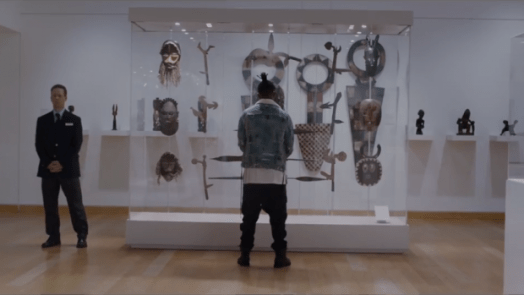
Killmonger in the Museum (Photo courtesy of article)

Last month saw the release of Marvel’s newest blockbuster, Black Panther.  Besides being a fantastic movie, this film offers a unique chance to open dialogues on a large scale about many topics- least of which are museums as mechanisms of colonialism.  This article discusses how and why museum professionals especially should look at their roles in this and the effects they have on the audiences we try to reach.  The piece ends by laying out suggestions for how museums can move forward incorporating and working towards more diverse and open dialogues between communities.

Two Museum Directors Say It’s Time to Tell the Unvarnished History of the U.S.

Ggover and Bunch
Gover and Bunch at Symposium (Photo courtesy of Smithsonian Magazine)

This article opens with the quote, “history matters because it has contemporary consequences,” and it just gets better from there.  Directors Kevin Gover (National Museum of the American Indian) and Lonnie Bunch (National Museum of African American History and Culture) participated in a day long symposium titled, “Mascots, Myths, Monuments and Memory,” in which they talked about confronting the historic and continued racist ideologies that are entrenched in contemporary American society and the role of museums.  They specifically discuss the example of the concurrent rise of confederate statues and racist mascots.

How the Dana Schultz Controversy- and a Year of Reckoning- Have Changed Museums Forever

protest
Election protest (photo courtesy of Quartz)

Chronicling a series of high profile controversies, this article looks at the combination of factors that have led to these, as well as the changes they are bringing to museums and their operation.  It also discusses why museums have become ground zero for explosive cultural encounters stating, “We’re in a time when these issues are real, these controversies are part of public space and public discourse, and museums are going to become the places where these issues get played out.”

Native Voices, Accurate History Forge Deeper, Better Understanding of American Indians in Nations Schools

NMAI education
Students using NK360 (photo courtesy of Smithsonian Insider)

This article showcases the role museums have within their respective walls and how they are branching out to have far reaching impacts in classrooms all over the nation.  Similar to classes taught at the Peabody by Curator of Education, Lindsay Randall, this article follows the creation and implementation of National Museum of the American Indian’s newest initiative, Native Knowledge 360. NK360 is a “long-term initiative to integrate the Native American experience into social studies, language arts and other curriculum in kindergarten through 12th-grade classrooms across the country.”   This program works with the inclusion and cooperation of Native communities and educators as well as provides educational materials for teachers.

Cats in the Collections

Contributed by Lindsay Randall

The collections staff at the Peabody keep telling me that I can’t have a cat. Which I guess was fair, until I found out that all this time they have been hiding a jaguar in our basement!

A JAGUAR!

Panthera_onca_zoo_Salzburg_2009_09
An adorable jaguar cub who would love to live at the Peabody and get belly scratches. Look at those mitts!!! By User:MatthiasKabel – Own work, CC BY-SA 3.0 https://commons.wikimedia.org/w/index.php?curid=8837354

A few weeks ago I was approached by Elizabeth Aureden, instructor in music, to design an interactive class for her Music 410 course, The Musical Brain. While looking through our collections for musical instruments, I learned from collections assistant Samantha Hixson that she had just found and catalogued some effigy rattles.

The objects were made of clay and painted a variety of colors, and some still rattled.

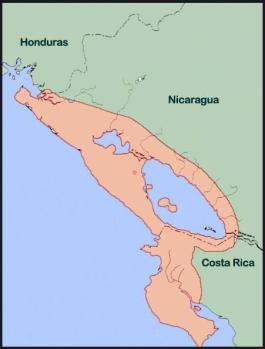
This new find seemed very promising and so I wanted to learn more about them. Research indicated that these objects were from the Nicoya Peninsula of Costa Rica and most likely date from AD 1000 – 1350.

Gran_Nicoya
Map showing the Nicoya cultural region. By Rodtico21 (Own work)[CC BY-SA 3.0 https://creativecommons.org/licenses/by-sa/3.0
The parts we have are clearly broken and part of a much larger artifact. These are the remnants of the tripod legs of a rattle effigy vessel. Each of the three legs would have contained three clay balls and had openings on the side for the sound. When shaken a rhythmic sound can be heard.

1024px-Vessel,_Nicoya,_Costa_Rica,_800-1350_AD,_ceramic_-_Naturhistorisches_Museum_Nürnberg_-_Nuremberg,_Germany_-_DSC03996
Image of a complete vessel. Notice the holes in the side of the legs.  By Daderot (Own work) [CC0], via Wikimedia Commons
That’s pretty neat! But the story became even cooler as I found more information about this style of pottery.

The bowls were used to add a percussive sound to a ceremony. And the sound it made was not an accidental rattling sound, but rather a deliberate and meaningful one. When the bowl is shaken or moved about, and the clay balls rattle together, they create a deep, rumble. This sound is mimicking the low growl of an actual jaguar!!!!! Researchers have even noted that when the bowl is tilted and moving forward – like a jaguar lunging at prey – the sound is more prominent.

If your interest is now piqued about other objects from the Nicoya Peninsula, check out Dr. Rebecca Stone’s book, The Jaguar Within.

page_1

So next time you are at the Peabody be on the lookout, because you never know what other predatory animals might be lurking!!!

Lion
Scary lion from the 1995 movie Jumanji.
Sometimes the Peabody seems like it’s playing its own version of the game Jumanji, with all the random artifacts that mysteriously present themselves to staff members.


Decoding a woven language

Contributed by Lindsay Randall

Cloth was the books the Spanish could not burn.

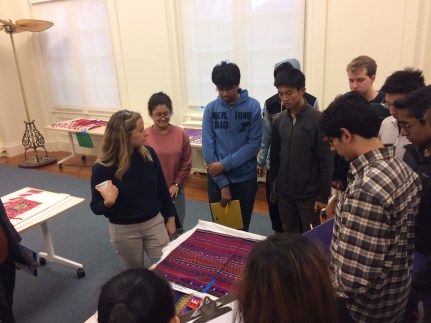
During Fall Term I worked with Meg Bednarcik and Nick Zufelt – both Instructors in Mathematics, Statistics, and Computer Science – to create a class that would focus on the computer science concepts of looping and parameters.

We decided to utilize the extensive Guatemalan textile collection at the Peabody, as they are brightly colored and engaging and most have repeating, or looping, motifs. We also liked the idea of incorporating clothing made and worn exclusively by indigenous women into a subject where they are woefully underrepresented.

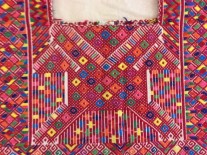
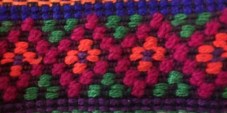
Eighteen huipils (wee-peels) were pulled for the class, with the images of another twelve scanned. A huipil is a traditional Maya women’s shirt.

as

The first activity was a matching game to show students how huipils had silent information encoded into them about the wearer’s home community. Each village has its own distinctive design. The students were given twelve cards with images of other huipils in our collection and asked to match them to huipils that were laid out in the room. The following images are from three villages, highlighting how the differences between villages, as well as the variation within a particular village.

Huipils from San Mateo

Huipils from San Ildefonso

Huipils from Almolongo

IMG_4990
Students participating in the village sorting game.

Then students worked with either Meg or Nick to find designs that had looping designs, or nested loops. Then they worked on creating parameters for the designs they had found.

czx
Meg Bednarcik points out looping patterns to her students.

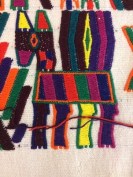
The third activity was asking students to identify certain motifs that are common in Maya imagery. Some, such as a deer, were more literal then others, such as the feathered water serpent or portals.

And as you learn in the write up bellow by Meg, this class served as the starting point for a term long project the students will be working on:

My AP CS A students ventured to the Peabody Institute to learn of Guatemalan huipils and the stories these women’s clothes tell of personal identity. The students will complete follow-up assignments to program their own design defining their personal identity here at the academy and beyond utilizing programming concepts learned in class such as objects and repetitions. Though many students were shocked to be at the Peabody for a CS class, they left reflecting on the many ways these programming ideas apply to other aspects of our world. I am eager to continue to utilize these resources at our fingertips to allow students the space to ponder their place in our interconnected world beyond PA, and consider the beneficial impact their work as computer scientists can have on others outside of the classroom.

~ Meg Bednarcik, Instructor in Mathematics, Statistics, and Computer Science

This has been one of the most interesting and fun classes for me to develop. I really enjoyed working with and learning about part of our collection that is underutilized. But most of all, I have been thoroughly engrossed by the current action Maya women are taking to ensure that their designs are protected and not appropriated. Based on the information I gleaned from my research, I included a huipil from Santiago Sacatepéquez, which is the only community so far that has been able to give legal protection to their woven intellectual property.

To learn more about huipils and their images, visit Guatemala City’s Ixchel Museum of Indigenous Textiles and Clothing website.


Below are symbols found in some of the huipils in the Peabody’s collection:

Serpent motif – geometric designs known as “kumatz’in”. “The Kaqchikel term kumatz means snake, or the feathered serpent.

 adsas

 Deer – Deer held particular significance in Maya mythology and the Dance of the Deer, originating from pre-Conquest times, is still performed at festivals today.

deer

The Double Headed Eagle – The double headed eagle in Maya mythology represents the Great God with two faces, one looking to good and the other to evil, or to heaven and earth. Double-headed birds are motifs frequently used for decorating ceremonial garments. The image to the right outlines the shape of the double headed eagle.

XZX   cxzc

Sky bands – represents the path of the sun with the Xs formed in the “empty” space refers to the end of the solstices.

sky.jpg

Offering plate / Portal – “portal” or “door” was the Maya name for the entrance into the “other world” (spirit world). The dot in the center represents the door through which an ancestor can travel.

dsfs

The Star That Proceeds The Sun – This motif has been a part of Mesoamerican cosmology since Olmec times. It can be seen in celestial bands along with the sun, the moon, and particularly Venus. It is also featured in codices, such as the Popol Vuh.

fd

Bird – At the beginning of the rains, and when maize is sowed, they can be seen in large quantities on the rivers and lakes.

fdfds.jpg

Sun – A sun is embroidered around the neckline. If a woman in the village just became a widow, she would wear her huipil without the sun around the neck, because she would have lost her sun

 fdsfds

Lightning – Vertical zigzag lines are associated with rain and lightning.

dsads.jpg

Lion / Jaguar – The animal has been given a mane, indicating European influence. The cougar or American lion has no mane.

gdsfewr

A Visit to Brookwood School

Contributed by Lindsay Randall

Packing up my car with artifacts always signals that I am off on an adventure!

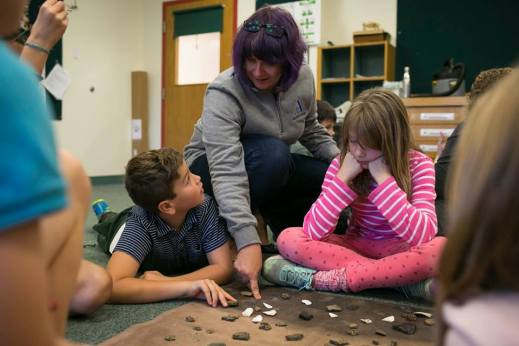
Recently I traveled to Brookwood School in Manchester-by-the-Sea to work with the 4th grade classes. The students had recently begun learning about ancient cultures and how historians and scientists study them, particularly when there are no written records – or at least ones that we can read!

To help everyone better understand how archaeology allows us to investigate cultures of the past, I brought our mock excavation site. The faux dig is made up of painted canvas squares and real artifacts. It is based on a real archaeological dig that took place in Andover decades ago at a pre-contact Native American site, approximately 500 years old.

Working in groups, students rotated around each square or “unit” to look at the artifacts and to hypothesize what human activities were taking place. The groups were able to correctly identify which unit was similar to a kitchen, where the house stood, and where pottery was being made – proving that they had become experts in deciphering the clues left behind!

22196140_10156307217615839_197208658612584290_n
Curator of Education Lindsay Randall working with students to identify a fire pit and pottery making.

Principles of Editing

Contributed by Lindsay Randall

A few weeks ago I began trekking down to Cambridge every Tuesday evening for the class Principles of Editing, offered through Harvard Extension School. I signed up for the class as I was looking for something that would help me to improve and polish our lesson booklets and other educational materials as we share them with the public. Christina Thompson, editor for the Harvard Review, has structured the class to teach lay people how to produce good, clean copy when editing material such as blogs, newsletters, websites, brochures, and other text.

PE2

Christina has a quirky personality one expects in a writer and the other adult students frequently use humor to make points about the homework. My type of people! The camaraderie in the class certainly makes the late nights enjoyable.

I am looking forward to learning more about editing and to see what other rousing debates we will engage in. (Last week was about when to use Em dashes and En dashes. WARNING: they can elicit strong – occasionally violent – emotions in individuals!)

Summer collaboration with Salem State University

more excavating
Excavating at RNH

Contributed by Lindsay Randall

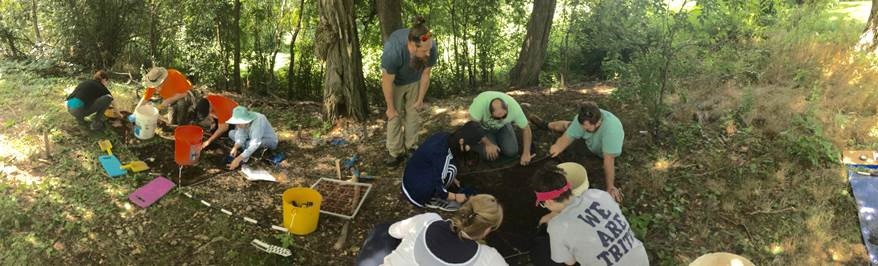
The Peabody Museum once again partnered with Dr. Bethany Jay, professor of history at Salem State University, to run the graduate summer institute class, Preserving the Past: Using Archaeology to Teach History.

The week long class focuses on how archaeology can be used in middle and high school classrooms as a way to talk about minorities who are often left out of the historical record.  Each day was focused on a different minority group such as Native Americans, women, enslaved people, and free blacks.

Each day gives students background content to ground them in the topic, a tour of a historic or other site, and hands-on lesson plans. This year’s lesson plans included the Peabody’s “Maps and Dreams,” which utilizes Native American petroglyphs as well as a map in Phillips Andover’s Knafel Map Collection and “Little Spots Allow’d Them,” which focuses on the archaeology of the Royall House and Slave Quarters. They also were able to see the mock excavation activity about Katherine Nanny Naylor which the Commonwealth Museum hosts as part of their Archaeology of the Big Dig.

The last day is always the highlight of the class. Dr. Nate Hamilton of University of Southern Maine generously lenthis time and expertise to the class, allowing the students to participate in a real excavation at the Rebecca Nurse Homestead in Danvers MA.

Also this summer, Dr. Brad Austin of Salem State University brought his class Teaching Difficult Topics: Native American History to the Peabody. The class spent the day working with the Peabody’s History 300 lessons “alterNATIVE uses” and “Trail Where They Cried.”

In “alterNATIVE uses” students examine both a stone and metal projectile point to better understand how iron and trade affect both Native and European communities during the 1600 and 1700s. Each student was given a replica stone and metal projectile point along with the lesson plan.

Brad Austin's class working on analyzing points in the 'alterNATIVE uses' lesson
Brad Austin’s class working on analyzing points in the ‘alterNATIVE uses’ lesson

In the “Trail Where They Cried” the students learned how to make the complex history of Cherokee Removal more accessible to students through a Choose Your Own Adventure style activity.

Both activities were a big hit and the students have asked to use more of the Peabody’s teaching resources.

Bushels of Baskets

Contributed by Samantha Hixson

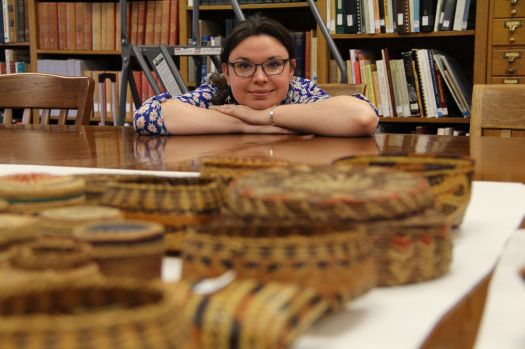
Though the Peabody is small by museum standards we are mighty, especially when it comes to our baskets.  With close to 400 baskets, the Peabody collection covers all major geographical regions and tribal communities of North America, and spans over 200 years.  Baskets from notable artists like Molly Neptune Parker (Maine) and Clara Darden (Louisiana) help to support and curate these artists’ work, and are examples of continued and evolving traditions within Native communities.

One of my first large projects at the Peabody was to completely catalog, inventory, and rehouse this great collection.  The purpose of this was twofold:

First, it was important to consolidate our records regarding these baskets.  Museums are full of information, and it’s usually in five different places! By gathering what we know, and putting it all in one place, we not only gain better control over this knowledge, but we make it more accessible to museum staff, researchers, and students.  The convenience of this newfound accessibility encourages more use in the classroom and more research by professionals, giving these baskets the attention they deserve.

Secondly, by revamping the basket organization and rehousing, we are better able to care for these objects and their specific needs.  Although baskets aren’t usually as fragile as most people fear, they still require some TLC.  By creating storage mounts that are custom designed to each basket, we are able to provide more support to the object, especially when it is being moved and shifted around during handling.  Within our ethnographic storage, space is at a premium, so another byproduct of the rehousing was the space it opened up.  We were able to clear seven shelves!

basket elf
Basket Elf in natural habitat

Happy baskets, happy collection staff.

To see previous work done with the baskets by Catherine Hunter, check out these previous blogs!

Language of Baskets

Baskets Explored