There were no classes on Tuesday May 9th to allow students to take AP exams and to give faculty dedicated time to meet within their departments. Knowing that we would not have students in the Peabody for classes or work duty I took that day as an opportunity to spread my crafting chaos throughout the museum.
I began by painting some of the fabric squares that will serve as mock excavation units for our Privy to the Past lesson about Katherine Nanny Naylor. The excavation was of her privy, or outhouse, and so I painted the brick wall that enclosed it, as well as the darker night soil.
Lindsay Randall hard at work painting
The finished canvas square
In addition to the squares, I have created bags of artifacts that represent objects that were found during the original excavation. Later this summer I will be collaborating with Liza Oldham of the OWHL to create a multi-day lesson for older students to further their historical literacy, as the archaeological and documentary records related to Katherine Nanny Naylor seemingly contradict one another.
If the idea of privies intrigues you, please check out the Iowa State Archaeology program as they have some excellent information about why archaeologist just LOVE privies!
The other crafting project that I undertook was some paper repair work. After numerous classes and events our models of the Royall House and Slave Quarters site has begun to show its age (3 years!). Using double sided tape, an x-acto knife, and hands that a surgeon would envy, I managed to make all the necessary repairs to ensure the longevity of the models.
When you think of the binary search algorithm you immediately think an archaeology museum is the perfect place for students to get a hands on example. Right?
Well it certainly was not what students in Nick Zufelt’s Computer Science 500 class expected when they showed up at the museum. To many of the students who had been to the Peabody with their history or science class to look at objects, it was a bit perplexing how they could be combining archaeology with computer science.
What many do not know is that the Peabody has many other resources that PA faculty can tap into. Mr. Zufelt discovered something that Peabody Museum still had that no other place on campus (not even the OWHL!) still had: our card catalog.
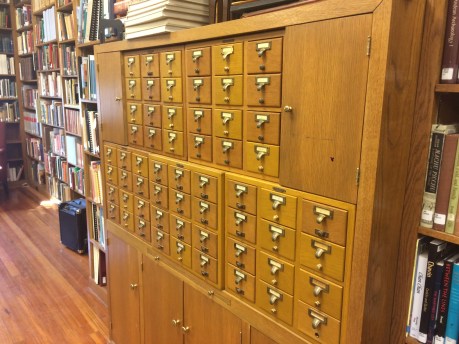
The card catalog at the Peabody Museum
When Nick first came up with the idea to use our card catalog in an interactive lab activity for his students, we were ecstatic. We love when Peabody resources are utilized for learning in such out of the box ways. The card catalog was a perfect hands on example for students to understand the binary search algorithm.
To those who are not familiar with this concept (and I was certainly one of them!) Nick began the class with this simple introduction:
When you look up a word in the dictionary, do you start at page 1, look for the word, then move onto page 2, etc.? No, of course not. You have a more sophisticated way of searching through the massive list of words. This activity hones in on the algorithm underlying this process: the binary search algorithm. The basic idea is: chop in half, go to the half that will have your item in it; repeat.
Nick Zufelt, computer science faculty, explaining the project to the students
Each student was then given a page listing 23 different cards from our card catalog system and told to pick one of them. Then they had to find the card and write down the process of how they found it, but in a manner that a computer could follow.
At this point, you might be saying to yourself, “wow that seems like a pretty easy project….” WRONG!
While this activity may strike us as simple, it actually turned into a battle of the wills for many students as they struggled throughout the period to create a very simple process that was also accurate. And when some students had a friend try their process, they often found that what they had devised was incorrect (Arrrgggg!!! The FRUSTRATION!!!!)
This type of learning helps to make abstract concepts more accessible for students as they begin learning something that forces them to think in a completely new and different manner.
Mr. Zufelt has already talked about bringing future students back for the activity and we look forward to working with him and his students on this and other computer science adventures at the Peabody!
NOTE: Despite still having a card catalog, the Peabody library is completely cataloged in the system used by the Oliver Wendell Holmes Library. Our librarian Mary Beth Clack is currently updating records to make monographic series more accessible.
In 2017 archaeologists Meg Conkey, Dan Sandweiss, Ryan Wheeler, and Nancy Gonlin founded the Journal of Archaeology and Education. The journal is hosted at the University of Maine’s Digital Commons website.
JAE originated with Peabody Advisory Committee chair Dan Sandweiss during strategic planning work and inspired by the Robert S. Peabody Museum of Archaeology’s long history of using archaeology in the classroom, one which got a boost in 2002 when this focus became our raison d’être. There has been a growing interest in learning around archaeology—from college and university curricula to service learning, as well as archaeology in the high school classroom and initiatives like Project Archaeology. Despite many connections with allies at the Society for American Archaeology and the Archaeological Institute of America, practitioners in this area are diverse and only loosely connected.
An open-access, online journal is one major step to foster a sense of community and create a platform to share everything from practice to theory and research. This format ensures equal access to interested parties, something which we all believe is critical. During the Society for American Archaeology’s 2017 meeting in Vancouver we held the inaugural meeting of the JAE editorial board, which includes members from museums, educational institutions, academia, government, and more. Editorial board members spent some time getting to know one another and brainstormed ways to encourage article submissions to the new journal.
JAE Mission Statement
The Journal of Archaeology and Education is a peer-reviewed, open-access journal dedicated to disseminating research and sharing practices in archaeological education at all levels. We welcome submissions dealing with education in its widest sense, both in and out of the classroom—from early childhood through the graduate level—including public outreach from museums and other institutions, as well as professional development for the anthropologist and archaeologist. The journal’s founders recognize the significant role that archaeology can play in education at all levels and intend for the Journal of Archaeology and Education to provide a home for the growing community of practitioners and scholars interested in sharing their first-hand experiences and research.
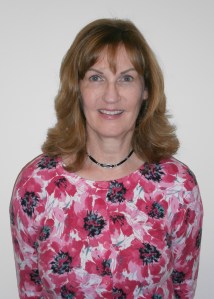
Nancy Gonlin—JAE Editor
Nancy Gonlin is a Senior Associate Professor at Bellevue College, Washington. She earned her Ph.D. in Anthropology at The Pennsylvania State University, is a Registered Professional Archaeologist, and a former Dumbarton Oaks Fellow of Harvard University. Her specialization is the Classic Maya civilization of Mexico and Central America. Nancy is on the Editorial Board of Ancient Mesoamerica, published by Cambridge University Press. She has taught for over 25 years and is highly regarded for her pedagogical contributions – she is the 2012 recipient of Bellevue College’s Margin of Excellence. As an active member of the Society for American Archaeology, Nancy serves on the Committee on Curriculum and has been appointed as the upcoming Chair of the Book Award Committee. She co-author Copán: The Rise and Fall of an Ancient Maya Kingdom, and co-edited Commoner Ritual and Ideology in Ancient Mesoamerica, Ancient Households of the Americas, and Human Adaptation in Ancient Mesoamerica. Nancy’s fifth book will be a co-edited volume on a new field of research in archaeology, The Archaeology of the Night.
As an online only, open access journal, JAE is designed for quick and timely publication of accepted papers. To that end, each year will constitute a volume and each article will be a separate numbered issue. As soon as an article is accepted in final version, copy-edited, and laid out, it can be published instantly.
Once again DNA analysis of sites is opening up our understanding of how societies operated historically. By testing bone samples from Room 33 in Pueblo Bonito of Chaco Canyon, scientists were able to shed more light on the inner workings of power, class, wealth and status of ancestral Puebloans, and the major role women played within these.
Mound 72 of the Cahokia culture complex, when originally excavated in 1967, was thought to be a shining example of a burial of elite male warriors. Fast forward almost 50 years and imagine archaeologist’s surprise when one third of the skeletons found were in fact female! These findings call into question the idea that Cahokia was a male warrior-led patriarchy.
The excavation of young Hohokam woman’s grave is an example of what the excavators and author call the “Bioarchaeology of care.” The young woman, who lived about 800 years ago had scoliosis, rickets, and tuberculosis. Through looking at this site, archaeologists are able learn more about the community in which the girl lived, and how they supported and cared for her, giving a decidedly human lens to a science that can sometimes become disconnected.
This week it seemed there were a lot of great links discussing new and exciting things happening within the world of archaeology. Here are just a few that we found:
This article talks about the role of diseases in shaping the genetic diversity of contemporary Native American communities. Historically these effects were documented by written accounts with little to no physical evidence since most European introduced diseases leave no evidence on bone. Recent breakthroughs in DNA markers, however, have been able to physically prove the evolutionary effects of these pandemics.
This article is a great example of how archaeologists are able to create and test hypothesis when attempting to solve puzzles encountered while excavating.
An interesting article that not only highlights the use of modern science in investigating historic traumas, but a great example of how important cultural context is both historically and in a contemporary lens.
Not only is this a super cool article talking about the first example of in situ beer making in China, but also a great example of how archaeologists are able to extrapolate larger and further reaching conclusions from a small snap shot of the past.
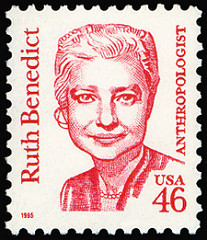
A quick Google search reveals that Ruth Benedict still looms large in the minds of contemporary anthropologists. Benedict (1887-1948) is known for many things—she was a favorite student of anthropology icon Franz Boas, she conducted multidisciplinary work across anthropology, psychology, and social science, and was close friend and confidant of Margaret Mead. Mead wrote a marvelous biography of her friend that gives her impressions alongside published and unpublished works by Benedict. Biographies continue to appear, including two dual bios of Mead and Benedict. Benedict wrote and talked about the paradigm shift in our field that she witnessed in the twentieth century as Boasian humanism gave way to scientific approaches. She famously argued that anthropology needed both.
1995 commemorative US postage stamp featuring Ruth Benedict.
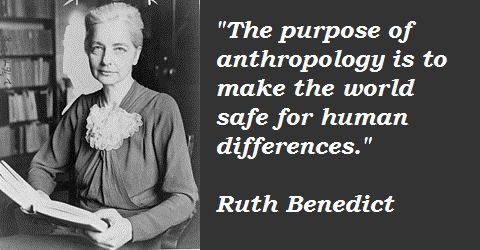
Benedict has fared pretty well in the internet age. Blogger Jason Antrosio, writing at Living Anthropologically, pits Benedict against social geographer Jared Diamond, arguing that Benedict did what Diamond does, only better, more eloquently, with at least as much erudition, more personally, and at least seventy-five years before Diamond. Antrosio’s satiric comparison specifically looks at Diamond and Benedict’s take on what traditional societies have to teach the Western world. Likewise, Alex Golub, in his blog Savage Minds, argues that Benedict’s concise prose presages today’s best blog writing. Perhaps not surprisingly, some of Benedict’s more pithy insights appear on internet sites dedicated to quotation. One of these quotes has gotten a lot of attention recently—here it is:
“The purpose of anthropology is to make the world safe for human differences”
Along with a presence on the quotation websites, this quote has made the rounds as an internet meme (framed against a nice photo of Benedict) and, perhaps most famously, was featured in remarks made by President Barack Obama during a press conference with Afghan President Ghani on March 24, 2015. The President referred to his own mother’s training as an anthropologist, as well as Ghani’s background. The remark, however, doesn’t specifically attribute the quote to Benedict. Simon Kuper, writing in The Financial Times, has dubbed Barack Obama the “anthropologist-in-chief” and a number of others have pointed out that President Obama’s interest in anthropology has tracked a growing interest in our discipline.
One version of the popular Ruth Benedict internet meme.
Specifically too, that quotation has resonated with a lot of people, myself included. I added it to my e-mail signature sometime over the summer—a place that I usually reserve for my contact info alone. I did notice, however, that while the quote appeared on a lot of websites, there was never any specific source cited. Archaeologist Meg Conkey told me recently that she too like the quote, but was unsure of its origins. She asked me if I knew and pointed out a Reddit post about the quote. The Reddit post argues that “Ruth Benedict never said it, not in any of her published writings. It seems to be merely myth. It is never specifically cited, nor does it make historical sense. In her own time, anthropology was a SCIENCE, not a political party.” The post includes a long list of internet memes, blog posts, and other websites that all attributed the quote to Benedict, but with no specific reference to back it up.
The quote aside for a moment, it is pretty clear that Benedict’s work had a strong political element. In many ways, as a cultural relativist, she sought to challenge American exceptionalism with her work. Benedict, along with anthropologist Gene Weltfish, prepared a pamphlet titled “The Races of Mankind” in 1943, intended as a guide for American troops operating overseas. This became an appendix to later editions of her 1940 book Race: Science and Politics, which makes both a humanistic and scientific case for the equality of all races.
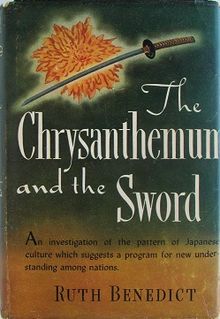
A first edition copy of Ruth Benedict’s book The Chrysanthemum and the Sword.
During WWII Benedict prepared an “ethnography at a distance” study of Japanese culture for the U.S. Office of War Information, which appeared in 1946 as The Chrysanthemum and the Sword: Patterns of Japanese Culture. Along with her earlier work, Patterns of Culture, Chrysanthemum remains one of Benedict’s iconic projects. And it may provide a clue about that quote. This is what Benedict writes on page 14 of Chrysanthemum:
“The tough-minded are content that differences should exist. They respect differences. Their goal is a world made safe for differences, where the United States may be American to the hilt without threatening the peace of the world, and France may be France, and Japan may be Japan on the same conditions.”
Anthropologists certainly are a tough-minded lot, even if we get a bit loosey-goosey on our quotations. I suppose this is a consequence of progress, as brainyquotes.com replaces Bartlett’s.
A trip to the bookshelf provides another clue. On page 402 of their textbook Anthropology: The Human Challenge (15th edition) William Haviland and his co-authors include a nice profile of Ruth Benedict. There they say:
As Benedict herself once said, the main purpose of anthropology is “to make the world safe for human differences.”
So, she did say this, or at least something a lot like this. For the precise, we should likely reconsider using those quotes or their exact placement. It’s not surprising, however, that we still have a special place for Benedict in our discipline. Blogger Antrosio makes a nice point that Benedict, however, isn’t perfect, and that she suffers from the same flaws that afflict Jared Diamond:
“This history reveals the major theme missing from both Benedict and Diamond–an anthropology of interconnection. That as Eric Wolf described in Europe and the People Without History. Peoples once called primitive–now perhaps more politely termed tribal or traditional–were part of a co-production with Western colonialism.”
Johannes Fabian, in his 1983 book Time and the Other: How Anthropology Makes Its Object, makes much the same argument. Despite the shortcomings, Benedict has a lot to offer, from ideas about cultural relativism and race, to the direction that anthropology can take in the twenty-first century. As the contemporary scientific paradigm breaks free of its dialectic with humanism, can humanism assert itself in whatever comes next?
November 1 is still a few weeks away but Dia de los Muertos—the Mexican Day of the Dead—came early to the Peabody. On Thursday September 29 Dr. Marisela Ramos of the History and Social Sciences Department brought her History 200 class. The class has been learning about different civilizations from around the world and the Peabody’s Dia de los Muertos lesson is a fun and interactive way for the students to learn about a holiday that is still celebrated today, but which has deep roots to a time before Europeans came to the Americas.
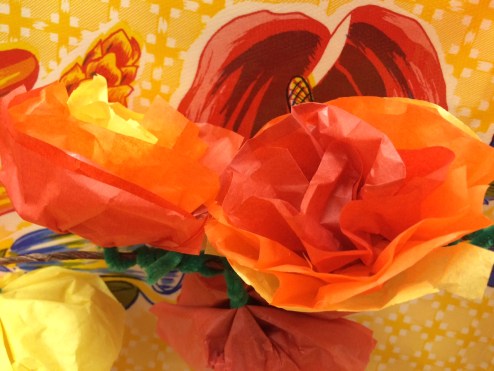
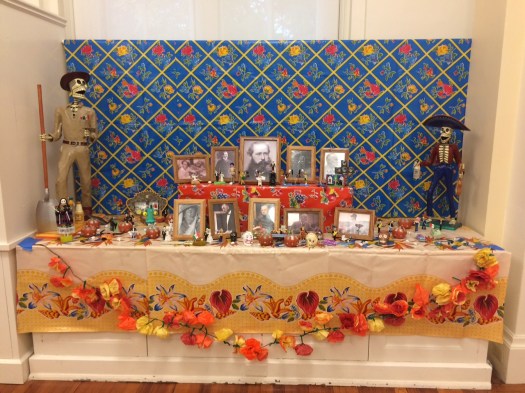
The holiday is celebrated in Mexico and is a mix of traditional native beliefs (primarily from the Maya and Aztec cultures) that were combined with European Catholic traditions. It is believed that between October 31 and November 2—coinciding with Catholicism’s All Saints Day and All Souls Day—that the souls of loved ones return. Many homes have alters with images of the deceased. Marigolds are often placed on the alters, as the smell helps guide the souls home, and food is left out for the souls to eat after their long journey.
Tissue paper marigolds
Our alter has images of notable people connected with the Peabody:
Robert Singlton Peabody – Our founder and PA class of 1857. His image is always in a place of honor.
Charles Peabody – Son of Robert and the first director of the Peabody Museum.
Warren Moorehead – Excavated many important archaeological sites and appointed by Theodore Roosevelt to the federal Board of Indian Commissioners.
Alfred Kidder – Considered the “Grandfather of American Archaeology” for his work at Pecos Pueblo.
Douglas Byers – Helped to professionalize the field of archaeology into a legitimate science.
Frederick Johnson – One of the first archaeologists to engage experts from other fields while investigating the Boylston Street Fishweir site in Boston.
Adelaide Bullen – Excavated the Lucy Foster Site in Andover, one of the first archaeological studies of a free Black
Ripley Bullen – Husband of Adelaide. Excavated many sites locally in and around Andover while doing graduate work at Harvard.
Richard “Scotty” MacNeish – Investigated the origins of agriculture and civilization in the Americas.
Gene Winter – Served as museum caretaker in the 1980s and served as honorary curator. He was associated with the museum for over 70 years.
Students in Dr. Ramos’s class helped arrange the altar and made paper flowers to decorate the shrine as they also enjoyed traditional Mexican candy given out during the holiday.
This summer we have worked on updating our course catalog that we share with the faculty at Andover. All of our programs incorporate the Peabody’s unique artifacts into classes that allow students to explore topics in art, history, science, foreign languages, math, music, and many other subjects. While we offer many classes that support the goals and objectives of faculty through meaningful and engaging experiences for their students, we are also always have to collaborate to create new learning opportunities.
This year we are working with the History Department to create a week long activity for all History 100 students. It is an artifact rich class which will rely heavily on the expertise and assistance of our Curator of Collections, Marla Taylor. The in-depth lesson will focus on the interaction and trade roots of the Moche, Maya, Puebloan, and Hopewell cultures. We cannot wait to get started!
To see what other lessons and activities we offer to the different departments at Phillips Academy, please browse our catalog
As another school year begins, students on the lookout for a quiet place to study in the evening will have a new option. The Peabody is now hosting study hours every Thursday evening from 5pm-9:15pm.
We will also be collaborating with the peer tutoring program on campus to provide a calm space for focused study and learning.
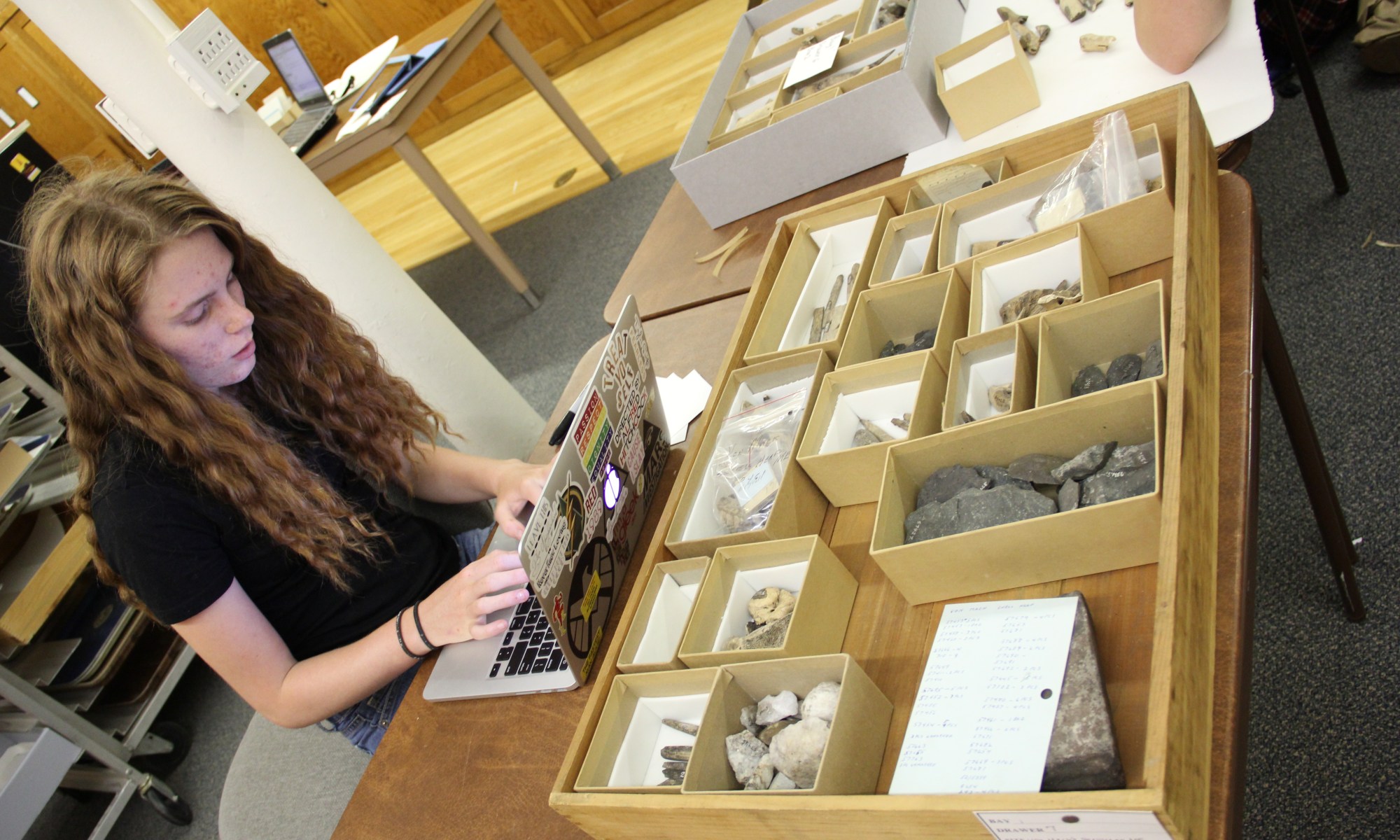
Embarking on a full inventory and rehousing of your museum collection is a daunting task. Transferring approximately 1,700 drawers into 3,000 archival boxes will take years of work. Fortunately for me, I have access to an invaluable resource – Phillips Academy students.
For a week in July, two Lowers (10th graders) came to the Peabody every day for four hours to fulfill their work duty commitment for the school year. I gave them a crash course in artifact identification and object handling techniques before they got down to business. As they worked through the meticulous process of inventorying everything in the collection, they made crucial observations that will improve my workflow. Together, these two students recorded the contents of twenty-nine drawers!
Work duty student inventorying a drawer
Work duty students will continue to be an essential work force as we move through the collection. I will share their progress and successes in the months and years to come.
Curator of Collections Marla Taylor and work duty students stand behind the empty boxes





 Nancy Gonlin is a Senior Associate Professor at Bellevue College, Washington. She earned her Ph.D. in Anthropology at The Pennsylvania State University, is a Registered Professional Archaeologist, and a former Dumbarton Oaks Fellow of Harvard University. Her specialization is the Classic Maya civilization of Mexico and Central America. Nancy is on the Editorial Board of Ancient Mesoamerica, published by Cambridge University Press. She has taught for over 25 years and is highly regarded for her pedagogical contributions – she is the 2012 recipient of Bellevue College’s Margin of Excellence. As an active member of the Society for American Archaeology, Nancy serves on the Committee on Curriculum and has been appointed as the upcoming Chair of the Book Award Committee. She co-author Copán: The Rise and Fall of an Ancient Maya Kingdom, and co-edited Commoner Ritual and Ideology in Ancient Mesoamerica, Ancient Households of the Americas, and Human Adaptation in Ancient Mesoamerica. Nancy’s fifth book will be a co-edited volume on a new field of research in archaeology, The Archaeology of the Night.





 The Peabody