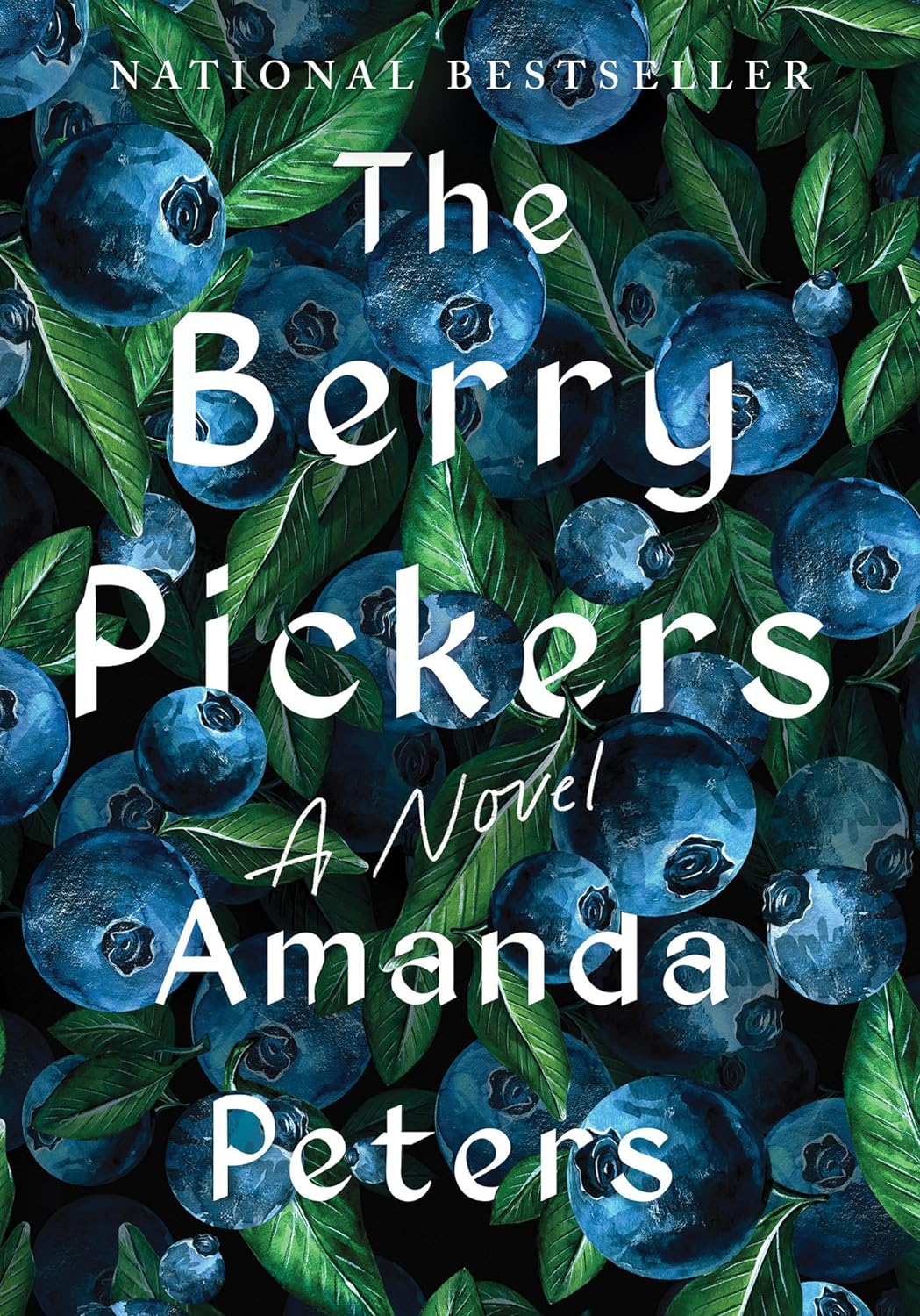
A four-year-old Mi’kmaq girl goes missing from the blueberry fields of Maine, sparking a tragic mystery that haunts the survivors, unravels a community, and remains unsolved for nearly fifty years.
The Berry Pickers is a heartbreaking, riveting tale of Indigenous family separation. We follow an Indigenous Mi’kmaq family in Nova Scotia who travels every summer to Maine to pick blueberries as migrant workers. In the summer of 1962, 4-year-old Ruthie, the youngest of the family’s five children, disappears from the fields. The last to see her is the second youngest, 6-year-old Joe, who takes the loss especially hard and carries his guilt in the years to come.
The book is told through two alternating character perspectives – one being Ruthie’s brother Joe and the second being a young girl named Norma. Growing up in Maine as the only child of affluent and overprotective parents, Norma, struggles to find the truth behind her recurring dreams and visions (that seem more like memories than imagination). As time and secrets unfold, these two storylines ultimately converge.
This is a treasure of a book – filled with loss and sadness yet manages to be hopeful as well. Amanda Peters (Mi’kmaq, Glooscap First Nation) has a lot of empathy for her characters and gently invites readers to examine the affects of intergenerational trauma, racist residential institutions, and the specific ways Indigenous families were treated – in a deeply personal way.
This story is both powerful and moving. Although told quietly, it did not take away from its impact.
Next on my list to read is Amanda Peter’s newest book, Waiting for the Long Night Moon: Stories. This is her debut collection of short fiction that describes Indigenous experiences across time and space – from contact with European settlers, to the forced removal of Indigenous children, to the present-day fight for the right to clean water.
The book will be available August 2024 in Canada and January 2024 in the U.S.
The first steps in the deinstallation process: items are removed and inventoried.
This month we began deinstalling our institution’s last remaining exhibit case. The case resides on the second floor in what was, until recently, our only environmentally controlled storage housing. The case was installed in 1967 and held materials recovered during excavations led by Scotty MacNeish in Mexico’s Tehuacán Valley. The display has sat largely hidden from view behind shelving since 2012, when this room was converted into a housing area.
Summer curatorial assistant, Cyrus, removing items from the case.
Beginning this spring, the room slowly changed from collection housing into offices and workspace for collections staff. As part of the transformation, collections were moved into the basement, boards covering the windows were removed, and collections supplies and worktables were assembled. The final piece to resolve was this exhibit case. With the help of our summer curatorial assistants, Kyra Smith and Cyrus Marion, we were finally able to tackle its deinstallation.
Those are actual mesquite seeds attached to the wall.
The case is a fantastic example of exhibit design from the ‘60s and includes charming hand-painted illustrations that have a lot of character. However, the materials within have been “on display” for decades and they need a rest. Moreover, with the window coverings removed, the room and case were exposed to unfiltered ultraviolet light, an agent of deterioration.
The key to the exhibit case.
Perhaps as an auspicious sign, a key to the exhibit case happened to be in one of the repurposed desks that we moved in for the new office space. With the case opened, we investigated how the items had been installed. Most were secured to the walls with bee’s wax. The wax held up remarkably well for the past six decades. In fact, it was somewhat difficult to remove the items from the wall. Once off the wall, the wax was more accessible and could be removed with heat. We did not remove the wax from botanical items due to their sensitivity to rapid changes in temperature.
Bees Wax held these items on the wall for 57 years!Instructions for the vitrine’s removal.
The items were rehoused and moved into our basement storage for a much-needed rest. The deinstallation of this case marks the end of our institution’s intentional move away from exhibitions, which began in 2017.
As summer approaches and we begin to wind down from the end of another school year, we could all use a good book (or podcast) to help us relax and escape our busy lives. We’ve rounded up our staff’s “Peabody Picks” for summer and hope one of these recommendations may accompany you to the beach, on your next trip, or at home on the couch. We hope you all enjoy your summer!
Happy reading (and listening)!
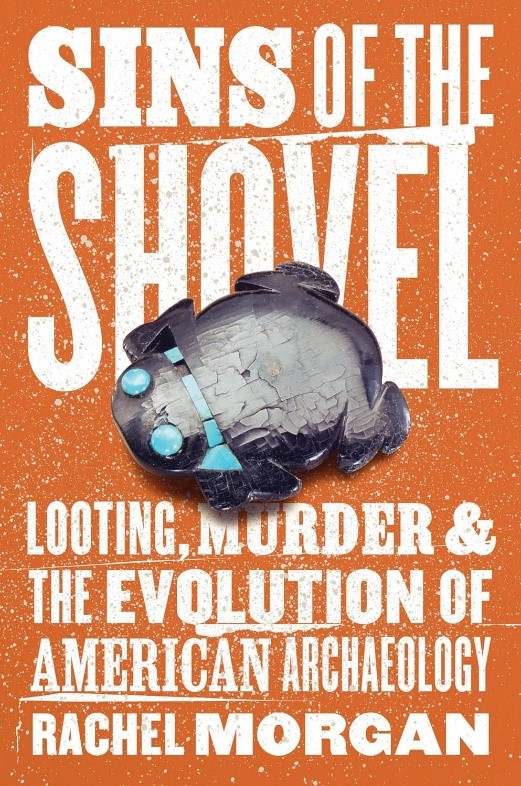
Ryan Wheeler, Director – Sins of the Shovel: Looting, Murder, and the Evolution of American Archaeology by Rachel Morgan
American archaeology was forever scarred by an 1893 business proposition between cowboy-turned-excavator Richard Wetherill and socialites-turned-antiquarians Fred and Talbot Hyde. Wetherill had stumbled upon Mesa Verde’s spectacular cliff dwellings and started selling artifacts, but with the Hydes’ money behind him, well—there’s no telling what they might discover. Thus begins the Hyde Exploring Expedition, a nine-year venture into Utah’s Grand Gulch and New Mexico’s Chaco Canyon that—coupled with other less-restrained looters—so devastates Indigenous cultural sites across the American Southwest that Congress passes first-of-their-kind regulations to stop the carnage. As the money dries up, tensions rise, and a once-profitable enterprise disintegrates, setting the stage for a tragic murder.
Sins of the Shovel is a story of adventure and business gone wrong and how archaeologists today grapple with this complex heritage. Through the story of the Hyde Exploring Expedition, practicing archaeologist Rachel Morgan uncovers the uncomfortable links between commodity culture, contemporary ethics, and the broader political forces that perpetuate destructive behavior today. The result is an unsparing and even-handed assessment of American archaeology’s sins, past and present, and how the field is working toward atonement.
“An incisive history of early American archaeology—from reckless looting to professional science—and the field’s unfinished efforts to make amends today, told “with passion, indignation, and a dash of suspense.” –New York Times
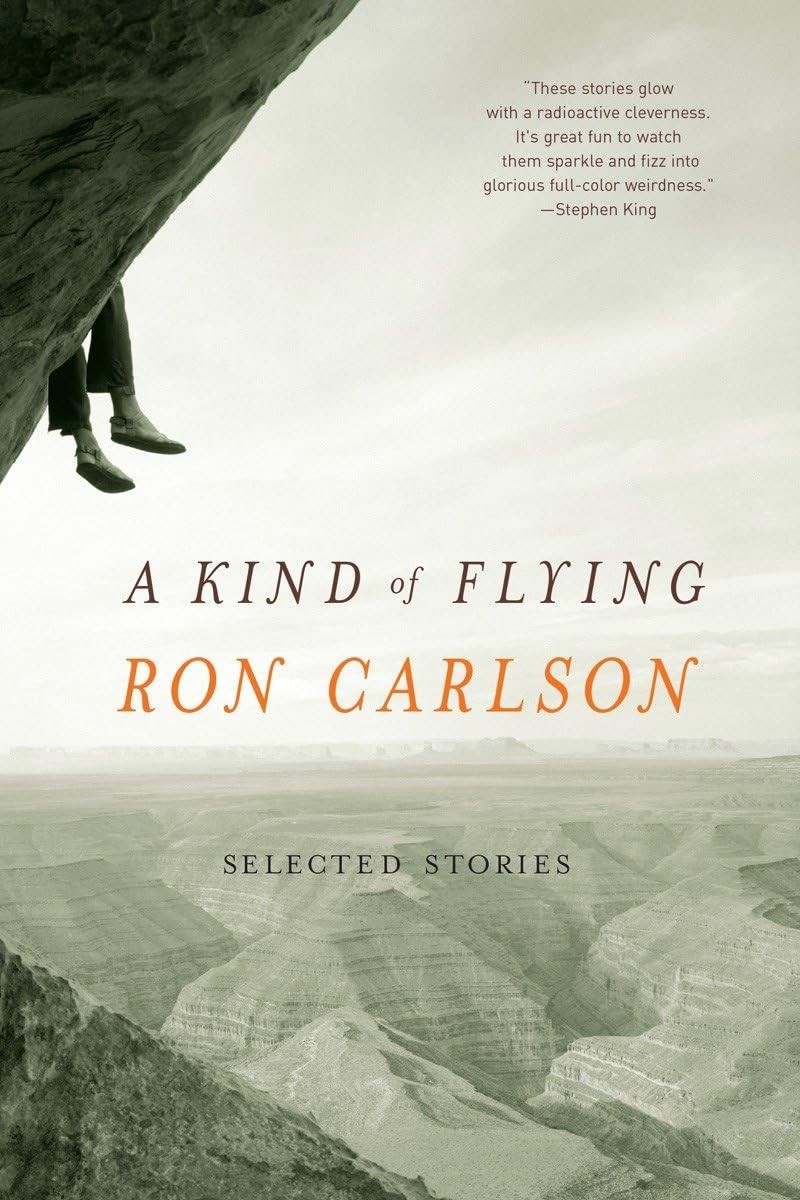
Richard Davis, Peabody Volunteer – A Kind of Flying: Selected Stories by Ron Carlson
Ron Carlson’s stories, sometimes wicked or bittersweet, often zany, are rich with a hard-earned hopefulness frequently absent in contemporary fiction. In this generous gathering from collections no longer available, longtime fans and new readers alike can savor the development of a master of idiosyncrasy.
Properly celebrated for his range, Carlson offers us a rural sheriff who’s wary of UFOs (“Phenomena”), a lawyer on a mission in remote Alaska (“Blazo”), a baseball player turned killer-by-accident (“Zanduce at Second”), and a man accusing Bigfoot of stealing his wife, followed by Bigfoot’s incomparable response.
.“These stories are full of surprises, jolts, and lightning strikes of recognition. Do yourself a favor and read Ron Carlson.” –Stephen King
John Bergman-McCool, Collections Coordinator – Podcasts: Handsome and Throughline from NPR
Handsome is a podcast from comedians Tig Notaro, Fortune Feimster, and Mae Martin. Every week, the handsome hosts field a question from a friend and attempt to answer it together, covering every subject you could think of. Along the way, Tig, Fortune, and Mae tell plenty of stories and just generally have a ridiculous time.
Throughlineis a time machine. Each episode, we travel beyond the headlines to answer the question, “How did we get here?” We use sound and stories to bring history to life and put you into the middle of it. From ancient civilizations to forgotten figures, we take you directly to the moments that shaped our world. Throughline is hosted by Peabody Award-winning journalists Rund Abdelfatah and Ramtin Arablouei.
Marla Taylor, Curator of Collections – Lamb: The Gospel According to Biff, Christ’s Childhood Pal by Christopher Moore
Marla – Sometimes I like to revisit favorite books that I have read in the past. Lamb by Christopher Moore is one of those books for me. The full title is Lamb: The Gospel According to Biff, Christ’s Childhood Pal.
Moore tells the story of a very human Joshua (Jesus) and his best friend/protector, Biff, as they explore their world and learn about themselves. Joshua can’t sin, so Biff has to do it all for him with some delightful and unexpected encounters. This book is irreverent and hilarious – it makes me laugh every time.
But Lamb is also so much more than that. It is a deeply sentimental story about friendship, an exploration of faith, and something that has stuck with me over the years. I really enjoy reading it periodically and hope you find the time to read it as well.
“An instant classic…terrific, funny, and poignant.” –Rocky Mountain News
Emma Lavoie, Administrative Assistant – The Only One Left by Riley Sager
At seventeen, Lenora Hope, Hung her sister with a rope – Now reduced to a schoolyard chant, the Hope family murders shocked the Maine coast one bloody night in 1929. While most people assume seventeen-year-old Lenora was responsible, the police were never able to prove it. Other than her denial after the killings, she has never spoken publicly about that night, nor has she set foot outside Hope’s End, the cliffside mansion where the massacre occurred.
Stabbed her father with a knife, Took her mother’s happy life – It’s now 1983, and home-health aide Kit McDeere arrives at a decaying Hope’s End to care for Lenora after her previous nurse fled in the middle of the night. In her seventies and confined to a wheelchair, Lenora was rendered mute by a series of strokes and can only communicate with Kit by tapping out sentences on an old typewriter. One night, Lenora uses it to make a tantalizing offer—I want to tell you everything. “It wasn’t me,” Lenora said, But she’s the only one not dead.
“Propulsive … a dizzying Gothic whodunit.” –New York Times Book Review
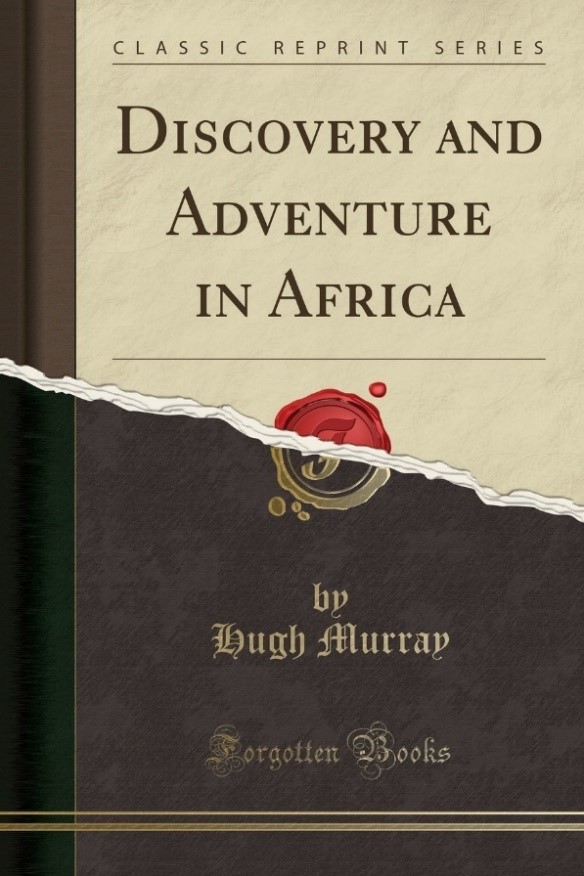
Michael Agostino, Peabody Volunteer – Discovery and Adventure in Africa by James Wilson Jameson and Hugh Murray
Mike – I like old books. Really old books. Old books which have sat on shelves for many years, sometimes read cover to cover, sometimes ignored and gathering dust. Passed down, sold, and exchanged, they end up in a bookstore that I manage to find while on vacation. I have been lucky enough to come across science books published in the late 1800’s and own four Darwins from that time period. No, these are not first edition collector’s items valued at thousands of dollars. I believe the most I ever spent was $30! They must be in good shape for me to buy them, but often show their age. I don’t mind these flaws as it adds to the character I am seeking.
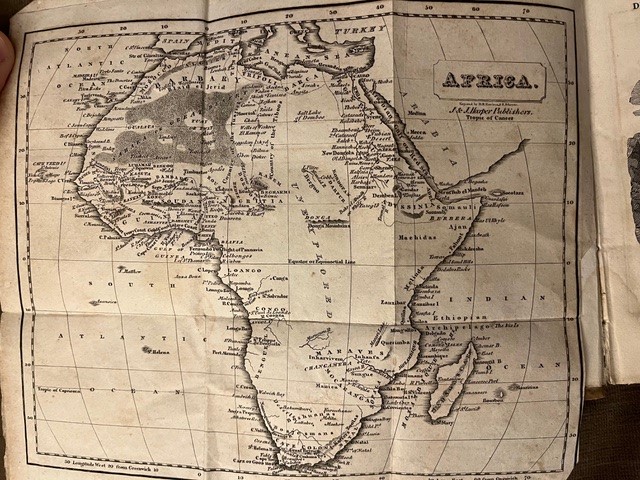
One year I purchased a very old book, “Discovery and Adventure in Africa,” printed in 1832. According to the writing inside the jacket, I spent $5. It is very fragile, yellow with age, and I must be careful when I open it and turn the pages. But what a find! It is number 16 of a 71 book series called “Harper’s Family Library.” It is written by two men who appear to be professors of history and they are recounting the travels and discovery of other Europeans in Africa. It contains a number of illustrations (“engravings”) which try to capture what the explorers are seeing. The real gem of the book is a 9” x 8” fold-out map of Africa. This map reflects the European knowledge of that era as numerous features appear on the edges of the continent but much of the interior is blank.
This 4” by 6” book is a tough read as the text is tiny. But the style is very colorful, common in old writing. Explorers and their teams died frequently in their travels. In this case, almost every explorer came down with high fevers and were ill for weeks. But many recovered to continue months of travel marked with deteriorating resources and energy. They were met by kindness, distrust, help, violence, and puzzlement. The people they met varied in apparent wealth. Many led simple lives while others were the local kings and queens. Some villages contained dozens of inhabitants, while cities had populations in the thousands. Since the descriptions are second and even third-hand, it is hard to decide how accurate the accounts are. But even with that in mind, the window back in time is still interesting and I am enjoying reading about the various cultures the explorers encountered.
Given its age, I was lucky to find this book on a store shelf. But you can find it for sale on the web as you can for almost anything. For me, the hunt continues and if I’m lucky I will find another volume of this great series of books.
“This work has been selected by scholars as being culturally important, and is part of the knowledge base of civilization as we know it.” –Wentworth Press
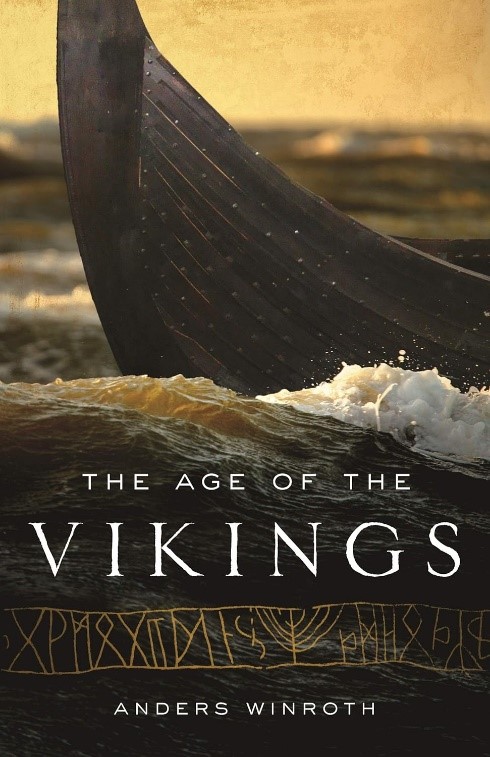
Nick Andrusin, Temporary Educator and Collections Assistant – The Age of the Vikings by Anders Winroth
The Vikings maintain their grip on our imagination, but their image is too often distorted by myth. It is true that they pillaged, looted, and enslaved. But they also settled peacefully and traveled far from their homelands in swift and sturdy ships to explore. The Age of the Vikings tells the full story of this exciting period in history. Drawing on a wealth of written, visual, and archaeological evidence, Anders Winroth captures the innovation and pure daring of the Vikings without glossing over their destructive heritage. He not only explains the Viking attacks, but also looks at Viking endeavors in commerce, politics, discovery, and colonization, and reveals how Viking arts, literature, and religious thought evolved in ways unequaled in the rest of Europe. The Age of the Vikings sheds new light on the complex society, culture, and legacy of these legendary seafarers.
“[Winroth] has an impressive knowledge of the sources, the archaeology, and the modern historical literature. . . . Winroth really knows what he is writing about, and has done the research. . . . I recommend the work to anyone with little knowledge of the subject and a wish to learn more.”–New York Review of Books
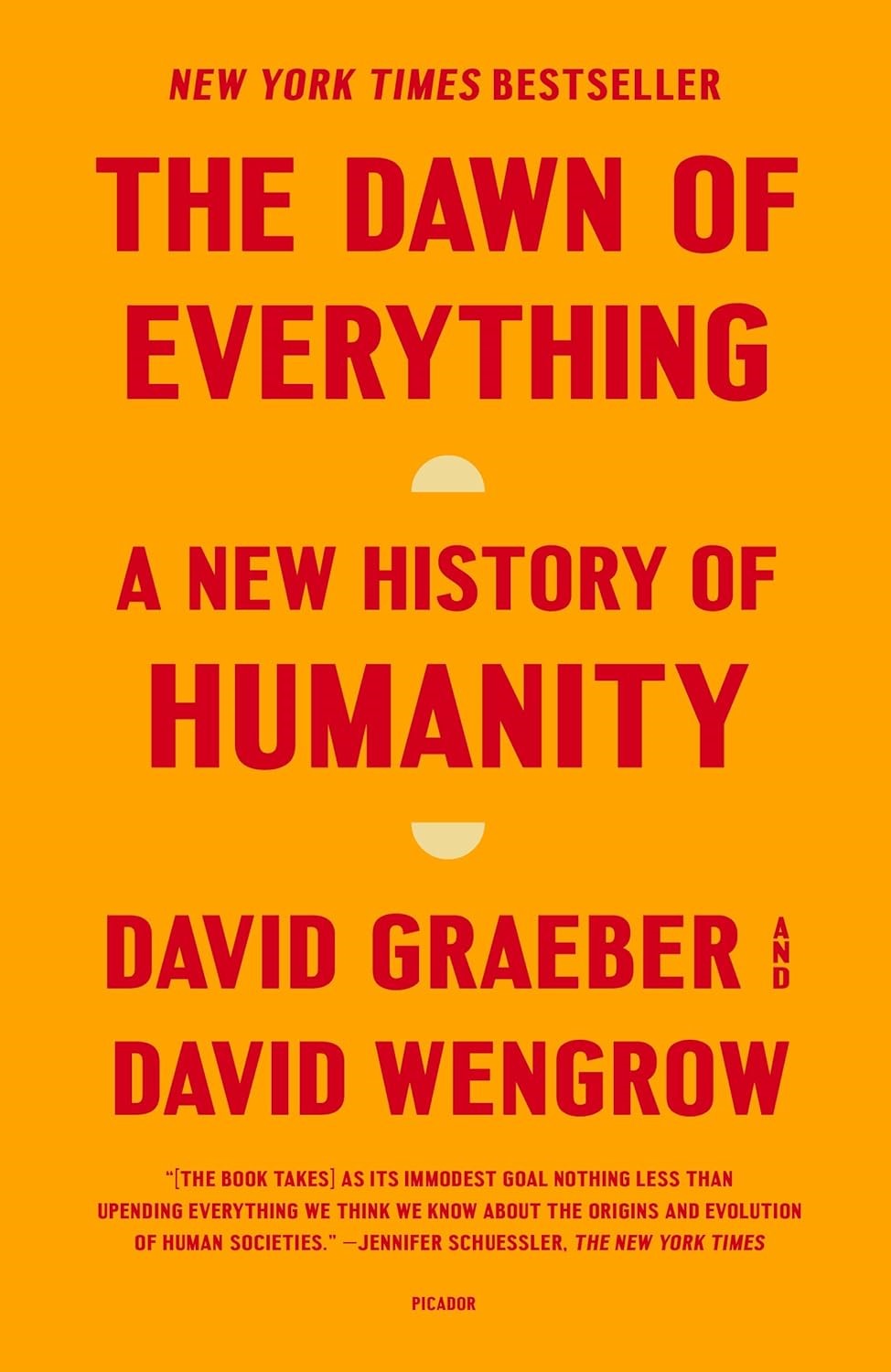
Cyrus Marion, Curatorial Assistant – The Dawn of Everything: A New History of Humanity by David Graeber and David Wengrow
A dramatically new understanding of human history, challenging our most fundamental assumptions about social evolution―from the development of agriculture and cities to the origins of the state, democracy, and inequality―and revealing new possibilities for human emancipation.
Drawing on pathbreaking research in archaeology and anthropology, Graeber and Wengrow reveal how history becomes a far more interesting place once we learn to throw off our conceptual blinders and perceive what’s really there. If humans did not spend 95 percent of their evolutionary past in tiny bands of hunter-gatherers, what were they doing during all that time? If agriculture and cities did not mean a plunge into hierarchy and domination, then what kinds of social and economic organizations did they lead to? The answers are often unexpected, and suggest that the course of human history may be less set in stone, and more open to playful, hopeful possibilities, than we tend to assume.
Cyrus – Pay special attention to those footnotes! You do not want to pass those up in your reading.
“[The book takes] as its immodest goal nothing less than upending everything we think we know about the origins and evolution of human societies.” –The New York Times
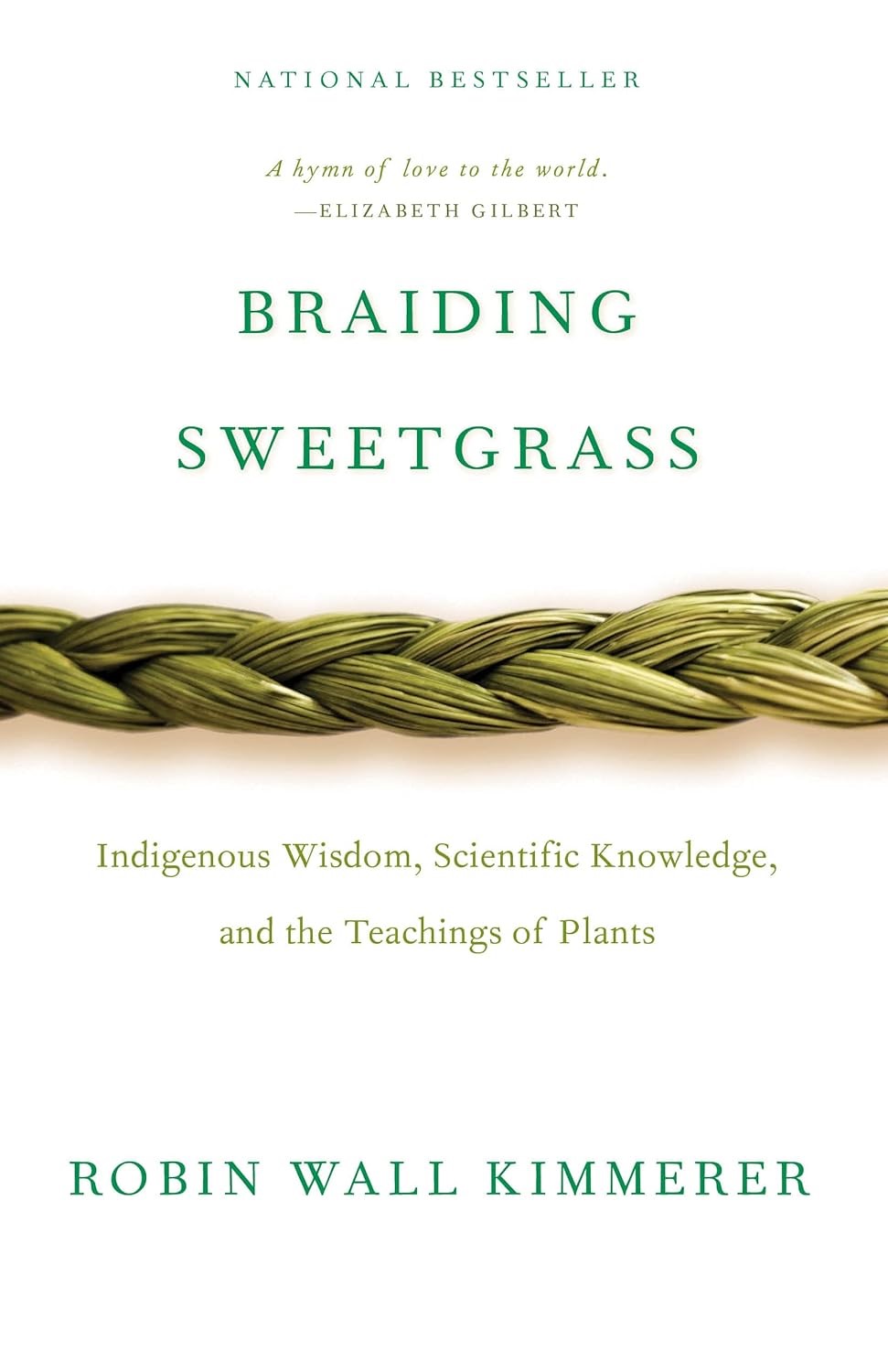
Kyra Smith, Curatorial Assistant – Braiding Sweetgrass: Indigenous Wisdom, Scientific Knowledge, and the Teachings of Plants by Robin Wall Kimmerer
As a botanist, Robin Wall Kimmerer has been trained to ask questions of nature with the tools of science. As a member of the Citizen Potawatomi Nation, she embraces the notion that plants and animals are our oldest teachers. Drawing on her life as an indigenous scientist, and as a woman, Kimmerer shows how other living beings―asters and goldenrod, strawberries and squash, salamanders, algae, and sweetgrass―offer us gifts and lessons, even if we’ve forgotten how to hear their voices. In reflections that range from the creation of Turtle Island to the forces that threaten its flourishing today, she circles toward a central argument: that the awakening of ecological consciousness requires the acknowledgment and celebration of our reciprocal relationship with the rest of the living world. For only when we can hear the languages of other beings will we be capable of understanding the generosity of the earth, and learn to give our own gifts in return.
“Robin Wall Kimmerer has written an extraordinary book, showing how the factual, objective approach of science can be enriched by the ancient knowledge of the indigenous people. It is the way she captures beauty that I love the most—the images of giant cedars and wild strawberries, a forest in the rain and a meadow of fragrant sweetgrass will stay with you long after you read the last page” –Jane Goodall
Additional reading recommendations from our Peabody Staff
The Peabody has taught many lessons over the years, so we have a lot of teaching instruments and old plans laying around. When we get contacted by an instructor here at Phillips Academy, we dive into those piles to see what can be used and how! This is what happened very recently with our Trade Connections lesson.
The opportunity arrived when history fellow Anna Green asked us to do a few lessons for her history 100B class. She was looking for a lesson to fit into her student’s final project, a presentation on various Native American cultures from South to North America. We sat down with her one day and sketched out what this lesson could look like and what we could incorporate.
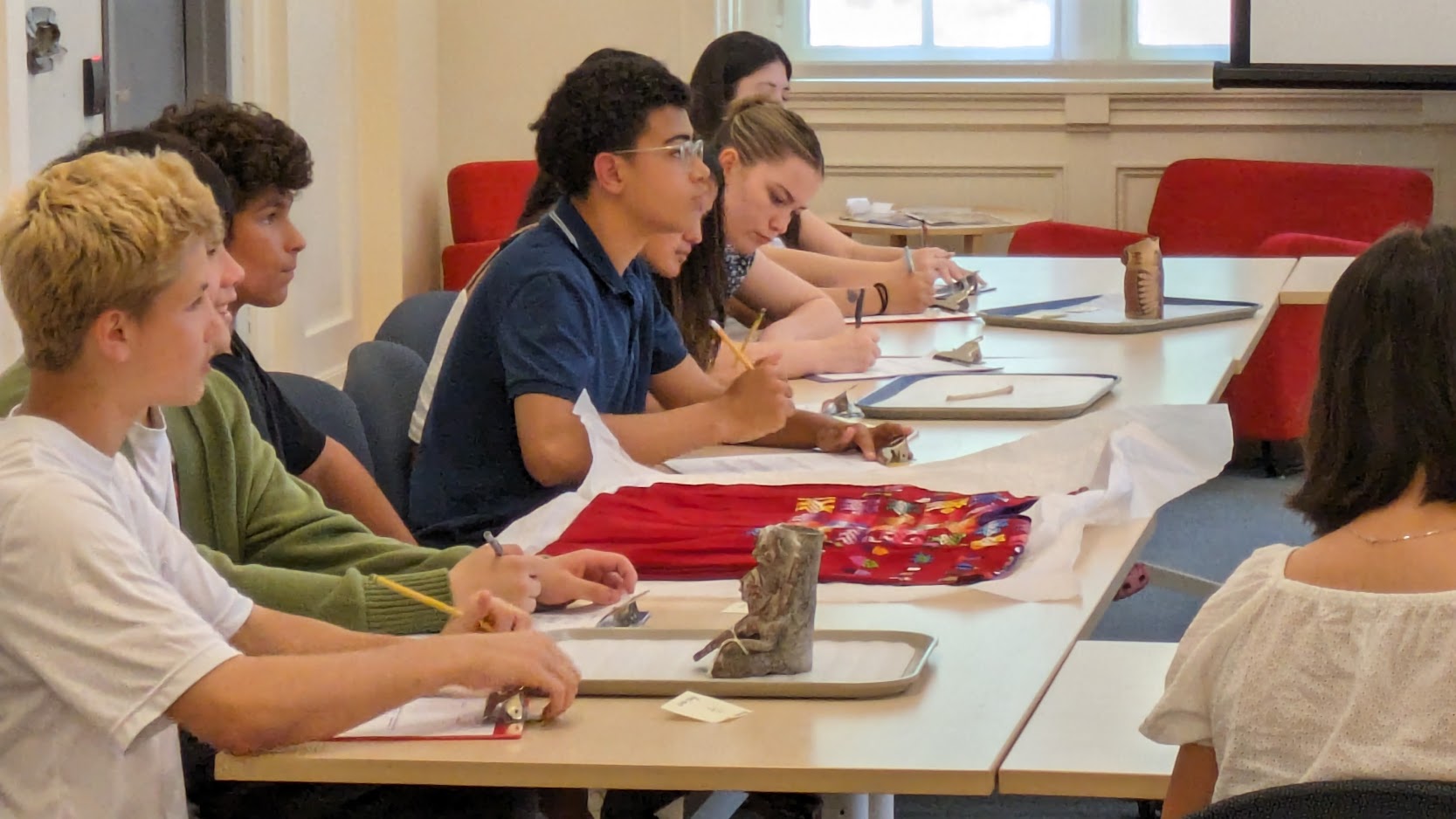
We have a previously existing lesson known as Trade Connections that we last taught in December 2022. This lesson features objects from 4 different regions of the Americas (Mesoamerica, Andes, American Southwest and American Southeast) and discuss how these societies traded and interacted with each other over the millennia. So, for this new version we focused on 8 objects that represent the areas for the assignment. In addition, we made sure that both ancient and modern examples from these cultures were included, showing that there are forms of continuation with these Indigenous groups.
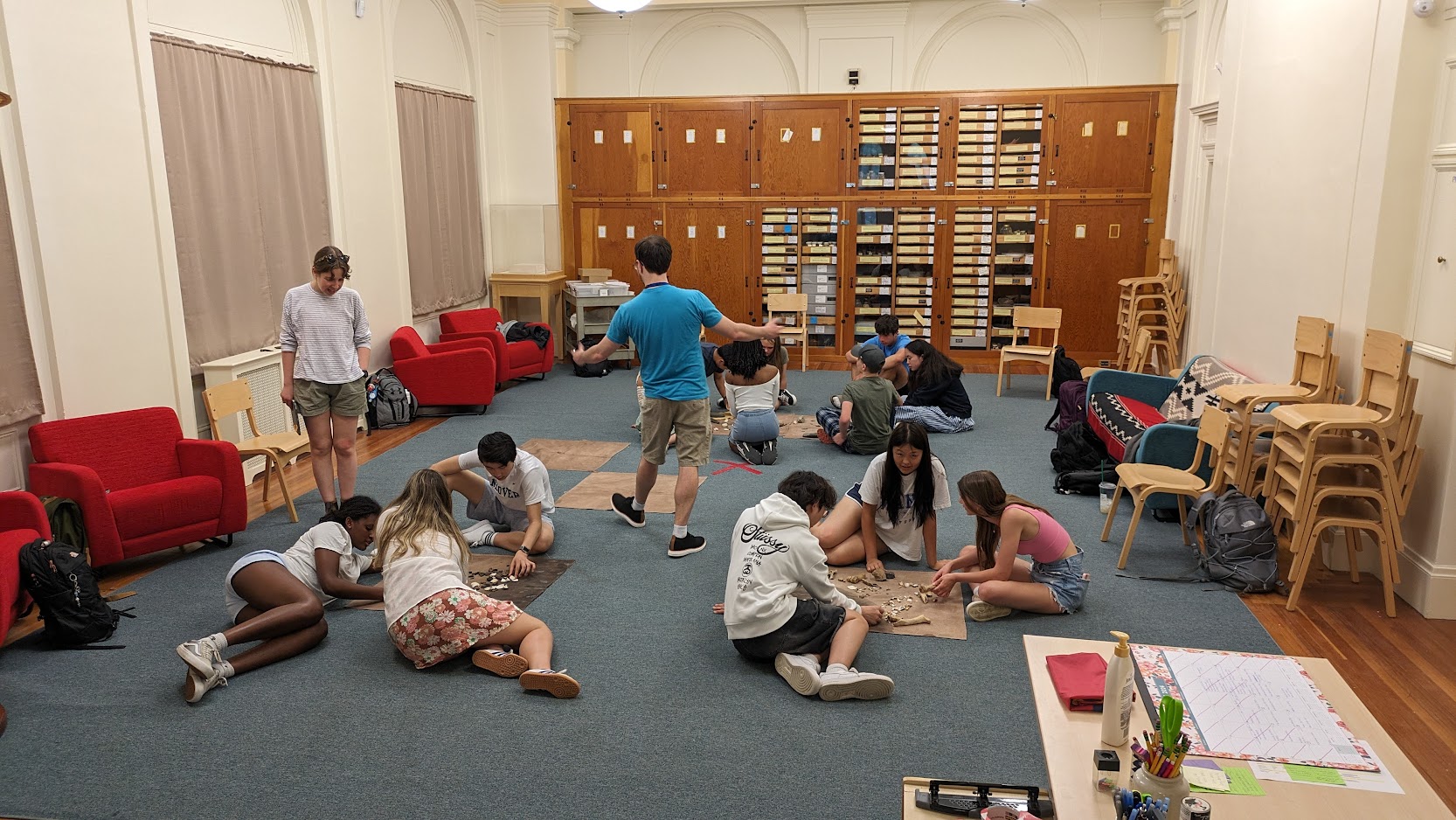
But we didn’t stop at just substitutions of objects. We wanted students to practice basic object interaction so they could approach looking at artifacts in a way that they may not have done before. To do that we broke out the tried-and-true Tarps exercise, which basically give them a crash course in item handling and simple archaeology. Here we set up a mock dig site complete with objects used for different purposes (pottery making, cooking, etc.) and have the students use there critical thinking skills to evaluate what the objects are and areas are used for based on how they found them (kitchen, stone tool workshop, etc.).
(shoulda’ been a conductor…)
After completing the Tarps exercise, students apply their newly acquired knowledge and skills to study of the objects from Mesoamerica, the Andes, American Southwest and American Southeast. We asked them to write down their observations of the object, what are its potential uses, what does it tell you about the culture, was it made by ancient or modern individuals, etc. The students then use this knowledge to pick and research an object on their own for their final project.
It was great revamping an older lesson and making it available for today’s classes at Phillips Academy!
Every month our collections staff monitor glue traps stationed around the building. The traps provide a way to monitor what kind of insect activity is happening at our Institute. They serve as one of several pillars of our Integrated Pest Management (IPM) program. IPM is a sustainable approach to managing pests that utilizes techniques that minimize risk to human health and the environment. Other pillars in our program include regular cleaning, maintaining temperature and humidity at levels that slow down and discourage insect activity, and isolating and treating affected items with deep cold or hypoxic conditions.
Insects within research and museum collections are a reality, especially within an old building like the Peabody. Some insects do not pose a danger to the collection, but their presence can signify that environmental conditions within the building may be outside of our target range. Other pests can damage the collection, and their presence requires immediate attention. In the past, the presence of one adult carpet beetle out in the open in our ethnographic collection area was enough to kick off a month’s long survey of susceptible items.
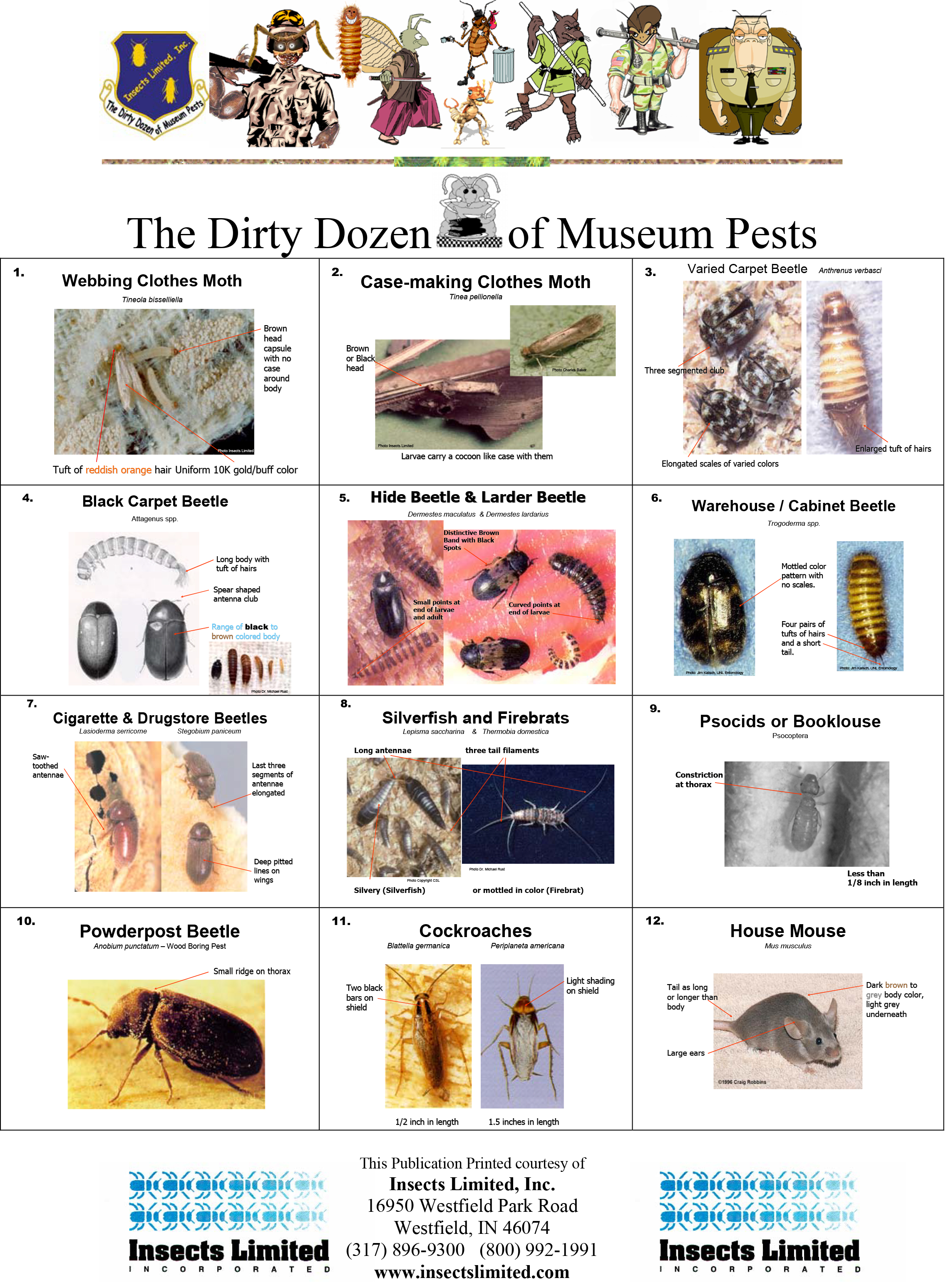
Insects Limited is a great resource for IPM solutions and insect identification, including this poster of museum baddies.
Our traps are placed along the walls where many insects prefer to travel and they are open on either side. When caught, the position of the bugs give us a sense of where insects are coming from, either within the building or from the outside. Some insects can live and breed within the building, while others have to leave to find a mate before coming back to lay eggs.
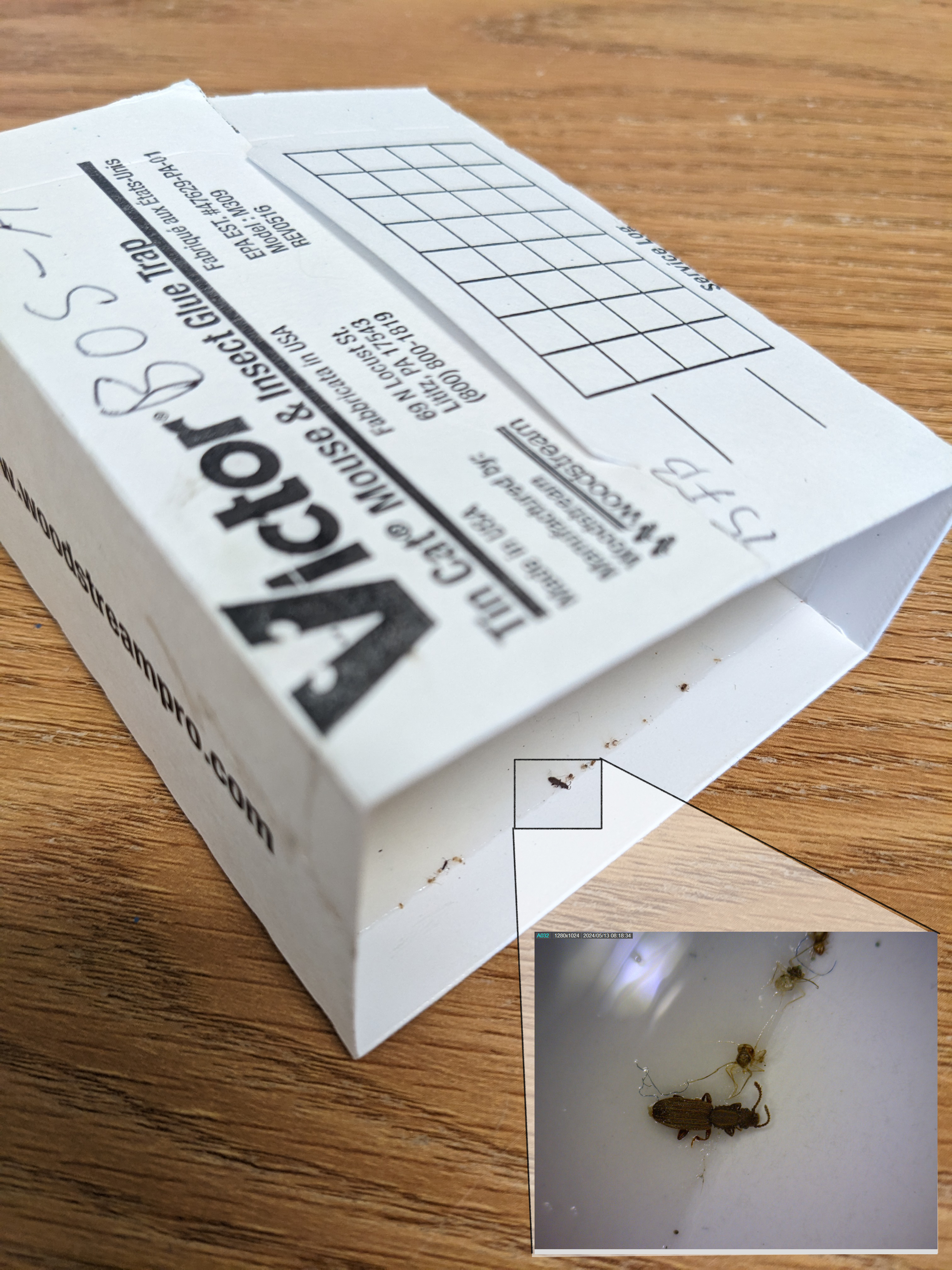
This month, as temperatures outside the building are warming up and the humidity is increasing, we are starting to see an increase in activity within our traps. One trap returned an insect that required closer inspection.
The trap in question with an enlarged image of the unknown insect.
In the above image, there are lots of little specks and one larger. The small specks are psocids (booklice), one of the dirty dozen pests depicted above. Booklice feed on molds, fungi, grains, insect fragments, and other starchy material, including glue from bookbindings (link). If this trap were in our library or archives, we would want to do a good cleaning. There are no at-risk collections where this trap is located, though a vacuum cleaning is warranted.
The larger speck is a beetle of some variety. It came from the room side of the trap, not the door side. It is roughly 1-2 mm in length (very small!) and needs to be examined under magnification. Amazingly, there are many beetles of this size. One that we have seen in traps in the past is the minute brown fungus beetle (MBFB) (link). They are an insect that doesn’t pose a direct risk to the collections, however they can indicate warm and wet environmental conditions. MBFB eat wet organic matter and plaster, and if found in large numbers they may alert us to leaks in the building.
A more alarming possibility is the powderpost beetle (link). This is a truly dangerous pest. They can decimate wood. Adults are rarely seen, and they lay tiny eggs on or just under the wood surface. When the eggs hatch the larva burrow under the surface and tunnel around until they emerge from tiny pin holes when they are adults.
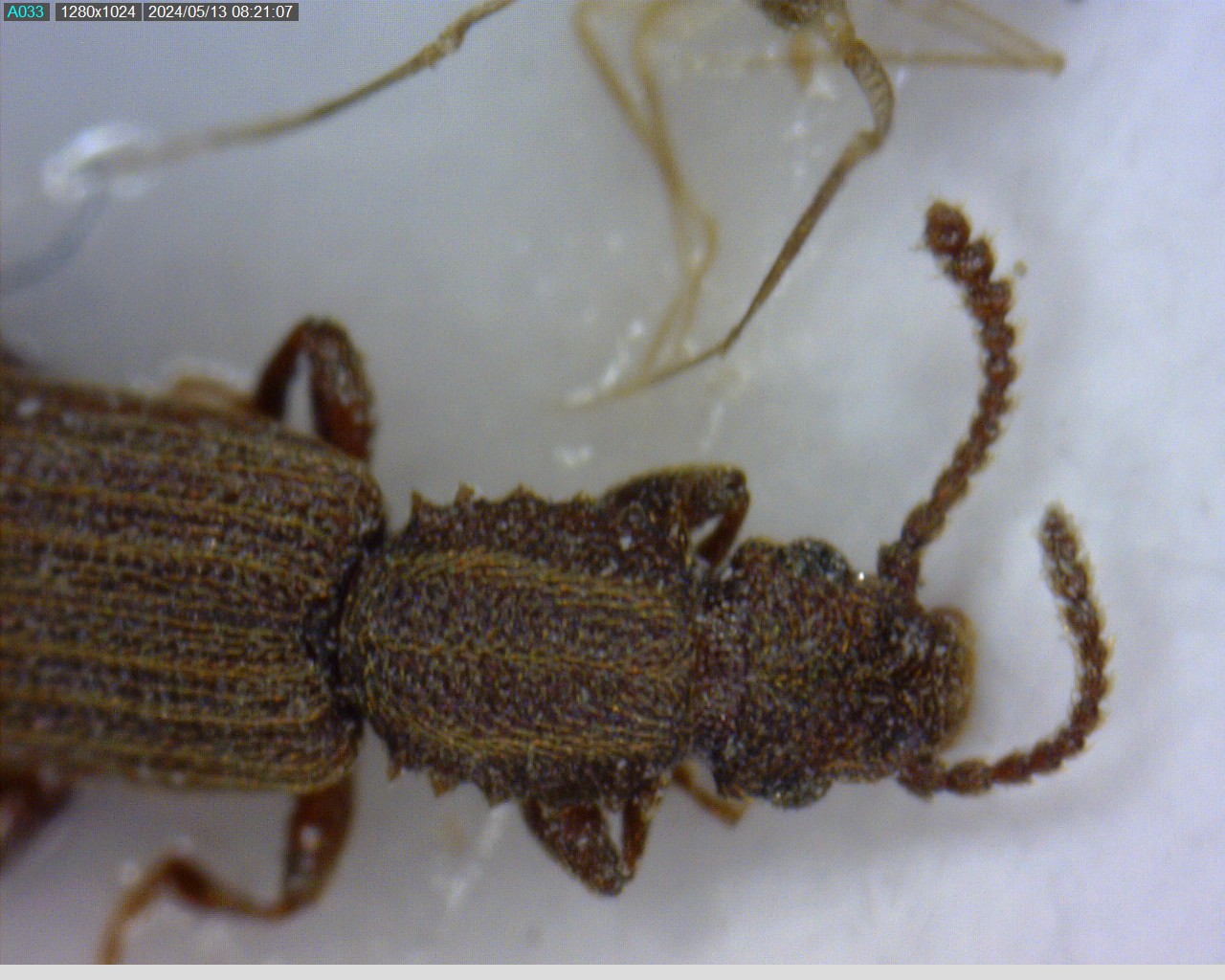
Here is a very up close and personal view of the mystery insect.
Under magnification our insect doesn’t look like either of these. A very useful tool for identifying unknown insects is the image lookup function in Google images.
Click the above icon and follow the prompts to upload your image. Google will return images that look similar to your upload.
With the image loaded into Google, we were pretty quickly able to find very close visual matches that suggest that our beetle is a Saw Tooth Grain Beetle (link, link). This beetle is a common kitchen pest frequently found in oatmeal and grain. There is a possibility that this insect is a random encounter, however they are known to consume tobacco, which we have housed with our collection. We have susceptible items within the collection, but they aren’t housed anywhere near this trap location. This is one to keep our eyes on, so we’ll be monitoring this area for future encounters.
May is National Pet Month, a time to celebrate how important our pets are! Whether they are just being their playful selves or providing assistance in various ways, pets contribute so much love in people’s lives. They also make our social media that much more entertaining.
This month we’d like to introduce some more Peabody Pets! Amongst these new faces, you may see some familiar furry friends from our first Peabody Pets blog here!
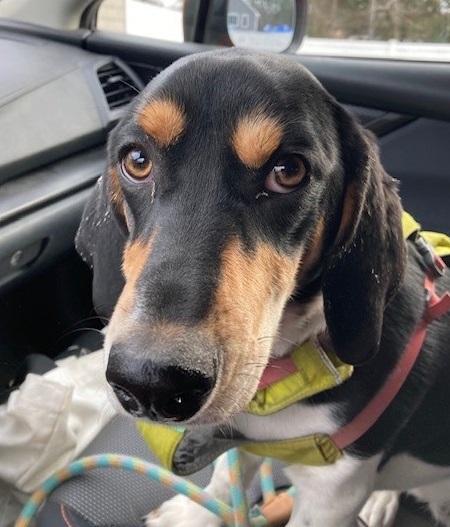
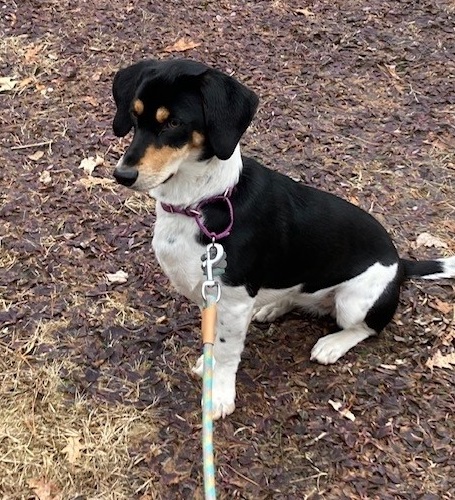
Meet Opal
Opal is a beagle/basset hound mix that was rescued from Oklahoma. She was a puppy when she came to Peabody curator of collections Marla Taylor’s family just about a year ago and they decided her birthday is February 14th. Opal was named by Marla’s sons – they came up with the name completely on their own and it won the family vote. Opal loves her boys!
Opal’s favorite foods are broccoli, carrots, and salami. She LOVES chasing the ball in the backyard but hasn’t figured out that she needs to bring it back to have it thrown again. She also loves trying to play soccer with the boys (but she uses her mouth). Opal does not hesitate to climb onto your lap when she wants some attention.
Meet Sophie and Elle
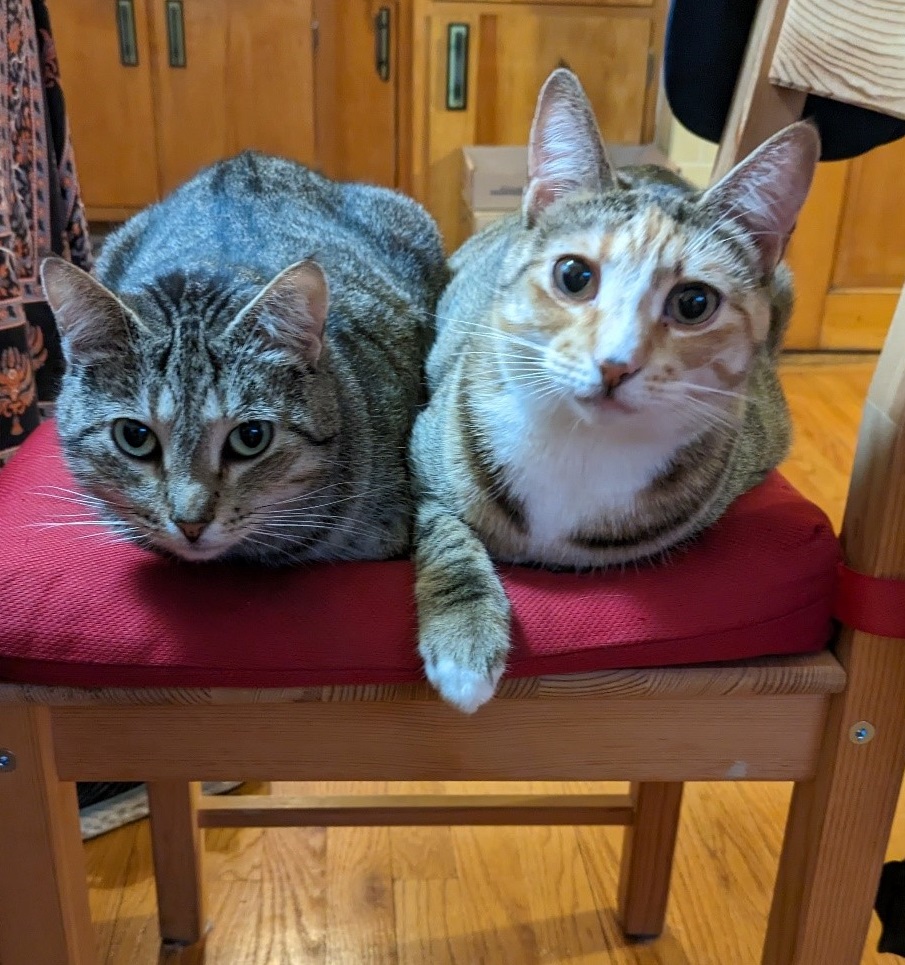
Sophie and her daughter Elle are the newest additions to Peabody director Ryan Wheeler’s family. Sophie (also known as Baby Cat, Baby Momma Cat, Clio, Buttons, etc.) was part of a feral cat colony in Fort Lauderdale, where she befriended Ryan in 2021. She was ultimately rescued by the organization Love for Cats in 2022 and was soon joined by her kitten Elle (named for Millie Bobby Brown’s character Eleven from Stranger Things).
In July 2022, Ryan traveled to Florida to bring Sophie and Elle back to Massachusetts. Despite being feral, Sophie enjoys sitting with her humans, interacting with her dog friend Scotty, and, occasionally, snuggling with her daughter. Elle is now two years old and the biggest cat at Ryan’s home. She enjoys being goofy, watching television, and playing with her toys.
Meet Batson
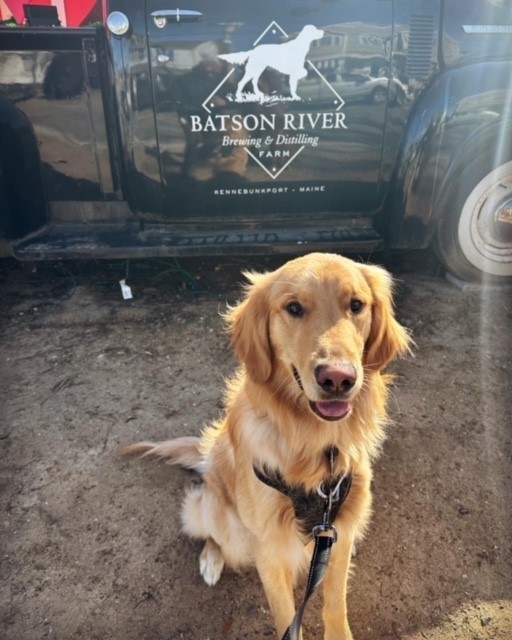
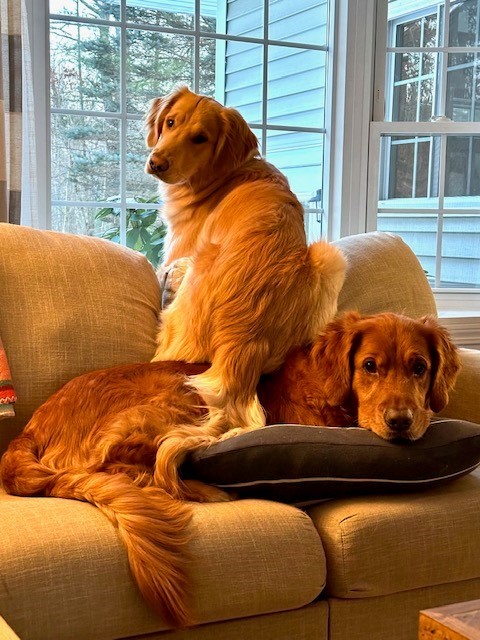
Batson is a 1-year old golden retriever whose birthday was just last month! He is the second fur child to Peabody administrative assistant Emma Lavoie and her family. Batson gets his name from the Batson River that flows through Kennebunkport, Maine. The towns of Wells and Kennebunkport, Maine are very dear to Emma’s family, as her family has spent summers there since she was a child. Batson’s namesake is also dedicated to the Batson River Brewing & Distilling Company, a local favorite in Maine!
Batson’s favorite activities are swimming, running on the beach (and into the ocean), looking out the window, giving hugs, wrestling or sitting on his brother, and looking at himself in a mirror (we’re still figuring that one out). His favorite foods are peanut butter, green beans, carrots, and his meatball and jerky treats. You may recognize Batson’s brother, Rourke, from our previous pet blog. Rourke is now 5 years old and loves having a little brother… most of the time. Rourke got his name from Emma’s old family Irish name O’Rourke (meaning Red Hero). Emma found the family crest during her visit to Ireland in the fall!
Meet Baz
Remember Baz from our previous blog? He’s now 17 years old! Baz has been a long-time member of Peabody collections coordinator John Bergman-McCool’s family. He will follow you around the house for hours waiting for the moment you sit down. Then, he claims his spot in your lap. The remaining time is spent sleeping on your pillow. He loves cucurbits of all kinds and playing fetch.
Meet Scotty
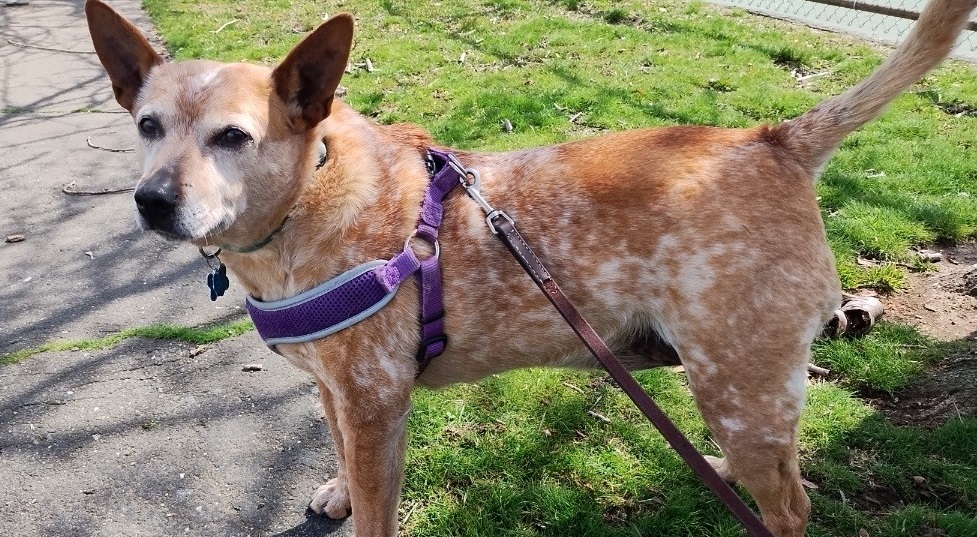
Recognize Scotty from our previous blog? Scotty MacLeish is an Australian cattle dog mix who joined Peabody director Ryan Wheeler’s family in fall 2016. He was about a year old at that time, a rescue from Tennessee. Scotty soon made an appearance in Ryan’s Human Origins course, where he helped facilitate conversations about dog domestication (being part dingo!).
Scotty enjoys hanging around with his cat friends, but doesn’t enjoy rainy or cold weather. His name is a tribute to Richard “Scotty” MacNeish, fifth director of the Robert S. Peabody Institute of Archaeology and super star archaeologist of plant domestication.
Meet Dexter
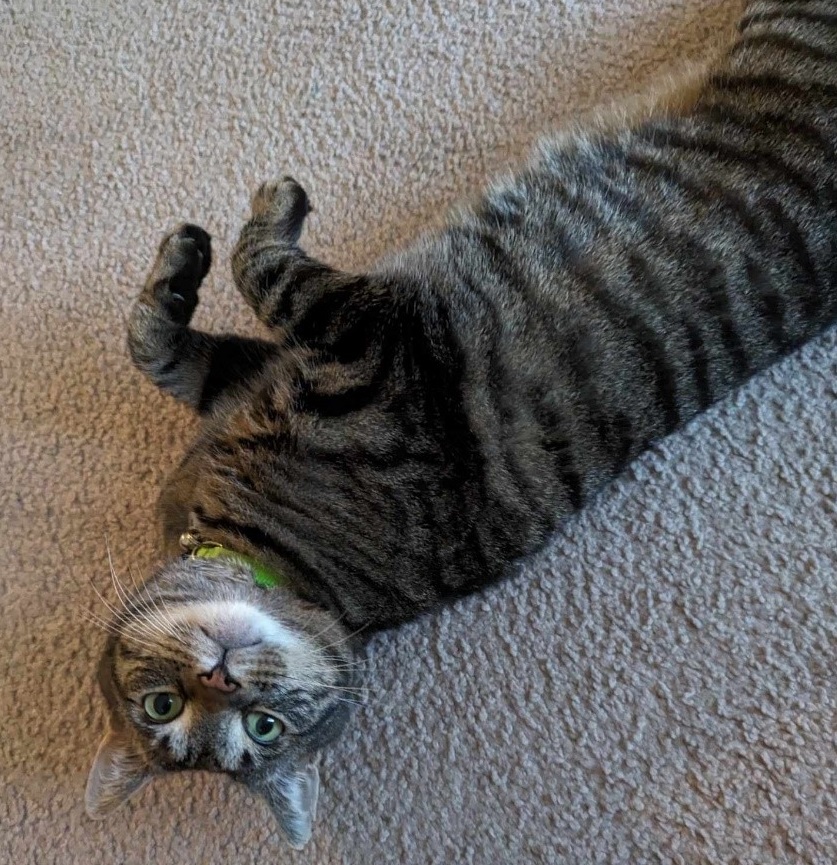
This is Dexter! He is a 6 year old Tabby cat. He was adopted from the pet adoption center in Irondequoit, NY, joining Peabody temporary educator and collections assistant, Nick Andrusin’s family back in 2019. His new family did not pick his name. Instead, they chose to keep his original name, Dexter, as he already knew and answered to it before adoption.
His favorite activities include rough housing, staring at birds, and sitting on an open lap for as long as possible. He loves cream cheese and deli meats.
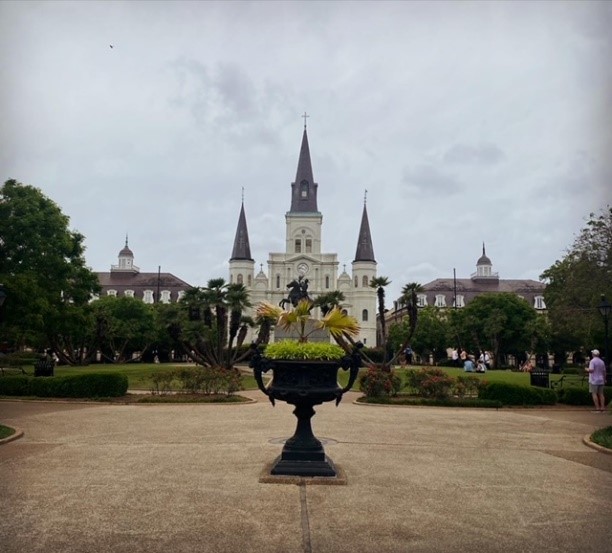
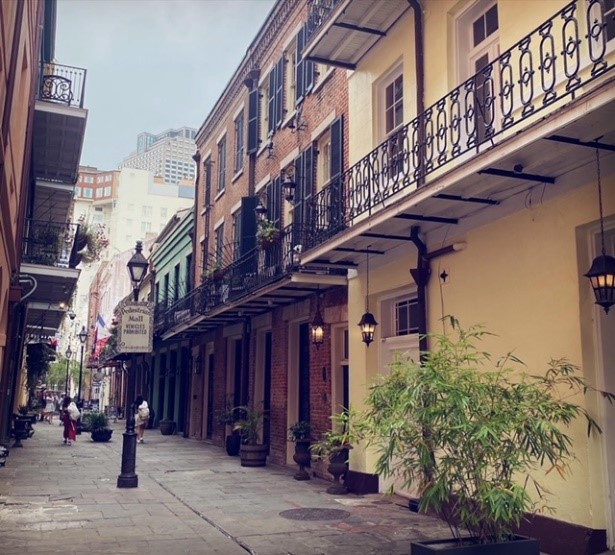
This month, members of the Peabody staff attended the 89th annual meeting of the Society for American Archaeology (SAA). This year, the annual meeting was in New Orleans, Louisiana. SAA was founded in 1934 and is the largest organization for archaeologists conducting work in North and South America. Fun fact: the first meeting by SAA took place at Phillips Academy in December 1935!
Today, the SAA includes over 7,000 members and their annual meetings take place all over the country, giving archaeologists the opportunity to present papers and posters on their research, as well as conduct symposiums and panel discussions related to current issues in the field of archaeology.
There are many institutions and vendors who take part in SAA’s exhibit hall, where various groups rent space to promote their organizations and activities. This is also a wonderful place to meet and network with other institutions and archaeologists. The Peabody booth was very popular – and this may or may not have had to do with our booth neighbors, the Institute for Canine Forensics. They were the best neighbors and of course we had a blast meeting Katana and Jazz (two of their service canine teammates.)
Staff with the Peabody booth at SAA
This was one of the largest exhibit hall turnouts the Peabody has experienced at SAA and it was a great opportunity for staff to meet new people interested in the Peabody for research, educational programming with the Journal of Archaeology and Education, collection care, and NAGPRA work. It was also wonderful for staff to reunite with past friends and colleagues.
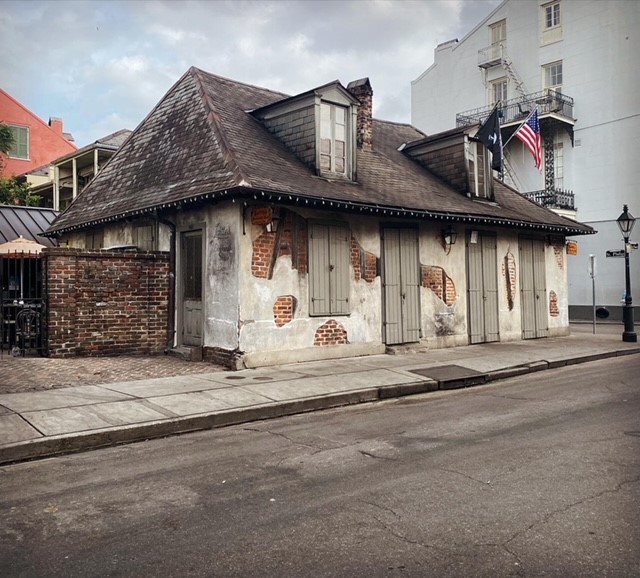
With the SAA conference in New Orleans (right in the heart of the French Quarter no less), there were many opportunities to explore the historical city and jazz culture. I even got to see a site associated with my ancestors – the Lafitte brothers, who used the property for their privateering and smuggling operations in New Orleans.
Next year’s SAA meeting will take place in Denver, Colorado – where SAA will be celebrating 90 years! You can be sure to see the Peabody in attendance!
Sometimes you find a neat thing while cleaning. Everyone has experienced this in one form or another. A missing phone charger, an old book, a hat you haven’t seen in months, etc. This happens at Phillips Academy too, but instead of an old DVD or a lost sweater…it’s an entire archeological collection.
In early 2023 Peabody Institute became the caretaker for an old collection know as the PA Classical Collection, formerly stored by the campus facilities office along with paintings, furniture, and china. It includes art and antiquities from in and around the Mediterranean region, dating from the late Bronze Age to the modern day, including items like ancient Greek pottery, Roman glassware, Late Egyptian masks, and coins from the Islamic Caliphate. Phillips Academy asked the Peabody Institute if we could house and look after the collection.
(They all arrived in boxes like this one)
We believe the collection came to the Academy sometime in the early 1940s, as there were some photographs and labels from that time, and indications there had been an exhibition at the Addison Gallery of American Art. It also seems like the collection went into storage sometime in the 1980s. Meaning this material had not seen the light of day in around 40 years. These are all best guesses, as there was a very short paper trail associated with the collection. Parts of its provenance are unknown.
With the help of a few volunteers and students, we spent time in 2023 working with the material. Unpacking items oneat a time, photographing each item, and assigning catalog numbers. Each item was originally wrapped in bubble wrap and tissue paper(!) so we upgraded storage to modern museum standards (well, as best we could do while the building was under construction).
(Much better than bubble wrap and duct tape older than me!)
Once the collection was better documented and houses, we wanted to know exactly what we had. While the staff here is very knowledgeable, ancient antiquities are a bit outside our wheelhouse an expert classic world art and antiquities, was invited to provide basic identification and dates for each item. Most of the collection was authentic to our surprise, with only a few reproductions.
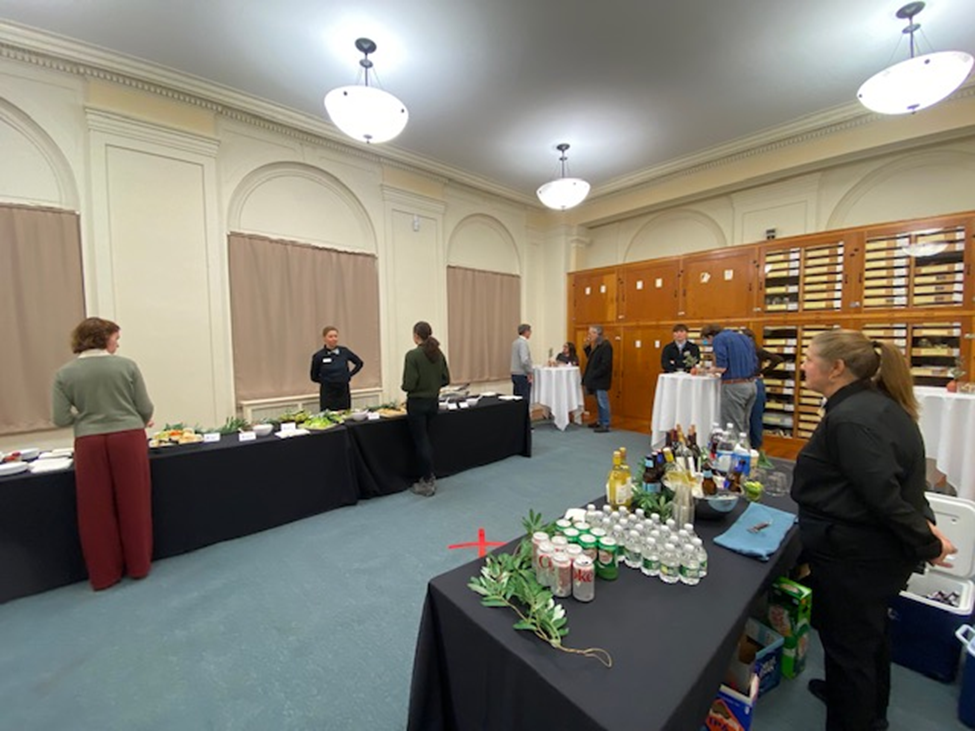
So, we had all these items roughly identified, and properly stored, now what? Well, naturally we threw a party. The building had recently reopened after construction had (mostly) finished and we used the Hornblower Galley to host an open house. Mediterranean food, and exhibit labels, and the campus community helped us have a grand old evening showing off the new/old collection.
(that’s me in the gray!)
The Peabody Institute is now making the PA Classical Collection available for use in classes. While the Peabody has no specific lessons plans associated with this collection, our hope is for teachers to incorporate items they are interested in into their existing classes, be it art, language, history, etc. We have already had some success in bringing items to Latin classes! It’s nice that a collection once shown at PA is about to rejoin the community, adding historical context and facilitating learning for a whole new generation of students. This whole blog isn’t just about the collection though, it’s really a cautionary tale about the importance of deep cleaning, you never know what might be back there!
Almost five years ago, I began volunteering at the Peabody Institute. I remember speaking with Peabody Curator of Collections, Marla Taylor, one evening after an evening presentation there and, as they say, the rest is history. In my time there, I think I’ve seen every possible iteration of projectile point imaginable – and there have been many – but what resonates most for me are the stories behind almost every object I’ve handled.
The museum has an important collection of approximately 600,000 objects essentially from North, Central, and South America. It is unlikely that I’ll get to see or work with every one. So far, I have helped catalog 12,000 year old bones from a cave in Peru where South American agriculture is believed to have started, reshelved a couple of dozen hominid skull casts, been taught the rudiments of differentiating mere stones from artifacts that were used for a myriad of tasks, and more.
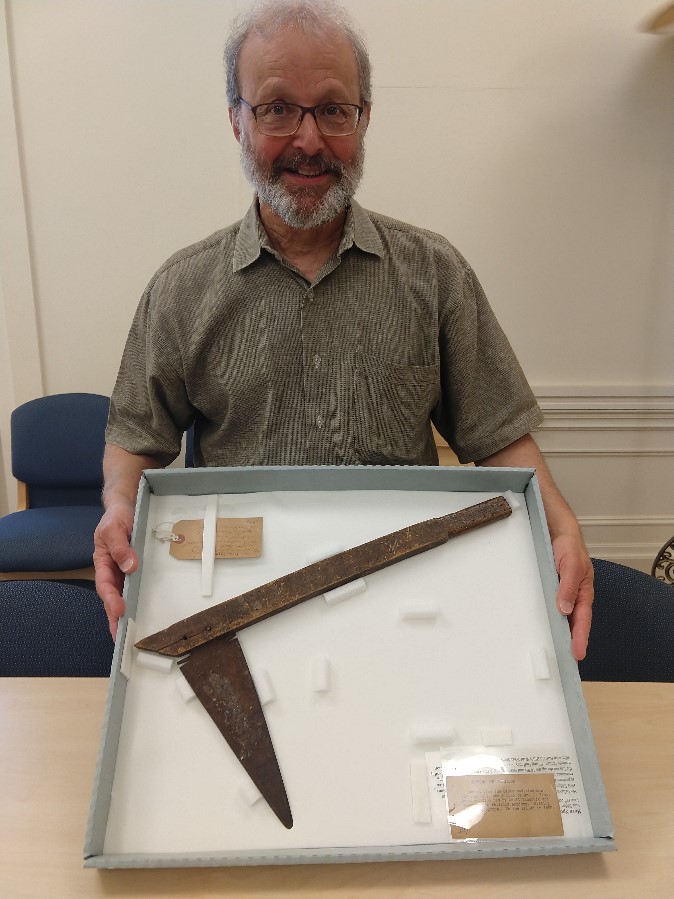
How I ended up there is a longer story, but on one of several tours, a tomahawk that was found after the Battle of Little Big Horn was shown to me. It was made from a table leg and a piece of metal from another object that was pounded into its newer, more lethal form. My son thought that was pretty compelling and asked for a photo of me with that object – the museum and I willingly complied.
Peabody Volunteer, Richard, with a tomahawk from the Battle of Little Big Horn.
I recently was examining an object that I couldn’t identify – as with many things my neophyte status should suggest – and I asked my ‘boss’ what it might be. You need to understand that the folks at the museum have seen and handled many such objects, so when they get excited by one, I figure it has some particular traction. Marla said – “Oh – that’s really cool,” so I paid close attention.
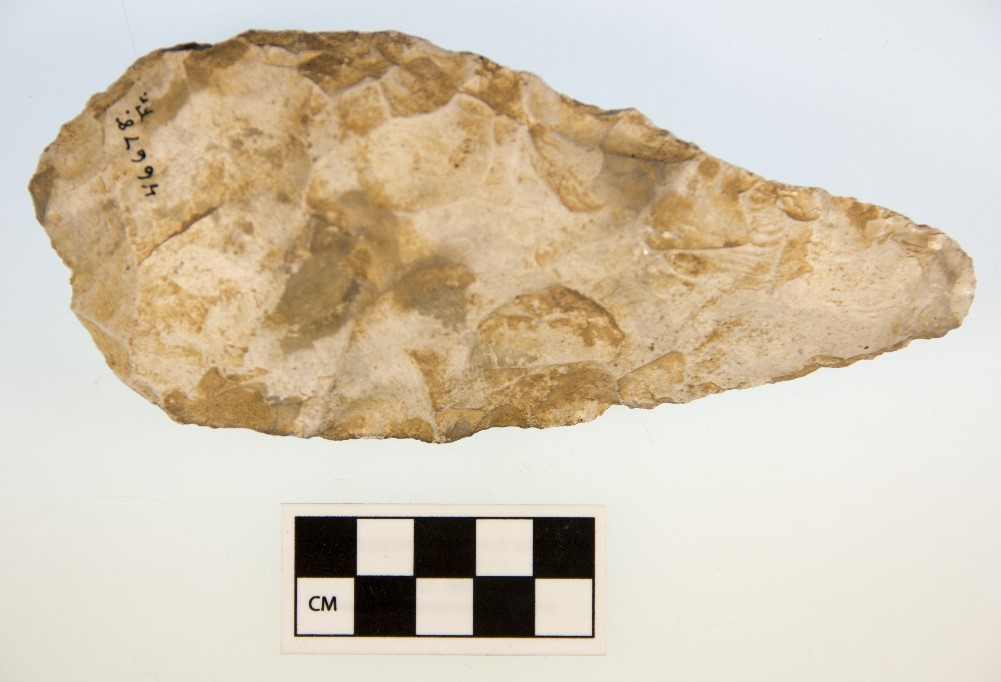
She said that it was made of flint – it was both very fine grained and smooth, except for some obvious flakes that had seemed to have been worked by somebody – something. Further, she said she knew that it came from a particular region in France and proceeded to pull up a Google search that clearly matched the object I held – a stone hand axe. So far, so good.
Next to the photo and a map were the characters ‘1MYA’ – which, I had to ask about. They, of course, meant 1 Million Years Ago. So – in my hand, I held a hand axe from France that was picked up, engineered, and used by somebody, something about one million years ago!
A stone hand axe from France, circa 1 Million Years Ago.
I went home and found myself puzzling over the object and its age. I can’t keep straight Homo sapiens, Australopithecus, Neanderthal, or any of those beings and ages, but I felt pretty sure that Homo sapiens didn’t go back that far. And after e-mailing Marla the next day, I was assured that indeed, it wasn’t of Homo sapiens origin – it was Home erectus – dating back to that 1MYA descriptor.
So – in short, I’ve had the privilege – for it is that – of holding an object, made by an ancient being for whatever purpose he or she felt necessary. I’m assuming that they weren’t thinking that it would be cool if it ended up in museum someday. They were using it to be sure they ate that night and survived long enough, so that we H. sapiens would have a go in their future.
So – long story short – it’s pretty much not only educational and worthwhile, but lots of fun volunteering at the Peabody.
After five years, I continue to enjoy and feel productive with my time at the Peabody – enmeshed with interesting objects with compelling stories, but more importantly with an amazing group of staff, colleagues, and friends. To a one, they are intelligent, patient (no job need be done in haste or unsafely), generous in both time and knowledge, and tolerant of my quirky humor and often bad puns. It doesn’t get any better.
Work duty students are back assisting with collections projects.
We are excited to announce that after a year-and-a-half hiatus, work duty resumed at the Peabody two weeks ago! Preparations in the months leading up to building renovations, scheduled for the winter of 2023, meant that Peabody staff couldn’t devote resources to overseeing work duty students. Once the renovations began, the building would be unsafe for students and staff.
The most daunting pre-construction project was moving thousands of collection boxes from the basement into temporary housing on the first floor. Help from work duty students would have been welcomed, but had we taken on students in the fall they would be looking for new assignments that winter, which didn’t seem fair to the students. We decided that work duty should be cancelled at the Peabody for the 2022-2023 academic year.
Collections boxes are moving into their new housing! This image was intentionally blurred to obscure the details of our new collections housing until the move has been completed.
Last fall, as construction began winding down, we were eager to bring work duty back. Organizing the collection in the newly renovated basement would be a larger undertaking than any of the pre-construction preparations. Generally, we knew students would be allowed back in the building this academic year, but we didn’t know an exact date. The Dean of Student’s office generously offered to take on students who were interested in working at the Peabody until we could safely bring them back.
Ultimate week is the perfect time to relax while working on a collections project.
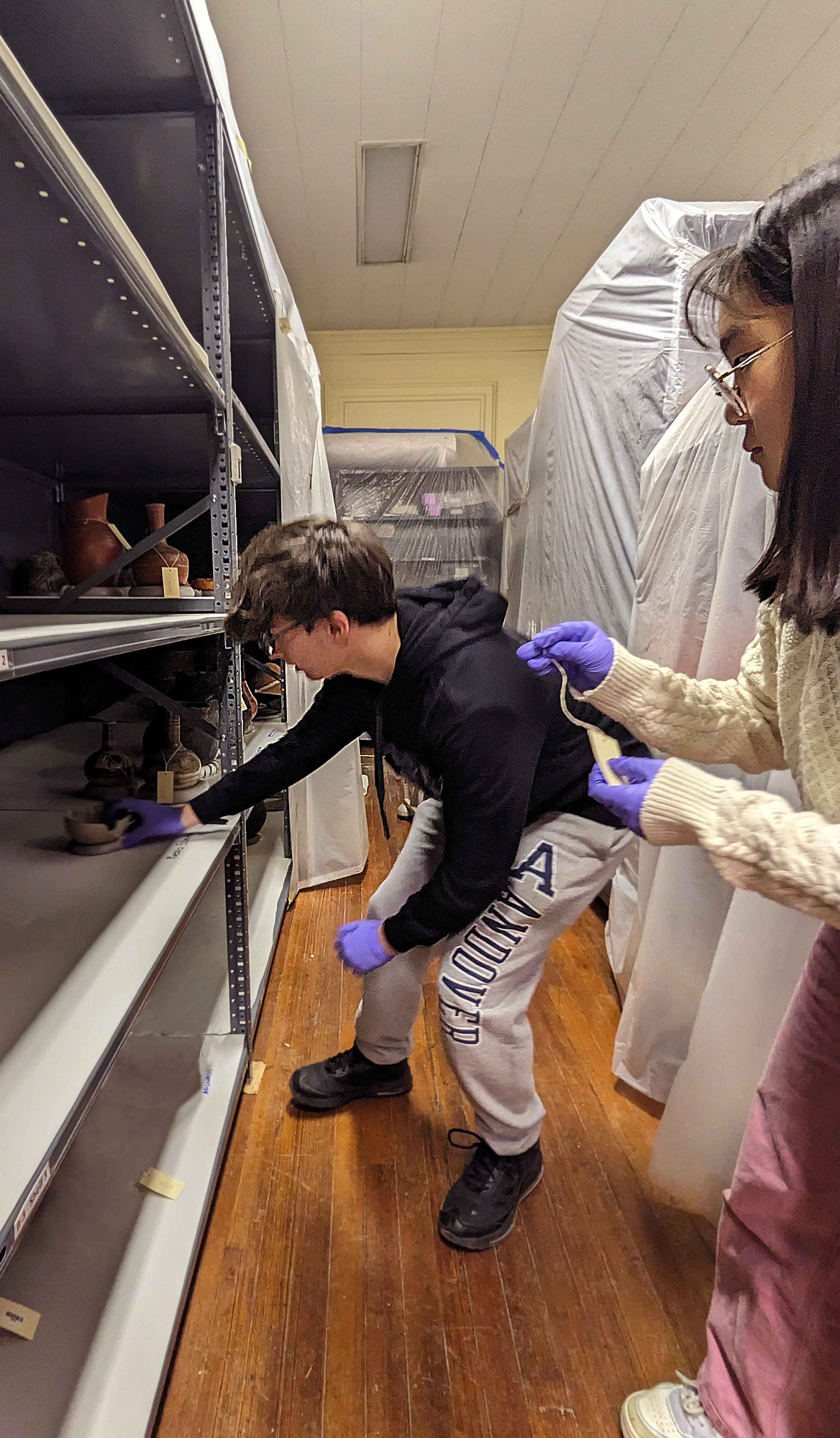
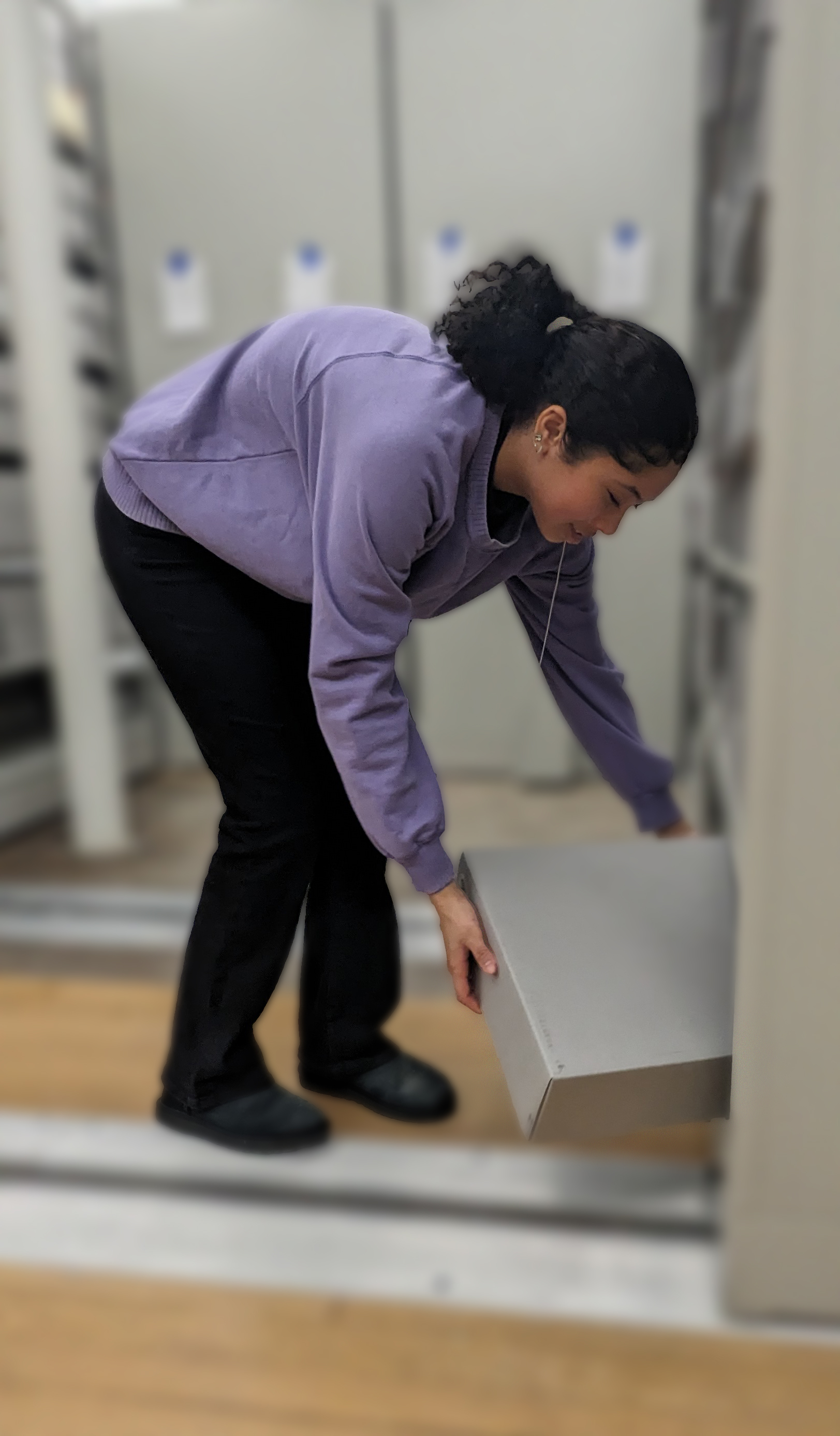
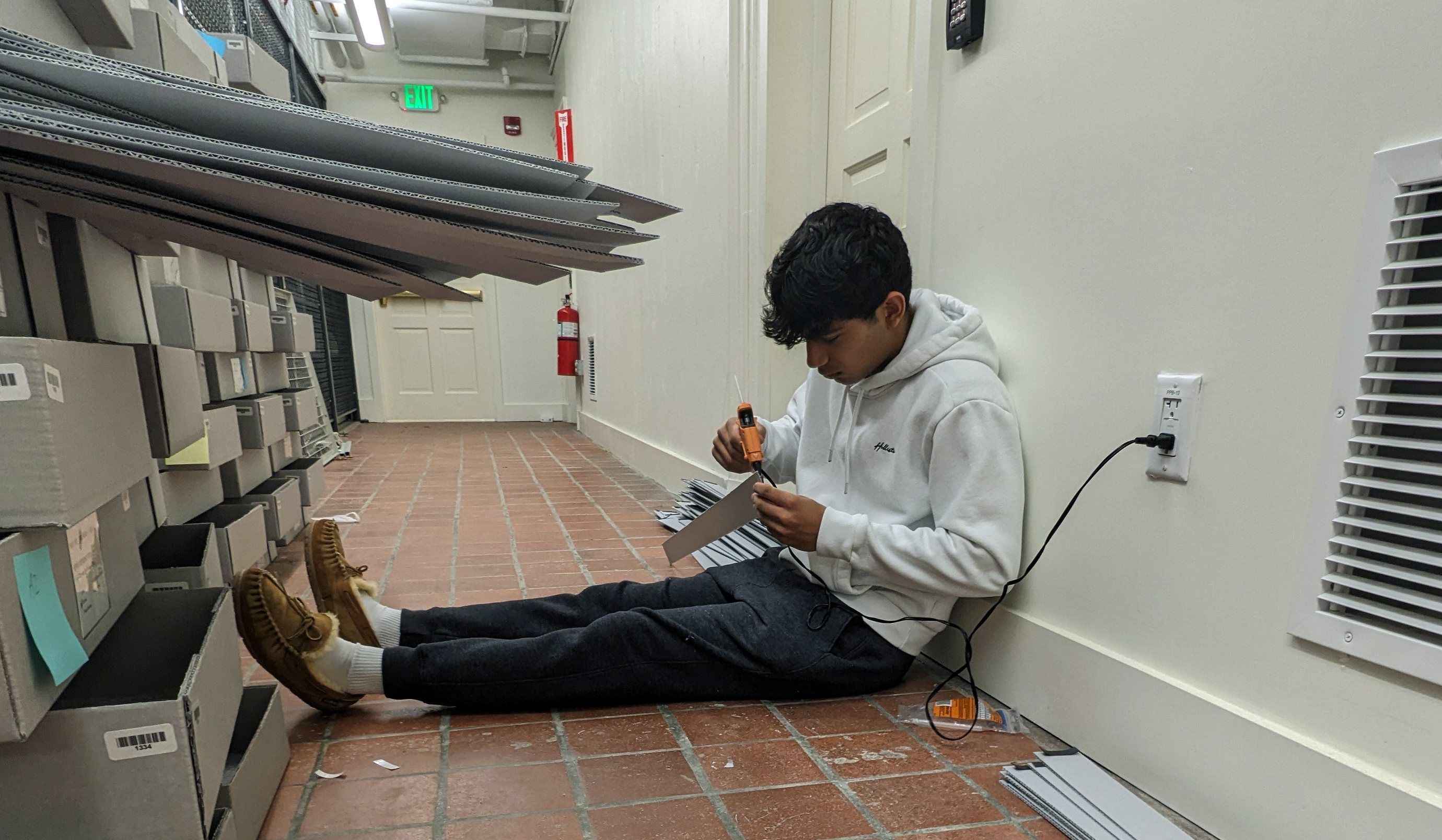
Now that the students have returned, they have been assisting us with preparing the basement to receive collections from throughout the building. They have added foam to shelving, helped sort items by geographic region, and solved inevitable mysteries that crop up in the wake of a large move. Their help has made it possible for staff to focus on moving our collection into the basement.
We are very happy to have students back and look forward to the spring term when we can welcome the wider Phillips community into the building.














 The Peabody