Contributed by Katie Lincoln, Andover Summer Session Archaeologist
If you were to ask an archaeologist what the hardest part of the job is, you might expect them to answer with something physically demanding, like digging holes or spending late nights cleaning and classifying artifacts.
For many archaeologists, however, the hardest part of our jobs is translating tiny fragments of material culture into stories about people from the past – and finding ourselves in those stories along the way.
For example, how can one small ceramic fragment say something about those who made and used it? What can the presence or absence of certain objects change how we think about people? How do we know that our conclusions are correct and culturally sensitive?
Phillips Academy Summer Session students grappled with these questions as they embarked on their own archaeological dig this past July. Tasked with excavating a Revolutionary War-era mansion belonging to Phillips Academy’s founder, Samuel Phillips Jr., students took on the responsibility of collecting artifact data and interpreting it – both in their final written assignments and in their final exhibition. At every step, they were asked not just to identify what they found, but to imagine the students, staff, and community members who came before them and left these things behind.
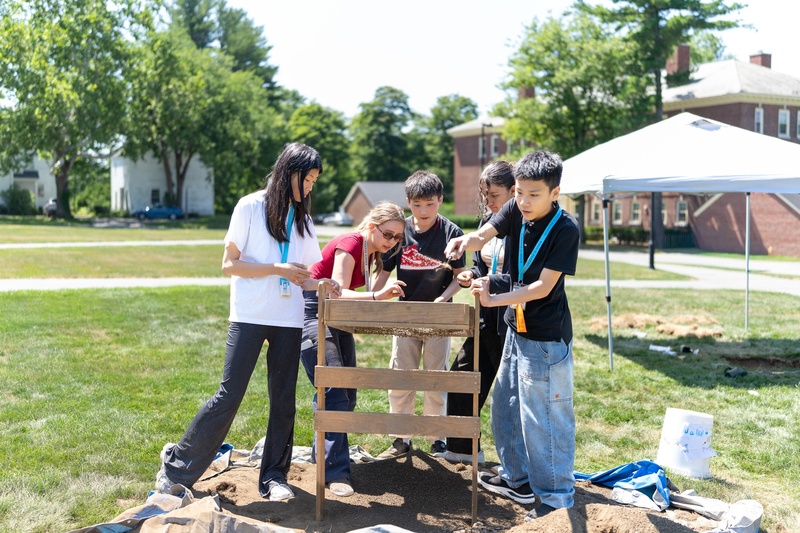
Over the course of their four-week-long excavation on Phillips Academy’s West Quad, students uncovered a wide variety of artifacts. As part of an assignment new to the Dig This! course this year, students were asked to use an artifact to make a broad interpretation about past life in Andover, at Phillips Academy, or at the Mansion House – and, in doing so, to draw a line between their own experience as students and the experience of the students whose lives they were piecing back together.
Their presentations exceeded expectations, revealing just how closely these summer session students came to identify with nineteenth and twentieth century Andover residents.
Pencil ends and early twentieth-century print type, for instance, became evidence of a shared reality: students worked hard, even in their dorms, whether in 1926 or 2026. Looking at the worn-down pencils, our students recognized their own late nights in someone else’s.
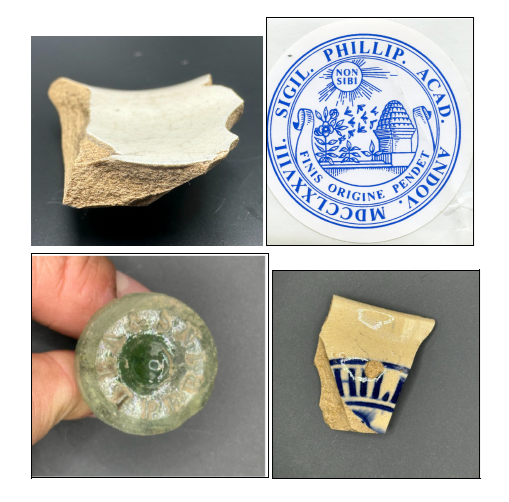
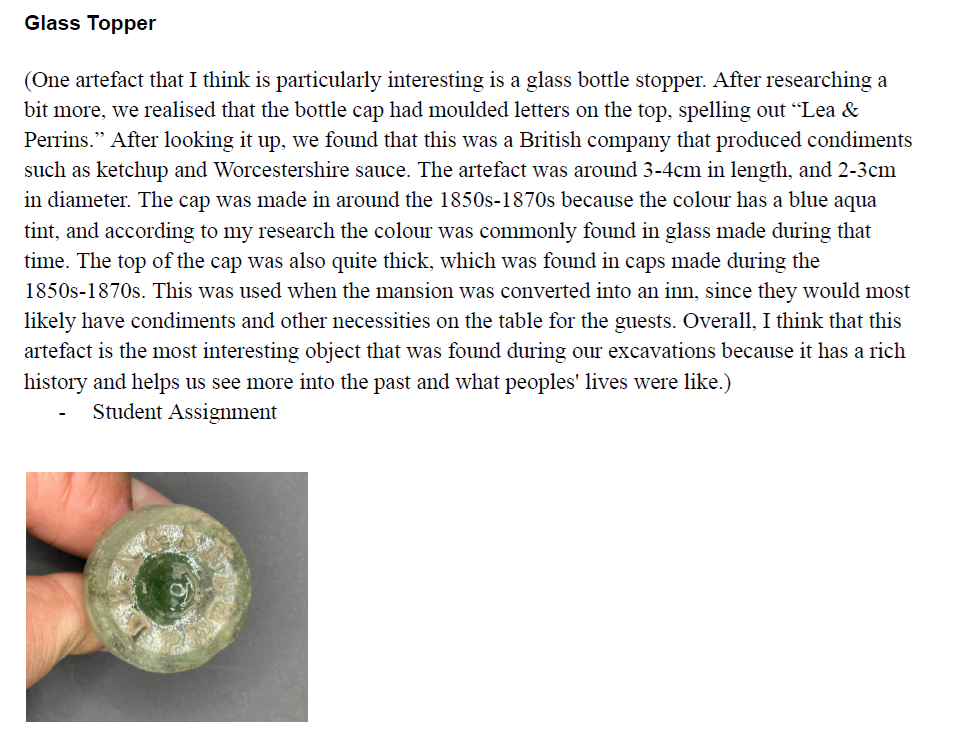
A ceramic sherd with “HILL” transfer-printed on it told a similar story. Interpreted as nineteenth-century refined earthenware, likely part of a mug decorated with the Phillips Academy school seal, it was paired with a Worcestershire sauce bottle cap and various other glass artifacts. Students read this cluster of objects as evidence of meals shared at the Mansion House when it functioned as an inn and tavern – and imagined nineteenth-century Phillips students gathered there with friends and neighbors. Students identified that this experience was not so different from how they themselves might share a meal at Paresky Commons after a long day.
Overall, this summer’s excavation was a success. Students learned and mastered archaeological field methods including site mapping, artifact identification, and field paperwork. Most importantly, however, students learned how to use artifacts to speak to past peoples and experiences. More than that, they learned how to pull apart historical narratives and find themselves inside them – recognizing a fellow student’s hard work, worry, and routine across a gap of one or two hundred years.
We thank the students of the 2026 Mansion House Field Crew, and we look forward to incorporating more interpretive analysis in future iterations of the Dig This! Course.